
Denmark Solid Waste Management Market Size and Share
Market Overview
| Study Period | 2020 - 2031 |
|---|---|
| Forecast Data Period | 2026 - 2031 |
| Base Year Market Size (2025) | USD 3.21 Billion |
| Market Size (2026) | USD 3.37 Billion |
| Market Size (2031) | USD 4.30 Billion |
| Growth Rate (2026 - 2031) | 5.01 % |
| Market Concentration | Medium |
Major Players *Disclaimer: Major Players sorted in no particular order Image © Mordor Intelligence. Reuse requires attribution under CC BY 4.0. | |
Denmark Solid Waste Management Market Analysis by Mordor Intelligence
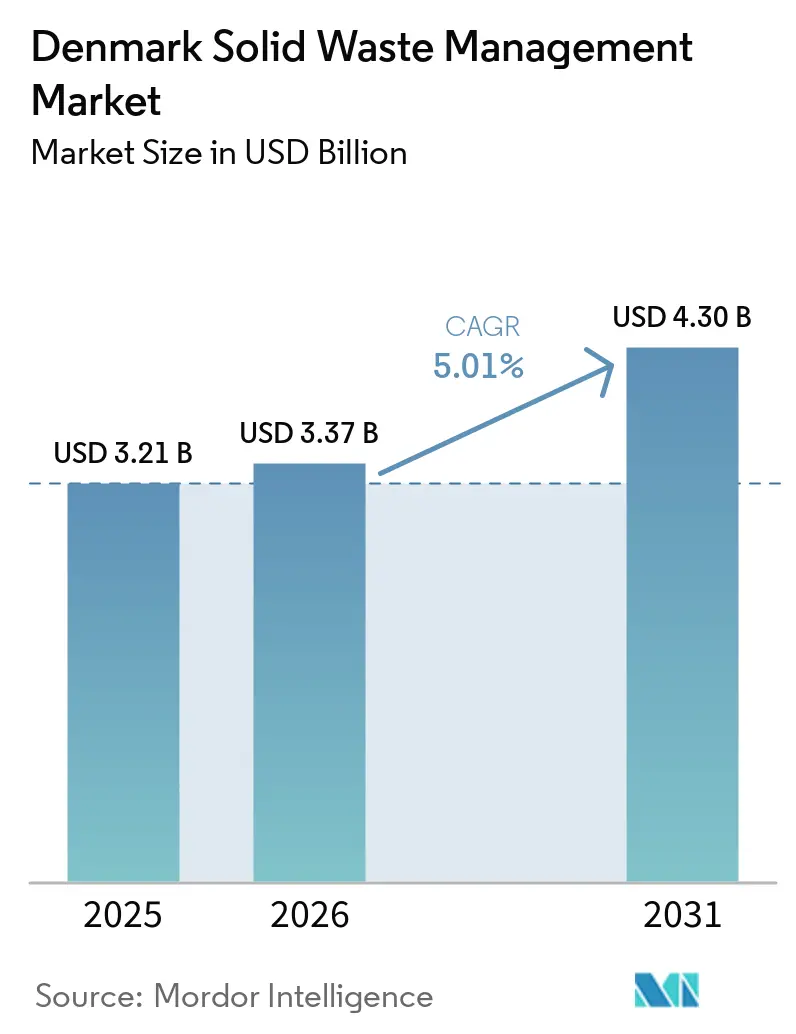
The Denmark Solid Waste Management Market size is expected to grow from USD 3.21 billion in 2025 to USD 3.37 billion in 2026 and is forecast to reach USD 4.30 billion by 2031 at 5.01% CAGR over 2026-2031.
The Denmark solid waste management market is transitioning from conventional waste disposal toward source segregation, material recovery, and lower-carbon treatment methods. Municipalities continue to play a central role in household waste collection and treatment, while private operators compete for commercial and industrial waste contracts, recycling services, and specialized treatment streams. The implementation of separate collection for 10 household waste fractions, together with extended producer responsibility for packaging, is increasing demand for sorting, aggregation, recycling, and traceable downstream treatment capacity. At the same time, district heating remains a key outlet for residual waste, linking waste-to-energy economics to Denmark’s heat supply system. Higher segregation requirements, stricter carbon objectives, efforts to reduce reliance on incineration, and growing demand for resource recovery are reshaping the market. However, operators continue to face challenges in managing composite materials, securing economically viable recycling outlets, and adapting existing treatment infrastructure to support a more circular waste system.
Key Report Takeaways
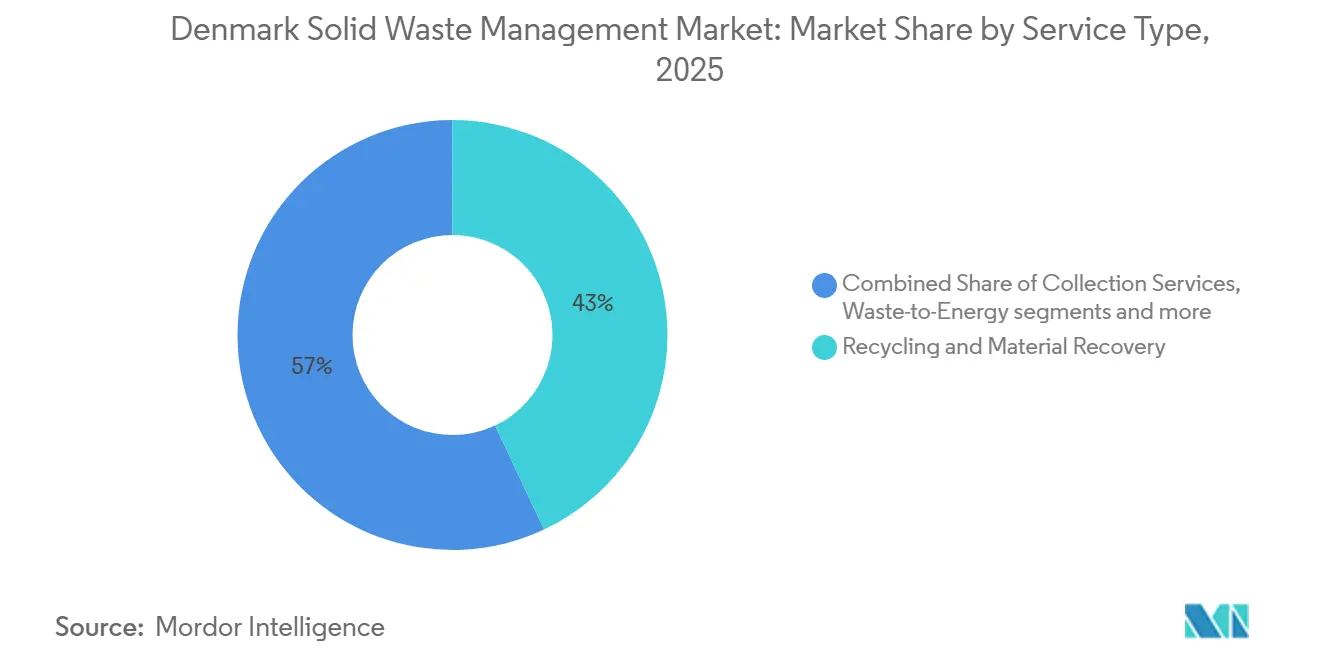
- By service type, recycling and material recovery held 43% of the Denmark solid waste management market share in 2025, while waste-to-energy is forecast to grow at a CAGR of 7.2% through 2031.
- By waste type, municipal solid waste accounted for 46% of Denmark solid waste management market size in 2025, while medical waste is forecast to grow at a 6.1% CAGR through 2031.
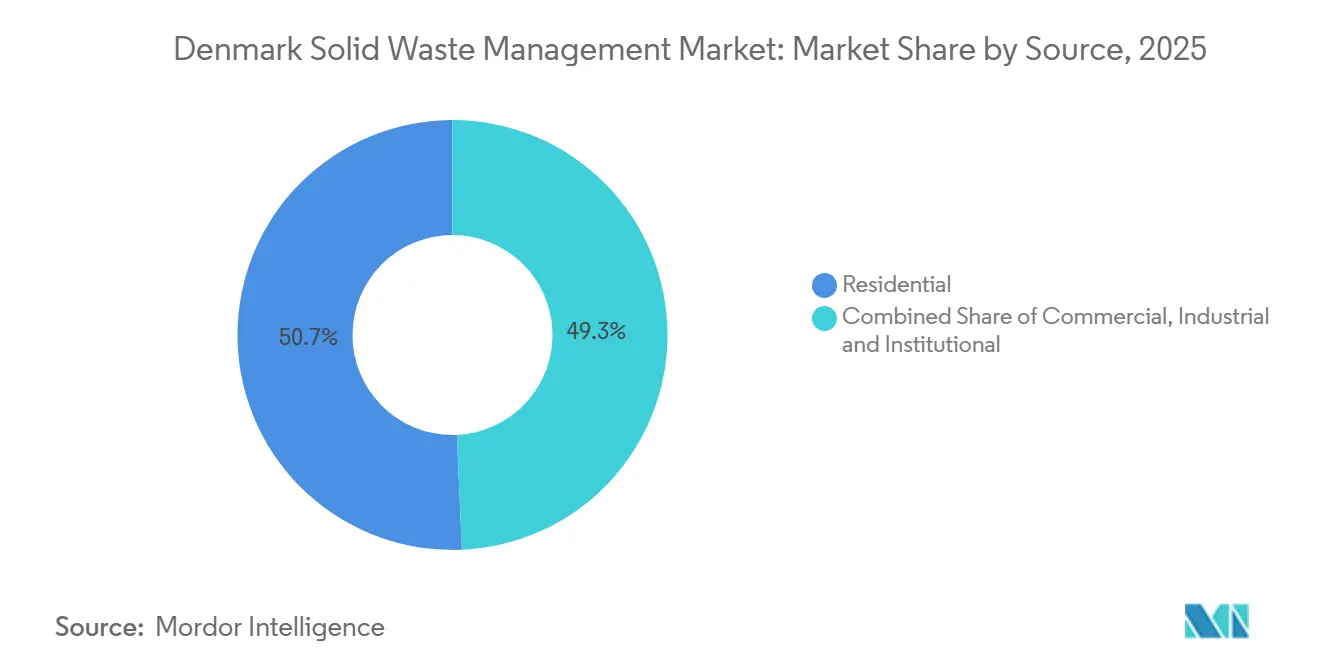
- By source, residential waste accounted for 50.7% of revenue in 2025, while commercial waste is forecast to grow at a 5.6% CAGR through 2031.
Note: Market size and forecast figures in this report are generated using Mordor Intelligence’s proprietary estimation framework, updated with the latest available data and insights as of January 2026.
Denmark Solid Waste Management Market Trends and Insights
Drivers Impact Analysis*
| Driver | (~) % Impact on CAGR Forecast | Geographic Relevance | Impact Timeline |
|---|---|---|---|
| Nationwide Rollout of 10-Fraction Household Waste Sorting System | +1.4% | National, across all 98 municipalities | Short term (≤ 2 years) |
| District Heating Networks Fuel Demand for High-Efficiency Waste Incineration | +1.1% | National, strongest in Copenhagen, Roskilde, and Esbjerg | Medium term (2-4 years) |
| Strong Municipal Ownership Accelerating Waste Infrastructure Investments | +0.9% | National, with early effects in Greater Copenhagen and Zealand | Short term (≤ 2 years) |
| Expansion of Construction & Demolition Waste Recovery Programs | +0.7% | National, especially urban and peri-urban areas | Medium term (2-4 years) |
| Deposit Return System Driving High-Value Packaging Recovery | +0.5% | National | Short term (≤ 2 years) |
| Growing Need for Recycling of Renewable-Energy Infrastructure Components | +0.3% | Coastal and North Sea areas, especially West Jutland | Long term (≥ 4 years) |
| Source: Mordor Intelligence | |||
Nationwide Rollout of 10-Fraction Household Waste Sorting System
Denmark’s 10-fraction household sorting system covers food waste, paper, cardboard, glass, metal, plastic, food and beverage cartons, textiles, hazardous waste, and residual waste. By January 1, 2025, 91 of 98 municipalities had fully implemented the system, while the remaining seven were expected to complete implementation during 2025.[1]Danish Environmental Protection Agency, “Mapping of Municipal Household Waste Systems 2024/2025,” Danish Environmental Protection Agency, mst.dk The Denmark solid waste management market benefits from separate collection, which improves the supply of recoverable materials and makes municipal contracts more focused on sorting performance. National pictograms under the statutory order on waste support more consistent household sorting and can reduce contamination in collected materials. As recycling fractions increase, less residual material is available to waste-to-energy facilities. This change is shifting value toward collection, sorting, and secondary-material processing while requiring incinerator operators to manage lower volumes of thermal feedstock.
District Heating Networks Fuel Demand for High-Efficiency Waste Incineration
District heating gives Denmark’s waste-to-energy assets a role that extends beyond waste treatment. Networked district heating systems served 65% of Danish households in 2024.[2]Danish District Heating Association, “State of Green White Paper: District Energy 2024,” Danish District Heating Association, dbdh.org ARGO’s Roskilde plant processed 358,757 tons of residual waste in 2025 and supplied 3,073,675 GJ of district heating, equal to annual heating for 57,885 households, as well as 226,424 MWh of electricity.[3]ARGO, “ARGO Produces Record Amounts of District Heating,” ARGO, argo.dk The Denmark solid waste management market, therefore, continues to demand efficient thermal treatment even as separate collection expands. However, tighter residual waste supply and competitive tendering favor plants that can improve heat output, control costs, and add carbon capture capacity. Vestforbrænding and Copenhagen Infrastructure Partners formed the Gaia venture to develop carbon capture at the Glostrup facility, showing how operators are seeking additional revenue beyond gate fees and heat sales.
Strong Municipal Ownership Accelerating Waste Infrastructure Investments
Municipalities retain strategic control of much of Denmark’s waste infrastructure while increasingly purchasing services through tenders. Rules adopted in June 2023 required municipal incineration plants to become independent legal entities by January 1, 2025, and required municipalities to tender the incineration of collected waste. This structure pushes public operators to improve operating efficiency and environmental performance without removing municipalities from long-term infrastructure planning. ARGO retained contracts from its nine owner municipalities and added seven municipalities in Zealand in 2025. Vestforbrænding secured 18 municipal treatment tenders in the first round of mandatory tendering. Larger contractors have an advantage because fleet electrification, data systems, and contract compliance require capital, which has helped six companies cover 71% of primary collection contracts.
Expansion of Construction and Demolition Waste Recovery Programs
Construction and demolition waste is Denmark’s largest waste stream by volume, at 5 million tons annually, accounting for more than 40% of national waste generation. Updated building rules in 2025 strengthened lifecycle assessment requirements, pre-demolition planning, and controls for problematic substances in recycled concrete and brick. Skive Municipality’s selective demolition procurement approach uses requirements for the handling of bricks, timber, windows, and tiles to make reuse a factor in public tenders. The model supports more work in pre-demolition audits, source separation, and material grading. It also shifts operator revenue toward higher-value recovered materials rather than simple gate-fee volume. The Denmark solid waste management market can benefit from this approach, in which stable specifications allow recyclers to invest in sorting and processing capacity.
Restraints Impact Analysis*
| Restraint | (~) % Impact on CAGR Forecast | Geographic Relevance | Impact Timeline |
|---|---|---|---|
| Overcapacity in Waste-to-Energy Facilities Reducing Feedstock Availability | -0.8% | National, most acute in Greater Copenhagen and Zealand | Short term (≤ 2 years) |
| Limited Domestic Market Restricts Large-Scale Recycling Investments | -0.6% | National | Medium term (2-4 years) |
| Cross-Border Waste Trade Creates Revenue Uncertainty | -0.4% | National ports and logistics hubs | Medium term (2-4 years) |
| Complex Recycling of Composite and Fiber-Based Materials | -0.3% | National, with added exposure on the West Jutland coast | Long term (≥ 4 years) |
| Source: Mordor Intelligence | |||
Overcapacity in Waste-to-Energy Facilities Reducing Feedstock Availability
Waste-to-energy capacity exceeds the volume of domestic waste available for incineration, which weakens plant utilization and gate-fee conditions. Denmark’s circular economy action plan identified 700,000 tons of excess incineration capacity and set a goal to reduce capacity by 30% by 2030. Almost half of Denmark’s municipal waste was incinerated with energy recovery in 2022, which shows the sector’s exposure to residual waste availability. Separate collection is reducing the residual fraction as more food waste, paper, plastic, metal, and textiles move into recovery channels. Smaller and older facilities have less ability to absorb this pressure when they must also finance emissions controls and carbon capture upgrades. The Denmark solid waste management market must therefore balance better recycling outcomes with orderly adjustment of thermal treatment capacity.
Limited Domestic Market Restricts Large-Scale Recycling Investments
Denmark’s population of 5.9 million limits the volume of material available for specialized streams. Small flows of cartons, textiles, and composite materials can fall below the level needed to support dedicated domestic plants without cross-border offtake or public co-financing. VANA and Verdis announced a partnership in June 2026 to establish Denmark’s first dedicated facility for used food and beverage cartons at Avedøre Holme. The project aims to reduce treatment abroad and create a local solution with clearer documentation. Packaging producer responsibility, which took full effect in October 2025, improves reporting and cost allocation for companies that place packaged products on the Danish market. It does not remove the basic need for reliable volumes and wider Nordic outlets for more difficult fractions.
*Our forecasts treat driver/restraint impacts as directional, not additive. The impact forecasts reflect baseline growth, mix effects, and variable interactions.
Segment Analysis
By Service Type: Recycling Leads Revenue While Energy Recovery Adds Carbon Capture
Recycling and material recovery held 43% of the Denmark solid waste management market share in 2025, making it the largest service category. The packaging producer responsibility framework became fully active across material types on October 1, 2025, creating clearer collection and recycling cost obligations for producers. This framework supports more predictable demand for material recovery services. Collection was the second-largest service category, and its procurement is moving toward electric fleets and more demanding operational reporting. The 71% share of primary collection contracts held by six companies in 2025 shows that capital and tender readiness matter in this part of the Denmark solid waste management market.
Waste-to-energy is forecast to grow at a CAGR of 7.2% through 2031, making it the fastest-growing service category. Although Denmark’s planned reduction in incineration capacity limits growth in waste throughput, WtE market revenues are supported by the increasing value of district heating, district cooling, carbon capture, and carbon-removal services. Operators are therefore focusing on improving energy recovery and generating additional revenue from emissions-management solutions rather than relying solely on higher waste volumes. The Gaia project illustrates this transition by linking biogenic carbon capture from waste incineration with a commercial carbon-removal agreement, with credit deliveries scheduled to begin in 2029. Consequently, the segment’s growth is increasingly driven by value-added treatment, energy recovery, and carbon-management revenues, which can offset the impact of declining incineration volumes.



By Waste Type: Municipal Waste Leads While Medical and Industrial Streams Broaden Demand
Municipal solid waste accounted for 46% of the Denmark solid waste management market size in 2025, making it the largest waste type. In 2025, Denmark’s municipal waste generation remained high relative to the EU-27 average of 513 kg per capita, reflecting the substantial volume of household and commercial waste requiring collection, sorting, recycling, and treatment. The 10-fraction waste-sorting system changes the composition of the municipal waste stream by separating food waste, plastics, metals, textiles, paper, and other materials at the point of collection. This reduces the calorific value of the residual waste stream while increasing the volume of materials available for recycling and recovery. Construction and demolition materials require specialized collection, sorting, and aggregate recovery due to their annual volume of 5 million tons.
Medical waste is forecast to grow at a 6.1% CAGR through 2031, making it the fastest-growing waste type. It is supported by health infrastructure and an aging population. Blue Phoenix inaugurated a carbon capture pilot for high-temperature hazardous-waste incineration in Nyborg in January 2025. The facility is designed to capture 145,000 tons of carbon dioxide annually from 180,000 tons of hazardous industrial waste and supply 80% of Nyborg Municipality’s district heating. Agricultural waste continues to move mainly through biogas and composting. Electronic waste and single-use plastics are also subject to producer responsibility requirements, which add compliance work and recovery opportunities.
By Source: Residential Waste Leads While Commercial Flows Become More Formalized
Residential sources held 50.7% of total revenue in 2025, making them the largest source category. Household sorting is nearly universal, and per-capita waste generation is high. Copenhagen Municipality awarded Verdis a contract in April 2025 to treat diaper waste through 2031. The contract reflects a more granular separation of household materials that were previously difficult to recover. Residential collection also supplies the separate fractions needed by municipal recycling systems. Consistent pictograms across households and public settings improve sorting quality and reduce variation among municipalities.
Commercial sources are forecast to grow at a 5.6% CAGR through 2031, making them the fastest-growing source category. The packaging producer responsibility framework has formalized fees and reporting requirements for businesses placing packaged goods on the Denmark market. Those obligations make commercial packaging flows more visible and easier to allocate to collection and recycling services. The VANA and Verdis carton facility responds to this change by developing local treatment capacity for an EPR-supported material stream. Industrial sources were the third-largest group and are changing as manufacturing uses more lightweight composites and automated equipment. Institutional sources were the smallest group, but schools, hospitals, and public buildings use the same national sorting system as households. This common approach can improve the value of materials collected from public institutions by reducing contamination and standardizing handling.
Geography Analysis
Denmark’s dispersed population across a peninsula and islands requires collection networks with higher logistics intensity than in denser European areas. Copenhagen is the leading commercial center because it combines population density, business activity, major treatment assets, and district heating demand. ARC Amager Bakke supplies district heating to 140,000 households and electricity to 550,000 people in the capital area. ARGO’s Roskilde plant supplied district heating to 57,885 households in 2025.
Copenhagen and Zealand also have a strong pipeline of recycling infrastructure. Verdis and VANA are developing carton and diaper recycling capacity at Avedøre Holme in 2026. Jutland is increasingly important for industrial and renewable-energy waste. RWE installed the first offshore wind turbine combining a carbon dioxide-reduced steel tower and recyclable rotor blades at the 1.1 GW Thor wind farm in April 2026. The installation points to a future need for composite material handling as wind assets reach the end of their service life. Jutland operators with access to coastal logistics and composite processing capabilities may be better positioned to capture these industrial waste flows.
Southern Denmark and the smaller islands have lower waste volumes, less heat demand, and higher transport costs per ton. These areas are more likely to depend on inter-municipal agreements and centralized treatment rather than separate local facilities. Denmark is broadly on track for its 2025 target of 55% municipal waste recycling and its 2035 target of 10% landfilling. Coordinated treatment helps address regional differences in waste volumes by directing waste to facilities with available treatment capacity, improving asset utilization and service efficiency. However, this regional integration also limits the scope for organic growth in smaller local markets, as shared infrastructure reduces the need for additional standalone treatment capacity. The Denmark solid waste management market remains nationally regulated but varies by local density, heat networks, and access to specialized recovery facilities.
Competitive Landscape
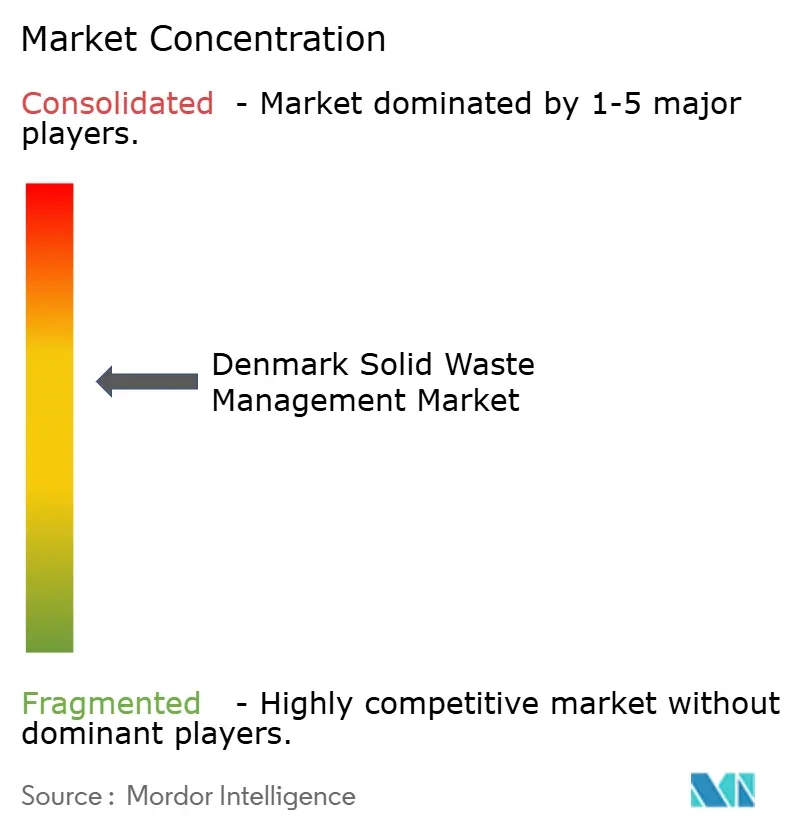
The Denmark solid waste management market exhibits a medium level of market concentration, with inter-municipal utilities and regional private companies sharing collection and treatment activities. Six companies accounted for 71% of primary collection contracts in 2025. ARC, ARGO, Vestforbrænding, AffaldPlus, Kredsløb, and Norfors use long-standing municipal relationships and district heating operations to support treatment activity. Marius Pedersen, Stena Recycling, and Blue Phoenix compete through specialized collection, recycling, and hazardous-waste capabilities. The tender system places greater weight on fleet investment, process efficiency, reporting, and environmental performance.
ARGO expanded from 9 to 16 active municipal contracts on Zealand in 2025 while maintaining record district heating output. Vestforbrænding and Copenhagen Infrastructure Partners created Gaia to develop carbon capture at the Glostrup waste-to-energy facility. Gaia signed a 2.95-million-ton carbon removal agreement with Microsoft in July 2025, with credit delivery scheduled to begin in 2029. Blue Phoenix opened a hazardous-waste carbon capture pilot in Nyborg in January 2025, extending competition into higher-value industrial treatment. These moves show that established treatment operators are using decarbonization projects to protect their position as residual waste volumes tighten.
The Denmark solid waste management market also has openings in composite recovery, carbon capture at smaller plants, and digital information for construction and demolition materials. Companies with access to dependable feedstock and municipal contracts have a practical advantage when financing dedicated facilities. The first domestic carton recycling project addresses the gap in local composite packaging treatment. Operators must meet requirements under the Environmental Protection Act and report waste data through the national system. This compliance framework increases the cost of entry for new providers. It also encourages partnerships between municipalities, technology suppliers, and waste operators. Competition is therefore focused on service reliability, recovery quality, capital strength, and the ability to operate in accordance with national reporting rules.
Denmark Solid Waste Management Industry Leaders
ARC Amager Ressourcecenter
Vestforbrænding I/S
Marius Pedersen A/S
Kredsløb A/S
Blue Phoenix
- *Disclaimer: Major Players sorted in no particular order

Recent Industry Developments
- June 2026: VANA and Verdis A/S announced a collaboration to establish Denmark’s first dedicated recycling facility for used food and beverage cartons at Avedøre Holme, where Verdis is simultaneously developing a diaper recycling plant. The facility aims to establish one of the leading carton-treatment capacities in the Nordic region. The project addresses the gap in domestic treatment for fiber-composite packaging. It also provides a local response to the collection and reporting requirements introduced under packaging producer responsibility.
- April 2026: RWE installed the world’s first offshore wind turbine combining a carbon dioxide-reduced steel tower and recyclable rotor blades at the 1.1 GW Thor offshore wind farm off Denmark’s west coast. The project includes 36 carbon dioxide-reduced steel towers and 120 recyclable rotor blades across 40 turbines. Full turbine installation is scheduled for the end of 2026, and commercial operations are expected in 2027. The project highlights the need for recycling routes for composite materials as offshore wind assets age.
- July 2025: Gaia, the Vestforbrænding and Copenhagen Infrastructure Partners joint venture, signed a 2.95-million-ton carbon removal agreement with Microsoft. Credit delivery is scheduled for 2029. The agreement links carbon capture at a waste-to-energy plant with a contracted commercial buyer. It provides the Glostrup project with a revenue stream beyond conventional waste-treatment fees and district-heating sales.
- January 2025: Copenhagen Infrastructure Partners, through Energy Transition Fund I, entered an investment and joint venture agreement with Vestforbrænding to develop, build, and operate a carbon capture facility in Glostrup, Denmark. The fund held a majority stake in the joint venture during construction and operations. The arrangement combines municipal waste infrastructure with investment capacity for a major decarbonization project.


Denmark Solid Waste Management Market Report Scope
The Denmark Solid Waste Management Market is Segmented by Service Type (Collection Services, Transportation & Logistics, Recycling & Material Recovery, Treatment & Disposal, and More), by Waste Type (Municipal Solid Waste, Industrial Waste, Hazardous Waste, Agricultural Waste, and More), and by Source (Residential, Commercial, Industrial, and Institutional). The Market Forecasts are Provided in Terms of Value (USD).
| Collection Services |
| Transportation & Logistics |
| Recycling & Material Recovery |
| Treatment & Disposal |
| Waste-to-Energy |
| Others |
| Municipal Solid Waste |
| Industrial Waste |
| Hazardous Waste |
| Construction & Demolition Waste |
| Agricultural Waste |
| Medical Waste |
| Others |
| Residential |
| Commercial |
| Industrial |
| Institutional |
| By Service Type | Collection Services |
| Transportation & Logistics | |
| Recycling & Material Recovery | |
| Treatment & Disposal | |
| Waste-to-Energy | |
| Others | |
| By Waste Type | Municipal Solid Waste |
| Industrial Waste | |
| Hazardous Waste | |
| Construction & Demolition Waste | |
| Agricultural Waste | |
| Medical Waste | |
| Others | |
| By Source | Residential |
| Commercial | |
| Industrial | |
| Institutional |


Key Questions Answered in the Report
What is the forecast for the Denmark solid waste management market size?
The Denmark solid waste management market is forecast to reach USD 4.3 billion by 2031, growing at a 5% CAGR from 2026 to 2031. The forecast reflects investment in collection, recovery, treatment, and energy-related services. It also reflects the move from basic disposal toward separately collected materials, stronger tender requirements, and more advanced treatment capacity.
Which service area leads waste management revenue in Denmark?
Recycling and material recovery is the largest service category, accounting for 43% of the market share in 2025, supported by household sorting and producer responsibility for packaging. These measures increase the availability and traceability of separate waste fractions. They also make sorting quality, contamination control, and reliable downstream outlets more important for municipal service providers.
Why is waste-to-energy still important in Denmark?
District heating served 65% of Danish households in 2024, which supports demand for efficient waste-to-energy plants. Plants are also adapting to lower residual waste volumes through efficiency and carbon capture projects.
What is changing in household waste collection?
The 10-fraction system had been fully implemented in 91 of 98 municipalities by January 1, 2025. It separates valuable material fractions before residual waste reaches treatment facilities.
What restricts recycling investment in Denmark?
Denmark’s smaller material volumes can limit the availability of dedicated local facilities for cartons, textiles, and composites without cross-border outlets or public support. This is why stable feedstock and regional partnerships are important for specialized facilities. Operators also need enough material quality and long-term demand to support equipment investment and ongoing operating costs.
Page last updated on:


 Your data is secure and never sold or shared.


