
Distiller's Dried Grains With Solubles (DDGS) Feed Market Size and Share
Market Overview
| Study Period | 2021 - 2031 |
|---|---|
| Market Size (2026) | USD 17.97 Billion |
| Market Size (2031) | USD 25.15 Billion |
| Growth Rate (2026 - 2031) | 6.95 % |
| Fastest Growing Market | Asia Pacific |
| Largest Market | North America |
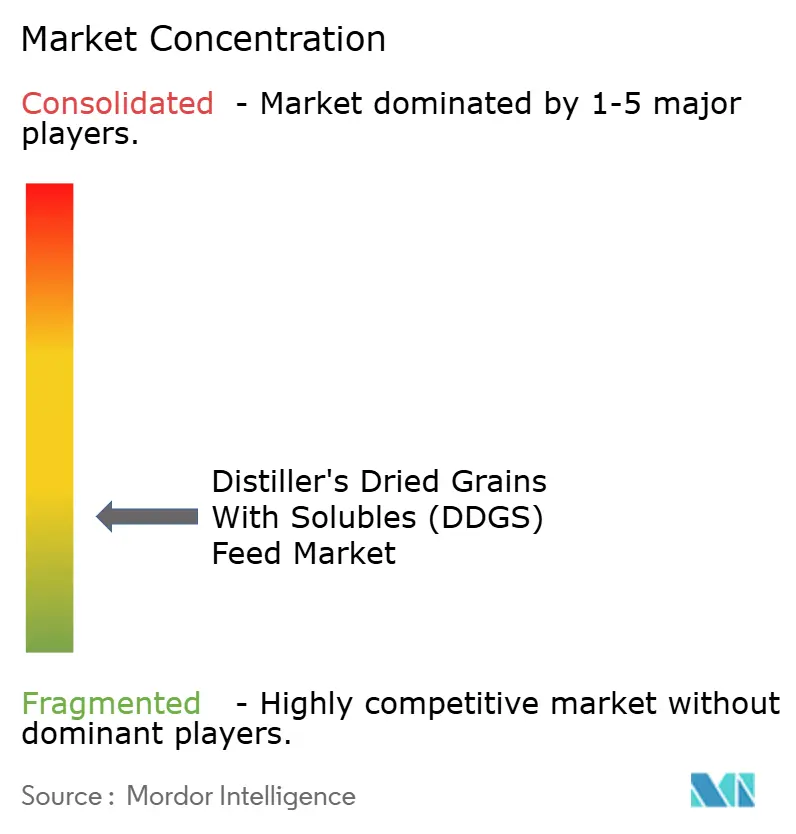
| Market Concentration | Low |
Major Players *Disclaimer: Major Players sorted in no particular order Image © Mordor Intelligence. Reuse requires attribution under CC BY 4.0. | |
Distiller's Dried Grains With Solubles (DDGS) Feed Market Analysis by Mordor Intelligence
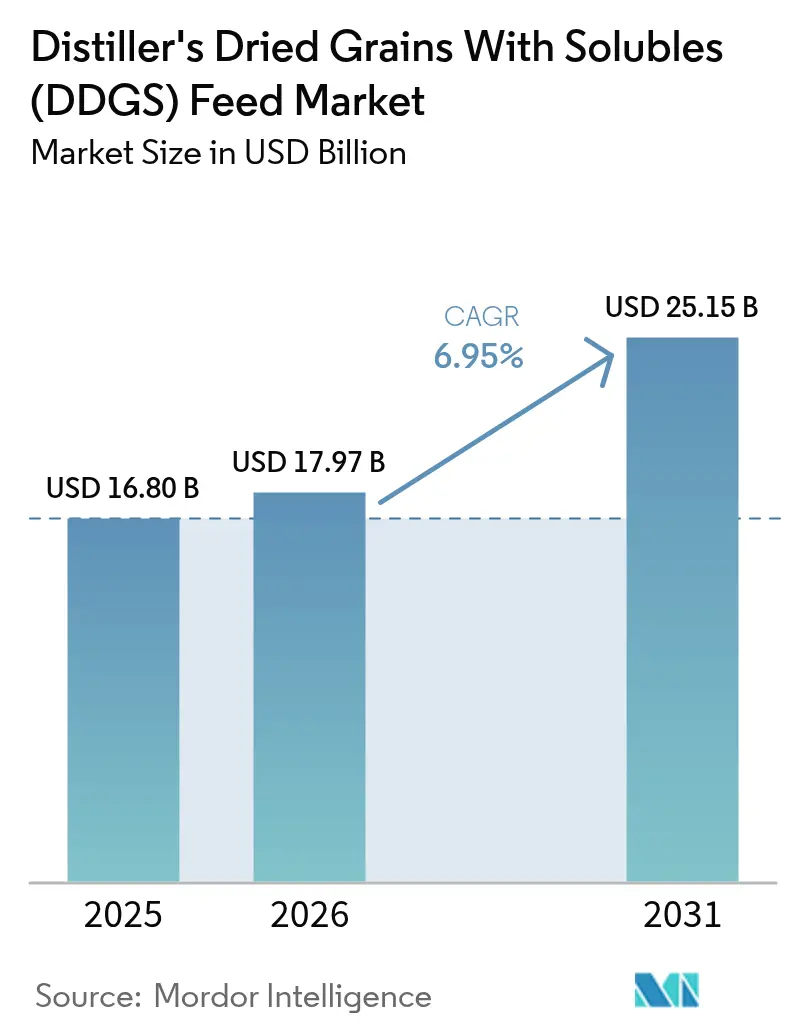
Distiller's Dried Grains With Solubles (DDGS) feed market size in 2026 is estimated at USD 17.97 billion, growing from 2025 value of USD 16.80 billion with 2031 projections showing USD 25.15 billion, growing at 6.95% CAGR over 2026-2031. Sustained ethanol production, widening livestock populations, and technology that raises protein concentration are the primary engines behind this expansion. Feed manufacturers view DDGS as a dependable hedge against volatile protein meal prices because the ingredient delivers 27-30% crude protein at costs that usually sit 10-15% lower than soybean meal. Strong adoption in Asia-Pacific and South America keeps global demand aligned with the growing output that flows from North American and Brazilian dry-grind plants. Meanwhile, fractionation upgrades that strip fiber and raise digestibility are opening the Distiller's Dried Grains With Solubles (DDGS) feed market to poultry, swine, and aquaculture rations once considered off-limits. Governments provide financial incentives, including subsidies, to farmers who incorporate DDGS into animal feed formulations. In India, government policies encourage DDGS adoption in livestock nutrition through subsidies and awareness campaigns. In 2023, the Indian Ministry of Consumer Affairs implemented an interest subsidy program to increase ethanol production from various feedstocks, including grains [1]Source: Ministry of Consumer Affairs, Food and Public Distribution, “Guidelines on Interest Subvention Scheme for New Grain-Based Ethanol Projects,” Press Information Bureau, pib.gov.in.
Key Report Takeaways
- By Type, Corn-based Distiller's Dried Grains With Solubles (DDGS) maintains commanding market leadership with approximately 59.20% share in 2025, while amino acid-enriched DDGS variants emerge as the fastest-growing subsegment at 9.25% CAGR through 2031.
- Dairy cattle commanded a 33.40% share of the Distiller's Dried Grains With Solubles (DDGS) feed market size in 2025, while poultry diets are projected to grow at a 9.85% CAGR through 2031.
- North America generated 44.30% of the market share in 2025, while Asia-Pacific is projected to grow at a 7.22% CAGR through 2031.
Note: Market size and forecast figures in this report are generated using Mordor Intelligence’s proprietary estimation framework, updated with the latest available data and insights as of 2026.
Global Distiller's Dried Grains With Solubles (DDGS) Feed Market Trends and Insights
Drivers Impact Analysis*
| Driver | (~) % Impact on CAGR Forecast | Geographic Relevance | Impact Timeline |
|---|---|---|---|
| Rising demand for high-protein cost-effective animal feed | +2.1% | Global with strongest pull in Asia-Pacific and South America | Medium term (2-4 years) |
| Expansion of the global ethanol/biofuel industry | +1.8% | North America and South America core, extending to Asia-Pacific | Long term (≥ 4 years) |
| Improved fractionation technologies lowering fiber content | +1.2% | North America and Europe leading, technology transfer to Asia-Pacific | Medium term (2-4 years) |
| Rising DDGS inclusion in poultry and swine rations in Asia | +1.5% | Asia-Pacific core with spillover to Southeast Asia and India | Short term (≤ 2 years) |
| Aquaculture feed adoption driven by cost parity with fishmeal | +0.9% | Asia-Pacific dominant, expanding to South America and Europe | Medium term (2-4 years) |
| Low-carbon fuel-standard premiums for certified green DDGS | +0.8% | North America and Europe | Long term (≥ 4 years) |
| Source: Mordor Intelligence | |||
Rising Demand for High-Protein Cost-Effective Animal Feed
The global expansion in meat consumption drives continuous demand for protein-rich feed ingredients that provide economic value while maintaining animal performance. According to the Organization for Economic Co-operation and Development (OECD), global poultry meat consumption reached 141,274.7 thousand metric tons in 2024, increasing from 139,334.2 thousand metric tons in 2023 [2]Source: OECD Secretariat, “OECD-FAO Agricultural Outlook 2023-2032: Meat Consumption Dataset,” Organisation for Economic Co-operation and Development, oecd.org. DDGS provides approximately 27-30% crude protein content at costs typically 10-15% below soybean meal equivalent, creating compelling economics for feed formulators managing margin pressure. University of Nebraska research demonstrates that variable DDGS inclusion rates up to 25% in finishing cattle rations produce no significant performance differences, providing nutritionists flexibility to optimize formulations based on ingredient availability and pricing dynamics. This research challenges traditional conservative inclusion limits and suggests broader application potential across livestock species.
Expansion of the Global Ethanol/Biofuel Industry
Ethanol capacity expansion creates a direct multiplier effect on DDGS supply, with each gallon of ethanol generating approximately 17-18 pounds of DDGS co-product. In January 2025, Green Plains' Tallgrass carbon capture project in the United States demonstrates the improvement of ethanol economics through low-carbon premiums. The project reduced carbon intensity from 51 to approximately 19, allowing participation in 45Z Clean Fuel Production Credits and state low-carbon fuel markets. These environmental premiums provide economic incentives for ethanol production during periods of reduced processing margins.
Improved Fractionation Technologies Lowering Fiber Content
Advanced processing technologies are transforming DDGS from a commodity byproduct into differentiated feed ingredients tailored for specific applications. Fiber separation techniques reduce crude fiber content from traditional 8-10% levels to 6-7% in modified products, significantly improving digestibility for monogastric species. High-protein DDGS formulations achieving 32-35% protein content through enhanced fractionation command premium pricing in poultry and swine applications where amino acid profiles approach soybean meal quality.
Rising DDGS Inclusion in Poultry and Swine Rations in Asia
Rapid urbanization intensifies demand for poultry meat and eggs across Southeast Asia and India. For instance, according to the Department of Animal Husbandry and Dairying, in India, the per capita availability of eggs is at 103 eggs per annum in 2023-24 [3]Source: Department of Animal Husbandry and Dairying, “Annual Report 2023-24,” Government of India, dahd.gov.in . Nutritionists are raising DDGS inclusion to 10-15% in broiler grower diets by pairing fractionated material with enzyme packages that improve metabolizable energy. Vietnamese importers lifted purchases 18% in 2024, and Indian feed mills are testing U.S. low-sulfur product to stay within local regulations. These shifts help the DDGS feed market diversify beyond its ruminant stronghold.
Restraints Impact Analysis*
| Restraint | (~) % Impact on CAGR Forecast | Geographic Relevance | Impact Timeline |
|---|---|---|---|
| Volatile grain prices eroding DDGS price advantage | -1.4% | Global with strongest impact in corn-dependent regions | Short term (≤ 2 years) |
| Competition from soybean, canola and other protein meals | -1.1% | Worldwide, especially oilseed-heavy regions | Medium term (2-4 years) |
| Tightened mycotoxin/sulfur limits in key export markets | -0.7% | European Union and Asia-Pacific import corridors | Medium term (2-4 years) |
| Rail-car shortages inflating delivered costs from inland plants | -0.5% | North America | Short term (≤ 2 years) |
| Source: Mordor Intelligence | |||
Volatile Grain Prices Eroding DDGS Price Advantage
DDGS prices mirror corn because both stem from the same supply chain. When corn spikes, distillers' grains often follow within days, narrowing the normal 10-15% discount that underpins demand. January 2025 spot bids averaged USD 155 per ton while CIF NOLA export values reached USD 216 as river logistics tightened.Feed formulators maintain flexibility to substitute alternative protein sources when DDGS pricing exceeds economic thresholds, creating demand elasticity that limits pricing power during supply-constrained periods.
Competition From Soybean, Canola, and Other Protein Meals
Soybean meal's superior amino acid profile and established supply chains create ongoing competitive pressure for DDGS applications, particularly in monogastric species where protein quality significantly impacts performance outcomes. Canola meal and other oilseed byproducts offer similar protein content with different nutritional profiles, enabling feed formulators to optimize least-cost formulations based on relative ingredient pricing. The expanding renewable diesel industry's demand for vegetable oils creates potential supply tightness in oilseed meals, which could improve DDGS competitiveness through relative pricing advantages.
*Our forecasts treat driver/restraint impacts as directional, not additive. The impact forecasts reflect baseline growth, mix effects, and variable interactions.
Segment Analysis
By Type: Corn Remains Foundational but High-Protein Variants Surge
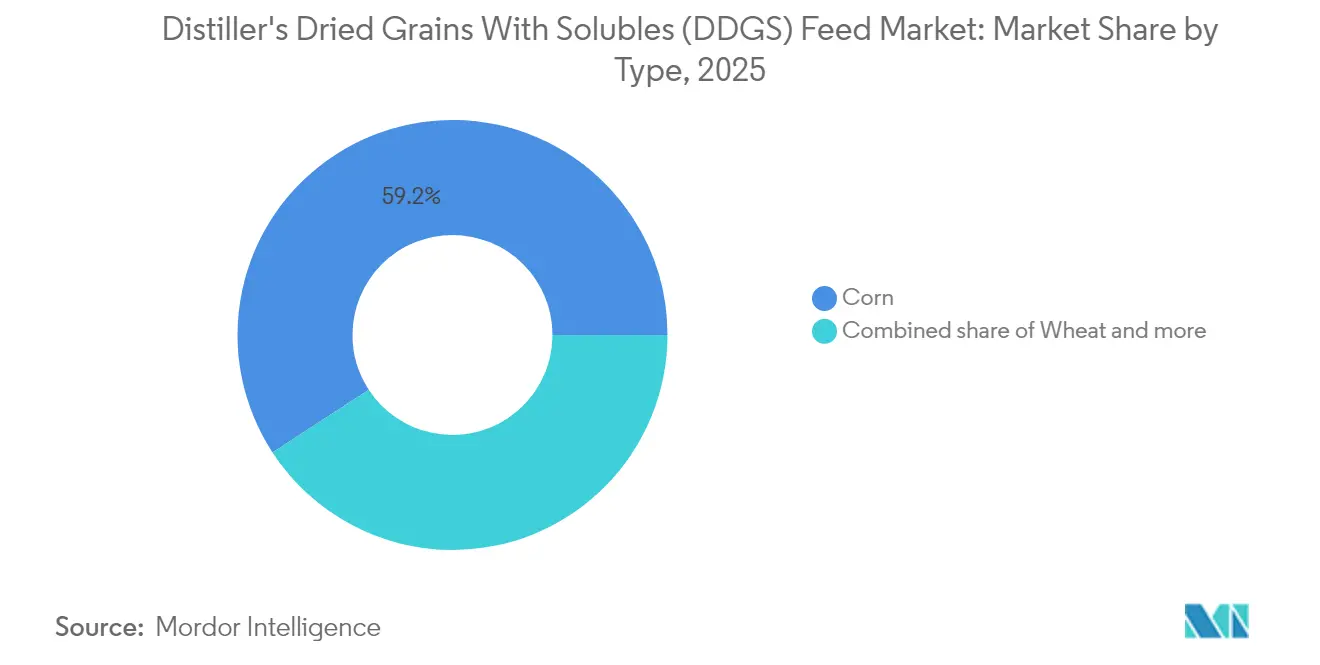
Corn Distiller's Dried Grains With Solubles (DDGS) maintains commanding market leadership with approximately 59.20% share in 2025, reflecting North America's corn ethanol infrastructure dominance and established supply chains that deliver consistent quality and availability. This segment's maturity provides price stability and technical expertise that support reliable feed formulation. Wheat DDGS captures smaller regional markets, particularly in Europe and Canada, where wheat-based ethanol production creates localized supply streams. Rice DDGS remains niche but shows promise in Asian markets where rice processing infrastructure supports specialized applications.
While amino acid-enriched DDGS variants emerge as the fastest-growing subsegment at 9.25% CAGR through 2031, targeting premium applications where enhanced nutritional profiles justify higher pricing. Amino acid-enriched forms command further premiums when valine or lysine levels are raised through targeted enzyme additions. Even so, corn continues to anchor price discovery, ensuring steady liquidity for buyers who value consistent nutrient specs.



By Animal Type: Ruminants Lead but Monogastric Offer Faster Upside
Dairy cattle represent the largest application segment at 33.40% market size in 2025, leveraging ruminants' superior fiber digestion capability that enables higher DDGS inclusion rates up to 20-30% of total ration dry matter without performance penalties. Beef cattle applications closely follow, benefiting from University of Nebraska research demonstrating flexible inclusion strategies that maintain feed efficiency while providing cost advantages over traditional grain-based rations
Poultry emerges as the fastest-growing segment at 9.85% CAGR, driven by improved fractionation technologies that reduce fiber content and enhance amino acid availability for broiler and layer applications. Swine applications expand steadily, though SDSU research indicates increased water consumption requirements that necessitate infrastructure considerations for producers adopting higher inclusion rates.

Geography Analysis
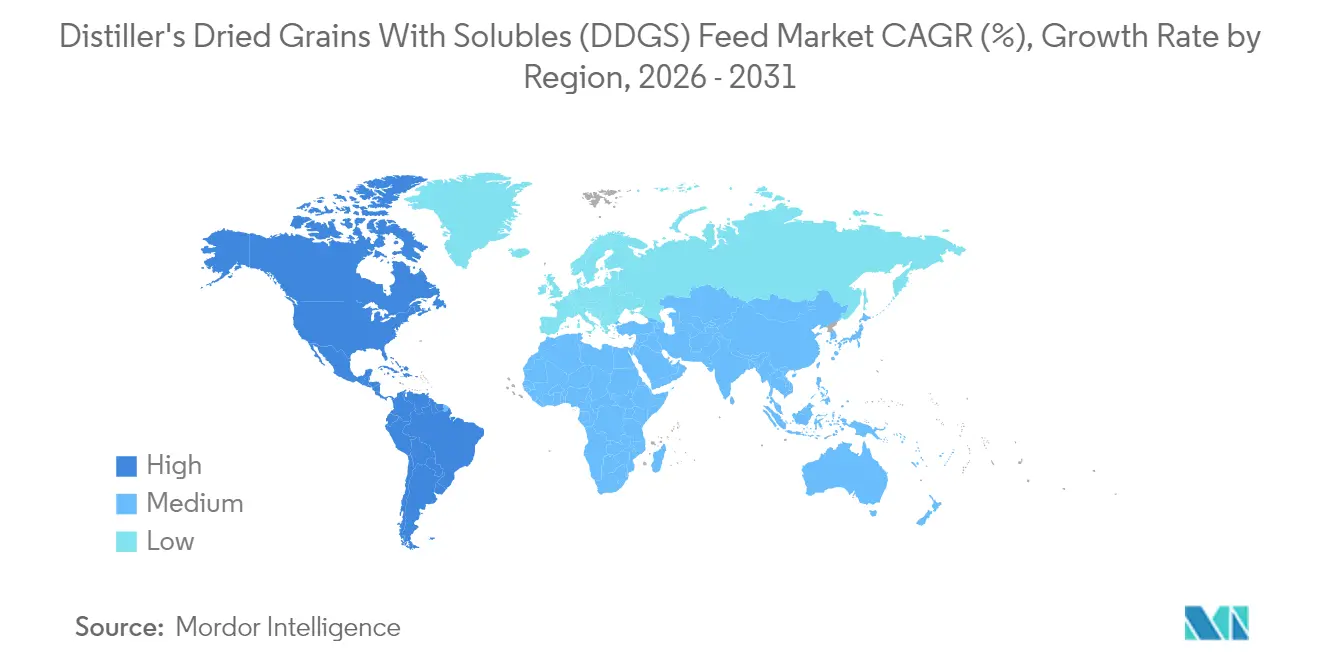
North America retained 44.30% of the 2025 market share in 2025, driven by the United States' massive corn ethanol infrastructure that generates over 40 million metric tons of DDGS annually through facilities operated by major producers, including Archer Daniels Midland, POET, and Green Plains. Canada contributes through wheat-based ethanol production, while Mexico represents a major export destination that absorbs significant United States DDGS volumes despite occasional rail service disruptions that impact delivery reliability. Rail service into Mexico underpins steady exports, though periodic car shortages lift delivered cost and encourage seaboard feeders to diversify supply.
Asia-Pacific delivers the fastest uptick at 7.22% CAGR through 2031. China’s corn ethanol expansion and India’s grain-based distillery ramp-ups enlarge the regional supply pool, while booming poultry and aquaculture sectors lift consumption. Vietnam, Thailand, and Indonesia collectively imported more than 4 million metric tons in 2024, and quality-certified products are clearing customs faster as suppliers adopt aflatoxin detection protocols similar to SecureFeed.
The South American Distiller's Dried Grains With Solubles (DDGS) feed market is expanding, driven by Brazil's corn ethanol production growth of 24.5% year-on-year. Domestic livestock feed mills consume increasing volumes, with excess production targeted for Andean and Caribbean markets. Argentina's wheat-based ethanol facilities produce DDGS variants suitable for dairy operations in Chile and Uruguay.

Regulatory Landscape
DDGS quality and safety compliance is shaped by feed-material definitions, animal food preventive controls, and national feed-regulation modernization. In the United States, DDGS production and handling for feed fall under FDA Food Safety Modernization Act requirements for animal food (21 CFR Part 507), pushing facilities and downstream handlers to formalize hazard analysis, preventive controls, and verification for risks such as mycotoxins and nutrient variability.
Compositional and labeling anchors increasingly define trade acceptability in importing regions. The European Union maintains DDGS positioning within the feed materials catalog via Regulation (EU) 2022/1104, which provides technical specifications, including moisture and mineral-related limits. Canada advanced its modernization agenda as Feeds Regulations, 2024 (SOR/2024-132) amendments took effect in December 2025, tightening expectations around labeling, safety, and oversight for feeds. In July 2026, Brazil's Ministry of Agriculture and Livestock issued the country's first official DDG identity and quality standard, formalizing criteria for identity, classification, and labeling and reducing technical friction for domestic use and exports.
Competitive Landscape
The Distiller's Dried Grains With Solubles (DDGS) feed market is highly fragmented, with a few companies holding the majority of the market share. Archer Daniels Midland Company, CHS Inc., POET LLC, Land O’Lakes, Inc., and CropEnergies AG. These industry leaders invest in new product launches and acquisitions to expand their businesses. Additionally, they are prioritizing research and development to introduce new products at competitive prices.
Green Plains’ pivot toward low-carbon certifications is illustrative of a broader sustainability arms race. The company will sequester about 800,000 metric tons of CO₂ annually from three Nebraska facilities by late 2025, a move that supports premium pricing and cushions against ethanol margin swings. ADM is investing USD 300 million in new corn oil extraction at a North Dakota site, signaling a push toward higher coproduct value capture. Smaller firms such as The Andersons tap niche opportunities, including wet DDGS delivery within truck radius of Ohio poultry integrators.
Competitive advantage increasingly hinges on technology and logistics. Plants that retrofit fractionation can command USD 40 per ton premiums, while those situated near Class I rail lines enjoy lower basis into Gulf export channels. Overall rivalry fuels steady quality improvements without tipping the market toward oligopoly, preserving multiple sourcing options for feed buyers that underpin healthy expansion of the Distiller's Dried Grains With Solubles (DDGS) feed market.
Distiller's Dried Grains With Solubles (DDGS) Feed Industry Leaders
Archer Daniels Midland Company
CHS Inc.
POET LLC
Land O’Lakes, Inc.
CropEnergies AG
- *Disclaimer: Major Players sorted in no particular order

Market Opportunities and Future Outlook
Policy-anchored ethanol throughput remains a key lever for DDGS availability and trade flows, creating opportunity for suppliers that can pair scale with predictable quality. In March 2026, the U.S. Environmental Protection Agency finalized Renewable Fuel Standard volumes for 2026 and 2027, reinforcing the policy framework that supports ethanol output and associated co-products such as DDGS. On the demand side, export channels and large feed-producing importers continue to balance North American supply, supported by trade reporting that shows U.S. DDGS exports at 1,081,691 metric tons in May 2026 (the largest May volume since 2015) and ahead of 2025 levels.
A second opportunity area is product differentiation and formulation support for monogastric and aquaculture rations, where variability management is a buying criterion. Oil-content variability in DDGS (often cited in the 8-12% range) is driving more precise nutrition practices, including higher antioxidant usage at elevated inclusion rates, which improves the attractiveness of DDGS streams with tighter specifications and documentation. Investments that increase traceability, strengthen contaminant control, and support consistent nutrient profiles, including fractionation-enabled high-protein variants, expand addressable demand beyond traditional ruminant-heavy usage and support premium pathways for feed mills and integrators that need repeatable performance and compliance-ready paperwork.
Recent Industry Developments
- June 2026: Archer Daniels Midland (ADM) opened a new 7,500 square meter animal feed and premix facility in Apucarana, Parana, Brazil, with installed capacity of 40,000 tons per year. The site strengthens ADM's regional animal nutrition footprint and supports localized formulation and quality control that can complement DDGS-based feed programs. It also adds manufacturing capacity closer to South American livestock growth corridors and export logistics.
- May 2025: CHS announced upgrades at its Myrtle Grove terminal aimed at improving handling and logistics performance for agricultural commodities. Better terminal throughput and reliability support smoother export execution for DDGS and related feed ingredients, particularly when inland logistics constraints tighten. The move aligns with the market's focus on cost-to-serve and delivery consistency for bulk feed co-products.
- October 2024: ADM launched its Digital Grain Elevator FOB Ag Logistics Platform to streamline grain transportation and delivery operations with real-time status visibility and automated workflows. Enhanced traceability and dispatch efficiency improve coordination between grain origination, ethanol production inputs, and outbound co-products such as DDGS. The platform also supports documentation practices that buyers increasingly request for quality and compliance assurance.


Research Methodology Framework and Report Scope
Market Definition and Coverage
For this study, the DDGS feed market is defined as the sale value of distillers dried grains with solubles used as an animal feed ingredient, including common grain-based DDGS types that come out of ethanol production and are traded for livestock and poultry rations.
Scope exclusions: We exclude non-DDGS co-products and non-feed uses of distillers grains, and we also exclude on-farm feed grains that are not marketed as DDGS.
Segmentation Overview
- By Type
- Corn
- Wheat
- Rice
- Amino Acids
- Blended Grains
- Other Types
- By Animal Type
- Dairy Cattle
- Beef Cattle
- Swine
- Poultry
- Aquaculture
- Other Animal Types
- By Geography
- North America
- United States
- Canada
- Mexico
- Rest of North America
- Europe
- Germany
- United Kingdom
- France
- Italy
- Spain
- Russia
- Rest of Europe
- Asia-Pacific
- China
- Japan
- India
- Thailand
- Rest of Asia-Pacific
- South America
- Brazil
- Argentina
- Rest of South America
- Middle East
- Saudi Arabia
- Turkey
- Rest of Middle East
- Africa
- South Africa
- Rest of Africa
- North America
Data Sources, Market Sizing, and Validation
Desk Research
We started with desk research to build the fact base for supply, demand, and pricing logic, then tested key assumptions using field inputs. Public sources such as USDA (including FAS), FAO, UN Comtrade, and IMF macro series helped us align trade flows, livestock inventory trends, and currency and inflation context that influence DDGS demand and pricing.
To keep the model tied to the actual feed value chain, we also reviewed ethanol-industry and feed-ingredient references, including Renewable Fuels Association materials, government agriculture ministries, and peer-reviewed animal nutrition journals, for inclusion rates and nutrient benchmarks. Company annual reports, investor presentations, and credible industry news were then used to cross-check capacity additions, plant operating trends, and distribution patterns, supported by a paid subscription for company financials and a paid patent database to track process and drying improvements. These desk research sources are illustrative only, and we used many other public references for data collection, validation, and clarification.
Primary Interviews and Surveys
Primary work was used to pressure-test DDGS consumption patterns, typical inclusion rates by animal category, and regional price realization, since published feed ingredient data is not always consistent. We spoke with a mix of ethanol co-product marketers, feed formulators, distributors, and procurement teams across major consuming regions so that trade and production signals could be translated into realistic consumption and pricing assumptions.
Distribution of primary research fieldwork respondents
| Company type | Respondent position | Region |
|---|---|---|
| Top tier: 26% | CXOs: 16% | APAC: 46% |
| Mid tier: 58% | Functional/Unit leaders: 26% | EMEA: 31% |
| Smaller Players: 16% | Managers: 58% | Americas: 23% |
Market-Sizing & Forecasting
Market sizing used a top-down build where ethanol output and co-product yield rates were converted into DDGS availability by region, and that output was filtered through trade balances to infer local consumption. Since DDGS is priced and used like a feed ingredient, the value layer was then created by applying region-level average realized prices, and those prices were checked against feed grain and protein meal movements to ensure the spreads were plausible.
To keep the model tied to purchasing behavior, key inputs included livestock and poultry headcount trends, typical DDGS inclusion rates in rations, regional ethanol production levels, import and export volumes, and observed price differentials versus soybean meal and corn. Where data gaps appeared, we used conservative ranges for inclusion and yield assumptions and then narrowed those ranges based on expert feedback and trade consistency.
Forecasting relied mainly on scenario analysis, with a base case shaped by expected ethanol production trajectories, livestock production growth, and regional trade policy direction. The scenarios were then sanity-checked with selective bottom-up approximations, such as sampling supplier and channel price points and combining them with indicative tonnage movements, before final totals were locked.
Data Validation & Update Cycle
Outputs were validated through multiple checks so the final numbers did not depend on one assumption. We compared modeled DDGS value and implied volumes against independent signals such as changes in ethanol production, export patterns, and livestock feed demand direction, and then investigated any sharp jumps that did not match those signals.
A second analyst review was completed for calculation logic, unit consistency, and year-on-year movements, followed by targeted re-contact with interviewees when a region or animal category showed unusual variance. The report is refreshed annually, and interim updates are done when a material event affects ethanol output, trade flows, or feed ingredient pricing. Before delivery, a final pass is made to incorporate the latest public releases so clients receive an updated view.
Mordor Intelligence's Ddgs Feed Market Size Compared Against Other Published Estimates
Published DDGS feed market estimates can differ because the scope choices behind them are not always the same, and the price and volume logic is often handled differently. Differences usually show up when firms mix product definitions, convert tons to value using different price timing, or project demand using untested assumptions about feed inclusion.
Some external estimates lean on broad feed segmentation and apply generalized growth rates from livestock expansion, which can pull in adjacent co-products or blended categories and lift the total. In Mordor Intelligence, the value is counted only for DDGS sold into animal feed, and the model stays consistent by tying volumes to ethanol-linked availability, trade balances, and region-level realized pricing checks.
Benchmark comparison
| Source | Market Size | Gaps in Research Methodology |
|---|---|---|
| Mordor Intelligence | USD 17.97 B (2026) | |
| Industry Publisher A | USD 18.67 B (2024) | Uses a different base year and longer historical window, and the segmentation-led approach can blend DDGS with broader feed attributes, which makes price timing and inclusion-rate assumptions less traceable to ethanol-linked availability. |
| Industry Publisher B | USD 16.20 B (2024) | Anchors the size to an earlier pricing environment and a 2024 base, and the ton-to-value conversion method is not clearly tied to regional realized price checks, which can compress value in higher price regions. |
The spread in the table mainly comes from base-year selection and how tightly DDGS volumes are connected to ethanol output and net trade, before pricing is applied. By keeping the steps transparent and checking them against observable supply and demand signals, the resulting market size stays balanced and easier to reproduce when assumptions are updated.


Key Questions Answered in the Report
What is the forecast value of the Distiller's Dried Grains With Solubles (DDGS) Feed Market by 2031?
Revenue is projected to reach about USD 25.15 billion as the ingredient gains traction in monogastric and aquaculture diets.
Which animal segment currently consumes the largest share of Distiller's Dried Grains With Solubles (DDGS) ?
Dairy cattle account for 33.40% of global volume due to their ability to handle higher fiber inclusion.
Why are high-protein Distiller's Dried Grains With Solubles (DDGS) variants growing quickly?
Fractionation lowers fiber and raises crude protein to 32-35%, letting poultry and swine integrators lift inclusion without digestibility penalties.
How do carbon capture projects affect Distiller's Dried Grains With Solubles (DDGS) economics?
Low-carbon certifications tied to sequestration qualify coproducts for premium pricing under programs such as California LCFS.
Which region is expected to grow fastest in Distiller's Dried Grains With Solubles (DDGS) usage?
Asia-Pacific leads with a 7.22% CAGR driven by expanding poultry, swine, and aquaculture industries.
Page last updated on:


 Your data is secure and never sold or shared.


