
Customer Digital Onboarding Platform Market Size and Share
Market Overview
| Study Period | 2021 - 2032 |
|---|---|
| Market Size (2027) | USD 4.12 Billion |
| Market Size (2032) | USD 9.19 Billion |
| Growth Rate (2027 - 2032) | 17.39 % |
| Fastest Growing Market | Asia-Pacific |
| Largest Market | North America |
| Market Concentration | Medium |
Major Players *Disclaimer: Major Players sorted in no particular order Image © Mordor Intelligence. Reuse requires attribution under CC BY 4.0. | |
Customer Digital Onboarding Platform Market Analysis by Mordor Intelligence
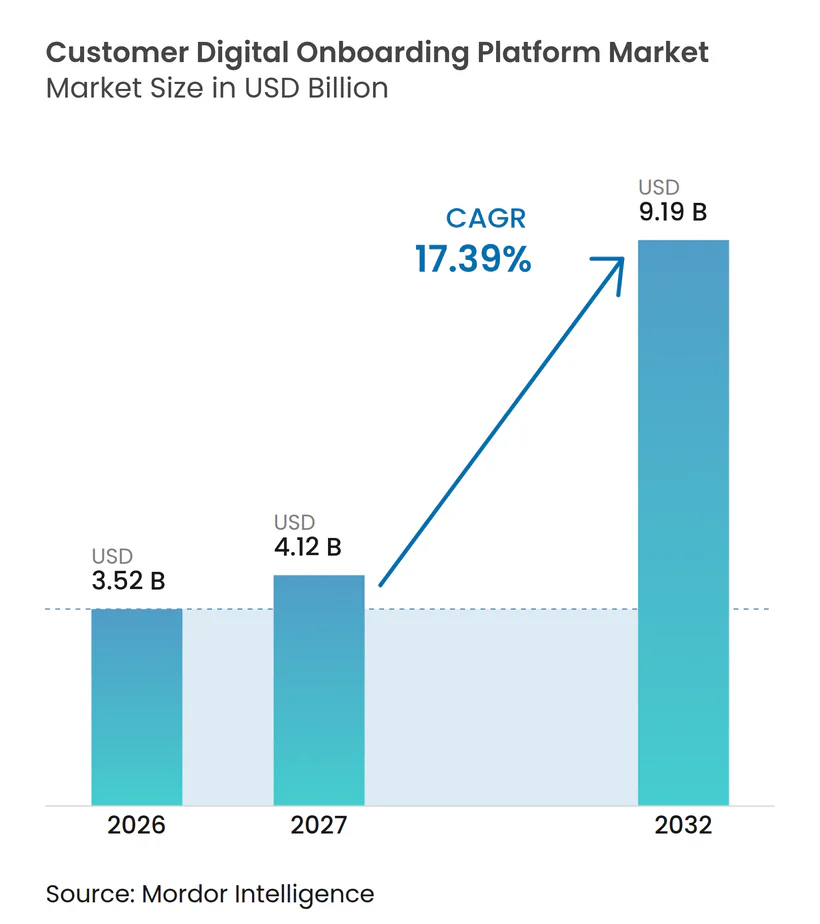
The customer digital onboarding platform market size is projected to expand from USD 3.52 billion in 2026 and USD 4.12 billion in 2027 to USD 9.19 billion by 2032, registering a CAGR of 17.39% between 2027 and 2032. The customer digital onboarding platform market is shaped by the need to complete identity checks without adding avoidable steps to account opening. Organizations increasingly treat the first digital interaction as both a fraud-control point and a customer acquisition moment. Tighter AML, KYC, customer due diligence, and identity requirements create a lasting need for more capable onboarding systems. Digital banks, embedded finance providers, and super-app operators are increasing the number of organizations that need these systems at scale. The customer digital onboarding platform market also favors providers that can combine reliable verification, low abandonment, adaptable compliance controls, and clear records of automated decisions.
Key Report Takeaways
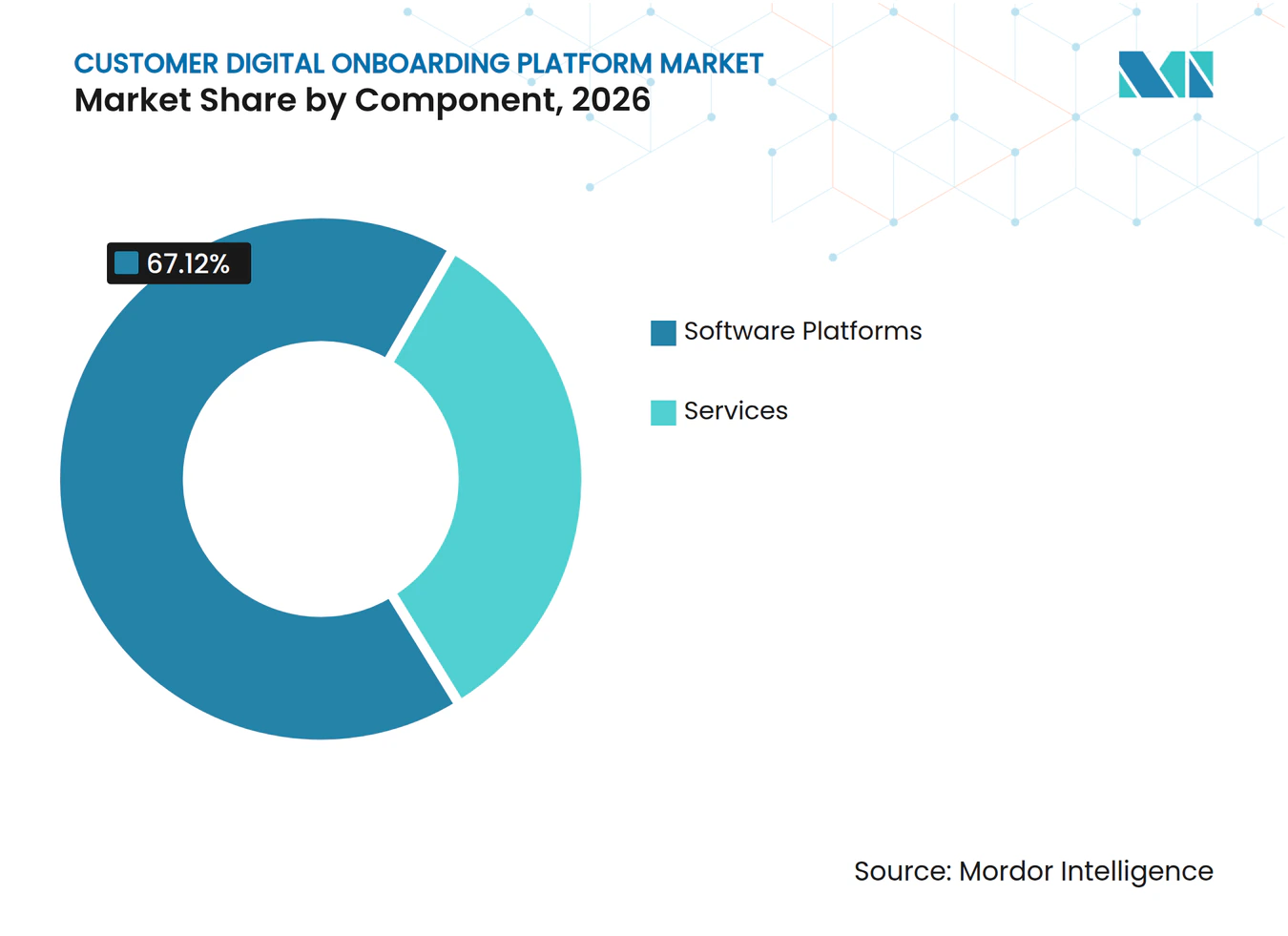
- By component, software platforms held 67.12% revenue share in 2026, while services are projected to expand at a 17.79% CAGR through 2032.
- By deployment model, cloud-based deployment held 72.38% share in 2026 and is projected to expand at a 17.74% CAGR through 2032.
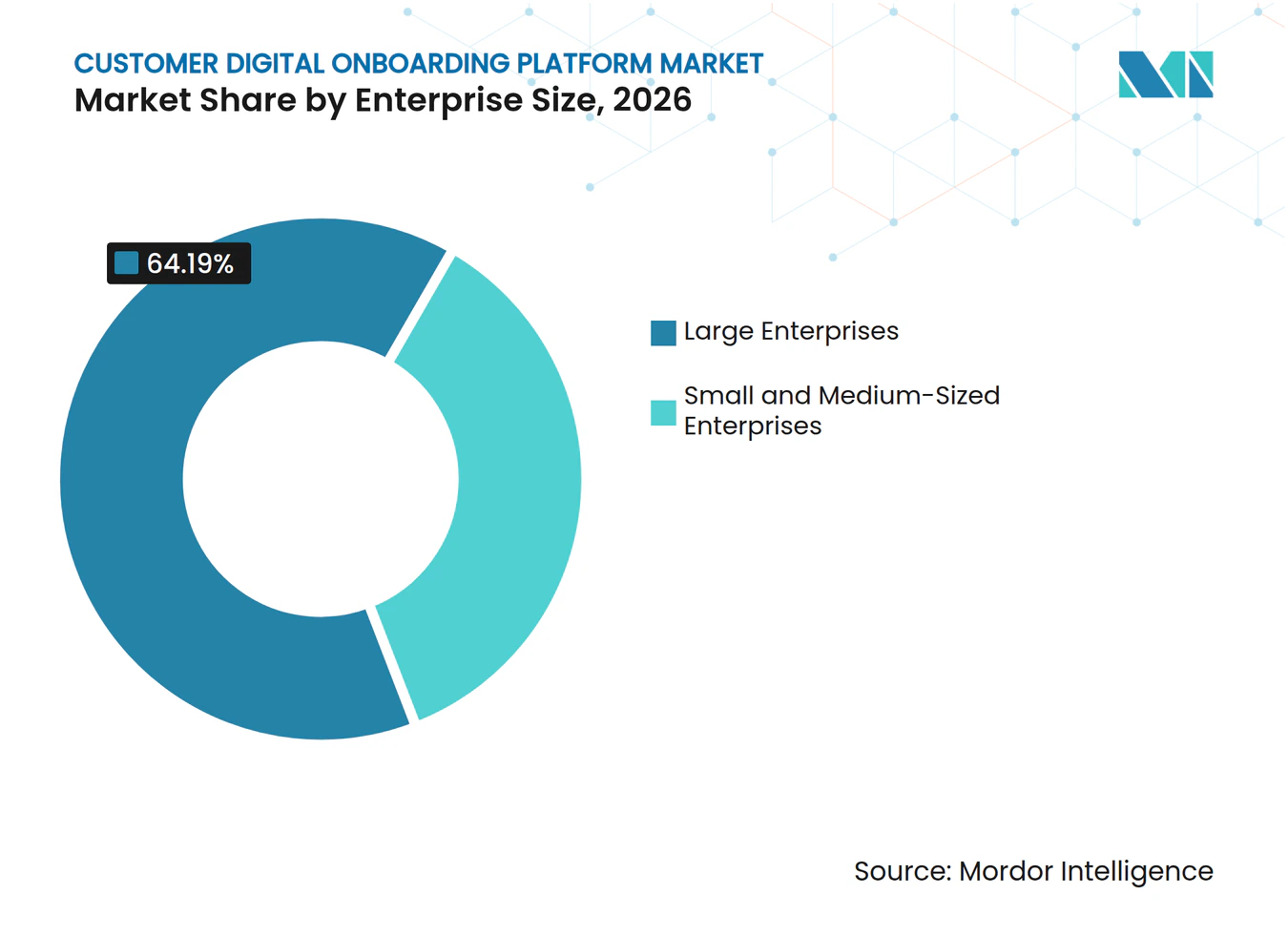
- By enterprise size, large enterprises held 64.19% share in 2026, while SMEs are projected to expand at a 17.81% CAGR through 2032.
- By end-user industry, information technology and telecom held 28.36% share in 2026, while BFSI is projected to expand at an 18.56% CAGR through 2032.
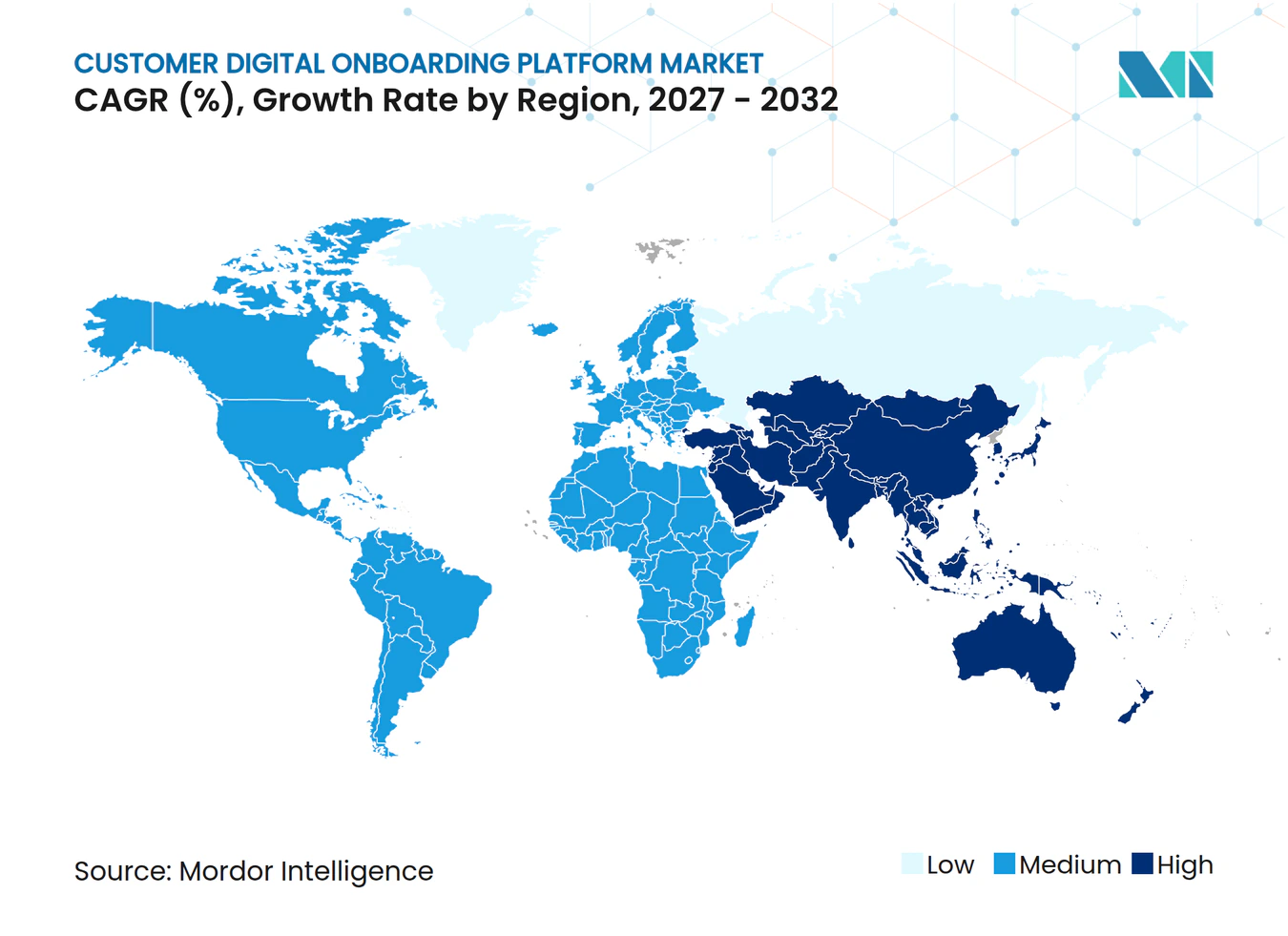
- By geography, North America held 38.63% share in 2026, while Asia-Pacific is projected to expand at an 18.36% CAGR through 2032.
Note: Market numbers in this report are based on Mordor Intelligence's proprietary estimation framework, which combines nine months of actuals with Q4 projections for base year 2026.
Market Trends and Insights
Drivers Impact Analysis of Customer Digital Onboarding Platform Market*
| Driver | (~) % Impact on CAGR Forecast | Geographic Relevance | Impact Timeline |
|---|---|---|---|
| Rising Demand for Seamless Digital Customer Acquisition and Account Opening | +3.5% | Global | Short term (≤ 2 years) |
| Increasing KYC, AML, CDD, and Customer Identification Requirements | +3.2% | Global, North America and Europe | Short term (≤ 2 years) |
| Growing Adoption of Mobile-First and Omnichannel Onboarding | +2.8% | Global, Asia-Pacific core, spillover to Middle East and Africa | Medium term (2-4 years) |
| Increasing Adoption of AI-Powered Identity Verification and Automated Decisioning | +2.5% | Global | Medium term (2-4 years) |
| Expansion of Digital Banking, Fintech, Embedded Finance, and Digital Commerce | +2.0% | Asia-Pacific core, spillover to Middle East and Africa and South America | Long term (≥ 4 years) |
| Adoption of Digital Identity Wallets and Reusable Credentials | +1.5% | Europe, North America | Long term (≥ 4 years) |
| Source: Mordor Intelligence | |||
Rising Demand for Seamless Digital Customer Acquisition and Account Opening
The customer digital onboarding platform market benefits when organizations can reduce the time and effort needed to open an account. In 2025, 70% of financial institutions reported losing clients due to slow or inefficient onboarding, up from 48% in 2023. Applicants now compare account opening to simpler digital services, making a slow process more likely to lead to abandonment. Many abandoned applications do not become formal complaints, so institutions can miss the full cost of an ineffective process. Providers are responding by implementing workflows that route lower-risk applicants to automated approval and apply additional checks to higher-risk cases. This approach helps the customer digital onboarding platform market by combining fraud control with a smoother entry experience.
Increasing KYC, AML, CDD, and Customer Identification Requirements
The customer digital onboarding platform market is supported by requirements that are becoming more specific across jurisdictions. The United Nations Office on Drugs and Crime has stated that financial crime can cost the global economy up to USD 2 trillion annually.[1] European policy is moving toward more consistent anti-money-laundering requirements across member states. The European Digital Identity Framework also establishes a common basis for digital identity wallets and related trust services. In the United States, beneficial-ownership reporting creates a stronger need to identify changes that can affect a customer risk profile. These conditions make continuous monitoring and re-verification more relevant after the initial onboarding event.
Growing Adoption of Mobile-First and Omnichannel Onboarding
Mobile devices are a frequent starting point for account opening, while applicants still expect to continue an application through other channels. The customer digital onboarding platform market, therefore, favors systems that keep application information available when a user moves from mobile to web or an in-person interaction. A complete restart after a channel change can add friction and reduce completion. Digital onboarding systems can reduce this problem by preserving session state and collecting nonessential information after account activation. Mobile-first design also makes it easier to integrate document capture, biometric checks, and status updates into a single journey. The result is a stronger case for customer digital onboarding platform market providers that support consistent experiences across channels.
Increasing Adoption of AI-Powered Identity Verification and Automated Decisioning
AI use in KYC and AML processes increased from 42% of financial institutions in 2024 to 82% in 2025. Deepfakes, synthetic identities, and injection attacks have reduced the reliability of manual review as a stand-alone control. Systems increasingly combine document checks, biometric outcomes, device signals, and behavioral information into a risk assessment. A 2026 peer-reviewed study reported that AI-driven authentication can reduce false positives by up to 30% in targeted settings and that some liveness approaches achieved accuracy close to 98% in controlled conditions. Automated decisions also need records that show the inputs, outputs, and confidence levels used in the process. This need for transparent decision records strengthens demand for governance functions within the customer digital onboarding platform market.
Restraints Impact Analysis of Customer Digital Onboarding Platform Market*
| Restraint | (~) % Impact on CAGR Forecast | Geographic Relevance | Impact Timeline |
|---|---|---|---|
| Data Privacy, Biometric Consent, and Cross-Border Data Transfer Requirements | -1.5% | Global, North America and Europe | Short term (≤ 2 years) |
| High Implementation Costs and Total Cost of Ownership | -1.2% | Global | Medium term (2-4 years) |
| False Rejections, Manual Review Queues, and AI Model Governance Challenges | -0.8% | Global | Medium term (2-4 years) |
| Limited Access to Reliable Identity Data in Emerging Markets | -0.5% | Middle East and Africa, South America | Long term (≥ 4 years) |
| Source: Mordor Intelligence | |||
Data Privacy, Biometric Consent, and Cross-Border Data Transfer Requirements
Biometric onboarding can involve facial geometry, liveness sequences, and voice data, all of which receive heightened legal protection in many jurisdictions. The General Data Protection Regulation treats biometric data used for unique identification as a special category of personal data. It can require explicit consent and impact assessments before large-scale processing. Illinois law also establishes notice and consent duties for biometric information, with statutory damages of USD 1,000 for negligent violations and USD 5,000 for intentional violations.[2] Different data transfer and localization rules add operational workload for providers serving multiple countries. These requirements can slow the customer digital onboarding platform market when vendors must configure separate consent, storage, and retention controls.
High Implementation Costs and Total Cost of Ownership
Custom enterprise deployments can take 18 to 36 months, particularly where legacy banking systems need extensive integration. Average annual AML and KYC operating expenditure was USD 72.9 million per firm in 2025, including technology, staff, and continuing model maintenance. The cost can be difficult for mid-sized organizations to justify without sufficient customer volumes or compliance exposure. Older core systems can also need middleware before a modern onboarding system can exchange data reliably. Cloud-native systems can reduce some of the infrastructure burden, but regulatory updates and ongoing integration needs still affect total ownership costs. These conditions restrain the customer digital onboarding platform market by favoring larger buyers and limiting the reach of full-platform deployments.
*Our forecasts treat driver/restraint impacts as directional, not additive. The impact forecasts reflect baseline growth, mix effects, and variable interactions.
Customer Digital Onboarding Platform Market Segment Analysis
By Component:
Software Platforms Lead Revenue While Services ExpandSoftware platforms held 67.12% of the customer digital onboarding platform market share in 2026. Organizations use these platforms as orchestration layers connecting identity verification, compliance decisions, document capture, and liveness checks. A configurable platform can bring several checks into a coordinated workflow rather than relying on separate tools. This helps buyers adjust the process for different customer types, risk levels, and regulatory settings. Their revenue position reflects the importance of a central control layer in large deployments.
Services are projected to expand at a 17.79% CAGR from 2027 to 2032. The increase reflects the work required to maintain compliance processes as document requirements, KYC thresholds, and consent rules change. Many organizations prefer to obtain this capacity from a provider rather than build it internally. Managed compliance services can include regulatory monitoring, workflow adjustment, and operational support. The customer digital onboarding platform market is moving from isolated implementation projects toward longer-running service relationships.


By Deployment Model:
Cloud-Based Systems Support Scaled OnboardingCloud-based deployment held 72.38% of the customer digital onboarding platform market share in 2026 and is projected to expand at a 17.74% CAGR through 2032. Cloud systems can support real-time identity lookups, liveness updates, and ongoing KYC events. They also let buyers use capacity as needed instead of maintaining all infrastructure internally. Continuous platform updates can be delivered more readily in cloud environments. These features explain why cloud deployment leads to both current use and future expansion.
On-premises systems remain relevant where data residency or internal technology policies are strict. Government and financial clients in China, India, and Gulf Cooperation Council states may retain more data within their own environments. Hybrid models combine cloud-based orchestration with locally managed storage. This approach can balance performance needs with local data requirements. The customer digital onboarding platform market continues to favor deployment flexibility because buyer requirements differ across regions.
By Enterprise Size:
Large Enterprises Lead While SMEs AccelerateLarge enterprises held 64.19% of the customer digital onboarding platform market share in 2026. Their greater compliance exposure and transaction volumes can support investment in broad verification and case management capabilities. Long procurement processes have historically favored established providers with extensive deployment resources. Large organizations often operate in more than 1 jurisdiction, increasing their need for configurable controls. These factors maintain their leading position in current spending.
SMEs are projected to expand at a 17.81% CAGR between 2027 and 2032. Cloud-native systems and usage-based API pricing lower minimum commitments that previously limited access for smaller organizations. Qatar National Bank launched a fully digital SME onboarding platform in 2025, enabling account opening in minutes without a branch visit. This type of deployment can reduce manual effort that makes smaller-business onboarding costly. The customer digital onboarding platform industry can widen its customer base when providers offer workflows and pricing that fit this group.

By End-User Industry:
IT and Telecom Lead While BFSI AcceleratesInformation technology and telecom held 28.36% of the customer digital onboarding platform market share in 2026. These users apply digital identity tools to subscriber onboarding, SIM-swap risk management, and account verification across developer ecosystems. Their high-volume digital interactions make automated identity checks especially relevant. Telecom providers need to balance speed with controls against account misuse. This combination supports the segment's leading position.
BFSI is projected to expand at an 18.56% CAGR through 2032. Global AML fines reached USD 4.6 billion in 2024, with North America accounting for 94% of the total. Financial institutions also face competition from neobanks that offer account opening in less than 3 minutes. Healthcare and life sciences use onboarding systems for telehealth, while retail and e-commerce focus on account takeover and age-verification controls. Socure won a 5-year, USD 163 million federal contract in May 2026 to provide identity-proofing technology for Login.gov, showing the relevance of the customer digital onboarding platform market to public-sector use.
Geography Analysis
North America Customer Digital Onboarding Platform Market
North America held 38.63% of the customer digital onboarding platform market share in 2026. The region combines a mature enterprise buyer base with intense AML enforcement and complex state-level privacy requirements. North America accounted for 94% of global AML fines totaling USD 4.6 billion in 2024. United States biometric rules, including Illinois requirements, increase demand for documented consent and retention processes. Canada and Mexico add demand as open-banking activity and fintech licensing broaden the number of organizations needing structured onboarding.
Europe Customer Digital Onboarding Platform Market
Europe is being reshaped by the European Digital Identity Framework. All European Union member states are required to provide European Digital Identity Wallets to citizens and businesses by the end of 2026.[3] From December 2027, banks, e-money institutions, and payment service providers will need to accept those wallets where identity verification is legally required. Providers able to ingest verifiable credentials have an advantage over document-capture-only workflows. Germany, the United Kingdom, France, and the Netherlands remain important adoption markets.
APAC, MEA and South America Customer Digital Onboarding Platform Market
Asia-Pacific is projected to expand at an 18.36% CAGR through 2032, the fastest regional rate in the customer digital onboarding platform market. Neobank activity, public digital identity systems, and mobile payment infrastructure support this outlook. India’s Aadhaar-based e-KYC infrastructure can streamline account-opening processes for organizations that use it. Singapore firms reported 92% AI adoption in KYC in 2025. South America and the Middle East offer further opportunities, while parts of Africa face limits because reliable government identity data are less available.
Competitive Landscape
Market Concentration
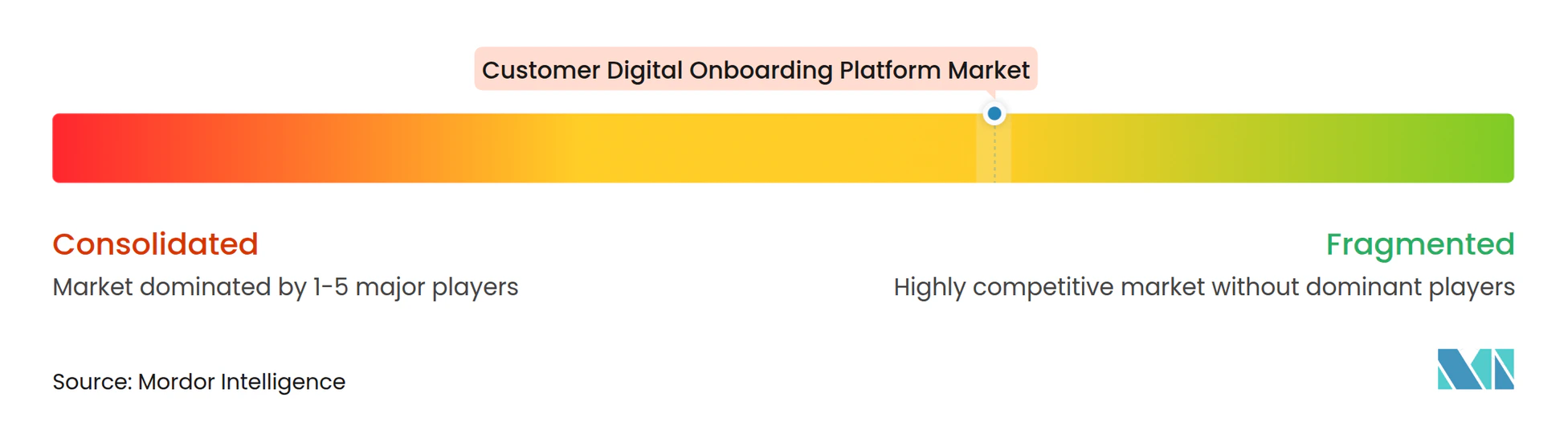
The customer digital onboarding platform market is moderately fragmented at the platform level, while the identity-verification layer is consolidating. Vendors compete through data coverage, verification quality, governance functions, and integration depth. Identity networks can serve as a useful differentiator by combining signals from many verified and fraudulent transactions. Jumio states that its Identity Graph draws on more than 1 billion cross-customer interactions.[4] This can support quicker re-verification of returning users through a biometric match.
Providers are extending from point verification into broader trust and compliance services. Socure acquired Fravity in August 2026 and integrated the acquired company’s agent-building capabilities into RiskOS Agents. Veriff acquired KYB specialist Vespia in February 2026 to add company-status monitoring, ownership-change tracking, and sanctions exposure management. IDnow was acquired by Corsair Capital in a USD 295 million transaction in 2025. These moves indicate a push toward platforms that support onboarding, ongoing monitoring, and business verification within a single relationship.
Explainable AI is an important competitive issue because enterprises need to understand and document automated identity decisions. Standards for presentation-attack detection and document authenticity can also affect procurement choices. Opportunities remain in public-sector identity proofing, cross-border Know Your Business processes, and healthcare workflows that need appropriate biometric consent controls. The customer digital onboarding platform market can benefit when providers adapt those capabilities to specific operating requirements.
Customer Digital Onboarding Platform Industry Leaders
-
Jumio Corporation
-
Trulioo Information Services Inc.
-
Signicat AS
-
Veriff OÜ
-
Au10tix Ltd.
- *Disclaimer: Major Players sorted in no particular order
Customer Digital Onboarding Platform Market Companies Covered in this Report
- Jumio Corporation
- Trulioo Information Services Inc.
- Signicat AS
- Veriff OÜ
- Au10tix Ltd.
- IDnow GmbH
- Sum and Substance Ltd.
- Shufti Pro Limited
- Persona Identities, Inc.
- Socure Inc.
- First Mile Group, Inc. d/b/a Alloy
- Mitek Systems, Inc.
- Ondato UAB
- UAB iDenfy
- PXL Vision AG
- Innovatrics, s.r.o.
- Incode Technologies, Inc.
- ID.me, LLC
- Intellicheck, Inc.
- HyperVerge Technologies Private Limited
Recent Industry Developments in Customer Digital Onboarding Platform Market
- October 2026: Trulioo strengthened its identity verification integration for Fiserv clients across global markets, enabling Fiserv's financial institution clients to access Trulioo's person and business verification capabilities, spanning 195 countries and 14,000+ document types, directly through their existing Fiserv infrastructure, reducing vendor proliferation in compliance stacks.
- October 2026: Veriff published guidance for UK employers on Right to Work digital checks following updated UK Home Office digital verification frameworks, outlining how platforms avoid onboarding bottlenecks in employment verification workflows.
- September 2026: Instructure integrated Veriff’s biometric ID verification into Parchment, its academic transcript-ordering platform, extending onboarding-platform use cases into education-credentialing workflows for students ordering official transcripts.
- August 2026: Socure raised USD 156 million at a USD 5.2 billion valuation, led by Summit Partners with participation from Goldman Sachs Alternatives, Wells Fargo, and Docusign. The company simultaneously acquired Austin-based agentic AI startup Fravity and integrated its agent-building capabilities into the RiskOS platform as RiskOS Agents, automating fraud investigation and compliance workflows that previously required human intervention.
Global Customer Digital Onboarding Platform Market Report Scope
The Customer Digital Onboarding Platform Market refers to the global market for software platforms and services that enable organizations to digitally register, verify, authenticate, and onboard new customers through streamlined, automated, and secure processes. These platforms facilitate digital identity verification, electronic document collection and validation, customer information capture, biometric authentication, electronic signatures, compliance screening, and integration with customer relationship management (CRM) and other enterprise systems. They help organizations reduce onboarding time and operational costs, enhance the customer experience, minimize identity fraud, and comply with regulatory requirements, including know your customer (KYC) and anti-money laundering (AML) obligations, where applicable.
The Customer Digital Onboarding Platform Market Report is Segmented by Component (Software Platforms, and Services), Deployment Model (Cloud-Based, On-Premises, and Hybrid), Enterprise Size (Large Enterprises, and Small and Medium-Sized Enterprises), End-User Industry (BFSI, Healthcare and Life Sciences, IT and Telecom, Retail and E-Commerce, Industrial Manufacturing, and Government and Public Sector), and Geography (North America, South America, Europe, Asia-Pacific, Middle East, and Africa). The Market Forecasts are Provided in Terms of Value (USD).
Segmentation Overview
| Software Platforms |
| Services |
| Cloud-Based |
| On-Premises |
| Hybrid |
| Large Enterprises |
| Small and Medium-Sized Enterprises |
| BFSI |
| Healthcare and Life Sciences |
| Information Technology and Telecom |
| Retail and E-Commerce |
| Industrial Manufacturing |
| Government and Public Sector |
| North America | United States |
| Canada | |
| Mexico | |
| South America | Brazil |
| Argentina | |
| Rest of South America | |
| Europe | Germany |
| United Kingdom | |
| France | |
| Italy | |
| Spain | |
| Russia | |
| Netherlands | |
| Rest of Europe | |
| Asia-Pacific | China |
| Japan | |
| India | |
| South Korea | |
| Australia and New Zealand | |
| Rest of Asia-Pacific | |
| Middle East | Saudi Arabia |
| United Arab Emirates | |
| Turkey | |
| Rest of Middle East | |
| Africa | South Africa |
| Nigeria | |
| Rest of Africa |
| By Component | Software Platforms | |
| Services | ||
| By Deployment Model | Cloud-Based | |
| On-Premises | ||
| Hybrid | ||
| By Enterprise Size | Large Enterprises | |
| Small and Medium-Sized Enterprises | ||
| By End-User Industry | BFSI | |
| Healthcare and Life Sciences | ||
| Information Technology and Telecom | ||
| Retail and E-Commerce | ||
| Industrial Manufacturing | ||
| Government and Public Sector | ||
| By Geography | North America | United States |
| Canada | ||
| Mexico | ||
| South America | Brazil | |
| Argentina | ||
| Rest of South America | ||
| Europe | Germany | |
| United Kingdom | ||
| France | ||
| Italy | ||
| Spain | ||
| Russia | ||
| Netherlands | ||
| Rest of Europe | ||
| Asia-Pacific | China | |
| Japan | ||
| India | ||
| South Korea | ||
| Australia and New Zealand | ||
| Rest of Asia-Pacific | ||
| Middle East | Saudi Arabia | |
| United Arab Emirates | ||
| Turkey | ||
| Rest of Middle East | ||
| Africa | South Africa | |
| Nigeria | ||
| Rest of Africa | ||
Key Questions Answered in the Report
What is the customer digital onboarding platform market size?
The customer digital onboarding platform market is projected to move from USD 3.52 billion in 2026 and USD 4.12 billion in 2027 to USD 9.19 billion by 2032.
What is driving demand for customer digital onboarding platforms?
Demand is supported by stricter KYC and AML needs, digital account opening, mobile-first journeys, and the need to manage fraud without adding unnecessary friction.
Which deployment model leads adoption?
Cloud-based deployment held 72.38% share in 2026 and is projected to expand at a 17.74% CAGR through 2032.
Which customer group is expanding fastest?
SMEs are projected to expand at a 17.81% CAGR through 2032 as cloud delivery and usage-based pricing improve accessibility.
Which end-user sector has the fastest outlook?
BFSI is projected to expand at an 18.56% CAGR through 2032 because financial institutions face compliance pressure and competition from digital-first providers.
Which region has the highest projected expansion?
Asia-Pacific is projected to expand at an 18.36% CAGR through 2032, supported by digital identity infrastructure, neobank activity, and fintech adoption.