
Crypto-Agility Platform Market Size and Share
Market Overview
| Study Period | 2021 - 2032 |
|---|---|
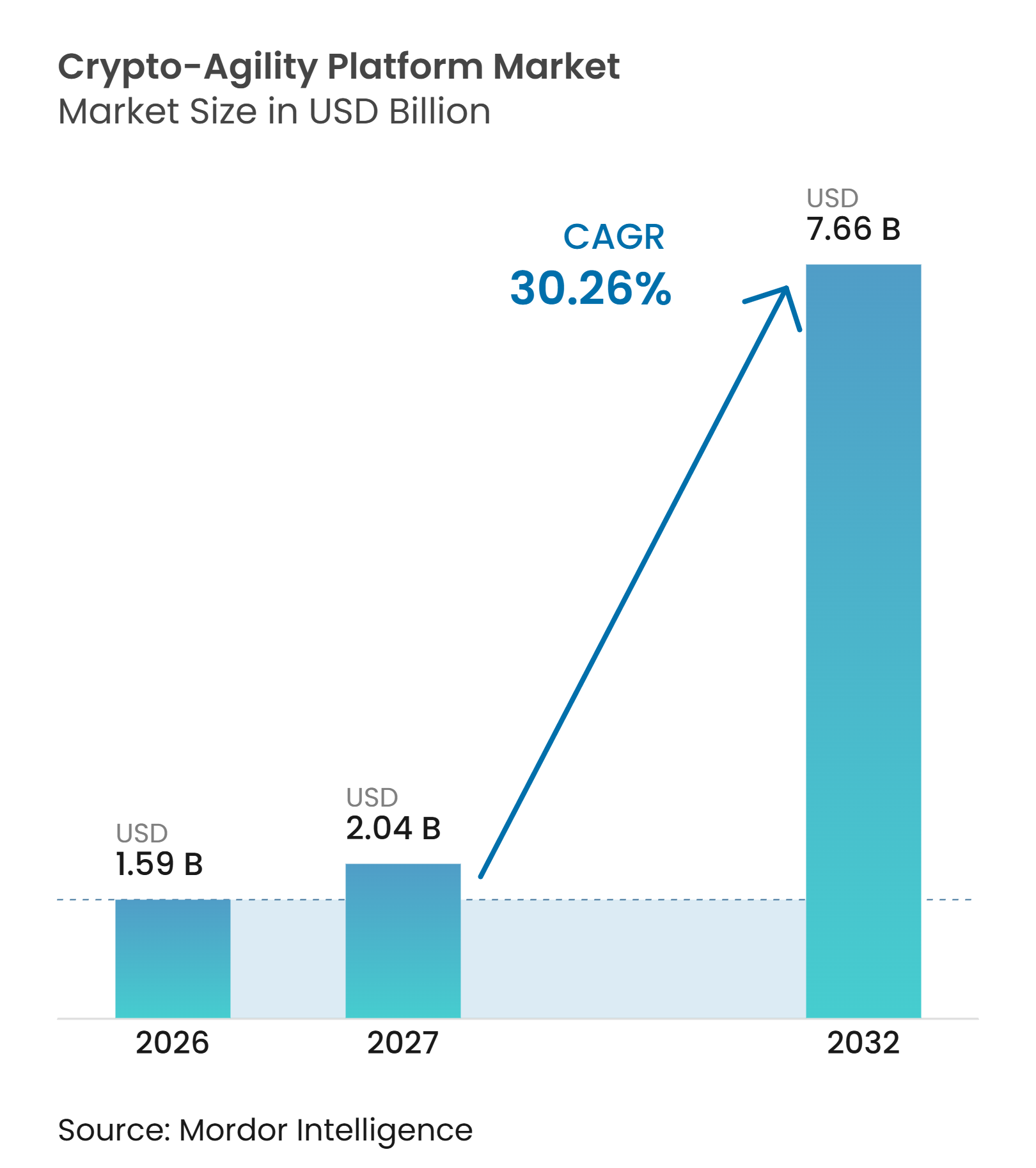
| Market Size (2027) | USD 2.04 Billion |
| Market Size (2032) | USD 7.66 Billion |
| Growth Rate (2027 - 2032) | 30.26 % |
| Fastest Growing Market | Asia-Pacific |
| Largest Market | North America |
| Market Concentration | Low |
Major Players *Disclaimer: Major Players sorted in no particular order Image © Mordor Intelligence. Reuse requires attribution under CC BY 4.0. | |
Crypto-Agility Platform Market Analysis by Mordor Intelligence
The Crypto-Agility Platform Market size is projected to be USD 1.59 billion in 2026, USD 2.05 billion in 2027, and reach USD 7.66 billion by 2032, growing at a CAGR of 30.26% from 2027 to 2032. The crypto-agility platform market is being shaped by migration deadlines, long-lived data exposure, and rising machine-identity workloads that place greater pressure on security teams and turn cryptographic management into a business continuity issue across applications, internal networks, public services, remote access channels, and supplier connections that support daily customer service and internal business activity. Federal and European migration plans are making cryptographic change a near-term governance requirement for many organizations in the crypto-agility platform market, affecting procurement, legal, supplier management, and security functions that must agree on scope, priorities, approved technologies, and reporting before change programs can begin. Certificate renewal workloads and the growth of hybrid infrastructure are increasing the need for automated inventory management, policy controls, and coordinated operating procedures across technology teams, especially where records are distributed across applications and suppliers, with different controls, renewal schedules, and ownership structures. Providers are competing to combine discovery, orchestration, certificate lifecycle management, and post-quantum planning in a single operating model for the crypto-agility platform market, linking technical controls with management reporting, supplier coordination, operational testing, and audit evidence. The opportunity is strongest where firms translate complex migration work into practical programs for regulated customers, while helping them sequence technical changes, supplier responsibilities, testing, and internal accountability across decentralized technology estates and long-standing operational processes in highly regulated and interconnected operating environments where interruption risk, audit scrutiny, and sensitive information create urgent priorities.
Key Report Takeaways
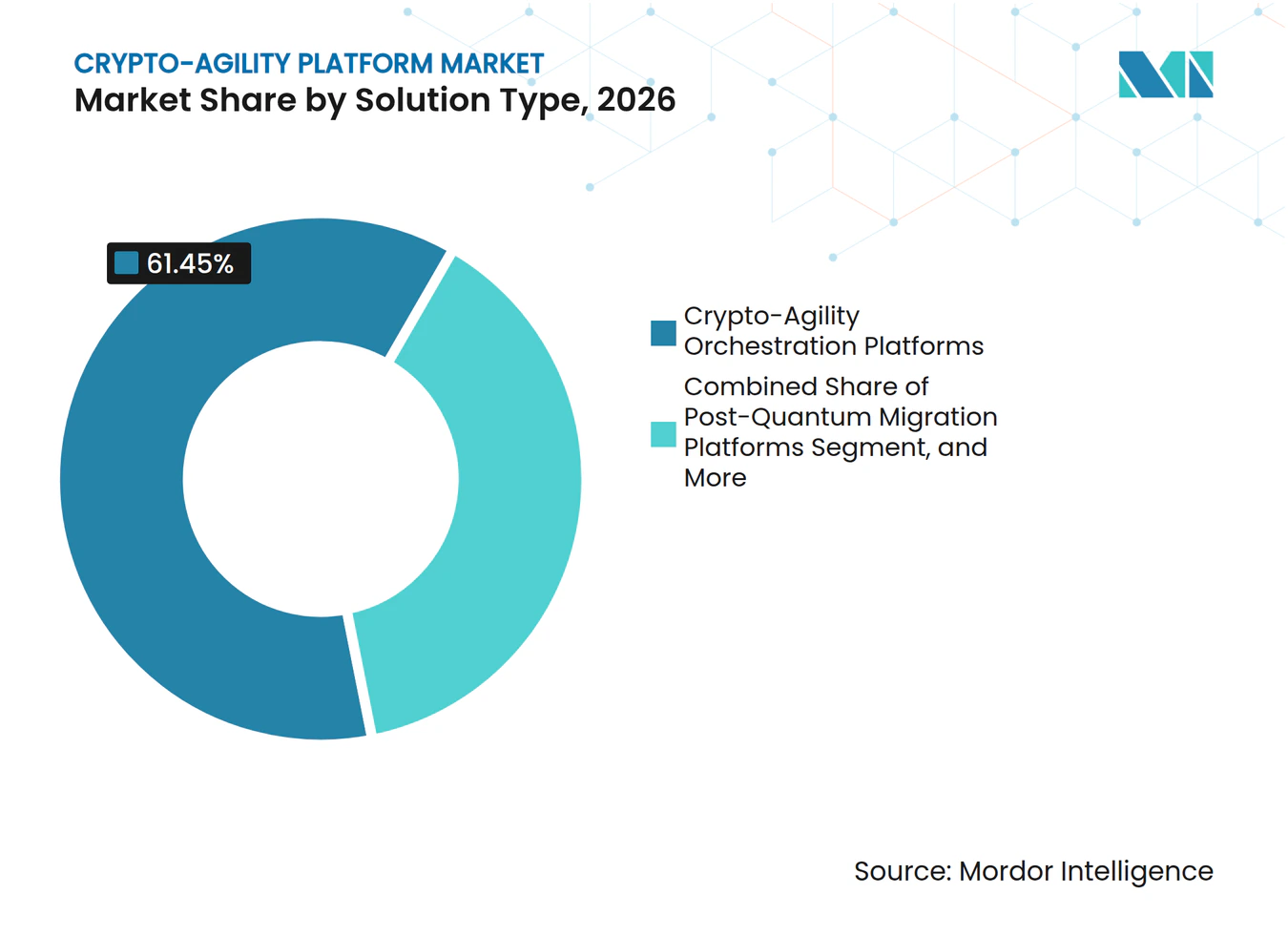
- By solution type, Crypto-Agility Orchestration Platforms held 61.45% of the Crypto-Agility Platform Market share in 2026, while Post-Quantum Migration Planning Platforms are projected to expand at a 31.44% CAGR through 2032.
- By deployment mode, On-Premises deployment held 68.15% of the Crypto-Agility Platform Market share in 2026, while Cloud-Based deployment is projected to expand at a 31.80% CAGR through 2032.
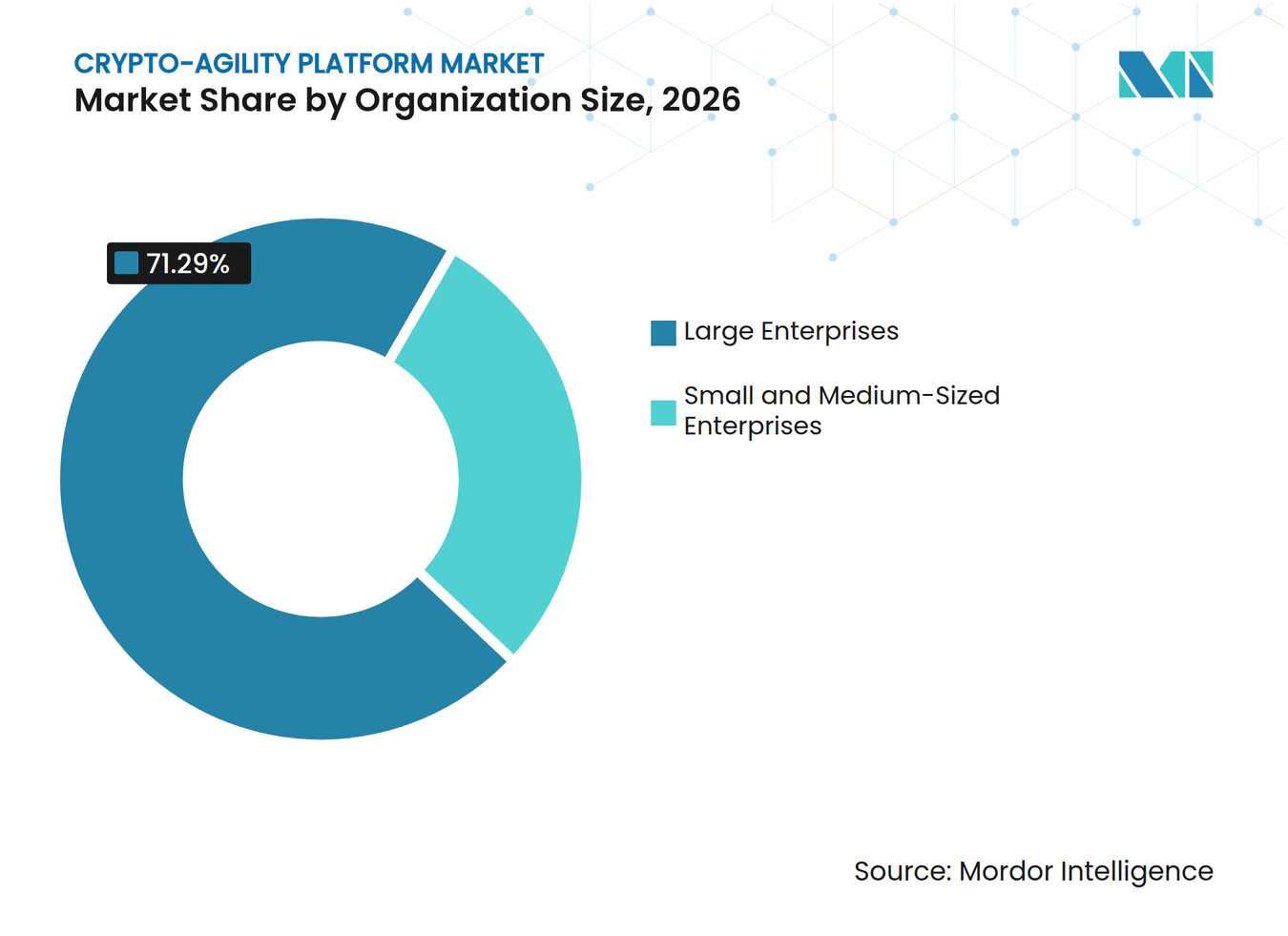
- By organization size, Large Enterprises held 71.29% of the Crypto-Agility Platform Market share in 2026, while Small and Medium-Sized Enterprises are projected to expand at a 32.05% CAGR through 2032.
- By end-user industry, BFSI held 30.18% of the Crypto-Agility Platform Market share in 2026, while Government and Public Administration is projected to expand at a 30.78% CAGR through 2032.
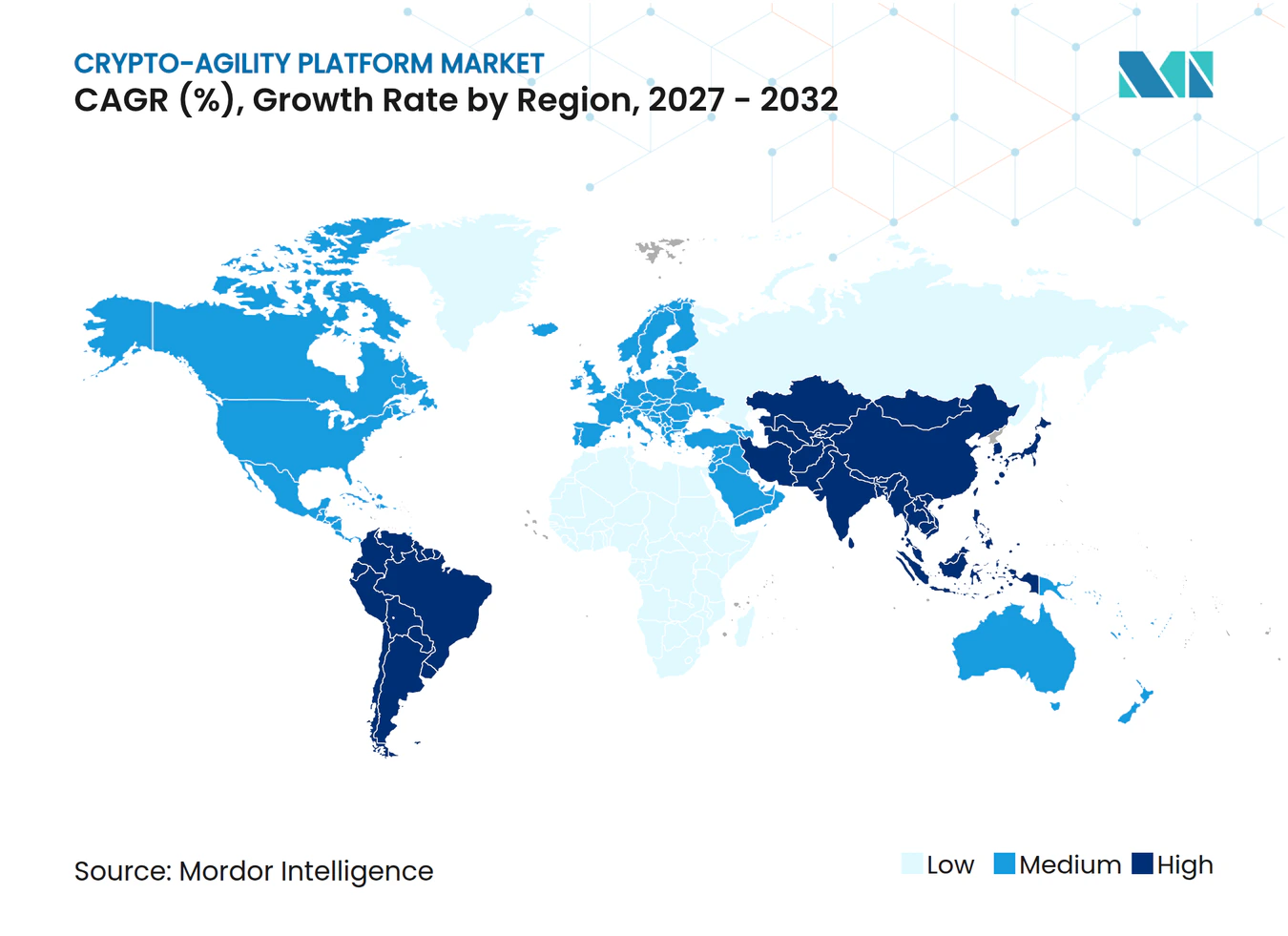
- By geography, North America held 37.66% of the market share in 2026, while Asia-Pacific is projected to expand at a 31.09% CAGR through 2032.
Note: Market numbers in this report are based on Mordor Intelligence's proprietary estimation framework, which combines nine months of actuals with Q4 projections for base year 2026.
Market Trends and Insights
Drivers Impact Analysis of Crypto-Agility Platform Market*
| Driver | (~) % Impact on CAGR Forecast | Geographic Relevance | Impact Timeline |
|---|---|---|---|
| Accelerating Post-Quantum Migration Mandates | +7.5% | Global, with concentrated near-term pull in North America and Europe | Short term (≤ 2 years) |
| Harvest-Now-Decrypt-Later Risk for Long-Lived Data | +6.2% | Global, with highest urgency in BFSI, government, and healthcare | Short term (≤ 2 years) |
| Shortening Certificate Lifecycles and Machine-Identity Sprawl | +5.0% | Global, particularly North America and Europe | Medium term (2-4 years) |
| Expansion of Hybrid, Multi-Cloud, and Air-Gapped Environments | +3.8% | North America and Europe, with rising relevance in Asia-Pacific government and defense | Medium term (2-4 years) |
| Rising Demand for Continuous Cryptographic Inventory and CBOM | +2.7% | Global, concentrated in North America and European regulatory zones | Medium term (2-4 years) |
| Crypto-Agility Requirements in Long-Life Embedded and Critical-Infrastructure Systems | +2.1% | Global, particularly European and Asia-Pacific industrial and energy systems | Long term (≥ 4 years) |
| Source: Mordor Intelligence | |||
Accelerating Post-Quantum Migration Mandates Are Compressing Enterprise Decision Cycles
Federal requirements are reducing the scope for organizations to postpone cryptographic planning. Executive Order 14412 set December 31, 2030,, as the deadline for U.S. federal agencies to migrate high-value assets to post-quantum key establishment, with digital signature migration due by December 31, 2031. The accompanying OMB Memorandum M-26-15 sets out a five-phase program for the federal transition. The planned Federal Acquisition Regulation changes extend the practical effect of these requirements to covered contractors, including firms in defense, health technology, and financial infrastructure. The European Commission's coordinated roadmap also calls for member states to begin the transition by the end of 2026 and move high-risk systems by 2030. These aligned deadlines are shortening procurement cycles in the crypto-agility platform market because organizations need to establish ownership, inventory, and migration plans sooner.
Harvest-Now-Decrypt-Later Risk Makes Long-Lived Data a Current Security Concern
The harvest-now-decrypt-later threat shifts the timing of cryptographic investment for organizations that retain sensitive data for extended periods. A Federal Reserve paper notes that data collected today can remain exposed once an attacker retains it for later decryption.[1] Europol advises organizations to locate cryptography across network connections, certificates, backups, databases, and internal services before they can rank migration work. This requirement gives inventory and risk-prioritization functions a central role in the crypto-agility platform market. Healthcare, financial services, government, and satellite communications carry particular exposure because their records can remain valuable for many years. Research on quantum transitions also finds that hybrid key-exchange approaches can reduce the duration of confidentiality risk. The commercial need is therefore not limited to replacing algorithms, as buyers also need a defensible order for protecting data that cannot be recovered once taken.
Shorter Certificate Lifecycles and Machine-Identity Growth Raise Automation Needs
Shorter TLS certificate lifecycles are making renewal work harder to manage through manual processes. The crypto-agility platform market benefits from large renewal workloads, which require more consistent ownership, policy enforcement, and automated action. DevOps, microservices, and connected-device deployments are also adding machine identities across enterprise estates. Security teams need enrollment and renewal workflows that can operate without interrupting applications. This pressure supports tools that connect certificate lifecycle management with cryptographic inventories and migration policies. It also narrows the viable field to providers capable of supporting high-volume operational workloads.
Hybrid, Multi-Cloud, and Air-Gapped Environments Increase Cryptographic Complexity
Hybrid infrastructure makes algorithm changes more difficult because keys and certificates can sit across cloud services, local hardware security modules, and legacy applications. The crypto-agility platform market addresses this problem with tools that identify dependencies across these locations. Organizations must establish a unified view before they can safely replace cryptographic methods across different cloud key stores and on-premises environments. Air-gapped and classified environments present a separate challenge because they cannot rely on continuous cloud delivery for algorithm updates. Fraunhofer AISEC identifies compatibility and hardware-neutral migration support as important for critical and classified systems. These operating conditions support orchestration across disconnected, sovereign, and multi-cloud deployments, while making simple single-environment scanning tools less suitable for complex infrastructure.
Restraints Impact Analysis of Crypto-Agility Platform Market*
| Restraint | (~) % Impact on CAGR Forecast | Geographic Relevance | Impact Timeline |
|---|---|---|---|
| Fragmented Legacy Dependencies and Hidden Cryptographic Usage | -1.8% | Global, with greatest impact in North America and Europe | Long term (≥ 4 years) |
| Performance and Interoperability Trade-Offs of Post-Quantum Algorithms | -1.4% | Global, particularly Asia-Pacific low-resource embedded deployments | Medium term (2-4 years) |
| Shortage of Cryptography Engineering and Migration Expertise | -1.0% | Global, most severe in emerging markets and mid-sized organizations | Medium term (2-4 years) |
| Unclear Procurement Boundaries Between Discovery, PKI, HSM, and Migration Platforms | -0.7% | Global, particularly large-enterprise procurement workflows | Short term (≤ 2 years) |
| Source: Mordor Intelligence | |||
Fragmented Legacy Dependencies and Hidden Cryptographic Usage Slow Discovery
Organizations cannot migrate cryptographic assets that they cannot identify. Older systems often place cryptographic calls inside custom middleware, compiled software, third-party libraries, and firmware. The crypto-agility platform market must therefore address discovery beyond standard application interfaces. Vendor software and payment-service dependencies can leave an institution exposed even where its internal controls have been updated. Hidden certificates, hardcoded keys, and embedded secrets may only emerge when a change causes an unexpected failure. This makes migration programs longer and more expensive than initial plans suggest, creating a need for testing and remediation alongside inventory functions.
Performance and Interoperability Trade-Offs Limit Some Deployments
Post-quantum algorithms can increase the computational and data-transfer requirements of systems built for classical cryptography. The Banque de France's Project Leap Phase 2 found material performance differences between traditional and post-quantum approaches in payment-system testing. Larger keys and ciphertexts can affect connection handshakes in settings such as real-time payments and high-frequency transactions. NIST continues to assess additional signature schemes, which means organizations will need to follow an evolving set of algorithms and implementation choices. Existing embedded devices may also lack the memory or processing capacity for a software-only transition. The crypto-agility platform market can support testing and staged change, but it cannot remove all hardware constraints or eliminate the cost of replacement.
*Our forecasts treat driver/restraint impacts as directional, not additive. The impact forecasts reflect baseline growth, mix effects, and variable interactions.
Crypto-Agility Platform Market Segment Analysis
By Solution Type:
Orchestration Leads While Migration Planning ExpandsCrypto-Agility Orchestration Platforms held 61.45% of the crypto-agility platform market share in 2026. Their lead reflects the need to control changes to the algorithm before broad remediation can proceed. Orchestration gives teams a central method for applying cryptographic changes without rebuilding every application. The crypto-agility platform market size in this segment is driven by buyers who need common policies across heterogeneous environments. Discovery and inventory products remain an entry point for organizations mapping their cryptographic estate.
Post-Quantum Migration Planning Platforms are projected to expand at a 31.44% CAGR through 2032. They support organizations that need phased plans, governance, and progress reporting after initial discovery. Federal direction on automated cryptographic bills of materials reinforces a more consistent view of deployed cryptography. AppViewX combined cryptographic bill-of-materials generation, remediation recommendations, and dashboards in its November 2025 release. NIST's ongoing evaluation of signature algorithms adds value to planning platforms, helping keep programs current.



By Deployment Mode:
On-Premises Remains Important as Cloud Demand AcceleratesCloud-Based deployment is projected to expand at a 31.80% CAGR through 2032. Shorter certificate lifecycles make scalable renewal and reporting services more attractive. The crypto-agility platform market size for cloud delivery is driven by workloads for certificate issuance, automation, and posture reporting. Keyfactor achieved FedRAMP certification in 2026, permitting authorized federal customers to use its cloud certificate lifecycle management service.[2] Regulated customers also need to demonstrate that external services align with established governance and operating policies. Many firms will retain local governance and sensitive keys while using cloud services for operational automation.
Cloud-Based deployment is projected to expand at a 31.80% CAGR through 2032. Shorter certificate lifecycles make scalable renewal and reporting services more attractive. The crypto-agility platform market size for cloud delivery is driven by workloads for certificate issuance, automation, and posture reporting. Keyfactor achieved FedRAMP certification in 2026, permitting authorized federal customers to use its cloud certificate lifecycle management service. Many firms will retain local governance and sensitive keys while using cloud services for operational automation.
By Organization Size:
Large Enterprises Lead While SMEs Gain RelevanceLarge Enterprises accounted for 71.29% of the market share in 2026. They have extensive application portfolios, legacy dependencies, and exposure to compliance obligations. Their programs can span certificate management, key management, remediation, and supplier dependencies. The crypto-agility platform market continues to rely on these enterprises because they can fund multi-year transformation programs. Their needs favor suppliers with broad integrations, professional services, and partner ecosystems.
Small and Medium-Sized Enterprises are projected to advance at a 32.05% CAGR through 2032. Demand will grow as large customers incorporate post-quantum requirements into defense, health care, and financial services supply chains. Smaller organizations commonly need managed services and packaged deployments because they lack dedicated cryptography specialists. Keyfactor expanded its Global Partner Program in July 2026 to support advisory, implementation, and managed services around trust infrastructure. This creates a channel opportunity for managed security service providers and systems integrators.

By End-User Industry:
BFSI Provides Scale While Government Sets the PaceBFSI held 30.18% of the market share in 2026. Financial institutions operate large cryptographic estates and keep transaction information sensitive for long periods. The crypto-agility platform market is relevant for banks, insurers, payment providers, and market infrastructure operators. A post-quantum financial infrastructure submission to the U.S. Securities and Exchange Commission stated that 3% of banking websites supported post-quantum cryptography in March 2026. The G7 roadmap calls for critical financial systems to complete migration during 2030-2032.
Government and Public Administration is projected to expand at a 30.78% CAGR through 2032. Government demand is driven by formal deadlines rather than only internal risk assessments. Federal requirements in the United States and coordinated European plans give agencies and contractors a clearer investment timetable. IT and telecommunications providers also need post-quantum readiness because they operate infrastructure used by other organizations. Health care, life sciences, energy, utilities, and industrial manufacturing offer additional demand as resilience rules develop.
Geography Analysis
North America Crypto-Agility Platform Market
North America held 37.66% of the crypto-agility platform market share in 2026. Federal agencies, regulated financial institutions, and contractors affected by U.S. requirements create a large addressable base for the crypto-agility platform market. OMB Memorandum M-26-15 offers a multi-year transition structure that improves visibility for public-sector planning. Keyfactor's 2026 FedRAMP certification expands the available cloud certificate lifecycle management options for authorized federal customers. The region's financial and technology base also needs practical methods to assess long-lived data and machine-identity exposure.
Europe Crypto-Agility Platform Market
Europe is the second-largest regional presence, led by activity in Germany and France. Germany's BSI updated its TR-02102 guidance in March 2025 to include recommendations on post-quantum algorithms. The European roadmap calls for member states to start the transition by the end of 2026 and complete the move for high-risk infrastructure by 2030.[3] Payment-system testing by the Banque de France and the Deutsche Bundesbank found performance differences that require further work before full deployment.
APAC and MEA Crypto-Agility Platform Market
Asia-Pacific is projected to grow at a 31.09% CAGR through 2032. Japan, India, South Korea, and China are advancing quantum-security capabilities through public research, standards work, and infrastructure programs. KISA finalized 4 Korean post-quantum cryptography algorithms in January 2025, establishing a domestic reference for government and critical infrastructure procurement. The crypto-agility platform market can also find emerging demand in the Middle East and early financial-sector needs in South Africa and Nigeria.
Competitive Landscape
Market Concentration
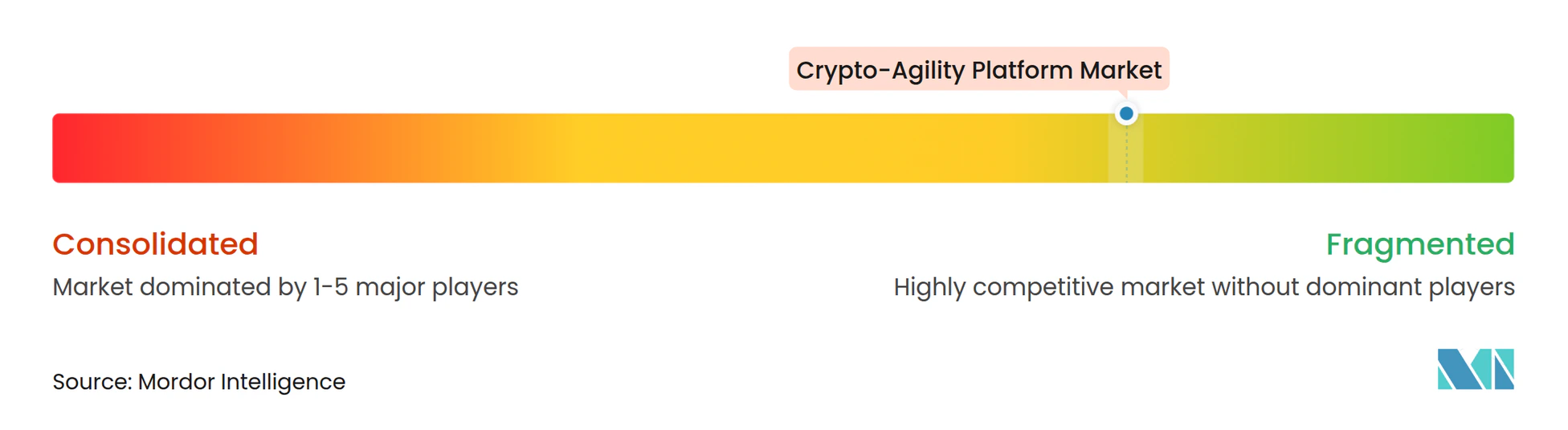
The crypto-agility platform market is fragmented, with more than 20 active vendors across discovery, orchestration, posture management, and migration planning. No provider has a dominant position across all solution categories. The crypto-agility platform market favors companies with post-quantum functions built into their architecture, rather than added to older public key infrastructure products. Customers also need cryptographic bills of materials, support for hybrid algorithms, and reliable updates as standards evolve. These requirements make integrated trust-infrastructure management more valuable than isolated point tools.
Keyfactor secured a USD 1 billion+ strategic growth investment led by Summit Partners in July 2026 to fund product development, geographic expansion, hiring, and acquisitions. Its July 2026 partner program expansion supports advisory, implementation, and managed service offerings. Its FedRAMP certification also strengthens its ability to address authorized federal deployments. Other specialists continue to focus on discrete requirements in cryptographic asset management, disconnected environments, and network security. These moves show how capital, ecosystem reach, and government channels shape competition in the crypto-agility platform market.
The crypto-agility platform market has gaps in continuous cryptographic bill-of-materials maintenance, managed services for mid-sized organizations, and algorithm health monitoring. NIST's third-round evaluation of 9 additional digital-signature candidates means organizations must prepare for further changes in standards.[4] Smaller specialists can compete in classified, air-gapped, and telecommunications environments that need focused support. Clear solution boundaries and partner support can reduce friction when buyers group public key infrastructure, hardware security modules, discovery, and migration into a single procurement decision.
Crypto-Agility Platform Industry Leaders
-
QuSecure, Inc.
-
SandboxAQ, Inc.
-
PQShield Ltd.
-
CryptoNext Security SAS
-
Keyfactor, Inc.
- *Disclaimer: Major Players sorted in no particular order
Crypto-Agility Platform Market Companies Covered in this Report
- QuSecure, Inc.
- SandboxAQ, Inc.
- PQShield Ltd.
- CryptoNext Security SAS
- ISARA Corporation
- Keyfactor, Inc.
- SafeLogic, Inc.
- evolutionQ, Inc.
- QNu Labs Private Limited
- Arqit Quantum Inc.
- Quantum Xchange, Inc.
- QryptoCyber Limited
- essendi it GmbH
- AppViewX, Inc.
- Tychon, Inc.
- PQ Solutions Limited
- Kloch Technologies, LLC
- ExeQuantum Pty Ltd
- Crypto4A Technologies Inc.
- Qrypt, Inc.
Recent Industry Developments in Crypto-Agility Platform Market
- July 2026: Keyfactor secured a USD 1 billion+ strategic growth investment led by Summit Partners, with existing investors Insight Partners and Sixth Street Growth retaining significant ownership. Capital was directed toward product innovation, geographic expansion, team building, and strategic acquisitions to accelerate Keyfactor's position in the AI-era and post-quantum trust infrastructure. The company also achieved FedRAMP certification to support federal agency adoption of its cloud-based CLM offering.
- July 2026: Keyfactor expanded its Global Partner Program to enable partners to build advisory, implementation, and managed services focused on crypto-agility and PQC readiness, rolling out across AWS, Microsoft Azure, and Google Cloud marketplaces in the financial services, telecommunications, automotive, government, health care, and industrial IoT verticals.
- June 2026: The White House published Executive Order 14412, “Securing the Nation Against Advanced Cryptographic Attacks,” which establishes December 31, 2030, as the deadline for U.S. federal agencies to complete PQC key-establishment migration for high-value assets. Simultaneously, OMB Memorandum M-26-15 provided a five-phase implementation roadmap, initiating the FAR amendment process to extend compliance requirements to federal contractors by December 31, 2030.
- May 2026: NIST published IR 8610, advancing 9 additional digital signature candidates, FAEST, HAWK, MAYO, MQOM, QR-UOV, SDitH, SNOVA, SQIsign, and UOV, to the third round of PQC standardization, reinforcing the long-term case for crypto-agility platforms capable of updating algorithm libraries without full product redeployment.
Global Crypto-Agility Platform Market Report Scope
The Crypto-Agility Platform Market comprises revenues generated from software platforms and related services that enable organizations to discover, inventory, assess, govern, monitor, and migrate cryptographic assets, algorithms, certificates, keys, and dependencies across enterprise environments. These solutions help organizations maintain cryptographic resilience, prepare for post-quantum cryptography (PQC) transitions, automate cryptographic modernization programs, manage cryptographic risk, and ensure compliance across on-premises, cloud, hybrid, and critical infrastructure environments. The market includes platforms supporting cryptographic discovery, orchestration, posture management, migration planning, governance, and continuous monitoring of cryptographic assets and machine identities.
The Crypto-Agility Platform Market Report is Segmented by Solution Type (Cryptographic Discovery and Inventory Platforms, Crypto-Agility Orchestration Platforms, Cryptographic Posture Management Platforms, Post-Quantum Migration Planning Platforms, and Other Solution Types), Deployment Mode (On-Premises, and Cloud-Based), Organization Size (Large Enterprises, and Small and Medium-Sized Enterprises), End-User Industry (Government and Public Administration, Banking, Financial Services, and Insurance [BFSI], IT and Telecommunication, Healthcare and Life Sciences, Energy and Utilities, Industrial Manufacturing, Retail and E-Commerce, and Other End-User Industries), and Geography (North America, South America, Europe, Asia-Pacific, Middle East, and Africa). The Market Forecasts are Provided in Terms of Value (USD).
Segmentation Overview
| Cryptographic Discovery and Inventory Platforms |
| Crypto-Agility Orchestration Platforms |
| Cryptographic Posture Management Platforms |
| Post-Quantum Migration Planning Platforms |
| Other Solution Types |
| On-Premises |
| Cloud-Based |
| Large Enterprises |
| Small and Medium-Sized Enterprises |
| Government and Public Administration |
| Banking, Financial Services, and Insurance (BFSI) |
| IT and Telecommunication |
| Healthcare and Life Sciences |
| Energy and Utilities |
| Industrial Manufacturing |
| Retail and E-Commerce |
| Other End-User Industries |
| North America | United States |
| Canada | |
| South America | Brazil |
| Argentina | |
| Mexico | |
| Rest of South America | |
| Europe | Germany |
| United Kingdom | |
| France | |
| Italy | |
| Russia | |
| Rest of Europe | |
| Asia-Pacific | China |
| Japan | |
| India | |
| South Korea | |
| Rest of Asia-Pacific | |
| Middle East | Saudi Arabia |
| United Arab Emirates | |
| Rest of Middle East | |
| Africa | South Africa |
| Nigeria | |
| Rest of Africa |
| By Solution Type | Cryptographic Discovery and Inventory Platforms | |
| Crypto-Agility Orchestration Platforms | ||
| Cryptographic Posture Management Platforms | ||
| Post-Quantum Migration Planning Platforms | ||
| Other Solution Types | ||
| By Deployment Mode | On-Premises | |
| Cloud-Based | ||
| By Organization Size | Large Enterprises | |
| Small and Medium-Sized Enterprises | ||
| By End-User Industry | Government and Public Administration | |
| Banking, Financial Services, and Insurance (BFSI) | ||
| IT and Telecommunication | ||
| Healthcare and Life Sciences | ||
| Energy and Utilities | ||
| Industrial Manufacturing | ||
| Retail and E-Commerce | ||
| Other End-User Industries | ||
| By Geography | North America | United States |
| Canada | ||
| South America | Brazil | |
| Argentina | ||
| Mexico | ||
| Rest of South America | ||
| Europe | Germany | |
| United Kingdom | ||
| France | ||
| Italy | ||
| Russia | ||
| Rest of Europe | ||
| Asia-Pacific | China | |
| Japan | ||
| India | ||
| South Korea | ||
| Rest of Asia-Pacific | ||
| Middle East | Saudi Arabia | |
| United Arab Emirates | ||
| Rest of Middle East | ||
| Africa | South Africa | |
| Nigeria | ||
| Rest of Africa | ||
Key Questions Answered in the Report
What is the size of the crypto-agility platform sector?
The crypto-agility platform market is projected to grow from USD 2.05 billion in 2027 to USD 7.66 billion by 2032, at a 30.26% CAGR.
Which solution type holds the largest share?
Crypto-Agility Orchestration Platforms held 61.45% share in 2026 because organizations need a controlled way to change algorithms across systems.
Which deployment model is growing fastest?
Cloud-Based deployment is projected to grow at a 31.80% CAGR through 2032 as firms automate certificate issuance, renewal, and reporting.
Which end-user sector leads adoption?
BFSI held 30.18% share in 2026, supported by extensive cryptographic estates, data-retention needs, and regulatory pressure.
Which region is expanding fastest?
Asia-Pacific is projected to grow at a 31.09% CAGR through 2032 as governments and critical-infrastructure operators expand quantum-security programs.