
Cross-Cultural Training Market Size and Share
Market Overview
| Study Period | 2021 - 2031 |
|---|---|
| Market Size (2026) | USD 2.26 Billion |
| Market Size (2031) | USD 3.16 Billion |
| Growth Rate (2026 - 2031) | 6.97 % |
| Fastest Growing Market | Asia Pacific |
| Largest Market | North America |
| Market Concentration | Medium |
Major Players *Disclaimer: Major Players sorted in no particular order Image © Mordor Intelligence. Reuse requires attribution under CC BY 4.0. | |
Cross-Cultural Training Market Analysis by Mordor Intelligence
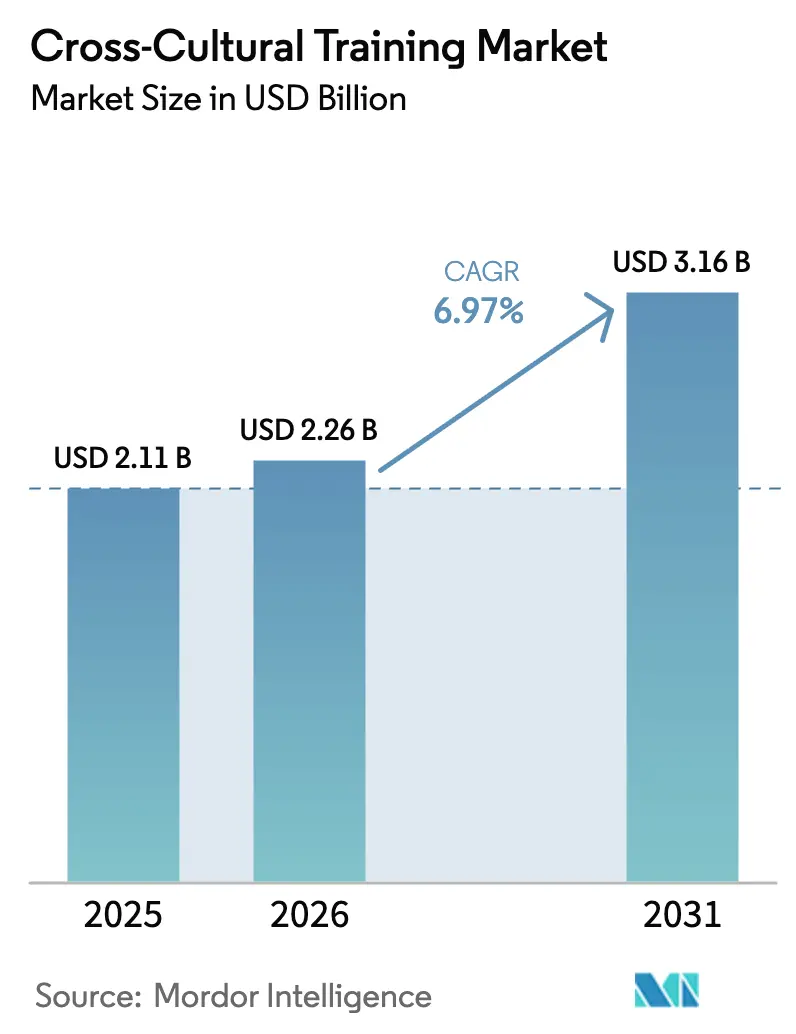
The Cross-Cultural Training Market size is expected to grow from USD 2.11 billion in 2025 to USD 2.26 billion in 2026 and is forecast to reach USD 3.16 billion by 2031 at a 6.97% CAGR over 2026-2031. Demand has shifted from discretionary HR programming to strategic infrastructure as multinational companies focus on culture-readiness, compliance, and cybersecurity. Enterprise buyers emphasize scalable delivery, analytics, and measurable outcomes as remote collaboration and mobility expand. Providers integrating adaptive e-learning with in-person reinforcement experience stronger adoption in roles requiring coordination and client-facing communication. Feature-led M&A activity is evident, as seen in Learnlight’s acquisition of BLCC to expand regional scale and accelerate AI-driven language learning in Benelux corporate environments.
Key Report Takeaways
- By delivery mode, e-learning and online platforms led with 39.80% in the Cross-Cultural Training Market in 2025, while blended learning is forecast to expand at a 7.25% CAGR through 2031.
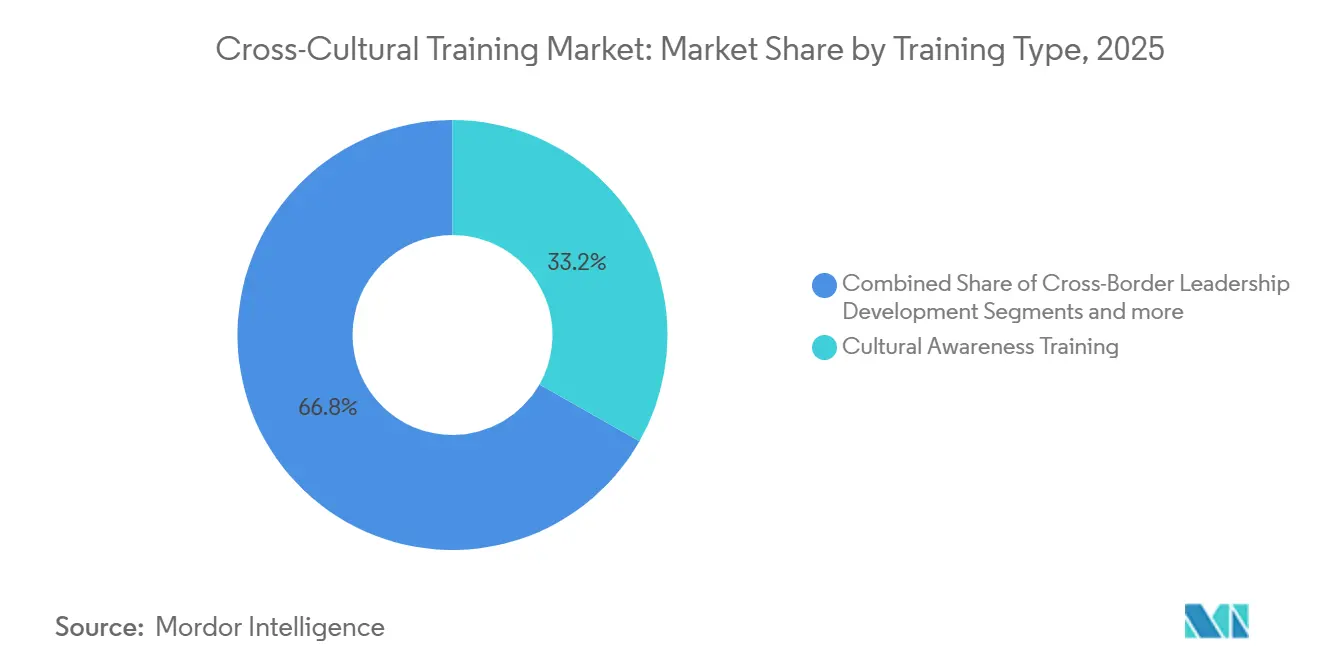
- By training type, cultural awareness training held 33.22% in the Cross-Cultural Training Market in 2025, while cross-border leadership development is projected to grow at a 7.10% CAGR through 2031.
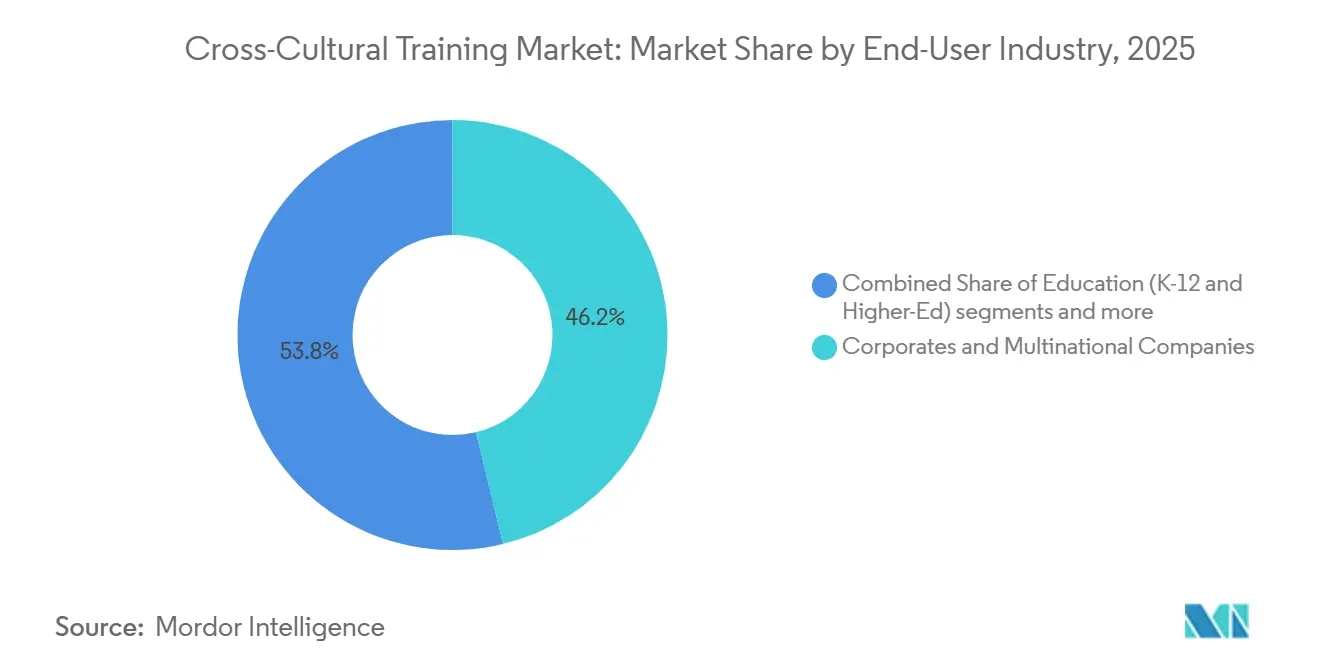
- By end-user industry, corporates and multinational companies accounted for 46.23% in the Cross-Cultural Training Market in 2025, while government and non-profit organizations are advancing at a 6.62% CAGR through 2031.
- By organisation size, large enterprises commanded 61.35% in the Cross-Cultural Training Market in 2025, while SMEs are forecast at a 7.02% CAGR through 2031.
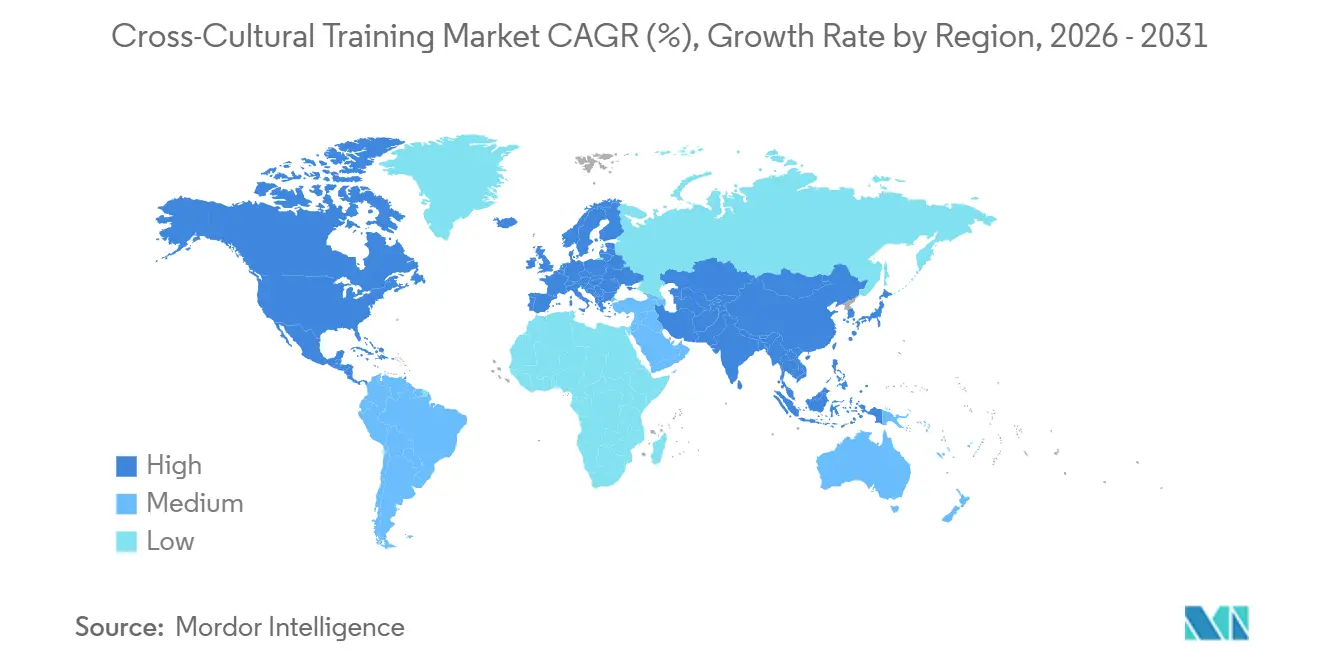
- By geography, North America led with 35.28% in the Cross-Cultural Training Market in 2025, while Asia-Pacific is set to grow at a 7.58% CAGR through 2031.
Note: Market size and forecast figures in this report are generated using Mordor Intelligence’s proprietary estimation framework, updated with the latest available data and insights as of 2026.
Market Trends and Insights
Drivers Impact Analysis of Cross-Cultural Training Market*
| Drivers | (~) % Impact on CAGR Forecast | Geographic Relevance | Impact Timeline |
|---|---|---|---|
| Expatriate assignments are expanding as globalization drives cross-border workforce mobility | +1.2% | Global, concentrated in North America & Asia-Pacific | Medium term (2-4 years) |
| Fortune 1000 companies are intensifying diversity and inclusion initiatives | +1.8% | North America & Europe, expanding to Asia-Pacific | Short term (≤ 2 years) |
| International student and scholar flows are rising, boosting demand for cultural training | +0.9% | United States, United Kingdom, Canada, Australia focus | Medium term (2-4 years) |
| Post-merger integration programs are emphasizing cultural alignment across organizations | +0.7% | North America & Europe, spillover to emerging markets | Short term (≤ 2 years) |
| Remote and gig-based agile teams are increasing, creating new cross-border collaboration needs | +1.4% | Global, tech-enabled economies | Short term (≤ 2 years) |
| AI-powered adaptive learning platforms are localizing content to suit diverse cultural contexts | +1.1% | Global, faster adoption in developed markets | Long term (≥ 4 years) |
| Source: Mordor Intelligence | |||
Expatriate assignments are expanding as globalization drives cross-border workforce mobility
The rise in global rotations for specialists and leaders has increased the need for fast, role-specific cultural preparation aligned with assignment timelines. Organizations now favor mobile learning paths and simulation-based practices over multi-day workshops. Mobility providers report ongoing investments in expatriate support, including tax, transport, and analytics-driven program management. In 2025, Cartus added 25 clients, expanded services for over 100 clients, launched a Global Automated Tax Engine, and partnered with ExpatRide for transportation services. The cross-cultural training market is increasingly integrated with mobility workflows, while blended digital and in-person reinforcement remains essential for complex assignments.
Fortune 1000 companies are intensifying diversity and inclusion initiatives
DEI has shifted from discretionary training to governance-linked practices with executive oversight, performance metrics, and audit readiness. European regulations emphasize pay transparency and equity as governance indicators, driving cultural competence in HR and leadership processes. Spain’s 2026 DEI agenda focuses on belonging and culture, while the European Union (EU) Salary Transparency Directive requires companies to address salary gaps, highlighting cultural readiness in HR programs. Companies prioritize listening-led learning and psychologically safe communication to support cultural education. The cross-cultural training market now emphasizes continuous learning, manager enablement, and dashboards linking inclusion skills to retention and innovation, benefiting vendors in regulated markets[1]WithJuno, “The Future of Work: How Modern HR Practices Are Shaping Employee Experiences,” WithJuno, withjuno.com.
International student and scholar flows are rising, boosting demand for cultural training
Higher education institutions are expanding culture and language modules for inbound and outbound groups, including faculty involved in international research. Increased focus on international recruitment and engagement drives demand for orientation programs to ease culture shock and improve persistence. The Institute of International Education highlights sustained efforts in internationalization, emphasizing cultural readiness. Ritsumeikan Asia Pacific University offers a two-month Global Competency Enhancement Program with multinational faculty, English instruction, and immersive peer living. CIEE’s “Leading Change in Latin America” initiative awarded 100 scholarships in 2025, with enrollment growing 40% into Spring 2026. Asian universities host intensive programs combining instruction and cultural fieldwork[2]CIEE, “CIEE: Bringing the World to Latin America – New Programs, Scholarships, and More,” CIEE, ciee.org.
Post-merger integration programs are emphasizing cultural alignment across organizations
Distributed teams face challenges from differing communication norms, meeting styles, and decision-making speeds that collaboration tools alone cannot resolve. Learning platforms now integrate real-time nudges, analytics, and micro-lessons to embed cultural fluency into workflows. Skillsoft introduced an AI-driven skills intelligence platform and secured four enterprise clients in fiscal Q3 2026, reflecting enterprise interest in scalable AI-led learning. Corporate language initiatives aim to enhance cross-cultural communication as employees demand flexibility, continuous learning, and authentic leadership. The cross-cultural training market emphasizes sentiment-based coaching, soft skills pathways, and leadership content, with buyers favoring platforms delivering measurable, workflow-aligned results.
Restraints Impact Analysis of Cross-Cultural Training Market*
| Restraints | (~) % Impact on CAGR Forecast | Geographic Relevance | Impact Timeline |
|---|---|---|---|
| SMEs face budget constraints, limiting investment in structured cross-cultural training | -0.8% | Global, acute in emerging markets | Short term (≤ 2 years) |
| Instructor-led immersive programs remain costly, creating affordability barriers | -0.6% | North America & Europe | Medium term (2-4 years) |
| Nationalist resistance to perceived foreign influence is slowing adoption in some regions | -0.3% | Selective markets, policy-dependent | Medium term (2-4 years) |
| Measuring behavioural ROI proves difficult, making it harder to justify training spend | -0.5% | Global, enterprise focus | Long term (≥ 4 years) |
| Source: Mordor Intelligence | |||
SMEs face budget constraints, limiting investment in structured cross-cultural training
Smaller firms often scrutinize L&D budgets during economic shifts, delaying initiatives, reducing travel, and limiting vendor access, which slows program updates. SMEs increasingly use open resources and peer-led learning to cut costs, though aligning content with role outcomes adds internal overhead. Buyers now prioritize targeted skill gaps, microlearning, and role-based pathways tied to performance KPIs. Public-sector programs, such as Hannover’s intercultural training for SME HR managers and employees, address local communication and conflict management challenges. The cross-cultural training market supports SMEs with subscription pricing, mobile-first formats, and analytics dashboards, reducing reliance on consulting[3]Litmos, “Surviving L&D Budget Cuts,” Litmos, litmos.com.
Measuring behavioral ROI proves difficult, making it harder to justify training spend
Enterprises often track learning inputs and satisfaction but underinvest in impact and ROI measurement, weakening the business case for culture readiness during budget cycles. A systematic review in 2025 found cross-cultural training generally yields positive outcomes, though changes in cultural competence and intelligence are not always statistically significant, complicating attribution and budget defense. L&D leaders cite gaps in baseline data, control groups, and integrated analytics as barriers to credible ROI. Organizations are aligning learning objectives with business KPIs, integrating datasets, and building data literacy to improve measurement. Providers benefit by linking leading indicators to outcomes like retention[4]Mindskillz, “Measuring Training ROI: How Mindskillz Transforms Training Investments into Measurable Business Results,” Mindskillz, mindskillz.in.
*Our forecasts treat driver/restraint impacts as directional, not additive. The impact forecasts reflect baseline growth, mix effects, and variable interactions.
Cross-Cultural Training Market Segment Analysis
By Training Type:
Leadership Development Outpaces Awareness Training as Boards Prioritize Pipeline ResilienceCultural awareness training held a 33.22% share in 2025, focusing on onboarding and global collaboration. These programs address regional differences in communication styles, hierarchy, and time norms. Cross-border leadership development is projected to grow at a 7.10% CAGR through 2031, driven by succession planning and improving manager effectiveness in diverse teams. The market for leadership-focused cross-cultural training programs is expanding. DEI-aligned training is shifting from standalone workshops to integrated systems that reinforce behaviors in meetings, feedback cycles, and performance reviews. Expatriate and relocation preparation remains critical for long-term postings and high-stakes roles, where early misalignments can jeopardize objectives. Cartus continues investing in tax engines, data dashboards, and transport partnerships, reflecting the convergence of mobility services and cultural readiness in enterprise programs.
Language and communication training supports collaboration in multilingual teams and customer-facing roles, often blending with culture and leadership content. Corporate buyers prioritize flexible access and scenario-based practice to build confidence, especially for remote and hybrid teams. The industry integrates language practice with cultural scenarios, helping learners adjust tone, directness, and decision framing. As organizations expand in Latin America, Europe, and Asia, vendor catalogs mapping language proficiency to role tasks and customer journeys gain traction. University and study-abroad programs also incorporate multi-language support, embedding language training within cultural pathways.



By Delivery Mode:
Hybrid Models Capture Cost Savings and Social LearningE-learning and online platforms held a 39.80% share of the cross-cultural training market in 2025, driven by AI-curated content that reduces per-learner costs and accelerates time-to-competence. Immersive scenarios and short simulations are now standard in digital curricula for roles involving frequent client and partner interactions. Classroom-based programs remain relevant for executive cohorts prioritizing confidentiality and peer exchange, while workshops and seminars persist in markets valuing real-time peer learning despite higher costs. Providers are increasingly offering catalogs with language tracks and regional norms to support distributed teams as enterprises focus on scale and localization.
Blended learning, growing at a 7.25% CAGR through 2031, benefits from cost efficiency and social reinforcement, reducing forgetting curves in rotational roles. Partnerships enhance this trend, such as Rosetta Stone’s collaboration with USA Fencing to expand language subscription access. Vendors are also creating immersive cultural content, exemplified by Rosetta Stone’s work with the Choctaw Nation on a digital course featuring authentic voices and imagery. The market favors modular learning journeys, asynchronous practice, and targeted coaching, with platforms integrating learner analytics to track engagement and progression.
By End-User Industry:
Government & Non-Profit Segments Advance at 6.62% CAGR as Defense Agencies Embed Culture-ReadinessCorporates and multinationals contributed 46.23% of revenue in 2025, driven by global teams, cross-border projects, and M&A integration, which maintained culture-readiness as a leadership priority. Enterprise buyers focused on consolidating platforms that integrate culture training with leadership and technical skills, enabling scalable deployment and progress tracking. Government and non-profit organizations are advancing at a 6.62% CAGR through 2031, as civic agencies, development banks, and municipalities emphasize inclusive services and community engagement. These buyers prioritize transparency in methodologies, ethical standards, and data privacy, favoring vendors with clear frameworks and public-sector expertise.
Education sectors benefit from student mobility, with universities embedding culture modules into degree programs and seasonal intensives. CIEE’s scholarship initiative in Latin America, extending enrollment into 2026, demonstrates how program design and financial access drive demand for intercultural learning. As education institutions, governments, and NGOs integrate culture-readiness into training and preparation, cross-sector partnerships with training providers are expected to grow. Vendors must align with institutional calendars, meet accreditation requirements, and ensure privacy standards to remain competitive.
By Organisation Size:
SMEs Forecast at 7.02% CAGR as Mobile-First Platforms Sidestep Instructor-Led CostsLarge enterprises held a 61.35% market share in 2025, driven by volume purchasing and embedding cultural capabilities into leadership KPIs and succession plans. These organizations integrate cultural modules with technical and management catalogs, adopting AI-driven platforms to scale personalized learning. The cross-cultural training industry is addressing this demand with analytics overlays, role-specific curated journeys, and streamlined tools for assignments, scheduling, and impact reporting. Enterprises also require localized content aligned with market norms and compliance standards.
SMEs are expected to grow at a 7.02% CAGR through 2031, supported by mobile-first and subscription-based learning models that reduce travel and facilitation costs. Role-based microlearning and peer-led formats further enhance SME adoption. Publicly supported programs, such as Hannover's free intercultural training focusing on communication, cultural perception, and conflict resolution, help overcome barriers. Vendors are offering small-team plans with analytics and progress tracking, while learning-ops platforms enable SMEs to link training to business metrics for renewal justification. As SMEs increasingly serve global clients and supply chains, demand is rising for concise, on-demand content tailored to frontline and mid-level roles.
Geography Analysis
North America Cross-Cultural Training Market
North America holds 35.28% of the cross-cultural training market share in 2025, driven by culture-readiness initiatives in leadership development, mobility, and hybrid team enablement. U.S. providers are expanding content and partnerships to support sports associations, higher education, and corporate divisions requiring scalable language and culture curricula. Enterprise buyers prefer platforms integrating cultural training with skills intelligence and analytics. Demand remains steady across corporate, government, and university sectors, preparing teams for cross-border collaboration and service delivery.
APAC Cross-Cultural Training Market
Asia-Pacific is projected to grow at a 7.58% CAGR through 2031, fueled by regional integration, manufacturing shifts, and outbound investments. Programs like Ritsumeikan Asia Pacific University’s Global Competency Enhancement Program highlight how universities institutionalize cultural and language immersion. Asian universities combine language instruction with field experiences to enhance intercultural fluency. India’s growing role as a global talent hub drives demand for culture-readiness in engineering, customer operations, and innovation teams. Distributed teams in the region prioritize language and cultural practices for remote collaboration.
EMEA and LATAM Cross-Cultural Training Market
Europe’s demand is supported by regulations emphasizing equity, pay transparency, and inclusivity, which rely on cultural fluency. Spain’s DEI priorities for 2026 and the European Union (EU) Salary Transparency Directive are increasing adoption of auditable culture-readiness programs linked to people metrics. Providers are expanding regionally, as seen with Learnlight’s acquisition of BLCC, enhancing Benelux coverage and combining language expertise with platform delivery. Public initiatives, such as Hannover’s free intercultural training for SMEs, complement private investments. The Middle East & Africa and Latin America offer growth opportunities as connectivity improves and employers seek scalable programs. Educational partnerships, scholarships, and regional conferences on intercultural exchange are building capacity and demand across institutions.

Competitive Landscape
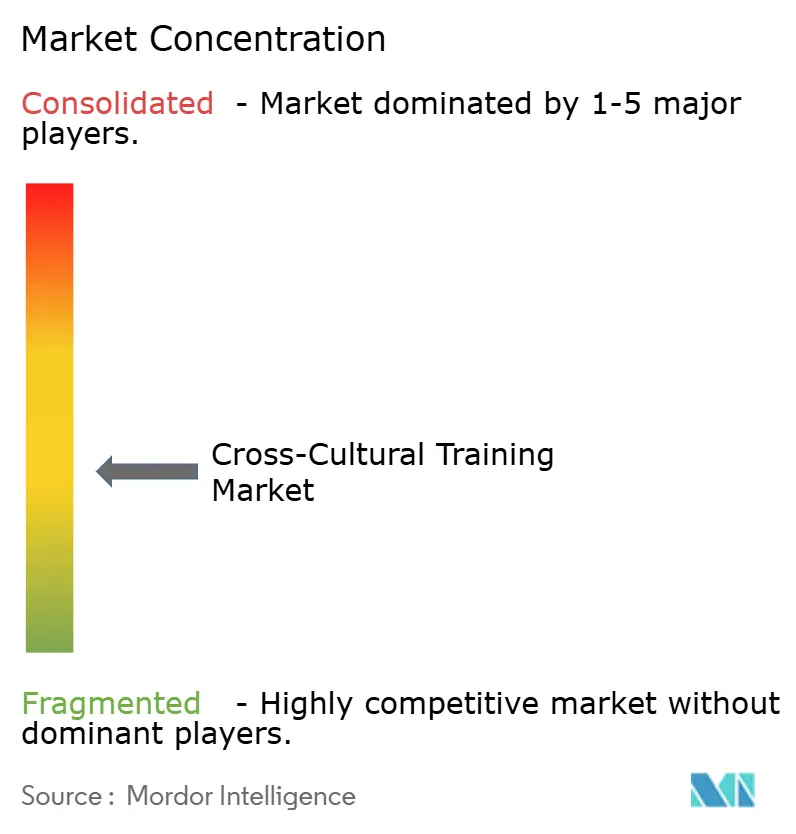
The cross-cultural training market is moderately fragmented, with global providers, regional specialists, and SaaS-native entrants competing on technology integration, analytics, and localization. Companies such as Skillsoft, Learnlight, Berlitz, and Rosetta Stone differentiate through platform ecosystems, language coverage, and partnerships. Platforms increasingly focus on AI-driven curation, data-rich dashboards, and integrations that position cultural training alongside leadership and technical skills. Buyers prioritize visible outcomes and role-based learning paths that support distributed teams. Vendors combining strong content libraries with measurement tools and localization workflows are well-positioned in this environment.
Learnlight expanded its Benelux presence by acquiring BLCC in December 2025, aligning regional strengths with its AI-powered Fluency Lab. Rosetta Stone collaborated with the Choctaw Nation to create an immersive course preserving language and cultural context, showcasing its custom content capabilities. Skillsoft launched an AI-native skills intelligence platform and secured early enterprise clients, reinforcing its analytics-driven learning approach. These moves align with the market’s shift toward integrated platforms delivering culture, language, and leadership training.
Partnerships enhance reach and relevance. Rosetta Stone’s collaboration with United States of America Fencing expanded language learning access to a broad member base, demonstrating how associations help vendors scale into new learner communities. Cartus marked its 70th anniversary with continued investment in mobility solutions, supporting expatriate learners with operational resources for successful assignments. As buyers increasingly link cultural fluency to performance and governance metrics, providers unifying content, analytics, and compliance-ready reporting gain a competitive edge. The market is converging on capabilities aligned with enterprise outcomes.
Cross-Cultural Training Industry Leaders
Berlitz Corporation
Learnlight
Aperian Global
Cultural Awareness International
Global LT
- *Disclaimer: Major Players sorted in no particular order
Cross-Cultural Training Market Companies Covered in this Report
- Berlitz Corporation
- Learnlight
- Aperian Global
- Cultural Awareness International
- Global LT
- Anderson Intercultural
- RW3 CultureWizard
- Commisceo Global Consulting
- Cartus Corporation
- IOR Global Services
- Language & Culture Worldwide (LCW)
- Brookfield Global Relocation Services
- TMC – A Berlitz Company
- Skillsoft
- ELM Learning
- Global Integration
- Rosetta Stone (ICL)
- Cultural Intelligence Center
- CrossCulture GmbH
- Hofstede Insights

Recent Industry Developments in Cross-Cultural Training Market
- December 2025: Learnlight has acquired the Business Language and Communication Centre to strengthen its Benelux presence. This acquisition combines Learnlight's platform-based learning with BLCC's corporate language programs in Dutch, French, English, and German, enhancing its regional offerings.
- December 2025: Rosetta Stone collaborated with the Choctaw Nation of Oklahoma to create an immersive digital course for Chahta anumpa, incorporating authentic voices and imagery to improve access for over 230,000 Choctaw citizens.
- October 2025: Cartus celebrated 70 years, gained 25 new clients, enhanced services for over 100 clients, introduced a Global Automated Tax Engine and Data Insights Dashboard, and collaborated with ExpatRide to launch a global transportation service.


Global Cross-Cultural Training Market Report Scope
This study provides a comprehensive analysis of the Cross-Cultural Training Market, outlining its definition, assumptions, and methodological framework. It evaluates the market landscape by examining key drivers such as globalization-driven workforce mobility, diversity mandates, and the rise of AI-enabled adaptive learning platforms, alongside restraints including budget limitations in SMEs and challenges in measuring behavioral ROI. The report offers detailed segmentation by training type, delivery mode, end-user industry, organization size, and geography, supported by market size and growth forecasts. Competitive dynamics are assessed through Porter’s Five Forces, market concentration, and company profiles of leading players, highlighting their strategies, financials, and recent developments. Finally, the study identifies future opportunities, unmet needs, and white-space potential, providing actionable insights for stakeholders to navigate evolving market conditions. The report provides market size and forecasts for the Cross-Cultural Training Market, in value (USD), for the above segments.
| Cultural Awareness Training |
| Language & Communication Training |
| Diversity, Equity & Inclusion (DEI) Training |
| Cross-Border Leadership Development |
| Expatriate & Relocation Preparation |
| Classroom-Based |
| E-learning / Online |
| Workshops & Seminars |
| Blended Learning (Hybrid) |
| Corporates & Multinational Companies |
| Education (K-12 & Higher-Ed) |
| Government & Non-Profit |
| Military & Defense |
| Others (Hospitality & Tourism,Healthcare) |
| Large Enterprises |
| Small & Mid-Sized Enterprises (SMEs) |
| North America | Canada |
| United States | |
| Mexico | |
| South America | Brazil |
| Peru | |
| Chile | |
| Argentina | |
| Rest of South America | |
| Europe | United Kingdom |
| Germany | |
| France | |
| Spain | |
| Italy | |
| BENELUX (Belgium, Netherlands, Luxembourg) | |
| NORDICS (Denmark, Finland, Iceland, Norway, Sweden) | |
| Rest of Europe | |
| Asia-Pacific | India |
| China | |
| Japan | |
| Australia | |
| South Korea | |
| South-East Asia (SG, MY, TH, ID, VN, PH) | |
| Rest of Asia-Pacific | |
| Middle East & Africa | United Arab Emirates |
| Saudi Arabia | |
| South Africa | |
| Nigeria | |
| Rest of Middle East & Africa |
| By Training Type | Cultural Awareness Training | |
| Language & Communication Training | ||
| Diversity, Equity & Inclusion (DEI) Training | ||
| Cross-Border Leadership Development | ||
| Expatriate & Relocation Preparation | ||
| By Delivery Mode | Classroom-Based | |
| E-learning / Online | ||
| Workshops & Seminars | ||
| Blended Learning (Hybrid) | ||
| By End-User | Corporates & Multinational Companies | |
| Education (K-12 & Higher-Ed) | ||
| Government & Non-Profit | ||
| Military & Defense | ||
| Others (Hospitality & Tourism,Healthcare) | ||
| By Organization Site | Large Enterprises | |
| Small & Mid-Sized Enterprises (SMEs) | ||
| By Geography | North America | Canada |
| United States | ||
| Mexico | ||
| South America | Brazil | |
| Peru | ||
| Chile | ||
| Argentina | ||
| Rest of South America | ||
| Europe | United Kingdom | |
| Germany | ||
| France | ||
| Spain | ||
| Italy | ||
| BENELUX (Belgium, Netherlands, Luxembourg) | ||
| NORDICS (Denmark, Finland, Iceland, Norway, Sweden) | ||
| Rest of Europe | ||
| Asia-Pacific | India | |
| China | ||
| Japan | ||
| Australia | ||
| South Korea | ||
| South-East Asia (SG, MY, TH, ID, VN, PH) | ||
| Rest of Asia-Pacific | ||
| Middle East & Africa | United Arab Emirates | |
| Saudi Arabia | ||
| South Africa | ||
| Nigeria | ||
| Rest of Middle East & Africa | ||


Key Questions Answered in the Report
What is the current size and projected growth of the global cross-cultural training market to 2031?
The global Cross-Cultural Training Market is valued at USD 2.11 billion in 2025, expected to reach USD 2.26 billion in 2026, and projected to grow to USD 3.16 billion by 2031 at a 6.97% CAGR over 2026–2031.
Which delivery modes are gaining the most traction and why?
E-learning led with 39.80% share in 2025, and blended learning is the fastest-growing at a 7.25% CAGR because it balances cost efficiency with social reinforcement and analytics-supported tracking.
Which regions lead and which are expanding fastest through 2031?
North America led with 35.28% share in 2025, while Asia-Pacific is set to grow at a 7.58% CAGR through 2031, reflecting regional integration and growing cross-border collaboration.
For which customer segments is demand strongest?
Corporates and multinationals accounted for 46.23% of revenue in 2025, while government and non-profit organizations are advancing at a 6.62% CAGR due to inclusive service and community engagement mandates.
What are the biggest drivers behind investment in culture-readiness programs?
Board-level DEI priorities, expansion of international education programs, and the rise of remote cross-border teams are key drivers, with enterprises adopting AI-native platforms and association partnerships to scale learning.
How are SMEs building cross-cultural capability with limited budgets?
SMEs favor mobile-first, subscription-based learning and public programs that offset costs, such as Hannover’s free intercultural training series, while leveraging analytics to align learning with business outcomes.
Page last updated on:





