
Connected Mobility Market Size and Share
Market Overview
| Study Period | 2020 - 2031 |
|---|---|
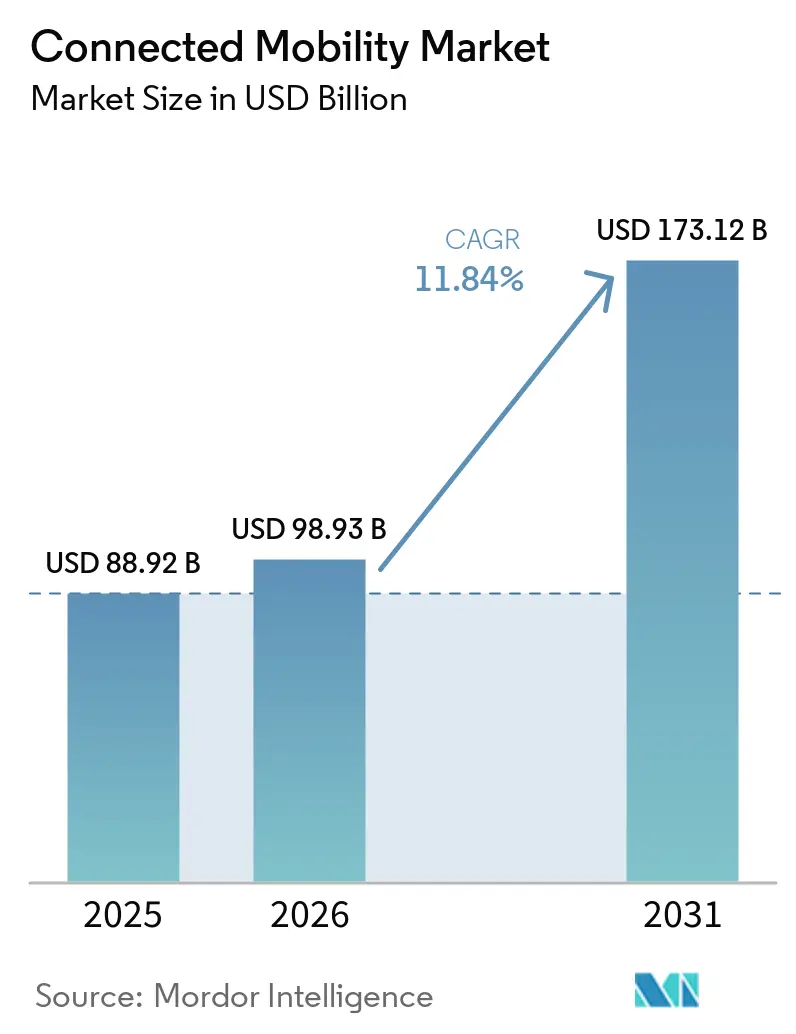
| Market Size (2026) | USD 98.93 Billion |
| Market Size (2031) | USD 173.12 Billion |
| Growth Rate (2026 - 2031) | 11.84% CAGR |
| Fastest Growing Market | Asia-Pacific |
| Largest Market | Asia-Pacific |
| Market Concentration | Medium |
Major Players *Disclaimer: Major Players sorted in no particular order Image © Mordor Intelligence. Reuse requires attribution under CC BY 4.0. | |
Connected Mobility Market Analysis by Mordor Intelligence
The connected mobility market size is expected to increase from USD 88.92 billion in 2025 to USD 98.93 billion in 2026 and reach USD 173.12 billion by 2031, expanding at a CAGR of 11.84% over 2026-2031. The connected mobility market is shifting toward vehicles that operate as software platforms, rather than isolated mechanical products. Embedded connectivity is becoming standard equipment in new vehicles across major production regions. Safety rules, 5G networks, vehicle-to-everything connectivity, and electric-vehicle data needs are increasing demand for connected systems. OEMs are absorbing more hardware cost at production because subscriptions can provide recurring service revenue. The connected mobility market is also moving competitive value toward update delivery, data management, and software services, while standardized hardware faces greater price pressure.
Key Report Takeaways
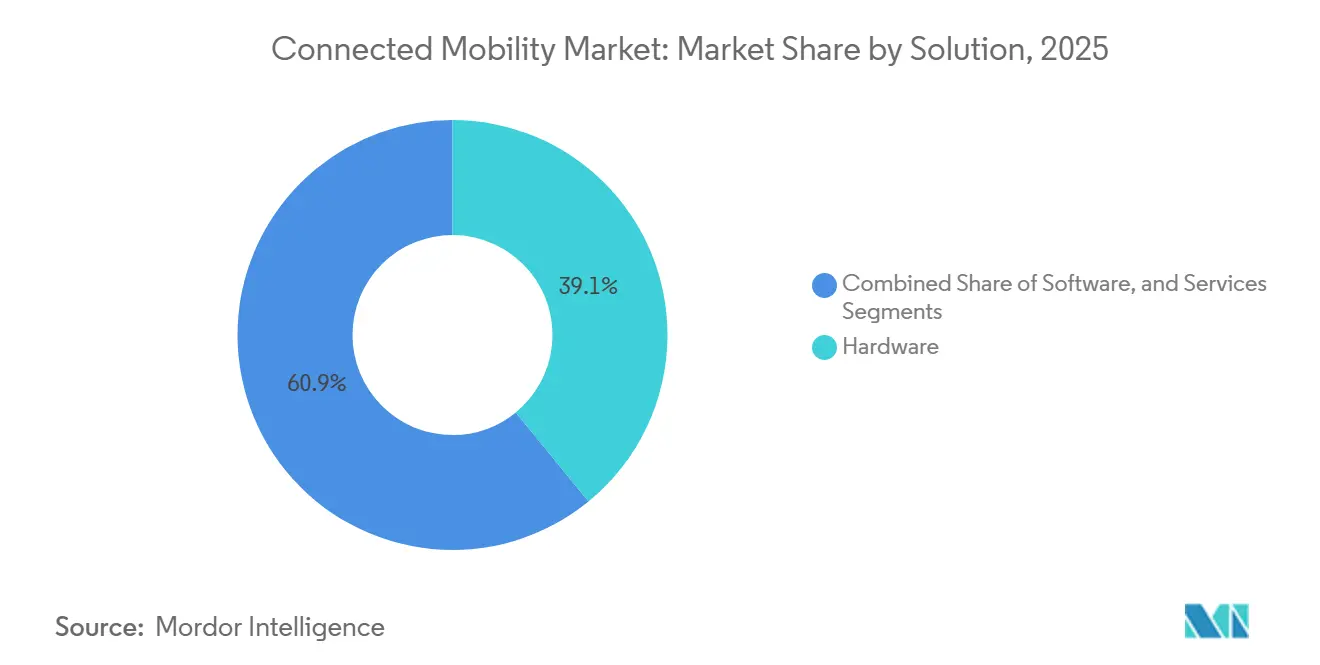
- By solution, hardware held 39.10% share of the connected mobility market in 2025, while software is projected to expand at a 13.21% CAGR through 2031.
- By vehicle type, passenger vehicles accounted for 55.31% share of the connected mobility market in 2025, while two and three-wheelers are projected to expand at a 13.43% CAGR through 2031.
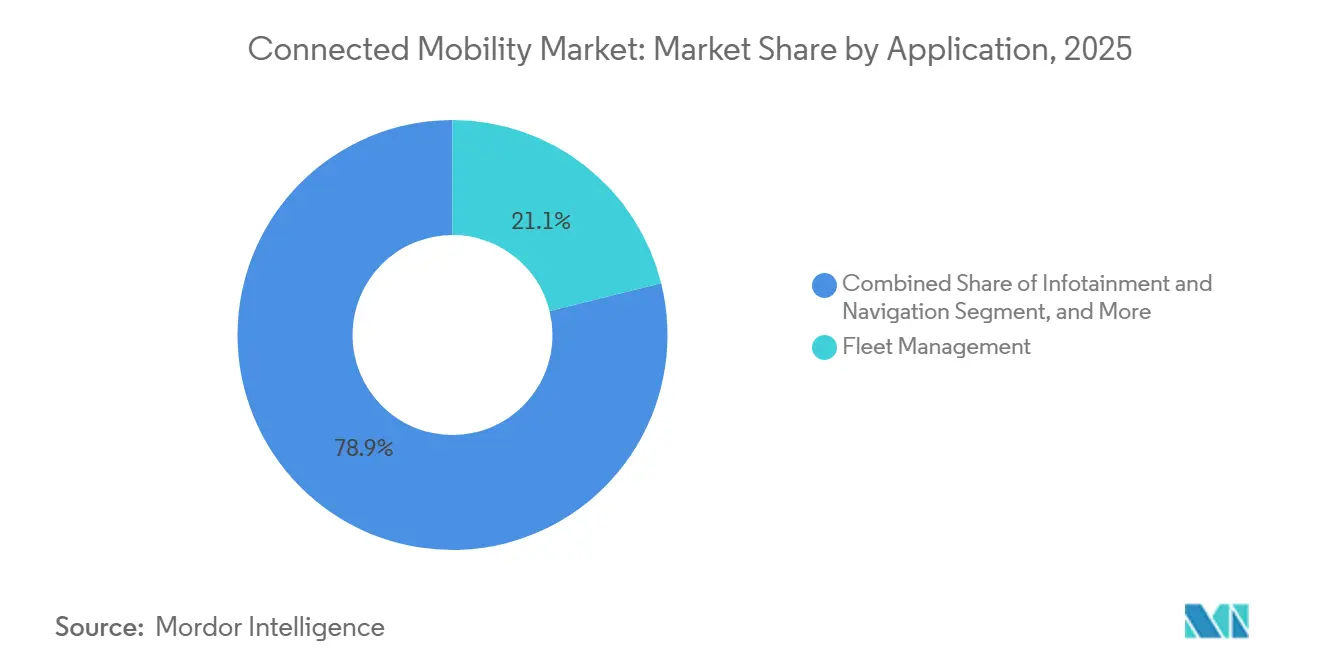
- By application, fleet management held 21.13% share of the connected mobility market in 2025, while over-the-air updates are projected to expand at a 15.20% CAGR through 2031.
- By end-user industry, automotive OEMs accounted for 31.70% share of the connected mobility market in 2025, while fleet operators are projected to expand at a 13.14% CAGR through 2031.
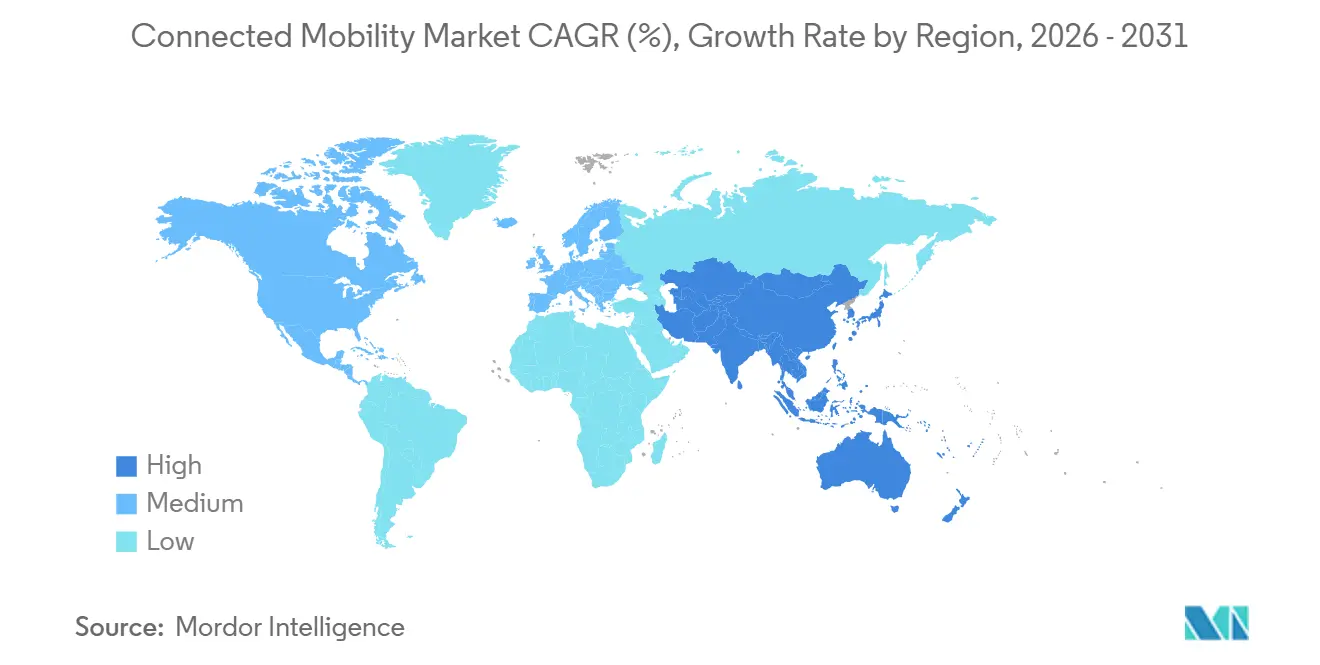
- By geography, Asia-Pacific held 32.45% share of the connected mobility market in 2025 and is projected to expand at a 13.87% CAGR through 2031.
Note: Market size and forecast figures in this report are generated using Mordor Intelligence’s proprietary estimation framework, updated with the latest available data and insights as of January 2026.
Global Connected Mobility Market Trends and Insights
Drivers Impact Analysis*
| Driver | (~) % Impact on CAGR Forecast | Geographic Relevance | Impact Timeline |
|---|---|---|---|
| Mandatory Safety, eCall, and ADAS Requirements | +2.5% | Europe, United Kingdom, China, expanding across Asia-Pacific and South America | Short term (≤ 2 years) |
| 5G Rollout and Low-Latency V2X Services | +2.0% | China, South Korea, European highway corridors, North America | Medium term (2-4 years) |
| Software-Defined Vehicles and EV Data Architectures | +2.0% | Global, led by China, Europe, and North America | Medium term (2-4 years) |
| Fleet Optimization and Usage-Based Insurance | +1.5% | North America, Europe, core Asia-Pacific, extending to the Middle East and Africa | Short term (≤ 2 years) |
| OEM Subscription and In-Vehicle App Ecosystems | +1.0% | North America and Europe, with early gains in China | Medium term (2-4 years) |
| Edge AI for Real-Time Vehicle Inference | +0.8% | Global, led by China and North America | Long term (≥ 4 years) |
| Source: Mordor Intelligence | |||
Mandatory Safety, eCall, and ADAS Requirements
European Union authorities must refuse type approval for vehicles that do not meet updated next-generation eCall specifications under Commission Delegated Regulation (EU) 2025/1871.[1]European Commission, “Commission Delegated Regulation (EU) 2025/1871 Amending Regulation (EU) 2015/758 as Regards eCall Standards,” europa.eu This deadline requires OEMs to update telematics control unit specifications and Internet Protocol multimedia subsystem compatibility. The United Kingdom requires next-generation eCall in all new vehicle registrations from September 2025. Its telecommunications upgrades are required by March 2027, while the earlier 2G-based service is scheduled for retirement during 2029-2030. The European Union General Safety Regulation also requires advanced driver-distraction warning systems for all new vehicles from July 2026, creating additional demand for onboard sensors and processing capabilities. China’s draft requirements for SAE Level 3 and Level 4 automated driving systems are scheduled to take effect by July 2027, turning earlier guidance into enforceable hardware and software requirements.
5G Rollout and Low-Latency V2X Services
The shift from dedicated short-range communications to cellular vehicle-to-everything technology now follows a regulatory timetable. The Federal Communications Commission required operations using dedicated short-range communications in the upper 5.9 GHz band to cease by December 14, 2026. This change requires road agencies, OEMs, and fleets to complete their transition to cellular vehicle-to-everything services. Kapsch TrafficCom and the North Carolina Turnpike Authority launched a production cellular vehicle-to-everything tolling system on the Triangle Expressway in February 2026. Verizon Business launched its Edge Transportation Exchange platform in June 2025, with early users including the Arizona Commerce Authority, the Delaware Department of Transportation, and Volkswagen Group of America. In China, demonstrations of 5G-Advanced applications in October 2025 showed real-time sensor sharing across operators, influencing future platform design for vehicles produced in the country. The connected mobility market benefits as live deployments reduce the gap between pilot projects and commercial infrastructure. The transition also changes procurement decisions because vehicle manufacturers can specify production-ready modules, rather than reserving connectivity hardware for limited demonstrations. Road operators gain an operational reason to invest when tolling, warnings, and traffic coordination can use the same network framework. This makes interoperability, network coverage, and device certification central considerations for suppliers seeking repeatable deployment contracts.
Software-Defined Vehicles and EV Data Architectures
Software-defined vehicle programs are changing the economic role of connectivity in the connected mobility market. Excelfore deployed an over-the-air update and remote diagnostics platform for the Tata Sierra in April 2026 using AWS IoT Core and the eSync over-the-air standard. The deployment showed that cloud-based vehicle lifecycle management had reached commercial production in an emerging automotive market. Volvo introduced its HuginCore platform with the EX60 in January 2026, using a single codebase configured for each vehicle. This design allows one interface update to reach 2.2 million vehicles produced since 2020. Li Auto’s vehicle-cloud architecture uses the same time-series database in the vehicle and in the cloud, reducing data conversion and improving diagnostic detail at the fleet scale. The European Union-funded UP2DATE4SDV project supports modular updates and hardware upgrades, linking software investment to reduced physical recall exposure.
Fleet Optimization and Usage-Based Insurance
Commercial fleets using telematics have reported primary liability premium discounts of 10-25% when they maintain documented safety scores. The cost difference is making connected operations a procurement requirement rather than an optional efficiency program. SambaSafety found that 60% of commercial auto insurers selected 2 or more operating areas for telematics deployment in 2025. The report also identified a shift from renewal-time data reviews to continuous risk scoring during the policy period. Verizon Connect reported that 46% of fleet professionals used video telematics in 2026, up 10 percentage points from 2023. Factory-installed telematics could narrow the role of aftermarket device providers unless they differentiate through software, data services, and workflow tools.
Restraints Impact Analysis*
| Restraint | (~) % Impact on CAGR Forecast | Geographic Relevance | Impact Timeline |
|---|---|---|---|
| Cybersecurity Vulnerabilities and Recall Exposure | -2.0% | Global | Short term (≤ 2 years) |
| High Multi-Band V2X and Connectivity Costs | -1.5% | Emerging markets in Asia-Pacific, the Middle East and Africa, and South America | Medium term (2-4 years) |
| Cross-Border Data Localization and Privacy Compliance | -0.8% | Europe, China, and India | Long term (≥ 4 years) |
| Fragmented V2X Standards and Spectrum Governance | -0.5% | Global, particularly North America and Europe | Medium term (2-4 years) |
| Source: Mordor Intelligence | |||
Cybersecurity Vulnerabilities and Recall Exposure
Cybersecurity incidents now create direct financial and operational risks for vehicle manufacturers. Researchers at the University of California, San Diego disclosed in July 2026 that security systems installed in at least 2.2 million vehicles used a shared Bluetooth authentication key. The issue could allow someone within 5 m to unlock doors, activate horns, or prevent a vehicle from starting without the owner’s key fob. The US Cybersecurity and Infrastructure Security Agency issued advisory ICSA-26-216-01 for the affected Acrisure hardware in August 2026.[2]Cybersecurity and Infrastructure Security Agency, “ICS Advisory ICSA-26-216-01, Acrisure KARR BT and DR-100,” cisa.gov The Automotive Security Research Group also documented a capture-replay weakness affecting rolling-code keyless entry in the 2024 Suzuki Swift. UN Regulation No. 155 and ISO/SAE 21434 make cybersecurity management a supplier qualification issue, which can increase compliance barriers for smaller component suppliers.
High Multi-Band V2X and Connectivity Costs
Multi-band designs combine 5G standalone service, cellular vehicle-to-everything communications at 5.9 GHz, global navigation satellite systems, Wi-Fi, and optional satellite backup. These configurations add component and integration costs that remain difficult for price-sensitive vehicle categories. The constraint is strongest for two- and three-wheelers in South and Southeast Asia, even though these categories have the highest demand for connected vehicles. HARMAN introduced its Ready Ride connectivity platform for two-wheelers at MWC Barcelona 2026, using a locally scalable telematics control unit and integrated software stack. The design recognizes that conventional passenger-car telematics control unit pricing does not fit two-wheeler economics. Fleet operators in the Middle East, Africa, and South America also face cross-border multi-SIM roaming costs. Higher deployment volumes are reducing component costs, but full multi-band capability will need time to become accessible across vehicle types and regions.
*Our forecasts treat driver/restraint impacts as directional, not additive. The impact forecasts reflect baseline growth, mix effects, and variable interactions.
Segment Analysis
By Solution: Software Gains Importance as OTA Delivery Becomes Essential
Hardware held 39.10% of the connected mobility market revenue in 2025. Its position reflected high shipments of telematics control units and rising integration of vehicle-to-everything communication modules across North American and Chinese OEM platforms. New European Union passenger-car production is estimated to generate 15-18 million telematics control unit shipments annually in 2026. Hardware includes telematics control units, vehicle-to-everything modules, and edge computing gateways. Edge gateways are gaining relevance as zonal electrical and electronic architectures move processing into high-performance central units. The connected mobility hardware market size, therefore, remains supported by necessary onboard connectivity equipment. OEM production programs require a stable supply, validation, and long operating life for these components, which limits how quickly standardization can erode their value. Hardware suppliers also need to accommodate different communication networks, electrical architectures, and country-specific regulatory requirements. Those conditions preserve a role for engineering support even as software accounts for a larger portion of future differentiation. Yet module standardization is expected to place pressure on hardware margins. Suppliers need to pair devices with secure software, lifecycle services, or proprietary vehicle data capabilities.
Software is projected to expand at a 13.21% CAGR through 2031, the fastest rate among solution categories. Connected vehicle platforms and over-the-air delivery systems are the central software subsegments. Centralized computing provides the network design needed to coordinate updates across an entire fleet. Volvo’s HuginCore approach demonstrates how a structured delivery layer can update 2.2 million vehicles across multiple model years from a single codebase. HARMAN open-sourced its Connected Services Platform through the Eclipse Foundation in May 2025, seeking to expand third-party application development rather than protect a closed middleware layer.[3]HARMAN International, “HARMAN Becomes One of the First to Open-Source Complete Connected Services Platform with Eclipse Foundation,” harman.com SAE International published an information report on network vehicle-to-everything services in February 2026, supporting protocol convergence. Services are also moving toward subscriptions, while tailored integration work is declining as application programming interfaces and open middleware become more common. The solution mix is expected to favor software and services over time, although hardware retains revenue leadership. Hardware suppliers must still meet strict vehicle reliability, cybersecurity, and certification requirements, so the change is not simply a replacement of devices with code. Instead, software enables each installed device to support more functions throughout the vehicle's life cycle. This relationship gives OEMs a reason to favor platforms that can manage updates, diagnostics, subscriptions, and third-party applications with consistent security controls.



By Vehicle Type: Passenger Vehicles Lead While Two and Three-Wheelers Advance Fastest
Passenger vehicles accounted for 55.31% of connected mobility market revenue in 2025. Near-universal embedded telematics in new European Union passenger cars, strong attachment in North American premium vehicles, and telematics in Chinese electric vehicles supported this position. The connected mobility market share of passenger vehicles also reflects OEM strategies that turn embedded hardware into recurring digital services. General Motors reported USD 800 million of OnStar business revenue in the second quarter of 2026. Super Cruise subscriptions exceeded 850,000 by midyear, while annual subscription revenue increased by 70% year over year. Heavy and light commercial vehicles held the next-largest shares of demand. India’s AIS-140 requirements and US electronic logging device rules establish telematics as a compliance need for commercial fleets.
Two and three-wheelers are projected to expand at a 13.43% CAGR through 2031, the highest rate among vehicle types. Electric vehicle use in last-mile logistics, government connectivity requirements, and OEM investment are supporting adoption. India’s proposed AIS-230 standard would require vehicle-to-vehicle communication in new two-wheelers, passenger vehicles, and commercial vehicles produced from October 2028. HARMAN presented Ready Ride with Qualcomm Technologies at MWC Barcelona 2026, combining a scalable telematics control unit, a cellular modem, and an OEM backend for two-wheelers. Kinetic Engineering partnered with Jio Things to add next-generation telematics and fleet-performance monitoring to its electric two-wheeler range. These deployments extend connectivity beyond premium electric scooters to broader fleet use. Buses follow smart-city transit investment in China and Europe, but at a slower pace than the two- and three-wheeler categories. Public transit deployments still create demand for route visibility, passenger information, maintenance monitoring, and safety communications. Their purchasing cycles often depend on municipal budgets and infrastructure coordination, which can delay deployment. The contrast with two-wheelers shows why suppliers need cost structures and data services suited to each vehicle class, rather than a single connectivity package.
By Application: OTA Updates Become a Core Delivery Requirement
Fleet management held 21.13% of the connected mobility market revenue in 2025. This leading position reflects mature commercial use of telematics across North America and Europe. Geotab launched its next-generation GO device family and made its Ace AI platform generally available in February 2026. The products support electric fleet data collection, quicker processing, and automated operational analysis. Samsara expanded AI Multicam, two-way voice communication through dash cameras, and its 360 Camera platform in June 2026. These tools move video telematics from incident recording toward driver coaching and dispatch communication. Infotainment and navigation remain large and stable applications, while remote diagnostics and predictive maintenance benefit from continuous electronic control unit health data.
Over-the-air updates are projected to expand at a 15.20% CAGR through 2031. Software-defined vehicles depend on persistent delivery systems for driver-assistance calibration, powertrain optimization, infotainment features, and cybersecurity patches. Ford addressed an Image Processing Module A software field action for certain 2025 Aviator and Explorer models through a planned over-the-air update in March 2026. The action demonstrated how updates can replace some dealer-based recall activities and shorten resolution times. Usage-based insurance and mobility-as-a-service had smaller current revenue contributions but are expected to gain relevance as telematics suppliers provide direct data pipelines to insurers and urban operators. Vehicle safety and security applications are also extending to vehicle-to-everything infrastructure. The connected mobility market needs reliable update capacity because most software-based functions depend on continuing deployment and verification. A delivery platform must identify the correct vehicle configuration, securely distribute software, confirm installation, and retain records for compliance and support. These requirements make update operations a continuing service rather than a one-time feature. Providers that can handle mixed hardware generations and several electronic control units may have an advantage as fleets and OEM vehicle portfolios become more diverse.
By End-User Industry: OEMs Retain Revenue Control While Fleet Operators Scale
Automotive OEMs accounted for 31.70% of the connected mobility market revenue in 2025. They design the vehicle platform, install connectivity equipment, and control primary data streams used by downstream services. This role gives OEMs influence over the architecture and commercial terms of connected services. Honda’s ASIMO OS for the 2026 Honda 0 Series, Volvo’s HuginCore, and Renault’s Ampere-developed architecture show the continued investment in OEM-controlled software systems. In January 2026, Visteon introduced an in-car conversational navigation system with TomTom and an AI-ADAS Compute Module powered by NVIDIA technology. These products demonstrate the supplier's approach of providing high-value compute building blocks. The connected mobility industry is therefore balancing proprietary OEM operating systems with standardized modules and middleware from Tier 1 suppliers.
Fleet operators are projected to expand at a 13.14% CAGR through 2031. Artificial intelligence-enabled telematics can improve routing, maintenance planning, and insurance cost management. Geotab acquired Verizon Connect’s commercial telematics operations in Australia and 9 European countries in October 2025. In May 2026, Geotab reported more than 1 million active fleet subscriptions in Europe, the Middle East, and Africa. The transaction shows how acquisitions are consolidating a field once shaped by regional fleet providers. Mobility service providers and logistics companies are expanding with last-mile delivery and shared mobility services. Government and smart-city agencies remain smaller buyers, but their roadside investments determine whether vehicle-to-everything systems provide useful cooperative safety services. Their decisions influence the density of roadside units, the availability of traffic data, and the practical value of onboard connectivity beyond the vehicle itself. As a result, OEMs and suppliers need to align product roadmaps with local infrastructure programs. This public role can create long sales cycles, but it can also establish the technical environment required for later vehicle-side adoption.
Geography Analysis
Asia-Pacific accounted for 32.45% of connected mobility market revenue in 2025 and is projected to grow at a 13.87% CAGR through 2031. China held the largest country position in the region, supported by more than 500 active cellular vehicle-to-everything pilot zones, electric vehicle programs, and 5G-Advanced infrastructure. South Korea and Japan contribute high-value projects linked to driver-assistance rules and autonomous mobility trials. India has the strongest country growth path within Asia-Pacific because AIS-140 supports commercial fleet tracking. The proposed AIS-230 requirement, effective October 2028, is already influencing OEM product plans. Two- and three-wheeler electric fleets in India and Southeast Asia require battery health data, charging-session data, and dense-urban route optimization. This need is prompting targeted platform work from HARMAN, Qualcomm Technologies, and Geotab.
North America was the second-largest regional revenue contributor in 2025. The region combines commercial fleet telematics demand created by US electronic logging rules with the regulatory migration from dedicated short-range communications to cellular vehicle-to-everything technology. The Federal Communications Commission deadline of December 14, 2026, requires road infrastructure operators and OEM platforms to complete the conversion together. Stellantis participated in a US Department of Transportation 5G connected-vehicle test for real-time safety notifications in August 2026. Canada supports steady demand through enterprise fleet telematics. Mexico embeds cellular vehicle-to-everything modules in vehicles supplied to domestic and US customers. The regional connected mobility market, therefore, benefits from regulatory replacement demand and established commercial fleet use.
Europe has mature adoption, with near-universal embedded telematics in new European Union passenger-car production in 2025. The Connecting Europe Facility Digital allocated more than EUR 3 billion (USD 3.39 billion) for 5G corridor deployment along 26,000 km of highways. Denmark recorded 83.4% 5G availability in 2025, and Norway approached 100%. BMW, Bosch, and RISE demonstrated cross-border roadwork-warning data sharing at the 5GAA Nordic event in April 2026.[4]5G Automotive Association, “C-V2X Technology Reaches U.S. Milestone with the First Day One Deployment District at the ITS World Congress 2025,” 5gaa.org South America, the Middle East, and Africa held smaller combined revenue positions but are supported by government fleet digitization and aftermarket telematics. Powerfleet secured a contract in February 2026 to track thousands of South African government vehicles, showing that public procurement can provide a volume base in Africa. The share of the connected mobility market in these regions remains small, although institutional fleet demand can strengthen the local service base. Government fleet contracts can help local installers, connectivity providers, and software partners build operational experience before private fleets adopt comparable tools. This pattern matters, as vehicle buyers remain highly sensitive to hardware costs and ongoing data charges. It also explains why fleet digitization programs can be more important than consumer connectivity in the early development of these regional markets.

Competitive Landscape
The connected mobility market has a moderately concentrated platform layer, where Continental AG, Denso Corporation, Robert Bosch GmbH, Geotab, and Samsara shape reference architectures. It remains more fragmented in applications and communication modules, with more than 20 credible companies active in hardware, software, and services. Large Tier 1 suppliers are repositioning around software revenue as hardware becomes more standardized. Bosch presented an AI extension platform based on NVIDIA DRIVE AGX Orin at CES 2026, allowing OEMs to add 150-200 TOPS of onboard computing without redesigning existing hardware.[5]Robert Bosch GmbH, “Bosch Presents Cockpit Innovations at CES 2026 in Las Vegas,” bosch-mobility.com Aptiv reported double-digit non-automotive revenue expansion and mid-teens software revenue expansion from Wind River in the second quarter of 2026. These actions show why software services are becoming more important to supplier strategy. Suppliers can use installed computing and connectivity equipment as a base for driver-assistance functions, cockpit experiences, diagnostics, and future subscriptions. The approach may improve recurring revenue, but it also requires suppliers to maintain software security and compatibility after vehicle production. OEMs will continue to weigh control over customer data against the speed and specialized capabilities offered by external platform partners.
Companies are also using open platforms, certified vehicle-to-everything equipment, acquisitions, and semiconductor partnerships to strengthen their positions. HARMAN released its Connected Services Platform through the Eclipse Foundation in May 2025, encouraging a larger external application ecosystem. Denso has pursued interoperable vehicle-to-everything infrastructure through its OmniAir-certified MobiQ roadside module. Geotab’s acquisition of Verizon Connect’s international operations increased its access to small and mid-sized fleets. Visteon, Valeo, and ZF have also partnered with NVIDIA or Qualcomm Technologies to offer computing systems that OEMs can adopt without having to develop every component in-house. The connected mobility market rewards suppliers that combine usable data, secure updates, and compatibility across vehicle systems. Open software can attract developers and reduce integration work, while certified hardware can reassure OEMs and road operators that devices will function in accordance with recognized standards. Acquisitions add customer scale, but their value depends on combining data, customer support, and product roadmaps without disrupting established fleet operations. Semiconductor alliances provide access to processing capability, although the supplier still needs to make the system practical for different vehicle architectures and cost targets.
Opportunities remain in electric vehicle fleet management, mixed-fleet over-the-air orchestration, and cooperative tolling and traffic management. Kapsch TrafficCom and the North Carolina Turnpike Authority showed the commercial viability of connected tolling on NC-540 in February 2026. Sibros Technologies focuses on software lifecycle management, while ECARX targets centralized cockpit and driver-assistance computing. ECARX introduced a preproduction Zenith computing platform based on Qualcomm’s Snapdragon Elite Automotive in February 2026. Fleet and logistics customers increasingly assess artificial intelligence capability and data interoperability alongside hardware. Electric fleets require data on battery condition, charging, and route use that conventional internal-combustion fleet platforms did not prioritize. Mixed fleets also require an update system capable of managing vehicles with varying ages, electronic architectures, and connectivity equipment. These customer requirements leave room for specialist software providers, even as larger Tier 1 suppliers continue to control important vehicle interfaces.
Connected Mobility Industry Leaders
Continental AG
Robert Bosch GmbH
Denso Corporation
Aptiv PLC
Harman International
- *Disclaimer: Major Players sorted in no particular order


Recent Industry Developments
- July 2026: Verizon Business connected new BMW Group vehicles in the United States to its nationwide 5G Standalone offering via KDDI's Global Communications Platform, marking the first production connected vehicle deployment on a 3GPP Release 16-aligned 5G core architecture in North America.
- June 2026: Samsara introduced the Samsara 360 Camera, expanded AI Multicam capabilities, and launched two-way voice communication through the dash cam, enabling real-time driver-manager communication and AI-triggered geofence alerts without dispatcher calls, materially expanding the operational scope of fleet video telematics.
- May 2026: Geotab announced it had surpassed 1 million active fleet subscriptions across EMEA, becoming the first end-to-end fleet telematics provider to reach this figure in the region, following the integration of Verizon Connect's commercial operations acquired in October 2025.
- April 2026: Powerfleet launched Vision 360 Plus, an AI-powered, multi-camera 360° fleet safety solution, in a commercial partnership with TELUS to expand the adoption of AI video telematics among North American enterprise and mid-market fleet operators.


Global Connected Mobility Market Report Scope
The connected mobility market encompasses hardware, software, and services that enable real-time communication, data exchange, and intelligent connectivity. Market Definition: three-wheelers for applications such as fleet management, infotainment, remote diagnostics, predictive maintenance, vehicle safety and security, usage-based insurance (UBI), over-the-air (OTA) updates, and Mobility-as-a-Service (MaaS). The market serves automotive OEMs, fleet operators, mobility service providers, logistics and transportation companies, and government and smart city authorities.
The Connected Mobility Market is Segmented by Solution (Hardware (Telematics Control Units (TCUs), Connectivity Modules (Cellular, GNSS, Wi-Fi and Bluetooth), V2X Communication Modules, Edge Computing Gateways, Smart Antennas and Communication Devices, and Other Connectivity Hardware), Software (Connected Vehicle Platform Software, Fleet Management Software, Telematics Platform Software, Over-the-Air (OTA) Software Platforms, Vehicle Data Management and Analytics Software, and Connected Mobility Management Platforms), and Services (Connectivity Services, Managed Telematics Services, System Integration and Deployment, Consulting and Support Services, and Maintenance and Lifecycle Services)), Vehicle Type (Passenger, Light Commercial Vehicles, Heavy Commercial Vehicles, Buses, and Two and Three Wheelers), Application (Fleet Management, Infotainment and Navigation, Remote Diagnostics, Predictive Maintenance, Usage-Based Insurance (UBI), Vehicle Safety and Security, Over-the-Air (OTA) Updates, and Mobility-as-a-Service (MaaS)), End-User Industry (Automotive OEMs, Fleet Operators, Mobility Providers, Logistics and Transportation Companies, and Government and Smart City Authorities), and Geography (North America, South America, Europe, Asia-Pacific, and Middle East and Africa). Market Forecasts in Terms of Value (USD).
| Hardware | Telematics Control Units (TCUs) |
| Connectivity Modules (Cellular, GNSS, Wi-Fi and Bluetooth) | |
| V2X Communication Modules | |
| Edge Computing Gateways | |
| Smart Antennas and Communication Devices | |
| Other Connectivity Hardware | |
| Software | Connected Vehicle Platform Software |
| Fleet Management Software | |
| Telematics Platform Software | |
| Over-the-Air (OTA) Software Platforms | |
| Vehicle Data Management and Analytics Software | |
| Connected Mobility Management Platforms | |
| Services | Connectivity Services |
| Managed Telematics Services | |
| System Integration and Deployment | |
| Consulting and Support Services | |
| Maintenance and Lifecycle Services |
| Passenger Vehicles |
| Light Commercial Vehicles |
| Heavy Commercial Vehicles |
| Buses |
| Two and Three Wheelers |
| Fleet Management |
| Infotainment and Navigation |
| Remote Diagnostics |
| Predictive Maintenance |
| Usage-Based Insurance (UBI) |
| Vehicle Safety and Security |
| Over-the-Air (OTA) Updates |
| Mobility-as-a-Service (MaaS) |
| Automotive OEMs |
| Fleet Operators |
| Mobility Service Providers |
| Logistics and Transportation Companies |
| Government and Smart City Authorities |
| North America | United States | |
| Canada | ||
| Mexico | ||
| South America | Brazil | |
| Argentina | ||
| Rest of South America | ||
| Europe | Germany | |
| United Kingdom | ||
| France | ||
| Italy | ||
| Spain | ||
| Rest of Europe | ||
| Asia-Pacific | China | |
| Japan | ||
| India | ||
| South Korea | ||
| Rest of Asia-Pacific | ||
| Middle East and Africa | Middle East | Saudi Arabia |
| United Arab Emirates | ||
| Turkey | ||
| Rest of the Middle East | ||
| Africa | South Africa | |
| Nigeria | ||
| Rest of Africa | ||
| By Solution | Hardware | Telematics Control Units (TCUs) | |
| Connectivity Modules (Cellular, GNSS, Wi-Fi and Bluetooth) | |||
| V2X Communication Modules | |||
| Edge Computing Gateways | |||
| Smart Antennas and Communication Devices | |||
| Other Connectivity Hardware | |||
| Software | Connected Vehicle Platform Software | ||
| Fleet Management Software | |||
| Telematics Platform Software | |||
| Over-the-Air (OTA) Software Platforms | |||
| Vehicle Data Management and Analytics Software | |||
| Connected Mobility Management Platforms | |||
| Services | Connectivity Services | ||
| Managed Telematics Services | |||
| System Integration and Deployment | |||
| Consulting and Support Services | |||
| Maintenance and Lifecycle Services | |||
| By Vehicle Type | Passenger Vehicles | ||
| Light Commercial Vehicles | |||
| Heavy Commercial Vehicles | |||
| Buses | |||
| Two and Three Wheelers | |||
| By Application | Fleet Management | ||
| Infotainment and Navigation | |||
| Remote Diagnostics | |||
| Predictive Maintenance | |||
| Usage-Based Insurance (UBI) | |||
| Vehicle Safety and Security | |||
| Over-the-Air (OTA) Updates | |||
| Mobility-as-a-Service (MaaS) | |||
| By End-User Industry | Automotive OEMs | ||
| Fleet Operators | |||
| Mobility Service Providers | |||
| Logistics and Transportation Companies | |||
| Government and Smart City Authorities | |||
| By Geography | North America | United States | |
| Canada | |||
| Mexico | |||
| South America | Brazil | ||
| Argentina | |||
| Rest of South America | |||
| Europe | Germany | ||
| United Kingdom | |||
| France | |||
| Italy | |||
| Spain | |||
| Rest of Europe | |||
| Asia-Pacific | China | ||
| Japan | |||
| India | |||
| South Korea | |||
| Rest of Asia-Pacific | |||
| Middle East and Africa | Middle East | Saudi Arabia | |
| United Arab Emirates | |||
| Turkey | |||
| Rest of the Middle East | |||
| Africa | South Africa | ||
| Nigeria | |||
| Rest of Africa | |||


Key Questions Answered in the Report
What is the connected mobility market size?
The connected mobility market is expected to reach USD 98.93 billion in 2026 and USD 173.12 billion by 2031, expanding at a 11.84% CAGR.
What is driving demand for connected vehicle systems?
ECall and driver-assistance requirements, 5G rollout, fleet telematics, software-defined vehicles, and recurring subscription services are key demand factors.
Which connected mobility solution is expanding fastest?
Software is projected to expand at a 13.21% CAGR through 2031 as OEMs increase investment in over-the-air delivery and connected vehicle platforms.
Which vehicle category has the strongest outlook?
Two and three-wheelers are projected to expand at a 13.43% CAGR through 2031, supported by electric last-mile fleets and connectivity programs.
Why are over-the-air updates important for automakers?
They allow OEMs to deliver driver-assistance calibration, cybersecurity fixes, and feature updates without relying on dealer visits.
Which region leads connected mobility adoption?
Asia-Pacific held 32.45% of revenue in 2025 and is projected to expand at a 13.87% CAGR through 2031.
Page last updated on:






