
Confectionery Market Analysis by Mordor Intelligence
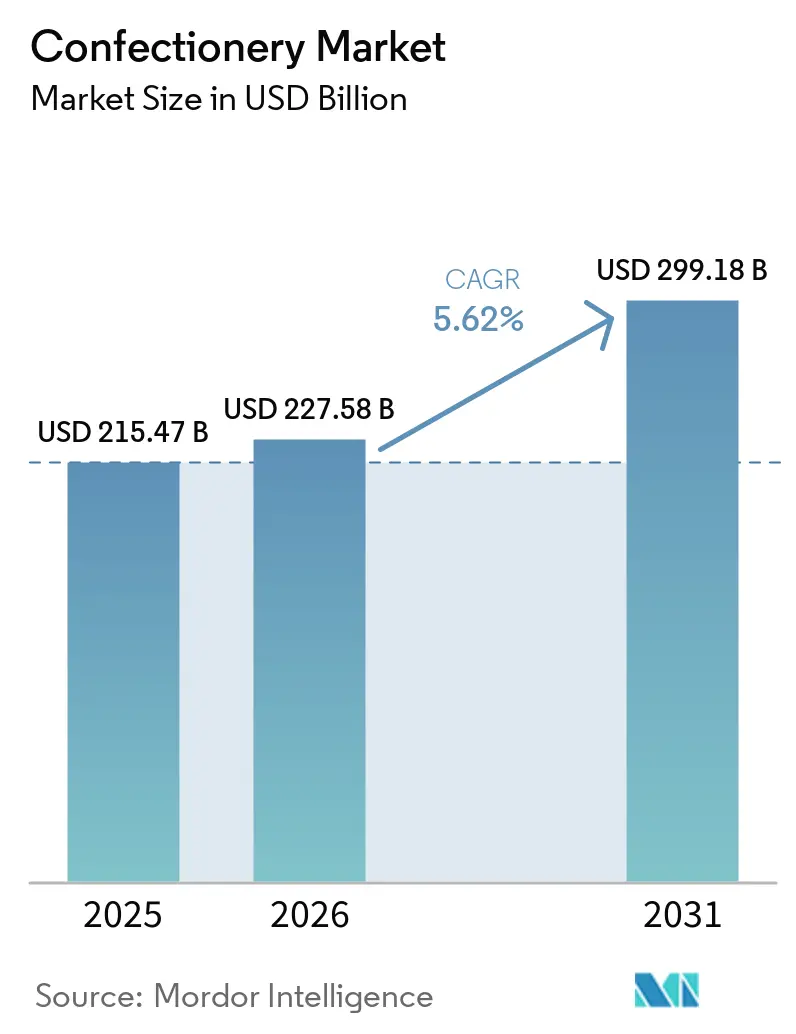
The confectionery market size is estimated at USD 227.6 billion in 2026 and is projected to be USD 240.4 billion in 2027, reaching USD 309.9 billion by 2032, growing at a CAGR of 5.21% from 2027 to 2032. The confectionery market volume is estimated at 25.68 million tons in 2026 and is projected to be 26.3 million tons in 2027, reaching 29.6 million tons by 2032, growing at a CAGR of 2.4% from 2027 to 2032.
Higher selling prices can lift value faster than volume as manufacturers recover ingredient costs. U.S. sugar-free and freeze-dried candy demand also creates opportunities beyond conventional sweet formats. Gifting and practical chocolate portions also support differentiation through the consumption occasion. Flexible production supports this variety, but narrower UK advertising access constrains suppliers' ability to promote qualifying products.
Key Report Takeaways
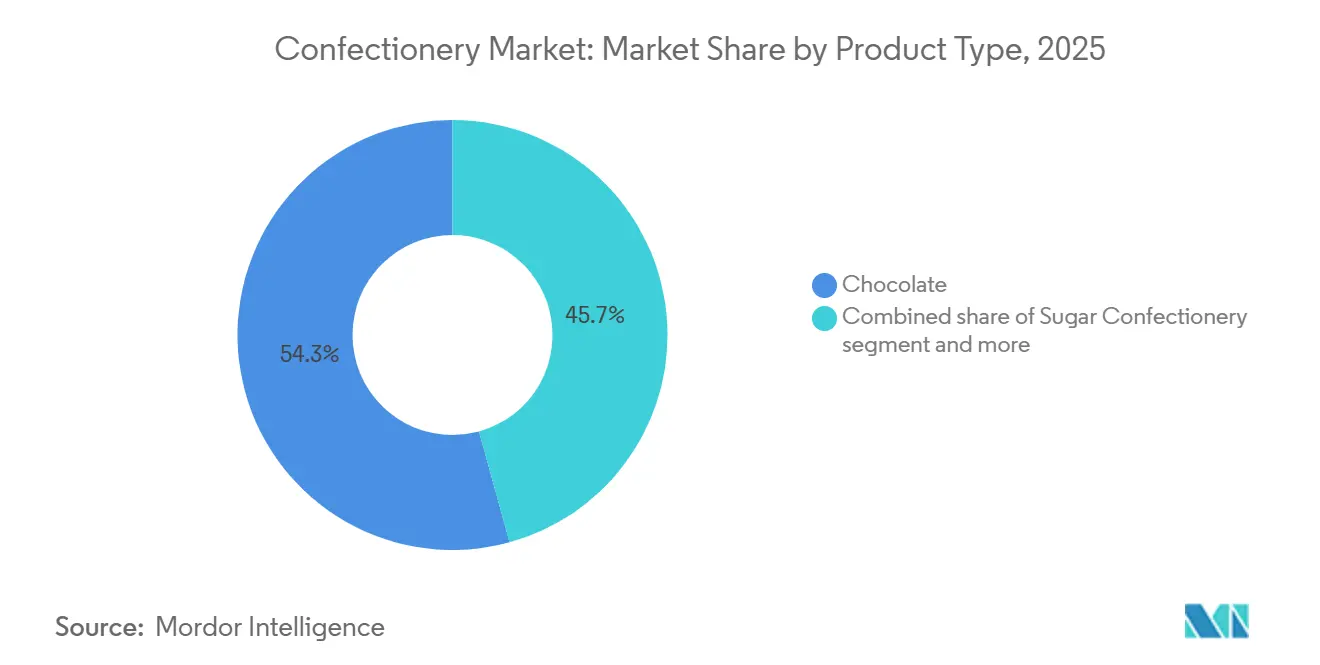
- By product type, chocolate led with a 54.2% confectionery market share in 2026, while sugar confectionery is forecast to grow fastest at a CAGR of 5.85% from 2027 to 2032.
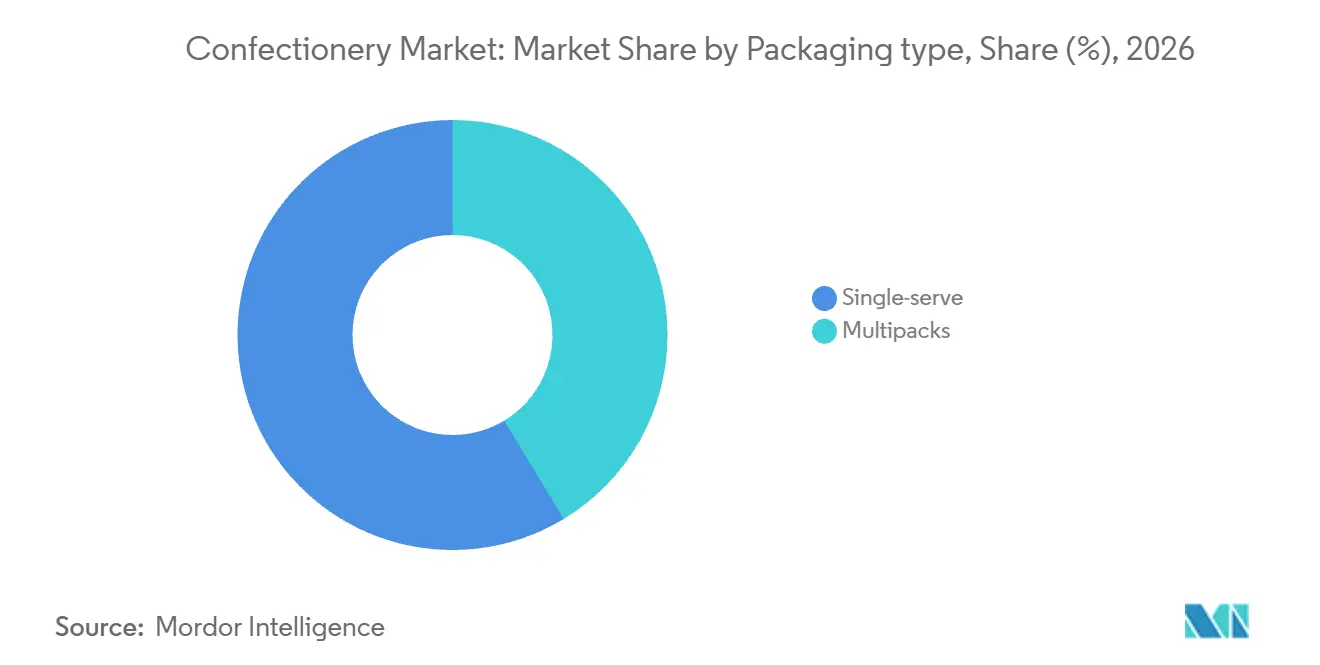
- Within packaging types, single-serve held a 58.66% share of the confectionery market size in 2026, with multipacks forecast to grow fastest at a CAGR of 6.05% from 2027 to 2032.
- Across price tiers, mass led with a 65.95% share in 2026, while premium is forecast to grow fastest at a CAGR of 6.55% from 2027 to 2032.
- By distribution channel, supermarkets and hypermarkets held the largest share at 36.39% in 2026, and online retail stores are forecast to grow fastest at a CAGR of 6.45% from 2027 to 2032.
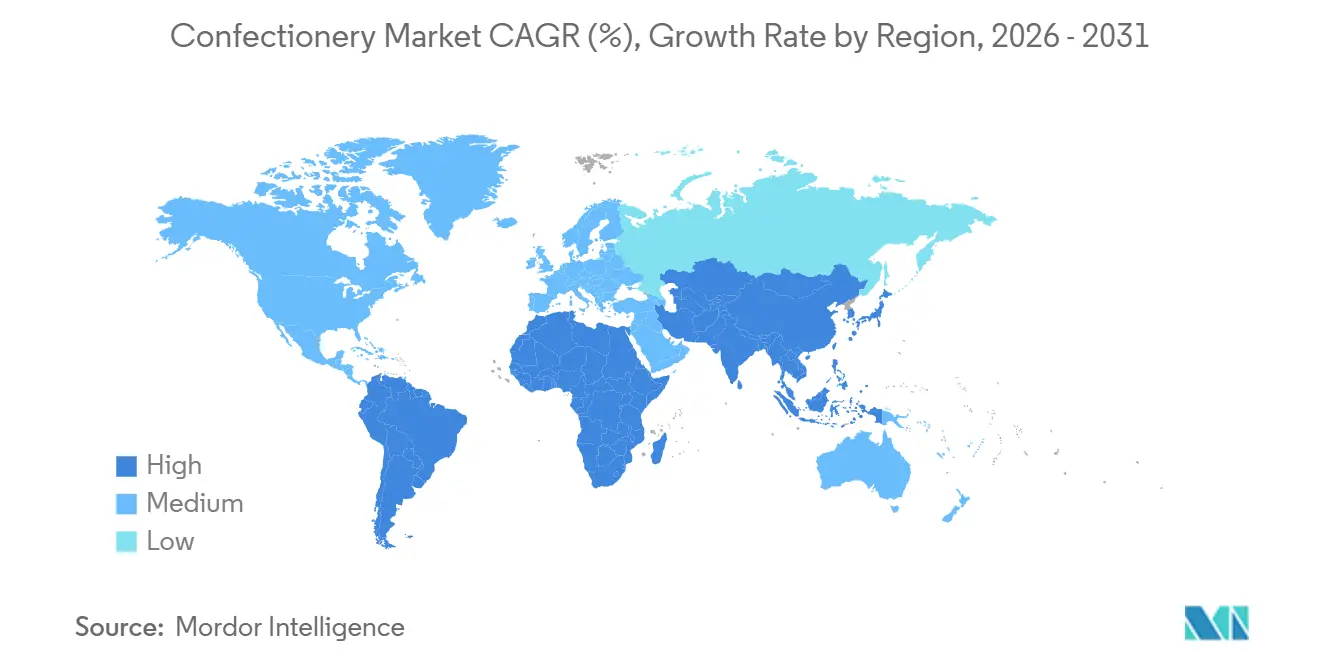
- Across geographies, North America led with a 36.52% share in 2026, while Asia-Pacific is forecast to grow fastest at a CAGR of 6.3% from 2027 to 2032.
Note: Market numbers in this report are based on Mordor Intelligence's proprietary estimation framework, which combines nine months of actuals with Q4 projections for base year 2026.
Market Trends and Insights
Drivers Impact Analysis of Confectionery Market*
| Driver | (~) % Impact on CAGR Forecast | Geographic Relevance | Impact Timeline |
|---|---|---|---|
| Premiumization and experiential gifting boom | +2.6% | North America and Belgium | Medium term (2-4 years) |
| Demand surges for reduced-sugar, sugar-free, and functional confectionery | +2.2% | Across the United States | Medium term (2-4 years) |
| Continuous flavor, texture, and health innovation | +1.9% | Across the United States | Short term (≤ 2 years) |
| Packaging and convenience support the growth | +1.5% | Republic of Argentina | Short term (≤ 2 years) |
| Ethical sourcing of ingredients, eco-friendly packaging | +0.8% | Cameroon, Côte d’Ivoire, Ghana, Indonesia, India, Nigeria | Long term (≥ 4 years) |
| Advent-calendar-style seasonal bundling | +0.5% | Across Great Britain | Short term (≤ 2 years) |
| Source: Mordor Intelligence | |||
Premiumization and experiential gifting boom
Gifting can sustain premium chocolate demand by making the occasion, as well as the quantity, part of the purchase. In H1 2026, Lindt and Sprungli AG reported that North America benefited from premiumization, with Lindt and Ghirardelli contributing significantly to premium-segment growth. Belgian seasonal chocolate volume rose 9% in the moving annual total through September 2025 versus the comparable 2024 period. YouGov also reported strong sell-through for high-end gift boxes, artisanal pralines, and seasonal collections in Belgium. Belgium's seasonal volume gain alongside strong gift-box sell-through supports allocating premium assortments to festive selling windows, where the measured demand extends beyond higher prices alone.
Demand surges for reduced-sugar, sugar-free, and functional confectionery
Sugar-free candy offers producers a route to additional spending while retaining the appeal of a sweet treat. Circana data showed U.S. sugarfree/sugarless candy sales through grocery, drug, and mass merchandisers reaching USD 154.2 million for the 52 weeks ending February 23, 2025. Those channel-specific dollar sales rose 3.5% year over year. Separately, Barry Callebaut's September 2025 survey of 24,000 people across 24 markets found that 83% stated a preference for shorter ingredient lists when buying chocolate confectionery. Sugar-free producers therefore have a measured channel-spending opportunity, while chocolate suppliers can use ingredient simplicity as a positioning cue rather than treating sugar content as the sole formulation attribute.
Continuous flavor, texture, and health innovation
Texture innovation can expand confectionery demand by offering a different eating experience within an established sweet-treat occasion. U.S. freeze-dried candy unit sales rose 63% in 2025.[1] The format delivered a light mouthfeel with crunch and chew, making texture part of the product's eating experience. For a candy manufacturer, this combination creates scope to compete through the way the product feels in the mouth, rather than relying solely on a new flavor variant. U.S. freeze-dried candy dollar sales grew 52% in 2025, so unit growth outpaced value growth for the format.
Packaging and convenience support the growth
Practical portions can extend the consumption occasions that a local chocolate-tablet offer serves. Nestlé relaunched local chocolate-tablet production in Argentina in August 2025, offering 3 varieties in 25- and 50-gram formats designed for practical consumption. The line operated at Magdalena in Buenos Aires and offered milk chocolate, almond, and semisweet varieties. A local tablet producer can thus combine different portion sizes with familiar flavor choices, keeping convenience within an established product format. The August 2025 relaunch restored Nestlé's local chocolate-tablet production after more than 20 years.
Restraints Impact Analysis of Confectionery Market*
| Restraint | (~) % Impact on CAGR Forecast | Geographic Relevance | Impact Timeline |
|---|---|---|---|
| Cocoa and sugar cost volatility | -2% | North America, Europe, Asia-Pacific | Short term (≤ 2 years) |
| Sugar-content and child-marketing regulation | -1.1% | United Kingdom and Norway | Medium term (2-4 years) |
| Carbon-credit land competition squeezing cocoa supply | -0.4% | Long term (≥ 4 years) | |
| Price-elastic volume drops after sharp hikes | -0.8% | Across North American markets | Short term (≤ 2 years) |
| Source: Mordor Intelligence | |||
Cocoa and sugar cost volatility
Commodity exposure can constrain confectionery demand through the price manufacturers need to charge for an economically viable product. The International Cocoa Organization reported that elevated cocoa prices over several years significantly reduced industrial and consumer cocoa demand through November 2025. The Food and Agriculture Organization's Sugar Price Index averaged 114 points in September 2026, up 14.7% year over year, amid expectations of tighter global sugar supplies in 2026/27. The cocoa demand response demonstrates the volume risk of sustained input inflation, while the international sugar index adds a separate cost signal for confectionery producers.
Sugar-content and child-marketing regulation
Advertising restrictions can make confectionery demand more expensive to stimulate by removing routes for promoting individual products. From January 5, 2026, UK rules restrict qualifying product advertising before 9 p.m. on TV and prohibit it in paid online advertising at any time for covered businesses with at least 250 employees. Confectionery must fall within the specified category and score at least 4 under the 2004-2005 nutrient profiling model to qualify. Sugar-free sweets and sugar-free chewing gum are excluded, while brand advertising is exempt when it does not depict a specific less-healthy product. These distinctions can change which recipes a large manufacturer can promote through paid digital campaigns. Producers of affected products face narrower promotional access, increasing the difficulty of converting product recognition into incremental purchases.
*Our forecasts treat driver/restraint impacts as directional, not additive. The impact forecasts reflect baseline growth, mix effects, and variable interactions.
Confectionery Market Segment Analysis
By Product Type:
Shared Chocolate Infrastructure Supports Brand ScaleChocolate accounted for a 54.2% share of the confectionery market size in 2026, making it the largest segment. The Hershey Company opened its 250,000-square-foot Reese Chocolate Processing facility in Hershey, Pennsylvania, in April 2025.[2] The facility extended the existing Reese plant and was designed to supply chocolate for REESE'S, KIT KAT, and HERSHEY'S products. Separately, chocolate accounted for 33% of Mondelez International Inc.'s net revenues in 2025, making it a substantial part of that producer's business. Shared chocolate processing links the supply requirements of several branded franchises, so investment in the intermediate product can support more than one finished-product range.
Sugar confectionery is the fastest-growing segment, with a forecast CAGR of 5.85% from 2027 to 2032. In Japan, candy retail sales value rose 9.1% in 2025, according to Kanro's presentation of INTAGE SRI+ data. Gummies grew 14% in value, while hard candy grew 3.9%, showing different growth profiles within the Japanese candy category. For Japanese sugar-candy producers, stronger gummy value growth places more expansion opportunity in that format than in hard candy.

By Packaging type:
Individual Servings Lead as Bundling Gains Production SupportSingle-serve represented a 58.66% confectionery market share in 2026, making it the largest segment. Hershey reported that standard-size bars represented 15% of candy, mint, and gum sales in convenience-store data for the year to date through June 29, 2025. That sales presence gives convenience-store suppliers a commercial reason to maintain standard-size bars within their candy, mint, and gum ranges.
Multipacks are the fastest-growing segment, at a forecast CAGR of 6.05% from 2027 to 2032. By June 2025, The Hershey Company reported investment in automation to produce multipacks across its broader snacking portfolio. The initiative involved candy, mint, and gum brand teams and was designed to allow flexibility for future scaling. For a confectionery manufacturer, automation can make the bundle an operating capability, because assembling several units requires coordination beyond producing the individual sweet. Repeatable bundle assembly can therefore help a supplier expand its confectionery selection while keeping the complexity of the finished pack from becoming a separate manual task for every unit.
By Price Tier:
Accessible Offers Anchor Demand as Premium Value ExpandsMass represented 65.95% of sales in 2026, making it the largest segment. Sunshine Holdings' confectionery manufacturing and brand-management business focused on delivering affordable products to consumers across Sri Lanka in FY2025/26. NielsenIQ reported that mainstream chocolate accounted for 54.6% of U.S. chocolate dollar sales in the 52 weeks ended December 27, 2025. Its price-based classification separates mainstream from value, premium, and super-premium chocolate. Mainstream chocolate therefore carried a majority of U.S. chocolate dollar sales, making that tier central to the category's measured revenue base.
Premium is the fastest-growing segment, with a forecast CAGR of 6.55% from 2027 to 2032. In 2025, Lindt and Sprungli AG reported that the global chocolate market's premium segment continued to outperform as consumers traded up for quality and mindful indulgence. Its seasonal and gifting portfolio supported above-market growth. At Lindt, 11.8% price increases partly drove 4.3% group-wide organic sales growth in H1 2026 and led to a 7.5% volume/mix decline as the company offset significantly higher input costs. Premium positioning can therefore support value growth, but the producer's results show that recovering costs through price can still weaken volume/mix.
By Distribution Channel:
Grocery Access and Digital Offers Require Distinct ChoicesSupermarkets and hypermarkets held 36.39% of confectionery sales in 2026, making them the largest segment. Circana's August 2026 analysis put grocer supermarkets at 63% of UK confectionery market value. A supplier without grocery listings would therefore miss the channel carrying most measured UK confectionery value, even with a distinctive chocolate or candy offer.
Online retail stores are the fastest-growing segment, with a forecast CAGR of 6.45% from 2027 to 2032. The National Confectioners Association reported that online sales represented 11.5% of annual U.S. non-chocolate candy dollar sales, using Circana data through the 52 weeks ending August 10, 2025. Convenience stores have a separate commercial role, with NACS Magazine reporting candy as a top-10 in-store category in the United States in 2025. A candy manufacturer can therefore develop online retail as a deliberate sales route while maintaining a distinct store offer for a channel where the product already has substantial category relevance.
Geography Analysis
North America Confectionery Market
North America held a 36.52% confectionery market share in 2026, making it the largest geography. In the United States, 99.8% of households purchased confectionery at least once in 2025, according to the National Confectioners Association. At that level of category reach, the commercial challenge in the U.S. household base shifts toward occasions and formats that can deepen existing participation. Serving an additional small treating occasion therefore offers a manufacturer a more plausible commercial expansion route than relying mainly on recruiting households that did not purchase any confectionery during the measured year.
Asia-Pacific Confectionery Market
Asia-Pacific is the fastest-growing geography, with a forecast CAGR of 6.3% from 2027 to 2032. Nestlé India Limited reported volume-led double-digit growth in its domestic confectionery product group in Q2 FY2026-27, ended September 30, 2026. The company attributed the performance to KITKAT market-share gains and sustained momentum in MUNCH and MILKYBAR. This provides an Indian growth mechanism in which established brands generate additional product demand, giving manufacturers a route to expansion through their existing confectionery businesses. The volume-led result supports a physical production opportunity for suppliers serving these franchises, beyond the revenue opportunity signaled by higher sales value alone.
South America's manufacturing role includes Brazil, where chocolate production rose from 806,000 metric tons in 2024 to 814,000 metric tons in 2025, expanding the country's manufactured supply. In Europe, Switzerland sold 192,548 metric tons of chocolate in 2025, including 55,719 domestically and 136,829 exported, making foreign buyers central to its producers. Within the Middle East and Africa, shops across Saudi Arabia offered imported and locally produced sweets and chocolates ahead of Eid al-Fitr 2025, with many consumers buying in bulk. A salesman at one Jeddah sweet shop reported doubled sales ahead of Eid al-Fitr 2026 as demand for sweets and chocolates rose. Saudi Eid al-Fitr demand gives local suppliers and importers a defined selling window around which to time chocolate and sweet deliveries.
Regulatory Framework and Outlook
The comparison covers selected jurisdictions from the perspective of packaged-confectionery manufacturers managing labels, packaging, and product communications. The U.S. Food and Drug Administration's January 2025 front-of-package nutrition-box proposal covered most foods bearing Nutrition Facts labels, subject to proposed exemptions. Germany's Central Agency Packaging Register (ZSVR) began administering registration and packaging-volume reporting under the German Packaging Law Implementation Act (VerpackDG) on August 12, 2026, under German Environment Agency oversight. In October 2026, the U.S. proposal was not final, with the Unified Agenda listing final-rule stage and projected December 2026 timing.
Regulatory Table of Confectionery Market
| Decision factor | United States | Brazil | Germany | China | Saudi Arabia |
|---|---|---|---|---|---|
| Primary authority | Food and Drug Administration | Agência Nacional de Vigilância Sanitária (ANVISA) | ZSVR for registration and reporting; state authorities for enforcement | State Administration for Market Regulation and county-level or higher local departments under the 2027 measures | Saudi Food and Drug Authority |
| Key instruments or direction | Nutrition Facts framework; proposed front-of-package nutrition box | RDC 429/2020 and IN 75/2020; proposed general-labeling amendments to RDC 727/2022 | VerpackDG; EU packaging regulation and phased recyclability requirements | GB 7718-2011; replacement GB 7718-2025 and food-label measures from March 16, 2027 | GSO 9; SFDA FD 2233 and 2333; approved child-directed food advertising requirements from 2028 |
| Commercial effect | Potential additional nutrient display for covered packaged foods | Front-of-package nutrition labels and nutrition-table requirements | Producer registration and volume reports; possible distribution bans or fines for breaches under state law | From March 16, 2027, mandatory information on the smallest sales unit's outer pack unless it opens easily for reading or inner information is clearly readable through it | Arabic retail labels with matching information in any additional language |
| Current policy attractiveness | High | Medium | Medium | Medium | Medium |
| Future direction of policy attractiveness | Hardening | No change | Hardening | No change | Hardening |
| Source: Mordor Intelligence | |||||
The U.S. high rating reflects the Nutrition Facts framework without an operative front-of-package duty and hardening reflects the proposed extra display, while Brazil's medium rating and unchanged outlook rest on established nutrition-label duties alongside a general-labeling review whose consultation ended October 19, 2026. Germany is medium with a hardening outlook because registration and reporting already apply, with EU packaging recyclability criteria phased in from 2030 at the earliest, and a grade B minimum scheduled from January 1, 2038. China's medium rating and unchanged outlook reflect continuity of mandatory prepackaged-food labeling through the March 16, 2027, replacement, including conditional outer-pack information placement. Saudi Arabia's medium rating and hardening outlook combine Arabic retail-label duties with preparation for approved child-directed food advertising requirements effective January 1, 2028.
Value Chain Stages
The comparison follows ingredient and packaging supply through chocolate production and co-packing to retail delivery. In February 2026, Amcor worked with chocolate producer Alter Eco and co-packer HALBA to move 3 chocolate-bar variants of 200 grams each, sold in France, to paper-based packaging.[3] Package weight fell 37% for dark dessert chocolate and 61% for both dark chocolate with whole hazelnuts and dark chocolate with whole almonds, compared with the previous packs. The new material is recyclable in practice where paper recycling streams exist.
Value Chain Analysis Table of Confectionery Market
| Primary activity | Key participants | Value capture | Bottleneck | Resilience response |
|---|---|---|---|---|
| Cocoa bean and ingredient supply | Cocoa bean and ingredient suppliers such as ofi | Cocoa ingredient sales | Qualifying replacement ingredients and suppliers | Maintain qualified supply alternatives with product specifications |
| Packaging material conversion and supply | Packaging suppliers such as Amcor | Packaging material sales | Changing materials while preserving pack function | Qualify material performance with the chocolate packer |
| Chocolate production and co-packing | Chocolate producers and co-packers such as Alter Eco, the producer, and HALBA, the co-packer | Finished-chocolate sales and contract-packing fees | Coordinating recipe and packing changes | Validate changes jointly with the producer and co-packer |
| Distribution to retail | Integrated producer-distributors such as Mondelez International Inc. | Branded product sales | Coordinating direct-store, warehouse, and distributor routes | Separate responsibilities for direct-store, warehouse, and distributor deliveries |
| Source: Mordor Intelligence | ||||
The Alter Eco redesign illustrates how a material change can connect the work of a brand owner, a co-packer, and a packaging supplier. Each role can capture a different part of the resulting commercial activity, making the ability to coordinate a transition valuable alongside the material itself. Involving the chocolate packer in material qualification turns packaging innovation into an operating capability, reducing dependence on a design that has not been reconciled with the packing process.
Competitive Landscape
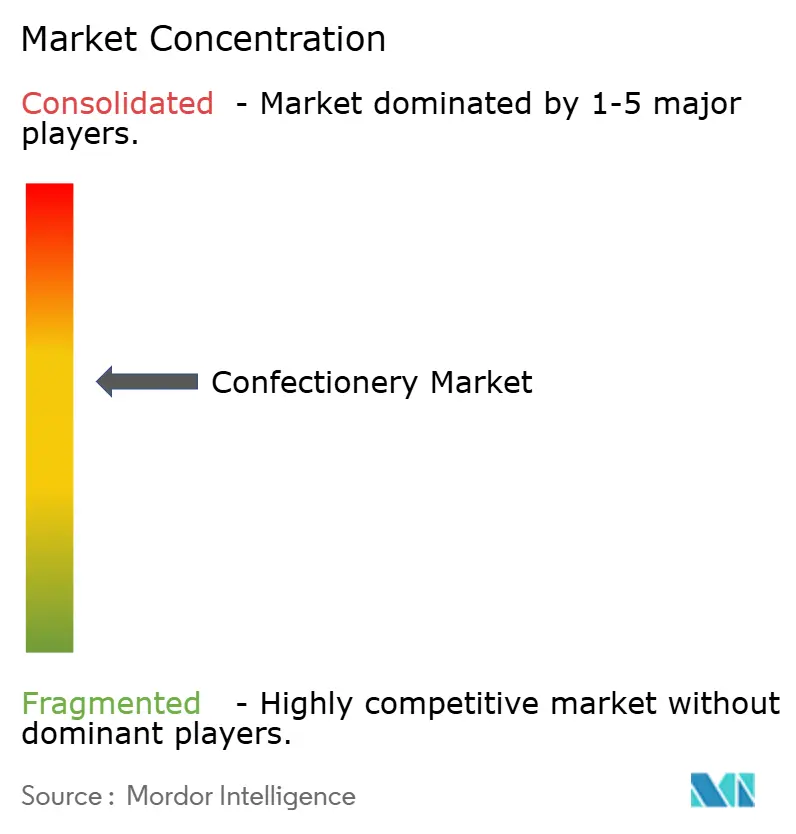
Competition centers on large branded groups, with Mars Inc., Mondelez International Inc., The Hershey Company, Nestle S.A., and Ferrero Group among the major participants. Mondelez reported whole-company global net revenue of USD 38.54 billion in 2025, up from USD 36.44 billion in 2024, across confectionery and other snacking categories. Hershey's North America Confectionery segment recorded net sales of USD 9.48 billion in 2025, up 4% from 2024. At that scale, these groups can fund several brand franchises at once, leaving challengers an opening to compete through narrower product propositions.
Factory flexibility gives producers a way to support several confectionery brands through shared manufacturing capability. Nestlé Canada completed a Toronto confectionery-factory expansion in 2026, adding production capacity, equipment, new production space, and expanded utilities. Its new line was designed to produce both Kit Kat and Aero for the Canadian market. The factory produces Smarties and Coffee Crisp for Canada as well, giving its operation a wider confectionery role than the new line alone. Nestlé Canada's local production across these established brands means challengers face a portfolio of Canadian-made products rather than an isolated new line.
In January 2025, Ferrero announced an agreement to acquire Power Crunch, a U.S. protein-snack company whose portfolio includes wafer bars and high-protein crisps. Ferrero's later FY2024/25 results described the acquisition as part of its expansion into high-protein snacking. In August 2026, Ferrero signed an agreement to acquire Purely Elizabeth, a U.S. wellness and breakfast food company offering granola, oatmeal, cereals, and protein products. The proposed transaction was subject to customary closing conditions and regulatory approvals. Together, these moves position nutrition-oriented adjacent categories as an acquisition route for the confectionery group, exposing specialist bar competitors to a rival able to buy established product propositions.
Confectionery Industry Leaders
-
Mars Inc.
-
Mondelez International Inc.
-
The Hershey Company
-
Nestle S.A.
-
Ferrero Group
- *Disclaimer: Major Players sorted in no particular order
Confectionery Market Companies Covered in this Report
- Mars Inc.
- Mondelez International Inc.
- Nestle S.A.
- Ferrero Group
- The Hershey Company
- Barry Callebaut AG
- Kellanova
- General Mills Inc.
- Yildiz Holding
- HARIBO Holding
- Perfetti Van Melle BV
- Lotte Corporation
- Meiji Holdings
- Ezaki Glico Co Ltd
- Grupo Arcor
- August Storck KG
- Lindt and Sprungli AG
- Godiva Chocolatier
- Cargill Cocoa and Chocolate
- Barry Callebaut (Processing)
Recent Industry Developments in Confectionery Market
- Oct 2026: Nestlé India Limited reported volume-led double-digit growth in its domestic confectionery product group for Q2 FY2026-27, ended September 30, 2026.
- Aug 2026: Ferrero Group signed an agreement to acquire Purely Elizabeth, a U.S. wellness and breakfast food company, subject to customary closing conditions and regulatory approvals.
- May 2026: Mars Inc. announced modernization at its Slough chocolate factory in the United Kingdom, with planned robotics, AI, machinery, cooling, and utilities upgrades within an investment phase that began in 2023 and was scheduled through 2028.
Scope and Methodology
Segmentation Overview
By Product Type
| Chocolate | Dark Chocolate | |
| Milk and White Chocolate | ||
| Sugar Confectionery | Hard Candy | |
| Mints | ||
| Pastilles, Gummies, and Jellies | ||
| Toffees and Nougats | ||
| Lollipops | ||
| Other | ||
| Snack Bar | Cereal Bar | |
| Energy Bar | ||
| Protein Bar | ||
| Fruit and Nut Bar | ||
| Gums | Chewing Gum | Sugar Chewing Gum |
| Sugar-free Chewing Gum | ||
| Bubble Gum | ||
By Packaging type
| Single-serve |
| Multipacks |
By Price Tier
| Mass |
| Premium |
By Distribution Channel
| Supermarket/Hypermarket |
| Online Retail Store |
| Convenience Store |
| Other Distribution Channels |
By Geography
| North America | United States |
| Canada | |
| Mexico | |
| Rest of North America | |
| South America | Brazil |
| Argentina | |
| Colombia | |
| Chile | |
| Rest of South America | |
| Europe | United Kingdom |
| Germany | |
| France | |
| Italy | |
| Spain | |
| Russia | |
| Sweden | |
| Belgium | |
| Poland | |
| Netherlands | |
| Rest of Europe | |
| Asia-Pacific | China |
| Japan | |
| India | |
| Thailand | |
| Singapore | |
| Indonesia | |
| South Korea | |
| Australia | |
| New Zealand | |
| Rest of Asia-Pacific | |
| Middle East and Africa | United Arab Emirates |
| South Africa | |
| Saudi Arabia | |
| Nigeria | |
| Egypt | |
| Morocco | |
| Turkey | |
| Rest of Middle East and Africa |
| By Product Type | Chocolate | Dark Chocolate | |
| Milk and White Chocolate | |||
| Sugar Confectionery | Hard Candy | ||
| Mints | |||
| Pastilles, Gummies, and Jellies | |||
| Toffees and Nougats | |||
| Lollipops | |||
| Other | |||
| Snack Bar | Cereal Bar | ||
| Energy Bar | |||
| Protein Bar | |||
| Fruit and Nut Bar | |||
| Gums | Chewing Gum | Sugar Chewing Gum | |
| Sugar-free Chewing Gum | |||
| Bubble Gum | |||
| By Packaging type | Single-serve | ||
| Multipacks | |||
| By Price Tier | Mass | ||
| Premium | |||
| By Distribution Channel | Supermarket/Hypermarket | ||
| Online Retail Store | |||
| Convenience Store | |||
| Other Distribution Channels | |||
| By Geography | North America | United States | |
| Canada | |||
| Mexico | |||
| Rest of North America | |||
| South America | Brazil | ||
| Argentina | |||
| Colombia | |||
| Chile | |||
| Rest of South America | |||
| Europe | United Kingdom | ||
| Germany | |||
| France | |||
| Italy | |||
| Spain | |||
| Russia | |||
| Sweden | |||
| Belgium | |||
| Poland | |||
| Netherlands | |||
| Rest of Europe | |||
| Asia-Pacific | China | ||
| Japan | |||
| India | |||
| Thailand | |||
| Singapore | |||
| Indonesia | |||
| South Korea | |||
| Australia | |||
| New Zealand | |||
| Rest of Asia-Pacific | |||
| Middle East and Africa | United Arab Emirates | ||
| South Africa | |||
| Saudi Arabia | |||
| Nigeria | |||
| Egypt | |||
| Morocco | |||
| Turkey | |||
| Rest of Middle East and Africa | |||
Market Definition
- Milk and White Chocolate - Milk chocolates is a solid chocolate made with milk (in the form of either milk powder, liquid milk, or condensed milk) and cocoa solids. White chocolate is made from cocoa butter and milk and contains no cocoa solids whatsoever. The scope includes regular chocolates, low-sugar, and sugar-free variants
- Toffees & Nougats - Toffees include hard, chewy, and small or one-bite candies marketed with labels as toffee or toffee-like confectionery. Nougat is a chewy confection with almond, sugar, and egg white as a basic ingredient; and it originated in Europe and Middle East countries.
- Cereals Bars - A snack composed of breakfast cereal that has been compressed into a bar shape and is held together with a form of edible adhesive. The scope includes snack bars made with cereals such as rice, oats, corn, etc. mixed with a binding syrup. These also include products labeled as cereal bars, cereal treat bars, or grain bars.
- Chewing Gum - This is a preparation for chewing, usually made of flavored and sweetened chicle or such substitutes as polyvinyl acetate. The types of chewing gums included in the scope are sugar-chewing gums and sugar-free chewing gums
| Keyword | Definition |
|---|---|
| Dark Chocolate | Dark chocolate is a form of chocolate containing cocoa solids and cocoa butter without the milk. |
| White Chocolate | White chocolate is the type of chocolate containing the highest percentage of milk solids, typically around or over 30 percent. |
| Milk Chocolate | Milk chocolate is made from dark chocolate that has a low cocoa solid content and higher sugar content, plus a milk product. |
| Hard Candy | A candy made of sugar and corn syrup boiled without crystallizing. |
| Toffees | A hard, chewy, often brown sweet that is made from sugar boiled with butter. |
| Nougats | A chewy or brittle candy containing almonds or other nuts and sometimes fruit. |
| Cereal bar | A cereal bar is a bar-shaped food product, made by pressing cereals and usually dried fruit or berries, which are in most cases held together by glucose syrup. |
| Protein bar | Protein bars are nutrition bars that contain a high proportion of protein to carbohydrates/fats. |
| Fruit & Nut bar | These are often based on dates with other dried fruit and nut additions and, in some cases, flavorings. |
| NCA | The National Confectioners Association is an American trade organization that promotes chocolate, candy, gum and mints, and the companies that make these treats. |
| CGMP | Current good manufacturing practices are those conforming to the guidelines recommended by relevant agencies. |
| Unstandardized foods | Unstandardized foods are those that do not have a standard of identity or that deviate from a prescribed standard in any manner. |
| GI | The glycemic index (GI) is a way of ranking carbohydrate-containing foods based on how slowly or quickly they are digested and increase blood glucose levels over a period of time |
| Skimmed milk powder | Skimmed milk powder is obtained by removing water from pasteurized skim milk by spray-drying. |
| Flavanols | Flavanols are a group of compounds found in cocoa, tea, apples, and many other plant-based foods and beverages. |
| WPC | Whey protein concentrate- the substance obtained by the removal of sufficient nonprotein constituents from pasteurized whey so that the finished dry product contains greater than 25% protein. |
| LDL | Low density Lipoprotein- the bad cholesterol |
| HDL | High density Lipoprotein- the good cholesterol |
| BHT | butylated Hydroxytoluene is a lab-made chemical that is added to foods as a preservative. |
| Carrageenan | Carrageenan is an additive used to thicken, emulsify, and preserve foods and drinks. |
| Free form | Not containing certain ingredients, such as gluten, dairy, or sugar. |
| Cocoa butter | It is a fatty substance obtained from cocoa beans, used in the manufacture of confectionery. |
| Pastellies | A type of of Brazilian candy made from sugar, eggs, and milk. |
| Draggees | Small, round candies that are coated with a hard sugar shell |
| CHOPRABISCO | Royal Belgian Association of the chocolate, pralines, biscuit, and confectionery industry- A trade association that represents the Belgian chocolate industry. |
| European Directive 2000/13 | A European Union directive that regulates the labeling of food products |
| Kakao-Verordnung | The German chocolate ordinance, a set of regulations that define what can be labeled as "chocolate" in Germany. |
| FASFC | Federal Agency for the Safety of the Food Chain |
| Pectin | A natural substance that is derived from fruits and vegetables. It is used in confectionery to create a gel-like texture. |
| Invert sugars | A type of sugar that is made up of glucose and fructose. |
| Emulsifier | A substance that helps to mix to liquids that does not mix together. |
| Anthocyanins | A type of flavonoid that is responsible for the red, purple, and blue colors of confectionery. |
| Functional Foods | Foods that have been modified to provide additional health benefits beyond basic nutrition. |
| Kosher certificate | This certification verifies that the ingredients, production process including all machinery, and/or food-service process complies with the standards of Jewish dietary law |
| Chicory root extract | A natural extract from the chicory root that is a good source of fiber, calcium, phosphorous, and folate |
| RDD | Recommended daily dose |
| Gummies | A chewy gelatin-based candy that is often flavored with fruit. |
| Nutraceuticals | Food or dietary supplements that are claimed to have health benefits. |
| Energy bars | Snack bars that are high in carbohydrates and calories are designed to provide energy on the go. |
| BFSO | Belgian Food Safety Organization for the food chain. |
Research Methodology
Mordor Intelligence follows a four-step methodology in all our reports.
- Step-1: Identify Key Variables: In order to build a robust forecasting methodology, the variables and factors identified in Step 1 are tested against available historical market numbers. Through an iterative process, the variables required for market forecast are set, and the model is built on the basis of these variables.
- Step-2: Build a Market Model: Market-size estimations for the forecast years are in nominal terms. Inflation is not a part of the pricing, and the average selling price (ASP) is kept constant throughout the forecast period for each country.
- Step-3: Validate and Finalize: In this important step, all market numbers, variables, and analyst calls are validated through an extensive network of primary research experts from the market studied. The respondents are selected across levels and functions to generate a holistic picture of the market studied.
- Step-4: Research Outputs: Syndicated Reports, Custom Consulting Assignments, Databases & Subscription Platforms


