
Commercial Carpet Tiles Market Size and Share
Market Overview
| Study Period | 2021 - 2031 |
|---|---|
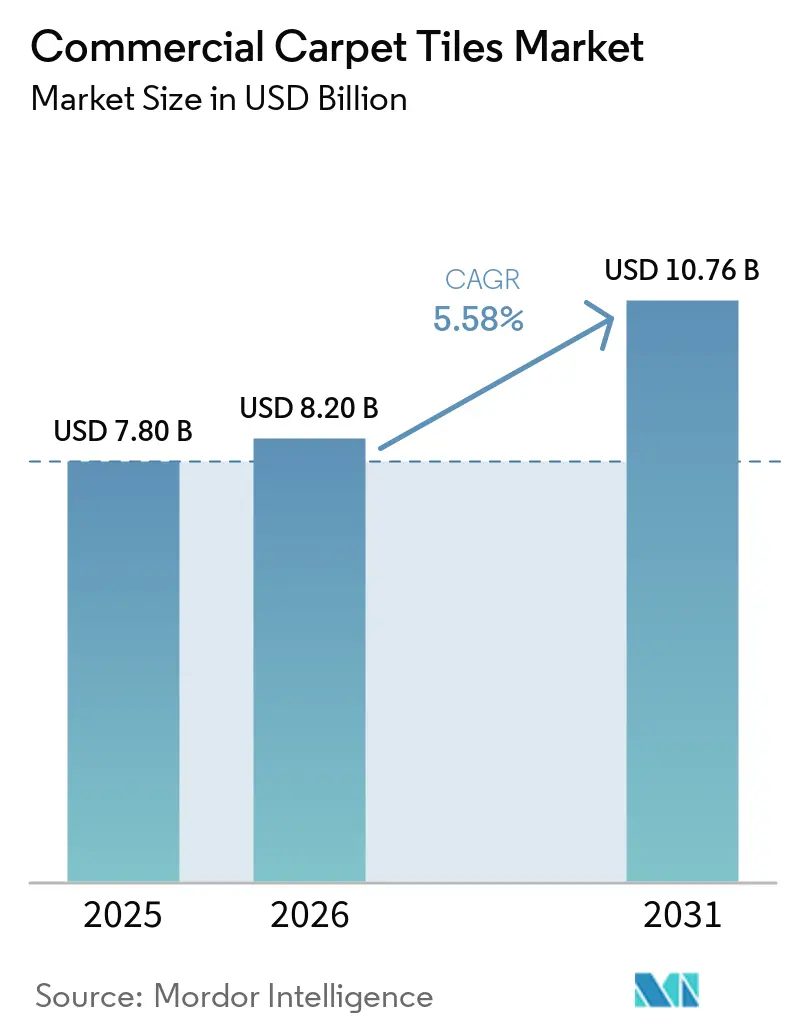
| Market Size (2026) | USD 8.20 Billion |
| Market Size (2031) | USD 10.76 Billion |
| Growth Rate (2026 - 2031) | 5.58 % |
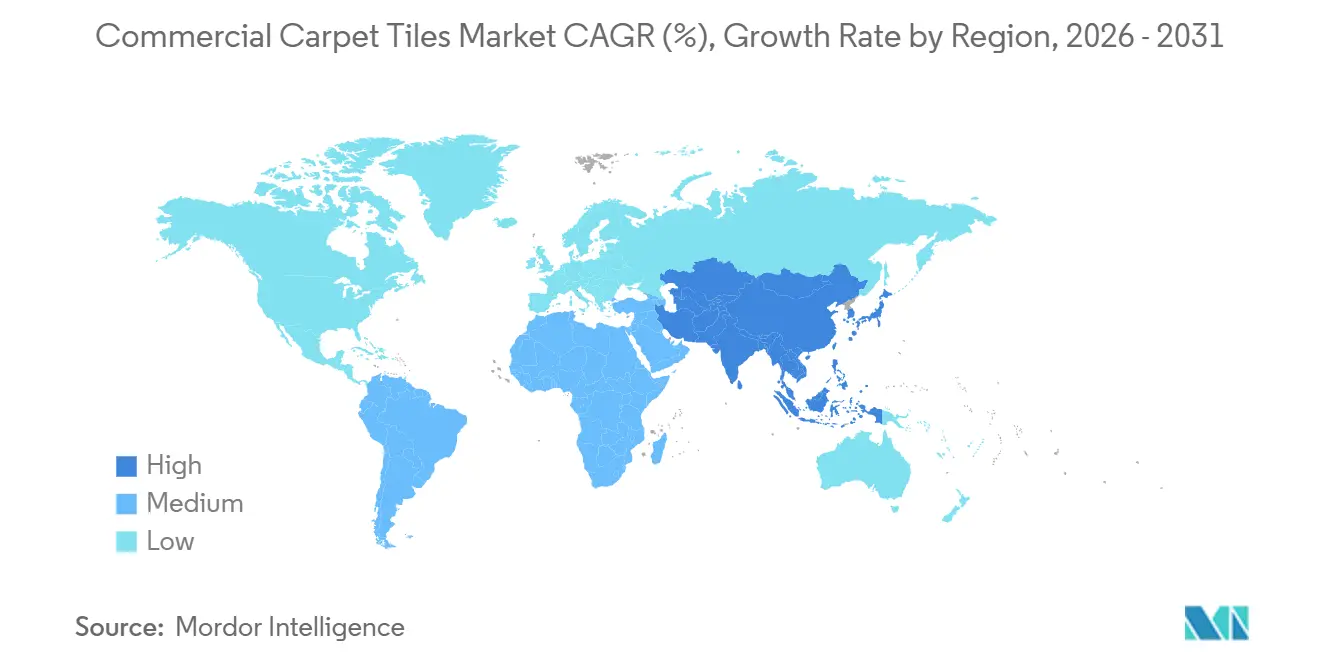
| Fastest Growing Market | Asia-Pacific |
| Largest Market | North America |
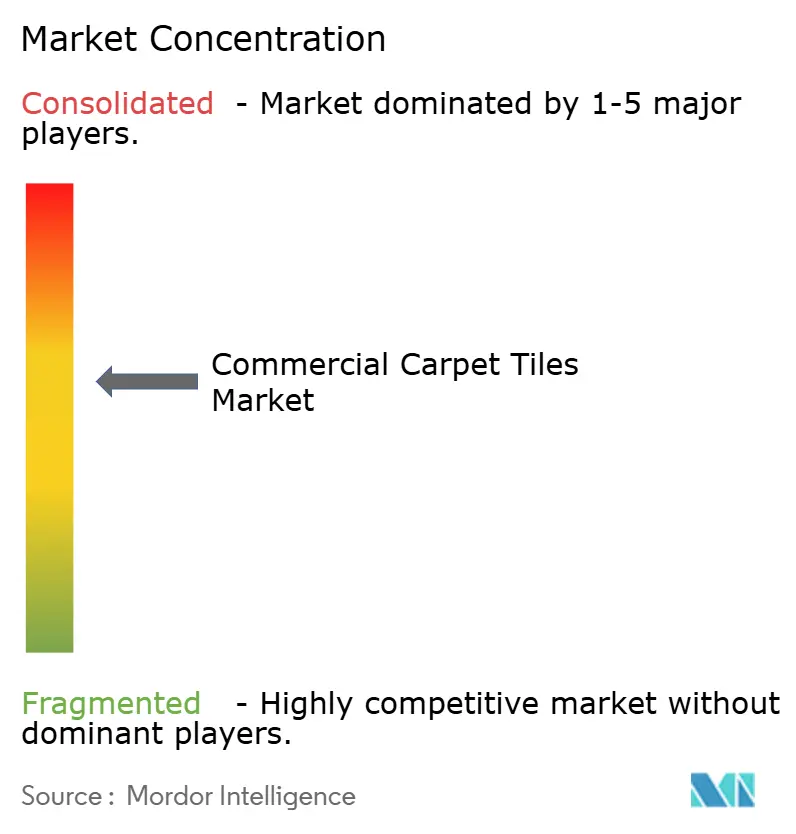
| Market Concentration | Medium |
Major Players *Disclaimer: Major Players sorted in no particular order Image © Mordor Intelligence. Reuse requires attribution under CC BY 4.0. | |
Commercial Carpet Tiles Market Analysis by Mordor Intelligence
The commercial carpet tiles market size was valued at USD 7.8 billion in 2025 and is estimated at USD 8.20 billion in 2026, and is forecast to reach USD 10.76 billion by 2031, growing at a 5.58% CAGR during 2026–2031. The commercial carpet tiles market is moving toward products with environmental product declarations, recycled inputs, and installation systems that support recovery at the end of use. Green-building requirements are making product documentation more important during project selection, particularly for office, institutional, and hospitality projects. Replacement work in mature office markets supports demand for products that can be installed in phases without closing an entire floor. Commercial and institutional construction in Asia-Pacific continues to provide new project opportunities, while premium specifications support the use of woven and other higher-value products. Manufacturers are responding through circular material programs, certified product portfolios, direct relationships with large customers, and systems that simplify installation and removal.
Key Report Takeaways
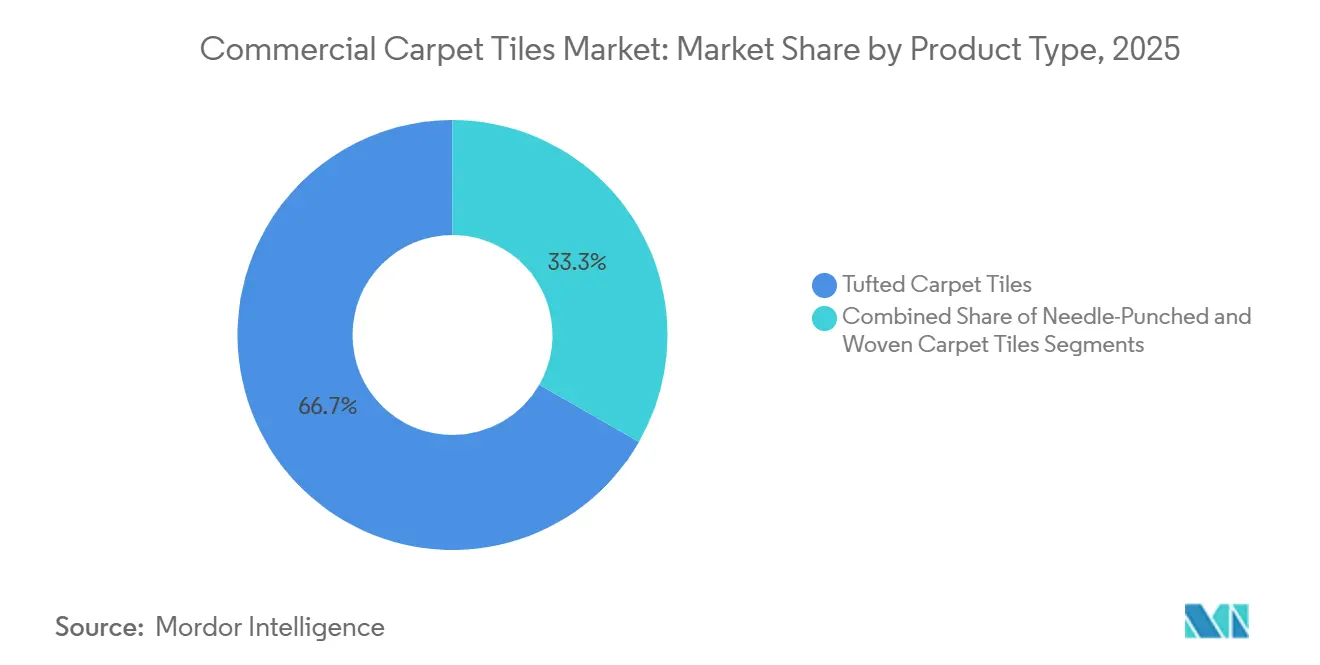
- By product type, tufted tiles held 66.7% of the commercial carpet tiles market share in 2025, while woven tiles are forecast to grow at a 6.4% CAGR through 2031.
- By fiber type, nylon held a 58.2% share in the commercial carpet tiles market in 2025, while polyester is forecast to grow at a 6.5% CAGR through 2031.
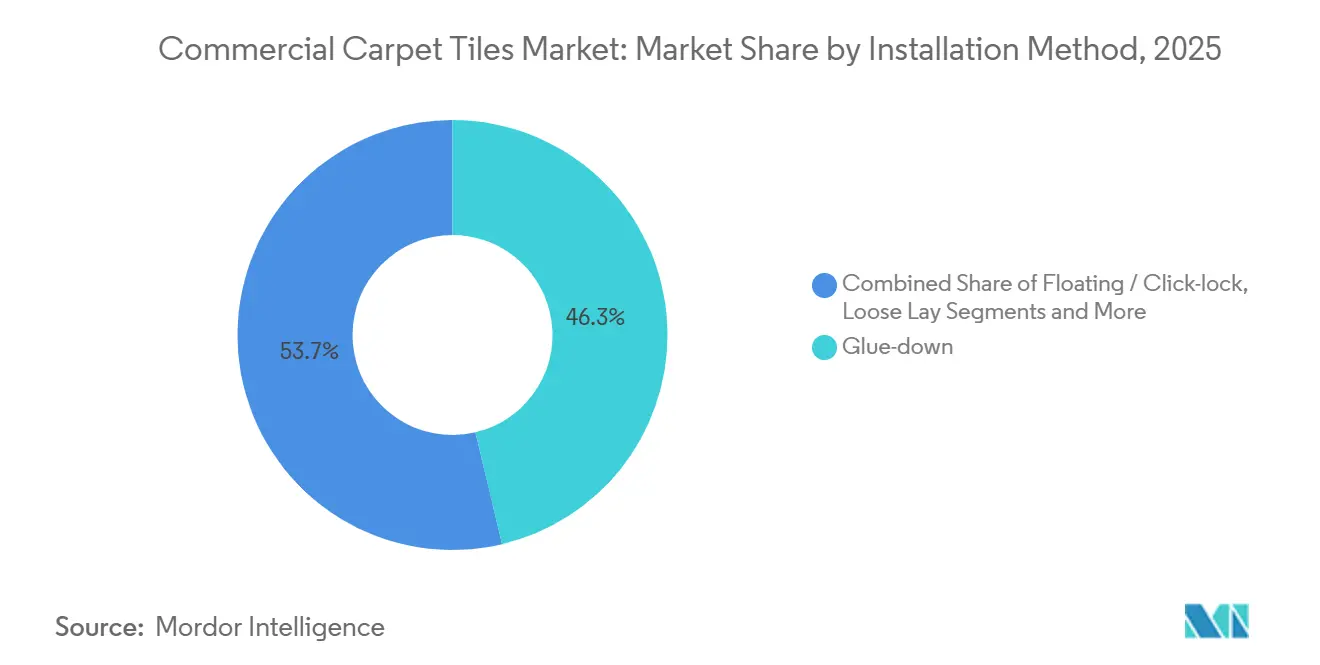
- By installation method, glue-down held a 46.3% share in the commercial carpet tiles market in 2025, while loose-lay systems are forecast to grow at a 6.3% CAGR through 2031.
- By construction type, new construction held a 72% share of the commercial carpet tiles market in 2025, while remodeling and retrofitting are forecast to grow at a 5.7% CAGR through 2031.
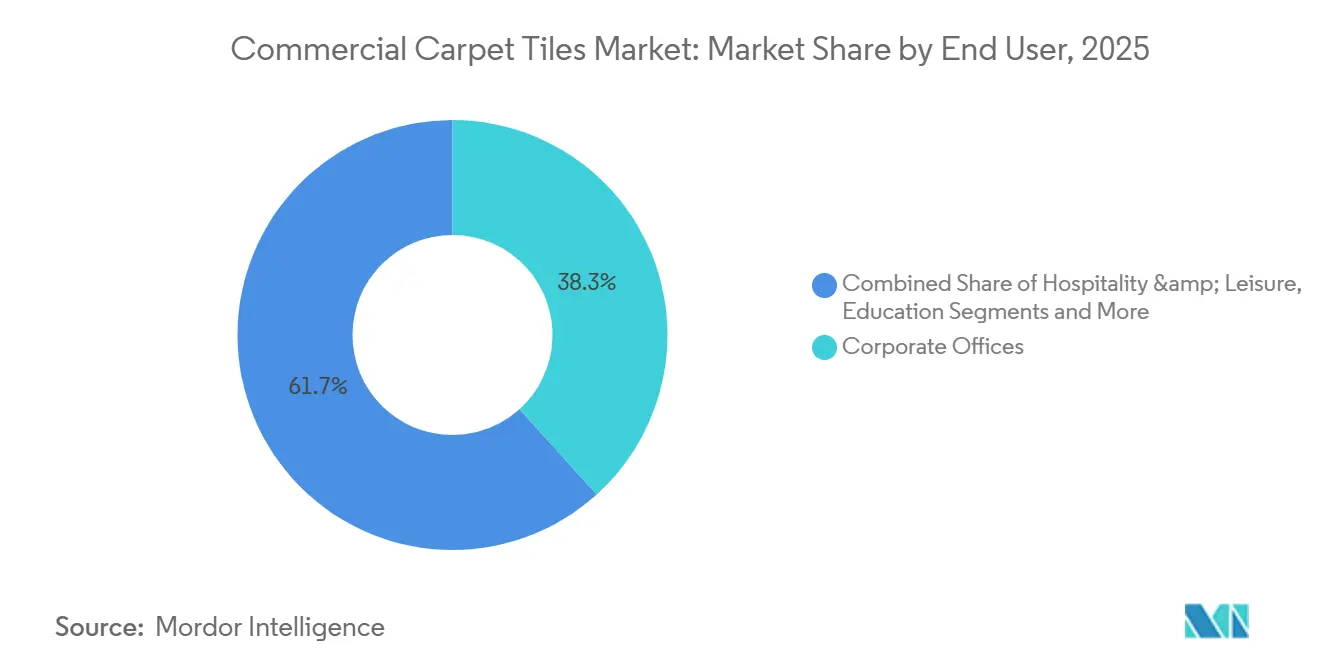
- By end user, corporate offices held a 38.3% share in the commercial carpet tiles market in 2025, while healthcare is forecast to grow at a 6.7% CAGR through 2031.
- By distribution channel, dealers and retailers accounted for 61% of the commercial carpet tiles market in 2025, while direct sales are forecast to grow at a 6.2% CAGR through 2031.
- By geography, North America held a 33.5% share in the commercial carpet tiles market in 2025, while Asia-Pacific is forecast to grow at a 6.8% CAGR through 2031.
Note: Market size and forecast figures in this report are generated using Mordor Intelligence’s proprietary estimation framework, updated with the latest available data and insights as of January 2026.
Global Commercial Carpet Tiles Market Trends and Insights
Drivers Impact Analysis*
| Driver | (~) % Impact on CAGR Forecast | Geographic Relevance | Impact Timeline |
|---|---|---|---|
| Renovation and retrofit acceleration in offices and hospitality | +1.8% | Global, with concentration in North America, Western Europe, and tier-1 Asia-Pacific cities | Medium term (2-4 years) |
| Green-building procurement (LEED/WELL/BREEAM) favors low-embodied-carbon tiles | +1.4% | Global, led by North America and the European Union, is accelerating in Asia-Pacific through compliance frameworks in Singapore, Japan, and Australia. | Long term (≥ 4 years) |
| Modularity advantages, fast install, low waste, lower lifecycle cost vs. broadloom | +1.2% | Global | Medium term (2-4 years) |
| Asia-Pacific commercial build-out and capex in education and healthcare | +1.5% | Asia-Pacific core, with spill-over to the Middle East and Africa | Long term (≥ 4 years) |
| Adhesive-free systems enabling reuse and circular de-installation | +0.9% | Global, with early adoption in North America and Nordic markets | Long term (≥ 4 years) |
| Circular take-back and recycling partnerships are expanding material recovery | +0.3% | North America and Europe, with pilots in Australia and New Zealand | Long term (≥ 4 years) |
| Source: Mordor Intelligence | |||
Renovation and Retrofit Acceleration in Offices and Hospitality
Renovation cycles in mature office markets are moving faster as landlords upgrade spaces to meet tenant expectations for acoustics, brand expression, and healthier interiors. This shift favors modular formats because phased installation can proceed around active operations with minimal downtime and limited disruption to occupants. The commercial carpet tiles market benefits from adhesive-free options that avoid curing delays, helping schedule-sensitive projects that must keep floors open. Hospitality properties continue to refresh guest rooms and meeting areas on shorter timelines, and soft-surface acoustics help maintain comfort and speech privacy. These practical considerations reinforce carpet tile preferences for areas where sound control and targeted replacement are valuable. The commercial carpet tiles market remains aligned with retrofit-led demand because modularity supports quick reinstatement and future reconfiguration.
Green-Building Procurement Favoring Low-Embodied-Carbon Tiles
Project teams now treat embodied-carbon transparency and emissions performance as integral to product selection rather than optional features. LEED v5 introduced a prerequisite for whole-building embodied-carbon quantification, which elevates product-specific Environmental Product Declarations to a standard requirement in many projects [1]Green Badger Editorial Team, “LEED v5 Embodied Carbon Prerequisite Overview,” Green Badger, greenbadger.com . WELL v2 enforces low-emitting product performance, and its emissions requirements are routinely met by leading carpet tile brands through recognized certification programs [2]International WELL Building Institute, “WELL Building Standard v2,” IWBI, iwbi.org . Cradle to Cradle certification remains an influential material-health signal, and several leading backings and carpet tile platforms have achieved verified levels under that program. Manufacturers with comprehensive lifecycle assessment programs and clear documentation practices gain specification preference because their data support project scoring and compliance reviews. The commercial carpet tiles market is thus moving toward verified transparency, which benefits brands that can furnish current EPDs and material health declarations.
Modularity Advantages, Fast Install, Low Waste, Lower Lifecycle Cost vs. Broadloom
Modular carpet tiles support faster project schedules because individual units can be replaced or rearranged without full-floor downtime. Installation waste is lower than roll formats, and targeted maintenance cuts replacement costs across the space during a standard lease term. Adhesive-free systems, such as repositionable connector squares at tile intersections, eliminate the need for wet adhesives and reduce installer complexity. This approach aligns with tenant changeovers and phased fit-outs because spaces can reopen quickly after installation. The commercial carpet tiles market continues to benefit from rapid-install logic, as the format reduces waste and simplifies end-of-life management. The total ownership profile improves when facility teams replace only the high-wear zones, leaving the remainder of the floor intact.
Asia-Pacific Commercial Build-Out and Capex in Education and Healthcare
Asia-Pacific is projected to be the fastest-growing region as institutional projects in healthcare and education sustain consistent fit-out activity. The region’s growth mix includes government-backed expansions, private investments in high-spec campuses, and ongoing interior improvements that proceed even when new construction slows. The commercial carpet tiles market benefits from these projects because acoustic performance and modularity support both patient well-being and classroom productivity. Regional procurement is also increasing transparency expectations, driving a preference for products with current EPDs and emissions certifications. Adhesive-free systems help large campuses that manage frequent renovations across multiple buildings. The commercial carpet tiles market captures this momentum because institutional spaces require solutions that balance cost, durability, and reconfiguration.
Restraints Impact Analysis*
| Restraint | (~) % Impact on CAGR Forecast | Geographic Relevance | Impact Timeline |
|---|---|---|---|
| Raw-material price volatility (nylon, bitumen, petrochemicals) | -0.8% | Global, with higher exposure in North America and Europe | Short term (≤ 2 years) |
| Share shift to resilient and LVT alternatives in high-wear zones | -1.1% | Global, concentrated in retail, healthcare back-of-house, and high-traffic hospitality areas | Medium term (2-4 years) |
| Installer scarcity and uneven contract-flooring skills | -0.4% | Global, acute in North America, the United Kingdom, and Australia | Medium term (2-4 years) |
| Compliance burden from product transparency and IAQ regulations | -0.2% | North America and Europe, with a rising influence in the Asia-Pacific | Long term (≥ 4 years) |
| Source: Mordor Intelligence | |||
Raw-Material Price Volatility (Nylon, Bitumen, Petrochemicals)
Input-cost swings in nylon, bitumen, and related petrochemical feedstocks create uncertainty for manufacturers and distributors. Spot volatility compresses margins and complicates pricing for multi-month project timelines that cannot absorb frequent cost resets. Producer price trends in carpet and rug manufacturing signaled some relief into early 2026, yet the long-run index level reflects a higher structural cost base relative to historical benchmarks [3]Federal Reserve Bank of St. Louis, “Producer Price Index by Industry, Carpet and Rug Mills (PCU3141131411),” FRED, fred.stlouisfed.org . Circular sourcing helps mitigate exposure because post-use material streams can reduce reliance on virgin resin when take-back programs run at scale. Companies are expanding reclamation and recycling programs that improve feedstock stability and enable higher recycled content. The commercial carpet tiles market will continue to manage cost pressure through circular inputs, but price variability remains a near-term operational headwind.
Installer Scarcity and Uneven Contract-Flooring Skills
Project schedules often extend when experienced installation crews are in short supply, especially during peak fit-out periods. Skill gaps can also affect installation quality, increasing the risk of rework and follow-on maintenance calls. Adhesive-free systems reduce complexity and enable crews new to modular carpets to learn faster. Leading brands run training programs to standardize best practices across dealer and installer networks, ensuring consistent field performance. This investment helps reduce callbacks and strengthens confidence in modular systems in markets with limited specialist capacity. The commercial carpet tiles market is resilient through these strains because modularity simplifies site work and allows staged delivery, yet labor bottlenecks still slow overall throughput.
*Our forecasts treat driver/restraint impacts as directional, not additive. The impact forecasts reflect baseline growth, mix effects, and variable interactions.
Segment Analysis
By Product Type: Tufted Tiles Retain Broad Use While Woven Tiles Lead Premium Growth
Tufted tiles accounted for 66.7% of the commercial carpet tiles market in 2025. Their leading position reflects cost efficiency, design flexibility, and compatibility with polyurethane and bitumen backings. Solution dyeing, patterning, and pile height options allow suppliers to serve a wide range of commercial interiors. Tufted products also have established dealer coverage and broad availability in take-back programs. These advantages help the format meet performance requirements across offices, education facilities, hospitality sites, and institutions. Its large installed base also supports repeat purchases, sample availability, and replacement tile needs. The commercial carpet tiles market continues to rely on tufted construction as the main option for projects that balance specification breadth with budget discipline.
Woven tiles are forecast to grow at a 6.4% CAGR through 2031, making them the fastest-growing product type. The format is supported by premium hospitality demand in the Gulf Cooperation Council and bespoke corporate campus projects in East Asia. Woven constructions are compatible with wool and bio-based fiber inputs that can support specialized certification goals. Hotel operators and corporate real estate teams also value distinctive design and extended service life in high-visibility interiors. Mohawk announced the acquisition of Bremworth in June 2026 to add premium wool capability and deepen its natural-fiber offering [4]Mohawk Industries, “Investor Relations,” Mohawk Industries, mohawkind.com. This move reflects the importance of premium product options in hospitality and commercial specifications. Needle-punched tiles remain relevant for entrance mats, exhibitions, modular office pods, and event spaces where a low pile and durable surface are practical priorities.



By Fiber Type: Nylon Maintains the Performance Benchmark While Polyester Gains Recycled Content Demand
Nylon accounted for 58.2% of fiber-type value in 2025 and remains the leading fiber in the commercial carpet tiles market. Its abrasion resistance supports use in commercial spaces with frequent foot traffic and rolling loads. Solution-dyeing provides color durability and design flexibility across many collections. Nylon also fits established environmental product declaration, health product declaration, and material-label programs. These documentation systems help project teams evaluate materials for LEED and BREEAM work. Fiber retains an important role in products that require dependable performance, color retention, and broad acceptance across specifications. Its position is especially strong where design requirements and long-term wear expectations are both important.
Polyester is forecast to grow at a 6.5% CAGR through 2031. Milliken’s Thrive Matter yarn contains 90% recycled PET and is used in multiple collections. The company reported an 89% reduction in embodied carbon per tile for collections using this fiber. Polypropylene continues to serve budget-focused commercial and institutional applications, although its lower abrasion resistance limits its use in premium applications. Wool plays a smaller but higher-value role in hospitality and heritage projects in the United Kingdom, Australia, New Zealand, and the Nordic region. Bio-based fibers remain at below 1% penetration, yet receive research attention due to their connection to biogenic carbon and material-health objectives.
By Installation Method: Glue-Down Leads While Loose-Lay Systems Gain Reuse Value
The glue-down installation accounted for 46.3% of the value in 2025. It remains common in large corporate and institutional projects where permanent bonding supports stable performance under rolling loads. The method also has a long record in projects with familiar installation practices and established contractor processes. Glue-down tiles, therefore, retain a substantial share of the commercial carpet tiles market despite growing interest in circular removal. A permanent installation can meet project needs when floor conditions, traffic patterns, and specification requirements favor a fixed system. Manufacturers continue to support this method across a broad range of products. Its existing penetration gives it an enduring role during the forecast period.
Loose-lay and adhesive-free systems are forecast to grow at a 6.3% CAGR through 2031. Tenants and healthcare operators use these systems to reduce disruption during renovation and to support end-of-life tile recovery. Interface states that TacTiles can reduce labor requirements and allow occupancy without an adhesive-curing delay. Tarkett’s DESSO collections also offer acoustic backing options in loose-lay configurations. Floating and click-lock formats serve the needs of fast-turn hospitality refurbishments, although seam integrity remains an issue under heavy commercial traffic. Nail and staple methods remain a limited option for wood-subfloor retrofit projects. The adhesive-free methods to benefit as take-back infrastructure and circular design requirements become more common.
By Construction Type: New Construction Holds Volume While Remodeling Grows Faster
New construction accounted for 72% of the commercial carpet tiles market size in 2025. Large projects in Asia-Pacific healthcare and education, Gulf hospitality, and North American campuses underpin this volume. New projects can provide extensive floor area and enable standardization across buildings within a development. Many budget-sensitive developments select mid-tier tufted products, which support volume but can limit average selling prices. Flagship corporate sites can still use premium products where design, acoustics, and material documentation are part of the brief. The major commercial construction activity is a foundation for the segment. New construction, therefore, remains the main volume base for manufacturers and distribution partners.
Remodeling and retrofit are forecast to grow at a 5.7% CAGR through 2031. This growth follows a broader need to update occupied offices and institutional assets with more flexible, lower-emission, and better-documented finishes. The segment is well-suited to phased installation because work can occur floor by floor or in occupied buildings. Refurbishment teams can replace a damaged or outdated zone without removing an entire finish. Premium design, adhesive-free systems, and environmental declarations carry more weight in these projects than in many budget-led new builds. The commercial carpet tile industry benefits because tile formats help ensure operational continuity during renovations. The refurbishment work supports higher-value product selection and sustained average selling prices.
By End User: Corporate Offices Maintain Share, While Healthcare Is Projected to Record the Fastest Growth
Corporate offices held 38.3% of end-user demand in 2025. Employers continue to use upgraded interior finishes, acoustics, and indoor air quality materials to improve shared workplace environments. Carpet tiles support this goal through modular replacement, design choice, and sound control in open work areas. The format also works with phased upgrades that do not require a full building closure. Office customers often consider environmental documentation when selecting products for a corporate space renewal. This supports demand for products with environmental product declarations and verified emissions information. Corporate offices remain the largest end-user segment in the commercial carpet tiles market, as their renovation cycles drive frequent replacement.
Healthcare is forecast to grow at a 6.7% CAGR through 2031. The segment requires products that can support acoustic control, heavy cleaning, and continuous operations. Interface reported 21% growth in global healthcare billings during the full-year 2025. Its education billings grew 8% over the same period. These results reflect the value of sector-focused product design and sustainability documentation in institutional procurement. Hospitality also supports demand through regular room refurbishment cycles and increased use of woven products in luxury properties. Education facilities value acoustic control in libraries, classrooms, and common areas, while public buildings provide steady but price-sensitive replacement demand.
By Distribution Channel: Dealers Retain Scale While Direct Sales Deepen Manufacturer Relationships
Dealers and retailers accounted for 61% of distribution-channel demand in 2025. They remain the main route to market for mid-market office projects, education work, and hospitality renovation. Contractors and designers use dealer showrooms to compare products, obtain samples, and coordinate delivery. This channel also connects manufacturers with local installers and project teams. Its reach helps suppliers serve projects that do not warrant a national-account relationship. Established dealer networks remain important to the commercial carpet tiles market because they support product availability and specification support across many local markets. Retailer and dealer involvement is particularly valuable where rapid sample fulfillment influences a project decision.
Direct sales are forecast to grow at a 6.2% CAGR through 2031. Large manufacturers are building relationships with corporate procurement teams, national accounts, and professional specifiers. Digital product information, building information modeling files, and environmental product declaration databases make this approach more practical. Direct programs can also integrate product customization, take-back enrollment, and post-installation support into one customer relationship. The direct transactions can yield net selling prices 8-12% higher than those for dealer-mediated orders. This channel is strengthened when customers need Scope 3 documentation for sustainability reporting. E-commerce remains focused on replenishment and spare-tile orders, while direct manufacturer-to-installer relationships are gradually expanding in developing regions.
Geography Analysis
North America accounted for 33.5% of the commercial carpet tiles market share in 2025. The region has a mature replacement cycle, with office refurbishments generating recurring demand for premium, documented products. LEED certification supports the use of environmental product declarations and low-embodied-carbon materials in many project specifications. The United States remains the largest national demand center, while Canada and Mexico add demand through office, government, and commercial construction. Compliance requirements such as FloorScore, GREENGUARD Gold, and California indoor air quality rules create technical barriers that can favor established certified suppliers. Replacement activity, certification expectations, and the need for flexible installation in occupied properties, therefore, shape the commercial carpet tiles market in North America.
Asia-Pacific is forecast to grow at a 6.8% CAGR through 2031. The region combines commercial construction volume with growing demand in education, healthcare, hospitality, and corporate sectors. Projects increasingly require flexible flooring that can accommodate phased occupation and localized replacement. Japan’s corporate and hospitality projects support demand for woven and high-performance tufted products. Australia and New Zealand provide a platform for circular materials, including Milliken’s Renasci tile, which launched in those markets in August 2025. The commercial carpet tiles market benefits as regional project teams pay closer attention to acoustic performance, recycled content, and documented environmental attributes. These needs support both mainstream tufted products and premium specifications.
Europe, the Middle East & Africa, and South America have distinct demand patterns shaped by compliance requirements, project investment, and purchasing power. Europe has a strong presence of replacement bases in corporate and institutional buildings, and BREEAM requirements support the documentation of flooring products. Tarkett operates a closed-loop recycling system for DESSO tiles at its Waalwijk facility in the Netherlands, supporting its circular product strategy with key European accounts. The Middle East has project-specific demand from hospitality and corporate developments, where premium woven and design-led tile options can be important. South America has opportunities in mixed-use and hospitality projects, although economic volatility can affect project timing and procurement. Across these regions, the commercial carpet tiles market is supported by project owners who prioritize acoustic comfort, modular replacement, and materials with clear sustainability records.

Competitive Landscape
The commercial carpet tiles market is moderately concentrated, with the top five global players together accounting for an estimated 60% of revenue in 2025. Interface, Shaw, Mohawk, Tarkett, and Milliken continue to scale circular logistics and invest in backings and fibers that support lower embodied carbon. Interface reports ongoing reductions in product carbon footprints and increased use of renewable energy across its manufacturing network. Tarkett’s DESSO portfolio emphasizes take-back integration and recycled content in backings, which supports regulatory goals in European projects. Adhesive-free systems are now widespread across leading brands and remain central to project speed and circular de-installation. The competitive playbook includes product-level EPD coverage, emissions certifications, and cradle-to-cradle credentials to meet evolving procurement requirements.
Strategic moves include updates to circular programs, new low-carbon collections, and expanded production of backings that can be fully recovered at the end of use. Interface detailed continued progress on climate metrics in its 2024 Impact Report and expanded European capacity to recycle post-use tiles into new products. Milliken launched a circular, resilient line that incorporates carpet waste and soft plastics, broadening its materials toolkit for zoned flooring strategies that pair soft and hard surfaces. These innovations complement core carpet tile ranges and give specifiers more options to balance acoustics, durability, and embodied carbon. Brands are also digitizing the path from design to delivery with online EPD access, visualization tools, and order tracking, which support on-demand manufacturing and smaller-batch replenishment. Digital tufting and AI-based pattern design are emerging levers to accelerate bespoke layouts while reducing design iteration time. The commercial carpet tiles market will continue to reward proof-backed sustainability, fast installation systems, and transparent data that simplifies project scoring.
Leaders are also advancing carbon-negative carpet tiles by using backings and fillers that store more carbon than they emit during manufacture, and by investing in renewable energy at production sites. Textile chemistry is shifting toward more circular and safer formulations, including sustainable materials - Bio-based polymer (partially plant-derived) components in backings that can be recaptured and reused. Training networks that improve installer proficiency with adhesive-free systems are expanding to ensure consistent field performance across markets. The commercial carpet tiles market remains dynamic as brands compete on lifecycle transparency, rapid-ship availability, and total cost of ownership advantages derived from targeted maintenance and modular flexibility. Suppliers that can document reductions in embodied carbon, simplify recovery, and deliver fast are positioned to defend and grow share through 2031.
Commercial Carpet Tiles Industry Leaders
Interface, Inc.
Shaw Industries Group, Inc.
Tarkett S.A.
Milliken & Company
Mohawk Industries, Inc.
- *Disclaimer: Major Players sorted in no particular order

Recent Industry Developments
- April 2026: Mohawk Industries acquired Hero Flooring and added Nike Grind recycled-rubber flooring to its commercial resilient portfolio. This strengthens its offerings for fitness centers and sports facilities, combining rubber durability with carpet tile acoustics in zoned layouts.
- April 2026: Mohawk Group updated its Rudiments carpet tile collection with Thrive Matter yarns (up to 90% recycled content) and EcoFlex NXT recyclable backing, replacing bitumen-backed versions. The update reduces embodied carbon and supports Mohawk's circular design framework.
- August 2025: Milliken launched Renasci resilient flooring in Australia and New Zealand, made from carpet waste and soft plastic waste as part of its circularity program.


Global Commercial Carpet Tiles Market Report Scope
The commercial carpet tiles market covers modular carpet flooring products designed for commercial and institutional spaces. It includes tufted, woven, and needle-punched carpet tiles made from nylon, polyester, polypropylene, wool, recycled materials, and emerging bio-based fibers. The scope covers glue-down, loose-lay, adhesive-free, floating, click-lock, nail-down, and staple-down installation methods.
The market assesses demand from new construction, remodeling, or retrofit projects. End-user coverage includes corporate offices, healthcare facilities, hospitality and leisure properties, retail spaces, educational institutions, public buildings, and government facilities. Distribution coverage includes dealers and retailers, and direct manufacturer sales.
The geographic scope includes North America, Europe, Asia-Pacific, the Middle East & Africa, and South America. The study excludes residential carpet tiles, broadloom carpets, rugs, resilient flooring products such as luxury vinyl tile, and non-modular floor coverings.
| Tufted Carpet Tiles |
| Needle-Punched Carpet Tiles |
| Woven Carpet Tiles |
| Nylon |
| Polyester (PET) |
| Polypropylene |
| Wool |
| Bio-based Fibers |
| Other Fiber Types |
| Floating / Click-lock |
| Glue-down |
| Nail / Staple-down |
| Loose-lay / TacTiles |
| New Construction |
| Remodeling / Retrofit |
| Hospitality & Leisure |
| Retail & Shopping Centers |
| Healthcare Facilities |
| Education |
| Corporate Offices |
| Public & Government Buildings |
| Other Commercial Users |
| Direct Sales |
| Dealers and Retailers |
| North America | Canada |
| United States | |
| Mexico | |
| South America | Brazil |
| Peru | |
| Chile | |
| Argentina | |
| Rest of South America | |
| Europe | United Kingdom |
| Germany | |
| France | |
| Spain | |
| Italy | |
| BENELUX (Belgium, Netherlands, Luxembourg) | |
| NORDICS (Denmark, Finland, Iceland, Norway, Sweden) | |
| Rest of Europe | |
| Asia-Pacific | India |
| China | |
| Japan | |
| Australia | |
| South Korea | |
| South-East Asia | |
| Rest of Asia-Pacific | |
| Middle East & Africa | United Arab Emirates |
| Saudi Arabia | |
| South Africa | |
| Nigeria | |
| Rest of Middle East & Africa |
| By Product Type | Tufted Carpet Tiles | |
| Needle-Punched Carpet Tiles | ||
| Woven Carpet Tiles | ||
| By Fiber Type | Nylon | |
| Polyester (PET) | ||
| Polypropylene | ||
| Wool | ||
| Bio-based Fibers | ||
| Other Fiber Types | ||
| By Installation Method | Floating / Click-lock | |
| Glue-down | ||
| Nail / Staple-down | ||
| Loose-lay / TacTiles | ||
| By Construction Type | New Construction | |
| Remodeling / Retrofit | ||
| By End-User | Hospitality & Leisure | |
| Retail & Shopping Centers | ||
| Healthcare Facilities | ||
| Education | ||
| Corporate Offices | ||
| Public & Government Buildings | ||
| Other Commercial Users | ||
| By Distribution Channel | Direct Sales | |
| Dealers and Retailers | ||
| By Geography | North America | Canada |
| United States | ||
| Mexico | ||
| South America | Brazil | |
| Peru | ||
| Chile | ||
| Argentina | ||
| Rest of South America | ||
| Europe | United Kingdom | |
| Germany | ||
| France | ||
| Spain | ||
| Italy | ||
| BENELUX (Belgium, Netherlands, Luxembourg) | ||
| NORDICS (Denmark, Finland, Iceland, Norway, Sweden) | ||
| Rest of Europe | ||
| Asia-Pacific | India | |
| China | ||
| Japan | ||
| Australia | ||
| South Korea | ||
| South-East Asia | ||
| Rest of Asia-Pacific | ||
| Middle East & Africa | United Arab Emirates | |
| Saudi Arabia | ||
| South Africa | ||
| Nigeria | ||
| Rest of Middle East & Africa | ||


Key Questions Answered in the Report
What is the projected value of commercial carpet tiles by 2031?
The commercial carpet tiles market is forecast to reach USD 10.8 billion by 2031, growing at a 5.6% CAGR from 2026.
Which product type has the greatest demand?
Tufted tiles led with 66.7% of value in 2025 due to their design flexibility and cost efficiency.
Which fiber is growing fastest for commercial carpet tiles?
Polyester is forecast to grow at a 6.5% CAGR through 2031, supported by recycled-content requirements.
Why are adhesive-free carpet tile systems gaining use?
Loose-lay systems are forecast to grow at a 6.3% CAGR because they reduce disruption and support tile recovery.
Which end user is expected to grow the fastest?
Healthcare is forecast to grow at a 6.7% CAGR through 2031, driven by demand for acoustic and cleanable flooring.
Which region is forecast to grow the fastest?
Asia-Pacific is forecast to grow at a 6.8% CAGR through 2031, supported by commercial and institutional construction.
Page last updated on:


 Your data is secure and never sold or shared.


