
Market Overview
| Study Period | 2020 - 2031 |
|---|---|
| Forecast Data Period | 2026 - 2031 |
| Base Year Market Size (2025) | USD 387.58 Million |
| Market Size (2026) | USD 407.85 Million |
| Market Size (2031) | USD 526.3 Million |
| Growth Rate (2026 - 2031) | 5.23 % |
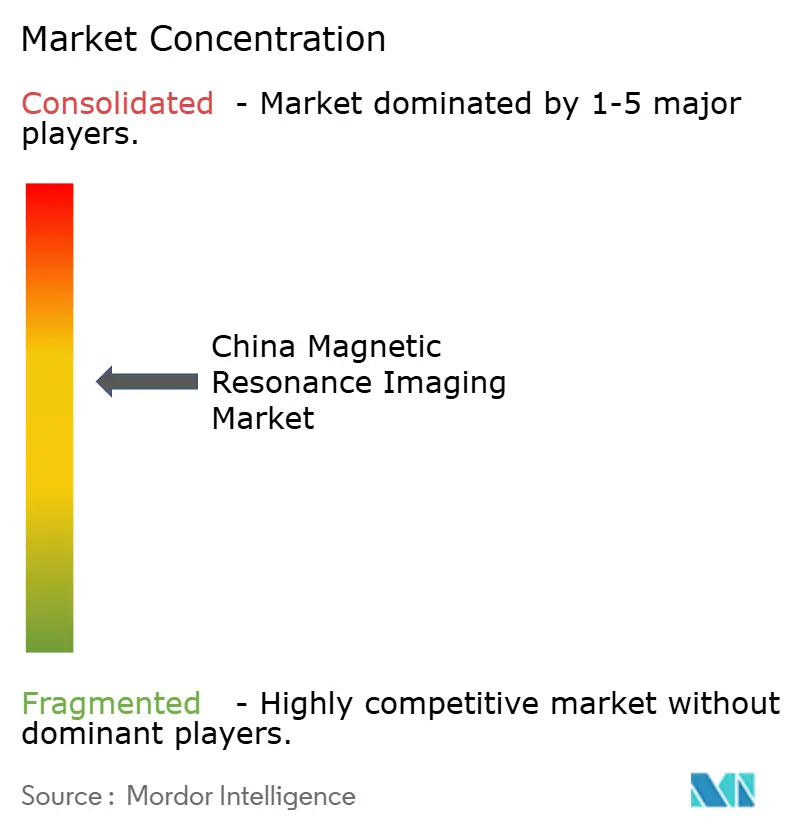
| Market Concentration | Medium |
Major Players
*Disclaimer: Major Players sorted in no particular order Image © Mordor Intelligence. Reuse requires attribution under CC BY 4.0. |
|
China Magnetic Resonance Imaging Market Analysis by Mordor Intelligence
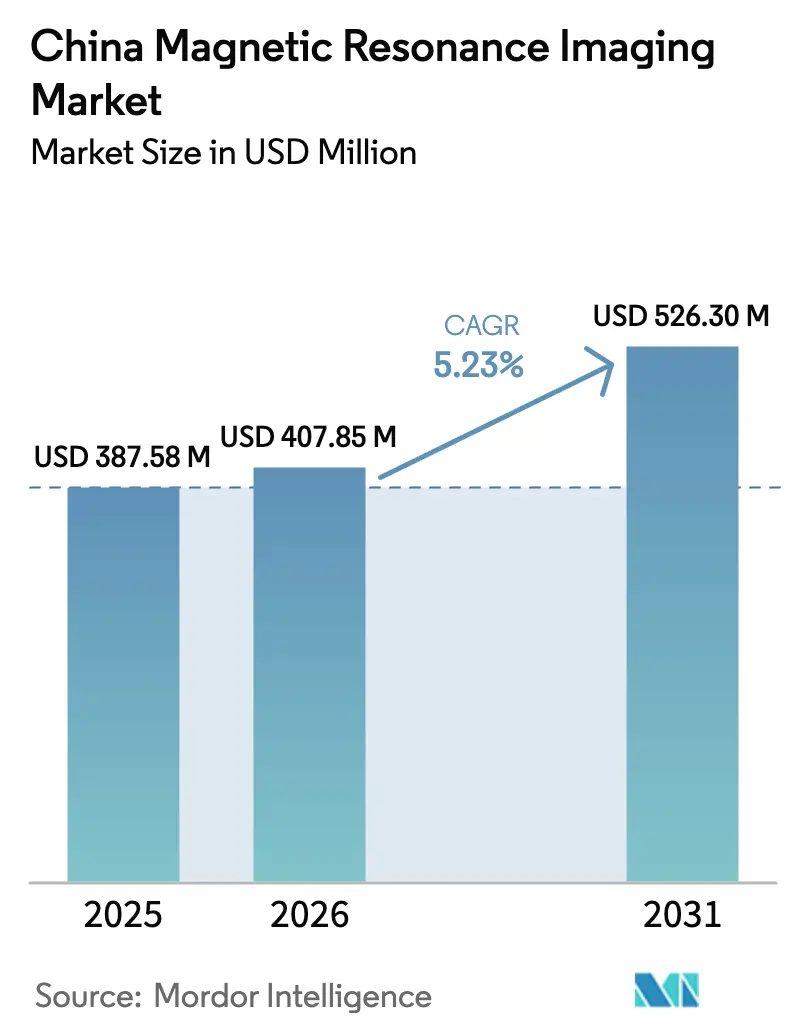
The China MRI market size was valued at USD 387.58 million in 2025 and estimated to grow from USD 407.85 million in 2026 to reach USD 526.3 million by 2031, at a CAGR of 5.23% during the forecast period (2026-2031). Continued public-health spending, helium-free magnet roll-outs, and widespread hospital AI adoption keep demand resilient despite lingering macro-economic uncertainty. Domestic vendors now supply most mid-field units, encouraged by volume-based procurement rounds that compress prices yet expand installed base coverage. Helium scarcity is accelerating solid-cooling innovation, while portable low-field systems open an entirely new access tier for rural stroke care. Finally, regulatory fast-tracks under the “Healthy China 2030” policy shorten time-to-market for novel systems and safeguard domestic R&D investment.
Key Report Takeaways
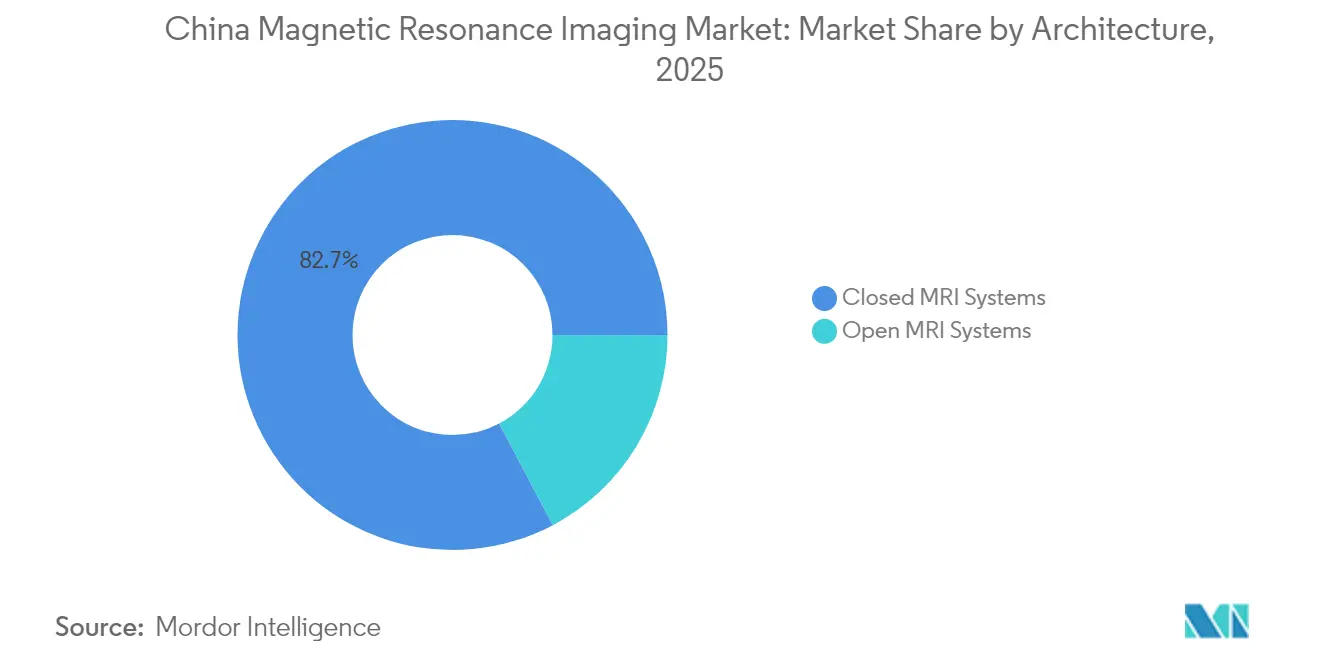
- By architecture, closed MRI systems led with 82.73% revenue share in 2025, while open systems are projected to expand at a 6.02% CAGR through 2031.
- By field strength, mid/high-field (1–3 T) systems held 55.74% of the China MRI market share in 2025, and ultra-high-field (>3 T) systems are forecast to grow 5.63% CAGR to 2031.
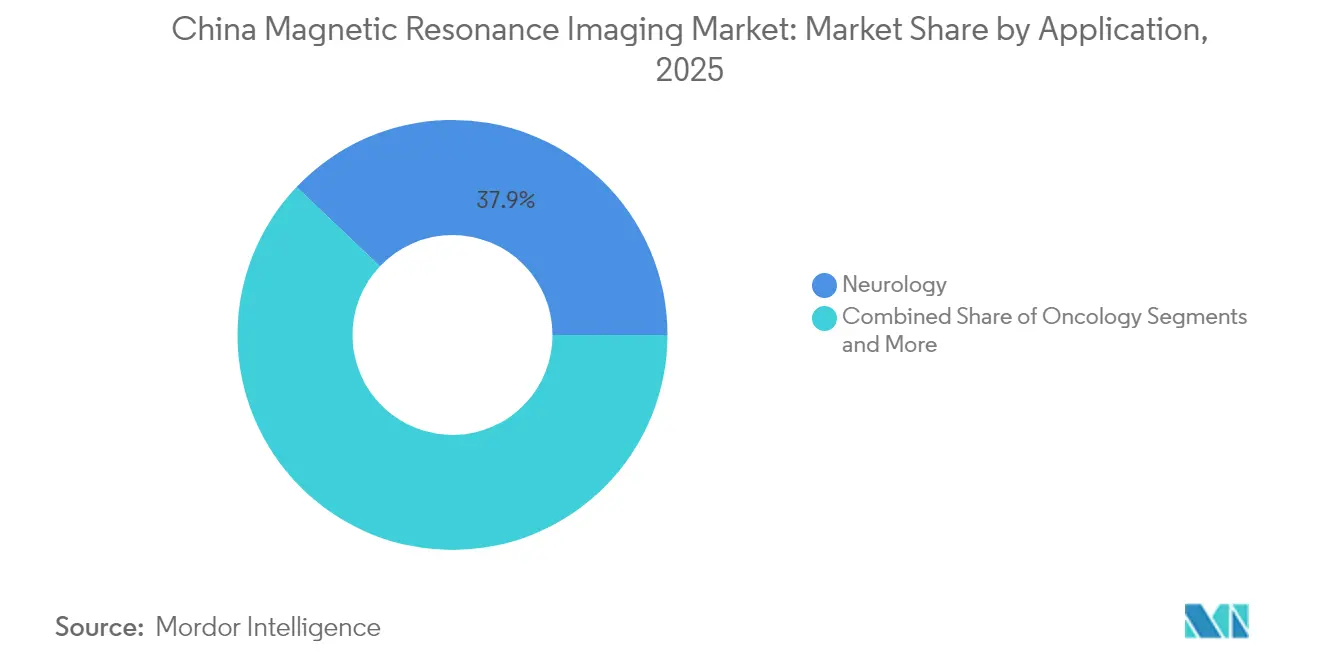
- By application, neurology accounted for 37.92% share of the China MRI market size in 2025 and oncology is advancing at a 6.03% CAGR through 2031.
- By end user, hospitals captured 47.88% share of the China MRI market size in 2025 while stand-alone imaging centers record the fastest projected CAGR at 6.18% through 2031.
Note: Market size and forecast figures in this report are generated using Mordor Intelligence’s proprietary estimation framework, updated with the latest available data and insights as of 2026.
China Magnetic Resonance Imaging Market Trends and Insights
Drivers Impact Analysis*
| Driver | (~) % Impact on CAGR Forecast | Geographic Relevance | Impact Timeline |
|---|---|---|---|
| Aging Population & Chronic-Disease Burden | +1.2% | National, concentrated in tier-1 cities | Long term (≥ 4 years) |
| Expansion Of Universal Health Coverage | +0.8% | National, with rural emphasis | Medium term (2-4 years) |
| Strong Central-Government Commitments Under "Healthy China 2030" | +1.0% | National | Long term (≥ 4 years) |
| Adoption Of High-/Ultra-High-Field & Hybrid MRI | +0.7% | Tier-1 and tier-2 cities | Medium term (2-4 years) |
| Volume-Based Procurement Fueling Domestic OEMs | +0.9% | National | Short term (≤ 2 years) |
| Rise Of Portable Low-Field MRI For Stroke Triage | +0.5% | Rural and emergency care settings | Short term (≤ 2 years) |
| Source: Mordor Intelligence | |||
Aging Population & Chronic-Disease Burden
China’s fast-graying society fuels imaging demand as inpatient costs for citizens aged ≥ 65 averaged USD 1,199.24 per stay in 2024 and continue to climb [1]. Chronic cardiac and neurovascular conditions often require MRI follow-up, and intracranial-aneurysm prevalence of 7%—well above global norms—further concentrates neurologic workload. Tier-1 hospitals respond with high-field upgrades that improve signal-to-noise ratios essential for micro-vascular scans. AI-enabled cardiac MRI now screens 11 cardiovascular pathologies at AUC 0.988 across eight centers, illustrating clinical gains that reinforce adoption. Together these demographic and disease trends lift exam volumes and justify broader capital budgets for next-generation systems.
Expansion of Universal Health Coverage
Commercial medical-insurance premiums reached RMB 900 billion in 2025, complementing public insurance and broadening reimbursement for advanced imaging. Diagnosis-Related Group payment caps cover more than 80% of inpatient expenditure, motivating hospitals to buy faster multipurpose scanners that clear patient backlogs. Rural capsule-clinic pilots rely on portable units that plug into wall outlets and deliver stroke triage accuracy comparable to fixed 1.5 T rooms, bridging access gaps. Together, coverage expansion and flexible reimbursement frameworks extend MRI utilization well beyond metropolitan corridors.
Strong Central-Government Commitments under “Healthy China 2030”
Regulatory reform remains pivotal: the National Medical Products Administration (NMPA) issued twenty-four measures in January 2025 that include parallel reviews and tax credits for innovative devices. Capital subsidies and procurement preferences favor domestic OEMs, aligning with targets to list six Chinese device firms among the global top 50 by 2025. Strategic mergers—such as Neusoft Medical’s state-backed equity infusion—build national champions that can compete overseas and defend local market share.
Adoption of High-/Ultra-High-Field & Hybrid MRI
United Imaging’s FDA-cleared 5 T scanner bridges the gap between mainstream 3 T and research-grade 7 T units, making sub-millimeter neuro-imaging viable in routine practice. Ultra-high-gradient 3 T platforms now finish a prostate study in 5.5 minutes while retaining diagnostic quality. Hybrid PET/MRI continues its oncology base yet gains traction in cardiology and epilepsy care as radiopharmaceutical approvals rise. These upgrades pivot hospitals toward premium modalities that shorten throughput time and enhance precision.
Restraints Impact Analysis*
| Restraint | (~) % Impact on CAGR Forecast | Geographic Relevance | Impact Timeline |
|---|---|---|---|
| High Capital & Helium-Related Opex | -1.5% | National, acute in tier-2/3 cities | Medium term (2-4 years) |
| Lengthy NMPA Class III Device Approval | -0.8% | National | Short term (≤ 2 years) |
| Radiologist Shortage & Workflow Bottlenecks | -0.7% | National, severe in rural areas | Long term (≥ 4 years) |
| Margin Squeeze From Centralized Price Caps | -1.0% | National | Short term (≤ 2 years) |
| Source: Mordor Intelligence | |||
High Capital & Helium-Related Opex
China consumes 25.65 million m³ of helium annually yet produces only 1.3 million m³, driving 95% import dependence. Spot prices have spiked 250% since 2015, squeezing hospital budgets and delaying service contracts. Conventional scanners consume roughly 27% of global helium each year, prompting shutdowns when supply is rationed [2]. OEMs now race to deploy solid-cooling magnets; Wandong Medical’s helium-free 1.5 T system maintains –269 °C coil temperature while reducing operating costs by more than one-half. These engineering gains mitigate, but do not yet eliminate, cost pressure in lower-tier cities.
Lengthy NMPA Class III Device Approval
Class III MRI devices undergo the most rigorous Chinese review cycle, requiring multi-center trials that prolong market entry. Despite the 2025 reform package, imported models still face longer queues than locally developed units and must establish on-shore quality-management systems before bidding eligibility. The time lag disadvantages foreign vendors in fast-moving procurement rounds and slows technology diffusion to end users eager for the latest software features.
*Our forecasts treat driver/restraint impacts as directional, not additive. The impact forecasts reflect baseline growth, mix effects, and variable interactions.
Segment Analysis
By Architecture: Closed Systems Maintain Dominance
Closed units accounted for 82.73% of the China MRI market in 2025 because their higher field strength supports complex neuro-oncologic and cardiac protocols. Throughput pressure and newer algorithms that automate patient positioning now let these sealed tunnels finish a brain scan in as little as 4 minutes. The arrival of wider-bore closed systems further improves patient comfort, eroding historical open-MRI advantages. Open designs nonetheless grow at a 6.02% CAGR as surgeons adopt intra-operative guidance and imaging centers cater to bariatric or claustrophobic populations. Hospitals in secondary cities increasingly buy hybrid models that promise closed-style image fidelity within semi-open form factors, balancing versatility with workflow efficiency.
A parallel engineering trend focuses on helium-free closed magnets, which slash long-term ownership costs and temper supply-chain exposure. Domestic vendors leverage government grants to redesign coil architecture around solid cryogens, strengthening their value proposition in tender documents. As end users weigh capital expenditure against function, closed systems retain the largest slice of the China MRI market size even as architectural preferences diversify.

By Field Strength: Mid-Field Rules, Ultra-High Field Accelerates
Mid/high-field 1-3 T units captured 55.74% of the China MRI market size in 2025 thanks to their clinical versatility and moderate siting requirements. Dual-gradient hardware and AI-driven reconstruction now let 1.5 T scanners rival 3 T detail in some orthopedic tests, protecting installed mid-field bases from immediate obsolescence. Concurrently, ultra-high-field >3 T platforms post a 5.63% CAGR on the back of precision-medicine research, advanced epilepsy mapping, and micro-vasculature imaging in dementia trials. United Imaging’s 5 T entry offers a pragmatic bridge that fits existing suites yet unlocks sub-millimeter resolution, foreshadowing broader ultra-high-field clinical mainstreaming.
Low-field systems, once relegated to niche uses, return to relevance via deep-learning reconstruction that compensates for weaker signal. Whole-body 0.05 T prototypes now produce diagnostic images in open wards without RF-shielded rooms. This resurgence addresses access inequity in county-level hospitals while offering stroke care within ambulance-based units.
By Application: Neurology Leads, Oncology Gains Speed
Neurology contributed 37.92% to the China MRI market share in 2025, mirroring the nation’s disproportionate intracranial-aneurysm and stroke burden. High-resolution vascular sequences and post-processing AI spot sub-3 mm aneurysms often missed by manual reads. Oncology, expanding at a 6.03% CAGR, benefits from aggressive screening programs for lung and colorectal cancer alongside growing PET/MRI adoption for treatment planning. Cardiology pushes AI-enabled CMR into daily practice, achieving near-real-time strain analysis and boosting throughput for ischemic heart-disease clinics. Musculoskeletal and gastroenterology segments also gain from motion-correction software and nanoprobe-based contrast agents that improve liver-fibrosis staging.
By End User: Hospitals Dominate, Imaging Centers Surge
Hospitals owned 47.88% of the China MRI market size in 2025, leveraging bundled procurement contracts and integrated service coverage. DRG-tied reimbursement incentives push tertiary centers to install faster scanners with automated workflows that maximize daily slot turnover. Stand-alone imaging centers, however, advance at 6.18% CAGR as commercial insurance channels reimburse premium studies and entrepreneurs build high-throughput facilities in suburban catchments. Rural mobile clinics and research labs form a smaller but strategic “Others” segment, often adopting portable or specialty coils to satisfy targeted diagnostic needs without heavy infrastructure.
Geography Analysis
Tier-1 cities—Beijing, Shanghai, Guangzhou, and Shenzhen—house the densest concentration of 3 T and above systems, reflecting higher disposable income and research-hospital clusters. Many academic centers place 7 T scanners in dedicated neuroscience wings to study micro-bleeds and small-vessel disease, reinforcing their reputation as technology incubators. Provincial capital hospitals emulate these leaders by purchasing 1.5 T helium-free units that reduce operating costs yet still deliver comprehensive protocol coverage. Migration from rural provinces to coastal megacities maintains imaging volumes and underpins supplementary service contracts.
Tier-2 and tier-3 cities constitute the next adoption wave. Local governments leverage central stimulus grants to modernize medical equipment, prioritizing mid-field scanners that avoid the power-upgrade costs tied to legacy 3 T rooms. Volume-based procurement rounds allow multiple county hospitals to combine orders, driving unit pricing down and reinforcing domestic manufacturers’ competitive edge. As private insurers expand, imaging centers in these cities deploy open configurations that cater to geriatrics and interventional pain management, diversifying revenue channels.
Rural regions still face access gaps, but mobile capsule clinics equipped with 0.23 T stroke-triage systems now bridge distances of hundreds of kilometers. Real-time teleradiology over 5G networks connects village doctors with urban neuroradiologists, ensuring timely interpretation even when staffing is thin. Government “Internet + Healthcare” policies fund these tele-network backbones, and AI triage algorithms further suppress report turnaround time. Over the forecast horizon, balanced regional deployment is expected as domestic OEMs refine ruggedized units suited to China’s vast interior.
Regulatory Landscape
MRI systems are regulated as Class III medical devices in China, with registration review and clinical evaluation overseen by the National Medical Products Administration (NMPA) and its Center for Medical Device Evaluation (CMDE). On June 23, 2026, CMDE issued the Registration Review Guideline for Medical Magnetic Resonance Imaging Systems (2026 Revision) (Announcement No. 21 of 2026), updating technical expectations for areas such as zero-helium architectures, AI-enabled imaging functions, and RF coil configurations. This changes how OEMs prepare product dossiers and plan test and verification.
Policy direction in 2026 also pointed to further streamlining of evidence requirements and standard-setting for MR. On April 30, 2026, NMPA proposed adding permanent magnet, conventional conducting, and superconducting MRI systems to the Clinical Evaluation Exempt Catalog, which can reduce reliance on extensive clinical studies for qualifying configurations. In parallel, the Medical Device Industry Standards Development and Revision Plan published on February 11, 2026 included new and revised standards covering MRI parameters (including spectroscopy-related items), tightening alignment between product specifications, type testing, and procurement eligibility.
Value Chain Analysis
The China MRI value chain covers upstream magnet and cryogenic subsystems (including helium or alternative cooling stacks), gradient amplifiers, RF coils, electronics and software, and shielding and room build-out, followed by system integration, installation, and lifecycle service (maintenance, upgrades, and helium management where applicable). Helium supply remains a structural input risk in the market context, with high import dependence and elevated price volatility. That is accelerating engineering substitution toward sealed, low-helium, and helium-free magnet designs, and increasing the importance of local component sourcing and service capability to control total cost of ownership.
Downstream, commercialization relies on tender participation, distributor and direct-sales coverage for hospitals and imaging centers, and service networks that can meet uptime expectations under DRG-linked throughput pressure. Multinational suppliers continue localizing parts of the chain in China through in-country manufacturing and R&D footprints, for example via Siemens Healthineers localization efforts and GE HealthCare China manufacturing presence referenced in recent coverage. Domestic OEMs then use volume-based procurement dynamics to scale installations and attach bundled service, software, and training to defend margins under price compression.
Competitive Landscape
The China MRI market is moderately consolidated, with United Imaging Healthcare, Neusoft Medical, and Wandong Medical expanding share through cost-competitive bids and helium-free differentiation. International incumbents Siemens Healthineers, GE HealthCare, and Philips Healthcare remain technology leaders in ultra-high-field research, yet price caps on centralized tenders compress margins. Domestic firms increasingly secure Class III clearances abroad—the 5 T Jupiter scanner gained U.S. FDA approval in 2024—bolstering export credibility and leveling the prestige gap.
Strategic alliances proliferate. Neusoft Medical teamed with General Technology Group to secure financing and broaden service networks, while Siemens committed USD 314 million to a new Suzhou manufacturing site that localizes 1.5 T and 3 T production. Hyperfine extended portable-scanner distribution to Middle-Eastern markets, demonstrating global appetite for point-of-care ultralow-field platforms [3]. The resulting innovation race spans AI workflow engines, quantum-accelerated reconstruction software, and sealed-magnet cooling stacks.
Pricing power tilts toward buyers under volume-based procurement, pressing vendors to bundle service contracts, AI modules, and training into one recurrent-revenue subscription. Companies that master this model secure renewal stickiness and data-lake assets critical for algorithm refinement. Over the next five years, the interplay between regulatory encouragement for domestic champions and relentless helium constraints will dictate share realignment.
China Magnetic Resonance Imaging Industry Leaders
-
Siemens AG
-
Canon Medical Systems
-
GE Healthcare
-
Koninklijke Philips NV
-
JiangSu Magspin Instrument Co. Ltd
- *Disclaimer: Major Players sorted in no particular order
Market Opportunities and Future Outlook
Regulatory and standards updates in 2026 create whitespace for OEMs that align product roadmaps with China-specific technical expectations, particularly for helium-free or low-helium magnet platforms and AI-enabled imaging functions. The CMDE Registration Review Guideline for Medical Magnetic Resonance Imaging Systems (2026 Revision) dated June 23, 2026, along with the 2026 standards work plan published February 11, 2026, provide clearer compliance and verification goalposts. That supports faster iteration cycles for localized platforms and RF coil portfolios targeted to China tender specifications.
A second opportunity centers on positioning high-end and specialized MRI while building on domestic industrial capability. The NMPA priority review program explicitly includes ultra-high-field MRI systems (>=5T). The NMPA also reported 76 innovative device approvals in 2025, plus 25 priority review approvals (up 212.5% year-on-year), indicating an active channel for differentiated systems and advanced clinical software. On the supply side, actions such as Wandong Medicals third-generation liquid-helium-free MRI launch at CMEF 2026 and Siemens Healthineers localization efforts, including localized MRI lineups, reflect procurement pull and engineering choices converging around operating-cost reduction, localization, and workflow productivity. This is most visible for tier-2/3 hospitals and imaging centers managing reimbursement-driven throughput targets.
Recent Industry Developments
- July 2026: Completed nearly 100 million yuan Series A financing to accelerate industrialization of PhaseXCool low-helium superconducting magnet technology for MRI. The funding accelerates PhaseXCool magnet deployment and strengthens domestic high-end MRI pipeline amid localization trends. The investment supports expanding the domestic magnet capability and fosters supply chain resilience for high-performance MRI systems.
- April 2025: Siemens Healthineers announced at CMEF plans to launch nearly 20 localized products in fiscal year 2025, including MAGNETOM Flow MRI and MAGNETOM Terra.X 7T. The localization rollout expands the domestic production footprint and enhances competitive positioning versus domestic players. This move reinforces China based access to advanced imaging capabilities and aligns with the broader localization strategy for medical devices.
- April 2024: Siemens Healthineers partnered with Shanghai Electric Healthcare to release three domestically produced medical imaging devices, including Ultramarine 1.5T MRI. The collaboration advances China based innovation and local manufacturing base in imaging equipment. The domestic product lineup broadens hospital network access to modern imaging solutions and strengthens local industry collaboration.
Research Methodology Framework and Report Scope
Market Definition and Coverage
For this report, the China magnetic resonance imaging (MRI) market covers revenue generated from MRI systems sold and installed in China across hospitals and imaging centers, along with the directly bundled system-level components that come with the scanner purchase and commissioning.
Scope exclusions: We exclude CT, X-ray, ultrasound, PET (including PET-MRI when priced and contracted as a PET system), routine service-only contracts, and standalone software that is not sold as part of an MRI system purchase.
Segmentation Overview
-
By Architecture
- Closed MRI Systems
- Open MRI Systems
-
By Field Strength
- Low-Field (<1T)
- Mid/High-Field (1–3T)
- Very- & Ultra-High-Field (>3T)
-
By Application
- Neurology
- Oncology
- Cardiology
- Musculoskeletal
- Gastroenterology
- Others (urology, gynecology, etc.)
-
By End User
- Hospitals
- Stand-alone Imaging Centers
- Others
Data Sources, Market Sizing, and Validation
Desk Research
Desk research was used to anchor the market to real demand signals in China before assumptions were tested through fieldwork. We relied on public, non-paywalled sources such as National Health Commission releases, National Bureau of Statistics time series, and China customs trade statistics where relevant to components and medical equipment flows. We also reviewed procurement and tender disclosures that are publicly posted by hospitals and provincial platforms, since MRI purchases in China are often visible through bid awards.
To make the model practical, we added structured checks from sources such as peer-reviewed radiology journals for utilization trends, policy documents tied to Healthy China 2030, and association updates that reflect installation and compliance patterns. Company annual reports, investor presentations, and credible press coverage were used to validate product positioning, pricing moves, and local manufacturing ramp-ups. A paid subscription for company financials, plus a global contracts and tenders database, was then used selectively for cross-checking selected deals. This desk source list is illustrative only, and many other references were used for data collection, validation, and clarification during the study.
Primary Interviews and Surveys
Primary work focused on interviews and structured surveys with MRI system suppliers, distributors, hospital radiology procurement teams, and service partners who see replacement cycles and upgrade decisions firsthand. We used these discussions to confirm price bands by field strength, the effect of volume-based procurement on ASPs, and how demand differs between top-tier hospitals and county-level facilities across major provinces.
Distribution of primary research fieldwork respondents
| Company type | Respondent position |
|---|---|
| Top tier: 38% | CXOs: 12% |
| Mid tier: 47% | Functional/Unit leaders: 38% |
| Smaller Players: 15% | Managers: 50% |
Market-Sizing & Forecasting
Sizing was built using a top-down approach once, where China MRI demand is reconstructed from the active installed base, expected replacement cycles, and new unit additions linked to hospital capacity expansion and policy-led upgrades. Those totals were then checked with selective bottom-up approximations, such as sampled tender prices multiplied by observed unit counts in key provinces, and a supplier and channel roll-up for a limited set of scanner categories to see whether the totals stayed within a realistic range.
In the model, a few practical variables carried most of the weight, including the split of purchases across closed and open systems, the adoption mix by field strength (below 1T, 1-3T, and above 3T), typical utilization pressure in radiology departments, and how procurement rules can compress ASPs while expanding unit coverage. Application needs were also considered, because neurology and oncology driven demand can pull higher field strength, which shifts the value outcome even when unit volume does not change much. For forecasting, we used scenario analysis supported by primary expert consensus. The base case reflects expected capital budgets, replacement timing, and procurement intensity, and gaps in deal visibility were handled through conservative assumptions, followed by rechecking against tender patterns and import-export indicators.
Data Validation & Update Cycle
Validation was done through several layers of checks so the final numbers did not rely on a single assumption. We compared outputs against independent signals such as tender activity direction, hospital expansion announcements, and observed shifts in field strength mix. Any large variances were investigated before sign-off. If an assumption moved the market too sharply, the team rechecked the driver, revisited the desk evidence, and re-contacted relevant interviewees when needed.
Reports are refreshed annually, and interim updates are made when material events occur, such as major procurement policy changes or large pricing resets. Before delivery, an analyst performs a fresh pass of the model inputs and the latest public information so clients receive an updated view consistent with the most recent market conditions.
Mordor Intelligence's China Magnetic Resonance Imaging Mri Market Size Versus Other Published Estimates
Published market sizes for China MRI can vary even when they appear to cover the same topic, because the included revenue line items and the year of pricing assumptions can differ. Some estimates emphasize unit shipments only, while others mix in broader imaging equipment revenue, which changes the final totals.
By tracking tender-clearing price bands and refresh timing within the model, Mordor Intelligence keeps the estimate aligned to scanner system revenue in China, rather than blending in service-only contracts or adjacent imaging modalities that inflate value in some publications.
Benchmark comparison
| Source | Market Size | Gaps in Research Methodology |
|---|---|---|
| Mordor Intelligence | USD 387.58 M (2025) | |
| Industry Association A | USD 430.00 M (2025) | Often combines MRI system revenue with a wider diagnostic imaging equipment basket in China, and may use list-price assumptions that do not fully reflect tender-driven ASP compression. |
| Regional Consultancy B | USD 350.00 M (2025) | Tends to focus on new system shipments into hospitals, which can undercount replacement-driven demand and upgrades, and may not fully adjust for mix shifts toward higher field strength systems. |
The spread in the table is mainly explained by what gets counted as MRI revenue and how ASPs are treated during procurement cycles. Our approach stays repeatable because it ties value to observable purchase activity, replacement timing, and field strength mix, and then it is checked through tender and interview feedback before the totals are finalized.
Key Questions Answered in the Report
How big is the China Magnetic Resonance Imaging Market?
The China Magnetic Resonance Imaging Market size is expected to reach USD 407.85 million in 2026 and grow at a CAGR of 5.23% to reach USD 526.3 million by 2031.
What segment is growing fastest by application?
Oncology imaging shows the quickest expansion at a 6.03% CAGR through 2031.
Who are the key players in China Magnetic Resonance Imaging Market?
Siemens AG, Canon Medical Systems, GE Healthcare, Koninklijke Philips NV and JiangSu Magspin Instrument Co. Ltd are the major companies operating in the China Magnetic Resonance Imaging Market.
How does helium scarcity affect MRI ownership costs?
Helium prices up 250% over the past decade have heightened operating expenses, spurring demand for helium-free magnets.