China Indoor LED Lighting Market Size and Share
Market Overview
| Study Period | 2020 - 2031 |
|---|---|
| Forecast Data Period | 2026 - 2031 |
| Base Year Market Size (2025) | USD 9.98 Billion |
| Market Size (2026) | USD 10.67 Billion |
| Market Size (2031) | USD 14.94 Billion |
| Growth Rate (2026 - 2031) | 6.95 % |
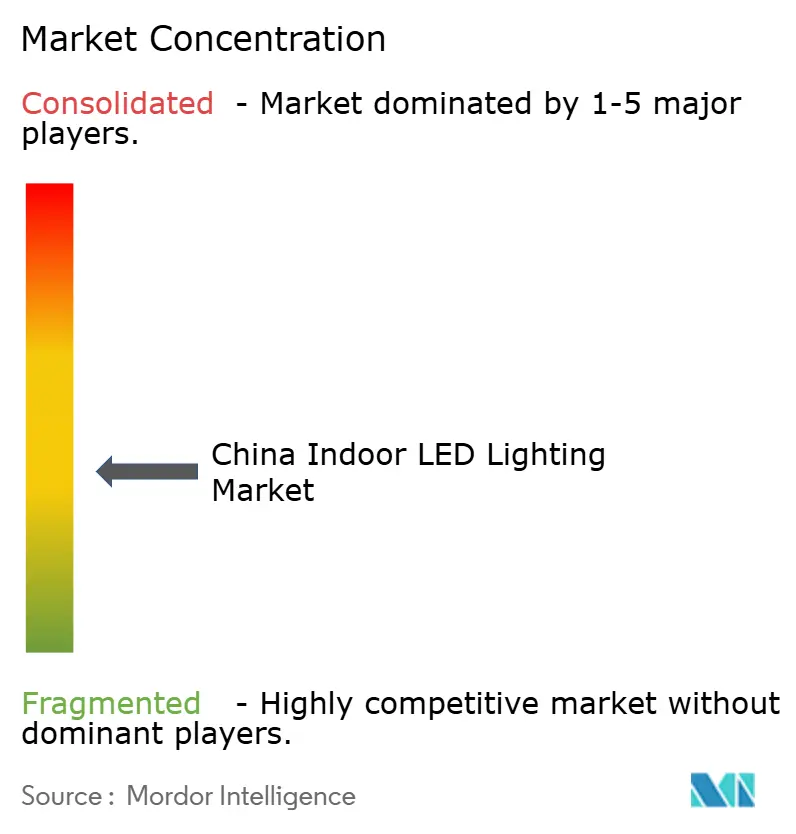
| Market Concentration | Medium |
Major Players *Disclaimer: Major Players sorted in no particular order Image © Mordor Intelligence. Reuse requires attribution under CC BY 4.0. | |
China Indoor LED Lighting Market Analysis by Mordor Intelligence
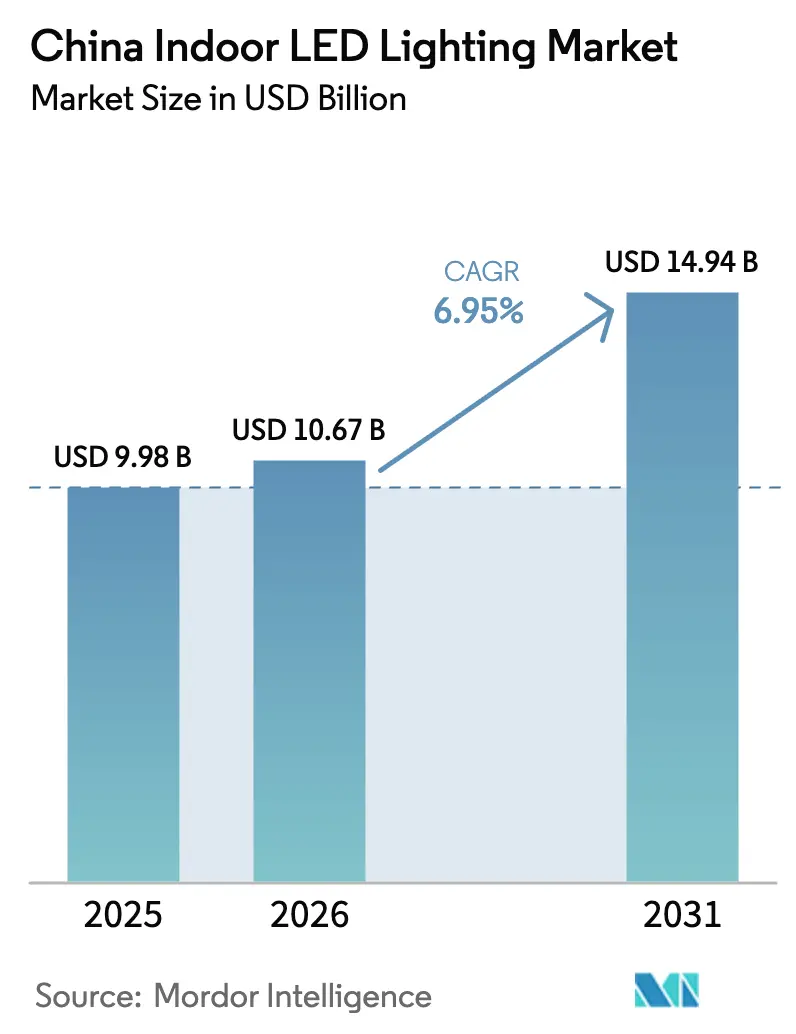
China indoor LED lighting market size in 2026 is estimated at USD 10.67 billion, growing from 2025 value of USD 9.98 billion with 2031 projections showing USD 14.94 billion, growing at 6.95% CAGR over 2026-2031. Robust policy enforcement, an accelerating secondary-replacement wave, and smart-city subsidies together underpin sustained demand even as chip price deflation compresses product margins. Rapid urbanization, particularly in Tier 2 cities, continues to drive residential upgrades, while ESCO financing facilitates large-scale retrofits across hospitals, universities, and factories. Supply-chain pressures on high-voltage driver ICs briefly constrain the production of premium mini-LED fixtures; however, technological differentiation in areas such as connectivity, tunable white, and human-centric lighting offsets pure price competition. In parallel, smart-building mandates encourage commercial owners to integrate lighting with occupancy sensing and daylight harvesting for additional operating cost savings.
Key Report Takeaways
- By product type, luminaires led with 61.55% revenue share in 2025; lamps are projected to expand at an 8.65% CAGR through 2031.
- By application, the residential segment captured 40.35% of the China indoor LED lighting market share in 2025 and is projected to advance at a 9.05% CAGR through 2031.
- By installation, retrofit projects accounted for 75.62% of the China indoor LED lighting market size in 2025, while new installs show the fastest CAGR at 7.24% to 2031.
- By distribution channel, wholesale and retail accounted for a 53.78% share of the China indoor LED lighting market size in 2025; e-commerce platforms, on the other hand, recorded the highest 7.06% CAGR through 2031.
Note: Market size and forecast figures in this report are generated using Mordor Intelligence’s proprietary estimation framework, updated with the latest available data and insights as of 2026.
China Indoor LED Lighting Market Trends and Insights
Drivers Impact Analysis*
| Driver | (~) % Impact on CAGR Forecast | Geographic Relevance | Impact Timeline |
|---|---|---|---|
| Government phase-outs of incandescent and CFL lamps | +1.8% | National, accelerated in Tier 1 cities | Short term (≤ 2 years) |
| Rapid decline in LED chip and package prices | +1.2% | Guangdong, Jiangsu production hubs | Medium term (2-4 years) |
| Boom in new commercial real-estate completions | +0.9% | Tier 1 and 2 eastern provinces | Medium term (2-4 years) |
| Secondary-replacement wave of first-generation LEDs | +1.4% | Early adoption clusters nationwide | Long term (≥ 4 years) |
| ESCO-financed retrofits with tax depreciation | +0.8% | Industrial and commercial sectors | Medium term (2-4 years) |
| Smart-city subsidies for IoT luminaires | +1.1% | 500+ pilot cities | Long term (≥ 4 years) |
| Source: Mordor Intelligence | |||


Government Phase-Outs Drive Market Transformation
The mandatory elimination of incandescent and CFL products compels building owners to switch immediately to LED solutions, ensuring a steady demand base even in a slowing macroeconomic environment.[1]Ministry of Industry and Information Technology, “Energy Efficiency Standards for Indoor Luminaires,” miit.gov.cn Minimum efficacy rules of 100 lumens per watt now apply to new indoor luminaires, effectively banning legacy technologies from fresh installations. Public facilities must also comply with local LED requirements, which will expand procurement to schools, hospitals, and municipal offices. Green-building certifications amplify this impact; institutions such as the University of Hong Kong have combined LED upgrades with occupancy sensors to achieve LEED status, illustrating a multiplier effect between regulation and the adoption of smart controls. As a result, the China indoor LED lighting market continues to grow even when discretionary capex tightens.
LED Chip Price Deflation Enables Mass Penetration
Domestic fabs achieved 15-20% cost reductions in 2024, widening the affordability of dimming, tunable white, and BLE mesh features that were previously premium. Lower bill-of-materials invites middle-income households to adopt connected lighting strips, while contractors substitute fluorescent tubes in cash-flow-sensitive retrofits. Manufacturers pivot toward value-added differentiation-Opple’s BLE2 portfolio embeds Bluetooth connectivity without a gateway, increasing stickiness and raising average selling prices. Falling component costs therefore expand the addressable base faster than prices decline, supporting real revenue growth for the China indoor LED lighting market.
Commercial Real-Estate Volatility Creates Mixed Signals
Office completions fell 23.8% and retail space dropped 18.2% in 2024, softening demand for new fixtures.[2]National Bureau of Statistics of China, “Commercial Real Estate Completion Statistics,” stats.gov.cn Yet, owners of existing towers race to lower operating costs; ESCO contracts at Wuhan’s Grade III-A hospital achieved 31.71% energy savings with a 2.5-year payback, demonstrating how retrofits thrive when new-build pipelines are in place. Hospitality chains follow suit—Longyin Xishan Hotel installed DALI-based dimming to cut energy bills and enhance guest experience. Consequently, retrofit momentum offsets the softness of the construction industry, preserving a balanced outlook for the China indoor LED lighting market.
Secondary-Replacement Wave Emerges
First-generation LEDs installed between 2015 and 2018 are now reaching end-of-life, triggering predictable replacement cycles. Facility managers view the upgrade as an opportunity to integrate wireless controls and enhance color rendering; Shanghai Jianfeng Heavy Machinery replaced early high-bay fixtures with smart CHZ models featuring remote configuration, thereby moving beyond simple illumination. This premium replacement demand elevates revenue even where unit volumes remain flat, sustaining healthy margins across the China indoor LED lighting market.
Restraints Impact Analysis*
| Restraint | (~) % Impact on CAGR Forecast | Geographic Relevance | Impact Timeline |
|---|---|---|---|
| High upfront cost for small contractors | -0.7% | Tier 3 cities, rural areas | Short term (≤ 2 years) |
| Price-driven competition reduces quality consistency | -0.5% | Price-sensitive segments nationwide | Medium term (2-4 years) |
| Driver-IC supply volatility for mini-LED | -0.4% | Premium fixture makers | Short term (≤ 2 years) |
| Blue-light-hazard compliance uncertainty | -0.3% | Commercial and healthcare facilities | Medium term (2-4 years) |
| Source: Mordor Intelligence | |||
High Upfront Costs Constrain Small Contractor Adoption
Despite falling component prices, premium fixtures often cost two to three times as much as fluorescent alternatives, deterring contractors whose bids hinge on the initial outlay. This hurdle persists in Tier 3 markets where lifecycle savings arguments carry less weight, and distribution outlets offer limited guidance on total cost of ownership. Consequently, budget-driven buyers occasionally favor sub-spec LED offerings that undermine long-term performance and erode trust.
Blue-Light-Hazard Standards Create Uncertainty
Pending IEC 62471 revisions that tighten photobiological limits, additional testing and potential optical redesigns may be required. Healthcare specifiers tend to favor 3000 K solutions to mitigate circadian disruption, while schools prioritize glare control and lower peak intensities. Manufacturers must either over-engineer their products now or face retrofit liabilities later, which raises R&D expenditure and lengthens the time-to-market across the China indoor LED lighting market.
*Our forecasts treat driver/restraint impacts as directional, not additive. The impact forecasts reflect baseline growth, mix effects, and variable interactions.
Segment Analysis
By Product Type: Luminaires Anchor Market Evolution
Luminaires and fixtures captured 61.55% of 2025 sales, while lamps are projected to deliver the fastest growth rate of 8.65% through 2031. The luminaires category benefits from integrated optics, thermal management, and embedded controls that satisfy stricter building codes and design aesthetics. Architects specify linear suspensions and recessed panels with wireless drivers, which lift the average revenue per unit. Lamps still flourish in retrofit environments where existing troffers or downlights accept quick PAR and T-lamp swaps, allowing cost-conscious users to realize immediate savings without the hassle of construction. On balance, this dual-track dynamic keeps the China indoor LED lighting market supplied with both high-value fixtures and volume-driven lamp replacements.
Follow-up demand reinforces the segment’s durability: as first-generation fixtures fail, owners often upgrade to sensor-rich luminaires that support Bluetooth mesh or DALI-2 protocols. Lamp retrofits mirror this trend, with smart E27 bulbs gaining traction in e-commerce channels. As R&D focuses on mini-LED backlighting and glare-free lens technology, luminaires continue to extend their lead in total value contribution to the China indoor LED lighting market.



By Application: Residential Segment Drives Momentum
Residential installations held a 40.35% share in 2025 and are pacing the field with a 9.05% CAGR. Rising disposable income and smaller household sizes in Tier 1 and Tier 2 cities spur decorative upgrades, while gaming and streaming culture expands demand for RGB strip lighting. Govee’s RMB 4 billion revenue in 2024 underscores how consumer-centric innovation can scale rapidly. Commercial offices, retail outlets, and hotels remain vital; energy-code revisions and wellness certifications drive corporate specifications for flicker-free, tunable lighting. The healthcare and education segments contribute a steady baseline volume through mandated efficacy and safety standards, thereby protecting downside risk for the China indoor LED lighting market.
The growing consumer appetite for app-based control and voice assistants also fuels the residential boom. Smart-home ecosystems bundle lighting with security cameras and smart speakers, elevating attach rates. Accordingly, residential remains the primary contributor to headline growth, while diversified non-residential demand stabilizes overall revenue streams.
By Installation Type: Retrofit Dominance Continues
Retrofits accounted for 75.62% of 2025 shipments, reflecting the vast stock of fluorescent and early LED fixtures still in use. ESCO models, tax incentives, and compressed LED paybacks shorten decision cycles, permitting large-scale projects in factories and universities. New construction logs the quicker 7.24% CAGR, yet contributes fewer absolute units given the smaller base. Smart-building regulations now specify sensor-ready fittings for new offices, adding premium revenue layers to fresh installations within the China indoor LED lighting market.
Importantly, retrofits are evolving beyond simple one-for-one swaps. Facility managers are increasingly coupling fixture change-outs with wireless gateways, creating a step-wise path to fully connected lighting without the need for disruptive rewiring. This staged strategy maintains high retrofit volumes while gradually increasing system value.

By Distribution Channel: E-Commerce Gains Pace
Wholesale retail retained 53.78% of transactions in 2025, driven by longstanding contractor relationships and robust after-sales support networks. E-commerce, however, leads to growth at a 7.06% CAGR as both homeowners and professional buyers become more comfortable with sourcing online. Platforms showcase detailed specification sheets, offer configurators, and enable rapid delivery, lowering search and logistics costs. Direct-sales models remain essential for bespoke commercial projects that require photometric design and commissioning services, but online self-service is increasingly covering commoditized products, such as downlights and A-lamp replacements.
Govee’s 30 million-plus app users prove how DTC models can scale, even in higher-ASP RGB strips that rely on immersive user communities. Traditional distributors respond by launching web stores and drop-ship programs, illustrating how omnichannel tactics will define future competition within the China indoor LED lighting market.
Geography Analysis
Tier 1 centers-Beijing, Shanghai, Guangzhou, Shenzhen-remain technology vanguards, adopting human-centric lighting and integrated controls first. Projects such as the Bund’s Interact installation exemplify premium connected solutions that also serve urban management needs. High per-capita incomes in these cities justify the early adoption of mini-LED downlights and low-UGR office panels, setting performance benchmarks that are replicated nationwide.
Tier 2 and Tier 3 cities are now at the forefront of volume expansion, as provincial capitals and manufacturing hubs benefit from smart-city grants and aggressive energy-efficiency goals. Guangdong, Jiangsu, and Zhejiang cluster both factories and large retrofit candidates, enabling short supply chains and test-and-iterate product cycles. Local governments promote LED adoption through subsidy vouchers for public schools and healthcare clinics, broadening the reach of the China indoor LED lighting market.
Rural districts constitute the next frontier. Grid build-outs and e-commerce logistics enable the cost-effective delivery of plug-and-play kits, allowing households to skip straight from incandescent bulbs to app-controlled LEDs. Cultural preferences for warm-white ambient lighting shape product portfolios, while mobile payment penetration simplifies procurement. Over the medium term, rural uptake supplies a fresh demand wave as urban markets mature.
Competitive Landscape
The field exhibits moderate fragmentation, with the top five companies accounting for slightly more than 30% of revenue, leaving room for nimble specialists to flourish. Local leaders Opple Lighting, NVC Lighting, and Foshan Electrical utilize their manufacturing scale and extensive after-sales networks to defend their domestic market share. Global majors Signify and ams OSRAM compete on optical IP and digital-service layers, often partnering with Chinese contractors for last-mile commissioning.
Innovation focus shifts toward smart-lighting ecosystems. Opple’s BLE2 line delivers gateway-free mesh connectivity, reducing project friction and supporting the addition of later sensors.[3]OPPLE Lighting, “Smart Lighting Solutions,” opple.ch Patent filings in driver-IC protection circuits and anti-glare optics highlight a race to differentiate amid falling component prices. Meanwhile, forthcoming blue-light safety rules will reward firms with deep R&D benches, enabling them to certify products rapidly, and thus slightly tilt market power toward established brands within the China indoor LED lighting industry.
Consolidation looms as capital requirements rise. Smaller assemblers lacking software expertise or compliance budgets may exit or merge, while venture funding-such as Luster LightTech’s CNY 785 million (USD 110.26 million) injection-signals investor appetite for platforms marrying hardware with cloud analytics. Overall, technology leadership, channel breadth, and compliance agility will decide winners over the forecast horizon.
China Indoor LED Lighting Industry Leaders
Signify Holding B.V.
ams OSRAM AG
Opple Lighting Co., Ltd.
NVC Lighting Holding Limited
Zhejiang Yankon Group Co., Ltd.
- *Disclaimer: Major Players sorted in no particular order

Recent Industry Developments
- August 2025: Okamura Densan introduced the Swiss brand NEKO LIGHTING to Japan, offering ultra-small downlights with UGR ≤ 19 for glare-critical interiors.
- February 2025: Luster LightTech secured CNY 785 million (USD 110 million) to scale smart-lighting solutions, reflecting sustained investor confidence.
- February 2025: State Administration for Market Regulation enforced revised energy-efficiency labels for self-ballasted fluorescent lamps, with a two-year transitional grace period for inventory clearance.
- January 2025: MasonLED subsidiary RiShang has won its fifth consecutive “Top Ten Linear Lighting Brands” award, underscoring its leadership in architectural strips.


China Indoor LED Lighting Market Report Scope
Agricultural Lighting, Commercial, Industrial and Warehouse, Residential are covered as segments by Indoor Lighting.| Lamps |
| Luminaires/ Fixtures |
| Residential |
| Commercial Offices |
| Retail Stores |
| Hospitality |
| Industrial Facilities |
| Healthcare and Education |
| Other Applications |
| New Installation |
| Retrofit Installation |
| Direct Sales |
| Wholesale Retail |
| E-commerce |
| By Product Type | Lamps |
| Luminaires/ Fixtures | |
| By Application | Residential |
| Commercial Offices | |
| Retail Stores | |
| Hospitality | |
| Industrial Facilities | |
| Healthcare and Education | |
| Other Applications | |
| By Installation Type | New Installation |
| Retrofit Installation | |
| By Distribution Channel | Direct Sales |
| Wholesale Retail | |
| E-commerce |


Market Definition
- INDOOR LIGHTING - It incorporates all LED based lamps and fixtures/luminaire that are used to illuminate indoor section of residential, commercial, industrial buildings and agricultural lighting. LED offers efficient brightness with higher durability in comparison to other lighting technology.
- OUTDOOR LIGHTING - It incorporates the LED lighting fixtures that is used for illumination for exterior/outdoor illumination. For instance, LED lighting fixtures used to illuminate streets and highways, transport hubs, stadiums and other public places such as parking spaces.
- AUTOMOTIVE LIGHTING - It refers to the lighting fixtures installed for illumination and signaling purposes. It is used in both exterior and interior lighting of the vehicle. Headlamps, fog lamp, daytime running light (DRLs) are examples of exterior light whereas cabin light are interior lights.
- END USER - It refers to the end use application area where the LED fixture will be installed. For instance, in terms of indoor lighting, we have residential, commercial and industrial as end user category. For automotive lighting, primary end user considered are automotive manufacturers and aftermarket sale
| Keyword | Definition |
|---|---|
| Lumen | Lumen is a unit of luminous flux in the International System of Units that is equal to the amount of light given out through a solid angle by a source of one-candela intensity radiating equally in all directions. |
| Footcandle | A foot-candle (or foot-candle, fc, lm/ft2, or ft-c) is a measurement of light intensity. One foot-candle is defined as enough light to saturate a one-foot square with one lumen of light. |
| Colour Rendering Index (CRI) | Color Rendering Index (CRI) is a measurement of how natural colors render under an artificial white light source when compared with sunlight. The index is measured from 0-100, with a perfect 100 indicating that colors of objects under the light source appear the same as they would under natural sunlight. |
| Luminous flux | Luminous flux is a measure of the power of visible light produced by a light source or light fitting. It is measured in lumens (lm). |
| Annual Energy Cost | Annual Energy Cost means the average daily energy consumption multiplied by 365 (days per year), expressed in kilowatt hour per year (kWh/a). |
| Constant voltage drivers | Constant voltage drivers are designed for a single direct current (DC) output voltage. Most common constant voltage drivers (or Power Supplies) are 12VDC or 24VDC. An LED light that is rated for constant voltage usually specifies the amount of input voltage it needs to operate correctly. |
| Constant Current Driver | Constant current LED drivers are designed for a designated range of output voltages and a fixed output current (mA). LEDs that are rated to operate on a constant current driver require a designated supply of current usually specified in milliamps (mA) or amps (A). These drivers vary the voltage along an electronic circuit which allows current to remain constant throughout the LED system. |
| Minimum Energy Performance Standards (MEPS) | Minimum Energy Performance Standards specify the minimum level of energy performance that appliances and equipment must meet or exceed before they can supply or used for commercial purposes. |
| Luminous Efficacy | Luminous efficacy is a measurement commonly used in the lighting industry that indicates the ability of a light source to emit visible light using a given amount of power. |
| Solid State Lighting | Solid-state lighting (SSL) is a type of lighting that uses semiconductor light-emitting diodes (LEDs), organic light-emitting diodes (OLED), or polymer light-emitting diodes (PLED) as sources of illumination rather than electrical filaments, plasma (used in arc lamps such as fluorescent lamps), or gas. |
| Rated Lamp Life | Lamp life, also referred to as rated life, is the time in hours a lamp will last before a percentage of lamps will burn out. |
| Color Temperature | Colour temperature is a scale that measures how ‘warm’ (yellow) or ‘cool’ (blue) the light from a particular source is. It is measured in degrees of the Kelvin scale (abbreviated to K), and the higher the number, the ‘cooler’ the light. The lower the ‘K’ number, the ‘warmer’ the light. |
| Ingress Protection rating (IP rating) | The IP (Ingress Protection) rating of a bulb or light fixture declares the level of protection it has against dirt and water. |
| Fidelity Index | The general colour fidelity index, Rf, represents how closely the colour appearances of the entire sample set are reproduced (rendered) on average by a test light as compared to those under a reference illuminant. |
| Gamut Index | The gamut area is defined as “the area enclosed by a set of test color samples illuminated by a light source, in a two-dimensional chromaticity diagram or a plane of color space.”1 Within a defined color space, a “gamut” describes the subset of colors that can be perceived under specific lighting conditions. |
| Binning | In the lighting industry, the act of "binning" of LEDs is the process of sorting LEDs by certain characteristics, such as color, voltage, and brightness. |
| Accent lighting | Accent lighting, also called highlighting, emphasizes objects by focusing light directly on them. Accent lighting is used inside and outside the home to feature locations such as an entrance or to create dramatic effects. |
| Dimmable driver | A dimming driver has two functions: As a driver, it converts the 230V AC mains input to a low voltage DC output. As a dimmer, it reduces the amount of electrical energy flowing to the LEDs, thereby causing them to dim. |
| Flicker | Flicker is the repeated and frequent variation in the output of a light source over time. |
| Fluorescent | A property of materials defined as the ability to emit light after absorbing electromagnetic radiation such as visible or UV light. |
| Candela | The candela is the unit of luminous intensity in the International System of Units. It measures the light output per unit solid angle emitted from a light source in a specific direction. |
| LUX | Lux is used to measure the amount of light output in a given area - one lux is equal to one lumen per square meter. It enables us to measure the total "amount" of visible light present and the intensity of the illumination on a surface. |
| Uniformity (U0) | The uniformity of lighting has significant effects on visual performance in both indoor and outdoor areas. Uniformity (represented as U0) value can be found by dividing the minimum brightness (Emin) resulting from calculations according to the current lighting order, to the average brightness value (Eavg). |
| Visible Light Spectrum | The visible light spectrum is the segment of the electromagnetic spectrum that the human eye can view. More simply, this range of wavelengths is called visible light. Typically, the human eye can detect wavelengths from 380 to 700 nanometers. |
| Ambient Temperature | Ambient Temperature is the temperature of the air surrounding an electrical enclosure. |
| Current-controlled dimming control | Current-controlled dimming controls LED brightness by varying the applied current using a 0-10V dimmer. Current-controlled dimming is smooth and HD-video friendly. It can only dim to a minimum of 5% of light output. |
| Design Light Consortium | It is a partnership of energy efficiency stakeholders in the United States and Canada to “promote quality, performance and energy efficient lighting solutions for the commercial sector”. |
| Pulse Width Modulation | Pulse-width modulation, or pulse-duration modulation, is a method of controlling the average power delivered by an electrical signal. |
| Surface Mounted Device | A surface mount device (SMD) is an electronic device whose components are mounted or placed directly on the surface of a printed circuit board. |
| Alternating Current | Alternating current is an electric current which periodically reverses direction and changes its magnitude continuously with time, in contrast to direct current, which flows only in one direction. |
| Direct Current | Direct current (DC) is an electric current that is uni-directional, so the flow of charge is always in the same direction. |
| Beam Angle | Beam angle (also called beam spread) is a measure of how light is distributed. On any plane perpendicular to the centerline of the light, the beam angle is the angle between two rays where the light intensity is 50% of the maximum light intensity. |
| LED Based Solar High Mast Lighting Systems | A Solar LED High Mast Light is a raised source of High illumination lights (6~8 lights) and with high intensity on the middle of major junctions (Ring roads, Outer Ring roads), turned on or lit automatically in the absence of light (at specified timings or at periodic times, every night). |
| Surface Mounted Diode (SMD) LEDs | A surface mount diode is a type that emits light and is flat mounted and soldered onto a circuit board. |
| Chip on Board (COB) LEDs | A COB LED is basically multiple LED chips (usually 9 or more) glued directly onto a substrate by the manufacturer to form a single module. |
| Dual In-Line Package (DIP) LEDs | A dual in-line package (DIP or DIL) is an electronic component package with a rectangular case and two parallel rows of electrical connector pins. |
| Graphene LED Lights | A graphene LED light bulb is simply an LED light bulb where the filament has been coated in graphene. A graphene LED bulb is reported to be 10% more efficient than regular LED light bulbs and they are cheaper to manufacture and buy. |
| LED Corn Bulbs | LED Corn lights are designed as an energy efficient alternative to high intensity discharge (HID) and SON lamps. It uses a large number of LEDs on a metal structure to provide sufficient light. This arrangement of LEDs looks a lot like a corn cob, hence the name "corn light". |
| Per Capita Income | Per capita income or total income measures the average income earned per person in a given area in a specified year. It is calculated by dividing the area's total income by its total population. Per capita income is national income divided by population size. |
| Charging Stations | A charging station, also known as a charging station or electric vehicle utility, is a power supply that provides electrical energy for charging plug-in electric vehicles. |
| Headlight | A headlight is a light that is mounted on the front of a car and illuminates the road in front of it. Low beam and high beam LED headlights are additional categories for these LED headlights. |
| Day Time Running Light (DRLs) | A daytime running lamp is a white, yellow, or amber lighting device mounted on the front of a road-going motor vehicle or bicycle. |
| Directional Signal Light | Directional signal lights are the front and rear lights on an automobile that flash to show the direction of a turn. |
| Stop Light | A red light that is mounted to the back of a car and turns on when the brakes are used to show that the car is stopped. |
| Reverse Light | The reverse light is at the back of the vehicle to indicate its backward motion. |
| Tail Light | A red light that can be seen in the dark is mounted on the rear of a road vehicle. Stop, reverse, and directional signal lights are all part of it. |
| Fog Light | Bright lights in automobiles used to increase visibility on the road in foggy conditions or to warn other drivers of the presence of the vehicle. |
| Passenger Vehicle | A passenger vehicle is a road vehicle, other than a moped or a motorcycle, intended for the transportation of people and designed for up to 8 to 9 seats. |
| Commercial Vehicle | A commercial vehicle (Bus, Truck, Van) is any type of motor vehicle used to transport goods or pay passengers. |
| Two Wheelers (2W) | A two-wheeler is a vehicle that runs on two wheels. |
| Streets & Roadways | Both roads and streets refer to hard, flat surfaces on the ground on which vehicles, people, and animals can travel. Since streetways are usually in cities and towns, they often have houses and buildings on both sides. The roadway is in the countryside and sometimes passes through forests and fields |
| Horticulture Lighting | Horticulture is the science and art of sustainably growing, producing, marketing and using high quality, intensively cultivated food and ornamental plants. |


Research Methodology
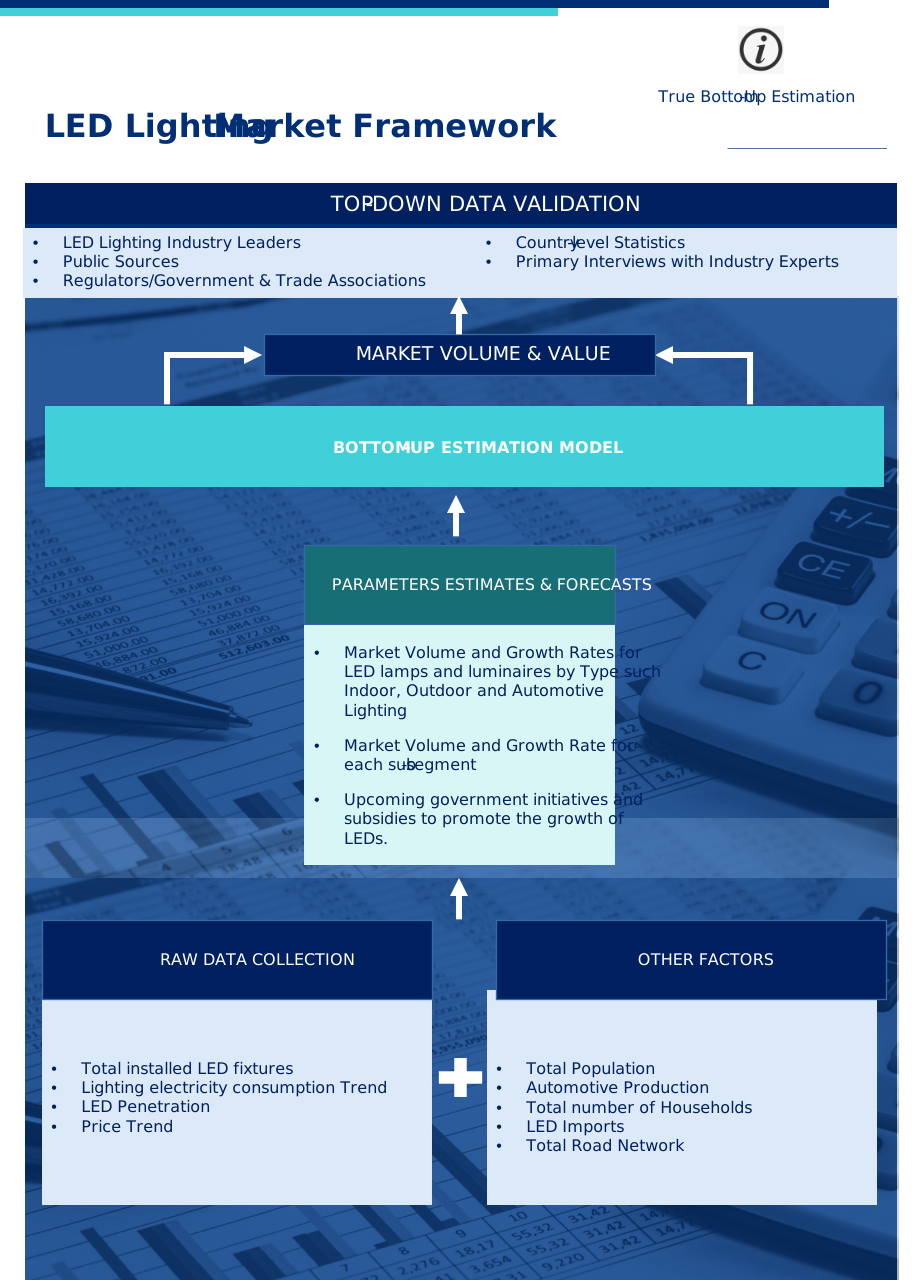
Mordor Intelligence has followed the following methodology in all our data center reports.
- Step 1: Raw Data Collection: To understand the market, initially, all crtical data points were identified. Critical information about countries and regions of interest including Per-capita Income, Population, Automotive Production, Interest rate on Auto-Loans, Number of Automobiles on Road, Total LED Import, Lighting Electricity Consumption among others were recorded or estimated based on internal calculations.
- Step 2: Identify Key Variables: To build a robust forecasting model, key variables such as Number of Households, Automotive Production, Road Networks among others were identified. Through an iterative process, the variables required for the market forecast were set, and the model was built using these variables.
- Step 3: Build a Market Model: Based on data and critical industry trend data (variables), including LED pricing, LED penetration rate, and project macro and micor economic factors were utilized for building the market forecasting.
- Step 4: Validate and Finalize: In this crucial step, all market numbers and variables derived through an internal mathematical model were validated through an extensive network of primary research experts from all the markets studied. The respondents are selected across levels and functions to generate a holistic picture of the market studied.
- Step 5: Research Outputs: Syndicated Reports, Custom Consulting Assignments, Databases & Subscription Platforms