
China Outdoor LED Lighting Market Size and Share
Market Overview
| Study Period | 2018 - 2031 |
|---|---|
| Forecast Data Period | 2026 - 2031 |
| Base Year Market Size (2025) | USD 3.43 Billion |
| Market Size (2026) | USD 3.75 Billion |
| Market Size (2031) | USD 5.84 Billion |
| Growth Rate (2026 - 2031) | 9.29 % |
| Market Concentration | Medium |
Major Players *Disclaimer: Major Players sorted in no particular order Image © Mordor Intelligence. Reuse requires attribution under CC BY 4.0. | |
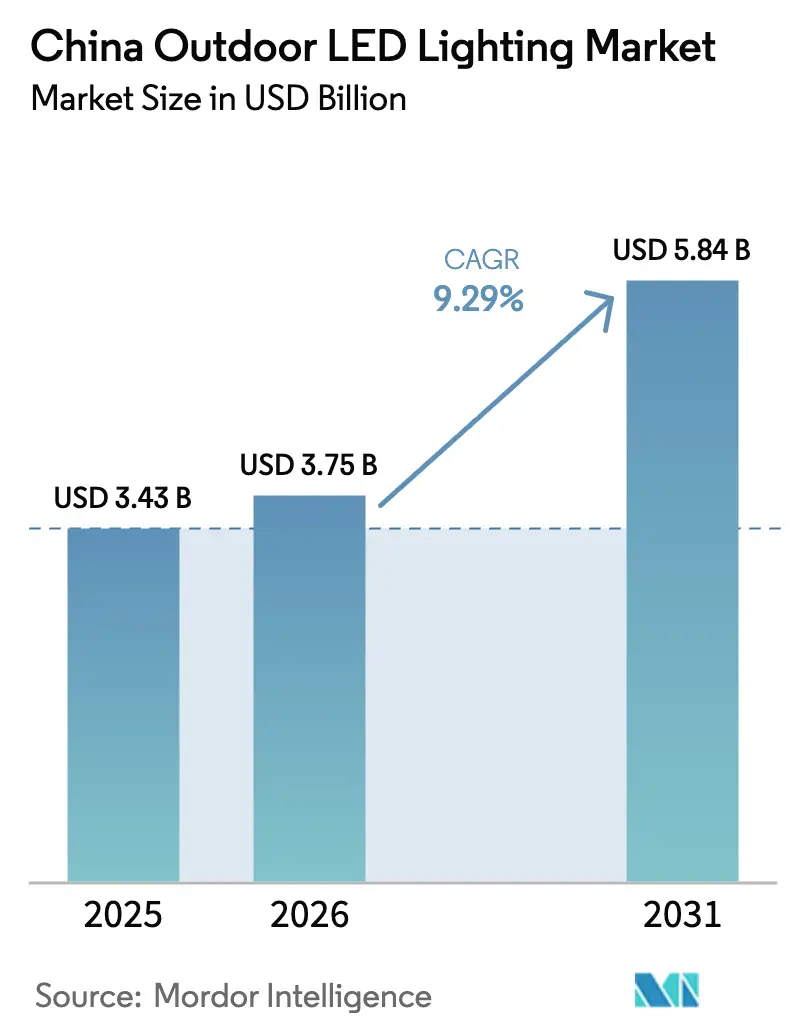
China Outdoor LED Lighting Market Analysis by Mordor Intelligence
The China outdoor LED lighting market size is expected to grow from USD 3.43 billion in 2025 to USD 3.75 billion in 2026 and is forecast to reach USD 5.84 billion by 2031 at 9.29% CAGR over 2026-2031. Demand momentum stems from national dual-carbon mandates, aggressive smart city rollouts, and large-scale municipal retrofit incentives. East China’s manufacturing depth and early adoption of smart controls reinforce supply reliability, while northwest provinces enjoy accelerated deployment backed by preferential infrastructure funding. Government subsidies now favor integrated smart-pole projects that bundle 5G small-cell radios, sensors, and LED luminaires, tightening the link between digital connectivity and energy efficiency. Meanwhile, domestic manufacturers rely on vertical integration to mitigate raw material volatility and keep pace with stricter RoHS rules that take effect in 2026.
Key Report Takeaways
- By product type, luminaires captured 69.58% of China's outdoor LED lighting market share in 2025; lamp retrofits, despite having a smaller revenue base, are expanding at a 10.44% CAGR through 2031.
- By application, street and roadway lighting maintained a 43.87% share of China's outdoor LED lighting market size in 2025, sports and stadium installations recorded the fastest growth at an 11.08% CAGR through 2031.
- By installation type, new installations accounted for 53.86% of China's outdoor LED lighting market share in 2025, reflecting ongoing urban expansion. However, retrofit projects are projected to expand at a 9.65% CAGR through 2031.
- By distribution channel, direct sales held a 66.57% share of the China outdoor LED lighting market size in 2025. E-commerce channels, although holding a modest base, are projected to post 7.95% growth by 2031.
Note: Market size and forecast figures in this report are generated using Mordor Intelligence’s proprietary estimation framework, updated with the latest available data and insights as of 2026.
China Outdoor LED Lighting Market Trends and Insights
Drivers Impact Analysis*
| Driver | (~) % Impact on CAGR Forecast | Geographic Relevance | Impact Timeline |
|---|---|---|---|
| Dual-carbon targets speed municipal LED shifts | +2.1% | National, early uptake in East and Central China | Medium term (2-4 years) |
| New-infrastructure subsidies for smart poles | +1.8% | National, tier-1 and tier-2 cities | Short term (≤ 2 years) |
| Urbanization expands city-cluster lighting | +1.5% | East, South, and Central China | Long term (≥ 4 years) |
| Light-pollution rule GB 39588-2020 raises precision demand | +1.2% | National, strictest in developed coastal provinces | Medium term (2-4 years) |
| 5G small-cell integration on lighting poles | +1.7% | East and South China | Short term (≤ 2 years) |
| Night-time economy zones in lower-tier cities | +0.9% | Central, Southwest, and Northwest China | Medium term (2-4 years) |
| Source: Mordor Intelligence | |||
Dual-Carbon Targets Speed Municipal LED Shifts
China’s 2060 carbon-neutral pledge obliges municipalities to replace conventional lamps with high-efficiency LED systems. The 2024-2025 Energy Saving and Carbon Reduction Action Plan requires a 50% high-efficiency penetration in general lighting by 2025, prompting accelerated tenders for outdoor luminaires.[1]State Council, “2024-2025 Energy Saving and Carbon Reduction Action Plan,” gov.cnFavorable green-finance programs, paired with outcome-based contracting, enable cities to fund retrofits through guaranteed energy savings streams. Procurers also rank suppliers on lifecycle carbon metrics, pushing manufacturers to document material emissions. Together, these mechanisms secure LED upgrades in municipal budgets, even when broader infrastructure outlays are reduced.
New-Infrastructure Subsidies for Smart Poles
The National Development and Reform Commission lists smart street lighting as foundational digital infrastructure, steering local special-bond proceeds toward integrated light-communication poles.[2]National Development and Reform Commission, “Guidance on Smart City Development,” ndrc.gov.cn Subsidies cover up to 85% of eligible project costs in developed provinces and 95% in western regions, slashing payback periods for advanced poles that host 5G radios, cameras, and edge-computing nodes. Interoperability guidelines from the Ministry of Industry and Information Technology standardize network protocols, letting cities mix equipment brands without vendor lock-in. These technical and fiscal levers sharply lift near-term adoption of multifunctional LED assemblies.
Urbanization Expands City-Cluster Lighting
Integrated city clusters from the Yangtze River Delta to the Central Plains demand cohesive roadway, park, and façade lighting. Continuous urban corridors allow bulk purchasing across jurisdictions, favoring vendors that can supply uniform optical performance at scale. Cluster-level planning also injects aesthetic goals, fueling decorative and landscape segments. Environmental codes require wildlife-friendly spectra along greenways, nudging product design toward tunable white control. As additional rail hubs and satellite towns emerge, predictable multi-year lighting pipelines develop for qualified suppliers.
5G Small-Cell Integration on Lighting Poles
Dense 5G coverage compels carriers to mount radios every 100-200 meters, raising pole counts far beyond those of legacy macro-sites. Pilot deployments in Beijing demonstrate that merging radios with LED drivers reduces civil work costs by 41% and shortens permitting time, thereby accelerating both telecom and lighting schedules. Electromagnetic-compatibility tests conducted by the Ministry of Industry and Information Technology have validated that high-frequency emissions do not degrade LED driver efficiency, clearing the way for nationwide rollouts. Vendors that pre-integrate power-sharing and fiber backhaul ports into luminaires capture premium margins, despite industry-wide price compression.
Restraints Impact Analysis*
| Restraint | (~) % Impact on CAGR Forecast | Geographic Relevance | Impact Timeline |
|---|---|---|---|
| Construction-sector slowdown curbing municipal CAPEX | -1.4% | National, most severe in tier-3 and tier-4 cities | Short term (≤ 2 years) |
| Margin squeeze from intense domestic price competition | -0.8% | National, concentrated in manufacturing hubs | Medium term (2-4 years) |
| Recycling regulations raising compliance cost of housings | -0.6% | National, with stricter enforcement in developed regions | Medium term (2-4 years) |
| Shortage of high-grade domestic LED driver ICs | -0.9% | National, with supply chain disruptions affecting all regions | Short term (≤ 2 years) |
| Source: Mordor Intelligence | |||
Construction Slowdown Curbs Municipal CAPEX
Infrastructure investment growth cooled to 5.5% in 2024 as real estate revenues shrank, throttling discretionary spending on lighting projects. Lower-tier cities, heavily reliant on land-sale proceeds, deferred nonessential lighting tenders and stretched payment cycles. Central transfers via special bonds mitigate the impact but remain earmarked for digital and green priorities, requiring suppliers to demonstrate energy and data-service value for each proposal.
Margin Squeeze from Domestic Price Rivalry
An estimated 10,000 LED enterprises cluster in Guangdong’s Guzhen town alone, sustaining overcapacity that drives unit prices down each bid round. Larger brands countered with automation, upstream chip investments, and service bundles, yet gross margins still fell by an average of 120 basis points in 2024. Smaller firms risk exit or acquisition as forthcoming mandatory RoHS compliance raises testing costs.
*Our forecasts treat driver/restraint impacts as directional, not additive. The impact forecasts reflect baseline growth, mix effects, and variable interactions.
Segment Analysis
By Product Type: Fixtures, Anchor System-Level Upgrades
Luminaires accounted for 69.58% of China's outdoor LED lighting market share in 2025, as municipalities favored sealed, IP-rated fixtures with integrated drivers and control modules. The China outdoor LED lighting market size for luminaires is projected to advance in lock-step with smart-city deployments as edge-computing sensors are increasingly embedded at the fixture level. Lamp retrofits, despite having a smaller revenue base, are expanding at a 10.44% CAGR because they offer quick paybacks for cities that defer full fixture replacements.
Smart fixtures now integrate radar, environmental monitors, and cameras, enabling data services that unlock additional revenue for operators. Signify’s Jiujiang mega-factory, encompassing 192 production lines, underpins the mass-scale roll-out of such sensor-rich fixtures. Lamp suppliers, for their part, focus on universal E27/E40 formats with Bluetooth mesh control options to capture budget-constrained retrofit projects.




By Application: Sports Venues Outpace Traditional Roadway Lighting
Street and roadway lighting maintained a 43.87% share of China's outdoor LED lighting market size in 2025, anchored by national road-safety mandates. Yet, sports and stadium installations are growing at the fastest rate, with a 11.08% CAGR, as China upgrades venues ahead of global tournaments. Broadcast-grade luminaires with flicker-free 2,000-lux output and DMX controls command premium pricing, creating a high-margin niche.
Municipalities also deploy color-tunable LEDs in waterfront promenades and cultural precincts to enhance night-time tourism, feeding demand for architectural and landscape products. Tunnel and bridge lighting specifications continue to tighten around glare control and emergency-response integration, sustaining steady replacement demand among highway authorities.
By Installation Type: Retrofit Share Expands Under Efficiency Mandates
New installations accounted for 53.86% of China's outdoor LED lighting market share in 2025, reflecting ongoing urban expansion. However, retrofit projects are accelerating at 9.65% CAGR as cities confront legacy sodium-vapor inventories and pursue carbon-intensity targets. Accelerated depreciation allowances introduced in 2024 shorten payback periods to under four years for most retrofit scenarios, widening procurement pipeline visibility.
Retrofit integrators are increasingly deploying modular LED engines that are compatible with existing poles and wiring, thereby reducing site disruption. Suppliers offering turnkey audit, finance, and installation bundles gain market share by simplifying project execution for cash-strapped local governments.

By Distribution Channel: Digital Procurement Gains Foothold
Direct sales routes retained 66.57% of China's outdoor LED lighting market share in 2025 because complex municipal projects still require bespoke design, installation, and after-sales support. E-commerce channels, though holding a modest base, posted 7.95% growth as standard-spec lamps and small-form luminaires moved online. Online sourcing appeals to county-level authorities seeking transparent pricing and shorter lead times.
Wholesale distributors bridge regional logistics gaps, stocking mid-volume SKUs for electrical contractors. Retail remains niche, serving facility-management replacements rather than large-scale projects. Over time, hybrid platforms that combine online RFQ tools with engineering support are expected to leverage the strengths of digital convenience and direct engagement.
Geography Analysis
East China accounted for 27.64% of 2025 sales, supported by over 7,700 LED enterprises in Zhongshan that manufacture an estimated 70% of the national output. Comprehensive smart-city budgets let Shanghai trial adaptive dimming across 400 km of arterial roads, bolstering orders for sensor-rich luminaires. Provincial subsidies also favor solar-hybrid poles along coastal ecological corridors, integrating photovoltaic panels with grid-tied LED drivers.
Northwest China is projected to post the fastest 12.1% CAGR through 2031, driven by central-government infrastructure packages worth USD 551 billion that target desert highways and emerging urban hubs. Higher subsidy ratios help offset municipal budget gaps and attract integrators capable of designing optics for harsh environments.
North China functions as a policy showcase. Beijing's integrated 5G-Advanced network spans more than 10 million residents, illustrating how smart-pole architectures can collapse telecom and lighting cost lines. Southwest and Central provinces are pivoting to a tourism-driven façade and landscape lighting approach, balancing glare control with cultural heritage preservation mandates. Northeast China's aging industrial base invests cautiously, yet local incentives for efficiency upgrades help maintain baseline demand.
Competitive Landscape
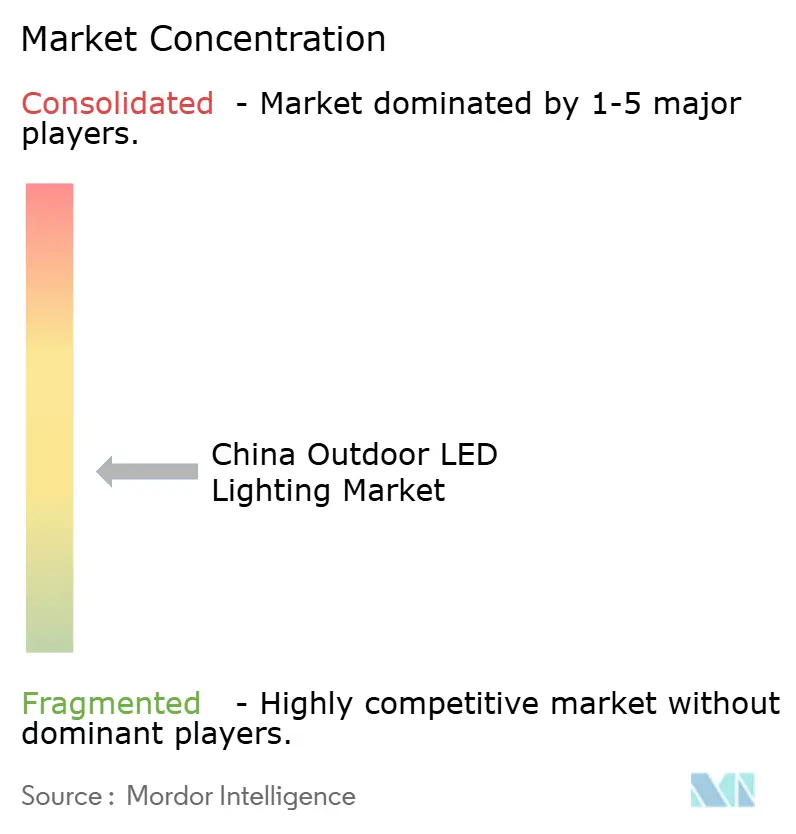
The market remains moderately fragmented, with the top five brands accounting for a combined 35% revenue share in 2024, leaving ample room for regional specialists to grow. Domestic leaders OPPLE Lighting, NVC Lighting, and Yankon Group expand vertically into chip packaging and driver electronics to buffer cost swings. Signify fortifies its China supply chain, deriving 78% of tier-1 components domestically while positioning its Interact platform for data-centric city contracts. Sanan Optoelectronics' USD 239 million purchase of Lumileds secures mid-to-high-end chip capacity and bolsters exports to Southeast Asia.[4]Wang Zhen, “Chinese Chipmaker Sanan to Buy Lumileds With Malaysian Partner for USD239 Million,” yicaiglobal.com
Telecom infrastructure giant China Tower enters lighting by converting 220,000 towers into sensor-equipped "digital towers," challenging pure-play lighting firms for smart-pole budgets. Smaller OEMs differentiate themselves through light-pollution-compliant optics and modular service packages, yet many face pressure from consolidation as RoHS testing fees are expected to rise in 2026. Software-as-a-service layers such as fault diagnostics, energy dashboards, and pole-sharing billing become decisive bid factors, nudging hardware-centric players toward partnerships with cloud providers.
White-space opportunities include off-grid solar LED kits for Belt and Road desert highways and heritage-site luminaires with ultra-narrow spectra that minimize fresco degradation. Companies capable of pairing such niche hardware with nationwide service coverage gain an edge as municipalities seek single-throat accountability.
China Outdoor LED Lighting Industry Leaders
Signify N.V.
OPPLE Lighting Co., Ltd.
NVC Lighting Holding Limited
Zhejiang Yankon Group Co., Ltd.
Foshan Electrical and Lighting Co., Ltd.
- *Disclaimer: Major Players sorted in no particular order

Recent Industry Developments
- August 2025: Sanan Optoelectronics completed a USD 239 million acquisition of Lumileds to deepen mid-range LED chip supply.
- May 2025: China Tower finished retrofitting 220,000 communications towers into multifunctional “digital towers” equipped with cameras, sensors, and LED luminaires.
- April 2025: The Ministry of Industry and Information Technology released a draft mandatory national RoHS standard covering 10 hazardous substances for electronic products.
- March 2025: The State Council launched an equipment update plan offering loan interest subsidies and ultra-long-term bonds for municipal lighting retrofits.


China Outdoor LED Lighting Market Report Scope
Public Places, Streets and Roadways, Others are covered as segments by Outdoor Lighting.| Lamps |
| Luminaires/ Fixtures |
| Street and Roadway Lighting |
| Architectural and Landscape |
| Sports and Stadium |
| Tunnel and Bridge |
| Parking and Transit Areas |
| Other Applications |
| New Installation |
| Retrofit Installation |
| Direct Sales |
| Wholesale Retail |
| E-commerce |
| By Product Type | Lamps |
| Luminaires/ Fixtures | |
| By Application | Street and Roadway Lighting |
| Architectural and Landscape | |
| Sports and Stadium | |
| Tunnel and Bridge | |
| Parking and Transit Areas | |
| Other Applications | |
| By Installation Type | New Installation |
| Retrofit Installation | |
| By Distribution Channel | Direct Sales |
| Wholesale Retail | |
| E-commerce |


Market Definition
- INDOOR LIGHTING - It incorporates all LED based lamps and fixtures/luminaire that are used to illuminate indoor section of residential, commercial, industrial buildings and agricultural lighting. LED offers efficient brightness with higher durability in comparison to other lighting technology.
- OUTDOOR LIGHTING - It incorporates the LED lighting fixtures that is used for illumination for exterior/outdoor illumination. For instance, LED lighting fixtures used to illuminate streets and highways, transport hubs, stadiums and other public places such as parking spaces.
- AUTOMOTIVE LIGHTING - It refers to the lighting fixtures installed for illumination and signaling purposes. It is used in both exterior and interior lighting of the vehicle. Headlamps, fog lamp, daytime running light (DRLs) are examples of exterior light whereas cabin light are interior lights.
- END USER - It refers to the end use application area where the LED fixture will be installed. For instance, in terms of indoor lighting, we have residential, commercial and industrial as end user category. For automotive lighting, primary end user considered are automotive manufacturers and aftermarket sale
| Keyword | Definition |
|---|---|
| Lumen | Lumen is a unit of luminous flux in the International System of Units that is equal to the amount of light given out through a solid angle by a source of one-candela intensity radiating equally in all directions. |
| Footcandle | A foot-candle (or foot-candle, fc, lm/ft2, or ft-c) is a measurement of light intensity. One foot-candle is defined as enough light to saturate a one-foot square with one lumen of light. |
| Colour Rendering Index (CRI) | Color Rendering Index (CRI) is a measurement of how natural colors render under an artificial white light source when compared with sunlight. The index is measured from 0-100, with a perfect 100 indicating that colors of objects under the light source appear the same as they would under natural sunlight. |
| Luminous flux | Luminous flux is a measure of the power of visible light produced by a light source or light fitting. It is measured in lumens (lm). |
| Annual Energy Cost | Annual Energy Cost means the average daily energy consumption multiplied by 365 (days per year), expressed in kilowatt hour per year (kWh/a). |
| Constant voltage drivers | Constant voltage drivers are designed for a single direct current (DC) output voltage. Most common constant voltage drivers (or Power Supplies) are 12VDC or 24VDC. An LED light that is rated for constant voltage usually specifies the amount of input voltage it needs to operate correctly. |
| Constant Current Driver | Constant current LED drivers are designed for a designated range of output voltages and a fixed output current (mA). LEDs that are rated to operate on a constant current driver require a designated supply of current usually specified in milliamps (mA) or amps (A). These drivers vary the voltage along an electronic circuit which allows current to remain constant throughout the LED system. |
| Minimum Energy Performance Standards (MEPS) | Minimum Energy Performance Standards specify the minimum level of energy performance that appliances and equipment must meet or exceed before they can supply or used for commercial purposes. |
| Luminous Efficacy | Luminous efficacy is a measurement commonly used in the lighting industry that indicates the ability of a light source to emit visible light using a given amount of power. |
| Solid State Lighting | Solid-state lighting (SSL) is a type of lighting that uses semiconductor light-emitting diodes (LEDs), organic light-emitting diodes (OLED), or polymer light-emitting diodes (PLED) as sources of illumination rather than electrical filaments, plasma (used in arc lamps such as fluorescent lamps), or gas. |
| Rated Lamp Life | Lamp life, also referred to as rated life, is the time in hours a lamp will last before a percentage of lamps will burn out. |
| Color Temperature | Colour temperature is a scale that measures how ‘warm’ (yellow) or ‘cool’ (blue) the light from a particular source is. It is measured in degrees of the Kelvin scale (abbreviated to K), and the higher the number, the ‘cooler’ the light. The lower the ‘K’ number, the ‘warmer’ the light. |
| Ingress Protection rating (IP rating) | The IP (Ingress Protection) rating of a bulb or light fixture declares the level of protection it has against dirt and water. |
| Fidelity Index | The general colour fidelity index, Rf, represents how closely the colour appearances of the entire sample set are reproduced (rendered) on average by a test light as compared to those under a reference illuminant. |
| Gamut Index | The gamut area is defined as “the area enclosed by a set of test color samples illuminated by a light source, in a two-dimensional chromaticity diagram or a plane of color space.”1 Within a defined color space, a “gamut” describes the subset of colors that can be perceived under specific lighting conditions. |
| Binning | In the lighting industry, the act of "binning" of LEDs is the process of sorting LEDs by certain characteristics, such as color, voltage, and brightness. |
| Accent lighting | Accent lighting, also called highlighting, emphasizes objects by focusing light directly on them. Accent lighting is used inside and outside the home to feature locations such as an entrance or to create dramatic effects. |
| Dimmable driver | A dimming driver has two functions: As a driver, it converts the 230V AC mains input to a low voltage DC output. As a dimmer, it reduces the amount of electrical energy flowing to the LEDs, thereby causing them to dim. |
| Flicker | Flicker is the repeated and frequent variation in the output of a light source over time. |
| Fluorescent | A property of materials defined as the ability to emit light after absorbing electromagnetic radiation such as visible or UV light. |
| Candela | The candela is the unit of luminous intensity in the International System of Units. It measures the light output per unit solid angle emitted from a light source in a specific direction. |
| LUX | Lux is used to measure the amount of light output in a given area - one lux is equal to one lumen per square meter. It enables us to measure the total "amount" of visible light present and the intensity of the illumination on a surface. |
| Uniformity (U0) | The uniformity of lighting has significant effects on visual performance in both indoor and outdoor areas. Uniformity (represented as U0) value can be found by dividing the minimum brightness (Emin) resulting from calculations according to the current lighting order, to the average brightness value (Eavg). |
| Visible Light Spectrum | The visible light spectrum is the segment of the electromagnetic spectrum that the human eye can view. More simply, this range of wavelengths is called visible light. Typically, the human eye can detect wavelengths from 380 to 700 nanometers. |
| Ambient Temperature | Ambient Temperature is the temperature of the air surrounding an electrical enclosure. |
| Current-controlled dimming control | Current-controlled dimming controls LED brightness by varying the applied current using a 0-10V dimmer. Current-controlled dimming is smooth and HD-video friendly. It can only dim to a minimum of 5% of light output. |
| Design Light Consortium | It is a partnership of energy efficiency stakeholders in the United States and Canada to “promote quality, performance and energy efficient lighting solutions for the commercial sector”. |
| Pulse Width Modulation | Pulse-width modulation, or pulse-duration modulation, is a method of controlling the average power delivered by an electrical signal. |
| Surface Mounted Device | A surface mount device (SMD) is an electronic device whose components are mounted or placed directly on the surface of a printed circuit board. |
| Alternating Current | Alternating current is an electric current which periodically reverses direction and changes its magnitude continuously with time, in contrast to direct current, which flows only in one direction. |
| Direct Current | Direct current (DC) is an electric current that is uni-directional, so the flow of charge is always in the same direction. |
| Beam Angle | Beam angle (also called beam spread) is a measure of how light is distributed. On any plane perpendicular to the centerline of the light, the beam angle is the angle between two rays where the light intensity is 50% of the maximum light intensity. |
| LED Based Solar High Mast Lighting Systems | A Solar LED High Mast Light is a raised source of High illumination lights (6~8 lights) and with high intensity on the middle of major junctions (Ring roads, Outer Ring roads), turned on or lit automatically in the absence of light (at specified timings or at periodic times, every night). |
| Surface Mounted Diode (SMD) LEDs | A surface mount diode is a type that emits light and is flat mounted and soldered onto a circuit board. |
| Chip on Board (COB) LEDs | A COB LED is basically multiple LED chips (usually 9 or more) glued directly onto a substrate by the manufacturer to form a single module. |
| Dual In-Line Package (DIP) LEDs | A dual in-line package (DIP or DIL) is an electronic component package with a rectangular case and two parallel rows of electrical connector pins. |
| Graphene LED Lights | A graphene LED light bulb is simply an LED light bulb where the filament has been coated in graphene. A graphene LED bulb is reported to be 10% more efficient than regular LED light bulbs and they are cheaper to manufacture and buy. |
| LED Corn Bulbs | LED Corn lights are designed as an energy efficient alternative to high intensity discharge (HID) and SON lamps. It uses a large number of LEDs on a metal structure to provide sufficient light. This arrangement of LEDs looks a lot like a corn cob, hence the name "corn light". |
| Per Capita Income | Per capita income or total income measures the average income earned per person in a given area in a specified year. It is calculated by dividing the area's total income by its total population. Per capita income is national income divided by population size. |
| Charging Stations | A charging station, also known as a charging station or electric vehicle utility, is a power supply that provides electrical energy for charging plug-in electric vehicles. |
| Headlight | A headlight is a light that is mounted on the front of a car and illuminates the road in front of it. Low beam and high beam LED headlights are additional categories for these LED headlights. |
| Day Time Running Light (DRLs) | A daytime running lamp is a white, yellow, or amber lighting device mounted on the front of a road-going motor vehicle or bicycle. |
| Directional Signal Light | Directional signal lights are the front and rear lights on an automobile that flash to show the direction of a turn. |
| Stop Light | A red light that is mounted to the back of a car and turns on when the brakes are used to show that the car is stopped. |
| Reverse Light | The reverse light is at the back of the vehicle to indicate its backward motion. |
| Tail Light | A red light that can be seen in the dark is mounted on the rear of a road vehicle. Stop, reverse, and directional signal lights are all part of it. |
| Fog Light | Bright lights in automobiles used to increase visibility on the road in foggy conditions or to warn other drivers of the presence of the vehicle. |
| Passenger Vehicle | A passenger vehicle is a road vehicle, other than a moped or a motorcycle, intended for the transportation of people and designed for up to 8 to 9 seats. |
| Commercial Vehicle | A commercial vehicle (Bus, Truck, Van) is any type of motor vehicle used to transport goods or pay passengers. |
| Two Wheelers (2W) | A two-wheeler is a vehicle that runs on two wheels. |
| Streets & Roadways | Both roads and streets refer to hard, flat surfaces on the ground on which vehicles, people, and animals can travel. Since streetways are usually in cities and towns, they often have houses and buildings on both sides. The roadway is in the countryside and sometimes passes through forests and fields |
| Horticulture Lighting | Horticulture is the science and art of sustainably growing, producing, marketing and using high quality, intensively cultivated food and ornamental plants. |


Research Methodology
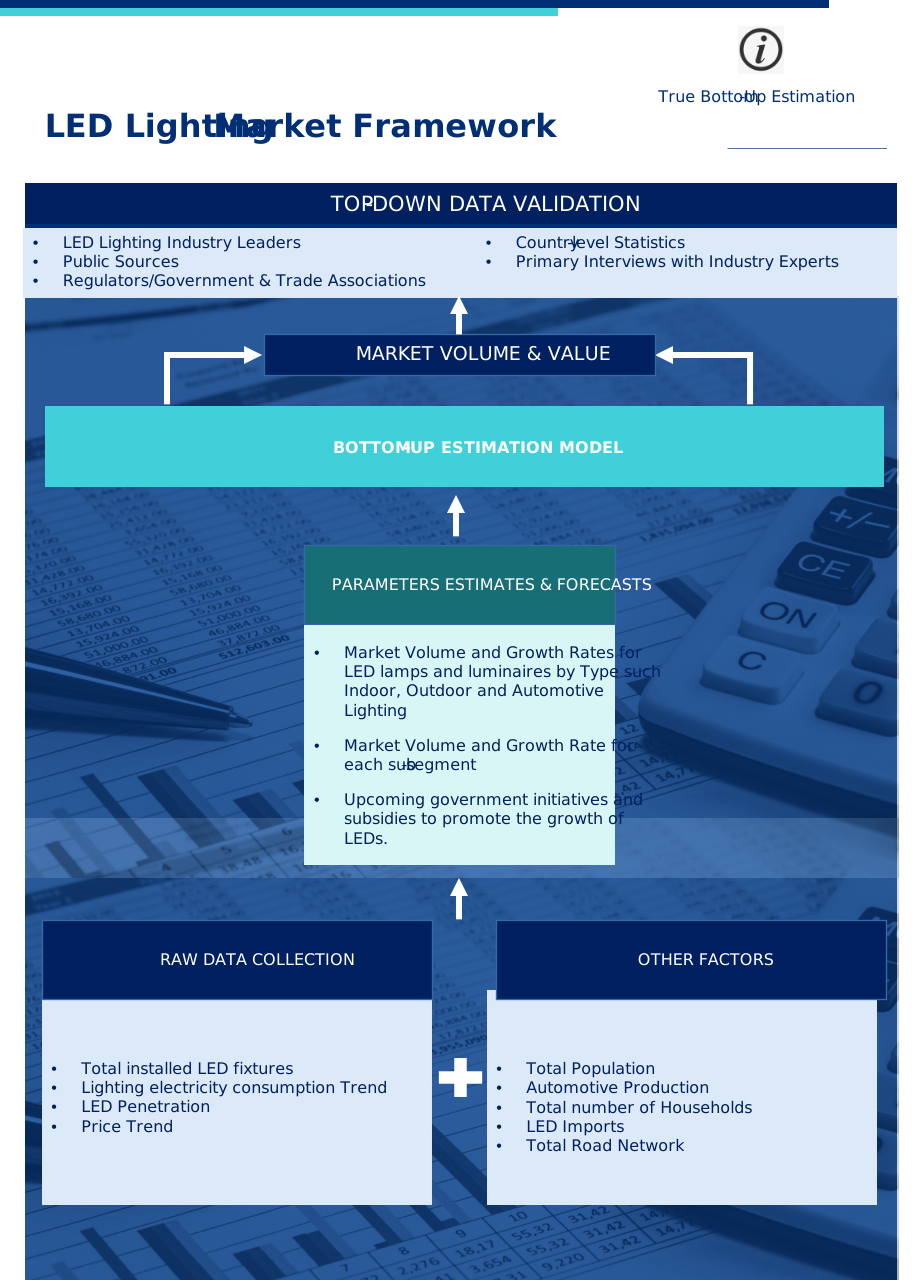
Mordor Intelligence has followed the following methodology in all our data center reports.
- Step 1: Raw Data Collection: To understand the market, initially, all crtical data points were identified. Critical information about countries and regions of interest including Per-capita Income, Population, Automotive Production, Interest rate on Auto-Loans, Number of Automobiles on Road, Total LED Import, Lighting Electricity Consumption among others were recorded or estimated based on internal calculations.
- Step 2: Identify Key Variables: To build a robust forecasting model, key variables such as Number of Households, Automotive Production, Road Networks among others were identified. Through an iterative process, the variables required for the market forecast were set, and the model was built using these variables.
- Step 3: Build a Market Model: Based on data and critical industry trend data (variables), including LED pricing, LED penetration rate, and project macro and micor economic factors were utilized for building the market forecasting.
- Step 4: Validate and Finalize: In this crucial step, all market numbers and variables derived through an internal mathematical model were validated through an extensive network of primary research experts from all the markets studied. The respondents are selected across levels and functions to generate a holistic picture of the market studied.
- Step 5: Research Outputs: Syndicated Reports, Custom Consulting Assignments, Databases & Subscription Platforms





 Your data is secure and never sold or shared.


