
Market Overview
| Study Period | 2020 - 2031 |
|---|---|
| Forecast Data Period | 2026 - 2031 |
| Base Year Market Size (2025) | USD 2.02 Billion |
| Market Size (2026) | USD 2.12 Billion |
| Market Size (2031) | USD 2.7 Billion |
| Growth Rate (2026 - 2031) | 4.96 % |
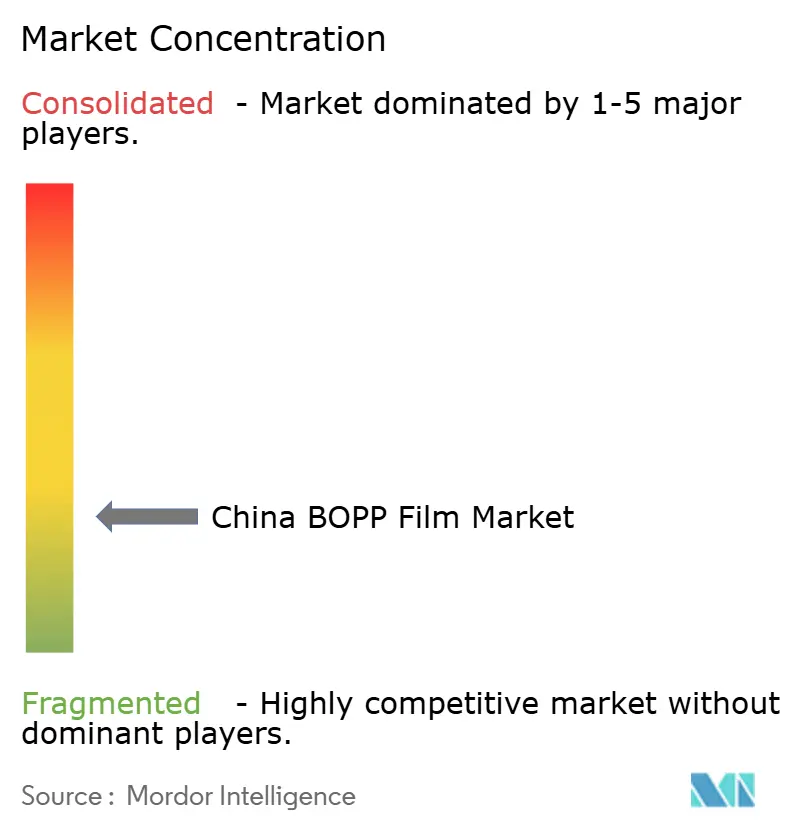
| Market Concentration | Low |
Major Players
*Disclaimer: Major Players sorted in no particular order Image © Mordor Intelligence. Reuse requires attribution under CC BY 4.0. |
|
China BOPP Film Market Analysis by Mordor Intelligence
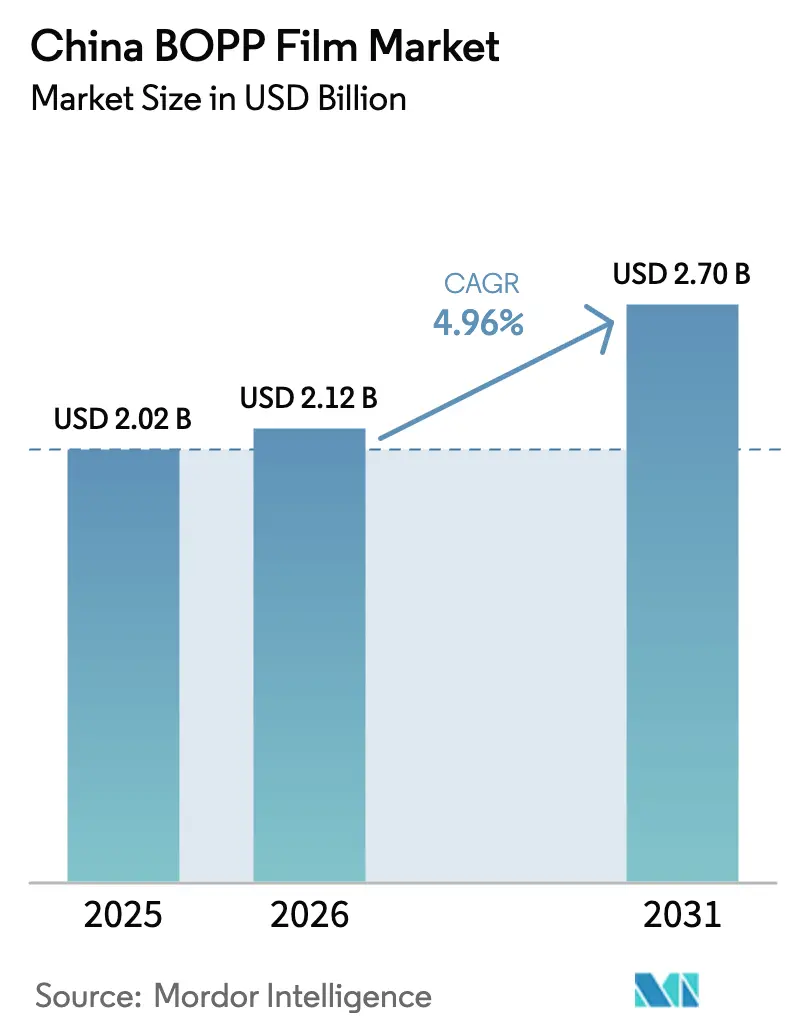
China BOPP film market size in 2026 is estimated at USD 2.12 billion, growing from 2025 value of USD 2.02 billion with 2031 projections showing USD 2.7 billion, growing at 4.96% CAGR over 2026-2031. Continuing growth rests on strong domestic demand from food, beverage and e-commerce channels, steady upgrades of tenter-line technology and expanding investments in specialty grades such as lithium-battery separator film. Transparent grades keep wide adoption in mainstream laminations while metallized, opaque and high-barrier structures unlock new value pools in snacks, nutraceuticals and premium labels. Cost discipline remains critical as polypropylene resin still accounts for more than 70% of total production cost, prompting thin-gauge innovation and strategic feedstock sourcing. At the same time, regulatory momentum around food-contact safety and national recycling frameworks is nudging converters toward compliant, mono-material formats that are easier to recover at end-of-life.
Key Report Takeaways
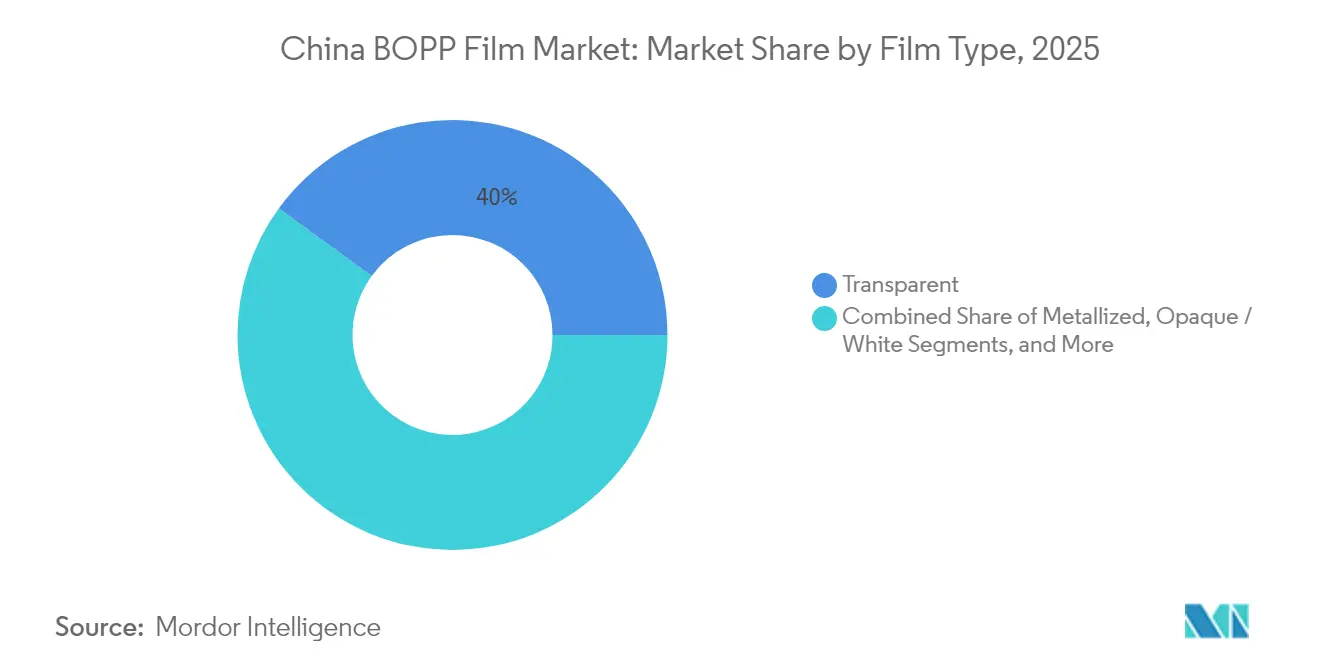
- By film type, transparent grades captured 39.98% of China BOPP film market share in 2025, whereas metallized films are poised to expand at a 6.23% CAGR through 2031.
- By thickness, the 15-30 micron range held 36.22% of the China BOPP film market size in 2025, yet films above 45 microns will advance fastest at a 5.94% CAGR.
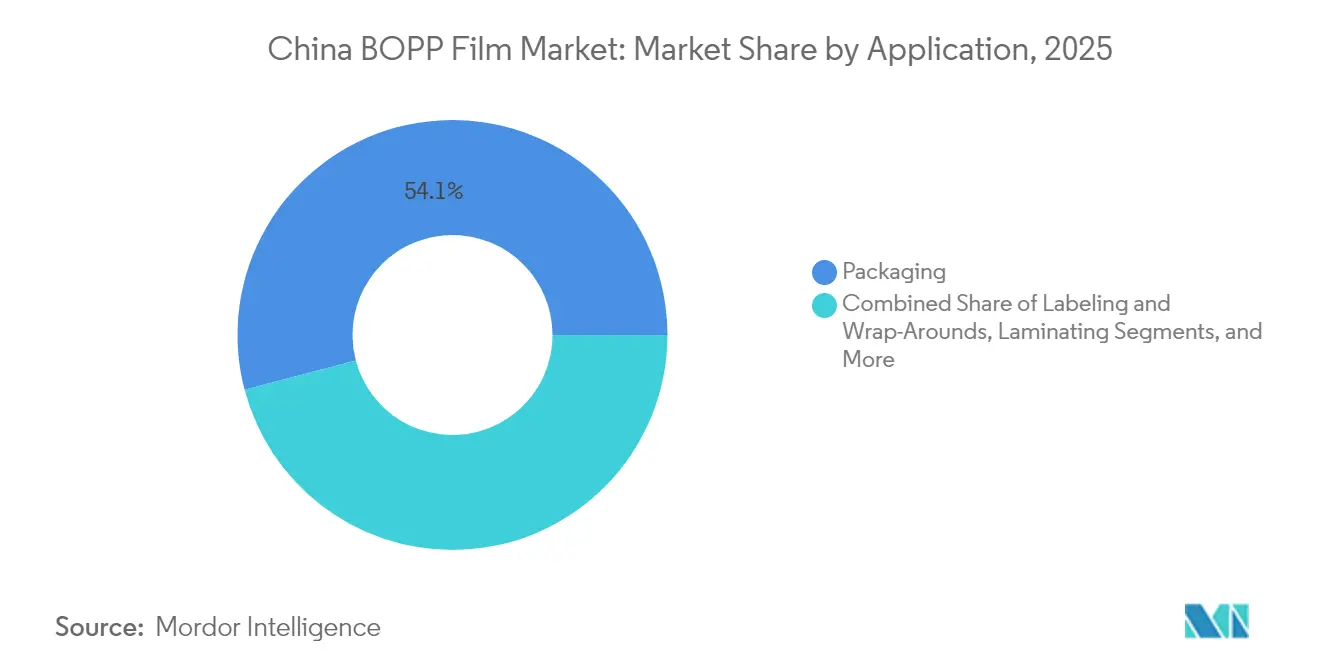
- By application, packaging accounted for 54.10% of 2025 demand and is set to grow at a robust 6.85% CAGR to 2031.
- By end-user vertical, food held 28.37% market share in 2025, while pharmaceutical and medical packaging will outpace all others at a 7.21% CAGR.
- By geography, Jiangsu, Zhejiang and Guangdong collectively housed more than half of national capacity in 2025 and continue to register the highest provincial utilization rates.
Note: Market size and forecast figures in this report are generated using Mordor Intelligence’s proprietary estimation framework, updated with the latest available data and insights as of 2026.
China BOPP Film Market Trends and Insights
Drivers Impact Analysis*
| Driver | (~) % Impact on CAGR Forecast | Geographic Relevance | Impact Timeline |
|---|---|---|---|
| Surging e-commerce packaging demand | +1.2% | National; tier-1 cities lead | Short term (≤ 2 years) |
| Government push for high-barrier food safety standards | +0.8% | National; stricter in major cities | Medium term (2–4 years) |
| Shift from PVC to BOPP labels in beverages | +0.6% | National; multinational brands lead | Medium term (2–4 years) |
| Rising demand for low-gauge cost-saving films | +0.7% | National; cost-sensitive sites | Short term (≤ 2 years) |
| Expansion of BOPP-based lithium-battery separator films | +0.4% | Battery manufacturing hubs | Long term (≥ 4 years) |
| Investments in high-speed domestic tenter lines | +0.3% | Major manufacturing provinces | Medium term (2–4 years) |
| Source: Mordor Intelligence | |||
Surging E-commerce Packaging Demand
Rapid growth of online retail continues to lift shipment volumes for courier bags, mailers and single-serve product packs that favor thin, printable BOPP substrates. Converters serving grocery delivery and pharmaceutical fulfillment increasingly request co-extruded films engineered for low-temperature seal initiation to protect temperature-sensitive goods. Producers reply with 12–15 micron transparent grades that retain puncture resistance while shaving resin use, thereby protecting margins even as freight costs stay elevated. Ink-receptive surface chemistries and improved anti-static packages shorten press setup time, a decisive edge for short-run personalization programs popular on livestream platforms.
Government Push for High-Barrier Food Safety Standards
Implementation of GB 4806.15-2024 for food-contact adhesives compels lamination houses to tighten migration controls and to document every batch of inks, primers and tie-layers. [1] Large-scale China BOPP film market producers have responded by installing multi-layer on-line thickness gauges and investing in ISO 17025-accredited labs so they can issue certificates of analysis within 24 hours. The new rules favor high-barrier metallized and coated grades that extend shelf life under stricter distribution temperatures, especially for ready-to-eat meals and dairy snacks sold via convenience stores.
Shift from PVC to BOPP Labels in Beverages
Brand owners targeting bottle-to-bottle PET recycling are moving away from PVC label stock toward polyolefin mono-material solutions that float and separate cleanly. Chinese label printers now specify pearlized or cavitated BOPP for heat-shrink sleeves that must survive 50 cycles of caustic wash yet detach without adhesive residue. The transition forces resin formulators to fine-tune shrinkage curves and dyne levels, spurring collaboration across the value chain and accelerating qualification cycles with global soft-drink giants.
Rising Demand for Low-Gauge Cost-Saving Films
Intensified price competition in snacks and dry goods packaging places a premium on gauges below 15 microns. Domestic tenter lines equipped with automated decurlers and multi-segment pin ovens now hold ±1% thickness tolerance across 8.7-meter webs, unlocking efficient slit-edge yields. Cost-down initiatives also drive solvent-free lamination and digital varnish replacement to avoid over-lamination in certain promo packs, further promoting material savings.
Restraints Impact Analysis*
| Restraint | (~) % Impact on CAGR Forecast | Geographic Relevance | Impact Timeline |
|---|---|---|---|
| Volatility in polypropylene feedstock prices | −0.9% | National | Short term (≤ 2 years) |
| Stringent single-use plastic waste regulations | −0.6% | National; regional variance | Medium term (2–4 years) |
| Capacity overbuild causing price compression | −0.5% | Major production regions | Short term (≤ 2 years) |
| Emerging bio-based film alternatives | −0.3% | Premium application pockets | Long term (≥ 4 years) |
| Source: Mordor Intelligence | |||
Volatility in Polypropylene Feedstock Prices
Spot PP resin hovered in a USD 740–755 per-ton band during early 2025, but order lead times shortened to one week as traders hesitated to build stocks amid uncertain macro conditions. Larger China BOPP film market producers now hedge up to 50% of their forward resin requirements under term contracts indexed to China-created benchmarks, while midsize players rely on syndicated purchasing pools to buffer weekly swings. Nonetheless, abrupt spikes can still compress film margins by 300–400 basis points in a single quarter.
Stringent Single-Use Plastic Waste Regulations
China’s phased bans on non-recyclable single-use plastics force retailers to prove yearly reduction targets and to submit recycling audits to municipal bureaus. [2] BOPP is comparatively advantaged because it is a mono-material polyolefin, yet multi-layer pouches combining PET/PE or paper/PE remain under scrutiny. Converters accelerate trials of washable inks and easy-peel sealants designed for mechanical sorting, while producers of specialty metallized grades launch proprietary demetallization processes to ensure full circularity.
*Our forecasts treat driver/restraint impacts as directional, not additive. The impact forecasts reflect baseline growth, mix effects, and variable interactions.
Segment Analysis
By Film Type: Metallized Films Drive Innovation
Metallized structures accounted for a modest slice of China BOPP film market size in 2025, yet their 6.23% CAGR signals accelerating traction in moisture-sensitive snacks, powdered beverages and over-the-counter medicines. Transparent films still held 39.98% China BOPP film market share in 2025, largely due to their versatility in horizontal form-fill-seal operations. Demand for metallized film rises where ≤0.5 g/m² oxygen transmission rate is non-negotiable, pushing suppliers to retrofit vacuum metallizers with plasma pretreatment for tighter adhesion. Brand owners also embrace clear barrier coatings as an alternative route to see-through, recyclable windows that maintain aluminum-equivalent barrier. The result is a premiumization path where converters secure higher per-kilogram profits while brand owners improve shelf appeal.
Second-generation coated metallized grades now combine half-mirror aesthetics with de-inkable surfaces, unlocking mainstream recyclability under APR guidelines. Pilot projects with beverage closures demonstrate that aluminum deposition as low as 300 angstroms still meets carbonation retention targets, proving viable across high-speed bottling. Multinational snack players structure two-year supply agreements to lock in capacity and reduce exposure to coated PET, signaling confidence that metallized BOPP will continue displacing incumbent substrates in rigid-to-flexible conversions.

By Thickness: Ultra-Thin Applications Accelerate
The dominant 15–30 micron band retained 36.22% China BOPP film market share in 2025, yet gauges above 45 microns will grow fastest at 5.94% over 2026-2031 on the back of stand-up pouch zippers, retort lids and industrial over-wraps. Producers strategically balance line mixes to capture both ends, dedicating older legacy widths to thin-gauge runs and saving new 10.4-meter assets for high-value thick products where output-per-millimeter is lower but price-per-ton higher. Inline IR cameras integrated with AI-driven feedback loops now deliver ±0.3 micron profiles, an essential requirement for converter uptime.
Demand for sub-12 micron transparent film grows in sachets and micro-pouches, but process windows tighten sharply; thus, only operators with high-precision chill-roll systems and positron thickness modeling can meet defect targets. Conversely, 60-micron oriented insulation tapes for motor windings draw interest from EV manufacturers because of dielectric strength and abrasion resistance. Together these trends illustrate how the China BOPP film market keeps diversifying thickness spectrums to fulfill disparate performance codes rather than converging on a single optimized gauge.
By Application: Packaging Dominance Intensifies
Packaging represented 54.10% of overall consumption in 2025 and will rise at 6.85% CAGR as China’s grocery retail continues its omnichannel pivot. High-barrier metallized snack wrap leads volume growth, while transparent over-wrap remains the workhorse in noodles, biscuits and condiment pouches. Meanwhile, label and wrap-around applications gain incremental share as beverage OEMs abandon PVC for floatable polyolefin skins—a shift that reinforces circular-economy compliance. Lamination houses diversify into retortable flexibles by deploying high-temperature adhesives compatible with BOPP/PET or BOPP/CPP stacks.
Pressure-sensitive tapes, though mature, sustain steady grade replacement: UV-cured acrylic adhesives call for tailored anchor coatings on BOPP backers, opening niche orders for surface-modified films. Online retailers also accelerate adoption of matte-finish bubble mailers utilizing opaque cavitated BOPP facestock to improve scuff resistance during last-mile delivery. Consequently, producers now juggle run schedules across multiple slit widths to keep pace with fragmenting SKU mixes in packaging.
By End-User Vertical: Pharmaceutical Surge Leads Growth
Food preserved its 28.37% share of the China BOPP film market size in 2025, fueled by continuous snacking demand and convenience meals. Yet pharmaceutical and medical packaging is positioned to expand at a market-leading 7.21% CAGR thanks to rising OTC volumes and post-pandemic cold-chain investments. Child-resistant and tamper-evident pouch formats increasingly specify 25-micron white opaque BOPP for back-panel printability coupled with superior delta-E stability under gamma sterilization. Beverage labels meanwhile remain a sizable demand node as polyolefin sleeves improve bottle recycling yield under Chinese PET roadmap targets.
Personal-care brands call for high-gloss pearlescent grades featuring controlled opalescence that masks fill lines without extra opaque masterbatch. Industrial tape and electronics reinforce moderate baseline loads but register sporadic spikes during construction booms or electronics refresh cycles. Across each vertical, compliance with national food-contact standards remains the universal gatekeeper, reinforcing the importance of robust migration-safe formulations tested under GB/31604 simulants.
Geography Analysis
Driven by proximity to polymer feedstock and port logistics, Jiangsu, Zhejiang and Guangdong collectively accounted for more than half of the China BOPP film market size in 2025. Jiangsu leads in specialty high-barrier output, leveraging integrated petrochemical complexes in Lianyungang and Suzhou that shorten resin supply chains and reduce in-plant inventory. Zhejiang anchors the largest concentration of privately owned tenter lines, many clustered in Jiaxing and Shaoxing, allowing shared solvent-recovery systems and skilled labor exchanges that heighten operational flexibility. Guangdong remains export-oriented; its producers routinely ship jumbo rolls through Shenzhen and Gaolan ports, serving converters across Southeast Asia and Latin America.
Inland expansion is accelerating under Western Development and Cheng-Yu Twin-City economic plans that subsidize advanced material projects. Chongqing and Sichuan now court BOPP producers with electricity tariffs 15% lower than coastal averages, offsetting freight penalties on finished rolls bound for eastern converters. Meanwhile, Hebei and Shandong focus on low-gauge commodity film, targeting regional food hubs in Henan and Anhui where logistics distances remain manageable. National rail upgrades facilitate back-haul opportunities, improving transport economics for bulky but lightweight film stock.
Regulatory enforcement intensity still varies by province. Coastal municipalities have adopted stricter post-consumer film-waste reporting, compelling local producers to pilot take-back schemes, whereas inland counties emphasize capacity utilization and job creation. Nevertheless, central government guidelines that benchmark recycling rates are closing the compliance gap, setting a common playing field for all players by 2027. Overall, regional specialization continues to sharpen comparative advantages while inter-provincial freight optimization buffers cost disparities, ensuring that the China BOPP film market maintains balanced growth across the nation.
Regulatory Landscape
China BOPP film production and downstream converting operate within China’s food-contact and product-quality supervision framework, including the Food Safety Law and the Interim Measures for the Supervision and Administration of the Quality and Safety of Food-Related Products (effective March 1, 2023). Against this backdrop, food-contact compliance and traceability have become more operationally demanding for laminated structures used in food and pharmaceutical packaging, increasing the need for documented migration control across adhesives, inks, and functional layers.
China is also moving on material standardization, with a national revision project for biaxially oriented polypropylene film (project number 20250472-T-607) issued on February 28, 2025. The revision is run under the National Standardization Administration of China, managed by the National Technical Committee on Plastic Products Standardization (TC48), and is positioned to align more closely with ISO 17555:2021 to support more harmonized testing language for producers and converters serving both domestic and export-oriented packaging chains.
Value Chain Analysis
The China BOPP film value chain begins with polypropylene resin procurement, often the dominant cost block for film producers, followed by extrusion and biaxial orientation on tenter lines. Downstream finishing then covers surface treatment, coating, and metallization to achieve barrier and printability requirements, after which jumbo rolls are slit and supplied to converters for lamination, printing, and pouching. End markets include food, beverage, pharmaceutical and medical packaging, alongside selected industrial and electronics-related applications.
Standard-setting and compliance activities increasingly connect upstream producers and downstream users, as film specifications, testing protocols, and documentation requirements flow through the chain. The value chain also includes established Chinese manufacturers such as Zhejiang Kinlead Innovative Materials Co., Ltd., Gettel Group Co., Ltd., and Anhui Guofeng Plastic Industry Co., Ltd. Guofeng is referenced as a drafting unit in standards activity, which points to how leading producers help shape technical requirements that then feed into converter qualification and customer acceptance processes.
Competitive Landscape
The China BOPP film market is fragmented. Scale remains meaningful, yet differentiation pivots more on technical agility and regulatory compliance. Leading state-backed enterprises operate multi-line complexes exceeding 200 kilotons per year, underpinned by fully integrated resin-to-film flows that shield against feedstock volatility. Privately owned innovators, in contrast, carve out niches in metallization, aqueous coating, and matte-frost finishes that command margin premiums.
Strategic differentiation increasingly emphasizes sustainability credentials. Several producers now market low-carbon “green-power” grades verified by third-party renewable-energy certificates, leveraging provincial incentives for rooftop solar adoption. Others tout closed-loop recycling pilots that reclaim trim waste and faulty rolls for depolymerization back into polypropylene feedstock. Early adopters of simultaneous-stretch technology, introduced through a landmark European acquisition in 2025, advertise superior biax uniformity and downgauging potential, appealing to converters aiming for line speed above 600 packs per minute. [3]
M&A momentum remains lively. Cross-border deals focus on augmenting product portfolios and market access rather than pure tonnage. Domestic consolidation intensifies wherever cash-flow stress from capacity overbuild erodes working capital. Technology partnerships with downstream FMCG and pharmaceutical customers deepen, manifesting in joint innovation centers that co-develop barrier enhancements, printable recyclability markers and AI-enabled defect inspections. Collectively, these dynamics underscore a marketplace where operational excellence and customer intimacy often outweigh headline capacity when securing long-term contracts.
China BOPP Film Industry Leaders
-
Zhejiang Kinlead Innovative Materials Co., Ltd.
-
Gettel Group Co., Ltd.
-
Anhui Guofeng Plastic Industry Co., Ltd.
-
Guangdong Decro Film New Materials Co., Ltd.
-
Jiangsu Shuangxing Color Plastic New Materials Co., Ltd.
- *Disclaimer: Major Players sorted in no particular order
Market Opportunities and Future Outlook
A clear opportunity lies in compliance-ready, higher-value BOPP structures that reduce friction for qualification in food-contact and laminated packaging as documentation and testing expectations tighten. The February 28, 2025 national standard revision project for BOPP film (20250472-T-607) under TC48 creates a concrete window for producers to align product design and test methods with evolving national requirements, with closer ISO 17555:2021 alignment supporting converters that serve regulated food and healthcare packaging.
Broader multi-base manufacturing footprints also give suppliers a route to differentiate on supply security and qualification speed. Zhejiang Kinlead Innovative Materials Co., Ltd., for instance, reports annual capacity of about 460,000 tons across facilities spanning China, Vietnam, and Egypt (as of 2026), while Gettel Group states 9 production bases across 6 provinces with 18 BOPP lines, which supports shorter lead times for regional converters and enables higher-grade specialization. As packaging customers continue to push mono-material solutions and thinner gauges to manage resin intensity, producers with wider capability sets, including metallization and coating as well as process control, can differentiate through downgauging, barrier enhancement, and documentation support rather than competing only on commodity tonnage.
Recent Industry Developments
- June 2026: Gettel Group Co., Ltd. Launched a new global digital portal to accelerate its international market deployment. The launch expands the company's global digital sales channel, strengthening international reach and direct sales, reducing channel drag and increasing pricing and contract control in the BOPP segment.
- April 2026: Anhui Guofeng New Materials Co., Ltd. Released 2025 Annual Report noting the integration of its BOPP and BOPET production centers and the stable operation of its 38,000-ton annual capacity high-end functional film project. The integration of BOPP/BOPET capacity and high-end functional films support premium segment growth and potential margin stability as product mix improves and utilization steadies.
- February 2026: Zhejiang Kinlead Innovative Materials Co., Ltd. Phase 1 of its new production base in Hangzhou Bay is scheduled to launch by end-2026, with annual sales capacity of RMB 400 - 500 million. The expansion into high-end BOPP capacity adds production capability, enabling broader product offerings and potential downstream integration.
Research Methodology Framework and Report Scope
Market Definition and Coverage
This market covers the value of biaxially oriented polypropylene (BOPP) film sold and used in China across packaging, labeling, and related converting uses, counted at the film level in revenue terms.
Scope exclusions: Excludes non-oriented PP films (such as CPP) and PET/PVC packaging films, even when they are used in similar end uses.
Segmentation Overview
-
By Film Type
- Transparent
- Metallized
- Opaque / White
- Pearlescent
- Other Film Type
-
By Thickness
- < 15 µm
- 15 – 30 µm
- 30 – 45 µm
- > 45 µm
-
By Application
- Packaging
- Labeling and Wrap-Arounds
- Laminating
- Pressure-Sensitive Tapes
- Other Application
-
By End-user Vertical
- Food
- Beverage
- Pharmaceutical and Medical
- Personal Care and Cosmetics
- Industrial
- Other End-user Vertical
Data Sources, Market Sizing, and Validation
Desk Research
Desk work starts by mapping both demand and supply for BOPP film in China, and then aligning that view with how converters and end users purchase and price film. We use public sources to keep the time series consistent, so the later interview inputs can be used to tighten assumptions rather than rebuild the base.
We typically use sources such as China Customs import-export statistics, the National Bureau of Statistics of China for related manufacturing indicators, and industry bodies such as plastics processing and packaging associations for production and application trends. We also review public standards and regulatory references tied to food contact packaging, plus peer reviewed papers that describe film structures, barrier performance, and downgauging. Company annual reports, investor presentations, and trade press are added to track capacity additions, product mix shifts, and resin linked pricing. Where needed, we also draw on a paid subscription for company financials and news, and a shipment-level trade database to sanity check external flows. These desk sources are not exhaustive, and we use additional public and paid references to collect data, validate it, and clarify open questions.
Primary Interviews and Surveys
Primary work focuses on confirming how BOPP film demand is formed in China, especially across packaging converters, brand-oriented buyers, and downstream users that specify barrier and sealing needs. Interviews and short surveys are used to validate film type mix, typical thickness ranges by application, price movements relative to polypropylene, and how quickly specialty grades are gaining share across major industrial clusters.
To avoid relying on a single viewpoint, we cross check inputs across producers, distributors, and converting-focused experts, then reconcile them back to the desk model so gaps are closed before final totals are signed off.
Distribution of primary research fieldwork respondents
| Company type | Respondent position |
|---|---|
| Top tier: 34% | CXOs: 17% |
| Mid tier: 49% | Functional/Unit leaders: 30% |
| Smaller Players: 17% | Managers: 53% |
Market-Sizing & Forecasting
Sizing is built using a top-down approach where packaging film demand is reconstructed from China specific indicators, and then filtered to the BOPP share using application level adoption patterns. The totals are corroborated with selective bottom-up approximations, such as sampling price per kg by film type and thickness, distributor channel checks, and producer capacity utilization conversations. This helps us adjust when desk signals and field feedback do not align.
Key inputs used in the model include polypropylene resin price direction and pass through timing, changes in typical gauge (thin down trends), the split between transparent and metallized grades, shifts in flexible packaging output tied to food and e-commerce shipping needs, and import export movements for polypropylene films. Where hard data is missing, we use bounded assumptions that are verified in calls, and we avoid filling gaps with single company run rates unless they are supported by multiple independent checks.
For the forecast, scenario analysis is used so demand growth and pricing can move differently under resin cycles, capacity additions, and specialty grade penetration. Assumptions for each scenario are reviewed with industry participants, then consolidated into a base case that stays consistent with observed end use growth signals.
Data Validation & Update Cycle
Validation is done through triangulation across desk indicators, interview feedback, and internal consistency checks, so the final number is not dependent on any one data stream. Outliers are flagged when implied price per kg, growth rates, or application shares drift away from what a converter or film producer would accept as realistic, and those areas are revisited before the model is finalized.
Each report goes through multi-step analyst review, followed by a final variance check against independent signals such as resin movements, packaging output trends, and trade flows. The report is refreshed annually, and interim updates are triggered when material events happen, such as major capacity starts, packaging policy shifts, or sharp feedstock price swings. Before delivery, a fresh pass is completed so clients receive an updated view based on the latest available information.
Mordor Intelligence's China Bopp Film Market Estimate Compared With Other Published Estimates
Published market sizes for China BOPP film can differ a lot, even when the titles look similar, because the underlying scope and unit economics are not always treated the same way. Differences typically come from what film types are counted, whether the number reflects producer sales or downstream converted value, and how prices are averaged across standard and specialty grades.
CPP and other non-oriented polypropylene films sit outside Mordor Intelligence's scope, which reduces the risk of inflating value by mixing adjacent packaging films with different thickness, pricing, and end use rules. The spread in other estimates is also driven by whether they assume aggressive specialty penetration early, use a single average price for all grades, or apply older resin-to-film pass through patterns without re-validating them against current converter buying behavior.
Benchmark comparison
| Source | Market Size | Gaps in Research Methodology |
|---|---|---|
| Mordor Intelligence | USD 2.02 B (2025) | |
| Packaging Analytics A | USD 3.65 B (2024) | Often centers on BOPP films for packaging and can blend broader packaging film revenue pools, which may fold in adjacent film families and downstream converted value instead of film only sales. |
| Industry Research Desk B | USD 5.10 B (2025) | May rely on capacity led extrapolation with a single blended ASP and limited adjustment for oversupply pricing, downgauging, and the split between commodity and specialty grades in China. |
Across the three figures, the main takeaway is that wider film baskets and higher assumed price levels tend to push the value higher than a film level BOPP only view. By keeping the model tied to application level mix and realistic pricing by grade and thickness, we can explain each step and repeat the sizing as new capacity, resin cycles, and packaging demand signals change.
Key Questions Answered in the Report
How large is the China BOPP film market in 2026?
The China BOPP film market size is USD 2.12 billion in 2026 and is projected to reach USD 2.7 billion by 2031.
What is the expected growth rate of China BOPP films through 2031?
The market is forecast to expand at a 4.96% CAGR from 2026 to 2031.
Which film type is growing fastest in China?
Metallized BOPP film is the fastest-growing type, with a 6.23% CAGR expected through 2031.
Which end-user vertical offers the highest growth potential?
Pharmaceutical and medical packaging shows the highest CAGR at 7.21% thanks to stricter safety demands and healthcare expansion.
How are regulations influencing China’s BOPP sector?
New GB 4806.15-2024 standards elevate food-contact compliance, while recycling mandates push development of mono-material and recycled-content films.
Where is most BOPP capacity located in China?
Jiangsu, Zhejiang and Guangdong hold more than half of national capacity, benefiting from established petrochemical infrastructure and port access.