
Ceramics Market Size and Share
Market Overview
| Study Period | 2021 - 2031 |
|---|---|
| Market Size (2026) | USD 252.93 Billion |
| Market Size (2031) | USD 344.83 Billion |
| Growth Rate (2026 - 2031) | 6.39 % |
| Fastest Growing Market | Asia-Pacific |
| Largest Market | Asia-Pacific |
| Market Concentration | Medium |
Major Players *Disclaimer: Major Players sorted in no particular order Image © Mordor Intelligence. Reuse requires attribution under CC BY 4.0. | |
Ceramics Market Analysis by Mordor Intelligence
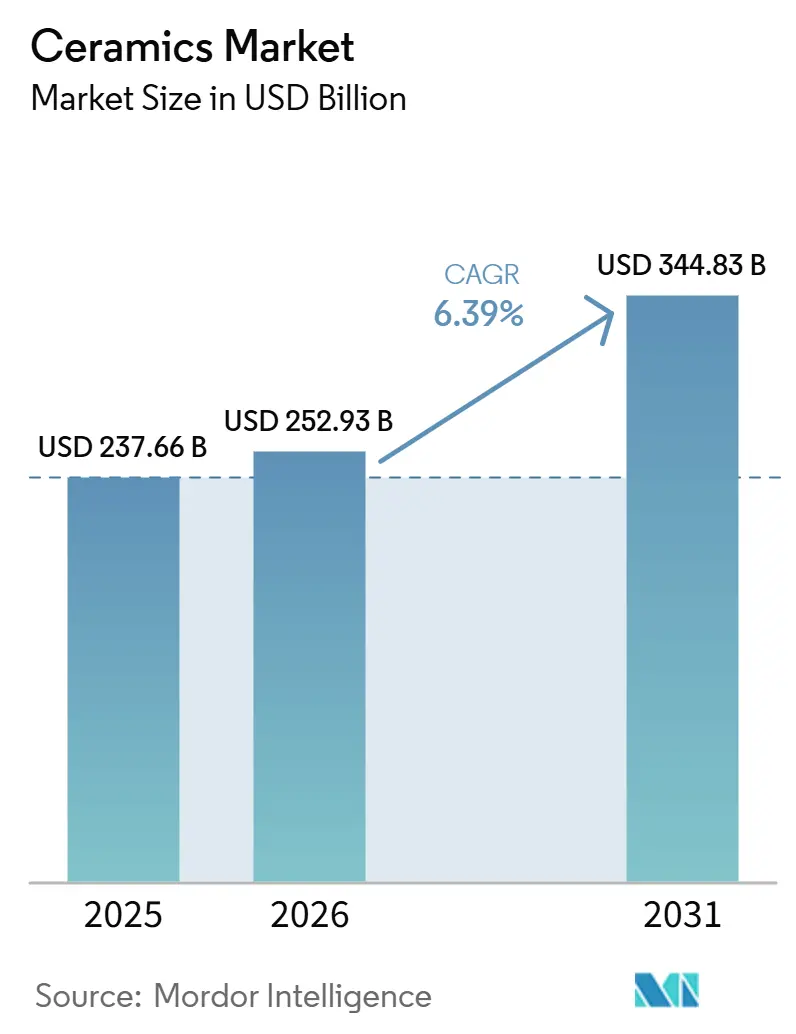
The Ceramics Market size was valued at USD 237.66 billion in 2025 and is estimated to grow from USD 252.93 billion in 2026 to reach USD 344.83 billion by 2031, at a CAGR of 6.39% during the forecast period (2026-2031). The ceramics market is supported by steady demand from residential, commercial, and public construction, as well as from tiles, sanitary ware, and structural products. The market is also gaining value from precision applications in semiconductor equipment, AI-linked electronics, electric vehicles, medical components, and renewable energy systems. This mix gives the ceramics market a broader demand profile than many other materials categories, as weakness in one end use is partly offset by activity in another. The market reflects a split between traditional products and technology-driven advanced materials, shaping investment priorities, plant expansions, and product development decisions across the supplier base. Cost pressure remains a constraint, as energy consumption, environmental compliance, and raw material price volatility affect operating margins, particularly for smaller producers that lack scale and balance sheet flexibility.
Key Report Takeaways
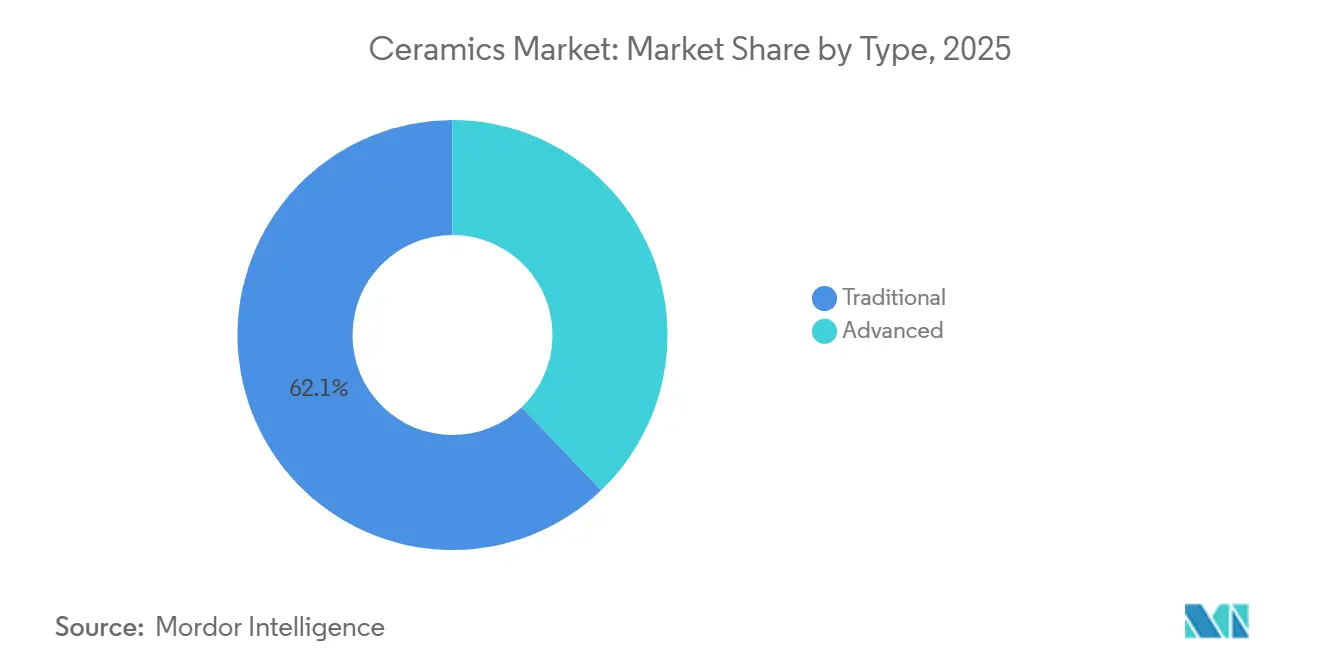
- By type, traditional ceramics led with 62.15% of revenue in 2025, while advanced ceramics are forecast to grow at a 7.83% CAGR through 2031.
- By application, tiles accounted for 48.61% of the Ceramics market size in 2025, while electrical and electronics are projected to expand at an 8.54% CAGR through 2031.
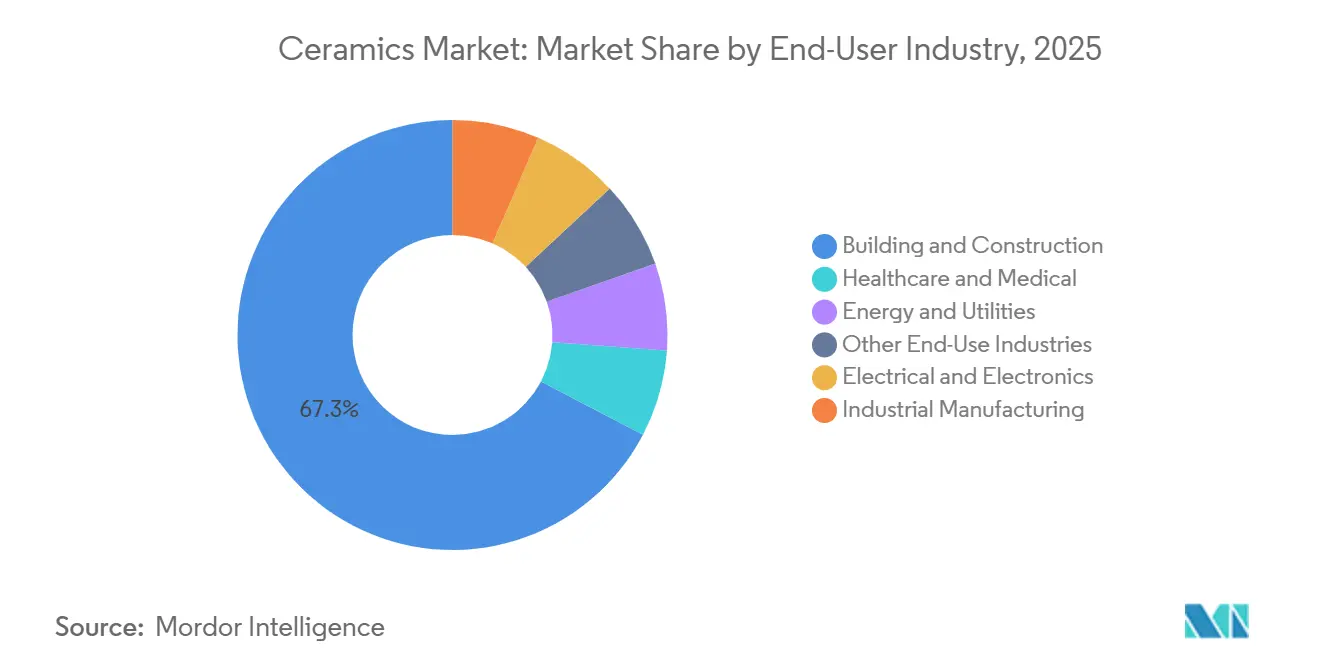
- By end-user industry, building and construction held 67.32% of the Ceramics market share in 2025, while electrical and electronics are forecast to grow at a CAGR of 8.41% through 2031.
- By geography, Asia-Pacific captured 46.27% of global revenue in 2025 and is also expected to post the fastest regional CAGR of 7.26% through 2031.
Note: Market size and forecast figures in this report are generated using Mordor Intelligence’s proprietary estimation framework, updated with the latest available data and insights as of January 2026.
Market Trends and Insights
Drivers Impact Analysis of Ceramics Market*
| Drivers | (~) % Impact on CAGR Forecast | Geographic Relevance | Impact Timeline |
|---|---|---|---|
| Rising Demand for Ceramics Across Residential and Commercial Construction | +2.0% | Asia-Pacific core, with spillover to the Middle East and South America | Short term (≤ 2 years) |
| Increasing Adoption of Advanced Ceramics in Electronics, AI Infrastructure, and Semiconductor Manufacturing | +1.4% | East Asia, especially Japan, South Korea, and China | Medium term (2-4 years) |
| Growing Replacement Demand for Ceramics as a Substitute for Metals, Polymers, and Natural Stone | +0.6% | Global | Long term (≥ 4 years) |
| Rising Demand for Modern Housing and Large-Scale Infrastructure Development in Emerging Markets | +0.8% | India, Southeast Asia, and the Middle East | Short term (≤ 2 years) |
| Expansion of Ceramics Applications into Renewable Energy Systems and Electric Vehicles | +0.7% | East Asia, North America, and Europe | Long term (≥ 4 years) |
| Source: Mordor Intelligence | |||
Rising Demand from Global Construction Activity
In construction, the ceramics market is closely tied to housing completions, renovation work, and public infrastructure delivery, with key applications including tiles, sanitary ware, bricks, and pipes. This pattern is especially visible in high-growth economies where urban expansion requires a steady supply of basic building materials and interior finishing products. When housing programs, city expansion, and commercial development advance together, the same project pipeline can lift demand across several ceramic product categories simultaneously. Data indicates that premium tile formats have been gaining traction in India, suggesting that the ceramics market in these locations is not only selling more units but also a more valuable product mix. This shift supports revenue growth even when lower-end products face price competition, and helps explain why the ceramics market remains anchored in construction fundamentals, even as newer applications attract greater strategic attention.
Increasing Adoption of Advanced Ceramics in Semiconductor and AI Infrastructure
Semiconductor and AI infrastructure spending is also driving growth in the ceramics market, as high-purity ceramic parts are required for fabrication, packaging, and thermal management systems. NGK Insulators, Ltd. announced in April 2026 that it would invest JPY 70 billion (approximately USD 480 million) in a new facility to expand capacity for ceramics used in semiconductor manufacturing equipment[1]NGK Corporation, “NGK to Increase Production Capacity of Ceramics for Semiconductor Manufacturing Equipment,” NGK Corporation, ngk-global.com. KYOCERA introduced a multilayer ceramic core substrate in April 2026 for advanced AI semiconductor packages used in xPUs and switch Application-Specific Integrated Circuits (ASICs), demonstrating how the ceramics market is moving deeper into data center hardware requirements. These developments indicate that the ceramics market is no longer tied solely to end products, as it is also becoming increasingly important for capital equipment and enabling materials that support semiconductor output. Product complexity is rising as package architecture becomes more demanding, which favors suppliers with extensive process experience and controlled manufacturing conditions. This raises entry barriers and gives the ceramics market a stronger technology layer than traditional construction categories typically offer.
Expansion of Ceramics in Renewable Energy and Electric Vehicles
The ceramics market is playing an increasingly important role in renewable power and electric mobility, as ceramic materials are used for insulation, thermal control, power conversion, and high-voltage system protection. The American Ceramic Society noted that global renewable energy capacity grew by a record 15.1% in 2024, supporting demand for ceramic components in wind, solar, and grid hardware. In electric vehicles, the ceramics market benefits from applications where dielectric strength, thermal conductivity, and chemical stability are difficult to replace with simpler materials. Saint-Gobain Ceramics and Eurodia Industrie announced a strategic partnership in October 2025 for Direct Lithium Extraction, combining ceramic adsorbent materials with process engineering for lithium recovery above 90%. This positions the ceramics market within energy transition equipment, rather than only in buildings or consumer products, and gives producers a path toward applications with stronger pricing and lower exposure to basic construction cycles.
Growing Replacement Demand and Material Substitution
The ceramics market is also benefiting from material substitution, as ceramics are replacing metals, polymers, and natural stone in settings where durability, heat resistance, biocompatibility, or appearance are prioritized over familiarity with the material. In healthcare, zirconia and other bioceramics are gaining adoption in dental and orthopedic applications because they combine strength with a clinical fit that metallic alternatives do not always provide. Lithoz reported in April 2025 that a long-term clinical follow-up study on 3D-printed bioceramic implants showed a 92% total success rate for patient-specific implants produced from tricalcium phosphate under ISO 13485 quality management. In industrial applications, the ceramics market benefits from the installation of higher-performance refractories that improve furnace efficiency and service life. On interior surfaces, digital printing enables ceramic producers to replicate natural-stone appearances at a lower cost, shifting spending toward ceramic formats without changing the end use. Murata's October 2025 agreement with QuantumScape is another example, as ceramic separators could open a new path for replacement-led demand in battery systems.
Restraints Impact Analysis of Ceramics Market*
| Restraints | (~) % Impact on CAGR Forecast | Geographic Relevance | Impact Timeline |
|---|---|---|---|
| High Energy Consumption in Ceramics Manufacturing, Raising Operating Costs and Exposure to Energy Price Volatility | -1.5% | Global, with stronger pressure in India, Europe, and China | Short term (≤ 2 years) |
| Volatility in Raw Material Prices, Particularly Kaolin, Feldspar, and Quartz, Driven by Supply Concentration and Trade Disruptions | -0.9% | Global, especially smaller regional producers in Asia | Medium term (2-4 years) |
| Stringent Environmental Regulations Increasing Compliance Costs and Capital Expenditure Requirements | -0.7% | Europe, China, and the United States | Long term (≥ 4 years) |
| Source: Mordor Intelligence | |||
High Energy Consumption in Ceramics Manufacturing
Energy-intensive firing and heat treatment processes present a clear operating constraint for the ceramics market. Research published in the International Journal of Applied Ceramic Technology in 2025 found that ceramic tile production consumed 32 kWh per square meter of output, with kilns responsible for more than 80% of sector emissions and a total global warming potential of 14.4 kg CO2e per square meter. These figures are significant because the ceramics market still has a large traditional manufacturing base where fuel cost fluctuations can pressure margins and reduce plant utilization. The research also notes that decarbonization options such as electrified kilns, hydrogen firing, and waste heat recovery are technically viable but require substantial capital investment that smaller producers may struggle to fund. The ceramics market faces a cost challenge from both fuel prices and the investment required to reduce fuel dependence over time. This restraint is particularly relevant in Europe, where regulatory tightening is increasing the cost of modernization for energy-intensive plants[2]European Parliament, “Industrial Emissions Directive, BREF for the Ceramic Manufacturing Industry,” European Parliament, europarl.europa.eu .
Volatility in Raw Material Prices
Raw material price volatility also constrains the ceramics market, as the supply of kaolin, feldspar, and quartz does not adjust quickly when trade conditions or industrial demand shift. The U.S. Bureau of Labor Statistics series available through Federal Reserve Economic Data (FRED) showed that the Producer Price Index for kaolin, clay, and ceramic and refractory minerals rose from 100.0 in January 2025 to 136.0 in April 2026. This movement illustrates how input costs in the ceramics market can increase before producers fully adjust product pricing or sourcing contracts. Larger companies can generally absorb some of this pressure through procurement scale and longer-term contracts, but smaller regional players remain more exposed to spot-market fluctuations. The ceramics market is sensitive when mining investment cycles lag behind downstream demand, as supply recovery then takes longer than the demand shock that triggered the disruption. This keeps cost pressure in place even after end-market conditions begin to stabilize.
*Our forecasts treat driver/restraint impacts as directional, not additive. The impact forecasts reflect baseline growth, mix effects, and variable interactions.
Ceramics Market Segment Analysis
By Type:
Advanced Ceramics Outpacing Traditional Growth Despite Structural DominanceTraditional ceramics accounted for 62.15% of revenue in 2025, maintaining its position as the largest category in the ceramics market by revenue. This share reflects its strong ties to tiles, bricks, pipes, sanitary ware, and pottery, which remain the primary ceramic products used in construction applications. These products move in large volumes, rely on established distribution systems, and benefit from consistent replacement and renovation demand. Traditional ceramics are also easier to distribute across regional markets, as logistics, installer familiarity, and specification standards are already well established. This makes the traditional ceramics category the largest segment of the ceramics market, even where pricing is more competitive. Shifts in housing, infrastructure, and remodeling activity, therefore, continue to have a broad effect on total revenue.
Advanced ceramics are forecast to grow at a CAGR of 7.83% through 2031. Growth is supported by functional and structural applications in electronics, industrial equipment, medical implants, and energy systems, where purity, dimensional control, and performance are prioritized over cost. NGK's April 2026 capacity expansion for semiconductor equipment ceramics and KYOCERA's product development in AI package substrates reflect how producers are directing investment toward more specialized output. Murata's new Ceramic Capacitor R&D Center, opened in February 2026, and its new production building, completed in April 2026, point in the same direction toward higher-value ceramic systems. More value creation in the ceramics industry is therefore shifting toward advanced materials, even as traditional products continue to dominate absolute revenue. This gives the ceramics market a two-track structure, with one side driven by construction demand and the other by technical performance requirements.



By Application:
Tiles Hold Scale, but Electrical Applications Drive the Growth AgendaTiles accounted for 48.61% of global revenue in 2025, giving them the largest application share in the ceramics market. This reflects the broad use of ceramic flooring and wall products in residential, commercial, and institutional construction, where durability, low maintenance, and design versatility are valued. The ceramics market remains closely tied to this category because tiles are used in both new construction and replacement spending, supporting recurring demand. Premium formats, including larger sizes and glazed vitrified products, have improved the value mix by raising average selling prices while keeping ceramic materials within mainstream building budgets. This benefits the ceramics market by adding value without reducing installation relevance, and it keeps tiles as the primary reference point for the broader application profile.
Electrical and electronics is projected to grow at an 8.54% CAGR through 2031, making it the fastest-growing application in the ceramics market. This category is benefiting from semiconductor fabrication, advanced packaging, demand for multilayer ceramic capacitors, and next-generation battery development, all of which require ceramic materials with stringent technical properties. KYOCERA's multilayer ceramic core substrate for AI semiconductors and Murata's ceramic separator developed with QuantumScape illustrate how application growth is extending across both chip hardware and energy storage systems. Refractories, abrasives, sanitary ware, pottery, and other uses continue to provide stable demand but are less likely to reshape the long-term growth profile independently. As electronics applications scale, the ceramics market stands to benefit, given that these products typically offer stronger value per unit than conventional building materials.
By End-User Industry:
Construction Commands Share, Electronics Drives MarginBuilding and construction accounted for 67.32% of demand in 2025, making it the largest end-user segment in the ceramics market. This share reflects the broad use of ceramics in flooring, wall coverings, sanitary products, structural formats, and infrastructure installations. The ceramics market depends on this end-user group because construction captures spending across mass housing, commercial projects, and public works. Many ceramic products are specified early in a project and then generate replacement demand later in the asset life cycle, giving the ceramics market a durable link to the built environment. Construction, therefore, remains the primary demand driver even as other end-user segments become more important for value growth.
Electrical and electronics is forecast to expand at an 8.41% CAGR through 2031, making it the fastest-growing end-user category in the ceramics market. Demand in this segment is linked to chip manufacturing, AI servers, packaging substrates, passive components, and high-performance thermal and dielectric applications where ceramic materials are difficult to substitute. KYOCERA's April 2026 substrate commercialization and NGK's semiconductor ceramics investment both indicate that electronics demand is influencing capacity decisions across the supplier base. Healthcare and medical use is also expanding through bioceramics, while energy and utilities represent an additional long-term demand stream through ceramic components used in renewable and power systems. The ceramics industry remains led by construction in terms of scale, but is increasingly shaped by electronics in terms of technical requirements and margin potential. This reflects how the ceramics market has become more balanced across end-use drivers over time.
Geography Analysis
APAC Ceramics Market
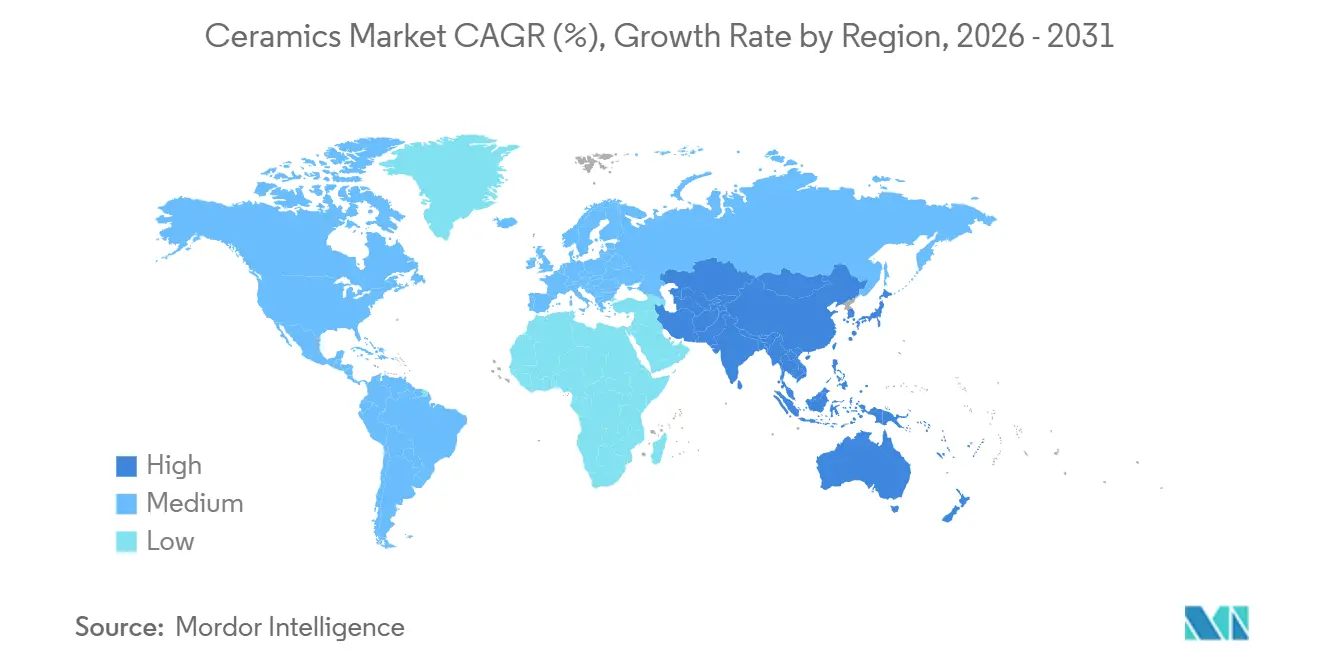
Asia-Pacific accounted for 46.27% of global revenue in 2025, making it the largest region in the ceramics market. The region is also projected to expand at a 7.26% CAGR through 2031, making it the fastest-growing regional block in the ceramics market. Asia-Pacific combines the world's largest production base for traditional ceramics with a strong concentration of advanced ceramics suppliers in Japan and South Korea. China remains central to tile output, while Japan and South Korea contribute more strongly to higher-value electronics and precision ceramics. This gives Asia-Pacific a balance of scale, cost competitiveness, technical capability, and end-market depth.
North America and Europe Ceramics Market
North America and Europe represent more mature parts of the ceramics market, where growth is tied less to new housing construction and more to renovation demand, industrial applications, semiconductor-related materials, and energy transition equipment. In Europe, the revised Industrial Emissions Directive has made compliance and kiln modernization a more visible competitive factor for ceramic manufacturers. This policy environment favors larger operators that can fund upgrades while maintaining stable output. North America benefits from steady remodeling activity and a meaningful base of advanced manufacturing applications. Mohawk Industries reported Q1 2026 net sales of USD 2.7 billion, up 8.0% year over year, indicating resilient flooring demand in the region.
MEA and South America Ceramics Market
South America, the Middle East, and Africa generate lower total revenue but remain important to the ceramics market due to their growth potential and role in regional diversification. In the Middle East, large construction programs and hospitality development continue to support ceramic demand, even amid disruptions to trade routes. RAK Ceramics reported in 2026 that regional conditions affected export flows, illustrating how the ceramics market in the Middle East and Africa (MEA) is shaped by both project demand and logistics risk. South America remains more closely linked to residential construction cycles and financing conditions, while advanced ceramics demand in both regions is still served largely through imports.

Competitive Landscape
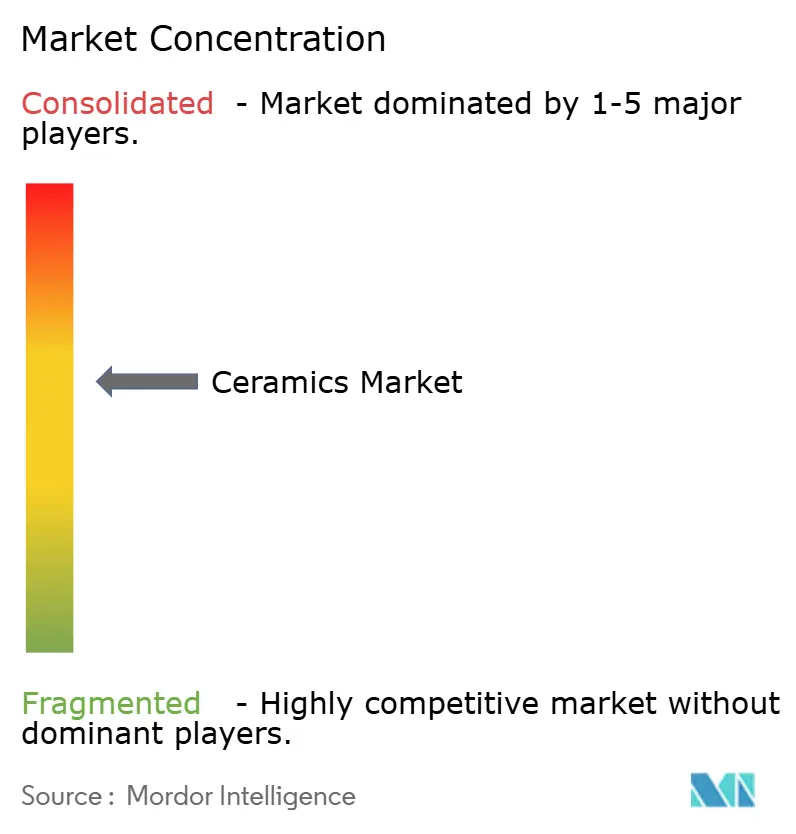
The ceramics market is moderately consolidated, which creates two distinct competitive patterns within the industry. In tiles, sanitary ware, bricks, and refractories, producers compete through regional scale, distribution reach, logistics control, and brand recognition in home improvement channels. No single company holds more than a low single-digit global share across the full traditional ceramics space, keeping the market open to many regional incumbents. Kajaria Ceramics, RAK Ceramics, Mohawk Industries, and LIXIL are scale players in these product groups, but their strength is defined by geography and category rather than global dominance. As a result, competitive intensity remains high even when demand conditions are favorable.
In advanced ceramics, the market is shaped by a smaller set of suppliers that compete through process capability, intellectual property, materials expertise, and application engineering. KYOCERA, Murata Manufacturing, NGK, Morgan Advanced Materials, and CeramTec operate closer to this model, where product performance and customer qualification matter more than commodity pricing. Morgan Advanced Materials reported FY2025 technical ceramics revenue of GBP 341.6 million (USD 453.93 million). The advanced ceramics market rewards long product cycles, materials know-how, and consistent manufacturing yields as applications expand into semiconductors, medical devices, and power systems.
Recent strategic moves illustrate how companies are expanding their addressable base in the ceramics market. NGK committed a new investment to semiconductor equipment ceramics in April 2026, signaling a capacity response to stronger chip-related demand. KYOCERA expanded its fine ceramics facility in North Carolina in April 2026 and commercialized a new ceramic core substrate for advanced AI semiconductor packages in the same month. Murata added R&D and production infrastructure in Japan in 2026, while its 2025 agreement with QuantumScape demonstrated how ceramic expertise can be applied to battery separators and new energy systems. These developments indicate that the ceramics market is becoming more specialized at the high end, even as traditional product lines remain crowded.
Ceramics Industry Leaders
Saint-Gobain
KYOCERA Corporation
CoorsTek Inc.
CeramTec GmbH
RAK CERAMICS
- *Disclaimer: Major Players sorted in no particular order
Ceramics Market Companies Covered in this Report
- 3M
- AGC Ceramics Co., Ltd.
- CeramTec GmbH
- CoorsTek Inc.
- Du-Co Ceramics Company
- Imerys S.A.
- Kajaria Ceramics Limited
- KYOCERA Corporation
- LIXIL Corporation
- Materion Corporation
- McDanel Advanced Ceramic Technologies
- MOHAWK INDUSTRIES, INC.
- Morgan Advanced Materials plc
- Murata Manufacturing Co., Ltd.
- NGK Spark Plug Co., Ltd.
- RAK CERAMICS
- Rauschert GmbH
- Saint-Gobain

Recent Industry Developments in Ceramics Market
- June 2026: RAK Ceramics signed an exclusive multiyear licensing agreement with Roberto Cavalli for the development, manufacture, and distribution of Roberto Cavalli-branded ceramic tiles, sanitary ware, and faucets. The first collections are scheduled to be unveiled at Cersaie 2026 in Bologna, Italy, in September 2026. The agreement repositions RAK in the premium lifestyle segment and reflects a strategy of competing on brand equity rather than volume pricing in architectural ceramics.
- April 2026: KYOCERA expanded its fine ceramics manufacturing facility in Hendersonville, North Carolina, adding a 30,000-psi cold isostatic press and 16,000 sq. ft. of production area to support energy, aerospace, semiconductor, and medical ceramic applications. The expansion followed a 20.6% year-over-year increase in KYOCERA's worldwide capital expenditure in the nine months through December 2025.


Global Ceramics Market Report Scope
Ceramics are hard, heat-resistant materials made from inorganic, nonmetallic substances such as clay, alumina, or silica. They are shaped by hand, on a wheel, or by molding and fired in a kiln at high temperatures to achieve their durable form.
The ceramics market is segmented by type, application, end-user industry, and geography. By type, the market is segmented into traditional and advanced. By application, the market is segmented into tiles, sanitary ware, bricks & pipes refractories, abrasives, electrical & electronic ceramics, pottery & tableware, and other applications. By end-user industry, the market is segmented into building & construction, electrical & electronics, industrial manufacturing, healthcare & medical, energy & utilities, and other end-use industries. The report also covers market size and forecasts for ceramics across 16 countries in major regions. The market sizes and forecasts are provided in terms of value (USD).
| Traditional |
| Advanced |
| Tiles |
| Sanitary Ware |
| Bricks & Pipes |
| Refractories |
| Abrasives |
| Electrical & Electronic Ceramics |
| Pottery & Tableware |
| Other Applications |
| Building & Construction |
| Electrical & Electronics |
| Industrial Manufacturing |
| Healthcare & Medical |
| Energy & Utilities |
| Other End-Use Industries |
| Asia-Pacific | China |
| India | |
| Japan | |
| South Korea | |
| Rest of Asia-Pacific | |
| North America | United States |
| Canada | |
| Mexico | |
| Europe | Germany |
| United Kingdom | |
| France | |
| Italy | |
| Russia | |
| Rest of Europe | |
| South America | Brazil |
| Argentina | |
| Rest of South America | |
| Middle-East and Africa | Saudi Arabia |
| South Africa | |
| Rest of Middle-East and Africa |
| By Type | Traditional | |
| Advanced | ||
| By Application | Tiles | |
| Sanitary Ware | ||
| Bricks & Pipes | ||
| Refractories | ||
| Abrasives | ||
| Electrical & Electronic Ceramics | ||
| Pottery & Tableware | ||
| Other Applications | ||
| By End-User Industry | Building & Construction | |
| Electrical & Electronics | ||
| Industrial Manufacturing | ||
| Healthcare & Medical | ||
| Energy & Utilities | ||
| Other End-Use Industries | ||
| By Geography | Asia-Pacific | China |
| India | ||
| Japan | ||
| South Korea | ||
| Rest of Asia-Pacific | ||
| North America | United States | |
| Canada | ||
| Mexico | ||
| Europe | Germany | |
| United Kingdom | ||
| France | ||
| Italy | ||
| Russia | ||
| Rest of Europe | ||
| South America | Brazil | |
| Argentina | ||
| Rest of South America | ||
| Middle-East and Africa | Saudi Arabia | |
| South Africa | ||
| Rest of Middle-East and Africa | ||


Key Questions Answered in the Report
What is current market size of Ceramics Market?
The Ceramics Market size was valued at USD 237.66 billion in 2025 and is estimated to grow from USD 252.93 billion in 2026 to reach USD 344.83 billion by 2031, at a CAGR of 6.39% during the forecast period (2026-2031).
Which product group leads revenue generation?
Traditional ceramics led with 62.15% of revenue in 2025, indicating that construction-linked products remain the largest segment.
Which application is growing the fastest through 2031?
Electrical and electronics are projected to grow at an 8.54% CAGR, ahead of all other application categories.
Which end-user group matters most for demand?
Building and construction accounted for 67.32% of demand in 2025, making it the main end-user base for ceramic consumption.
Page last updated on:





