
Cellulose Esters Market Size and Share
Market Overview
| Study Period | 2022 - 2032 |
|---|---|
| Market Size (2027) | USD 5.42 Billion |
| Market Size (2032) | USD 7.11 Billion |
| Growth Rate (2027 - 2032) | 5.61 % |
| Fastest Growing Market | Asia-Pacific |
| Largest Market | Asia-Pacific |
| Market Concentration | Medium |
Major Players *Disclaimer: Major Players sorted in no particular order Image © Mordor Intelligence. Reuse requires attribution under CC BY 4.0. | |
Cellulose Esters Market Analysis by Mordor Intelligence
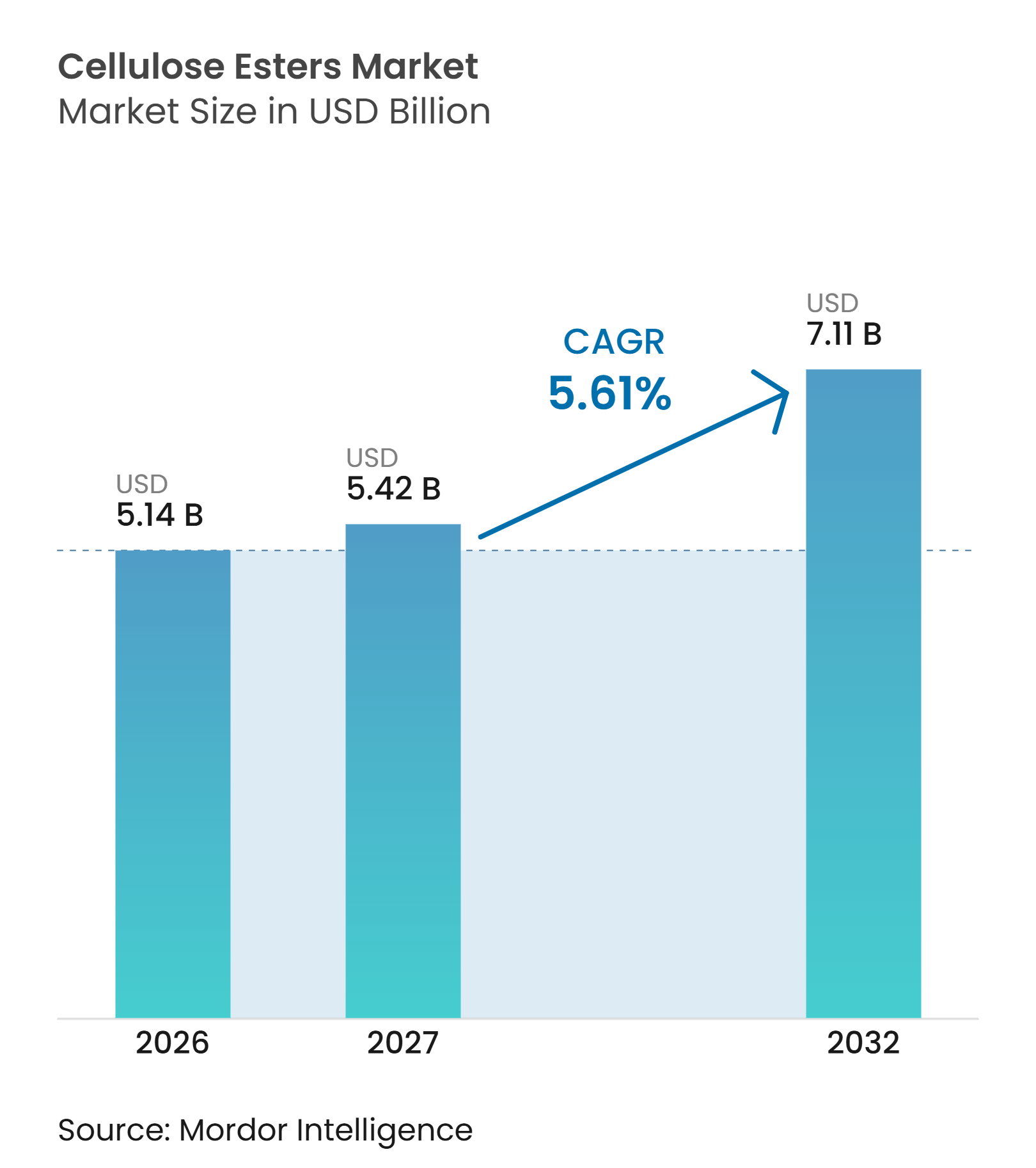
The Cellulose esters market size was valued at USD 5.14 billion in 2026 and is estimated to grow from USD 5.42 billion in 2027 to USD 7.11 billion by 2032, at a CAGR of 5.61% during the forecast period (2027-2032). The cellulose esters market is supported by demand for materials that can replace persistent synthetic polymers in selected applications. Regulations on intentionally added synthetic polymer microparticles are changing formulation choices in personal care products. Display manufacturing capacity in Asia is also increasing demand for high-performance cellulose ester materials used in optical applications. Producers are directing investment toward specialty grades for coatings, films, membranes, and cosmetics, as these applications have a different demand profile from that of cigarette filter tow. The cellulose esters market has growth opportunities in applications where material performance, certification, and supply security are considered alongside price.
Key Report Takeaways
- By raw material, Cellulose Acetate held 42.18% of the cellulose esters market share in 2026, while Cellulose Acetate Butyrate is forecast to grow at a 6.56% CAGR through 2032.
- By application, Coatings accounted for 28.67% of the cellulose esters market size in 2026, while Optical Films and Displays are forecast to advance at a 7.18% CAGR through 2032.
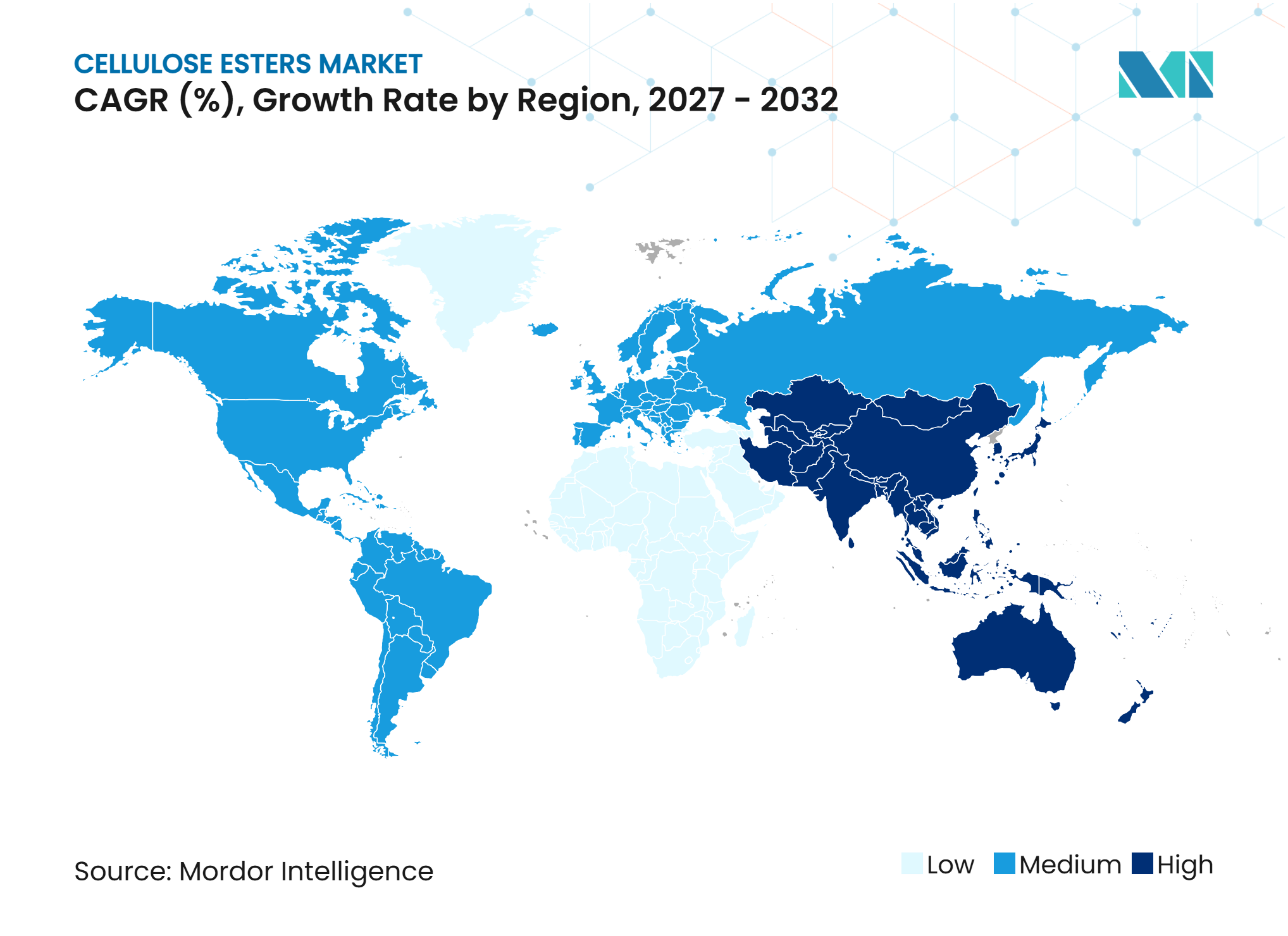
- By geography, Asia-Pacific held 38.34% of revenue in 2026 and is forecast to grow at a 7.03% CAGR through 2032.
Note: Market numbers in this report are based on Mordor Intelligence's proprietary estimation framework, which combines nine months of actuals with Q4 projections for base year 2026.
Market Trends and Insights
Drivers Impact Analysis of Cellulose Esters Market*
| Drivers | (~) % Impact on CAGR Forecast | Geographic Relevance | Impact Timeline |
|---|---|---|---|
| Bio-Based and Biodegradable Material Substitution | +1.2% | Global, with concentrated near-term gains in EU, Japan, and North America | Medium term (2-4 years) |
| Growth of Sustainable Packaging, Coatings and Films | +1.0% | Asia-Pacific core, spillover to North America and Europe | Medium term (2-4 years) |
| Expansion of Optical Films, Electronics and Advanced Membranes | +1.5% | China dominant, Japan and South Korea secondary | Short term (≤2 years) |
| Recycled-Content and Marine-Biodegradable Product Innovation | +0.6% | EU, Japan, and North American markets with nascent activity in APAC | Long term (≥4 years) |
| China Import Substitution and Regional Supply-Chain Localization | +0.9% | China core, with spillover to ASEAN Countries | Short term (≤2 years) |
| Source: Mordor Intelligence | |||
Bio-Based and Biodegradable Material Substitution
The European Union's restriction on intentionally added synthetic polymer microparticles is increasing interest in marine-biodegradable cellulose ester materials for personal care formulations. Eastman introduced Esmeri CC1N10 in June 2025, a cellulose ester micropowder sourced from sustainably managed forests for use in color cosmetics, sun care, and skin care products. The product targets formulations that require an alternative to conventional microplastic ingredients. Daicel launched BELLOCEA BS7 in March 2025, a spherical cellulose acetate particle with improved marine biodegradability for cosmetic applications. These launches indicate that the cellulose esters market is moving toward products that must meet performance, formulation, and biodegradability requirements simultaneously. This product direction can shift supplier competition away from standard tow grades and toward differentiated materials with more specialized customer qualification needs.
Growth of Sustainable Packaging, Coatings and Films
Cellulose acetate butyrate (CAB) is used in coatings because it provides UV resistance, compatibility with lower-toxicity solvents, and resistance to yellowing. These properties support its use in automotive, wood furniture, aerospace, and industrial coating systems. The move toward lower volatile organic compound (VOC) coating formulations in Europe, and similar standards in China, is encouraging reformulation activity in the cellulose esters market. CAB can replace nitrocellulose or acrylic materials where coating durability and appearance are priorities. Its use in premium vehicle interior and exterior finishes also links demand for coatings to the rising quality requirements of new-energy vehicle manufacturers. Material buyers must still manage supply exposure, as the acetic and butyric anhydride supply chains supporting these formulations are concentrated in the hands of a small number of suppliers.
Expansion of Optical Films, Electronics and Advanced Membranes
Optical-grade cellulose esters are gaining importance as display supply chains seek materials that can meet demanding quality requirements. China's expansion in display manufacturing is strengthening demand for triacetate cellulose used in polarizer protective films. This demand is tied to localized production planning as well as to the material's technical role in display components. In 2025, Toyobo began providing samples of a plant-derived polylactic acid optical film for semiconductor manufacturing and display inspection applications[1]. This development reflects the search for film materials that combine optical characteristics with plant-derived content. The cellulose esters market also benefits from membrane applications, where cellulose triacetate is used in hollow-fiber reverse osmosis systems for desalination and water treatment.
Recycled-Content and Marine-Biodegradable Product Innovation
Daicel announced International Sustainability and Carbon Certification PLUS (ISCC PLUS) certification in January 2026 for cellulose acetate at its Himeji Aboshi Plant and for CAFBLO, its marine-biodegradable cellulose acetate resin. The certification permits mass-balance-based claims where certified and conventional feedstocks are processed within the applicable chain-of-custody framework. This is relevant to personal care and packaging customers that require validated sustainable material claims. It also makes certification a commercial requirement rather than solely a product attribute. Suppliers that establish certified chains early can become more closely integrated with customer procurement and documentation processes. The cellulose esters market may therefore see stronger competition around traceability, certification scope, and consistent supply of verified materials.
Restraints Impact Analysis of Cellulose Esters Market*
| Restraints | (~) % Impact on CAGR Forecast | Geographic Relevance | Impact Timeline |
|---|---|---|---|
| Declining Cigarette Consumption and Filter-Tow Exposure | -0.8% | North America and Europe core markets, moderate pressure emerging in East Asia | Long term (≥ 4 years) |
| Acetic Anhydride, Butyric Anhydride and Energy-Cost Volatility | -0.5% | Global, most acute in Europe and China | Short term (≤ 2 years) and medium term (2-4 years) |
| Long Qualification Cycles for High-Purity Optical, Medical and Food-Contact Grades | -0.3% | Global, with greatest delay impact in China import-substitution projects | Long term (≥ 4 years) |
| Source: Mordor Intelligence | |||
Acetic Anhydride, Butyric Anhydride and Energy-Cost Volatility
Acetic anhydride and butyric anhydride are key inputs for the production of cellulose ester grades. Changes in their availability or cost can affect manufacturers across commodity and specialty product lines. Producers that are not integrated into upstream chemicals face greater margin pressure when input prices rise. Energy costs present an additional challenge, particularly for European operations with energy-intensive production processes. Celanese reported in its 2025 annual filing that its acetyl chain includes acetic acid, vinyl acetate monomer, emulsions, redispersible powders, and engineered materials, highlighting the breadth of the integrated chemical base associated with acetyl products. The cellulose esters market must balance specialty product pricing with cost changes that may not be passed through to customers immediately.
Long Qualification Cycles for High-Purity Optical, Medical and Food-Contact Grades
High-purity grades used in optical, medical, pharmaceutical, and food-contact applications require extended validation before a supplier can secure regular orders. Customers assess material consistency, traceability, processing behavior, and compliance documentation before changing qualified inputs. This creates a barrier for new producers seeking to enter optical-grade or regulated applications and can also delay the commercial benefit of local production projects designed to reduce import dependence. FDA requirements for pharmaceutical excipients and the European Medicines Agency's expectations for formulation materials make supplier qualification particularly important in pharmaceutical applications. Established producers in the cellulose esters market benefit from this dynamic, as approved materials can remain embedded in customer specifications for many years.
*Our forecasts treat driver/restraint impacts as directional, not additive. The impact forecasts reflect baseline growth, mix effects, and variable interactions.
Cellulose Esters Market Segment Analysis
By Raw Material:
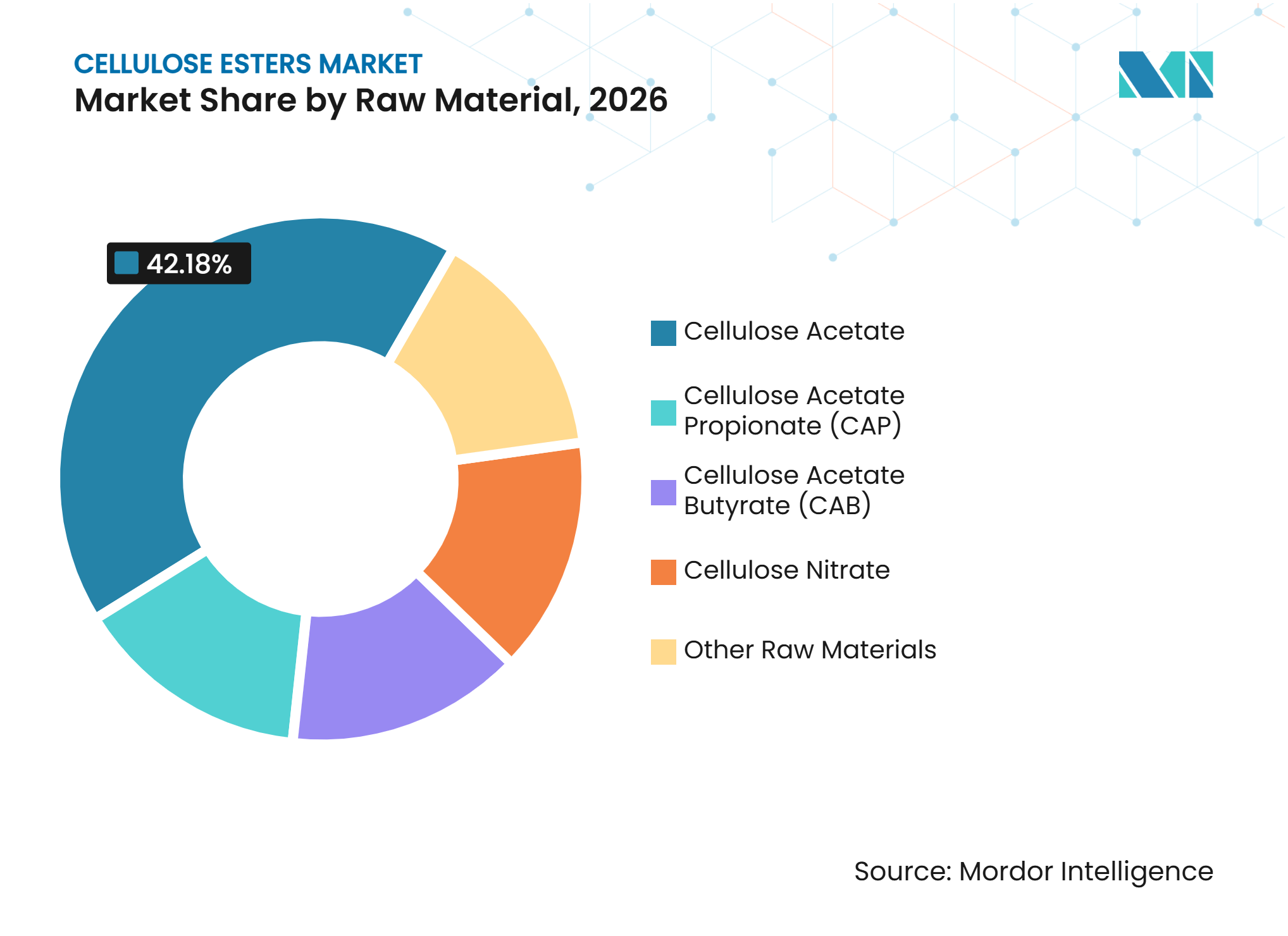
Optical-Grade Demand Changes the Product MixCellulose acetate accounted for 42.18% of the cellulose ester market share in 2026, supported by its established roles in cigarette filter tow, textile fibers, and optical films. The category includes commodity diacetate grades and higher-value triacetate grades, which serve different end uses and have different qualification requirements. Diacetate is used in tow and textile applications where output and reliable production are the primary considerations. Triacetate is used in polarizer protective films and optical membranes where purity and material performance are more important. The growth of display manufacturing in Asia is increasing demand for triacetate availability. This demand is shifting the raw material mix in the cellulose esters market toward grades tied to display, filtration, and high-performance film supply chains.
Cellulose acetate butyrate is projected to record a 6.56% CAGR from 2027 to 2032. CAB supports coating applications that require UV resistance, low-yellowing performance, and suitable flow characteristics. Its use in automotive, architectural, and wood coatings provides a different demand base from cigarette filter tow. Eastman identifies coatings, displays, and thermoplastics among the key downstream end markets for its cellulosic biopolymer stream. Cellulose acetate propionate is used in narrower coating applications where application behavior and finish quality are important. Cellulose nitrate continues to be used in lacquers and historical film-related applications, although environmental requirements affect material handling and disposal. ISO 9001 quality management systems and REACH registration requirements influence which cellulose ester grades can be supplied to European customers.



By Application:
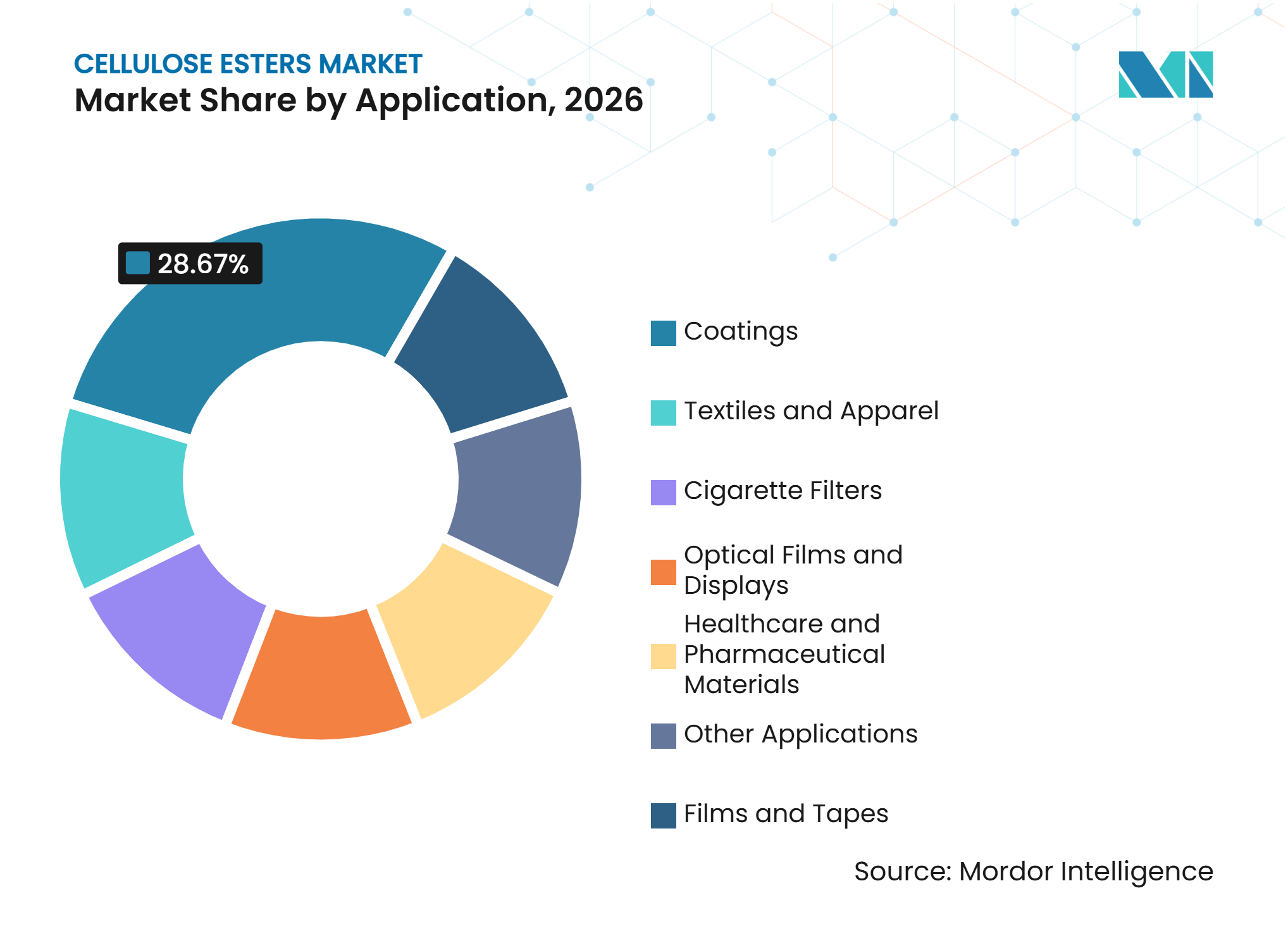
Coatings Lead While Optical Films and Displays Grow FasterCoatings accounted for 28.67% of the cellulose esters market in 2026. Cellulose acetate butyrate (CAB) is used in automotive, wood furniture, industrial, and selected aerospace coating systems because it supports durability and visual quality. Demand from new-energy vehicles adds another connection for coating suppliers, as manufacturers seek premium finishes and durable surfaces. The cellulose esters market benefits where coating formulators need alternatives compatible with lower volatile organic compound (VOC) systems. Coatings also provide an end-use base that is less dependent on tobacco demand. The application remains sensitive to the availability and pricing of upstream materials required to produce CAB and related ester grades.
Optical films and displays are expected to grow at a 7.18% CAGR through 2032. This application uses triacetate cellulose (TAC) in polarizer protective films for display systems. Demand is connected to the installed LCD base as well as new display inspection and semiconductor process applications. Toyobo's 2025 sample launch of a plant-derived optical film for display inspection and semiconductor manufacturing reflects continued material development in this area. Healthcare and pharmaceutical applications also use high-purity cellulose acetate membranes and controlled-release drug coating materials. FDA and EMA qualification processes make these applications stable but difficult for new suppliers to enter the market. Cigarette filters remain a significant application, but their relative share is expected to decline as demand for specialty films and membranes rises.

Geography Analysis
Asia-Pacific: Scale and Industrial Policy Shape Demand
Asia-Pacific accounted for 38.34% of revenue in 2026 and is forecast to expand at a 7.03% CAGR through 2032. China is a major source of demand for cellulose acetate tow, optical-grade triacetate cellulose, and coating-grade CAB. Its display, textiles, and specialty chemicals value chains create demand across several end uses rather than a single end market. Japan remains important for high-purity optical and filtration grades, while Japanese suppliers also serve customers in the cosmetics and specialty chemicals sectors. Daicel's ISCC PLUS certification for cellulose acetate and CAFBLO shows how verified sustainability claims are becoming relevant to product qualification in the region. Regional buyers must also consider compliance factors, including applicable Chinese Guóbiāo (GB) standards, REACH requirements for exports, and certification frameworks such as ISCC PLUS. The cellulose esters market in Asia-Pacific is supported by the combination of large-scale manufacturing and demand for higher-value applications.
China's focus on local production can alter how producers serve display and film customers. A localized supply base can reduce transport exposure and offer shorter response times for manufacturers. However, optical-grade materials require consistent quality and detailed customer qualification, making technical development as important as physical capacity expansion. In August 2025, Eastman and Huafon Chemical announced plans for a local cellulose acetate yarn facility in China, with the stated purpose of building a more localized production and service chain. The project indicates how international producers are responding to the importance of China's textile supply chain. The region's structural advantage extends beyond demand to include manufacturing depth, processing capacity, and proximity to end users.
North America: Specialty Grades Retain a Premium Role
North America remains a high-value region for specialty coatings, pharmaceutical excipients, performance films, and integrated chemical production. Eastman's Kingsport, Tennessee, complex produces CAB, CAP, and cellulose acetate grades from an integrated platform. The company identifies displays, coatings, and thermoplastics as key downstream markets for its cellulosic biopolymer business. This integration supports supply continuity across several grades and links cellulose ester output to the broader acetyl chain. North American customers also place importance on product consistency, regulatory documentation, and technical service. These factors favor established suppliers in applications where changing a material can require extensive reformulation or approval work.
In the first quarter of 2025, RYAM reorganized its High Purity Cellulose business into three units: Cellulose Specialties, Biomaterials, and Cellulose Commodities. This structure distinguishes differentiated cellulose products from more commodity-oriented operations and highlights the importance of acetate-grade dissolving pulp as an input to downstream cellulose ester production. Mexico can benefit from nearshoring by specialty chemical customers seeking shorter supply routes within North America. At the same time, cigarette tow exposure remains a restraint, as tobacco-related demand is under long-term pressure. The cellulose esters market in North America is shaped by a combination of integrated supply, specialized end uses, and the need to diversify beyond traditional tow applications.
Europe, South America, and the Middle East and Africa: Different End-Use Patterns
Europe is transitioning from a historically significant filter-tow manufacturing base toward higher-value cellulose ester grades. Germany and France remain important users of cellulose ester coatings in automotive refinish and furniture applications. European personal care customers also drive demand for biodegradable cosmetic ingredients that comply with the EU restriction on synthetic polymer microparticles. REACH remains a major regulatory influence for chemicals sold in the region. ISCC PLUS certification can strengthen a supplier's position when customers require credible sustainability claims. These conditions favor suppliers that can deliver technical performance with documented compliance.
South America contributes demand from coatings and textiles and has a supply-side connection through dissolving pulp production. Brazil and Argentina offer opportunities for consumption in industrial coatings, consumer products, and textile processing. The Middle East and Africa have slower but stable demand for tobacco manufacturing, coatings, and water treatment. While these regions have different demand patterns, each can support specialized cellulose ester applications beyond cigarette filters. The cellulose esters market share outside the largest regions is more dispersed, as end-use demand varies by country and local manufacturing base.
Competitive Landscape
Market Concentration
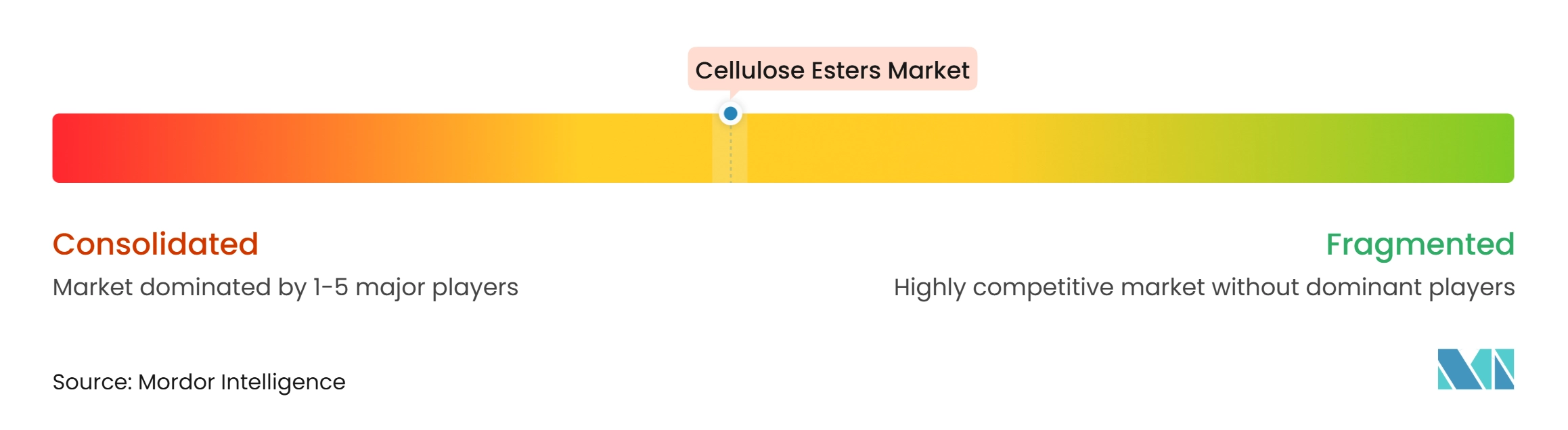
The cellulose esters market is moderately consolidated, with established producers holding integrated positions across acetylating agents, cellulose inputs, and finished ester grades. Eastman, Celanese, Daicel, RYAM, Cerdia, and Solvay are among the significant participants identified in this market. Vertical integration provides greater control over input availability, production quality, and customer service. It also creates high barriers for newer producers, as technical capabilities must be matched with reliable upstream supply. Competition varies across commodity tow, coatings, optical films, membranes, cosmetics, and textile applications. Companies with broad product portfolios can redirect focus toward applications with stronger growth prospects or higher qualification barriers.
Eastman is focusing on differentiated materials and regional manufacturing partnerships. Its 2025 Esmeri CC1N10 launch addressed demand for sustainable cosmetic ingredients. The company also announced a partnership with Huafon Chemical to establish localized manufacturing of Naia cellulose acetate yarn in China. Daicel has strengthened its position in certified sustainable materials through ISCC PLUS certification for cellulose acetate and CAFBLO[2]. RYAM's reorganization of its High Purity Cellulose business separates specialized materials from cellulose commodities in its reporting structure. These developments indicate that established suppliers are using product differentiation, sustainability credentials, and supply chain positioning as competitive tools.
The competitive environment also reflects pressure from changing tow demand and the need to meet strict requirements in specialty applications. Suppliers of optical, medical, and food-contact materials must undergo lengthy qualification processes and maintain robust compliance documentation. In Europe, REACH registration remains relevant, while ISCC PLUS certification can support verified sustainability claims in personal care and packaging supply chains. FDA requirements are important for pharmaceutical applications that use high-purity cellulose acetate materials. Opportunities remain in biodegradable packaging, advanced membrane filtration, and plastic-grade cellulose acetate products for eyewear. The competitive landscape is likely to favor companies that can combine technical performance with certified sourcing, customer qualification support, and secure regional supply.
Cellulose Esters Industry Leaders
-
Eastman Chemical Company
-
Celanese Corporation
-
Daicel Corporation
-
Cerdia International GmbH
-
China National Tobacco Corporation
- *Disclaimer: Major Players sorted in no particular order
Cellulose Esters Market Companies Covered in this Report
- Acordis Cellulosic Fibers Limited
- Ashok Alco-Chem Limited
- Celanese Corporation
- Cerdia International GmbH
- China National Tobacco Corporation
- Daicel Corporation
- Eastman Chemical Company
- Mitsubishi Chemical Group Corporation
- Nantong Acetate Fiber Co., Ltd.
- RYAM
- Shandong Henglian New Materials Co., Ltd.
- Sichuan Push Acetati Co., Ltd.
- SK Chemicals Co., Ltd.
- Solvay
- Toyobo co., Ltd.
Recent Industry Developments in Cellulose Esters Market
- September 2026: Jinan Acetate Chemical (Taiwan, 4763.TW) announced the acquisition of Cerdia Holding (Basel, Switzerland) from Blackstone for approximately USD 400 million. The acquisition adds significant global cellulose ester tow capacity and over 130 patents to Jinan Acetate's portfolio.
- August 2025: Eastman announced a formal strategic partnership with Huafon Chemical to establish a joint facility for Naia cellulose acetate filament yarn production in China. The partnership targets a fully localized manufacturing chain covering product development, production, and service, with the aim of increasing Naia cellulose ester capacity and improving supply chain responsiveness to China's textile market.
Global Cellulose Esters Market Report Scope
Cellulose ester is a chemical compound formed when the free hydroxyl (-OH) groups on natural cellulose (derived from wood pulp or cotton linters) react with an inorganic or organic acid through esterification. During this process, the hydroxyl groups on the cellulose backbone are partially or fully replaced by ester linkages, altering the physical and chemical properties of the base material.
The carbon fiber wrap market is segmented by raw material, application, and geography. By raw material, the market is segmented into cellulose acetate, cellulose acetate propionate (CAP), cellulose acetate butyrate (CAB), cellulose nitrate, and other raw materials. By application, the market is segmented into coatings, films and tapes, textiles and apparel, cigarette filters, optical films and displays, healthcare and pharmaceutical materials, and other applications. The report also covers market sizes and forecasts for carbon fiber wrap across 15 countries in major regions. The market sizes and forecasts are provided in terms of value (USD).
Segmentation Overview
| Cellulose Acetate |
| Cellulose Acetate Propionate (CAP) |
| Cellulose Acetate Butyrate (CAB) |
| Cellulose Nitrate |
| Other Raw Materials |
| Coatings |
| Films and Tapes |
| Textiles and Apparel |
| Cigarette Filters |
| Optical Films and Displays |
| Healthcare and Pharmaceutical Materials |
| Other Applications |
| Asia-Pacific | China |
| India | |
| Japan | |
| South Korea | |
| ASEAN Countries | |
| Rest of Asia-Pacific | |
| North America | United States |
| Canada | |
| Mexico | |
| Europe | Germany |
| United Kingdom | |
| France | |
| Italy | |
| NORDIC Countries | |
| Rest of Europe | |
| South America | Brazil |
| Argentina | |
| Rest of South America | |
| Middle East and Africa | Saudi Arabia |
| South Africa | |
| Rest of Middle East and Africa |
| By Raw Material | Cellulose Acetate | |
| Cellulose Acetate Propionate (CAP) | ||
| Cellulose Acetate Butyrate (CAB) | ||
| Cellulose Nitrate | ||
| Other Raw Materials | ||
| By Application | Coatings | |
| Films and Tapes | ||
| Textiles and Apparel | ||
| Cigarette Filters | ||
| Optical Films and Displays | ||
| Healthcare and Pharmaceutical Materials | ||
| Other Applications | ||
| By Geography | Asia-Pacific | China |
| India | ||
| Japan | ||
| South Korea | ||
| ASEAN Countries | ||
| Rest of Asia-Pacific | ||
| North America | United States | |
| Canada | ||
| Mexico | ||
| Europe | Germany | |
| United Kingdom | ||
| France | ||
| Italy | ||
| NORDIC Countries | ||
| Rest of Europe | ||
| South America | Brazil | |
| Argentina | ||
| Rest of South America | ||
| Middle East and Africa | Saudi Arabia | |
| South Africa | ||
| Rest of Middle East and Africa | ||
Key Questions Answered in the Report
What is current market size of Cellulose Esters Market?
The Cellulose esters market size was valued at USD 5.14 billion in 2026 and is estimated to grow from USD 5.42 billion in 2027 to USD 7.11 billion by 2032, at a CAGR of 5.61% during the forecast period (2027-2032).
Which raw material drives demand for cellulose esters?
Cellulose Acetate leads the raw-material category with a 42.18% share in 2026, supported by uses in tow, textiles, and optical film.
Which cellulose ester application is growing the fastest?
Optical Films and Displays is the fastest-growing application, with a projected 7.18% CAGR through 2032.
Why are biodegradable cellulose esters gaining attention?
Cosmetic and personal care formulators are seeking alternatives to synthetic polymer microparticles, supported by product launches from Eastman and Daicel.