
CBD Pet Products Market Size and Share
Market Overview
| Study Period | 2021 - 2031 |
|---|---|
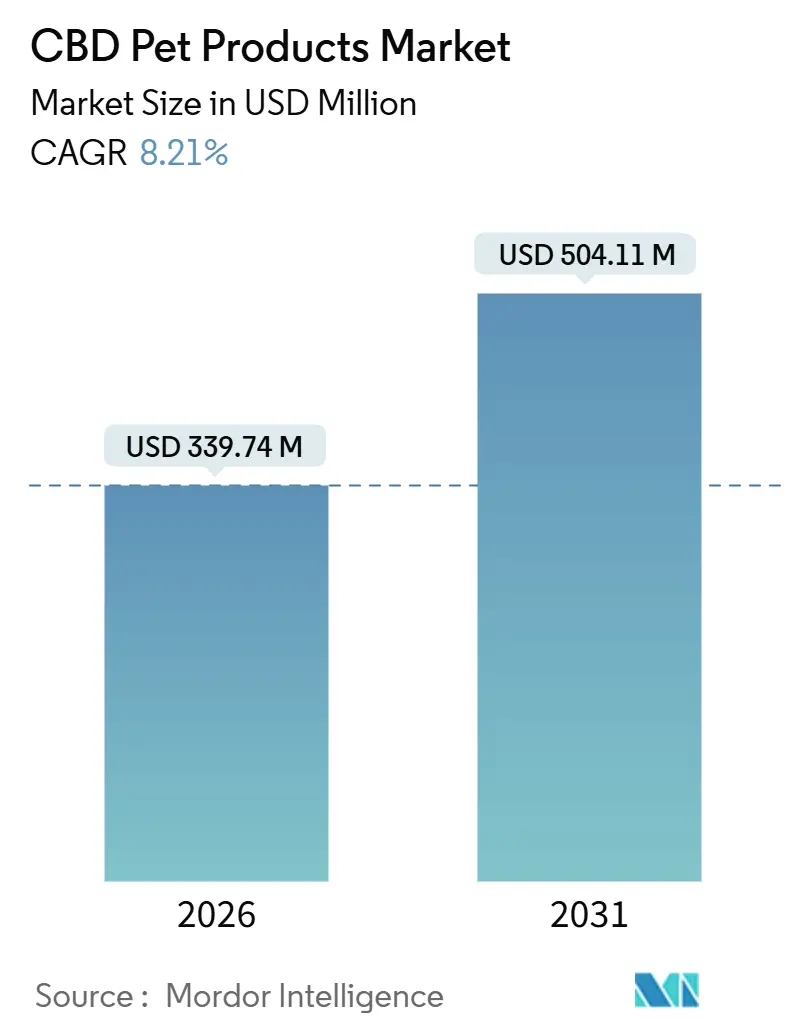
| Market Size (2026) | USD 339.74 Million |
| Market Size (2031) | USD 504.11 Million |
| Growth Rate (2026 - 2031) | 8.21 % |
| Fastest Growing Market | Asia-Pacific |
| Largest Market | North America |
| Market Concentration | Low |
Major Players *Disclaimer: Major Players sorted in no particular order Image © Mordor Intelligence. Reuse requires attribution under CC BY 4.0. | |
CBD Pet Products Market Analysis by Mordor Intelligence
The CBD pet products market size is USD 339.74 million in 2026 and is projected to reach USD 504.11 million by 2031, advancing at an 8.21% CAGR over the forecast period. Robust demand arises from pet humanization, macro-policy shifts that legalized hemp derivatives, and growing clinical evidence that cannabidiol reduces pain, anxiety, and seizure frequency. Therapeutic-grade tinctures, subscription-based e-commerce, and organic formulations with third-party certificates of analysis capture the greatest attention as owners seek transparency and precise dosing. Online platforms accelerate trial rates through influencer marketing and bundled replenishment plans, trimming acquisition costs. North America holds the largest market share, while the Asia-Pacific region demonstrates the fastest growth, driven by clear legislative frameworks in Australia and increasing discretionary income among pet owners in China and India.
Key Report Takeaways
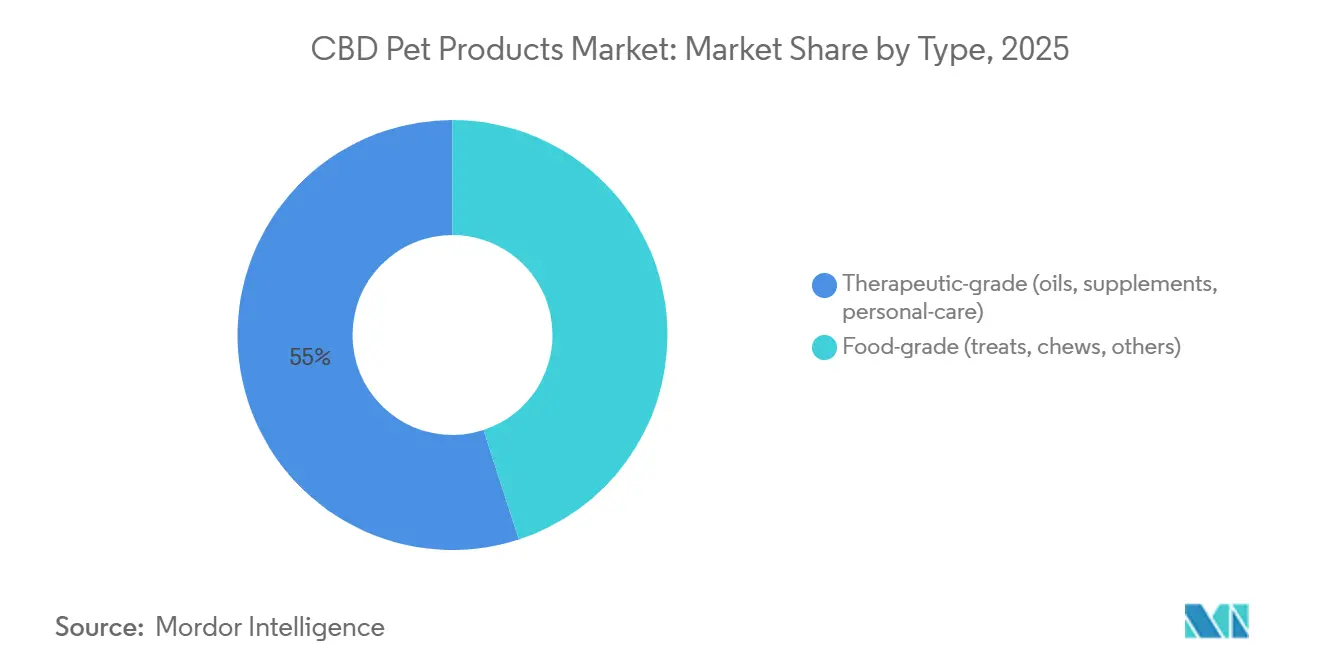
- By type, therapeutic-grade oils accounted for 55% of the CBD pet products market share in 2025 and are projected to grow at a 15.4% CAGR through 2031.
- By animal type, dogs accounted for 61% of the CBD pet products market size in 2025, while cats are projected to grow at a CAGR of 14.8% through 2031.
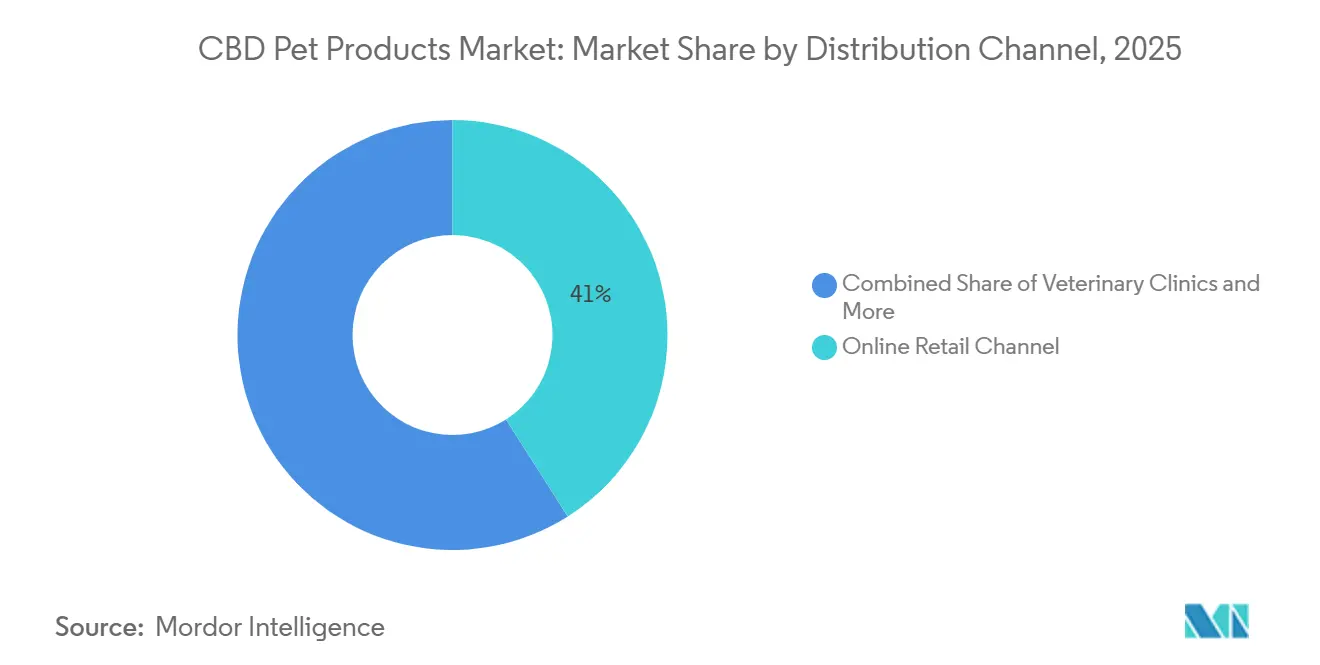
- By distribution channel, online retail accounted for 41% of the CBD pet products market size in 2025, and is advancing at an 18.7% CAGR through 2031.
- By geography, North America accounted for 48% of the CBD pet products market size in 2025, while the Asia-Pacific region is projected to rise at a 15.1% CAGR through 2031.
Note: Market size and forecast figures in this report are generated using Mordor Intelligence’s proprietary estimation framework, updated with the latest available data and insights as of January 2026.
Global CBD Pet Products Market Trends and Insights
Drivers Impact Analysis*
| Driver | (~) % Impact on CAGR Forecast | Geographic Relevance | Impact Timeline |
|---|---|---|---|
| Increasing incidence of chronic disorders in pets | +2.30% | North America and Europe | Medium term (2-4 years) |
| Rising pet ownership and humanization trends | +3.10% | Global urban centers | Long term (≥4 years) |
| Increased focus and expenditure on pet health and wellness | +2.70% | North America and Western Europe | Long term (≥4 years) |
| Expanding retail and e-commerce channels that allow CBD sales | +2.40% | Americas, Europe, and Australia | Short term (≤2 years) |
| Veterinary endorsements backed by emerging clinical evidence | +1.50% | North America and Europe | Medium term (2-4 years) |
| Low-THC veterinary drug legislation in key markets | +1.80% | United States, Canada, Australia, Germany, and the United Kingdom | Medium term (2-4 years) |
| Source: Mordor Intelligence | |||
Increasing Incidence of Chronic Disorders in Pets
Degenerative joint disease, epilepsy, and anxiety now afflict a sizable share of aging companion animals, prompting sustained demand for non-pharmaceutical interventions[1]Source: American Holistic Veterinary Medical Association, “2024 Member Survey,” AHVMA.ORG. Owners worry about the hepatotoxicity of long-term NSAID use and are turning to cannabinoid-based solutions that interact with CB1 and CB2 receptors. Clinical trials reported a 35% pain-score reduction in osteoarthritic dogs given full-spectrum CBD at 2 mg/kg twice daily, without liver-enzyme elevation. These outcomes nurture veterinary confidence and widen prescriptive adoption. The trend is especially evident in North America, where 40% of dogs aged seven years or older exhibit chronic arthritis symptoms. Parallel patterns emerge across Europe, positioning CBD as a bridge therapy for refractory conditions. The resulting uptick in daily dosing drives repeat purchases and strengthens lifetime customer value.
Rising Pet Ownership and Humanization Trends
In 2024, 67% of American households owned at least one pet, marking a significant increase from 2021[2]Source: American Veterinary Medical Association, “U.S. Pet Ownership Statistics,” AVMA, AHVMA.ORG. Millennials and Gen Z lead this expansion and treat animals as family, allocating monthly budgets of USD 60-120 for CBD treats in lieu of generic supplements costing one-third as much. Comparable sentiment in Germany, where pet ownership penetration reached 47% in 2024, reinforces tolerance for premium pricing. These consumers actively research ingredients, prefer organic hemp, and reward brands that publish batch-level potency tests. Social media amplifies personal testimonials, normalizing cannabidiol as a preventive wellness tool. As owners adopt adaptogen habits for their pets, demand for USDA-certified CBD tinctures increases across metropolitan areas worldwide.
Increased Focus and Expenditure on Pet Health and Wellness
Pet owners in North America spent significantly on veterinary care and wellness products during 2024, with preventive supplements accounting for a notable share of this spending. Growth aligns with rising pet-insurance penetration in the United States, with policies increasingly reimbursing alternative therapies such as CBD. Preventive positioning is critical, as brands market oils for daily maintenance of joint mobility and cognitive function before clinical symptoms appear. Insured owners perceive lower out-of-pocket risk, raising conversion rates. The dynamic is mirrored in Western Europe, where wellness subscriptions bundle CBD chews with routine flea protection, reinforcing monthly order cadence. Consequently, the CBD pet products market experiences stable baseline demand, insulating suppliers from seasonal volatility.
Expanding Retail and E-Commerce Channels That Allow CBD Sales
Amazon’s 2024 decision to list hemp-derived CBD for pets unlocked access to 200 million Prime subscribers. Chewy promptly followed, creating a curated storefront that highlights third-party lab reports, improving brand credibility. Brick-and-mortar giants Petco and PetSmart expanded their CBD assortments after favorable state guidelines reduced compliance uncertainty across multiple markets. Omnichannel presence compresses discovery barriers, allowing owners to add CBD products to existing shopping baskets rather than seeking specialty stores. Lower fulfillment costs and subscription discounts convert first-time buyers into repeat customers. The rapid scale achievable through online distribution positions digital-native brands to challenge legacy veterinary-clinic channels and capture incremental share in the CBD pet products market.
Restraints Impact Analysis*
| Restraint | (~) % Impact on CAGR Forecast | Geographic Relevance | Impact Timeline |
|---|---|---|---|
| High cost of premium CBD pet products | -1.40% | Global price-sensitive regions | Short term (≤2 years) |
| Stringent regulatory requirements for product approval | -1.80% | United States and Europe | Long term (≥4 years) |
| Quality and consistency issues from lack of standards | -1.20% | Global | Medium term (2-4 years) |
| Limited veterinarian education on cannabinoid pharmacokinetics | -0.90% | South America, Africa, parts of Asia | Medium term (2-4 years) |
| Source: Mordor Intelligence | |||
High Cost of Premium CBD Pet Products
Full-spectrum organic CBD oils retail at USD 0.15-0.25 per milligram, roughly triple the cost of glucosamine-chondroitin supplements, creating affordability barriers in emerging economies. A month-long CBD regimen for a medium-sized dog can be costly, positioning cannabidiol as a discretionary luxury rather than a staple. Upstream expenses include certified-organic cultivation, supercritical CO₂ extraction, and batch-level contaminant screening, all of which contribute significantly to production costs. When regulators do not mandate testing, price-sensitive owners often choose cheaper, uncertified products or abandon CBD altogether. Consequently, penetration remains low across South America and Africa, where disposable incomes are constrained. Persistent cost differentials in the CBD pet products market temper volume growth despite rising global awareness.
Stringent Regulatory Requirements for Product Approval
The Food and Drug Administration lacks a defined pathway for CBD pet products, creating compliance ambiguity that invites warning letters and stifles marketing claims[3]Source: U.S. Food and Drug Administration, “Regulation of Cannabis and Cannabis-Derived Products,” FDA.GOV. European Medicines Agency novel-food dossiers require extensive toxicology and stability studies, favoring well-capitalized firms and delaying entry for smaller brands. Even Australia’s recently streamlined Schedule 4 route mandates pharmacokinetic submissions. Lengthy approval timelines consume capital and create uncertainty that may deter investors. Firms unable to meet data requirements risk delisting or forced reformulation. These regulatory frictions slow SKU refresh cycles and limit the breadth of therapeutic indications offered within the CBD pet products industry.
*Our forecasts treat driver/restraint impacts as directional, not additive. The impact forecasts reflect baseline growth, mix effects, and variable interactions.
Segment Analysis
By Type: Therapeutic-Grade Oils Drive Premium Positioning
Therapeutic-grade oils captured 55% of the 2025 value, followed by food-grade treats, while personal-care topicals accounted for the remainder. Concentrated tinctures with 300-1,500 mg cannabidiol per bottle lead the CBD pet products market because they allow weight-based dose titration. Food-grade chews maintain share by masking hemp taste, yet they suffer lower bioavailability. Topicals remain niche but appeal to owners treating localized dermatitis without oral administration.
Therapeutic-grade oils will post a 15.4% CAGR through 2031, the fastest within the category, propelled by nano-emulsion technologies that cut onset time to 15 minutes. Food-grade treats are estimated to grow strongly, supported by new flavors and soft-chew formats. Topicals are also projected to expand steadily as veterinary dermatology increasingly embraces cannabinoid-infused shampoos and balms.



By Animal Type: Canine Dominance Faces Feline Disruption
Dogs contributed 61% of 2025 revenue, followed by cats, while other pets contributed a smaller share. Large-breed dogs consume more CBD per dose to manage osteoarthritis and anxiety, anchoring canine leadership in the CBD pet products market. Cats remained below one-third share because early coconut-oil carriers impaired palatability.
Cats will expand at a 14.8% CAGR to 2031, outstripping other species after fish-oil-based tinctures improved acceptance. Dogs are projected to grow strongly, supported by increasing insurance coverage for chronic pain management. Other pets, including horses and rabbits, are also estimated to expand steadily, driven by demand from performance-horse segments and the growth of specialty e-commerce offerings for exotic pets.
By Distribution Channel: E-Commerce Rewrites Access Economics
Online retail held 41% of 2025 spend, and veterinary clinics, retail pharmacies, and pet stores represent significant distribution channels. Digital channels, however, dominate the CBD pet products market by offering subscription discounts, rapid consumer education, and easy display of product certifications. Clinics leverage professional trust but face stocking hesitancy. Physical pet stores benefit from impulse buys but must comply with varying state rules.
Online retail will surge at 18.7% CAGR to 2031, far ahead of offline formats. Veterinary clinics are estimated to grow strongly as greater legal clarity boosts in-house sales. Retail pharmacies and pet stores are likely to trail, constrained by ongoing regulatory checks and increasing competition from direct-to-consumer brands.
Geography Analysis
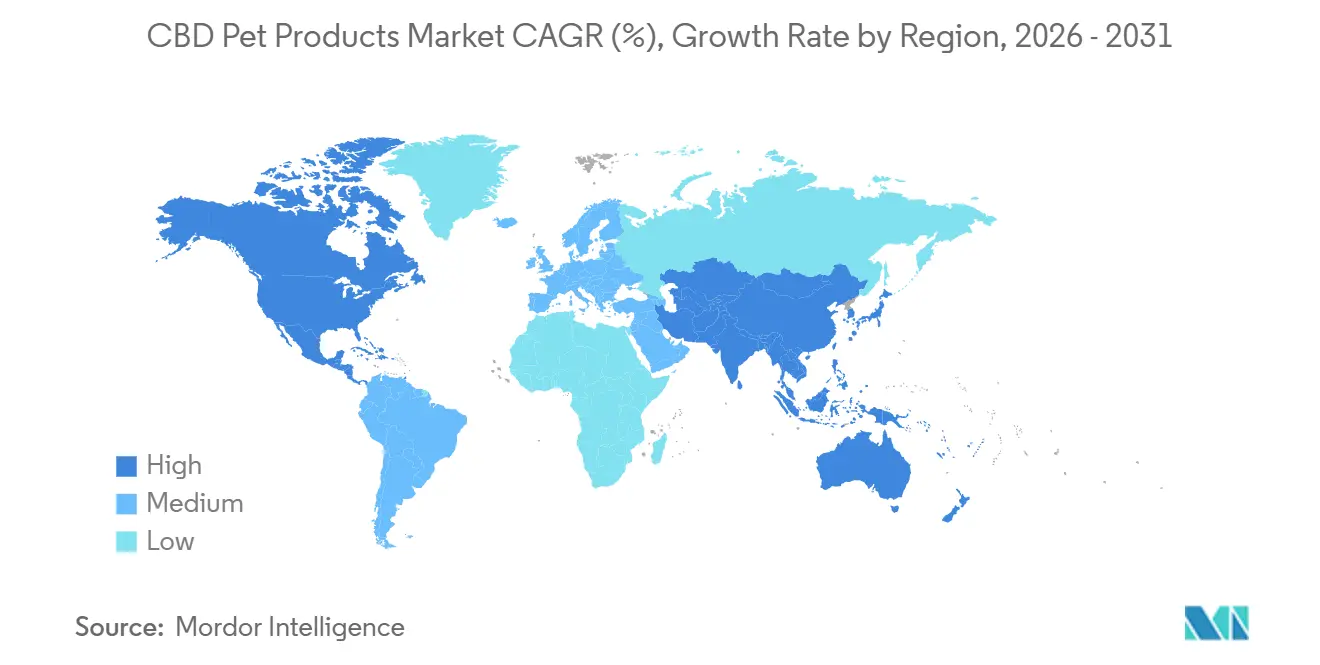
North America generated 48% of 2025 revenue and is estimated to continue expanding at a strong pace. United States households spend an average of USD 1,480 per pet annually and readily adopt organic CBD oils endorsed by veterinarians. Canada’s 2024 Cannabis Act amendments removed pre-market hurdles for hemp-derived pet products, letting provincial chains stock CBD alongside traditional supplements. Mexico is estimated to issue formal guidelines by 2027, unlocking pent-up demand currently served through gray imports.
Asia-Pacific is forecast to grow at 15.1% CAGR, the highest among all regions. Australia reclassified low-THC CBD as Schedule 4 in 2025, enabling prescription fulfillment through pharmacies and fueling immediate volume gains. China’s draft hemp-supplement regulations signal market opening in a country with rising middle-class expenditure and pet population. India awaits Food Safety and Standards Authority clarity, yet rising urban pet ownership is flagging a latent market opportunity once rules crystallize.
Europe will advance at a strong pace. Germany, the United Kingdom, France, and Spain together represent the majority of regional spend. Stricter Veterinary Medicines Directorate rules in the United Kingdom slow product launches but elevate overall quality standards, while Germany’s guidance excluding low-THC hemp extracts from narcotic regulations streamlines distribution. South America is also estimated to expand steadily, led by Brazil’s over-the-counter approval framework for CBD pet oils. Africa remains a nascent market, while South Africa’s prescription-only stance confines distribution primarily to licensed veterinary practices.

Regulatory Landscape
In the United States, CBD-containing pet products continue to face a constrained regulatory pathway at the federal level. The US Food and Drug Administration (FDA) has not approved or indexed any animal drug containing CBD, and products promoted for prevention or treatment of animal disease are treated as unapproved animal drugs subject to enforcement actions. For products positioned as animal food, CBD is not an authorized ingredient (it is not AAFCO-defined, GRAS, or an approved food additive), which keeps marketing claims, labeling, and distribution practices under close scrutiny even as hemp cultivation is governed separately under USDA hemp standards.
In Europe, CBD inclusion in animal feed is not authorized under Regulation (EC) No 1831/2003 for feed additives, and pathways tied to EU novel food and EFSA safety assessment have not delivered an approval that enables broad pet-market placement. In February 2026, the European Commission formally terminated a cannabidiol novel-food authorization procedure due to insufficient supporting data, reinforcing the region's high evidentiary bar. This fragmented compliance environment also raises the importance of veterinary practice rules (for example, state-level guidance linked to the veterinarian-client-patient-relationship in the US), which shapes how brands handle education, claims, and channel strategy.
Competitive Landscape
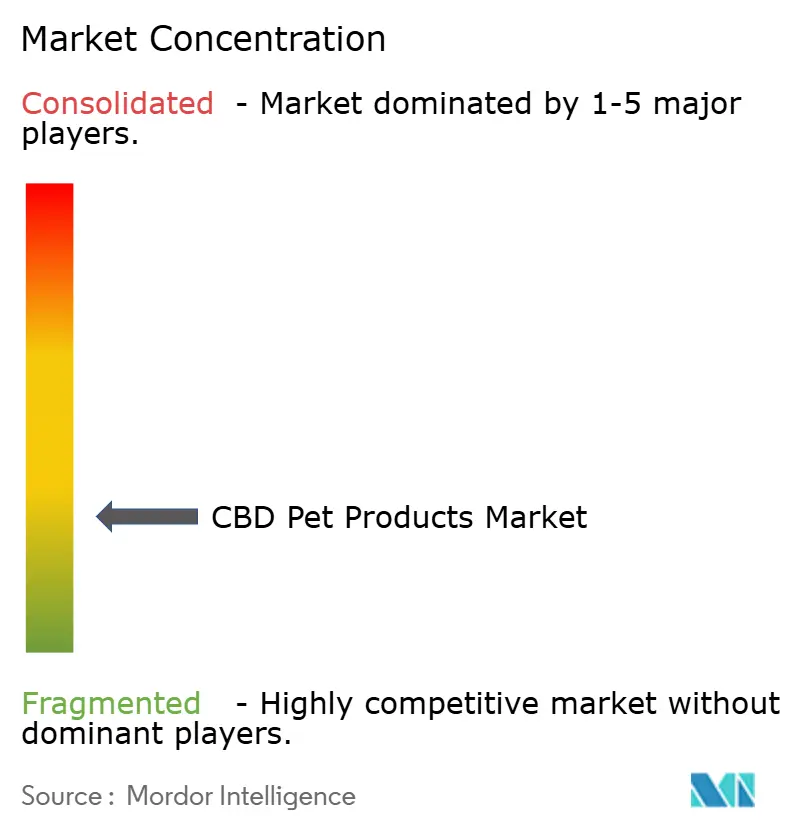
The CBD pet products market is fragmented. Charlotte’s Web, cbdMD (Paw CBD), Pet Releaf, Honest Paws, and Holista LLC are key players, leveraging strategies such as vertically integrated hemp farms, brand recognition, THC-free broad-spectrum extracts, organic certification, and functional botanicals like L-theanine.
Strategic themes include vertical integration to control quality, third-party testing to build trust, and veterinary partnerships to access clinical endorsement. Pet Releaf became one of the first suppliers to offer USDA-certified organic hemp across the entire supply chain in 2025, enabling placement in natural product retailers. HolistaPet collaborated with Colorado State University on feline pharmacokinetic studies that underpin dosing guides, fostering veterinary acceptance in 2024. Nano-emulsion and microencapsulation technologies spread across portfolios, delivering water-soluble formats that improve onset time and flavor masking.
Mergers and acquisitions accelerate scale. Swedencare’s acquisition of NaturVet’s hemp division adds USD 8,500 retail doors for European brands seeking North American entry in 2025. Competitive intensity is projected to rise as human-CBD incumbents enter the pet arena, pressing smaller labels to differentiate via breed-specific formulations or subscription services.
CBD Pet Products Industry Leaders
Charlotte's Web, Inc.
cbdMD (Paw CBD)
Pet Releaf
Honest Paws
Holista LLC
- *Disclaimer: Major Players sorted in no particular order

Market Opportunities and Future Outlook
The strongest opportunity set centers on compliant, evidence-forward product positioning and quality infrastructure that fits current enforcement realities. FDA action against therapeutic claims and non-authorized animal-food uses has pushed brands toward tighter labeling discipline, expanded third-party testing, and clearer certificates of analysis. This direction aligns with how online retail curation is evolving, including storefront models that emphasize lab reports and traceability. The Federal Register FDA request for information released in January 2025 on cannabis-derived products in veterinary use also signals that data collection on safety and use conditions is moving forward, which gives well-capitalized brands a way to differentiate with toxicology, stability, and pharmacokinetic packages.
Geographic whitespace remains visible in places where commercialization routes look clearer. In Australia, low-THC CBD was reclassified as Schedule 4 in 2025, enabling prescription fulfillment through pharmacies. In Canada, the 2024 Cannabis Act amendments reduced pre-market hurdles for hemp-derived pet products in provincial retail. On product demand, therapeutic-grade oils remain a key format for precise dosing and repeat purchase economics, while formulation improvements such as nano-emulsions and palatability-focused carriers support species-specific dosing guidance for cats and senior-dog chronic conditions. Brands that pair compliant claims frameworks with channel execution in e-commerce and vet-adjacent distribution can scale without relying on broad disease-treatment positioning that tends to carry higher regulatory risk.
Recent Industry Developments
- July 2026: cbdMD completed a self-affirmed Generally Recognized as Safe (GRAS) determination for its proprietary broad-spectrum hemp extract, supporting consumption up to 200 mg per day of CBD. The completed GRAS determination reinforces its safety substantiation strategy in a category where regulators continue to scrutinize permitted use levels and ingredient status.
- May 2026: Charlotte's Web closed a transaction with BT DE Investments Inc., a subsidiary of British American Tobacco p.l.c., that included a USD 10 million investment. The funding adds balance-sheet capacity for portfolio development and commercialization initiatives amid tightening compliance scrutiny in CBD-related categories.
- March 2025: Kradle expanded into feline wellness with a line of salmon-flavored, CBD-formulated lickable supplements targeting urinary health, skin and allergy support, and hairball control. The launch broadens category participation beyond dogs and supports the market shift toward species-specific formats designed to improve daily adherence.


Research Methodology Framework and Report Scope
Market Definition and Coverage
This market covers retail sales value of cannabidiol (CBD) products made for pets, counted when they are marketed for animal use and sold through common pet product channels. We size the market on a revenue basis in USD across major regions.
Scope exclusions: We exclude human CBD products used for pets, and we exclude non-CBD calming or wellness products that do not contain CBD.
Segmentation Overview
- By Type
- Food-grade
- Therapeutic-grade
- By Animal Type
- Dog
- Cat
- Other pets
- By Distribution Channel
- Online retail channel
- Retail pharmacies and pet stores
- Veterinary clinics
- Other channels
- By Geography
- North America
- United States
- Canada
- Mexico
- Rest of North America
- Europe
- Germany
- United Kingdom
- France
- Spain
- Rest of Europe
- Asia-Pacific
- China
- India
- Australia
- Rest of Asia Pacific
- South America
- Brazil
- Argentina
- Rest of South America
- Africa
- South Africa
- Rest of Africa
- North America
Data Sources, Market Sizing, and Validation
Desk Research
Desk research was used to set the market boundary, build the initial demand logic, and fix a realistic list of channels and product formats for pets. Public sources were reviewed for rule changes and labeling expectations that influence which CBD pet products can be counted, using sources such as the US FDA animal feed and CBD updates, USDA trade and agriculture releases, US Census retail trade series, and EU food safety and novel-food guidance pages.
To understand how the market is behaving, we also used company filings, investor presentations, and reputable press coverage to track new launches, channel expansion, and pricing shifts in pet supplements and treats. A paid subscription for company financials and another one for patent and intellectual property signals were selectively used to confirm product activity and category focus when public details were thin. The desk sources listed are illustrative, and many other public documents were reviewed for data collection, validation, and clarification.
Primary Interviews and Surveys
Primary work focused on checking what is actually selling, how pricing is moving by format, and how channel mix differs by country. We spoke with executives, functional leaders, and managers across branded suppliers, distributors, online sellers, and veterinary-linked channels. The interviews were spread across major pet ownership markets so gaps from desk research could be filled and key assumptions could be confirmed.
Distribution of primary research fieldwork respondents
| Company type | Respondent position | Region |
|---|---|---|
| Top tier: 31% | CXOs: 13% | APAC: 45% |
| Mid tier: 49% | Functional/Unit leaders: 38% | EMEA: 37% |
| Smaller Players: 20% | Managers: 49% | Americas: 18% |
Market-Sizing & Forecasting
Sizing starts with a top-down build where pet population and pet ownership patterns are combined with likely adoption of CBD usage, and then translated into revenue using channel presence and price points by product form. The model uses practical inputs such as the share of dogs versus cats in the addressable base, the split of sales across online retail, retail pharmacies, and veterinary clinics, and the average price per unit for oils, treats, supplements, and pet personal care items.
To keep the totals grounded, we run selective bottom-up checks using sampled brand and channel pricing, observed product counts, and estimated sell-through ranges shared by interviewees. Where data is missing for smaller countries or emerging channels, we apply proxy assumptions based on similar regulatory environments and comparable pet care spending. We then review whether the implied per-pet spend looks reasonable. Forecasts are built using scenario analysis supported by short-run trend smoothing. The scenarios are tied to expected regulation clarity, new product launches, and the pace of online channel growth discussed in primary calls.
Data Validation & Update Cycle
Validation is done through repeated cross-checks against independent signals, and then it is tightened through analyst review before sign-off. Our team tests whether the market totals match channel-level realities, whether implied pricing aligns with observed price bands, and whether growth rates are consistent with what interviewees see in repeat purchase and new customer intake.
When results look off, we isolate the assumptions that caused the variance, and we re-contact experts to confirm whether a real market shift occurred or whether the model input needs correction. Reports are refreshed annually, and interim updates are made when there are material events such as a policy change, a major channel restriction, or a meaningful jump in product availability. Before delivery, a final pass is completed so clients receive the latest updated view.
Mordor Intelligence's Cbd Pet Products Market Size Compared With Other Published Estimates
Different published numbers for CBD pet products usually come from where the line is drawn on what counts as CBD for pets, which channels are included, and which year is treated as the reference point. We also see differences because some studies mix in medical-claim use cases, or they assume a faster shift from niche to mass retail than what the channels show.
Observed channel mix (online versus veterinary clinics and retail pharmacies) and the practical boundary between food-grade treats and therapeutic-grade oils are two signals that keep Mordor Intelligence tied to products that are clearly sold and labeled for pets, and not adjacent human CBD demand that can inflate totals. The spread in estimates also reflects how firms treat currency timing, how they model average selling price progression, and how often assumptions are rechecked with industry participants.
Benchmark comparison
| Source | Market Size | Gaps in Research Methodology |
|---|---|---|
| Mordor Intelligence | USD 339.74 M (2026) | |
| Industry Publisher A | USD 447.98 M (2025) | Uses a pet CBD framing that is organized around indications and source type, which can pull in broader therapeutic-claim demand and a wider set of CBD offerings beyond pet-specific product boundaries. |
| Industry Publisher B | USD 331.00 M (2024) | Uses an earlier base year and a faster growth curve, which can lift the forward numbers quickly if price ramps and adoption are assumed before channel expansion is verified. |
The table shows that year selection and scope choices are the main reasons the values separate. By sticking to pet-labeled products and validating channel behavior and pricing ranges, our estimate stays traceable to clear demand drivers that can be checked again as the market evolves.


Key Questions Answered in the Report
How large is the CBD pet products market today and what is its growth outlook?
The CBD pet products market size is USD 339.74 million in 2026 and is forecast to reach USD 504.11 million by 2031 at an 8.21% CAGR.
Which product type leads sales in cannabidiol formulations for pets?
Therapeutic-grade oils hold 55% of 2025 revenue due to precise dosing and faster bioavailability versus treats and topicals.
Why are online channels gaining such fast momentum?
Amazon and Chewy now allow hemp-derived CBD listings, letting brands reach millions of shoppers and grow online revenue at an 18.7% CAGR through 2031.
What region is anticipated to offer the highest growth opportunity?
Asia-Pacific is projected to post a 15.1% CAGR through 2031 as Australia, China, and India ease regulatory barriers and pet ownership climbs.
Page last updated on:


 Your data is secure and never sold or shared.


