
Cassette Air Conditioner (AC) Market Size and Share
Market Overview
| Study Period | 2020 - 2031 |
|---|---|
| Market Size (2026) | USD 9.30 Billion |
| Market Size (2031) | USD 11.95 Billion |
| Growth Rate (2026 - 2031) | 5.14 % |
| Fastest Growing Market | Asia-Pacific |
| Largest Market | North America |
| Market Concentration | Medium |
Major Players *Disclaimer: Major Players sorted in no particular order Image © Mordor Intelligence. Reuse requires attribution under CC BY 4.0. | |
Cassette Air Conditioner (AC) Market Analysis by Mordor Intelligence
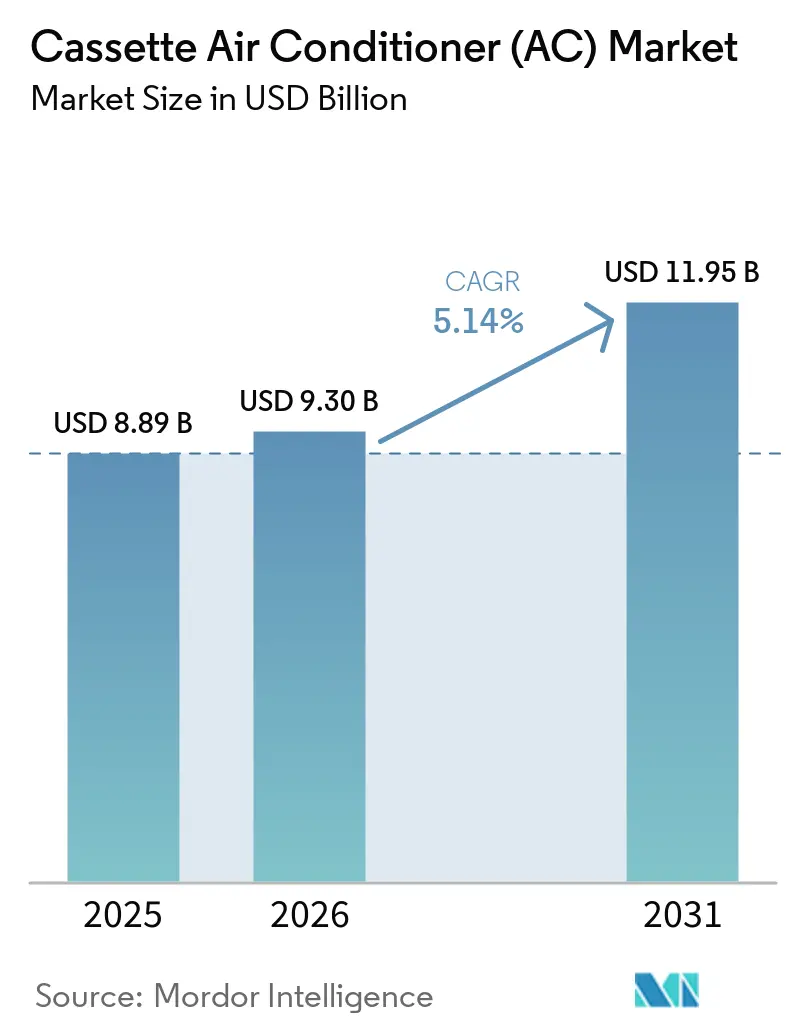
The cassette air conditioner market size is projected to be USD 8.89 billion in 2025, USD 9.30 billion in 2026, and reach USD 11.95 billion by 2031, growing at a CAGR of 5.14% from 2026 to 2031. Space cooling remains the fastest-growing energy demand in buildings, and it already accounts for close to 10% of global electricity use, keeping the cassette air conditioner market closely tied to long-term cooling needs in commercial and semi-commercial spaces[1]International Energy Agency, “Staying Cool Without Overheating the Energy System,” International Energy Agency, iea.org. Demand is also being supported by urban expansion, rising incomes, and warmer weather patterns, all of which are increasing the need for interior cooling systems that fit cleanly into ceiling layouts and distribute air evenly across open spaces. Commercial retrofit activity is adding another layer of support as building owners face stricter energy codes and move toward variable refrigerant flow systems that align well with cassette units in offices, schools, hotels, and healthcare sites. The cassette air conditioner market is also benefiting from stronger smart-building adoption, since operators now want indoor units that can connect with building management systems and support zone-level control, energy tracking, and remote monitoring[2]A. Rashidi et al., “A Systematic Review of Building Energy Management Systems, Sensors, IoT, and AI Integration,” Energies, mdpi.com. At the same time, refrigerant rules and installer shortages still limit speed in parts of the market, but those pressures sit against a broader base of structural demand from rising cooling loads, tighter efficiency standards, and active commercial construction cycles EPA.GOV, REHVA.EU.
Key Report Takeaways
- By product type, four-way units held 68.3% of the cassette air conditioner market share in 2025, while the same segment is projected to expand at a 6.56% CAGR through 2031.
- By capacity, the 6-10 KW band accounted for 49.1% of the cassette air conditioner market in 2025, while units above 10 KW are forecast to grow the fastest at a 5.35% CAGR through 2031.
- By technology, inverter units led with a 65.2% share in 2025, while inverter systems are also projected to record the highest CAGR at 6.45% through 2031.
- By installation type, ceiling-mounted units held a 73.1% share in 2025, while recessed-mounted units are expected to register the fastest growth at a 5.98% CAGR through 2031.
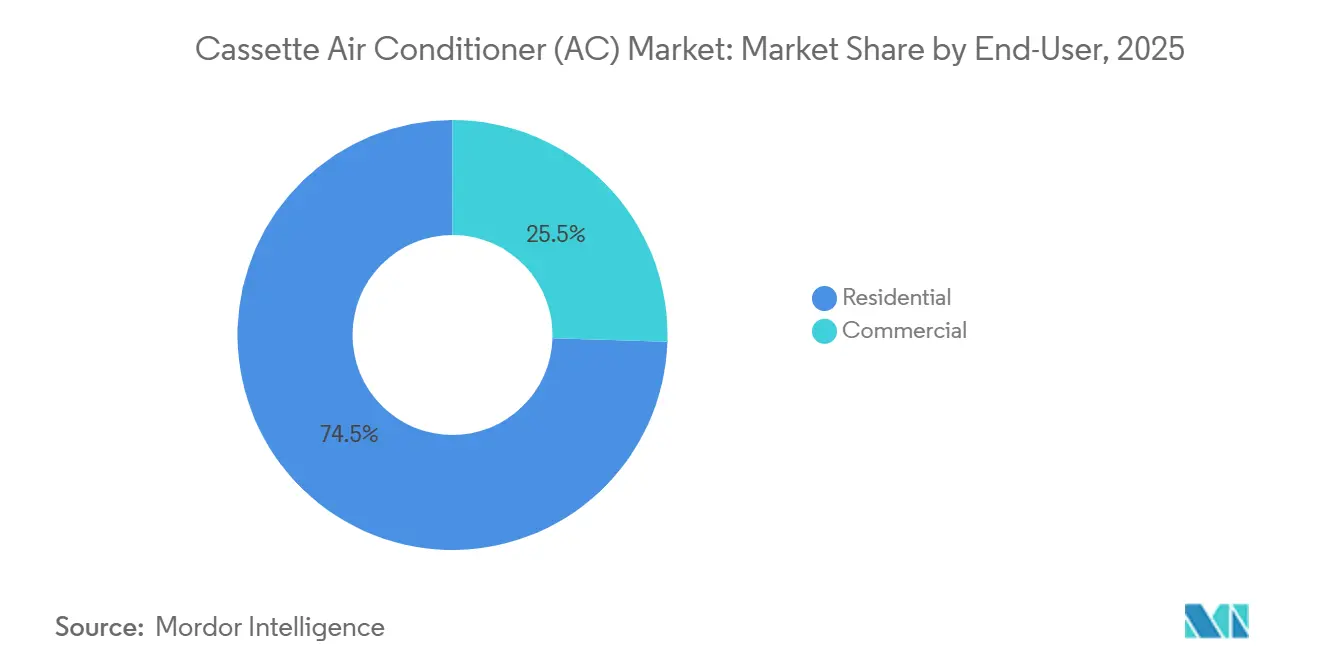
- By end user, residential accounted for a 74.5% share in 2025, while commercial is forecast to expand the fastest at a 6.82% CAGR through 2031.
- By distribution channel, B2C and retail consumers accounted for 79.3% of the market in 2025, while B2B and direct-from-manufacturer channels are projected to grow faster at a 5.12% CAGR through 2031.
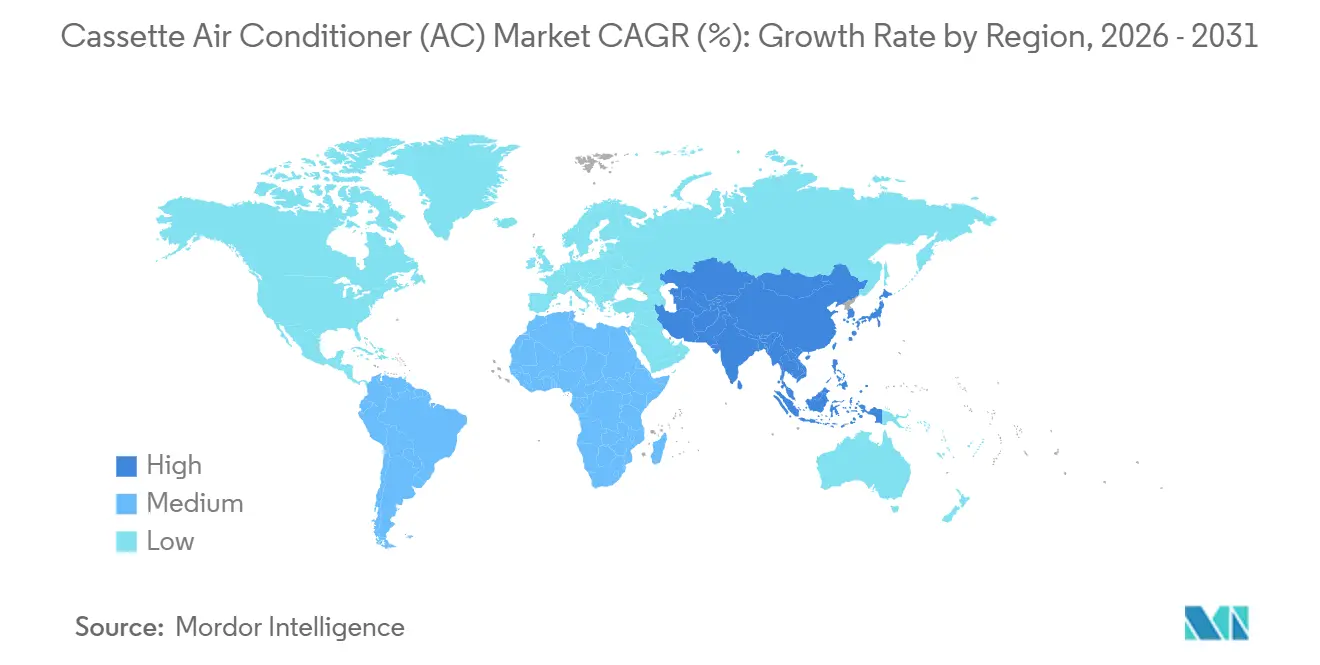
- By geography, North America held a 42.2% share in 2025, while Asia-Pacific is projected to register the fastest regional CAGR at 6.54% through 2031.
Note: Market size and forecast figures in this report are generated using Mordor Intelligence’s proprietary estimation framework, updated with the latest available data and insights as of January 2026.
Market Trends and Insights
Drivers Impact Analysis of Cassette Air Conditioner (AC) Market*
| Driver | (~) % Impact on CAGR Forecast | Geographic Relevance | Impact Timeline |
|---|---|---|---|
| Rising Demand for Space-Efficient HVAC in Ceiling-Constrained Commercial Retrofits | +1.2% | North America & Europe | Medium term (2–4 years) |
| Commercial Building Electrification and Energy Code Compliance | +1.1% | North America, Europe, Asia-Pacific | Medium term (2–4 years) |
| Growth of Premium Indoor Air Quality and Low-Noise Cooling Requirements | +0.5% | Asia-Pacific core, North America | Short term (≤ 2 years) |
| Smart BMS-Ready Cassette Units for Multi-Zone Commercial Control | +0.8% | North America, Europe, Asia-Pacific | Medium term (2–4 years) |
| Expansion of Hospitality, Healthcare, and Education Fit-Out Cycles | +0.7% | Global, spill-over to Middle East & Africa | Long term (≥ 4 years) |
| Rising Adoption in Warm-Climate Retrofit Projects Replacing Ducted Systems | +0.6% | Asia-Pacific, Middle East & Africa, South America | Medium term (2–4 years) |
| Source: Mordor Intelligence | |||
Rising Demand for Space-Efficient HVAC in Ceiling-Constrained Commercial Retrofits
The cassette air conditioner market is gaining from retrofit projects where ceiling space is too limited for full duct runs, yet the floor layout still needs balanced air coverage across open rooms. Post-pandemic office redesign has supported this shift, as many landlords in North America and Europe have changed fixed layouts to flexible multi-zone spaces that suit four-way cassette formats well. The IEA noted in its 2025 energy efficiency review that space cooling has recorded the fastest growth among building end uses since 2000, with annual growth of more than 4%, which strengthens the economic case for retrofit cooling upgrades[3]International Energy Agency, “Energy Efficiency 2025,” International Energy Agency, iea.org. Lease renewal cycles also support this demand pattern, since many commercial owners refresh HVAC systems every 5 to 7 years, creating recurring replacement demand rather than purely one-time demand. Product development has closely followed this pattern, as Daikin launched its 1-Way Blow Corner Cassette in June 2024 for spaces with minimal ceiling clearance or no false ceiling. This keeps the cassette air conditioner market well aligned with retrofit needs that combine layout limits, visual expectations, and modern zoning requirements.
Commercial Building Electrification and Energy Code Compliance
The cassette air conditioner market is also being boosted by stricter energy rules that now treat efficiency upgrades as compliance requirements for building owners. New York City’s 2025 Energy Conservation Code and 2025 NYC ASHRAE 90.1 entered enforcement on March 30, 2026, and these rules set mandatory HVAC efficiency thresholds for commercial buildings. California’s 2025 Title 24 standards require variable refrigerant flow heat pump systems as the baseline for many multi-zone office and school applications, which directly supports ceiling cassette demand within VRF system design. The United States Department of Energy also updated test procedures for central air conditioners and heat pumps, effective July 7, 2025, tightening how efficiency is measured and reported. These steps matter because owners who delayed upgrades now face a regulatory deadline rather than a voluntary efficiency decision. In this setting, the cassette air conditioner market benefits, as cassette units installed within VRF systems help owners meet code requirements, reduce energy use, and move projects through specification approval more quickly.
Smart BMS-Ready Cassette Units for Multi-Zone Commercial Control
The cassette air conditioner market is increasingly tied to smart-building demand, as commercial operators now treat building management system compatibility as a standard purchase requirement. Panasonic’s PACi NX cassette series supports KNX and Modbus interfaces as standard, making centralized monitoring and zone scheduling easier across commercial floors. A 2025 review in Energies that covered 89 peer-reviewed studies found that hybrid AI and IoT HVAC solutions consistently delivered 20% to 40% energy savings against non-integrated systems. A 2026 paper in Scientific Reports also showed that AI-based control frameworks can improve temperature prediction accuracy to within 1.0°C of the MAE, supporting tighter compressor modulation and better comfort control in inverter-based systems. Cassette units fit this need well because they combine ceiling-based airflow, built-in drain pumps, and standard communication ports in a format that works across multi-zone buildings. This supports the cassette air conditioner market as buildings move from stand-alone cooling equipment toward connected control platforms with energy reporting and remote diagnostics.
Expansion of Hospitality, Healthcare, and Education Fit-Out Cycles
The cassette air conditioner market is seeing steady support from hospitality, healthcare, and education projects, where quiet operation, ceiling integration, and room-by-room control are all important. Hotels need individual comfort settings with low noise, hospitals need controlled air distribution across specific zones, and universities need flexible cooling across lecture halls, offices, and support areas. The IEA’s 2026 global review stated that cooling degree days in 2025 were 6% below the 2024 record, yet underlying demand from commercial construction still held firm. Healthcare demand is especially important because post-pandemic capacity programs in parts of Asia-Pacific and the Middle East are now moving from planning to physical build-out, creating equipment orders several years after the original investment decisions. Trane Technologies said in its first-quarter 2026 results that demand remained strong in higher education, government, and healthcare, which supports this vertical pattern. As these fit-out cycles continue, the cassette air conditioner market stands to benefit from projects that need clean ceiling lines and dependable multi-zone cooling in busy interior environments.
Restraints Impact Analysis of Cassette Air Conditioner (AC) Market*
| Restraint | (~) % Impact on CAGR Forecast | Geographic Relevance | Impact Timeline |
|---|---|---|---|
| High Upfront Installed Cost Versus Wall-Mounted Split Units | -1.3% | Global, concentrated in developing markets | Short term (≤ 2 years) |
| Ceiling Plenum and Structural Integration Limitations in Existing Buildings | -0.9% | North America & Europe (older building stock) | Medium term (2-4 years) |
| Skilled Installation and Commissioning Dependence | -0.7% | Global, acute in South Asia & Middle East & Africa | Long term (≥ 4 years) |
| Refrigerant Compliance and Component Supply Volatility | -0.8% | Europe, North America, then Global | Medium term (2-4 years) |
| Source: Mordor Intelligence | |||
High Upfront Installed Cost Versus Wall-Mounted Split Units
The cassette air conditioner market still faces a clear barrier in price-sensitive settings, because installed system costs remain well above those of comparable wall-mounted split units. The draft states that cassette systems can add 30% to 50% to the total installed cost when ceiling access, drainage work, and specialist labor are included, making comparisons difficult for residential and small commercial projects. This issue is strongest in tier-2 and tier-3 cities across Southeast Asia, India, and Latin America, where demand growth is high, but buyers remain highly cost-aware. The challenge is also evident in the 6-10 kW band, which held a 49.1% share in 2025 and often serves residential and light commercial buyers who compare cassette systems directly with efficient wall-mounted inverter units. Some of this pressure may ease as manufacturing scales in lower-cost locations, and recent investments by LG in Indonesia and Carrier in India show active efforts to improve local economies[4]LG Electronics, “LG Expands HVAC Business With New Global South Facility,” LG Global Newsroom, lg.com . Even so, the cassette air conditioner market is likely to carry an installed-cost premium through the forecast period, especially in places where the contractor base is still thin.
Refrigerant Compliance and Component Supply Volatility
The cassette air conditioner market is also facing a more complex refrigerant transition, which affects both product planning and supply chain decisions. The United States EPA’s AIM Act, effective from January 2025, restricts the use of higher-GWP hydrofluorocarbons in new air conditioning and heat pump equipment. In Europe, the revised F-Gas framework further tightens compliance requirements, and REHVA noted that R32 will be prohibited in split systems below 12 kW from 2027 under the updated rules. This places pressure on suppliers in the 6-10 kW range, where R32 has been the main transition option after R410A. R290 offers a longer-term low-GWP path, but its flammability profile requires stricter safety procedures and substantial redesign. The draft also notes that low-GWP refrigerant pricing has been volatile, which means producers without long-term supply arrangements can face margin pressure during peak seasons. As a result, the cassette air conditioner market now treats refrigerant strategy as a central operating issue rather than a narrow technical adjustment.
*Our forecasts treat driver/restraint impacts as directional, not additive. The impact forecasts reflect baseline growth, mix effects, and variable interactions.
Cassette Air Conditioner (AC) Market Segment Analysis
By Product Type:
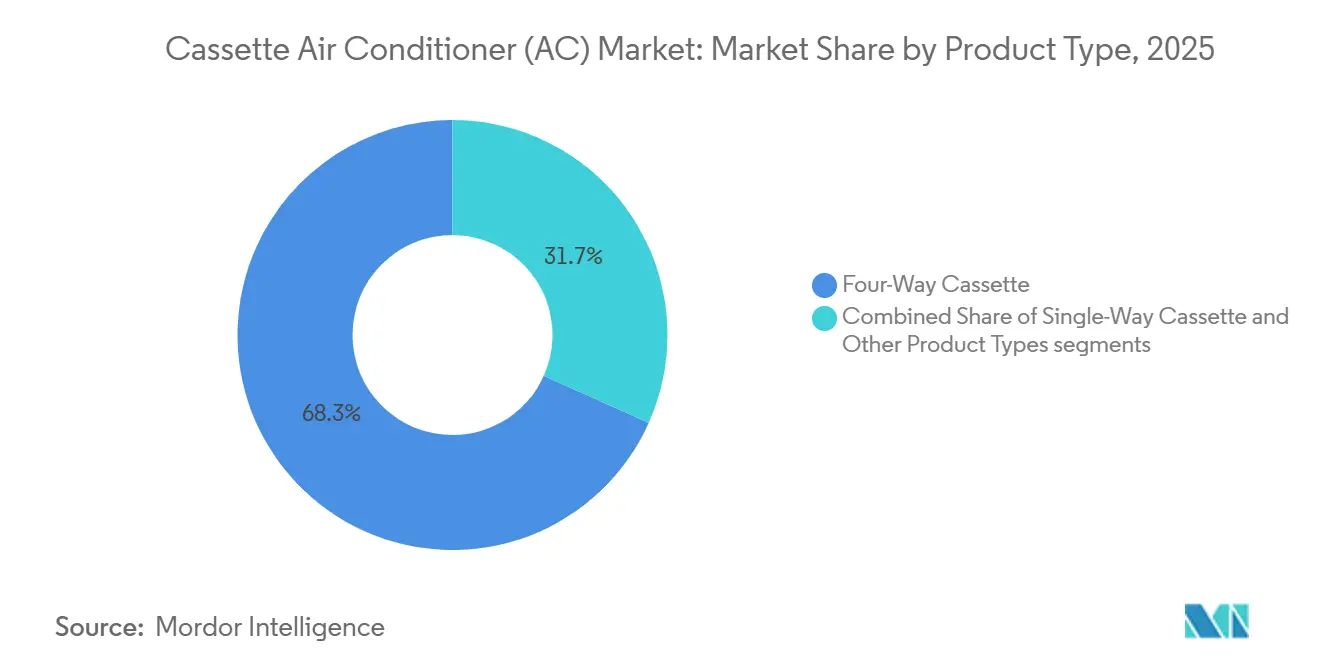
Four-Way Configuration Anchors Multi-Zone Commercial InstallationsFour-way cassette units held a 68.3% share in 2025, and that lead reflects their fit with open-plan interiors that need balanced airflow across the full room. Their louver design helps reduce hot spots and uneven cooling, which remains a common issue in larger commercial spaces with changing occupancy. They also align well with widely used 600×600 mm and 900×900 mm ceiling grid layouts, so installers often avoid major structural changes during office and retail projects. This practical fit keeps four-way models at the center of many specification-led projects in the cassette air conditioner market. Daikin’s Compact Cassette SkyAir line also shows how this part of the product mix is being shaped not only by thermal performance but also by architectural finish and system integration requirements.
Single-way models serve a narrower but still important role in corridors, reception zones, residential master suites, and spaces with shallow ceiling depth. The other product category, which includes two-way and slim variants, is gaining attention in refits where designers want a lower-profile reveal without losing ceiling integration. The four-way segment is projected to expand at a 6.56% CAGR through 2031, indicating faster growth than the overall cassette air conditioner market. That pace reflects both replacement demand from older fixed-speed installations and fresh demand from hospitality and healthcare projects. As this segment matures, product competition is shifting toward airflow control, connectivity, and easier commissioning, because core refrigeration performance is becoming more standardized across major brands.



By Capacity:
Mid-Range Demand Holds Steady as High-Capacity Segment Gains TractionThe 6-10 kW band held a 49.1% share in 2025, giving it the largest share across capacity ranges in the cassette air conditioner market. This band fits standard commercial room sizes of 30 to 80 square meters, which covers many hotel rooms, mid-sized offices, and private healthcare suites. It also matches the capacity range that works well with common suspended ceiling layouts and single-phase power supply in many buildings. That combination gives the segment a stable installed base and supports recurring replacement demand. The below-5 KW range still contributes unit volume, especially where residential cassette adoption or smaller retail spaces are involved.
Above-10 KW units are projected to record the fastest capacity growth at a 5.35% CAGR through 2031, as larger interior spaces need fewer but more powerful indoor units. This includes hotel ballrooms, hospital procedure rooms, university lecture theaters, and other high-load areas where multiple smaller units would complicate installation and service. Mitsubishi Electric’s 12 kW PLA-ZM series shows how suppliers are building in cloud connectivity and building management interfaces for this group of users. Samsung’s 14 kW four-way inverter heat pump cassette, cited in the draft, also reflects how suppliers are targeting large-space retrofit needs with more tailored specifications. The segment gains another near-term advantage from regulation, because equipment above 12 kW has a longer compliance runway in Europe than smaller split systems, which reduces transition pressure during the next few years.
By Technology:
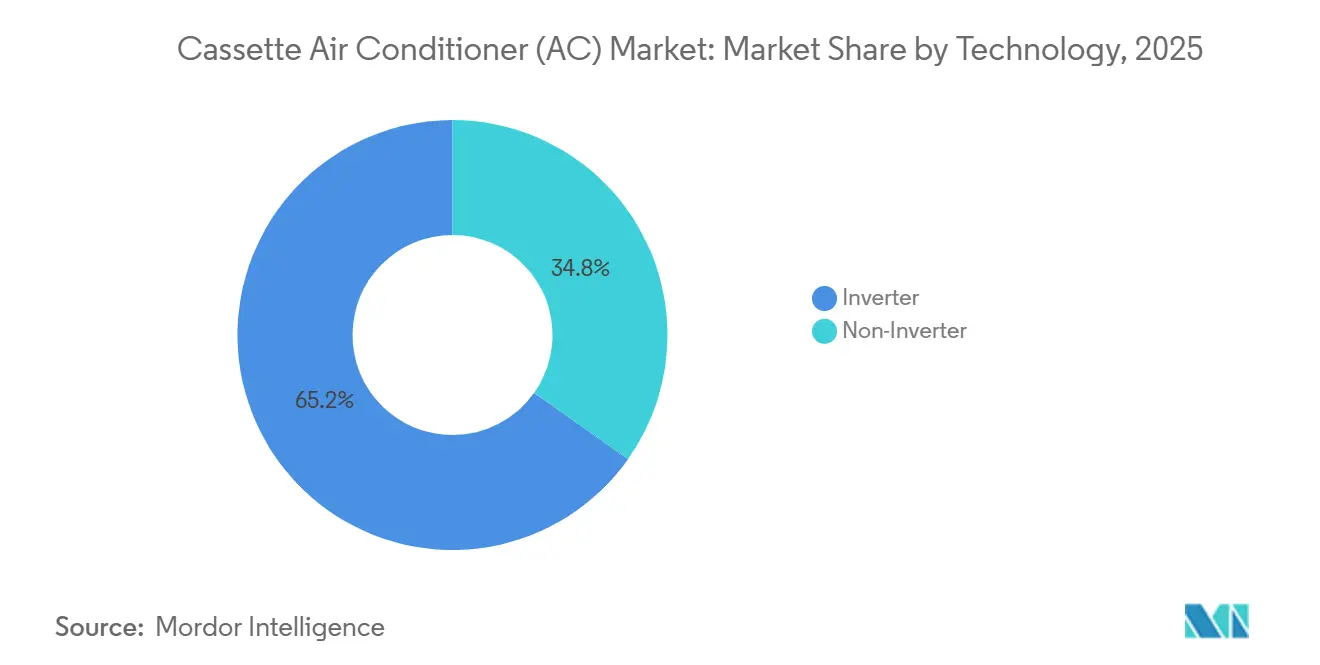
Inverter Drives the Market, With AI-Augmented Control Defining the Next PhaseInverter systems accounted for a 65.2% share in 2025, making them the leading technology format in the cassette air conditioner market. That lead reflects broad agreement among commercial HVAC buyers that variable-speed compressors offer better energy performance than fixed-speed alternatives over the full operating cycle, and that, in code-driven projects, that lifecycle advantage matters more than upfront price alone, because owners are increasingly measured on ongoing energy use and reporting. The inverter segment is projected to grow at a 6.45% CAGR through 2031, and this segment of the cassette air conditioner market is expanding faster than the overall market because regulations, labeling programs, and operator expectations all favor higher-efficiency equipment. India’s 2026 BEE star-rating framework, referenced in connection with Daikin India’s new range, also reinforces the link between efficiency tiers and buying behavior.
Inverter equipment also supports finer control when paired with building management systems, as compressor modulation can be tracked in real time and used for scheduling or occupancy-based adjustments. The 2026 Scientific Reports study on AI-driven HVAC control adds weight to this trend, showing that advanced models can keep temperature prediction within tight tolerances and support more responsive operation. Non-inverter units still matter in budget-sensitive markets across South Asia, Southeast Asia, and parts of Sub-Saharan Africa, where upfront equipment cost continues to outweigh lifecycle savings. The draft’s example of Midea’s Breezeless+ Roundflow Cassette shows that even value-oriented products are being refined to improve comfort and reduce drafts. Over time, the cassette air conditioner industry is likely to see non-inverter share compress as more markets extend efficiency standards into mainstream commercial and residential buying.
By Installation Type:
Ceiling Mounts Lead as Recessed Specifications Gain Ground in Premium ProjectsCeiling-mounted units accounted for 73.1% of the market in 2025, reflecting the original design logic of the cassette air conditioner market. Most cassette systems are meant to sit within a suspended ceiling void, with the unit body and drain hidden above the visible ceiling line. This layout works well in both retrofits and new commercial projects because it avoids major structural slab changes. It also keeps installation time competitive in projects where construction schedules are already tight. That makes ceiling-mounted units the standard choice across a broad installed base.
Recessed-mounted systems are projected to grow at a 5.98% CAGR through 2031 and are gaining ground in premium hospitality, office, and healthcare interiors. Their appeal is strongly visual, because the finish is more fully flush and fits coordinated ceiling designs where visible service elements are less acceptable. The healthcare case is also important, since smoother ceiling surfaces can align better with infection-control expectations in selected environments. Early coordination between structural, mechanical, and interior teams is more demanding in this segment, which supports a pricing premium for both the product and installation work. That premium makes
By End-User:
Residential Base Broad, Commercial Sub-Verticals Define Growth TrajectoryResidential end-users held a 74.5% share in 2025, making them the largest segment in the cassette air conditioner market. This position reflects the cumulative installed base across villas, apartments with false ceilings, and boutique residential developments, especially in the Asia-Pacific and North America. The residential cassette buyer is usually different from the wall-mounted split buyer, as the purchase is often tied to a more customized interior design. Developers and homeowners in this group tend to value concealed installation and a cleaner room finish. That helps explain why residential volume stays large even though the product sits at a premium compared with simpler alternatives.
Commercial end users are projected to grow at a 6.82% CAGR through 2031, making them the fastest-growing end-user segment in the cassette air conditioner market. Hospitality remains the largest commercial demand pool by installed volume, while healthcare and educational institutes are moving quickly as specification categories. The draft also points to corporate offices, retail, and data center support spaces as important sub-verticals, though each follows a different demand pattern. Trane Technologies said in 2026 that demand remained strong in data centers and core commercial markets such as higher education and healthcare, which supports the commercial growth story. As a result, the cassette air conditioner industry is being shaped less by one single commercial user type and more by a range of indoor environments that all need discreet, zoned ceiling cooling.
By Distribution Channel:
Retail Dominates Volume, B2B Specification Gains on Commercial GrowthB2C and retail consumers accounted for 79.3% of the market in 2025, keeping retail as the main volume channel in the cassette air conditioner market. This lead comes mainly from residential sales through multi-brand stores, exclusive brand outlets, and selected online platforms. The retail structure is especially evident in Asia-Pacific, where dealer networks often guide buyers from product selection to installer referral along the same sales path. Online activity is growing for smaller-capacity units, though full digital conversion remains limited because installation still needs local technical support. Retail, therefore, remains broadly accessible, even if it is not the fastest-growing route.
B2B and direct-from-manufacturers channels are projected to expand at a 5.12% CAGR through 2031 as commercial procurement rises. In these projects, developers, contractors, and consulting engineers buy against specification, service expectations, delivery timing, and system integration needs rather than only unit price. This is also where remote monitoring platforms can deepen long-term customer ties, because the supplier may stay involved after installation through service agreements and predictive maintenance tools. Daikin’s On-Site remote monitoring platform for SkyAir commercial systems is one example of how service and equipment are being linked more closely in project-based sales. That shift means the cassette air conditioner market is gradually balancing high-volume retail distribution with deeper B2B relationships anchored in lifecycle support.
Geography Analysis
North America Cassette Air Conditioner (AC) Market
North America held 42.2% of the global market share in 2025, making it the largest regional market for cassette air conditioners. This lead reflects a large commercial building base, a well-developed contractor network, and stricter energy code enforcement across important urban markets. Trane Technologies closed 2025 with a record enterprise backlog of USD 7.8 billion, and its Americas commercial HVAC applied bookings rose by more than 120% in the fourth quarter, which points to strong commercial demand conditions. New York City’s 2025 code enforcement now creates a direct compliance driver for system replacement in one of the world’s densest commercial building markets. California adds further support through Title 24, which favors VRF heat pump systems in many multi-zone office and school applications.
APAC Cassette Air Conditioner (AC) Market
Asia-Pacific is projected to expand at a 6.54% CAGR through 2031, making it the fastest-growing region in the cassette air conditioner market. China remains the largest production and consumption base in the region, and the draft states that it accounted for 68% of regional air conditioner unit consumption in 2026. Competition inside China is intensifying as domestic suppliers such as Midea, Gree, and Haier scale smart-featured products and build stronger commercial portfolios. Midea’s 2025 results, filed in March 2026, reported HVAC and Building Technologies revenue of CNY 35.79 billion, or USD 4.96 billion, up 25.7% year over year, with domestic central air conditioning share above 20%. India is another major growth center, with LG beginning construction of its third manufacturing plant and Carrier signing an agreement for a new Sri City facility, both of which support a larger local production base.
EMEA and South America Cassette Air Conditioner (AC) Market
Europe remains an important region for the cassette air conditioner market because building decarbonization rules are pushing HVAC replacement and refrigerant transition at the same time. The revised F-Gas framework supports a steady shift toward lower-GWP platforms, even though it also raises compliance complexity for suppliers. South America is emerging through warm-climate retrofits, especially where aging ducted systems are being replaced with ceiling-cassette VRF solutions in commercial buildings. The Middle East and Africa also add demand through high cooling loads and active hospitality and healthcare construction, especially in Gulf markets, while much of Sub-Saharan Africa remains limited by infrastructure and purchasing power constraints.

Competitive Landscape
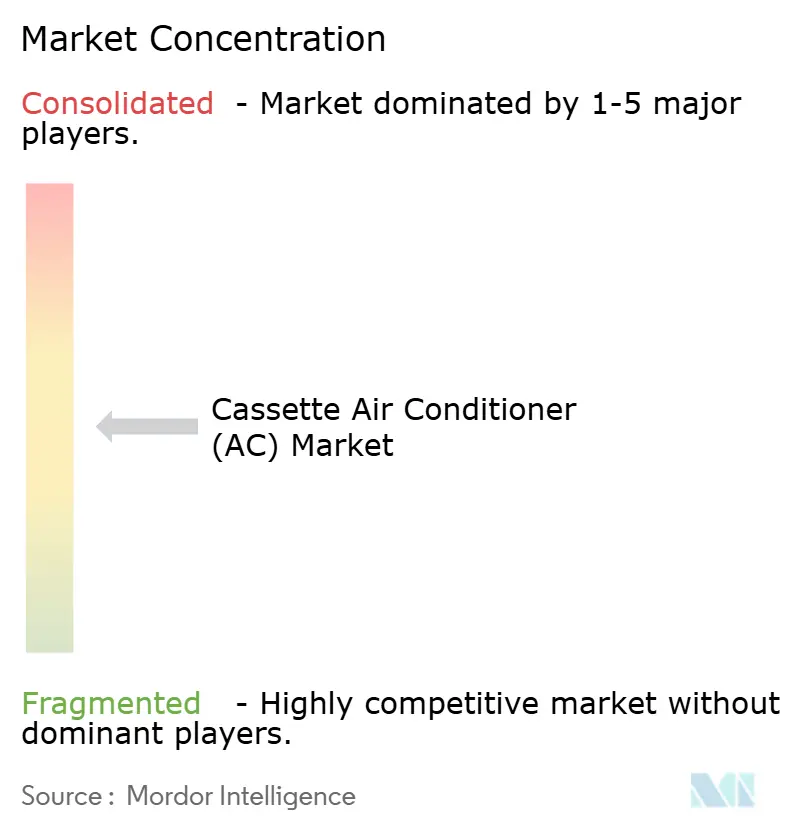
The cassette air conditioner market is moderately concentrated, with 5 to 6 major Japanese, Korean, and Chinese multinational brands holding much of the commercial specification base. Japanese players such as Daikin, Mitsubishi Electric, and Panasonic maintain strong positions by combining VRF integration capabilities with deep contractor familiarity and wide service networks. Korean companies compete strongly on design, smart features, and system control, while Chinese suppliers continue to improve their commercial offer through sharper pricing and broader feature sets. This keeps the cassette air conditioner market active across both premium and value-oriented tiers. The competitive picture is broad enough to prevent dominance by one supplier, yet concentrated enough that scale, installer relationships, and product integration still matter a great deal.
Product development has become a key point of competition, especially where buyers want remote monitoring, building management connectivity, and easier commissioning. Midea’s V9 VRF system launch in 2026 directly targeted efficiency, reliability, and easier installation in commercial HVAC, showing how Chinese suppliers are moving beyond price-led competition into specification-led offerings. Panasonic’s BMS-ready cassette systems and Mitsubishi Electric’s connected higher-capacity units also show that control platforms are now a routine part of the buying discussion. The cassette air conditioner market is also seeing more competition in premium applications where quiet operation, flush ceiling design, and digital controls are specified together. In practice, this means winning contracts now depends on software support, energy reporting, and after-sales capability as much as on cooling performance.
Strategic moves by major companies also show where competition is heading. LG expanded its HVAC footprint through its Indonesia production investment in 2025 and continues to use training infrastructure across multiple countries to build installer preference. Daikin expanded its commercial cassette offer with the 1-Way Blow Corner Cassette for tighter ceiling spaces, which directly addresses retrofit use cases. Trane’s strong 2025 backlog and booking growth show that demand in data centers, education, and healthcare is feeding into broader commercial HVAC competition. Across the cassette air conditioner market, the clearest white space remains in AI-enabled controls, predictive service tools, and stronger installer ecosystems in faster-growing emerging markets.
Cassette Air Conditioner (AC) Industry Leaders
Daikin Industries, Ltd
Mitsubishi Electric Corporation
Carrier Global Corporation
LG Electronics Inc.
Panasonic Holdings Corporation
- *Disclaimer: Major Players sorted in no particular order
Cassette Air Conditioner (AC) Market Companies Covered in this Report
- Daikin Industries, Ltd.
- Mitsubishi Electric Corporation
- LG Electronics Inc.
- Carrier Global Corporation
- Panasonic Holdings Corporation
- Samsung Electronics Co., Ltd.
- Hitachi, Ltd.
- Fujitsu General Limited
- Midea Group Co., Ltd.
- Gree Electric Appliances Inc. of Zhuhai
- Haier Group Corporation
- Toshiba Corporation
- Trane Technologies plc
- Johnson Controls International plc
- Lennox International Inc.
- Rheem Manufacturing Company
- Blue Star Limited
- Voltas Limited
- AUX Group
- Bosch Thermotechnology GmbH

Recent Industry Developments in Cassette Air Conditioner (AC) Market
- April 2026: Mitsubishi Electric released its updated 2025/2026 air conditioning, ventilation, and heat pump product catalog with new model introductions, including the MSZ-RZ with R290 refrigerant and 3D i-see sensor technology.
- October 2025: LG Electronics invested in a partner-operated production facility in Bekasi, West Java, Indonesia, dedicated to manufacturing LG air conditioners, with a total initial investment of Rp 374 billion (approximately USD 22 million) and an initial annual production capacity of 1.8 million units.
- March 2025: Daikin Central Europe expanded the Multi+ all-in-one system to include cassette indoor units, supporting up to four indoor units and a hot water tank from a single outdoor unit, targeting residential and small commercial retrofit applications.
- June 2025: Daikin Europe launched the 1-Way Blow Corner Cassette as part of the VRV 5 commercial platform, expanding its commercial cassette portfolio with a unit designed specifically for spaces with minimal ceiling clearance or without a false ceiling.


Global Cassette Air Conditioner (AC) Market Report Scope
| Single-Way Cassette |
| Four-Way Cassette |
| Other Product Types |
| Below 5 KW |
| 6 KW to 10 KW |
| Above 10 KW |
| Inverter |
| Non-Inverter |
| Ceiling Mounted |
| Recessed Mounted |
| Residential | |
| Commercial | Hospitality |
| Healthcare | |
| Retail | |
| Corporate Offices | |
| Educational Institutes | |
| Other Commercial Applications |
| B2B/Direct from the Manufacturers | |
| B2C/Retail Consumers | Multi-Brand Stores |
| Exclusive Brand Stores (EBOs) | |
| Online | |
| Other Distribution Channels |
| North America | Canada |
| United States | |
| Mexico | |
| South America | Brazil |
| Peru | |
| Chile | |
| Argentina | |
| Rest of South America | |
| Europe | United Kingdom |
| Germany | |
| France | |
| Spain | |
| Italy | |
| BENELUX (Belgium, Netherlands, and Luxembourg) | |
| NORDICS (Denmark, Finland, Iceland, Norway, and Sweden) | |
| Rest of Europe | |
| Asia-Pacific | India |
| China | |
| Japan | |
| Australia | |
| South Korea | |
| South East Asia (Singapore, Malaysia, Thailand, Indonesia, Vietnam, and the Philippines) | |
| Rest of Asia-Pacific | |
| Middle East and Africa | United Arab Emirates |
| Saudi Arabia | |
| South Africa | |
| Nigeria | |
| Rest of the Middle East and Africa |
| By Product Type | Single-Way Cassette | |
| Four-Way Cassette | ||
| Other Product Types | ||
| By Capacity | Below 5 KW | |
| 6 KW to 10 KW | ||
| Above 10 KW | ||
| By Technology | Inverter | |
| Non-Inverter | ||
| By Installation Type | Ceiling Mounted | |
| Recessed Mounted | ||
| By End-User | Residential | |
| Commercial | Hospitality | |
| Healthcare | ||
| Retail | ||
| Corporate Offices | ||
| Educational Institutes | ||
| Other Commercial Applications | ||
| By Distribution Channel | B2B/Direct from the Manufacturers | |
| B2C/Retail Consumers | Multi-Brand Stores | |
| Exclusive Brand Stores (EBOs) | ||
| Online | ||
| Other Distribution Channels | ||
| By Region | North America | Canada |
| United States | ||
| Mexico | ||
| South America | Brazil | |
| Peru | ||
| Chile | ||
| Argentina | ||
| Rest of South America | ||
| Europe | United Kingdom | |
| Germany | ||
| France | ||
| Spain | ||
| Italy | ||
| BENELUX (Belgium, Netherlands, and Luxembourg) | ||
| NORDICS (Denmark, Finland, Iceland, Norway, and Sweden) | ||
| Rest of Europe | ||
| Asia-Pacific | India | |
| China | ||
| Japan | ||
| Australia | ||
| South Korea | ||
| South East Asia (Singapore, Malaysia, Thailand, Indonesia, Vietnam, and the Philippines) | ||
| Rest of Asia-Pacific | ||
| Middle East and Africa | United Arab Emirates | |
| Saudi Arabia | ||
| South Africa | ||
| Nigeria | ||
| Rest of the Middle East and Africa | ||


Key Questions Answered in the Report
What is the projected value of the cassette air conditioner sector by 2031?
The cassette air conditioner market is projected to reach USD 11.95 billion by 2031 from USD 9.30 billion in 2026, growing at a 5.14% CAGR over 2026 to 2031.
Which product type leads demand in cassette-based cooling systems?
Four-way cassette units led with 68.3% share in 2025 because they fit open-plan spaces well and provide balanced air distribution across commercial interiors.
Which region is growing fastest for cassette AC demand?
Asia-Pacific is projected to record the fastest growth at a 6.54% CAGR through 2031, supported by urbanization, rising incomes, and expanding local manufacturing capacity.
Why are inverter cassette units gaining more traction than non-inverter models?
Inverter units held 65.2% share in 2025 and are projected to grow at 6.45% CAGR because they support better energy efficiency, tighter control, and easier integration with smart building systems.
What is the main restraint affecting adoption of ceiling cassette systems?
High installed cost remains the biggest restraint, since cassette systems need ceiling access, drainage work, and specialist labor, which can raise total installed cost by 30% to 50% against wall-mounted splits.
Page last updated on:





