
Cable Tie Market Size and Share
Market Overview
| Study Period | 2021 - 2031 |
|---|---|
| Market Size (2026) | USD 1.77 Billion |
| Market Size (2031) | USD 2.38 Billion |
| Growth Rate (2026 - 2031) | 6.12 % |
| Fastest Growing Market | Asia-Pacific |
| Largest Market | Asia-Pacific |
| Market Concentration | Medium |
Major Players *Disclaimer: Major Players sorted in no particular order Image © Mordor Intelligence. Reuse requires attribution under CC BY 4.0. | |
Cable Tie Market Analysis by Mordor Intelligence
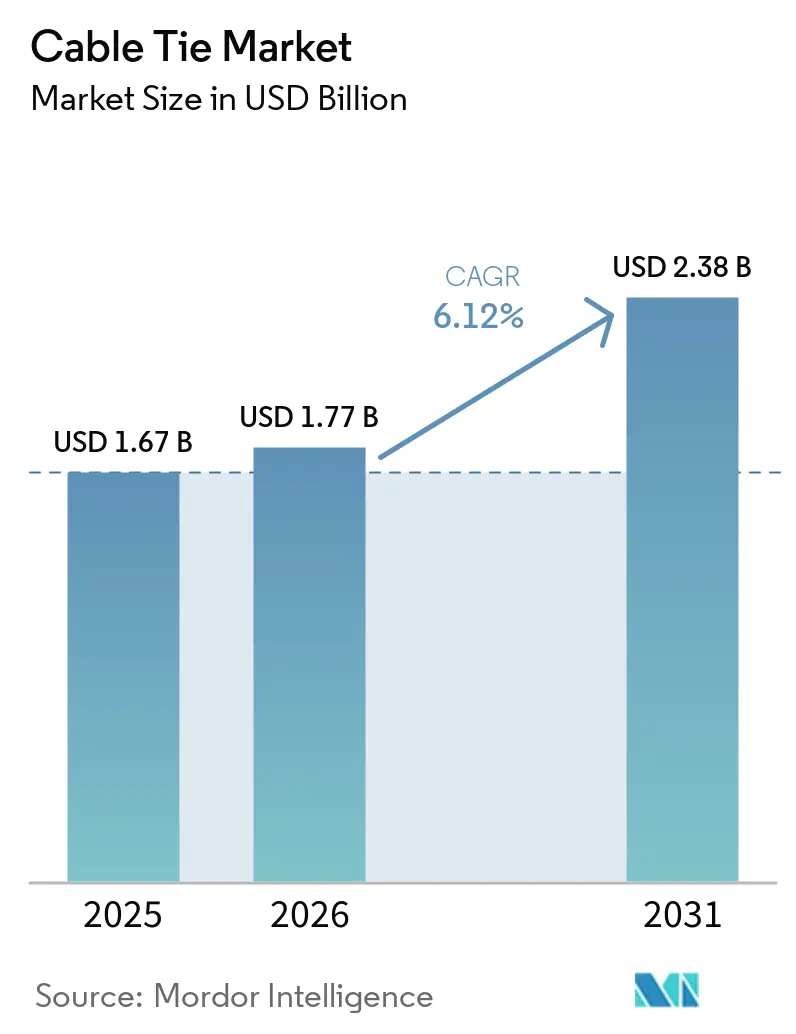
The cable tie market size was estimated at USD 1.67 billion in 2025 and is estimated to grow from USD 1.77 billion in 2026 to USD 2.38 billion by 2031, at a CAGR of 6.12% during the forecast period (2026-2031). The cable tie market is becoming increasingly segmented as low-cost nylon products face pricing pressure, while demand for certified, durable, and traceable formats increases. Electrification, data center construction, industrial automation, and network expansion are increasing the demand for cable management solutions in dense, demanding installations. Buyers are prioritizing heat resistance, ultraviolet stability, flame performance, vibration resistance, and the ability to reroute cables during maintenance. This shift supports suppliers that meet technical specifications and maintain engineering relationships with customers. Feedstock price volatility and regulatory requirements may further differentiate premium and commodity products in the cable tie market.
Key Report Takeaways
- By product type, releasable cable ties accounted for 47.56% of revenue in 2025, while ball lock cable ties are forecast to grow at a 6.84% CAGR through 2031.
- By material, nylon accounted for 52.87% revenue share in 2025 and is forecast to expand at a 7.13% CAGR through 2031.
- By end-user industry, electronics and electrical held 36.71% revenue share in 2025, while automotive is forecast to grow at a CAGR of 7.26% through 2031.
- By geography, Asia-Pacific accounted for 43.83% revenue share in 2025 and is forecast to grow at a 6.78% CAGR through 2031.
Note: Market size and forecast figures in this report are generated using Mordor Intelligence’s proprietary estimation framework, updated with the latest available data and insights as of January 2026.
Market Trends and Insights
Drivers Impact Analysis of Cable Tie Market*
| Drivers | (~) % Impact on CAGR Forecast | Geographic Relevance | Impact Timeline |
|---|---|---|---|
| Electrification, Data Center, and Industrial Automation Buildouts | +1.8% | Global, with concentration in North America, Asia-Pacific, and Northern Europe | Medium term (2-4 years) |
| Fiber, 5G, and High-Density Network Deployment | +1.2% | Global, with peak impact in Asia-Pacific, the Middle East, and Latin America | Short term (≤ 2 years) |
| Electric Vehicle Harness Complexity and Charging Infrastructure | +1.6% | China, Germany, the United States, and South Korea | Medium term (2-4 years) |
| Construction, Renovation, and Renewable Energy Installations | +0.9% | Asia-Pacific, the Middle East and Africa, and South America | Long term (≥ 4 years) |
| Radio Frequency Identification (RFID) and Metal-Detectable Ties for Traceability-Critical Operations | +0.5% | Global, with a concentration in food processing, pharmaceuticals, and medical device manufacturing | Medium term (2-4 years) |
| Source: Mordor Intelligence | |||
Electrification, Data Center, and Industrial Automation Buildouts
Data centers, electrical grids, and factory automation projects are driving demand for cable management hardware across the cable tie market. High-density rack environments require more power distribution, cooling, and networking connections than conventional commercial facilities. During commissioning, these installations often require cable ties to meet flame-resistance, tensile-strength, and reusability specifications. ABB invested USD 200 million in medium-voltage manufacturing capacity in Europe to support demand for grid upgrades. Automation projects also use robotic arms, servo drives, and articulated conveyors that require flexible routing and swivel-mount tie assemblies. These applications are increasing demand for specialized cable tie products rather than standard panel-wiring ties alone.
Fiber, 5G, and High-Density Network Deployment
Fiber and 5G deployments are generating demand across a broad range of locations, rather than only at major construction sites. The Broadband Equity, Access, and Deployment Program allocated USD 42.45 billion to broadband infrastructure[1]National Telecommunications and Information Administration, “Broadband Equity, Access, and Deployment Program,” National Telecommunications and Information Administration, ntia.gov, supporting fiber installations in rural and suburban areas of the United States. Fiber broadband coverage exceeded 60% of U.S. households by the end of 2025, with 11.8 million homes added during the year. Each connected home and cell site creates additional cable routing and fastening requirements. Consequently, outdoor-grade, heat-stabilized, and ultraviolet-resistant nylon products are gaining a larger role in the cable tie market, as network assets must operate reliably over long service lives.
Electric Vehicle Harness Complexity and Charging Infrastructure
Electric vehicle platforms are changing where and how cable ties are used within vehicles. The International Energy Agency reported more than 17 million electric car sales in 2024. Battery packs, inverters, and sensor systems increase wiring density compared with internal-combustion-engine vehicle designs. Higher-voltage systems and zonal wiring architectures concentrate fastening requirements in areas exposed to greater heat and vibration. These conditions favor materials designed to meet automotive testing requirements and provide stable mechanical performance. Public fast-charging stations create an additional demand channel, as cable ties used in these installations must withstand ultraviolet exposure, outdoor conditions, and repeated thermal cycling. The cable tie market gains demand when vehicle and charging infrastructure specifications require durable fastening solutions rather than basic indoor-grade products.
Construction, Renovation, Renewable Energy, and Traceability-Critical Operations
Solar and wind installations create recurring replacement demand because cable management components can degrade over long operating lives. Panduit introduced a 20-year manufacturer’s warranty in May 2026 for DuraTy acetal and Nylon 612 cable ties used in solar and energy infrastructure. Building and electrical codes also increase the number of fastening points required in commercial projects. As a result, construction and renovation activities increase demand for cable ties without requiring material changes to the installed equipment base. Food processing, pharmaceutical, and medical device facilities create a separate need for radio frequency identification (RFID) and metal-detectable products. These products support traceability and contamination control, making certification and product reliability important purchasing criteria in the cable tie market.
Restraints Impact Analysis of Cable Tie Market*
| Restraints | (~) % Impact on CAGR Forecast | Geographic Relevance | Impact Timeline |
|---|---|---|---|
| Nylon Resin and Stainless-Steel Feedstock Volatility | -1.0% | Global, with severe exposure in North America and Europe | Short term (≤ 2 years) |
| Low-Cost Substitutes and Commodity Price Competition | -0.7% | Price-sensitive markets in Southeast Asia, South America, the Middle East, and Africa | Medium term (2-4 years) |
| End-of-Life Sorting and Recyclability Constraints for Multi-Material Ties | -0.4% | Europe, with emerging relevance in North America | Long term (≥ 4 years) |
| Source: Mordor Intelligence | |||
Nylon Resin and Stainless-Steel Feedstock Volatility
Feedstock disruptions in 2026 exposed the limited margin protection available to converters that use standard PA6 and PA6,6 resins. BASF increased North American prices for caprolactam, polyamide polymer, and copolyamide by USD 0.10 per pound, effective June 2, 2026. NYCOA also announced a USD 0.15-per-pound price increase for Nylon 6, effective May 1, 2026. Many converters find it difficult to pass higher resin and freight costs through during quarterly pricing cycles. Producers with access to caprolactam, adipic acid, or compounding capabilities have greater protection than toll converters. These conditions may encourage smaller cable tie manufacturers to exit commodity product lines or seek support from more integrated manufacturers.
Low-Cost Substitutes and Commodity Price Competition
High-volume Asian producers compete aggressively on price across construction, DIY, and export channels. Commodity nylon ties can constrain the growth of premium products when procurement decisions primarily depend on unit costs. Reusable hook-and-loop wraps, push-mount clips, and spiral conduits also compete in certain consumer electronics and light commercial applications. These alternatives primarily pressure-fit rather than fully replace cable ties. India is emerging as an additional sourcing location for certified cable ties, supported by access to free-trade agreements with the European Union, the United Kingdom, Australia, and New Zealand[2]Tycab, “Why Global Buyers Are Sourcing Cable Ties From India, The FTA Advantage,” Tycab, tycabcableties.com. As more buyers qualify second sources, the cable tie market may experience stronger competition across standard product ranges.
*Our forecasts treat driver/restraint impacts as directional, not additive. The impact forecasts reflect baseline growth, mix effects, and variable interactions.
Cable Tie Market Segment Analysis
By Product Type:
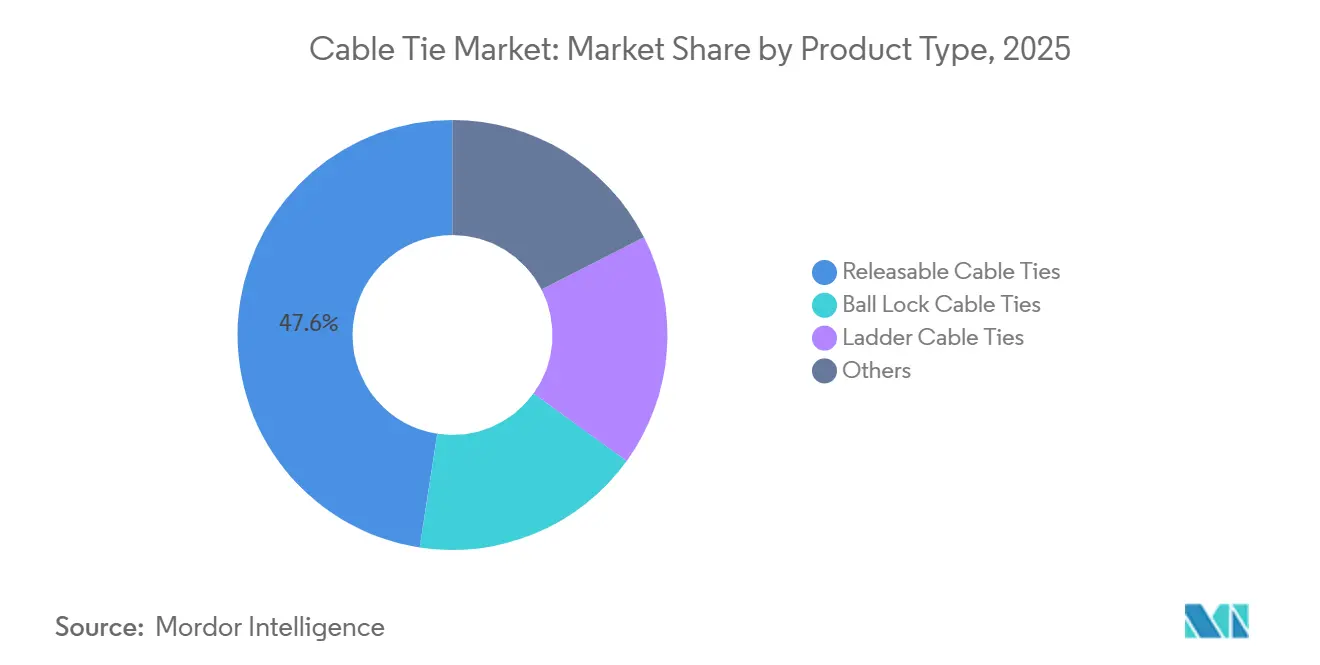
Releasable Ties Hold the Largest Position, While Ball Lock Ties Grow FastestReleasable cable ties accounted for 47.56% of the cable tie market in 2025. Their position reflects widespread use in data centers and telecommunications installations, where technicians frequently reroute cables during maintenance and upgrades. Facility managers and system integrators specify releasable designs during project planning because they eliminate the need to cut permanent ties and reduce material consumption during service work. These products are relevant in applications where downtime carries high costs. Consequently, releasable formats maintain a broad installed base across network and equipment environments.
Ball-lock cable ties are forecast to grow at a CAGR of 6.84% through 2031. Their non-slip locking mechanism supports use in wind installations, solar tracker frames, and industrial environments exposed to vibration. Stainless steel variants also serve applications that require corrosion resistance and sustained clamping strength. Ladder cable ties remain relevant for high-voltage bundling and marine applications because they distribute clamping force over a wider area. Push-mount ties, hook-and-loop products, and biodegradable formats fall within the other product type category. Product requirements are becoming more stringent as electrical installation standards introduce revised temperature classifications and tensile-strength testing methods.



By Material:
Nylon Combines the Largest Base with the Highest Growth RateNylon accounted for 52.87% of the cable tie market in 2025 and is forecast to expand at a CAGR of 7.13% through 2031. The material is used in indoor, automotive, industrial, solar, and telecommunications applications. Nylon 6,6 remains important for automotive wire harnesses and industrial automation systems that require flame resistance and heat stability. Nylon 6/12 is used in outdoor installations where humidity resistance and dimensional stability are critical. Panduit's May 2026 product information stated that Nylon 6/12 absorbs 0.3% moisture, compared with 1.2% for Nylon 6,6. This range of grades supports nylon's position as the largest material segment in the cable tie market.
Polypropylene is used in food-contact and pharmaceutical settings, where its chemical resistance supports hygiene requirements. Stainless steel products represent a smaller material segment but are used in exposed renewable energy and industrial installations. Their corrosion resistance supports projects with operating lives of 25 to 30 years. Other materials include bio-based and recycled-content products that address emerging sustainability requirements. European regulations covering certain plasticizers and halogenated flame retardants are raising the minimum specifications for products supplied to the region. Suppliers with validated halogen-free formulations may benefit in regulated applications.
By End-User Industry:
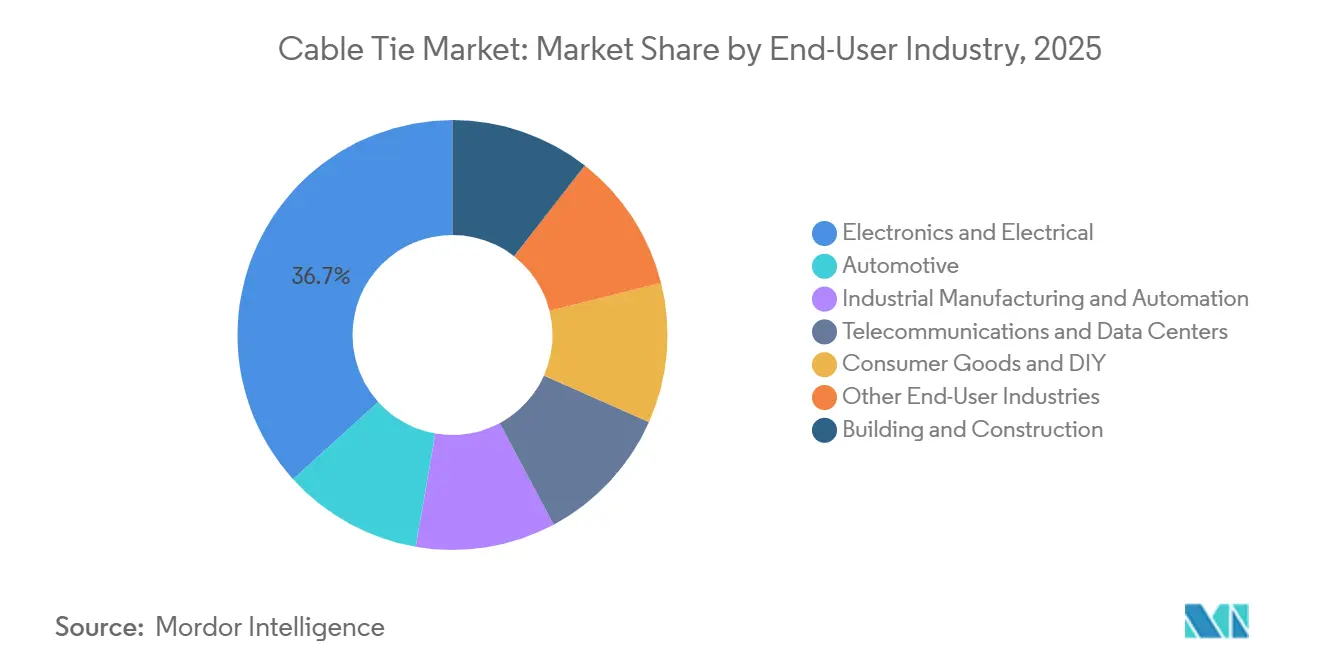
Electronics and Electrical Leads, While Automotive Adds GrowthElectronics and electrical accounted for 36.71% of the cable tie market in 2025. This segment includes printed circuit board assembly, consumer electronics, industrial electronics, medical devices, and data center infrastructure. These applications require cable routing within compact systems and production equipment. Performance requirements vary by application, limiting the shift in demand toward basic commodity products. Data centers commonly require releasable and halogen-free formats that support planned maintenance. Therefore, electronics and electrical applications provide a large and diverse demand base for the cable tie market.
The automotive segment is forecast to grow at a CAGR of 7.26% through 2031. Electric vehicles require battery packs, inverters, and sensors, increasing the need for wire-routing and fastening solutions. Automotive supply chains follow qualification standards that restrict the use of lower-specification fasteners. Building and construction remains the second-largest end-user segment by revenue, driven by renovation activity in Europe and infrastructure projects across Asia-Pacific and the Middle East. Industrial manufacturing and automation represent the third-largest end-user segment and are shifting toward motion-tolerant routing products for robotics and semiconductor plants. Consumer goods and DIY applications remain large-scale, lower-value segments, while e-commerce channels continue to reshape small-order distribution.
Geography Analysis
APAC Cable Tie Market
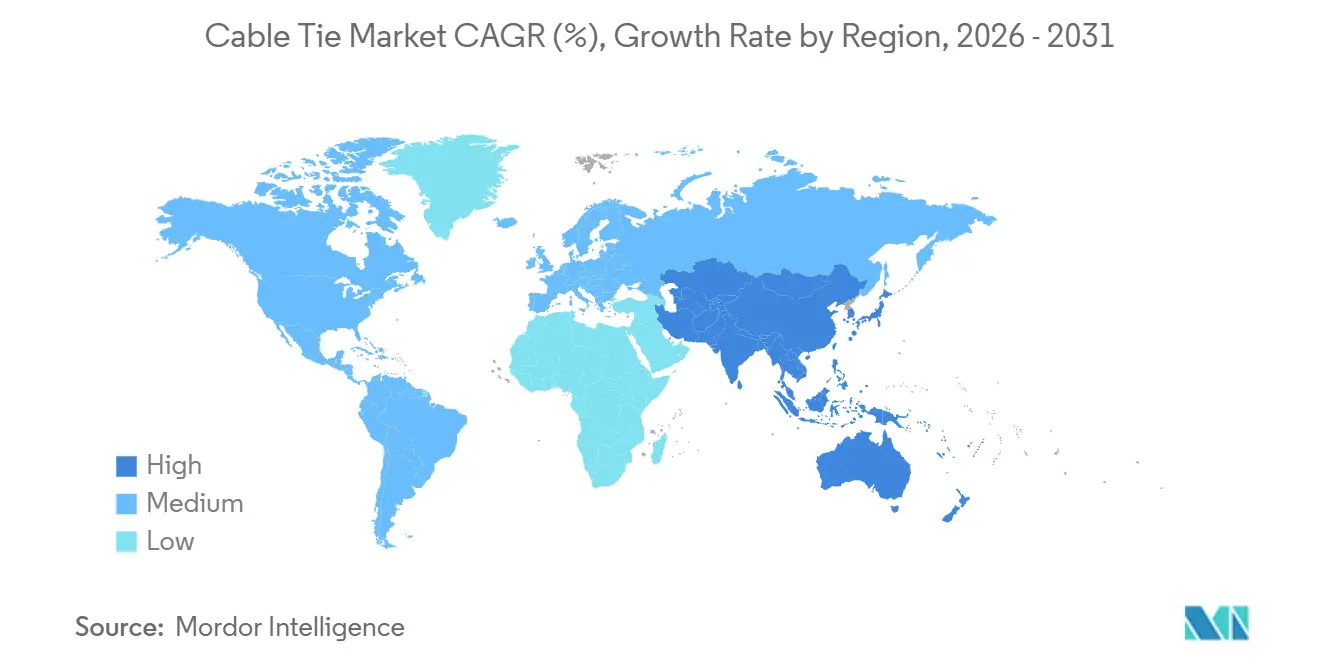
Asia-Pacific accounted for 43.83% of the cable tie market share in 2025 and is forecast to grow at a CAGR of 6.78% through 2031. The region has the largest production and consumption bases. China maintains a significant production presence in Zhejiang, Guangdong, and Hebei provinces, supporting cost competitiveness across the global supply chain. In India, electronics incentives, infrastructure programs, and access to export markets through trade agreements support demand. Japan and South Korea consume higher-value products for automotive and precision electronics applications. These factors support Asia-Pacific's role in the cable tie market's development.
North America Cable Tie Market
North America is the second-largest regional market. Broadband deployment, data center construction, and manufacturing investments are increasing the demand for cable ties in the United States. The USD 42.45 billion Broadband Equity, Access, and Deployment (BEAD) allocation supports outdoor fiber networks that require ultraviolet-stabilized and heat-stabilized nylon ties. Canada contributes to demand through automotive harness production and resource-sector projects. Mexico supports qualified supply to US automotive assembly plants due to its position within the North American production network. The National Electrical Code establishes minimum material performance requirements for permanent electrical installations.
EMEA and South America Cable Tie Market
Europe, South America, the Middle East, and Africa generate demand from distinct end-use applications. In Europe, German automotive electrification, data center projects in Ireland and the Nordic countries, and North Sea wind assets drive cable tie consumption. Registration, Evaluation, Authorisation and Restriction of Chemicals (REACH) requirements and the EN IEC 62275:2026 standard raise supply chain expectations for products used in European installations. South America benefits from industrial automation in Brazil and lithium infrastructure development in Argentina. The Middle East and Africa benefit from construction and renewable energy projects, including developments in Saudi Arabia and Abu Dhabi. Desert and coastal conditions increase demand for ultraviolet-stable and corrosion-resistant products across the cable tie market.

Competitive Landscape
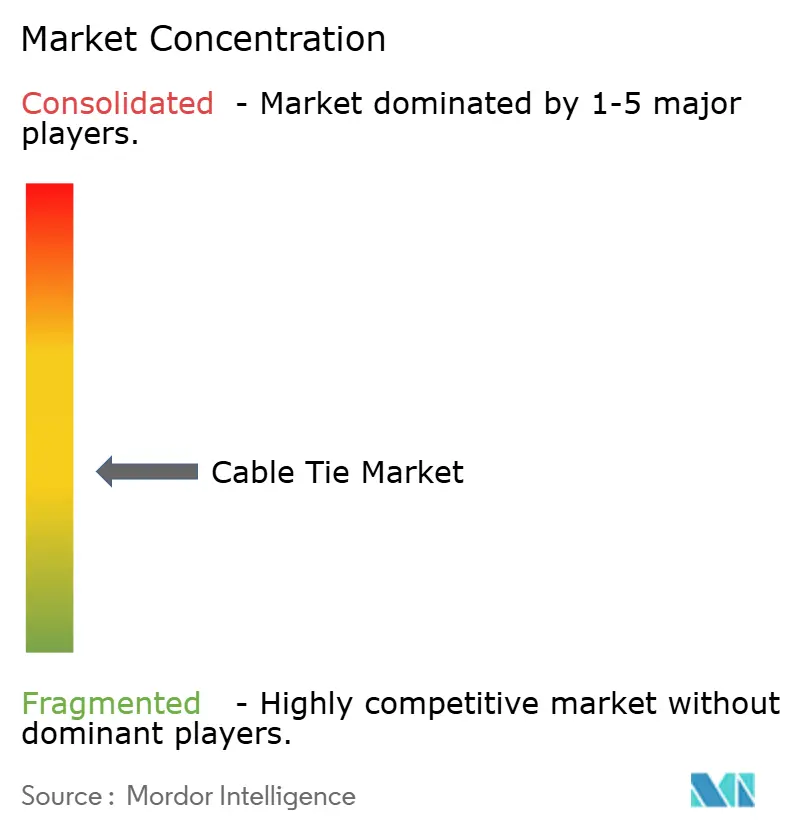
The cable tie market is moderately fragmented. HellermannTyton, Panduit, TE Connectivity, and ABB Installation Products compete through technical specifications and customer engineering relationships. Panduit collaborates with North American data center engineers on bundle-management specifications that may be incorporated into procurement contracts. These relationships can create switching costs for customers who require consistently approved products. Manufacturers in China and Taiwan compete on unit costs across construction, DIY, and export channels. Some manufacturers are pursuing UL and CE certifications to enter higher-value applications.
Companies are expanding their presence in infrastructure categories linked to demand for cable management. TE Connectivity acquired Phoenix Contact E-Mobility’s charging inlet business in March 2026 and completed its USD 2.3 billion acquisition of Richards Manufacturing in April 2025. These actions expand TE Connectivity’s access to electrification projects, in which cable ties are part of broader electrical specifications. In May 2026, Panduit introduced a warranty for solar and energy products that emphasized service life rather than unit price. ABB’s investment in European manufacturing reflects demand for grid upgrades in the cable tie market.
Sustainable material substitution and traceability-focused products remain product development areas. Radio Frequency Identification (RFID) and metal-detectable cable ties support physical-hazard control in food and pharmaceutical manufacturing. Panduit and HellermannTyton offer these technically demanding product formats, while specialists, including Detectamet and DIFVAN, compete through certifications and pricing. Automated cable-tying equipment also influences procurement requirements by increasing the need for dimensional consistency and machine-compatible product formats. These systems can operate at up to 84 cycles per minute, reducing the labor advantage associated with manual installation. The competitive landscape includes specification-led suppliers and lower-cost manufacturers seeking access to certified product categories.
Cable Tie Industry Leaders
Panduit Corp
HellermannTyton
ABB
3M
TE Connectivity
- *Disclaimer: Major Players sorted in no particular order
Cable Tie Market Companies Covered in this Report
- 3M
- ABB
- Advanced Cable Ties, Inc.
- AFT Fasteners
- Avery Dennison Corporation
- BAND-IT
- Essentra Components
- HellermannTyton
- HUA WEI INDUSTRIAL CO., LTD.
- KAI SUH SUH ENTERPRISE CO., LTD.
- NELCO
- NORMA Group
- Panduit Corp
- Partex Marking Systems
- Southwire Company, LLC.
- TE Connectivity

Recent Industry Developments in Cable Tie Market
- August 2026: BASF increased prices for caprolactam, PA6, and copolyamide by USD 0.10 per pound in North America, effective June 2, due to volatility across the nylon value chain resulting from geopolitical disruptions and feedstock constraints. This followed a USD 0.16-per-pound price increase announced in April 2026, increasing input costs for cable tie converters that use PA6 resin.
- May 2026: Panduit introduced a 20-year manufacturer’s warranty for its DuraTy acetal and Nylon 612 cable ties for solar and energy infrastructure applications. Nylon 612 absorbs 0.3% moisture, compared with 1.2% for conventional Nylon 6,6, supporting an outdoor service life of approximately 20 years. This is approximately three times the lifespan of standard cable ties under comparable UV exposure conditions.


Global Cable Tie Market Report Scope
A cable tie is a fastener used to secure items, primarily electrical cables and wires. Its low cost, ease of use, and strong binding capability make it widely used across various applications.
The cable tie market is segmented by product type, material, end-user industry, and geography. By product type, the market is segmented into releasable cable ties, ball lock cable ties, ladder cable ties, and others. By material, the market is segmented into nylon, polypropylene, stainless steel, and others. By end-user industry, the market is segmented into electronics and electrical, building and construction, automotive, industrial manufacturing and automation, telecommunications and data centers, consumer goods and diy, and other end-user industries. The report also covers market size and forecasts for the cable tie across 15 countries in major regions. The market sizes and forecasts are provided in terms of value (USD).
| Releasable Cable Ties |
| Ball Lock Cable Ties |
| Ladder Cable Ties |
| Others |
| Nylon |
| Polypropylene |
| Stainless Steel |
| Others |
| Electronics and Electrical |
| Building and Construction |
| Automotive |
| Industrial Manufacturing and Automation |
| Telecommunications and Data Centers |
| Consumer Goods and DIY |
| Other End-User Industries |
| Asia-Pacific | China |
| India | |
| Japan | |
| South Korea | |
| Rest of Asia-Pacific | |
| North America | United States |
| Canada | |
| Mexico | |
| Europe | Germany |
| United Kingdom | |
| France | |
| Italy | |
| Rest of Europe | |
| South America | Brazil |
| Argentina | |
| Rest of South America | |
| Middle East and Africa | Saudi Arabia |
| South Africa | |
| Rest of Middle East and Africa |
| By Product Type | Releasable Cable Ties | |
| Ball Lock Cable Ties | ||
| Ladder Cable Ties | ||
| Others | ||
| By Material | Nylon | |
| Polypropylene | ||
| Stainless Steel | ||
| Others | ||
| By End-User Industry | Electronics and Electrical | |
| Building and Construction | ||
| Automotive | ||
| Industrial Manufacturing and Automation | ||
| Telecommunications and Data Centers | ||
| Consumer Goods and DIY | ||
| Other End-User Industries | ||
| By Geography | Asia-Pacific | China |
| India | ||
| Japan | ||
| South Korea | ||
| Rest of Asia-Pacific | ||
| North America | United States | |
| Canada | ||
| Mexico | ||
| Europe | Germany | |
| United Kingdom | ||
| France | ||
| Italy | ||
| Rest of Europe | ||
| South America | Brazil | |
| Argentina | ||
| Rest of South America | ||
| Middle East and Africa | Saudi Arabia | |
| South Africa | ||
| Rest of Middle East and Africa | ||


Key Questions Answered in the Report
What is current market size of Cable Tie Market?
The cable tie market size was estimated at USD 1.67 billion in 2025 and is estimated to grow from USD 1.77 billion in 2026 to USD 2.38 billion by 2031, at a CAGR of 6.12% during the forecast period (2026-2031).
Which cable tie product type has the largest share?
Releasable cable ties held a 47.56% share in 2025 because maintenance teams use them for rerouting in data centers, telecommunications, electrical installations, and equipment installations.
Which cable tie material is growing fastest?
Nylon is the fastest-growing material at a 7.13% CAGR through 2031 and held 52.87% share in 2025, reflecting its use across automotive, industrial, solar, telecom, and indoor electrical work.
Which end-user sector is driving demand for cable ties?
Electronics and electrical led with a 36.71% share in 2025, while automotive is forecast to grow fastest at a 7.26% CAGR, as electric vehicles require more complex wiring systems.
Page last updated on:





