
Bulk Rail-to-Truck Transloading Services Market Size and Share
Market Overview
| Study Period | 2021 - 2032 |
|---|---|
| Market Size (2027) | USD 4.04 Billion |
| Market Size (2032) | USD 5.35 Billion |
| Growth Rate (2027 - 2032) | 5.79 % |
| Fastest Growing Market | Asia-Pacific |
| Largest Market | North America |
| Market Concentration | Low |
Major Players *Disclaimer: Major Players sorted in no particular order Image © Mordor Intelligence. Reuse requires attribution under CC BY 4.0. | |
Bulk Rail-to-Truck Transloading Services Market Analysis by Mordor Intelligence
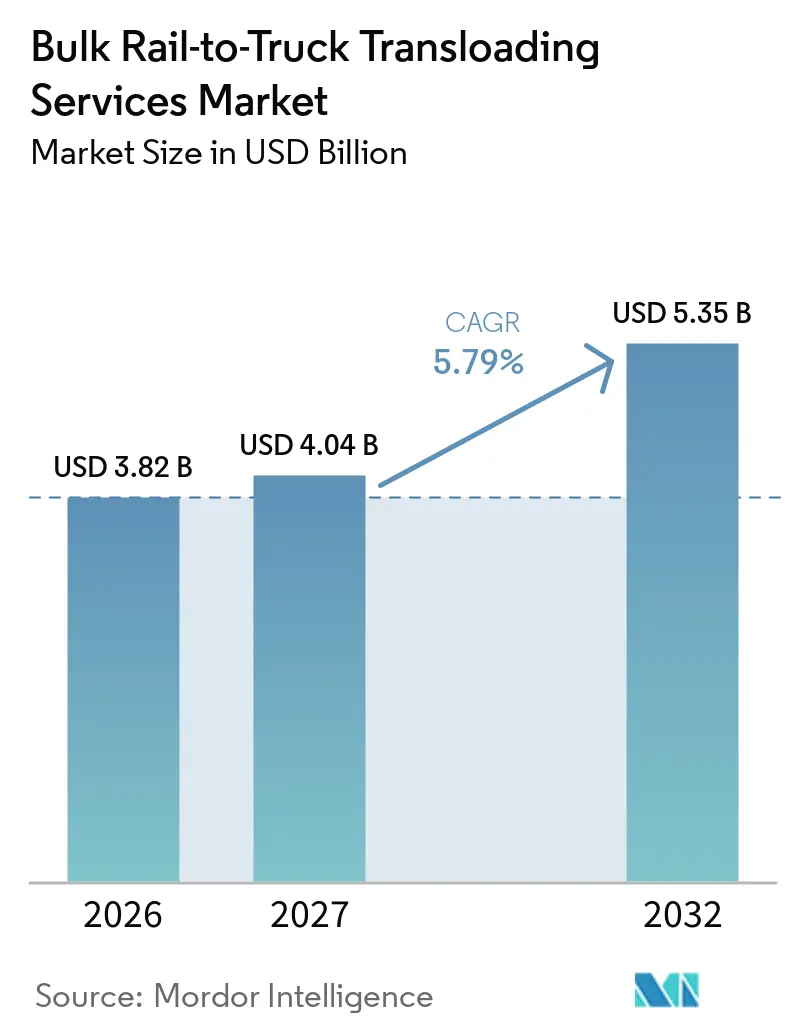
The bulk rail-to-truck transloading services market size is valued at USD 3.82 billion in 2026 and is estimated to grow from USD 4.04 billion in 2027 to reach USD 5.35 billion by 2032, at a CAGR of 5.79% during the forecast period (2027-2032).
The bulk rail-to-truck transloading services market benefits from the cost difference between long-haul rail transport and truck delivery for the last mile. Inflation-adjusted rail rates were 46% lower in 2025 than in 1981, while freight rail moved 1 ton nearly 500 miles per gallon of fuel on average. This operating model is relevant when shippers lack direct rail access at an origin or destination. The bulk rail-to-truck transloading services market also gains support from nearshoring, industrial development along short lines, and demand for liquid and chemical handling. Operators are responding through terminal expansion, specialized handling equipment, and services that combine storage, inspection, and local trucking.
Key Report Takeaways
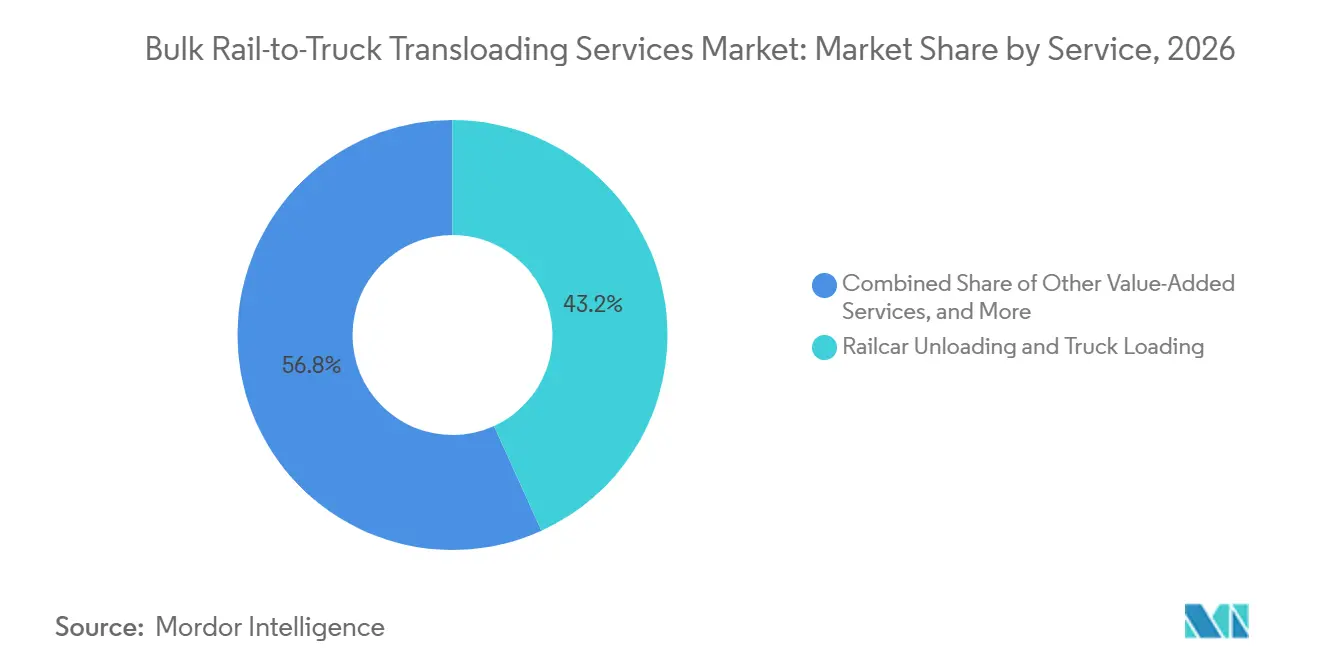
- By service, railcar unloading and truck loading led with 43.25% of the bulk rail-to-truck transloading services market share in 2026, while other value-added services are forecast to expand at a 7.29% CAGR through 2032.
- By commodity type, dry bulk led with 78.10% of the bulk rail-to-truck transloading services market size in 2026, while liquid bulk is forecast to expand at a 7.53% CAGR through 2032.
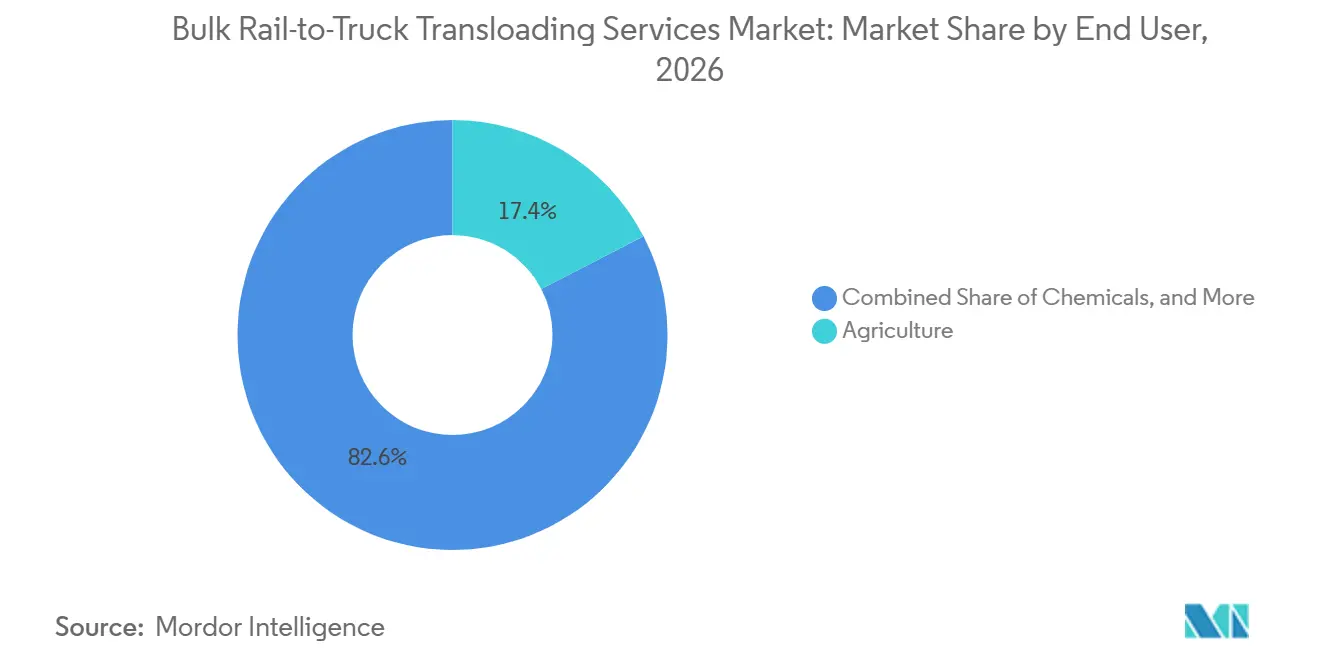
- By end user, agriculture led with 17.40% of the bulk rail-to-truck transloading services market share in 2026, while chemicals are forecast to expand at a 7.71% CAGR through 2032.
- By geography, North America led with 36.35% revenue share in 2026, while Asia-Pacific is forecast to expand at a 7.78% CAGR through 2032.
Note: Market numbers in this report are based on Mordor Intelligence's proprietary estimation framework, which combines nine months of actuals with Q4 projections for base year 2026.
Global Bulk Rail-to-Truck Transloading Services Market Trends and Insights
Drivers Impact Analysis*
| Driver | (~) % Impact on CAGR Forecast | Geographic Relevance | Impact Timeline |
|---|---|---|---|
| Long-Haul Rail Cost Advantage and Truck Last-Mile Flexibility | +1.8% | Global | Short term (≤ 2 years) |
| Limited Direct Rail Access at Origin and Destination | +1.4% | Global | Medium term (2-4 years) |
| Truck Capacity Tightness and Higher Road-Haul Costs | +0.9% | North America and Europe | Short term (≤ 2 years) |
| Nearshoring and Cross-Border Bulk Freight Growth | +0.8% | North America and Asia-Pacific spillover | Medium term (2-4 years) |
| Underused Short-Line Capacity as a Transload Catchment Asset | +0.6% | North America and Europe | Medium term (2-4 years) |
| Rail-to-Truck Decarbonization Requirements for Scope 3 Freight | +0.4% | Global | Long term (≥ 4 years) |
| Source: Mordor Intelligence | |||
Long-Haul Rail Cost Advantage Combined with Truck Last-Mile Flexibility
The bulk rail-to-truck transloading services market relies on rail for the long portion of a shipment and trucks for collection or final delivery. Rail rates adjusted for inflation were 46% lower in 2025 than in 1981, based on Surface Transportation Board revenue-per-ton-mile data cited by the Association of American Railroads. Rail rates also remained essentially flat during the prior 5 years, unlike trucking rates that respond quickly to fuel costs and driver availability. Freight rail moved 1 ton nearly 500 miles per gallon of fuel on average and was 3 to 4 times more fuel-efficient than trucking. The economic case is strongest for bulk moves above 500 miles, especially from inland production areas to export or coastal destinations. The Federal Railroad Administration reported that bulk commodities accounted for 52% of rail freight carloads, which gave transload terminals a consistent base of suitable freight across agricultural, mining, construction, and energy supply chains.
Limited Direct Rail Access at Origin and Destination
The bulk rail-to-truck transloading services market serves facilities that do not have private rail sidings. The United States freight network covered nearly 140,000 route miles through 6 Class I railroads, 22 regional railroads, and 584 local and short-line railroads, but many industrial and agricultural sites remained outside direct rail access.[1] These shippers must use truck-only freight or use a terminal to access rail for the main line haul. Building a rail spur or moving an operating site requires significant capital, which supports demand at established terminals. The Congressional Research Service estimated that as many as 23 million truckloads of intermodal-compatible freight moving 250 to 750 miles could shift from truck-only transport if shippers chose to do so, where terminals could provide needed rail access. Federal funding for a planned rail-served facility in Stafford County, Kansas, showed that public programs also recognized the access gap.
Truck Capacity Tightness and Elevated Road-Haul Costs
The bulk rail-to-truck transloading services market becomes more competitive when road-haul capacity tightens. The American Trucking Associations reported that trucking capacity had fallen by more than 10% from 2022 levels by late 2025 as higher operating costs and weak freight rates pressured smaller carriers. Federal enforcement actions involving non-domiciled commercial driver’s licenses added near-term uncertainty for driver availability in 2025. Per-mile trucking costs rose faster than inflation even while freight rates remained subdued, which increased pressure on fleet margins. Rail-linked terminals can reduce the road distance required for heavy and non-time-sensitive freight. Existing facilities are positioned to capture demand when shippers seek capacity during a recovery in truck rates, especially where loads can be consolidated at rail-served sites.
Nearshoring and Cross-Border Bulk Freight Growth
The bulk rail-to-truck transloading services market has received support from manufacturing investment in Mexico and cross-border supply chains. Trucks carried USD 450 billion of goods across the United States-Mexico border in 2025, compared with USD 350 billion in 2019.[2] Foreign direct investment in Mexico reached USD 21.4 billion in the first quarter of 2025, 5.4% above the first quarter of 2024. New automotive component, chemical, construction material, and consumer goods plants need inbound materials and outbound logistics when location choices prioritize labor access and customer proximity. CPKC’s single-line network connected Canada, the United States, and Mexico across more than 20,000 route miles. Bilateral United States-Mexico freight reached USD 71.1 billion in November 2025, supporting terminal demand near Texas and California gateway corridors.
Restraints Impact Analysis*
| Restraint | (~) % Impact on CAGR Forecast | Geographic Relevance | Impact Timeline |
|---|---|---|---|
| High Terminal, Track, and Specialized Equipment Capital Requirements | -0.8% | Global | Long term (≥ 4 years) |
| Rail Service Variability, Dwell, and Network Bottlenecks | -0.6% | North America and the Asia-Pacific core | Medium term (2-4 years) |
| Seasonal Volume Imbalance and Commodity Concentration | -0.4% | North America and South America | Short term (≤ 2 years) |
| Hazardous-Material, Environmental, and Food-Grade Compliance Costs | -0.3% | Global | Medium term (2-4 years) |
| Source: Mordor Intelligence | |||
Rail Service Variability, Dwell, and Network Bottlenecks
The bulk rail-to-truck transloading services market depends on predictable railcar delivery and truck dispatch windows. The Surface Transportation Board introduced mandatory service reporting for Class I railroads because service reliability had become a concern for customers and terminals.[3] Leading Class I railroads recorded manifest on-time arrival rates from 84% to 89% in the first quarter of 2025. That range left 11% to 16% of shipments outside scheduled arrival windows. Unplanned dwell can create holding costs and affect labor, yard, and truck scheduling. In September 2025, the board proposed reporting of original estimated time of arrival and industry spot and pull metrics to strengthen visibility of first- and last-mile service. The data can improve oversight, but it does not fully remove operational uncertainty for terminals handling time-sensitive freight or working with limited truck fleets.
Hazardous-Material, Environmental, and Food-Grade Compliance Costs
The bulk rail-to-truck transloading services market has additional compliance costs when facilities handle hazardous or food-grade cargo. Liquid chemicals need certified equipment, routing analysis, emergency response plans, and documented handling practices. The Pipeline and Hazardous Materials Safety Administration regulates hazardous-material transportation under 49 CFR Parts 171 through 180.[4] Food and grain terminals may require inspection and quality controls. CPKC’s Schiller Park facility provides on-site USDA and Federal Grain Inspection Service support for food-grade and agricultural flows. These requirements raise costs but also favor experienced operators who can offer compliant, specialized services, staff training, and detailed operating procedures.
*Our forecasts treat driver/restraint impacts as directional, not additive. The impact forecasts reflect baseline growth, mix effects, and variable interactions.
Segment Analysis
By service: Core handling anchors share, value-added capabilities lead growth
Railcar unloading and truck loading held 43.25% of the bulk rail-to-truck transloading services market share in 2026. The service is the standard terminal activity across commodity and customer groups in the bulk rail-to-truck transloading services industry. Operators unload hopper cars, tank cars, or other rail equipment and transfer freight into truck trailers or tankers. Rail spur access, truck turnaround time, throughput, and available acreage determine facility performance.
Other value-added services are projected to register a 7.29% CAGR through 2032 in the bulk rail-to-truck transloading services market. Bulk material transfer and handling include conveying, pumping, and conditioning for food-grade grain, liquid fertilizer, and chemicals. Temporary storage and staging separate rail arrival times from truck dispatch schedules. Blending, testing, repackaging, and labeling allow facilities to perform a broader supply chain role. CPKC’s Schiller Park inspection services illustrate how compliance support can extend a terminal service offer.

By commodity type: Dry bulk anchors volume, liquid bulk shifts the growth vector
Dry bulk accounted for 78.10% of the bulk rail-to-truck transloading services market size in 2026. Grain, coal, aggregates, cement, fertilizer, and sand fit rail’s high-volume transport economics. Bulk commodities made up 52% of rail freight carloads, supporting the segment’s large installed base. The 2025 harvest placed significant demand on agricultural transload facilities across the Midwest.
Liquid bulk is forecast to register a 7.53% CAGR through 2032 in the bulk rail-to-truck transloading services market. Petrochemical expansion, biofuel production, and nearshored specialty chemical manufacturing support this growth. Liquid terminals need insulated or heated tanks, pumps, and hazardous-material compliance systems. Break-bulk and project bulk cover steel coils, lumber, large equipment, and comparable cargo. Their activity is linked to construction and capital goods investment, while transport-chain emissions accounting encourages documented modal choices.
By end user: Agriculture leads volume, chemicals drive the fastest expansion
Agriculture held 17.40% of the bulk rail-to-truck transloading services market share in 2026. United States grain production is concentrated in the Midwest and Great Plains, where many facilities lack direct rail access. Transloading enables grain marketers to use rail for the long haul and trucks for delivery to ethanol plants, mills, and export elevators. Mining and metals also generate volumes from iron ore, copper concentrates, potash, steel products, and industrial minerals.
Chemicals are projected to register a 7.71% CAGR through 2032, the highest rate among end users in the bulk rail-to-truck transloading services market. Construction uses terminals to move aggregates, cement, and fly ash to locations without direct rail service. Nearshored specialty chemicals, fertilizer flows, and biofuel feedstocks support that expansion. Hazardous-material rules reward specialists with suitable equipment and planning systems. Energy, food and beverage, manufacturing, and other industries add carloads as sourcing patterns change.
Geography Analysis
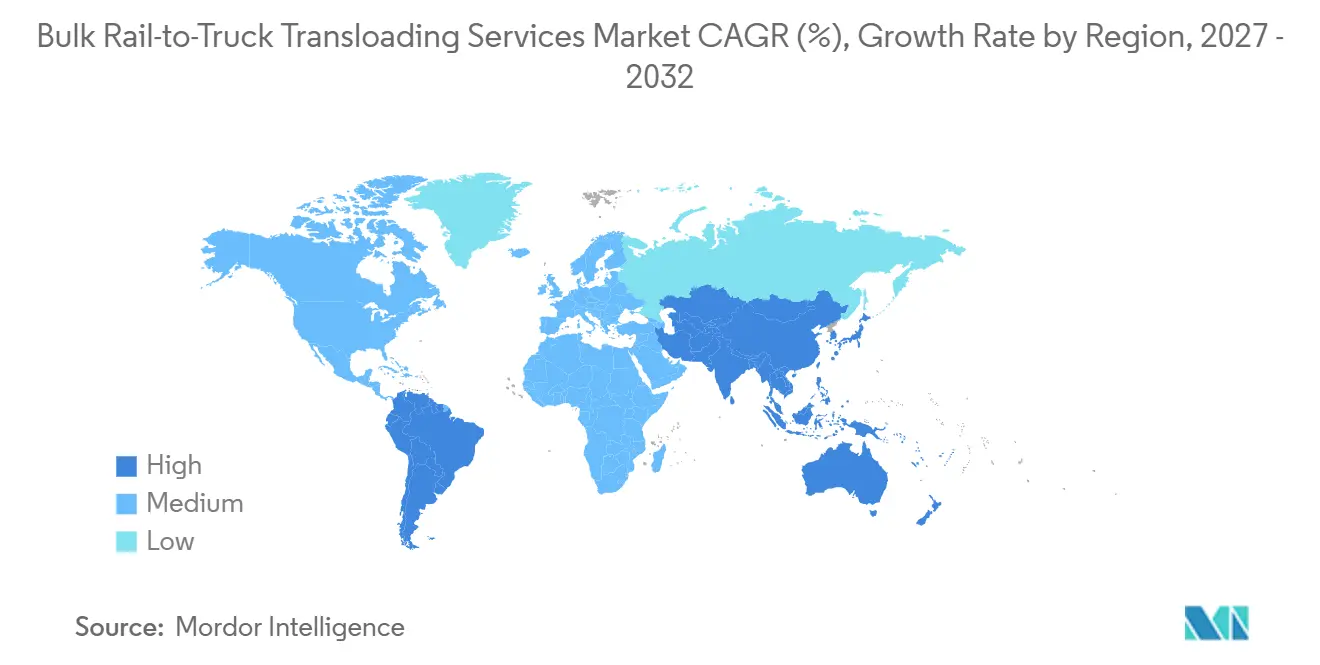
North America held 36.35% of the bulk rail-to-truck transloading services market size in 2026. The region combines extensive Class I rail coverage, large agricultural and industrial production areas, and established terminal investment. The United States network covered nearly 140,000 route miles and included 584 short-line and local railroads. Canada adds mining and agricultural freight through Alberta, the Prairie provinces, and forestry corridors. Mexico strengthens regional demand through supply chain integration, and the United States-Mexico freight is valued at USD 71.1 billion in November 2025.
Asia-Pacific is forecast to register a 7.78% CAGR through 2032, the fastest regional rate. Europe is shaped by Germany’s industrial base, Nordic forestry corridors, and port-linked materials handling. The United Kingdom, France, Italy, and Spain use terminals for port access, construction materials, and agricultural freight. Russia’s 2025 network redirection pressures changed some commodity freight patterns. India’s rail plans, China’s multimodal investment, Australian export flows, and Southeast Asian industrialization support the regional outlook.
South America is centered on Brazil’s soybean and grain corridors and Chile’s mining products. Argentina and Peru add mineral and agricultural volumes, while other countries have early-stage mining and lithium activity. Gulf Cooperation Council states are the center of Middle East and Africa demand because industrial diversification supported bulk-handling investment in 2025. South Africa’s export corridors and Nigeria’s agricultural logistics network provide longer-term opportunities.
Competitive Landscape
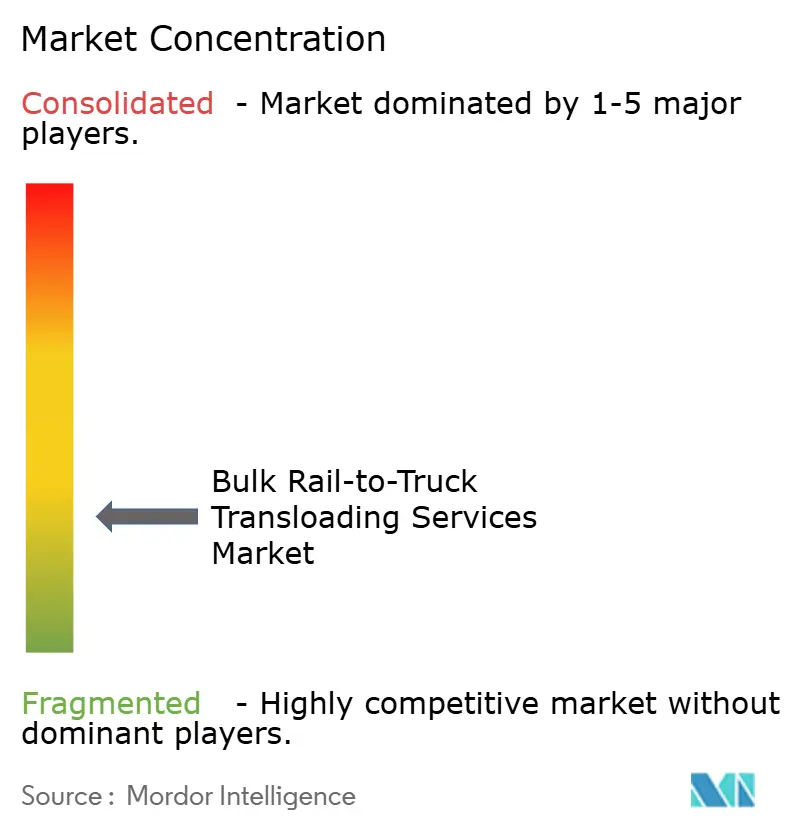
The bulk rail-to-truck transloading services market is fragmented because leading operators have strong regional positions but not a full global footprint. Loup Logistics and BNSF operations compete with Watco, Genesee & Wyoming, and Savage through network access, specialization, and rail corridor relationships. CRMS, RSI Logistics, OmniTRAX, Patriot Rail, and Travero provide localized services, often around a specific corridor or cargo type. Facility location, rail access, and available equipment create meaningful local advantages. The bulk rail-to-truck transloading services market rewards operators that match terminal capabilities to customer freight needs.
Operators use inventory systems, railcar visibility tools, and scheduling platforms to improve equipment use and customer communication. USD Partners announced the expected sale of its Hardisty Rail Terminal in January 2025 as pipeline alternatives were developed. This created potential for operators that diversify toward liquid chemicals, biofuels, and base chemicals. Watco received more than USD 600 million of minority equity investment in June 2025 to support expansion. The investment supported Watco’s full ownership of Industrial Rail Services assets at 6 Dow Chemical facilities.
BNSF and Spearpoint Logistics announced a partnership at the planned 4,500-acre Barstow International Gateway in September 2026. Norfolk Southern’s RailGreen added an emissions-related service option for freight customers. PHMSA rules and Surface Transportation Board reporting favor larger operators in specialized categories. Regional terminal networks and short-line access continue to support a broad group of providers.
Bulk Rail-to-Truck Transloading Services Industry Leaders
-
Union Pacific Railroad
-
BNSF Railway
-
CSX Transportation
-
Norfolk Southern Railway
-
Canadian National Railway
- *Disclaimer: Major Players sorted in no particular order
Recent Industry Developments
- September 2026: BNSF Railway and Spearpoint Logistics announced a strategic partnership at Barstow International Gateway in Barstow, California. The partnership integrates rail, logistics, and distribution capabilities at BNSF’s planned 4,500-acre facility designed to shift international freight to domestic containers and provide transload warehouse access.
- August 2026: The Surface Transportation Board adopted a procedural schedule for consideration of the Union Pacific and Norfolk Southern revised merger application. The proposed USD 85 billion combination will operate across 43 states and cover 52,215 route miles, with a target closing in mid-2027.
- June 2026: BNSF Railway received city council approval in Barstow, California, for its USD 4 billion Barstow International Gateway intermodal and transloading hub. NFI Industries was named as an initial logistics partner.
- February 2026: CPKC launched its Schiller Park multi-commodity transload facility near its Bensenville intermodal hub in the Chicago metropolitan area. The site handles agricultural products, steel, lumber, and free-flowing goods and provides on-site USDA and FGIS inspection services.
Global Bulk Rail-to-Truck Transloading Services Market Report Scope
| Railcar Unloading and Truck Loading |
| Bulk Material Transfer and Handling |
| Temporary Storage and Staging |
| Other Value-Added Services |
| Dry Bulk |
| Liquid Bulk |
| Break-Bulk and Project Bulk |
| Agriculture |
| Mining and Metals |
| Construction |
| Chemicals |
| Energy |
| Food and Beverage |
| Manufacturing |
| Other Industries |
| North America | United States |
| Canada | |
| Mexico | |
| South America | Brazil |
| Argentina | |
| Peru | |
| Chile | |
| Rest of South America | |
| Europe | Germany |
| United Kingdom | |
| France | |
| Italy | |
| Spain | |
| Russia | |
| Nordics (Denmark, Finland, Iceland, Norway, and Sweden) | |
| Rest of Europe | |
| Asia-Pacific | China |
| India | |
| Japan | |
| South Korea | |
| Australia | |
| Southeast Asia (ASEAN) | |
| Rest of Asia-Pacific | |
| Middle East and Africa | Saudi Arabia |
| United Arab Emirates | |
| Qatar | |
| South Africa | |
| Nigeria | |
| Egypt | |
| Rest of Middle East and Africa |
| By Service | Railcar Unloading and Truck Loading | |
| Bulk Material Transfer and Handling | ||
| Temporary Storage and Staging | ||
| Other Value-Added Services | ||
| By Commodity Type | Dry Bulk | |
| Liquid Bulk | ||
| Break-Bulk and Project Bulk | ||
| By End User | Agriculture | |
| Mining and Metals | ||
| Construction | ||
| Chemicals | ||
| Energy | ||
| Food and Beverage | ||
| Manufacturing | ||
| Other Industries | ||
| By Geography | North America | United States |
| Canada | ||
| Mexico | ||
| South America | Brazil | |
| Argentina | ||
| Peru | ||
| Chile | ||
| Rest of South America | ||
| Europe | Germany | |
| United Kingdom | ||
| France | ||
| Italy | ||
| Spain | ||
| Russia | ||
| Nordics (Denmark, Finland, Iceland, Norway, and Sweden) | ||
| Rest of Europe | ||
| Asia-Pacific | China | |
| India | ||
| Japan | ||
| South Korea | ||
| Australia | ||
| Southeast Asia (ASEAN) | ||
| Rest of Asia-Pacific | ||
| Middle East and Africa | Saudi Arabia | |
| United Arab Emirates | ||
| Qatar | ||
| South Africa | ||
| Nigeria | ||
| Egypt | ||
| Rest of Middle East and Africa | ||
Key Questions Answered in the Report
What is the projected value of bulk rail-to-truck transloading services by 2032?
The sector is forecast to reach USD 5.35 billion by 2032, rising from USD 4.04 billion in 2027 at a 5.79% CAGR.
Why do shippers use rail-to-truck transloading?
It combines rail economics for long moves with truck access for locations without private rail sidings.
Which service category held the largest share in 2026?
Railcar unloading and truck loading led the service mix with 43.25% revenue share in 2026.
Which commodity type is growing fastest through 2032?
Liquid bulk is forecast to register a 7.53% CAGR, supported by chemical, biofuel, and petrochemical activity.
Which end user is expanding fastest?
Chemicals are projected to record a 7.71% CAGR through 2032, led by specialty chemicals, fertilizer flows, and biofuel feedstocks.
Which region has the fastest projected growth?
Asia-Pacific is forecast to register a 7.78% CAGR through 2032, supported by rail and multimodal infrastructure development.