
Brazil Tractors Market Size and Share
Market Overview
| Study Period | 2020 - 2031 |
|---|---|
| Forecast Data Period | 2026 - 2031 |
| Base Year Market Size (2025) | USD 1.83 Billion |
| Market Size (2026) | USD 1.88 Billion |
| Market Size (2031) | USD 2.12 Billion |
| Growth Rate (2026 - 2031) | 2.48 % |
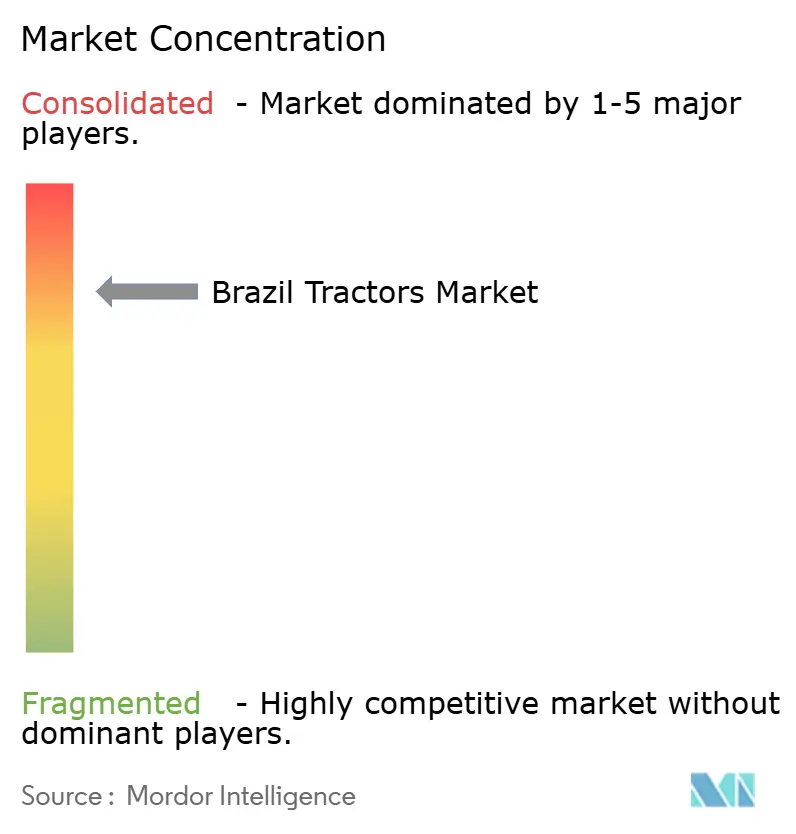
| Market Concentration | High |
Major Players *Disclaimer: Major Players sorted in no particular order Image © Mordor Intelligence. Reuse requires attribution under CC BY 4.0. | |
Brazil Tractors Market Analysis by Mordor Intelligence
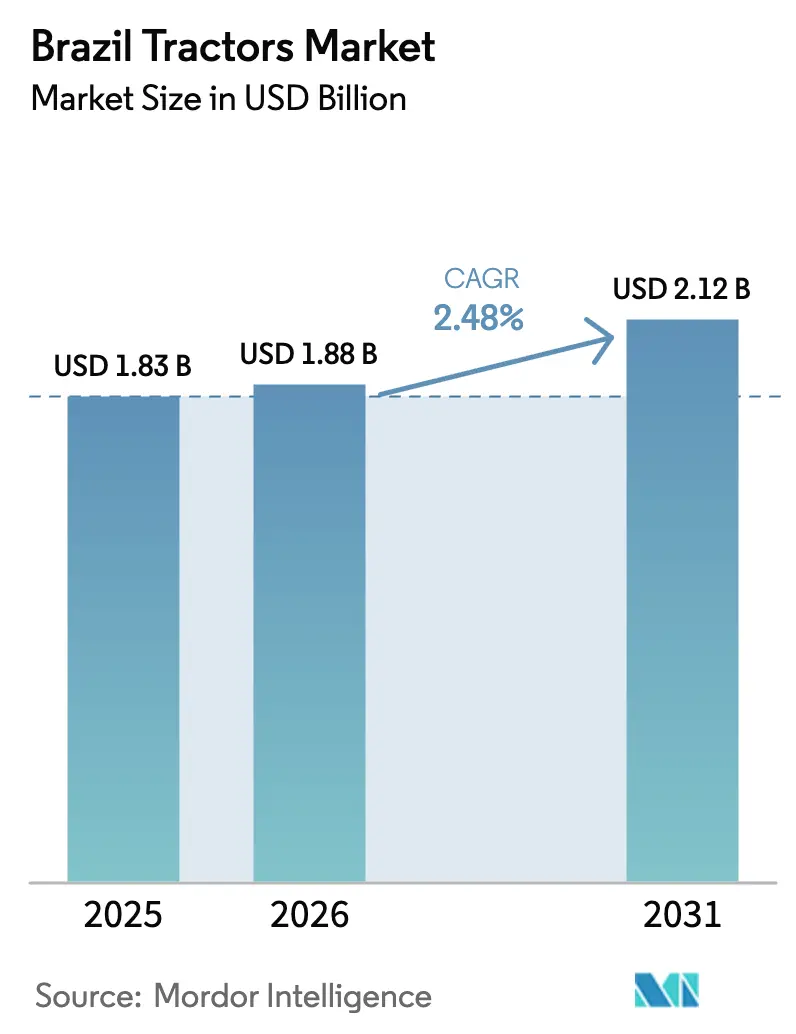
Brazil tractor market size in 2026 is estimated at USD 1.88 billion, growing from 2025 value of USD 1.83 billion with 2031 projections showing USD 2.12 billion, growing at 2.48% CAGR over 2026-2031. Demand growth rests on the country’s stature as South America’s largest agricultural economy and status as a top global food exporter. Widespread adoption of precision agriculture, the continued advance of large-scale farming in the Cerrado, and the spread of embedded-finance offerings reshape equipment procurement. At the same time, credit cost volatility and tariff structures that favor local assembly temper spending and keep the growth curve modest. Structural change is already evident in horsepower, drive-type, and power-source choices, indicating that the Brazil tractor market is evolving toward higher-capacity, digitally enabled machinery while retaining a deep base of low-horsepower units suited to smallholders.
Key Report Takeaways
- By horsepower, below-40 HP units led with 47.62% of Brazil tractor market share in 2025, whereas above-140 HP tractors are projected to expand at 6.93% CAGR through 2031.
- By drive type, Two-Wheel Drive systems held 62.41% of the Brazil tractor market in 2025, yet Four-Wheel Drive is the fastest-growing segment, with a 7.42% CAGR to 2031.
- By application, row-crop configurations captured a 56.88% revenue share in 2025; the fully electric retrofit subsegment is poised for a 8.71% CAGR to 2031.
- By fuel type, diesel models accounted for 88.74% of the Brazil tractor market size in 2025, though electric variants are set to grow at 9.06% CAGR.
- Mechanical gearboxes accounted 63.66% of the Brazil tractor market sales in 2025, whereas CVT and hydrostatic models are growing at 8.24% CAGR by 2031.
- By region, the South commanded 33.84% share of the Brazil tractor market size in 2025, while the Central-West is forecast to post a 5.93% CAGR to 2031.
Note: Market size and forecast figures in this report are generated using Mordor Intelligence’s proprietary estimation framework, updated with the latest available data and insights as of 2026.
Worldwide, activity is shaped by contributions from multiple countries and regions, with Brazil representing one among them. The global report on tractor market by Mordor Intelligence reflects how these countries and regional layers combine into a single system.
Brazil Tractors Market Trends and Insights
Drivers Impact Analysis*
| Driver | (~) % Impact on CAGR Forecast | Geographic Relevance | Impact Timeline |
|---|---|---|---|
| Rising Adoption of Precision-ag Mechanisation | +0.8% | South, Southeast, Central-West | Medium term (2-4 years) |
| Expansion of Large-Scale Cash-Crop Farms in Carrado | +0.6% | Central-West, North | Long term (≥ 4 years) |
| OEM Embedded-Finance Models Lowering Up-Front Cost | +0.5% | National | Medium term (2-4 years) |
| Integration of Telematics and Remote Diagnostics | +0.4% | South, Southeast | Short term (≤ 2 years) |
| Growth in Biomethane and Hybrid Tractor Pilots | +0.3% | South, Central-West | Long term (≥ 4 years) |
| Carbon-Credit Revenue Streams for Low-HP Electric Tractors | +0.2% | South, Southeast | Long term (≥ 4 years) |
| Source: Mordor Intelligence | |||
Rising Adoption of Precision-Ag Mechanisation
Connectivity partnerships between equipment makers and satellite providers are closing Brazil’s rural internet gap and lifting demand for sensor-equipped tractors. CNH Industrial’s deal with Intelsat enables satellite broadband in areas where only 19% of fields have coverage[1]“CNH and Intelsat Bring Satellite Internet to Brazilian Farms,” AgWeb Staff, agweb.com. Solar-powered SOLIX field robots from Solinftec add real-time weed detection without continuous connectivity[2]“Solar-Powered SOLIX Robot Targets Herbicide Reduction,” AgroPages Editorial, agropages.com. Bosch’s R $700 million smart-farming outlay in Campinas, backed by Finep and BNDES, will deepen local R&D capability. These moves accelerate precision-ag take-up, encouraging upgrades toward tractors with advanced guidance and data-logging features across the Brazilian tractor market.
Expansion of Large-Scale Cash-Crop Farms in Cerrado
Soybean output in the Cerrado climbed from under 1 million t in 1974 to more than 56 million t, reflecting government research and land-use policy that turned acidic savanna soils into productive farmland. The 70 million acres of degraded pasture can still be used for crops, mostly in Mato Grosso, Goiás, and Mato Grosso do Sul. Such expansion calls for high-horsepower units and large implements to work wide tracts efficiently. Consequently, demand for above-140 HP tractors in the Brazilian market continues to exceed the average.
OEM Embedded-Finance Models Lowering Up-Front Cost
Manufacturers increasingly blend equipment sales with in-house credit. John Deere’s venture with Bradesco links a R$17.4 billion agribusiness loan book to branded machinery finance, shielding farmers from soaring Selic rates[3]“Bradesco Acquires Stake in Banco John Deere,” Valor Econômico Reporters, valor.com.br. Similar offerings by CNH Capital and AGCO Finance smooth cash-flow pressures after the 2024 pause in federal subsidies. Flexible financing expands the reachable customer base, particularly among family farms in the South and Southeast, supporting steady turnover of mid-horsepower machines across the Brazil tractor market.
Integration of Telematics and Remote Diagnostics
John Deere’s R $180 million innovation center focuses on low-connectivity telematics suited to Brazil’s vast interior. AGCO’s FarmerCore mobile store pilot in Paraná leverages connected machines to schedule preventive maintenance visits[4]“John Deere Opens Innovation Hub in SP,” Estadão Conteúdo, estadao.com.br. Predictive diagnostics limit downtime during peak planting and harvest, providing tangible ROI for premium tractor models. As dealers roll out subscription-based support, telematics capabilities become a major purchase criterion, nudging farmers toward newer units within the Brazil tractor market.
Restraints Impact Analysis*
| Restraint | (~) % Impact on CAGR Forecast | Geographic Relevance | Impact Timeline |
|---|---|---|---|
| Volatile Selic-Linked Credit Costs Post-2024 Subsidy Pause | -0.9% | National | Short term (≤ 2 years) |
| High Import Tariffs on Power-train Components | -0.4% | National | Medium term (2-4 years) |
| Dealer-Network Gaps in North and Northeast Regions | -0.3% | North, Northeast | Medium term (2-4 years) |
| Safety Non-Compliance Among Low-Cost Grey-Market Imports | -0.2% | National | Long term (≥ 4 years) |
| Source: Mordor Intelligence | |||
Volatile Selic-Linked Credit Costs Post-2024 Subsidy Pause
Suspension of new federally subsidized Crop Plan loans and a Selic jump to 13.25% raised borrowing costs, stalling nearly R$50 billion of agricultural funding. Only PRONAF programs remain, preserving R$5.6 billion for smallholder lending. With many farmers delaying equipment replacement, short-term demand in the Brazil tractor market has softened, especially for mid-size models.
High Import Tariffs on Power-Train Components
Import duty, IPI, and ICMS taxes can add 30% or more to the landed cost of advanced engines and transmissions[5]“Brazil – Agricultural Equipment Import Duties,” International Trade Administration, trade.gov. While ex-tariff waivers exist, approval delays deter rapid technology refresh. Local-content mandates tied to BNDES credit further complicate sourcing. The result is slower diffusion of high-spec drivetrains within the Brazil tractor market and persistent price gaps versus imported machinery.
*Our forecasts treat driver/restraint impacts as directional, not additive. The impact forecasts reflect baseline growth, mix effects, and variable interactions.
Segment Analysis
By Horsepower: Demand Splits Between Family Farms and Large Estates
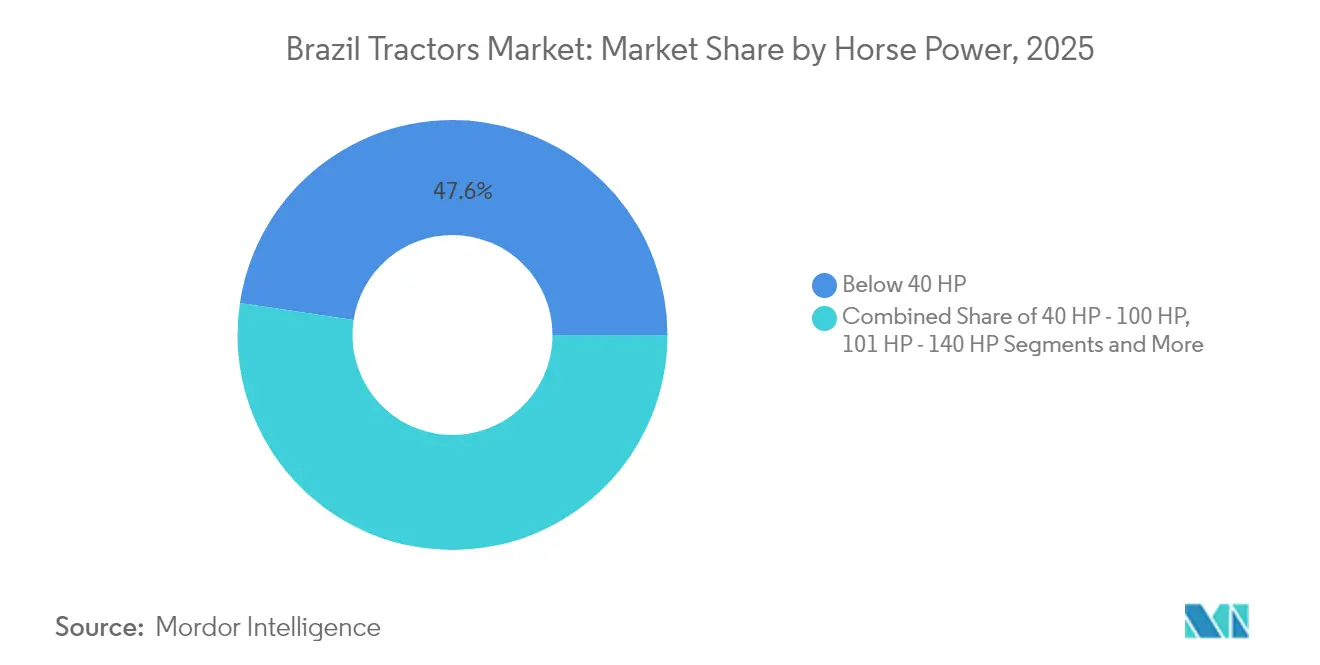
Below-40 HP units held 47.62% of the Brazil tractor market share in 2025, serving smallholders who grow diversified crops on limited acreage. In value terms, this bracket anchors recurring revenue as replacement cycles average 15 years. Mid-range 40–100 HP models form the core equipment pool for mixed-grain farms in the South and Southeast. Above-140 HP machines represented a smaller base but posted the fastest growth at 6.93% CAGR, fueled by Cerrado grain estates expanding double-cropping.
Precision guidance, variable-rate seeding, and high-capacity planters pull demand toward stronger tractors on frontier farms. Conversely, compact 20–70 HP 4WD tractors launched under Mahindra’s OJA platform target orchard and vegetable growers seeking maneuverability and lower total cost Mahindra. Such divergence underscores a two-speed Brazil tractor market where power needs and affordability define purchase choices. Spending constraints amid elevated interest rates could extend the life of under-40 HP fleets, yet operational scale economics favor continued up-take of premium power units among commercial crop producers.



By Drive Type: Four-Wheel Drive Gains Traction on Challenging Terrain
Two-Wheel Drive retained 62.41% of Brazil's tractor market share in 2025, mainly in the South and coastal Southeast, where soils are deep and field slopes are gentle. Adoption, familiarity, and lower purchase price keep replacement demand steady. Four-Wheel Drive’s 7.42% CAGR through 2031 mirrors land conversion in the Central West, North, and parts of the Northeast, where sandier soils and rolling ground demand extra traction.
Front-axle assist systems paired with higher horsepower enable wider implements, cutting passes per field, and saving diesel. OEMs now offer entry-level 4WD packages on 75–120 HP chassis, helping small growers accelerate the technology curve. Regional mechanization studies show large farms already operate with high tech adoption, while many small farms still lack 4WD access, SciELO. Dealer pilots that bundle tires, GPS kits, and remote support aim to shrink that gap, gradually shifting the drive-type mix across the Brazil tractor market.
By Application: Row-Crop Dominance Meets Electric Retrofit Potential
Row-crop units secured a 56.88% share in 2025, reflecting soybeans, corn, and cotton’s central role in export earnings. Orchard and specialty tractors carve out a resilient niche in citrus and coffee belts where canopy clearance and turning radius matter. Though starting from a low base, fully electric retrofit kits are forecast to rise at 8.71% CAGR, propelled by carbon-credit revenue and battery subsidy pilots.
Municipalities are also testing electric conversions for light-duty utility work. With its Fendt e100 Vario proof-of-concept, OEMs such as AGCO illustrate growing confidence in battery technology. If charging infrastructure expands alongside rural solar micro-grids, electric solutions could reach a tipping point in low-horsepower segments of the Brazilian tractor market
By Fuel Type: Diesel Still Rules, but Alternatives Gain Policy Tailwind
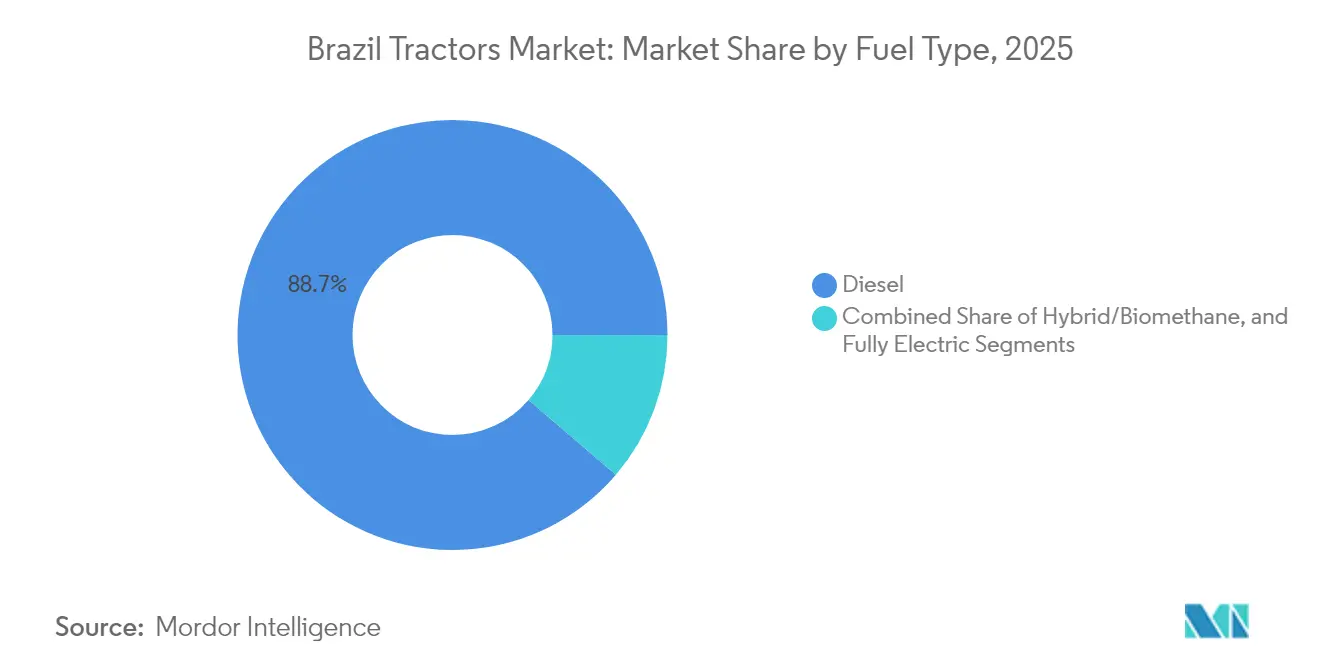
Diesel engines powered 88.74% of tractors sold in 2025, a share that underscores mature supply chains and robust torque delivery. Yet, electric, hybrid, and biomethane formats collectively are progressing at 9.06% CAGR. RenovaBio certificates and sugarcane-linked biomethane prospects give Brazil a unique platform for low-carbon mechanisation. Combined with investment in green hydrogen pilot plants at sugar mills, stakeholders anticipate alternative fuel penetration first in fleets that log predictable daily hours close to biofuel supply points.
Case IH’s Sorocaba hub will build energy-transition tractor lines for global markets, confirming Brazil’s role as a testbed. As battery pack prices trend down and carbon accounting tightens, the proportion of non-diesel units in the Brazil tractor market is set to climb, albeit from a low starting base.
By Transmission Type: Mechanical Simplicity Faces CVT Uptake
Mechanical gearboxes commanded 63.66% of sales in 2025, valued for durability and easy servicing in regions with sparse technicians. Still, CVT and hydrostatic models are growing at 8.24% CAGR, largely in tractors above 117 kW where fuel savings and operator comfort justify price premiums. The Brazil tractor market size tied to CVT systems is anticipated to double by 2031, aided by manufacturer financing bundles that highlight lower life-cycle costs.
Semi-powershift remains popular in mid-range tractors where farmers desire speed matching without the full CVT investment. CVT capability gains traction as precision planting relies on constant speed under variable load. However, after-sales logistics and spare-parts tariffs remain barriers to widespread conversion, reinforcing mechanical dominance across volume segments of the Brazil tractor market.
Geography Analysis
The South captured 33.84% of the Brazil tractor market in 2025, drawing on entrenched mechanisation and a dense dealer network in Rio Grande do Sul, Paraná, and Santa Catarina. Replacement demand for under-100 HP models predominates, yet farms increasingly experiment with telematics retrofits as mobile coverage improves. The Southeast sustains diversified equipment needs ranging from sugarcane row-crop tractors to orchard units for coffee and citrus. Availability of turnkey finance via regional banks supports the Brazil tractor market size in this zone, even under tighter national credit conditions.
The Central-West leads growth at 5.93% CAGR to 2031 as Mato Grosso and Goiás extend double-crop rotations. Large estates incorporate above-140 HP 4WD tractors to handle expansive grain fields, pushing the region’s share of Brazil tractor market size higher each year. Frontier states in the North, including Pará and Rondônia, show rising uptake tied to pasture conversion programs, though logistical hurdles keep absolute volumes modest. Dealer-network rollouts and satellite service facilities aim to close service gaps that currently suppress sales.
The Northeast remains under-mechanised, relying heavily on manual labor and small animal traction despite irrigation projects that improve farm viability. Climate variability and fragmented landholding patterns limit purchase scale. However, targeted PRONAF loans help family farms acquire compact 4WD units, creating an entry market for budget-oriented brands. Nationwide, geographic disparities in tractor density mirror broader socio-economic divides, ensuring that region-specific product-service bundles stay central to Brazil tractor market strategy.
Regulatory Landscape
Brazil tractors are shaped by industrial policy, credit-linked localization requirements, and technical compliance overseen by federal bodies such as MAPA and INMETRO. On the demand side, the Plano Safra 2026/2027 reinforces mechanization priorities and links modernization to science and innovation, while programs such as Move Brasil earmark credit for machinery purchases, affecting OEM pricing and dealer financing structures.
On the compliance side, MAPA has tightened controls around machinery movements and used equipment hygiene, including Portaria SDA/MAPA No. 1.580/2026 on phytosanitary transit requirements for used agricultural machines (cleanliness and inspection readiness). In parallel, INMETRO updates to mandatory certification requirements for imported agricultural machinery, including EMC and ingress protection criteria, set an October 2026 compliance milestone cited in industry evidence. These requirements raise the bar for imported units and can favor locally assembled configurations that align more easily with Brazilian conformity assessment processes.
Value Chain Analysis
The Brazil tractor value chain relies on both imported and locally sourced inputs, domestic assembly by major OEMs such as AGCO and CNH Industrial (along with local manufacturers), dealer distribution, and a broad aftermarket for parts and service. Industry evidence points to roughly 50% domestic content for key players, but continued dependence on imported engines, transmissions, and higher-tech subsystems keeps cost structures sensitive to exchange-rate swings and import frictions, particularly for premium drivetrains and electronics.
Downstream, dealers and OEM finance arms drive conversion by bundling equipment with credit and service plans, while the aftermarket supports older fleets with longer replacement cycles. In volume terms, wholesale sales were cited at 44,500 units in 2025, and trade flows show structural exposure to imports, with industry evidence indicating imports exceeded exports at 11,000 units imported versus 6,300 exported in 2025. Taken together, this reinforces the strategic importance of local manufacturing footprints, parts localization, and service coverage to limit downtime and manage total cost of ownership across Brazilian regions.
Competitive Landscape
The Brazilian tractor market exhibits moderate concentration. John Deere surged ahead after investing R$700 million to localize high-tech models and secure supply resilience. CNH Industrial follows, leveraging its Sorocaba expansion and dual brand (Case IH and New Holland) strategy to deepen reach. AGCO slipped to third due to gaps in mid-hp 4WD offerings, prompting its FarmerCore satellite store initiative to regain share.
High fixed capacity and soft short-term demand heighten price competition, especially in the 75–125 HP ranges. Precision technology ecosystems emerge as the new battleground. CNH’s stake in Bem Agro bolsters AI imagery for sugarcane and grain management. Deere’s Operations Center integrates field data into financing decisions, creating a service moat. Smaller local assemblers concentrate on under-40 HP niches, often courting family farms with aggressive pricing, but struggle with safety compliance, exposing them to regulatory fines.
Embedded finance partnerships give large OEMs an edge while dealers test subscription models, bundling telematics, maintenance, and upgrade pathways. Start-ups like Solinftec position autonomous field robots as complementary tools rather than outright tractor replacements, adding pressure on incumbents to differentiate. Overall competitive dynamics indicate that technology depth, financing reach, and rural service density will dictate share shifts within the Brazil tractor market through 2030.
Brazil Tractors Industry Leaders
Deere & Company
CNH Industrial
AGCO
Kubota Corporation
Mahindra & Mahindra Ltd.
- *Disclaimer: Major Players sorted in no particular order

Market Opportunities and Future Outlook
Policy-anchored credit and modernization programs create space for OEMs and dealers to shape offers around segmented farm economics, especially where interest rates constrain traditional purchasing. The 2026/2027 Plano Safra allocates R$ 525.1 billion in agricultural credit, and Move Brasil sets aside R$ 10 billion specifically for machinery and equipment, supporting programs that link equipment upgrades to productivity and technology adoption. With Pronaf cited in industry evidence at 5% interest versus Moderfrota at 13.5%, there is room for targeted product and financing bundles aimed at two different customer needs: compact and utility tractors for family farms, and higher-capacity, digitally enabled tractors for commercial producers.
Technology and compliance shifts also create opportunities across the tractor ecosystem beyond new-unit sales. MAPA phytosanitary transit controls for used machinery under Portaria SDA/MAPA No. 1.580/2026, along with tighter import compliance requirements tied to INMETRO, increases the value of certified refurbishment, inspection-ready used equipment logistics, and dealer-led aftermarket services. At the same time, OEM investment and R&D support through institutions such as BNDES, including Mais Inovacao, and the report context already pointing to telematics, remote diagnostics, and embedded finance partnerships, supports attach-rate opportunities for connectivity kits, subscription support, and precision-ag enablement on both new and existing fleets, particularly where dealer-network gaps continue to suppress uptime and adoption.
Recent Industry Developments
- April 2026: John Deere opened a new industrial facility in Canoas (Rio Grande do Sul) following an R$42 million investment to manufacture the 1025E sprayer. The localization of high-tech production strengthens supply resilience and expands domestic capacity for advanced equipment.
- April 2026: CNH Industrial secured an R$129 million financing from BNDES (Mais Inovação) for eight R&D projects in Brazil, including tractors and harvesters. The funding supports development of high-tech machinery and strengthens local capabilities and competitiveness.
- April 2026: John Deere - Opened a new industrial facility in Canoas (Rio Grande do Sul) following an R$42 million investment to manufacture the 1025E sprayer. The announcement reinforces Deere's local manufacturing footprint and supply chain resilience.


Research Methodology Framework and Report Scope
Market Definition and Coverage
For this study, the market covers tractors sold and used for farm work in Brazil, measured in value in USD, and aligned to typical demand from crop and livestock operations across the country.
Scope exclusions: We exclude construction and industrial tractors, used equipment resale, parts and service revenues, and attached implements that are sold separately from the tractor unit.
Segmentation Overview
- By Horsepower
- Below 40 HP
- 40 - 100 HP
- 101 - 140 HP
- Above 140 HP
- By Drive Type
- Two-Wheel Drive
- Four-/All-Wheel Drive
- By Application
- Row-Crop
- Orchard / Specialty
- Industrial and Other
- By Fuel / Power Source
- Diesel
- Hybrid / Biomethane
- Fully-Electric
- By Transmission Type
- Mechanical (Sync/Unsync)
- Semi-/Full Powershift
- CVT / Hydrostatic
- By Region
- South
- Southeast
- Central-West
- Northeast
- North
Data Sources, Market Sizing, and Validation
Desk Research
Desk work starts with pulling the official signals that tell us how mechanization and farm investment are moving in Brazil, and then those signals are translated into sizing inputs. We review sources such as IBGE agriculture statistics, the Ministry of Agriculture and related credit program publications, Banco Central do Brasil rate and credit conditions, and customs trade series that track tractor flows under standard product codes.
To make the numbers usable for modeling, we also use company annual reports and investor decks to understand product mix and pricing direction, along with association releases and credible press coverage of dealer activity and rural credit. When needed, paid subscriptions are used for company financials and for shipment level import and export checks so that unit and value trends can be cross-verified. The list above is illustrative only, and many other public documents and sources are also reviewed to collect data, validate assumptions, and clarify open questions.
Primary Interviews and Surveys
Primary work is used to pressure test what desk sources cannot fully explain, especially demand timing, average selling price movement, and mix shifts by horsepower and drivetrain. We speak with stakeholders across the value chain such as manufacturers, distributors and dealers, fleet owners and large farms, and independent service networks, and then we recheck assumptions with a second set of calls when inputs show wide variance.
Distribution of primary research fieldwork respondents
| Company type | Respondent position |
|---|---|
| Top tier: 27% | CXOs: 15% |
| Mid tier: 58% | Functional/Unit leaders: 27% |
| Smaller Players: 15% | Managers: 58% |
Market-Sizing & Forecasting
Sizing is built by reconstructing the demand pool from Brazil-specific machinery sales signals and farm economics, and then translating those signals into value using realistic price and mix assumptions. A top-down approach is used where unit demand is inferred from new tractor sales and replacement cycles (influenced by planted area, farm income, and subsidized credit availability), which are then converted into market value through average selling price by key tractor classes.
The totals are corroborated with selective bottom-up approximations, including sampled dealer throughput, supplier and channel checks on model mix, and unit-to-value conversions for imported tractors and locally assembled units where the data is visible. Key model inputs include annual tractor unit sales trend, horsepower mix migration, 2WD versus 4WD share shifts, rural credit disbursement and interest rate direction, and exchange rate movement that impacts pricing and import parity. For forecasting, we apply scenario analysis supported by a simple multivariate view of farm income and credit conditions, and the final path is adjusted after experts confirm what a normal ordering cycle looks like for Brazil. Where direct unit or price points are missing, gaps are handled through range-based assumptions that are anchored to adjacent years and validated through follow-up calls.
Data Validation & Update Cycle
Outputs are checked in several steps so that odd jumps do not pass through without explanation. We compare results against independent signals like reported machinery sales direction, trade movements, and credit conditions, and then investigate variances that appear too large for the known market drivers.
A second analyst review is completed before sign-off, and any key assumption that changes the size meaningfully triggers re-contact with interviewees for reconfirmation. Reports are refreshed annually, with interim updates when material events happen, and a final pre-delivery review is done so clients receive the latest updated view.
Mordor Intelligence's Brazil Tractors Market Sizing Compared With Other Published Estimates
Published market values for tractors in Brazil often do not match, even when they look like they cover the same topic, because the scope and the conversion logic are not consistent across sources. Differences usually come from what is counted as a tractor, which year is used as the base, and how unit trends are turned into USD values.
Some outside figures treat the market as import value only or apply a broad agricultural machinery umbrella that pulls in adjacent equipment. In Mordor Intelligence, the sizing is kept to tractor units sold into Brazil, with value built from unit demand and class-level pricing, and then cross-checked against credit signals and trade movements before the forecast is finalized.
Benchmark comparison
| Source | Market Size | Gaps in Research Methodology |
|---|---|---|
| Mordor Intelligence | USD 1.83 B (2025) | |
| Trade Data Monitor A | USD 0.38 B (2024) | This figure aligns to import value under tractor trade codes, which can miss locally produced and assembled tractors and can also exclude domestic channel pricing and dealer margin effects. |
| Industry Commentary B | USD 1.29 B (2023) | This estimate appears to use an earlier base year and a simplified value build that may not fully refresh for changes in horsepower mix, rural credit tightening, and USD conversion timing. |
The spread across the three numbers is mainly explained by coverage choices and how pricing is refreshed year to year. When unit demand, mix, and price drivers are kept explicit, the market total stays traceable to real purchase behavior and can be repeated and updated with the same steps.


Key Questions Answered in the Report
What is the current size of the Brazil tractor market and how fast is it growing?
The Brazil tractor market reached USD 1.88 billion in 2026 and is set to climb to USD 2.12 billion by 2031, registering a 2.48% CAGR.
Which horsepower segment is expanding most rapidly?
Tractors above 140 HP lead growth, advancing at 6.93% CAGR because large Cerrado grain farms need high-capacity machines.
How are financing conditions affecting tractor demand?
The 2024 suspension of subsidized loans and a Selic rate of 13.25% raised borrowing costs, prompting many farmers to delay purchases until credit terms stabilize.
Which region offers the strongest growth prospects?
The Central-West is forecast to log a 5.93% CAGR through 2031 as large-scale farms in Mato Grosso and Goiás continue expanding cropped area.
What technologies are most influencing new tractor purchases?
Precision-ag features, embedded telematics, and remote diagnostics are key differentiators, encouraging upgrades to connected models despite higher upfront prices.
Page last updated on:


 Your data is secure and never sold or shared.


