
Malaysia Trailer Market Size and Share
Market Overview
| Study Period | 2019 - 2031 |
|---|---|
| Forecast Data Period | 2026 - 2031 |
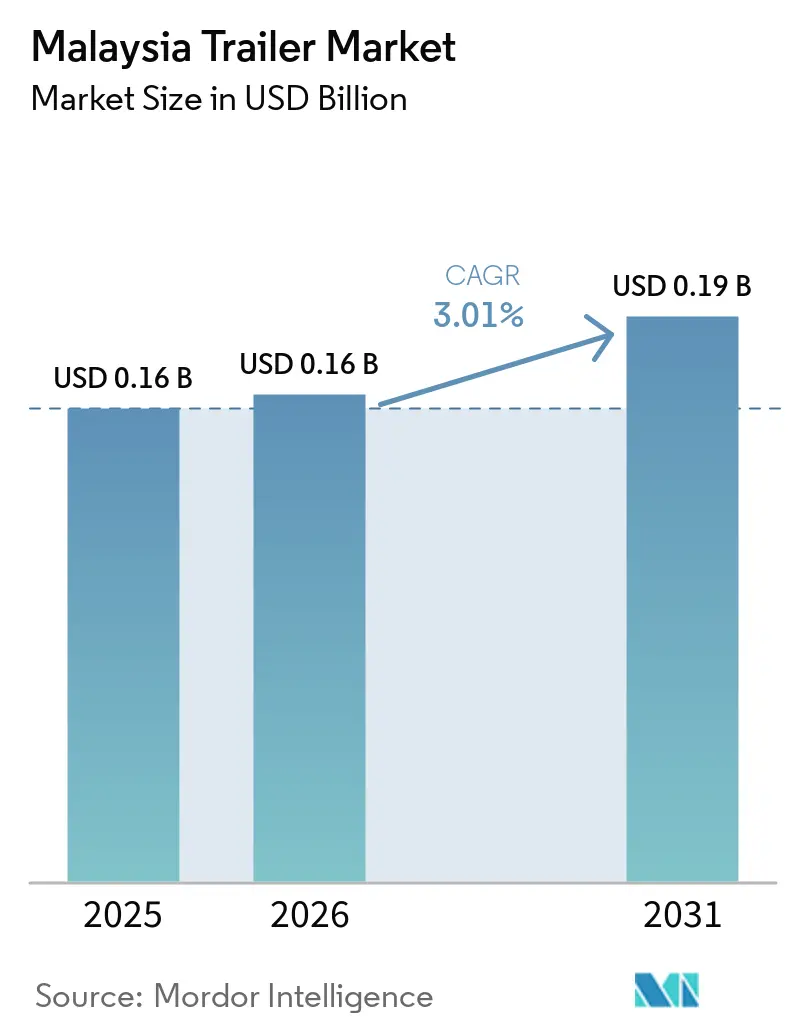
| Base Year Market Size (2025) | USD 0.16 Billion |
| Market Size (2026) | USD 0.16 Billion |
| Market Size (2031) | USD 0.19 Billion |
| Growth Rate (2026 - 2031) | 3.01 % |
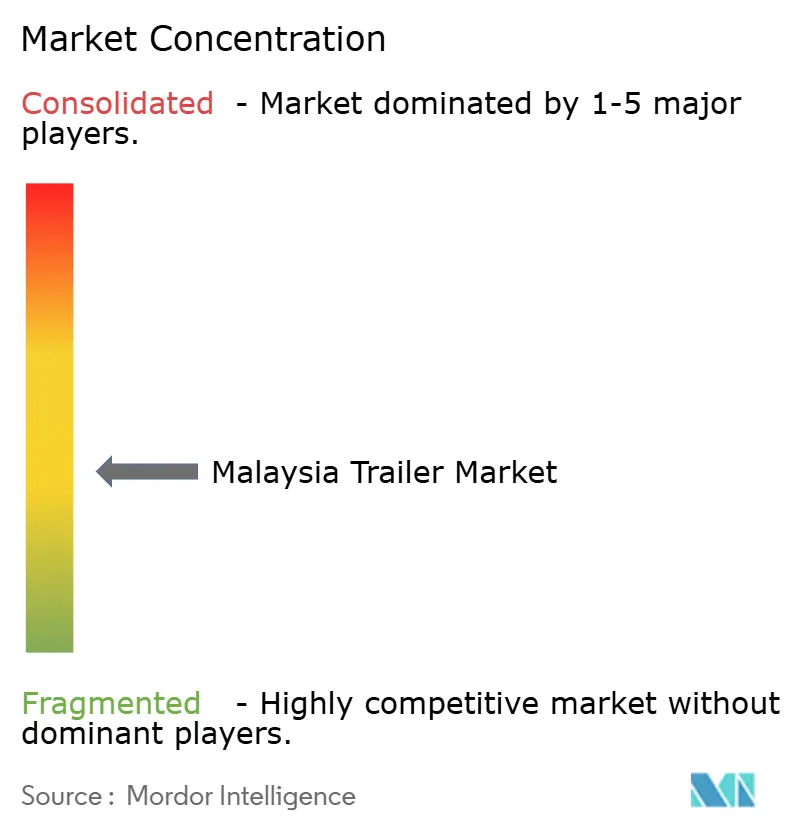
| Market Concentration | Medium |
Major Players *Disclaimer: Major Players sorted in no particular order Image © Mordor Intelligence. Reuse requires attribution under CC BY 4.0. | |
Malaysia Trailer Market Analysis by Mordor Intelligence
The Malaysian trailer market was valued at USD 0.16 billion in 2025 and USD 0.16 billion in 2026 and is projected to reach USD 0.19 billion by 2031, registering a CAGR of 3.01% between 2026 and 2031. The steady headline growth conceals an active re-balancing inside the Malaysian trailer market, where infrastructure projects, emission regulations, and fragmented fleet ownership are all changing buying priorities. Flatbed and lowboy demand is migrating toward the East Coast Rail Link (ECRL) corridor as rail-road interchange hubs emerge, while refrigerated capacity is clustering around Johor to support data-center construction and halal-export cold chains. Overloading enforcement has raised the cost of non-compliance, pushing operators toward multi-axle and lightweight designs that meet axle-load ceilings. At the same time, Euro V emission rules are accelerating telematics adoption so that fleet managers can recover the fuel-efficiency penalty of cleaner prime movers. Competitive intensity remains high because a major share of the Malaysian trailer market is served by small and medium trucking firms that collectively lack the balance-sheet strength to invest in high-spec equipment.
Key Report Takeaways
- By trailer type, enclosed dry-van units led the Malaysian trailer market with a 34.12% share in 2025, while refrigerated trailers recorded the fastest projected growth, with a 6.33% CAGR, as operators align with halal-export temperature mandates.
- By axle configuration, tandem-axle units held 47.25% share of the Malaysian trailer market size in 2025, yet multi-axle platforms are forecast to advance at a 5.21% CAGR through 2031.
- By load capacity, heavy-duty trailers above 40 tons captured 42.15% share of the Malaysian trailer market size in 2025 and are set to expand at a 5.85% CAGR between 2026 and 2031.
- By end user, logistics and transport companies accounted for 38.13% of demand in 2025, and will continue to exhibit the fastest growth with 4.36% CAGR through 2031.
Note: Market size and forecast figures in this report are generated using Mordor Intelligence’s proprietary estimation framework, updated with the latest available data and insights as of January 2026.
Malaysia Trailer Market Trends and Insights
Drivers Impact Analysis*
| Driver | ( ~ )% Impact on CAGR Forecast | Geographic Relevance | Impact Timeline |
|---|---|---|---|
| Cold-Chain and Last-Mile Expansion | +0.9% | Klang Valley, Johor, Penang | Short term (≤ 2 years) |
| Infrastructure and Inter-Modal Connectivity | +0.8% | Pahang, Terengganu, Kelantan, Sabah, Sarawak | Medium term (2-4 years) |
| Logistics Upswing for Perishables | +0.7% | Johor, Pahang, Perak export zones | Medium term (2-4 years) |
| Euro V Drives Lightweight Smart-Trailer | +0.5% | National urban freight corridors | Medium term (2-4 years) |
| Data-Center Build-Out Spurs Demand | +0.4% | Johor, Selangor, Penang | Short term (≤ 2 years) |
| Trailer-Sharing Boosts Utilization | +0.3% | Klang Valley, Johor corridors | Long term (≥ 4 years) |
| Source: Mordor Intelligence | |||
E-Commerce-Led Cold-Chain and Last-Mile Expansion
In 2025, Shopee and Lazada managed a significant volume of parcels in Malaysia. Their shift towards fresh grocery fulfillment now demands temperature-controlled facilities in urban micro hubs. In 2025, Volvo Trucks Malaysia, in collaboration with FGV Transport, expanded its fleet of refrigerated trucks, ensuring last-mile deliveries adhere to pharmacy-grade standards. Parcel integrators note that during festive peaks, the demand for refrigerated (reefer) trucks surges, leading to heightened short-term rental costs. This trend nudges fleet owners to invest in their own refrigerated assets. With the proliferation of cold-chain nodes in major cities, the Malaysian trailer market witnesses a quicker turnover of reefers, boosting its overall contribution to growth in the short term.
Infrastructure Investment and Inter-Modal Connectivity
The ECRL, which is 89% complete and set for Phase 1 commissioning in January 2027, will cut Kuantan-to-Port Klang transit time by half, prompting operators to stage flatbeds and container chassis at new inland depots in Mentakab and Dungun [1]“East Coast Rail Link Project Updates,” Malaysian Rail Link, mrl.com.my. The Pan-Borneo Highway, meanwhile, is unlocking timber and palm-oil estates in Sarawak for direct port access, creating demand for heavy-duty tippers in Miri and Bintulu. By the forecast period's end, port upgrades at Tanjung Pelepas and Penang are expected to significantly enhance capacity. However, a persistent cap on trailer-to-prime-mover ratios continues to restrict immediate chassis procurement. These initiatives collectively enhance the utilization of flatbeds, lowboys, and container chassis in the Malaysian trailer market, contributing to a significant increase in the projected growth rate.
Cold-Chain Logistics Upswing for Perishables
By 2026, halal-certified poultry and meat exporters aim to achieve significant growth in overseas sales. Meanwhile, processors in Perak and Johor are retrofitting their fleets with GDP-compliant reefers, responding to demands from Middle Eastern buyers for unbroken temperature logs [2]“Good Distribution Practice Guidelines for Cold Chain,” Ministry of Health, moh.gov.my . Durian growers moving premium Musang King cultivars now lease dedicated trailers that hold 7 °C for the 72-hour trip to port gates, favoring owned capacity over spot hire. Exporters, keen to sidestep shipment rejections, willingly absorb a premium that sees equipment costs running significantly higher than their dry-van counterparts. This pivot in demand is poised to bolster Malaysia's trailer market growth over the medium term.
Euro V Transition Drives Lightweight Smart-Trailer Upgrades
Euro V standards for petrol commercial vehicles took effect in September 2025; full fleet compliance is targeted by 2027 [3]“Diesel Subsidy Rationalization Impact on Transport Sector,” Bernama, bernama.com . Sinotruk Malaysia introduced Euro V prime movers in April 2025 and is bundling telematics that guide aerodynamic add-ons and tire-pressure optimization. Trailer builders, therefore, pivot to aluminum cross-members and high-tensile sidewalls that cut tare weight by up to 800 kg, preserving payload under strict gross-vehicle limits. Larger fleets finance the smart-sensor upgrade to hedge against fuel-cost swings, contributing significant points to the medium-term CAGR in the Malaysian trailer market.
Restraints Impact Analysis*
| Restraint | (~) % Impact on CAGR Forecast | Geographic Relevance | Impact Timeline |
|---|---|---|---|
| Commercial-Vehicle Sales Volatility | -0.6% | National urban freight corridors | Short term (≤ 2 years) |
| Crack-Down on Over-Loading | -0.4% | Klang Valley, Johor, Penang | Medium term (2-4 years) |
| Skilled Fabricator and Welder Shortage | -0.3% | Sarawak, Sabah, national workshops | Medium term (2-4 years) |
| Compliance with Conspicuity Rules | -0.2% | Rural inter-state freight roads | Long term (≥ 4 years) |
| Source: Mordor Intelligence | |||
Commercial-Vehicle Sales Volatility Post-Pandemic
Malaysia’s commercial-vehicle registrations fell 11.4% year-on-year to 61,654 units in 2025 as diesel-subsidy removal lifted fuel prices by 30% overnight. January 2026 rebounded 14.3% to 3,929 units, hinting at a cyclical recovery, yet trailer orders usually lag tractor purchases by two quarters. Cash-constrained operators are therefore extending trailer service lives from five to seven years, weighing on new-build demand and trimming significant points from the short-term Malaysia trailer market CAGR.
Crack-Down on Over-Loading Raises Operating Costs
JPJ inspectors issued over 3,600 overload penalties in Q4 2025 alone, with fines up to RM 500,000 (approximately USD 116,850) and several vehicle seizures in Kuala Lumpur[4]“Heavy Vehicle Weigh Station Enforcement Data 2025,” JPJ Malaysia, jpj.gov.my . Fleets, previously accustomed to a payload tolerance, are now compelled to invest in weigh-in-motion kits or face the necessity of adding trips. This adjustment has led to an increase in costs per ton-kilometre. Furthermore, hardware expenditures for each trailer have strained working capital. Consequently, this has resulted in a decline in the growth of Malaysia's trailer market amidst the ramp-up of enforcement in recent years.
*Our forecasts treat driver/restraint impacts as directional, not additive. The impact forecasts reflect baseline growth, mix effects, and variable interactions.
Segment Analysis
By Trailer Type: Refrigerated Units Outpace Dry-Van Incumbents
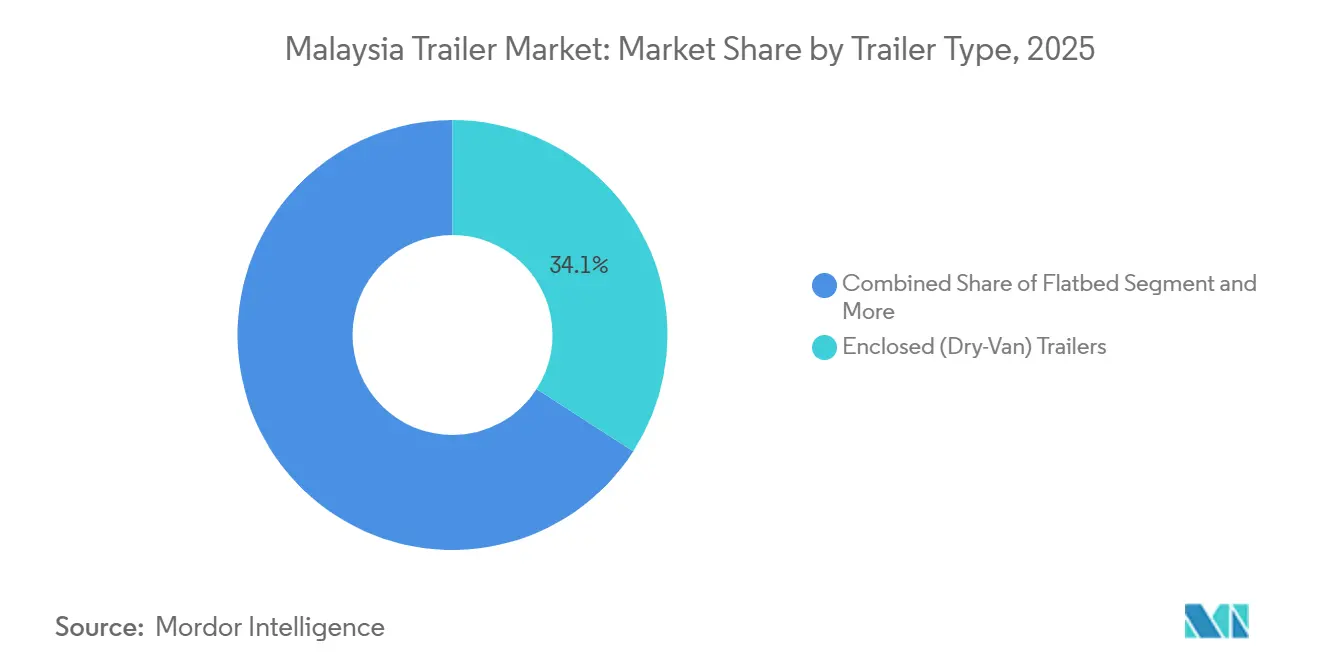
Enclosed dry-van equipment held 34.12% of the Malaysian trailer market share in 2025, serving parcel, FMCG, and palletized freight. Demand for refrigerated bodies is rising at a 6.33% CAGR, as halal exporters and grocery e-tailers lock in temperature-controlled capacity for perishables destined for the Middle East. Box-van fleets in Johor added telematics-ready reefers so they can provide real-time temperature logs, a contractual prerequisite for poultry, durian, and pharmaceutical shippers. Flatbeds continue to benefit from concrete-beam moves for the ECRL as well as steel haulage for Pan-Borneo Highway spans. Tankers have gained from a new voluntary construction code that sets design norms for palm-oil and petrochemical carriers, but the absence of enforcement means uptake remains voluntary.
A steady trickle of tipper orders comes from quarry operators in Pahang and Sarawak, while lowboys handle episodic data-center and oil-field modules exceeding 80 tons. Curtainsiders, valued for side-loading in congested urban docks, hover below a tenth of all deliveries yet show promise as e-commerce 3PLs chase faster dock cycles. Domestic builder MPSI Steel Industries has responded by adding a quick-change side-curtain line at its Selangor factory. The refrigerated shift is notable because operators that once relied on rented reefers during Ramadan now fund owned assets to avoid holiday surcharges, reshaping capital-expenditure patterns inside the Malaysian trailer market.



By Axle Type: Multi-Axle Gains as Payloads Climb
Tandem-axle platforms accounted for 47.25% of the Malaysian trailer market size in 2025, coupling a favorable payload with manageable tire-tax costs. Enforcement of axle-load ceilings, however, has catalyzed migration toward tri-axle and quad-axle rigs among construction and mining fleets eager to legalize heavier consignments without paying overload fines. The multi-axle segment is set to witness the fastest growth of 5.21% CAGR, as the shift is evident at Johor Port depots, where 40-foot high-cube containers push gross weights toward regulatory limits, compelling operators to spec an extra axle rather than risk roadside detention.
Terberg Zenith Malaysia is expanding local assembly space to accommodate multi-axle tippers, and CIMC’s Thailand hub now markets six-axle lowbeds to Malaysian buyers seeking shorter shipping distances. Single-axle units increasingly serve farm-gate haulage and small parcel carriers in secondary towns but are losing share as shippers consolidate loads to gain fuel-economy dividends. Rising Euro V tare weights make extra axle groups even more attractive because they preserve legal payload, reinforcing the up-shift trend across the Malaysian trailer market.
By Load Capacity: Heavy-Duty Dominates Amid Infrastructure Surge
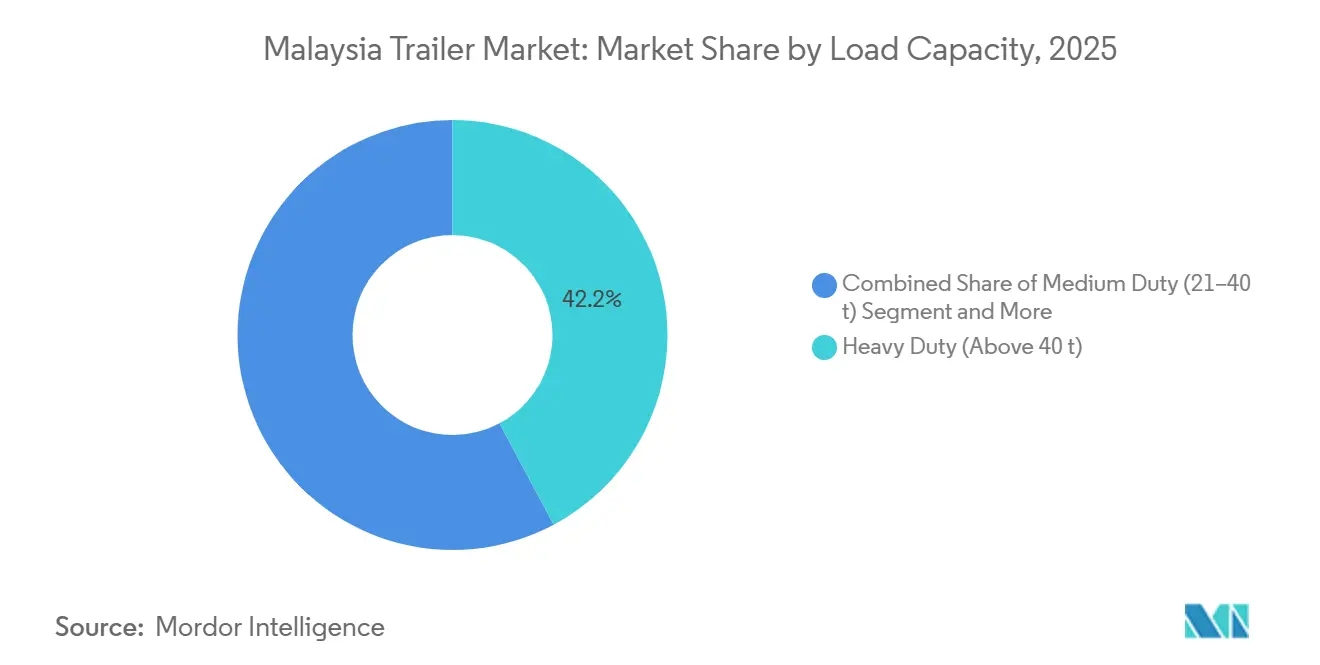
Heavy-duty trailers above 40 tons secured 42.15% of the Malaysian trailer market share in 2025 and are forecast to register a 5.85% CAGR as the Pan-Borneo Highway, ECRL, and data-center builds trigger sustained demand for bridge beams, girders, and power transformers. Mining houses in Sabah and Pahang take delivery of 70-ton dump trains to shift coal and iron ore from inland pits to barge terminals, further extending heavy-duty lead times at domestic yards.
Medium-duty (21-40 ton) equipment grows near the overall market average but faces thin margins because hauliers find it harder to pass higher diesel costs to contract shippers. Light-duty trailers under 20 tons keep a foothold in urban last-mile distribution, yet many parcel companies now upsize to medium utilities to reduce the number of trips per day. Consequently, capital budgets skew noticeably toward heavy-spec builds, reinforcing concentration at the top end of the Malaysia trailer market.
By End User: Logistics Operators Lead, Yet Cold-Chain Specialists Sprint
Logistics and transport companies formed 38.13% of trailer purchases in 2025 and should expand at a 4.36% CAGR, undershooting the headline growth of the broader Malaysia trailer market because many general-freight fleets delay renewal in response to weak tractor sales. Construction contractors accelerate procurement of flatbeds and lowboys during civil works peaks but taper orders once projects close out, introducing cyclicality.
Cold-chain specialists, on the other hand, front-load reefers before 2027 export-compliance deadlines. FGV Transport’s investment in telematics-equipped reefers shows how operators convert halal and pharmaceutical standards into pricing power. Agricultural consolidators are another bright spot; palm-oil and durian exporters now pay premiums for temperature-controlled line-haul because rejection risks dwarf freight costs. Mining, energy, and petrochemical actors remain niche, yet their loads are so heavy that each order represents a large ticket for domestic fabricators coping with labour shortages.
Geography Analysis
Peninsular Malaysia generates a notable share of trailer demand, with Klang Valley warehouses, Johor’s twin ports, and Penang’s electronics cluster acting as anchor markets. The ECRL shortens the Kuantan-to-Port Klang run to less than four hours, nudging freight planners toward rail-road interchange depots in Mentakab and Dungun and shifting purchase decisions toward shorter-haul container chassis. Johor’s Iskandar region is another hotspot because Google’s new data-center campus and Xin Hwa Holdings’ port-haulage fleet are absorbing lowboy and chassis inventory as container throughput swells.
Due to the Pan-Borneo Highway and a series of timber, coal, and hydroelectric projects, Sarawak and Sabah are witnessing the fastest growth in Malaysia's trailer market, despite accounting for just a quarter of it. While labor shortages have extended fabrication lead times, demand for 40-ton tippers remains strong, driven by inland estates' connections to ports via dual carriageways. Meanwhile, an upgrade at Penang’s port is set to significantly boost capacity by 2027, leading to an expansion of curtainsider and chassis fleets, even as JPJ tightens overload enforcement at weigh stations in the north.
Enforcement efforts differ across regions: In 2025, Klang Valley's roadside teams conducted spot checks, issuing numerous summonses and impounding units within a short period. In contrast, rural highways faced less scrutiny and showed notable lapses in conspicuity compliance. To address this, JPJ is rolling out new operating procedures in 2026. In Johor, trailer-sharing pilots are emerging, with asset-rotation agreements already achieving significant utilization gains, hinting at the potential reshaping of regional fleet economics by digital hubs in Malaysia's trailer market.
Competitive Landscape
Malaysia's trailer market is fragmented, with licensing laws mandating a minimum paid-up capital for general cargo and container haulage. Additionally, equity thresholds for Malaysians and Bumiputera deter many foreign entrants. Domestic players such as MPSI Steel Industries, Xin Hwa Holdings, and Firama Engineering have a strong presence in local fabrication, often bundling build-to-order trailers with in-house haulage services. For instance, Xin Hwa Holdings operates a significant number of units servicing Johor Port, Tanjung Pelepas, and Penang Port.
International players tread cautiously. CIMC Vehicles began marketing multi-axle platforms from its Thai plant in 2026 but refrained from committing to Malaysian assembly, citing a lack of tax incentives and the equity ceiling. Meanwhile, Terberg Zenith Malaysia, acquired in 2023, operates a site in Selangor with OEM jigs for Olympus bodies, now focusing on mining clients in Pahang and construction contractors in Johor.
White-space opportunities arise in pooled trailer platforms, due to the 2021 policy on shared assets. However, digital matchmaking is still in its infancy. First movers addressing telemetry, booking, and financing challenges could harness a long tail of under-utilized equipment. The transition to Euro V standards is driving demand for lightweight builds and predictive-maintenance software. Yet, with smart trailers commanding significant premiums, smaller fleets find them out of reach, creating an opportunity for bank-backed leasing schemes. Cold-chain innovators, like DHL Global Forwarding, are making strides. Their dual-temperature facility at KLIA, inaugurated in 2025, showcases how integrated logistics can outpace traditional players by providing turnkey reefer capacity and validated storage.
Malaysia Trailer Industry Leaders
MPSI Steel Industries Sdn Bhd
CIMC Vehicles (Group) Co., Ltd.
Schmitz Cargobull AG
Sinotruk Malaysia
Heil Trailer
- *Disclaimer: Major Players sorted in no particular order

Recent Industry Developments
- August 2025: DHL Global Forwarding opened a dual-certified 15–25 °C and 2–8 °C cold-chain hub inside the Kuala Lumpur International Airport Free Commercial Zone, the first facility at KLIA to pair on-airport storage with in-house reefer-truck transfers, targeting life-sciences clients.
- October 2024: Heil Trailer Asia appointed MPSI Steel Industries as its official Malaysian dealer for after-sales, spares, and warranty, strengthening parts availability for aluminum tankers used in petrochemical haulage.


Malaysia Trailer Market Report Scope
The scope includes segmentation by trailer type (flatbed trailers, enclosed (dry-van) trailers, refrigerated trailers, tanker trailers, tipper trailers, and lowboy trailers), axle type (single axle, tandem, axle, triple axle, and multi-axle), load capacity (light duty (≤20 t), medium duty (21-40 t), and heavy duty (above 40 t), and end user (logistics and transport companies, construction contractors, agricultural operators, mining and energy companies, and retail and distribution). Market size and growth forecasts are presented by value in USD.
| Flatbed Trailers |
| Enclosed (Dry-Van) Trailers |
| Refrigerated Trailers |
| Tanker Trailers |
| Tipper Trailers |
| Lowboy Trailers |
| Single Axle |
| Tandem Axle |
| Triple Axle |
| Multi-Axle |
| Light Duty (Less than/Equals 20 t) |
| Medium Duty (21-40 t) |
| Heavy Duty (Above 40 t) |
| Logistics and Transport Companies |
| Construction Contractors |
| Agricultural Operators |
| Mining and Energy Companies |
| Retail and Distribution |
| By Trailer Type | Flatbed Trailers |
| Enclosed (Dry-Van) Trailers | |
| Refrigerated Trailers | |
| Tanker Trailers | |
| Tipper Trailers | |
| Lowboy Trailers | |
| By Axle Type | Single Axle |
| Tandem Axle | |
| Triple Axle | |
| Multi-Axle | |
| By Load Capacity | Light Duty (Less than/Equals 20 t) |
| Medium Duty (21-40 t) | |
| Heavy Duty (Above 40 t) | |
| By End User | Logistics and Transport Companies |
| Construction Contractors | |
| Agricultural Operators | |
| Mining and Energy Companies | |
| Retail and Distribution |


Key Questions Answered in the Report
What is the current value of the Malaysian trailer market?
The Malaysian trailer market size stands at USD 0.16 billion in 2026 and is forecast to reach USD 0.19 billion by 2031.
How fast is the market expected to grow?
Between 2026 and 2031, the compound annual growth rate is projected at 3.01%.
Which trailer type is growing the fastest?
Refrigerated units are expanding ahead of the overall market as halal-export and e-grocery logistics demand more temperature-controlled capacity.
Why are multi-axle trailers becoming popular?
Stricter overloading enforcement and heavier construction consignments push operators toward extra axles to remain within legal payload limits.
Page last updated on:


 Your data is secure and never sold or shared.


