
Market Overview
| Study Period | 2020 - 2031 |
|---|---|
| Forecast Data Period | 2026 - 2031 |
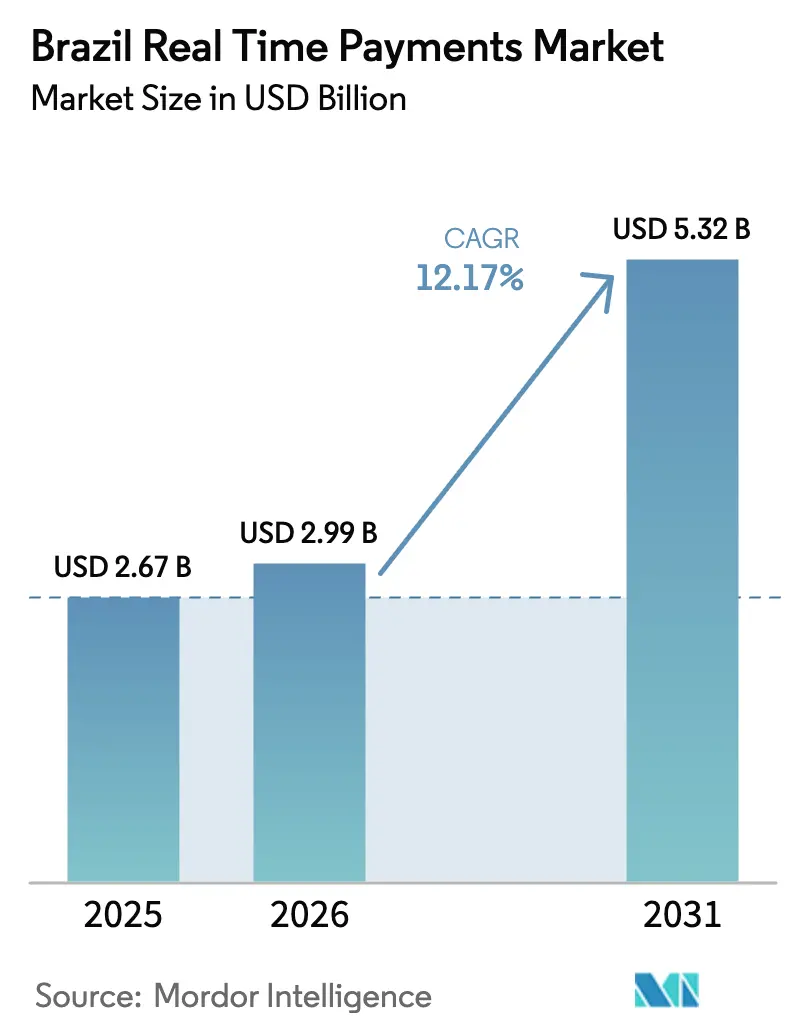
| Base Year Market Size (2025) | USD 2.67 Billion |
| Market Size (2026) | USD 2.99 Billion |
| Market Size (2031) | USD 5.32 Billion |
| Growth Rate (2026 - 2031) | 12.17 % |
| Market Concentration | Low |
Major Players *Disclaimer: Major Players sorted in no particular order Image © Mordor Intelligence. Reuse requires attribution under CC BY 4.0. | |
Brazil Real Time Payments Market Analysis by Mordor Intelligence
Brazil real time payments market size in 2026 is estimated at USD 2.99 billion, growing from 2025 value of USD 2.67 billion with 2031 projections showing USD 5.32 billion, growing at 12.17% CAGR over 2026-2031. Sustained expansion is linked to the Central Bank’s Pix network, which processed 276.7 million transactions in a single day during June 2025 and moved RUSD 26.5 trillion (USD 4.5 trillion) in 2024. Merchants shift toward lower-cost instant payments, fintechs compete through user-centric products, and regulatory mandates such as Open Finance accelerate service innovation. Cloud deployment enables elastic scaling, while embedded finance in super-apps drives transaction growth among digital-first consumers. Fraud-mitigation spending and interchange-fee caps temper revenue per payment but do not alter the long-term adoption trajectory of the Brazil real time payments market.[1]
Key Report Takeaways
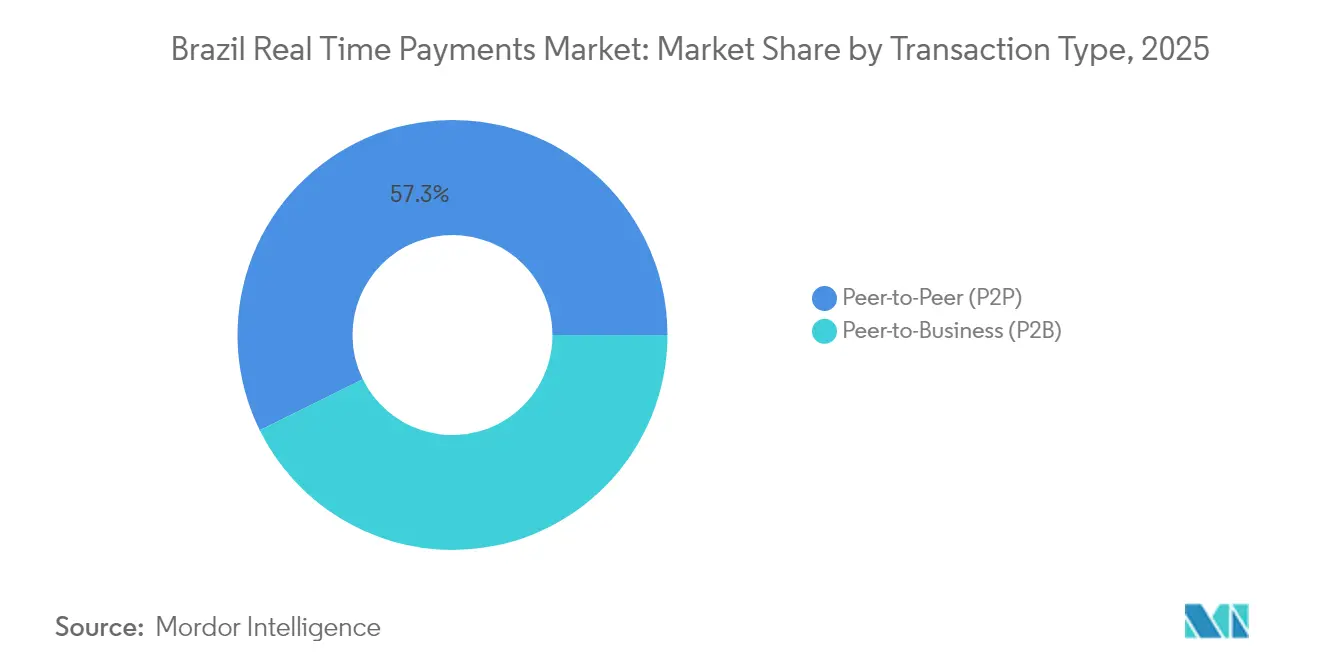
- By transaction type, P2P transfers held 57.30% of the Brazil real time payments market share in 2025, while P2B payments are projected to expand at a 14.89% CAGR through 2031.
- By component, Platform/Solution offerings represented 73.60% of the Brazil real time payments market size in 2025 and are complemented by Services, which grow at a 16.32% CAGR to 2031.
- By deployment mode, cloud-based solutions captured 66.70% revenue share in 2025 and will register a 14.33% CAGR to 2031.
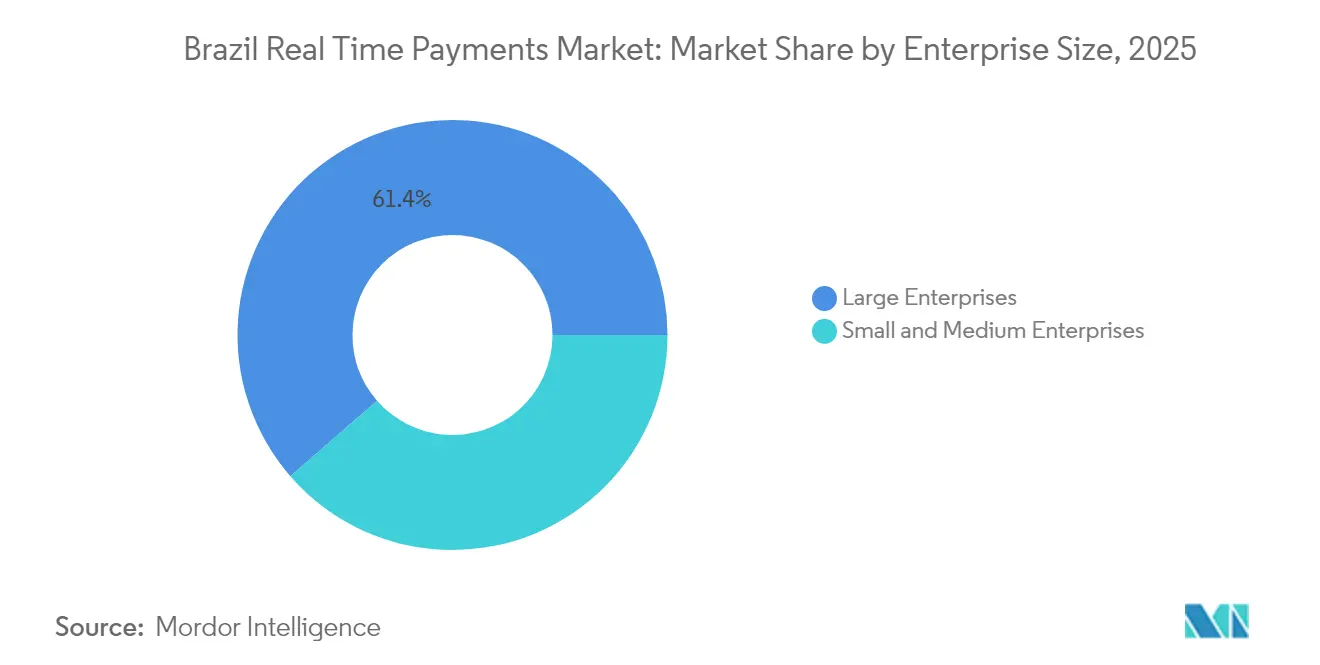
- By enterprise size, large companies led with 61.40% share in 2025; small and medium enterprises advance at a 13.65% CAGR to 2031.
- By end-user industry, retail & e-commerce commanded 22.90% revenue in 2025, while healthcare is the fastest-growing vertical at a 15.62% CAGR through 2031.
Note: Market size and forecast figures in this report are generated using Mordor Intelligence’s proprietary estimation framework, updated with the latest available data and insights as of 2026.
Market Trends and Insights
Drivers Impact Analysis of Brazil Real Time Payments Market*
| Driver | (~) % Impact on CAGR Forecast | Geographic Relevance | Impact Timeline |
|---|---|---|---|
| Maturation of Pix-Enabled RTP Ecosystem | +3.2% | National, with concentration in São Paulo, Rio de Janeiro, Brasília | Medium term (2-4 years) |
| QR-Code Adoption by Micro-Merchants in Urban Favelas | +1.8% | Southeast and Northeast urban centers, particularly São Paulo, Rio de Janeiro, Salvador | Short term (≤ 2 years) |
| Embedded Finance Expansion in Brazilian Super-apps | +2.4% | National, with early adoption in metropolitan areas | Medium term (2-4 years) |
| Real-Time Payroll Disbursements for Gig-Economy Workers | +1.6% | Major metropolitan areas, expanding to secondary cities | Short term (≤ 2 years) |
| Open-Finance API Mandates Intensifying Competition | +2.1% | National regulatory framework with uniform implementation | Long term (≥ 4 years) |
| Source: Mordor Intelligence | |||
Maturation of Pix-Enabled RTP Ecosystem
Pix Automático, launched in June 2025, supports recurring debits, lowering average merchant costs from 2.34% on credit cards to 0.33% on Pix. Daily transaction highs rose from 163 million in 2023 to 276.7 million in 2025. Growth of the Brazil real time payments market is reinforced by these network effects, improving cost efficiency for households and businesses alike.
QR-Code Adoption by Micro-Merchants in Urban Favelas
The Central Bank’s BR Code standard ensures interoperability, letting informal sellers accept Pix without costly card hardware. Urban micro-merchants gain digital sales opportunities, and 20% of retailers now offer Pix discounts that funnel volume from boleto and cash.[2] Rapid merchant onboarding underpins grassroots expansion of the Brazil real time payments market.
Embedded Finance Expansion in Brazilian Super-Apps
Fintech-led super-apps integrate payments, credit, and telecom. Nubank’s MVNO service widens client touchpoints, while MercadoLibre layers credit offers on e-commerce data. Open Finance data portability accelerates embedded finance, boosting transaction depth within the Brazil real time payments market.
Real-Time Payroll Disbursements for Gig-Economy Workers
FGTS Digital has required employers to send payments exclusively through Pix since March 2024.[3] Gig platforms replicate the model to differentiate on worker liquidity, expanding instant payout volumes and adding momentum to the Brazil real time payments market.
Restraints Impact Analysis of Brazil Real Time Payments Market*
| Restraint | (~) % Impact on CAGR Forecast | Geographic Relevance | Impact Timeline |
|---|---|---|---|
| Fraud Losses from Social-Engineering Pix Scams | -2.8% | National, with higher concentration in urban areas | Short term (≤ 2 years) |
| Interchange-Fee Caps Limiting Revenue per Transaction | -1.9% | National regulatory framework affecting all payment processors | Medium term (2-4 years) |
| Digital Divide in Northern States | -1.4% | Northern and Northeastern states, particularly rural areas | Long term (≥ 4 years) |
| Source: Mordor Intelligence | |||
Fraud Losses from Social-Engineering Pix Scams
Losses reached BRL 4.9 billion (USD 860 million) in 2024, a 70% jump year-on-year. The Central Bank’s upcoming MED 2.0 recovery mechanism will add safeguards but could lengthen dispute cycles and raise compliance costs, restraining short-term velocity in the Brazil real time payments market.
Interchange-Fee Caps Limiting Revenue per Transaction
Regulatory caps reduce merchant costs but shrink processor margins; a 0.1 percentage-point cut would lower a leading fintech’s profit by an estimated 2%. Competitive pressure to absorb reduced fees may deter infrastructure investment, tempering growth in the Brazil real time payments industry.
*Our forecasts treat driver/restraint impacts as directional, not additive. The impact forecasts reflect baseline growth, mix effects, and variable interactions.
Brazil Real Time Payments Market Segment Analysis
By Transaction Type:
Commercial Volumes Lift P2B PaymentsP2P transfers provided 57.30% of 2025 activity and remain the behavioral anchor that popularized Pix. Yet merchants increasingly push P2B acceptance because Pix’s 0.33% processing cost improves retail margins and enables real-time reconciliation. P2B volumes grow at a 14.89% CAGR through 2031, outpacing the Brazil real time payments market. Corporates also test Pix Automático for recurring invoices, positioning B2B adoption for a gradual lift.
As commercial acceptance scales, the Brazil real time payments market size for P2B is expected to reach USD x billion by 2031, strengthening merchant bargaining power with acquirers. Innovations such as “Pix no mundo” extend domestic formats to nearby cross-border corridors, broadening P2B revenue pools.

By Component:
Integration Services Unlock New RevenuePlatform/Solution infrastructure held 73.60% revenue in 2025 because real-time engines, settlement hubs, and compliance modules require high initial outlays. Larger banks outsource critical workloads to specialist vendors that satisfy resilience standards. Services revenue grows at 16.32% CAGR as firms seek API orchestration, cybersecurity, and managed fraud analytics.
Customization demand rises with Open Finance obligations, attracting consultancies that package rapid deployment kits for small institutions. Consequently, the Brazil real time payments market sees a rising share of integration projects that bundle platform fees with recurring managed-service contracts, diversifying supplier income.
By Deployment Mode:
Cloud Dominates for Elastic ProcessingCloud deployments accounted for 66.70% of 2025 flows and expand at 14.33% CAGR, powered by scalable capacity that handled the 276.7 million-transaction peak in June 2025. Providers leverage multi-zone redundancy to satisfy systemic-risk standards while controlling unit costs.
On-premise retention persists where banks possess sunk investments or stress sovereign-data stipulations. Hybrid-cloud models reconcile latency-sensitive workloads with analytics hosted off-site, but cloud remains the default for greenfield builds inside the Brazil real time payments market.
By Enterprise Size:
SMEs Accelerate through Low-Code OnboardingLarge enterprises held 61.40% share in 2025, reflecting IT resources to integrate Pix at launch. Subsequent standardization has lowered entry barriers; SMEs now on-board via QR kits and plug-in APIs, propelling a 13.65% CAGR. Government programs, such as compulsory Pix use for FGTS payments, further normalize instant settlement among small businesses.
This democratization lifts long-tail transaction volume, increases cash-flow visibility for lenders, and feeds credit-scoring engines. As SMEs scale digital sales, their share of the Brazil real time payments market widens, underscoring policy success in inclusive finance.
By End-User Industry:
Healthcare Outpaces RetailRetail & e-commerce kept 22.90% revenue leadership in 2025 because Pix reduces cart-abandonment risk with immediate confirmation. Telemedicine reforms, however, push healthcare transactions to a 15.62% CAGR, fastest among verticals. Clinics integrate Pix into appointment portals for upfront collection, aligning cash receipt with service delivery.
Utilities and telecom firms embed Pix Automático to reduce collection friction, while public-sector programs demonstrate institutional confidence, collectively enlarging sectoral depth in the Brazil real time payments market.
Geography Analysis
Metropolitan São Paulo and Rio de Janeiro remain epicenters of real-time payment usage due to smartphone density, 4G/5G coverage, and concentration of fintech headquarters. Southeast corridors generate a majority of transaction value, reinforcing a virtuous cycle of acceptance and consumer expectation. Brasília’s federal workforce further underpins volume via salary disbursement and tax payments through Pix.
Expansion into secondary capitals—Fortaleza, Salvador, Curitiba, Recife—pushes penetration beyond early adopters. These cities benefit from QR-code sweep campaigns led by acquirers looking to diversify merchant pools. Regional banks partner with cloud providers to deploy compliant yet cost-efficient payment gateways, accelerating network depth across the Brazil real time payments market.
Northern and Northeastern territories trail due to incomplete broadband reach; 28% of households there remain offline. Caixa’s blockchain-based offline pilot indicates that alternative connectivity can close gaps where fiber investment lags. Drex central-bank-digital-currency trials aim to add resilient offline rails, which could unlock latent demand and narrow the geographic divide in the Brazil real time payments market.
Regulatory Landscape
Banco Central do Brasil (BCB) sets the operating and technical rules for Pix and runs the Sistema de Pagamentos Instantaneos (SPI), with detailed participant, initiation, and processing requirements codified through BCB resolutions and Pix manuals. A key compliance anchor is the participant authorization and accreditation tightening tied to Resolution BCB No. 429 (Nov 2024), which requires Pix participants to secure BCB authorization within the stated transition window and brings participation under a more tightly supervised perimeter.
The framework is also converging with Open Finance. BCB issued Open Finance Data and Service Scope Manual v7.0 via IN 724 (Apr 16, 2026), including updates around payment initiation services that reinforce standard API and security expectations for institutions connecting commerce checkout to account-to-account transfers. Operational performance standards, including strict processing-time targets for primary transaction messaging, and the Pix Forum roadmap for 2026 further emphasize fraud controls, proximity payments operationalization, and expanded cash-out capabilities such as Pix Saque and Pix Troco.
Value Chain Analysis
The value chain starts with BCB as the scheme operator and infrastructure provider through SPI, which clears and settles Pix transactions, and extends to regulated payment institutions and banks acting as PSPs that provide end-user accounts, apps, and front-end experiences. Upstream enabling layers include identity and onboarding controls (CPF/CNPJ checks and KYC), directory and key-management functions, and message, routing, and risk systems aligned to BCB technical manuals, while downstream channels include merchant checkout (QR via BR Code and proximity), bill and subscription acceptance (including Pix Automático), and public-sector collections and disbursements.
Solution vendors and service providers supply the orchestration stack, including payment gateways, API management, cloud infrastructure, cybersecurity, fraud analytics, reconciliation, and dispute handling. Integration services are rising as Open Finance and Pix initiation standards push more participants to standardize interfaces. Distribution remains concentrated in digital channels (bank and fintech apps, merchant POS and e-commerce platforms), while bottlenecks center on compliance readiness, including authorization and performance targets, and fraud and social-engineering mitigation, which increases operational load across PSPs, merchants, and supporting risk-technology suppliers.
Competitive Landscape
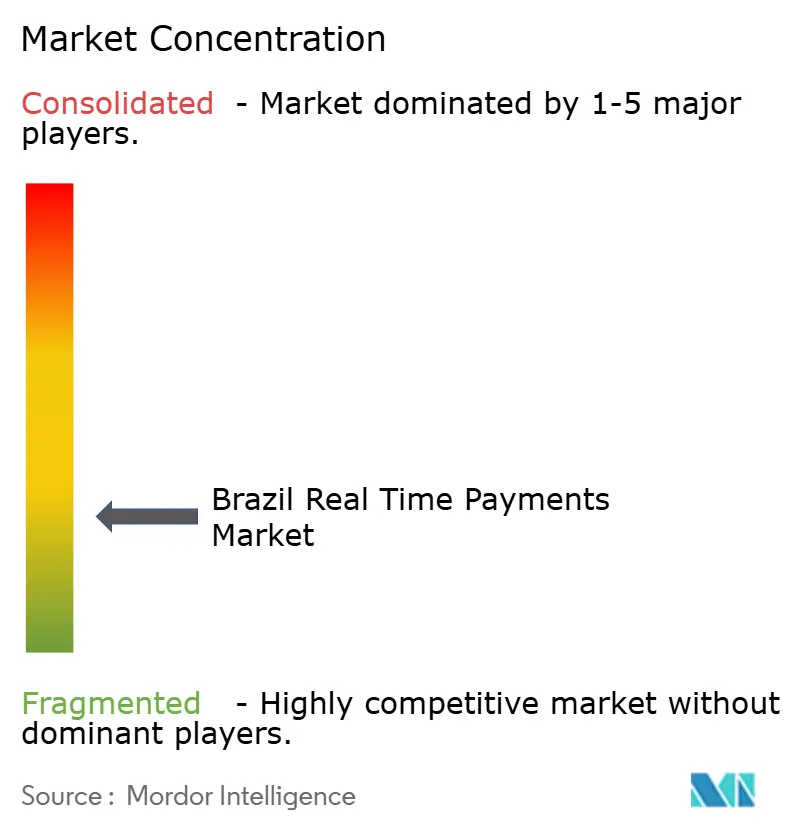
Roughly 800 licensed payment institutions compete, yielding a fragmented market. Traditional banks wield trust and liquidity access; Nubank, PicPay, and other fintechs pursue differentiation through superior UX and fee transparency. International processors retrofit legacy rails to Pix standards to protect client relationships.
Strategy profiles diverge. Ecosystem builders such as Nubank integrate telecom and insurance to entrench daily engagement. Specialists like StoneCo refine merchant acquiring economics for SMEs. Infrastructure vendors focus on white-label solutions that smaller banks and retailers adopt under Open Finance mandates. Multiple niches coexist because regulation enforces interoperability, creating contestable segments within the Brazil real time payments market.
M&A speculation signals consolidation in the acquirer layer; analysts project BRL 10-18 billion (USD 1.80-3.24 billion)synergy in a potential Stone–PagBank union. Visa’s 2025 launch of Pix-focused subsidiary Visa Conecta illustrates incumbent card networks repositioning to defend e-commerce relevance. Competitive intensity remains high as fee caps and fraud mitigation costs squeeze margins, prompting efficiency plays and technology partnerships.
Brazil Real Time Payments Industry Leaders
-
EBANX Ltda
-
Stripe, Inc.
-
Adyen NV
-
PayPal Holdings Inc.
-
Digital River Inc.
- *Disclaimer: Major Players sorted in no particular order
Brazil Real Time Payments Market Companies Covered in this Report
- Adyen NV
- PayPal Holdings Inc.
- Digital River Inc.
- EBANX Ltda
- Stripe, Inc.
- Rapyd Financial Network Ltd.
- MercadoLibre S.R.L. (MercadoPago)
- Braspag Tecnologia em Pagamentos Ltda
- PagSeguro Internet S/A
- dLocal Ltd.
- Banco do Brasil S.A.
- Itaú Unibanco Holding S.A.
- Banco Bradesco S.A.
- Santander Brasil S.A.
- Nu Pagamentos SA
- PicPay Serviços S.A.
- StoneCo Ltd.
- Wirecard Brazil (Moip)
- Banco Inter S.A.
- PayGo Pagamentos S/A
Market Opportunities and Future Outlook
Recurring and commerce-linked use cases create clearer whitespace beyond Pix's original P2P anchor. Pix Automático, launched June 2025, expands the addressable base for subscription billing and digital services, and payment facilitator disclosures indicate subscription conversion dynamics shift when recurring Pix is offered (for example, EBANX has published that a majority of Pix Automático users on its rails were new subscribers). At the same time, proximity acceptance is moving the Pix experience closer to card-like in-store journeys, creating opportunities for merchant acquirers, POS software providers, and checkout platforms to bundle Pix tap-to-pay and QR flows with reconciliation and loyalty features.
Regulation is also shaping investable priorities. BCB's Open Finance manual updates in April 2026, combined with Pix participation and audit-readiness requirements and the planned MED enhancements taking effect in 2026, raise demand for API security, transaction monitoring, and recovery workflows that can be packaged as managed services for smaller PSPs and SME-focused acquirers. With BCB publishing Pix statistics and maintaining detailed technical standards, vendors that operationalize compliance, including performance monitoring, multi-zone resilience, and standardized initiation, have a defined path to productize deployments for banks, fintechs, and merchants scaling Pix volumes in retail, e-commerce, and service verticals.
Recent Industry Developments in Brazil Real Time Payments Market
- April 2026: PayPal added Pix to PayPal Complete Payments for small and medium-sized businesses in Brazil. The integration broadens PayPal merchants access to account-to-account checkout options alongside card acceptance, helping transactions confirm faster and reducing payment frictions for domestic buyers.
- June 2025: Banco Central do Brasil launched Pix Automatico, enabling recurring payments through a single customer consent flow. The feature extends Pix from one-off transfers into subscription and bill-pay scenarios, increasing relevance for utilities, telecom, and digital services that depend on repeat collection.
- February 2025: Pix by Proximity launched with NFC linkage to Google Wallet to support tap-to-pay style Pix transactions. This brings in-store Pix usage in line with contactless consumer behavior and creates additional integration demand across wallets, POS software, and merchant acceptance stacks.
Brazil Real Time Payments Market Report Scope and Research Methodology
Market Definition and Coverage
For this study, the Brazil real-time payments market is defined as the revenue pool created from instant, account-to-account payment transfers that settle within seconds on domestic rails, and that are initiated by consumers, merchants, or public entities.
Scope exclusions: We exclude cross-border instant transfers, deferred card clearing flows, and scheduled ACH batch payments that do not settle in real time.
Segments Covered in This Report
- By Transaction Type
- Peer-to-Peer (P2P)
- Peer-to-Business (P2B)
- By Component
- Platform / Solution
- Services
- By Deployment Mode
- Cloud
- On-Premise
- By Enterprise Size
- Large Enterprises
- Small and Medium Enterprises
- By End-User Industry
- Retail and E-Commerce
- BFSI
- Utilities and Telecom
- Healthcare
- Government and Public Sector
- Other End-user Industries
Data Sources, Market Sizing, and Validation
Desk Research
Desk work starts with identifying what is considered an instant payment in Brazil, and how reported transaction volumes and usage patterns have moved since Pix scaled up. We typically use public releases and statistical dashboards from sources such as Banco Central do Brasil, the BIS CPMI materials on fast payments, the World Bank Global Findex for adoption context, and OECD digital economy indicators to frame the direction and constraints.
Then we layer in supporting signals from company filings, investor presentations, and reputable business press to map participant roles, fee practices, and monetization points that can create market revenue. Where needed, we also refer to paid subscriptions that provide company financial intelligence, patent databases for platform evolution, and an import or export shipment-level database when hardware or messaging components must be sanity checked. The sources listed here are illustrative only, and many other public documents were also reviewed for data collection, validation, and clarification.
Primary Interviews and Surveys
Primary work focuses on validating how pricing, take rates, and volumes behave across the main participants, including banks, payment service providers, merchants, and enabling technology firms. We also use these conversations to test adoption drivers by use case (such as P2P and merchant payments), and to pressure test assumptions around fee waivers, monetization timing, and fraud-related operating costs across Brazil.
Distribution of primary research fieldwork respondents
| Company type | Respondent position |
|---|---|
| Top tier: 27% | CXOs: 20% |
| Mid tier: 51% | Functional/Unit leaders: 26% |
| Smaller Players: 22% | Managers: 54% |
Market-Sizing & Forecasting
Sizing follows a top-down and bottom-up logic that can be repeated with limited but reliable inputs. We first reconstruct the value pool from Brazil instant-payment activity by using published transaction trends, use-case mix (P2P versus merchant or bill payments), and the share of flows that are actually monetized, and then we translate that into market revenue using realistic fee and pricing assumptions.
To keep the model tied to market behavior, a few fingerprints are tracked closely, such as yearly instant-payment transaction volumes, active user growth, merchant acceptance progress, average ticket size by use case, and the pace of pricing changes around Pix participation, including cases where free consumer transfers create monetization opportunities for services elsewhere. When a public series is missing or inconsistent, we fill the gap with interview-led ranges and apply conservative interpolation so the jump between years is explainable.
For forecasting, scenario analysis is used because policy changes, fee structures, and merchant adoption can move faster than a simple trend line would suggest. The scenario paths are then checked against a lighter bottom-up approximation using sampled pricing schedules and volume assumptions across participant groups, which helps adjust totals when a top-down value pool looks too aggressive or too soft.
Data Validation & Update Cycle
Validation is done by comparing outputs against independent signals that should move in the same direction, such as central bank volume disclosures, public adoption milestones, and observable changes in merchant acceptance behavior. If an estimate implies a sudden pricing jump or an adoption drop that is not supported by those signals, the assumptions are reviewed again and targeted follow-ups are run with experts to confirm what changed.
Before sign-off, the model goes through step-by-step checks for unit consistency, currency timing, and year-on-year variance so that outliers are explained rather than hidden. Reports are refreshed annually, and interim updates are made when material events occur, such as a major rule change, a shift in fee policy, or a meaningful shock to payment behavior. Right before delivery, an analyst does a final pass to ensure the latest public releases are reflected.
Mordor Intelligence's Brazil Real Time Payments Market Size Versus Other Published Estimates
Published numbers for Brazil real-time payments can spread out because teams may measure different things, such as transaction value versus provider revenue, and they also handle fees and "free to user" flows in different ways. Timing also matters because the market can change quickly when rules, pricing, or merchant incentives shift.
The main gap comes from whether transaction value is being counted as the market or whether only the monetized revenue pool is counted, and Mordor Intelligence treats the market as the USD revenue opportunity created by domestic instant rails (including Pix style account-to-account transfers) after excluding deferred card clearing, cross-border flows, and scheduled batch ACH. Differences also show up when an estimate assumes a faster ASP progression for merchant payments, applies aggressive FX conversion timing, or does not re-check adoption and pricing assumptions with local stakeholders during refresh cycles.
Benchmark comparison
| Source | Market Size | Gaps in Research Methodology |
|---|---|---|
| Mordor Intelligence | USD 2.67 B (2025) | |
| Trade Journal A | USD 6.73 B (2025) | Often presented as a transaction value proxy rather than a revenue pool, which inflates totals when free P2P flows and pass-through transfers are treated as market value without monetization filters. |
| Regional Consultancy B | USD 1.90 B (2026) | Uses a tighter revenue definition that can undercount merchant and public-sector related fees, and it may also apply more conservative assumptions on take rates and the timing of fee changes. |
Looking across the table, most of the spread is explained by what is being measured and when it is converted into USD, rather than by a single forecasting formula. By tying the estimate to observable domestic rails activity, monetization logic, and repeatable checks on pricing and adoption, the resulting number stays easier to interpret and to update when market conditions change.
Key Questions Answered in the Report
What is the current value of the Brazil real time payments market?
The Brazil real time payments market is worth USD 2.99 billion in 2026 and is projected to reach USD 5.32 billion by 2031.
Which transaction type is expanding fastest?
P2B payments grow at a 14.89% CAGR through 2031, driven by lower acceptance costs for merchants.
Why are cloud deployments dominant?
Cloud systems account for 66.70% of deployments because they scale elastically to handle peaks such as 276.7 million transactions in a day.
How is fraud impacting market growth?
Social-engineering scams reduced forecast CAGR by 2.8% in the short term, prompting new recovery mechanisms from the Central Bank.
Which industry vertical will grow quickest?
Healthcare real-time payments expand at a 15.62% CAGR as telemedicine and digital health initiatives digitize billing.
What strategic moves are incumbents making?
Visa launched Visa Conecta to capture Pix-based e-commerce flows, while fintechs such as Nubank bundle telecom services to deepen engagement.