
Brazil OTT Market Size and Share
Market Overview
| Study Period | 2020 - 2031 |
|---|---|
| Forecast Data Period | 2026 - 2031 |
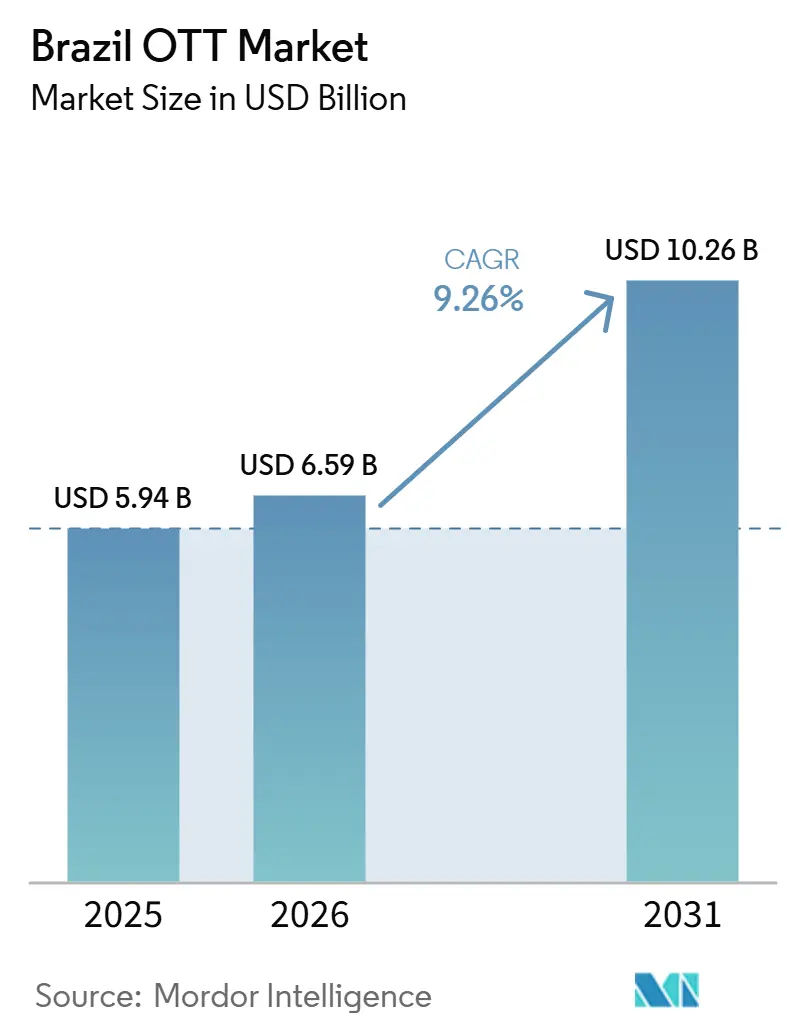
| Base Year Market Size (2025) | USD 5.94 Billion |
| Market Size (2026) | USD 6.59 Billion |
| Market Size (2031) | USD 10.26 Billion |
| Growth Rate (2026 - 2031) | 9.26 % |
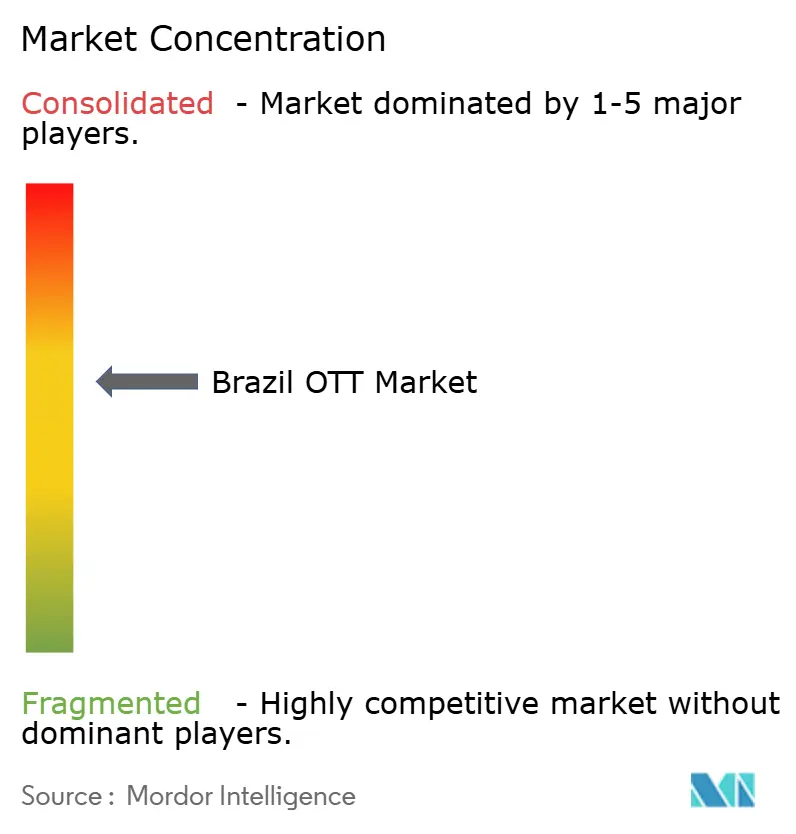
| Market Concentration | Medium |
Major Players *Disclaimer: Major Players sorted in no particular order Image © Mordor Intelligence. Reuse requires attribution under CC BY 4.0. | |
Brazil OTT Market Analysis by Mordor Intelligence
The Brazil OTT market size was valued at USD 5.94 billion in 2025 and estimated to grow from USD 6.59 billion in 2026 to reach USD 10.26 billion by 2031, at a CAGR of 9.26% during the forecast period (2026-2031). The Brazil OTT market is expanding as paid video services replace a shrinking pay TV base and become part of everyday viewing across more income groups. Higher household connectivity, wider mobile access, and more television-based internet use are increasing the available audience for streaming services. Advertising is moving toward digital video and connected television, which supports free and ad-supported viewing models alongside subscriptions. Providers are responding with sports bundles, local programming, and distribution partnerships that can reduce cancellations. Piracy, price sensitivity, fragmented content rights, and foreign content costs remain important constraints for the Brazil OTT market.
Key Report Takeaways
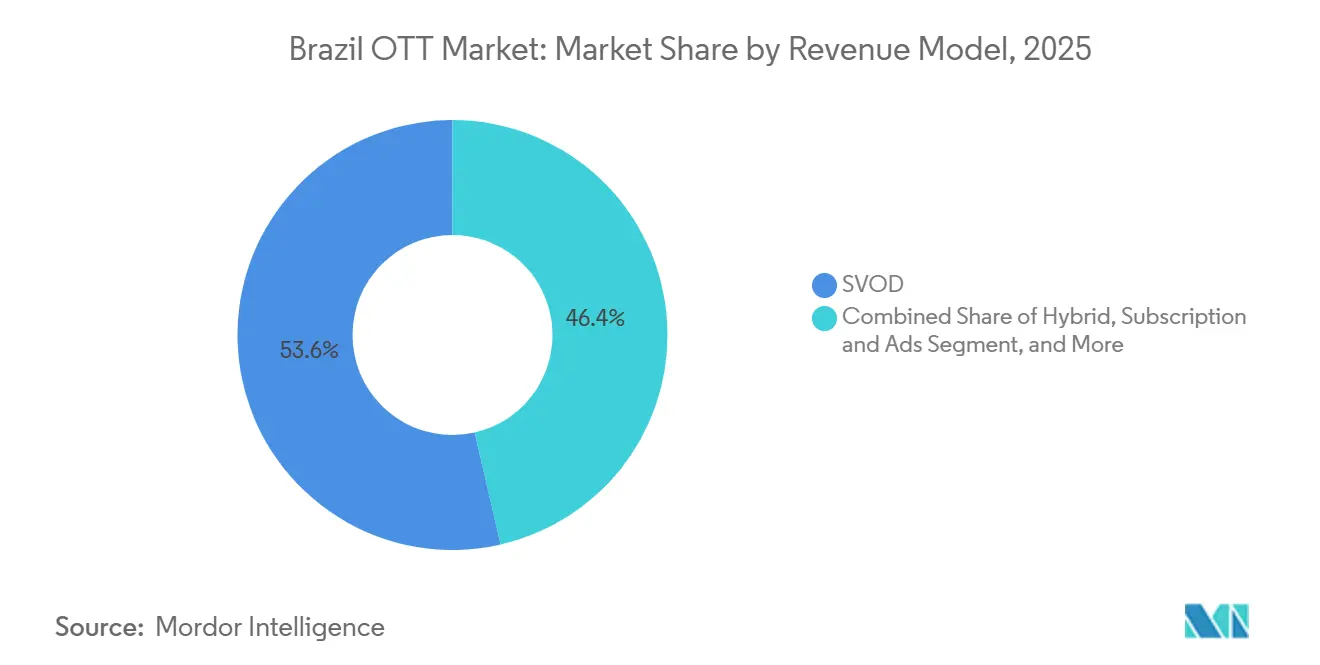
- By revenue model, SVOD accounted for 53.58% of Brazil OTT market revenue in 2025, while AVOD is projected to expand at a 9.91% CAGR through 2031.
- By device type, smartphones and tablets accounted for 55.41% of revenue in 2025, while smart TVs are projected to grow at a 9.85% CAGR through 2031.
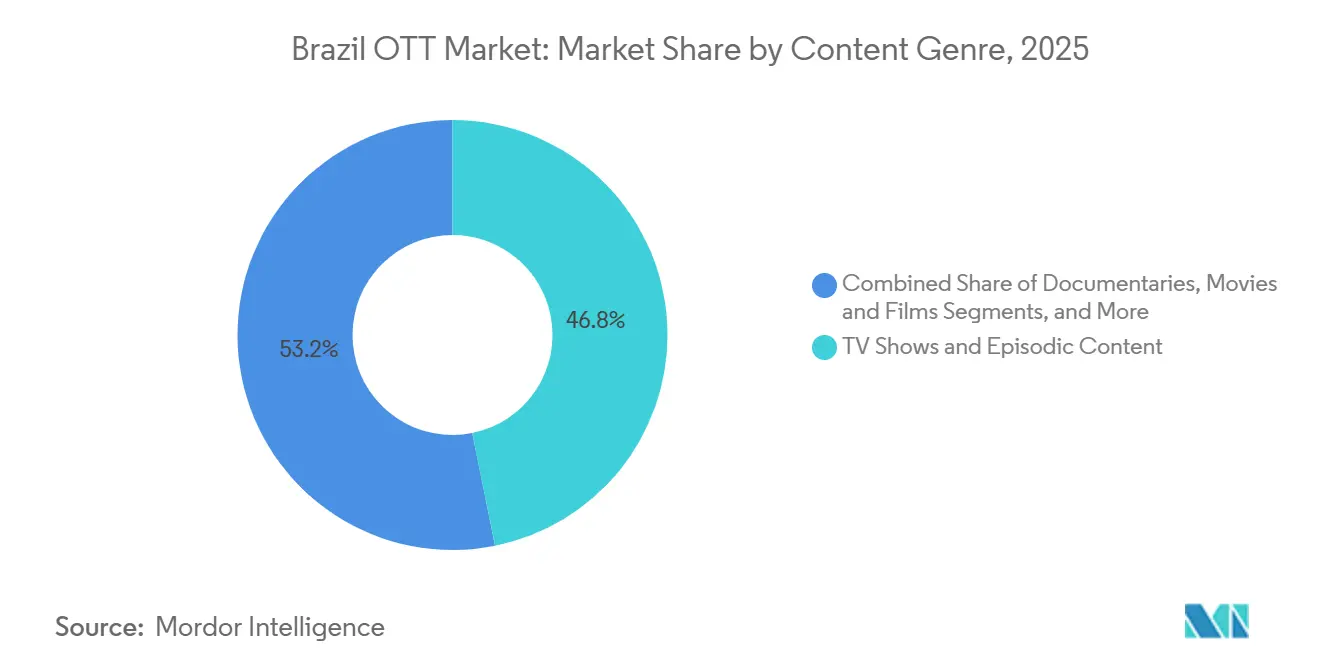
- By content genre, TV shows and episodic content accounted for 46.83% of Brazil OTT market revenue in 2025, while documentaries are projected to expand at a 10.04% CAGR through 2031.
Note: Market size and forecast figures in this report are generated using Mordor Intelligence’s proprietary estimation framework, updated with the latest available data and insights as of January 2026.
Brazil OTT Market Trends and Insights
Drivers Impact Analysis*
| Driver | (~) % Impact on CAGR Forecast | Geographic Relevance | Impact Timeline |
|---|---|---|---|
| Rising Broadband and Mobile Video Consumption | +2.5% | National, with early adoption in North and Northeast regions | Short term (≤ 2 years) |
| Rapid Shift From Pay TV to Streaming Bundles | +2.0% | National, concentrated in urban areas and extending to secondary cities | Short term (≤ 2 years) |
| Advertising Reallocation Toward CTV and Digital Video | +1.5% | São Paulo and Rio de Janeiro metropolitan areas, with national spillover | Medium term (2-4 years) |
| Localized and Brazilian-Language Content Advantage | +0.9% | National, with production hubs in São Paulo and Rio de Janeiro | Medium term (2-4 years) |
| Expansion of White-Label OTT and ISP Distribution | +0.6% | South and Southeast Brazil, especially regional fiber markets | Medium term (2-4 years) |
| FAST Monetization and Ad-Supported Revenue Scalability | +0.4% | National, with strong adoption in São Paulo, Rio de Janeiro, and Belo Horizonte | Long term (≥ 4 years) |
| Source: Mordor Intelligence | |||
Rising Broadband and Mobile Video Consumption
Brazil’s internet base passed a meaningful threshold in 2025, giving the Brazil OTT market a larger pool of connected viewers. The IBGE reported that 90.5% of people aged 10 and older used the internet in 2025. Mobile phones remained the main access device, used by 98.7% of internet users. Television-based internet access rose to 57.8% of users in 2025 from 53.5% in 2024, which widened the audience for large-screen viewing. This shift supports services that combine premium video with advertising, live channels, and familiar television interfaces. The Brazil OTT market also benefits when regional fiber providers connect smaller cities, where viewing had often depended solely on mobile devices.
Rapid Shift From Pay TV to Streaming Bundles
The decline of pay TV is changing the way video services compete in Brazil. Pay TV connections ended 2025 at 7.6 million, down 1.6 million from the prior year and at their lowest level since 2009. At the same time, 33.4 million households held at least 1 paid streaming subscription, covering 44.4% of homes with television sets. Internet video has become a stated substitute for cable among 10% of households without pay TV, suggesting that the shift is linked to convenience, content choice, and price. The Brazil OTT market is therefore shifting from a race for first-time subscribers toward a need to hold viewers through broader bundles. Amazon Prime Video and Globo introduced the Prime + Premiere package in July 2026, offering access to Campeonato Brasileiro Série A matches for BRL 63.90 (USD 10.85) per month, demonstrating how sports rights can support retention. Services that combine sports, news, and entertainment can offer a clearer reason to stay subscribed than a single-genre catalog.
Advertising Reallocation Toward CTV and Digital Video
Advertising is providing a second source of growth for the Brazil OTT market beyond subscription additions. Digital advertising investment reached BRL 42.7 billion (USD 7.30 billion) in 2025, up 12.7%, with video accounting for 49% of investment.[1]IAB Brasil, “Publicidade Digital no Brasil Cresce 12,7% e Atinge R$ 42,7 Bilhões em 2025,” IAB Brasil, portaldapropaganda.com.br Open television’s share of advertising spending fell from 50% in 2022 to 33.57% in 2025, while internet advertising reached 40.6%. This transfer of spending gives ad-supported platforms more room to fund programming without relying only on subscription price increases. Connected television viewing is especially relevant because viewers can receive television-like programming with more targeted advertising. The Brazil OTT market can benefit as advertisers seek measurable video inventory and as platforms improve their advertising sales and audience measurement.
Localized and Brazilian-Language Content Advantage
Brazilian-language programming remains important for providers seeking durable audience relationships. Public audiovisual investment reached BRL 1.41 billion (USD 241 million) in 2025, 29% above 2024, and supported 1,556 active projects across 3,981 registered works. The scale of this activity increases the supply of local stories, helping distinguish Brazilian services from broadly similar global catalogs. A bill passed by the Lower House in November 2025 set a Condecine-Streaming levy of up to 4% of gross revenue, while allowing discounts of up to 60% for direct investment in local production or co-production. Local production can therefore help platforms meet cultural demand and manage future regulatory costs. The Brazil OTT market has room for partnerships between domestic broadcasters, studios, and global services, as such arrangements can expand reach while sharing production costs.
Restraints Impact Analysis*
| Restraint | (~) % Impact on CAGR Forecast | Geographic Relevance | Impact Timeline |
|---|---|---|---|
| Content Licensing Fragmentation and Catalog Inefficiency | -0.8% | National, with greater effects on smaller regional platforms | Medium term (2-4 years) |
| High Churn in Multi-Subscription Households | -0.6% | National, concentrated in Class B and C urban households | Short term (≤ 2 years) |
| Piracy and Unmonetized Viewing Leakage | -0.5% | National, with higher incidence in North and Northeast regions | Short term (≤ 2 years) |
| Dependence on Imported Content Economics | -0.3% | National, with São Paulo and Rio de Janeiro as key licensing hubs | Long term (≥ 4 years) |
| Source: Mordor Intelligence | |||
Content Licensing Fragmentation and Catalog Inefficiency
Content rights remain difficult to manage across Brazil’s subscription, advertising-supported, and broadcast channels. Older studio contracts were often built for pay TV, and their expiry or renewal can move titles between services at different times. A title available on a global service in another country may therefore be missing from its Brazilian catalog for an extended period. This creates gaps for audiences and can make illegal alternatives more attractive when a desired program is unavailable. Smaller providers face higher pressure because they cannot always buy exclusive premium rights or offer a broad catalog. The Brazil OTT market also faces registration and reporting requirements for audiovisual works, while the streaming bill adds tax-reporting obligations under the Condecine-Streaming framework. Larger platforms can spread these legal and operational costs across wider catalogs, which may preserve their advantage.
High Churn in Multi-Subscription Households
Household budgets can limit the ability of services to maintain multiple paid subscriptions. Brazilian homes managed an average of 8.2 streaming services in 2025, including 4.6 paid services and 3.6 free services, according to the supplied research. The number of available services can make it easier for households to cancel and rejoin when a specific program is released. Income differences add to that risk because households with paid streaming subscriptions reported an average per capita income of BRL 3,072 (USD 525), compared with BRL 1,454 (USD 249) for households without subscriptions. New paying households may consequently be more sensitive to price increases than the existing subscriber base. The Brazil OTT market is likely to reward providers that offer lower-priced ad tiers, free channels, and bundles with recognized sports or entertainment brands. These options give viewers a reason to remain in the service ecosystem even when they reduce paid spending.
*Our forecasts treat driver/restraint impacts as directional, not additive. The impact forecasts reflect baseline growth, mix effects, and variable interactions.
Segment Analysis
By Revenue Model: SVOD Leads Revenue While AVOD Broadens Monetization
SVOD held 53.58% of Brazil OTT market revenue in 2025, making it the primary revenue model for premium on-demand programming. The position reflects a preference for ad-free access to series, films, and local programming. Serialized viewing also remains familiar to Brazilian audiences because telenovelas have long been central to conventional television schedules. Amazon Prime Video, Disney+, and Netflix compete largely through exclusive programs, sports, franchises, and release timing. TVOD remains a smaller option for rentals and cinema releases, while hybrid plans give users a lower-priced entry point.
AVOD is projected to expand at a 9.91% CAGR from 2026 to 2031, making it the fastest-growing revenue model. Its development follows the movement of advertising budgets from open television toward digital video and connected television. Free services can attract viewers who do not want another recurring payment, while premium services can use ad tiers to retain price-sensitive households. FAST channels add scheduled programming and a familiar channel guide without requiring a subscription. This model can generate revenue from viewing time and advertising demand, rather than relying solely on net subscription additions.



By Device Type: Mobile Holds the Largest Base While Smart TVs Gain Importance
Smartphones and tablets held 55.41% of Brazil OTT market revenue in 2025, reflecting the country’s mobile-first internet use. Mobile phones were used by 98.7% of internet users, while the ICT Households Survey reported that 99% of mobile internet users accessed content through those devices. Prepaid plans represented 52% of mobile phone users, a factor that can limit heavy data use but still supports regular video viewing. Smartphones are practical for commuting and daily use, which helps them retain their primary role as a gateway device. The Brazil OTT market share held by mobile devices shows that content availability and payment options must work well on smaller screens.
Smart TVs are projected to expand at a 9.85% CAGR from 2026 to 2031. Their growth is tied to more homes using television sets to access internet video and to the wider availability of FAST services. Among Brazilian viewers who watch FAST content, 83% use smart TVs. Smart TVs offer a more familiar setting for shared household viewing, live channels, sports, and advertising-supported programs. Television-based internet use rose by 4.3 percentage points between 2024 and 2025, indicating that the large-screen audience is widening.
By Content Genre: Episodic Programming Supports Revenue While Documentaries Grow Fastest
TV shows and episodic content accounted for 46.83% of Brazil OTT market revenue in 2025. This category benefits from a long-established audience preference for serialized stories, including novelas, series, and reality programs. Globoplay’s catalog is built around these formats, while global services have also commissioned Brazilian original series. Episodic releases can encourage repeat viewing and give subscribers a reason to stay through a season. Movies and films are another major category, supported by theatrical windowing and interest in Brazilian cinema.
Documentaries are projected to expand at a 10.04% CAGR from 2026 to 2031, the fastest rate among content genres. Factual programming can add breadth to catalogs at a lower cost per hour than scripted drama. It is especially useful for advertising-supported and FAST services that need larger libraries to support extended viewing. Netflix announced “Marcha das Onças,” its first nature documentary produced in South America, in partnership with Brazilian studios, and focused on the Pantanal.[2]Netflix, “Netflix Anuncia 10 Novas Produções Nacionais em Parceria com o Mercado Audiovisual Brasileiro,” Netflix, einerd.com Sports, music, and comedy programs also continue to add variety as rights move from pay TV toward subscription and hybrid services.
Geography Analysis
The Central-West recorded the highest household streaming penetration in Brazil at 51.5% in 2025, compared with a national rate of 44.4%.[3]Instituto Brasileiro de Geografia e Estatística, “Streaming de Vídeo Já Alcança 44,4% dos Lares Brasileiros,” Teletime, teletime.com.br The Southeast remains the commercial center of the Brazil OTT market because São Paulo and Rio de Janeiro host major broadcasters, studios, licensing teams, and much of the country’s broadband infrastructure. Household income is clearly associated with paid streaming use, with higher-income, more urban areas showing greater use. The South also benefits from dense fixed-broadband coverage and active regional fiber providers.
The Northeast had the lowest household streaming penetration at 30.7% in 2025, leaving ample room for expansion. The North and Northeast together include more than 80 million people and are home to many of the country’s first-time internet users. Rural household internet penetration reached 88% in 2025, compared with 35% in 2016, while mobile network coverage in rural areas reached 68%. The Condecine-Streaming bill directs 30% of collected funds to producers in the North, Northeast, and Central-West, thereby increasing the availability of regionally relevant programming. Mobile-delivered FAST services are well-suited to these areas because pay TV infrastructure was less developed outside major cities.
Brazil accounted for more than half of South America’s streaming subscriptions, according to the supplied research. Its scale makes the Brazil OTT market a practical launch location for regional content and pricing tests. Decisions made in Brazil can influence wider South American strategies because the country has a large Portuguese-speaking audience and a broad mix of urban and regional viewers. The Brazil OTT market share of regional subscriptions also strengthens the case for local production, advertising sales, and direct distribution investment. Regional differences will still require providers to balance premium offers in wealthier areas with accessible, mobile-friendly options in lower-penetration locations.
Competitive Landscape
Amazon Prime Video held 21% platform engagement share in the second quarter of 2026, followed by Disney+ at 19% and Netflix at 18%, based on the supplied JustWatch data. The close positions indicate that the Brazil OTT market lacks a clear leader among the largest global platforms. Disney+ grew through Star-branded Brazilian co-productions and established franchises, while Netflix faced more visible price sensitivity as its lead narrowed. Globoplay became profitable in late 2025 after a decade of losses and reported 11.8 million subscriptions, demonstrating that a domestic platform can compete at scale.
Distribution is becoming as important as content for the Brazil OTT market. Regional internet service providers can reach households that large global services may not serve efficiently through direct marketing. Watch TV Entretenimentos and Zapping Brasil act as wholesale aggregators for providers looking to add video services to their broadband offers. Mileto Tecnologia selected Synamedia Go in March 2026 to support personalized content discovery as it expands its streaming operations.[4]Synamedia, “Mileto Tecnologia Accelerates Streaming Growth With Synamedia Go,” Synamedia, synamedia.com The move followed Mileto’s acquisition of OiTV’s subscriber base and infrastructure in March 2025.
FAST platforms form a separate competitive layer within the Brazil OTT market. Samsung TV Plus, Pluto TV, and Tubi have become prominent smart TV services, giving viewers free access to scheduled channels and catalog content. Amazon Prime Video and Globo also launched the Prime + Premiere bundle in July 2026, using live football to make the service more useful to sports viewers. The planned framework for streaming regulation gives companies another reason to invest in Brazilian production and co-production. The Brazil OTT market is therefore competitive at the top, but it remains open to local broadcasters, platform aggregators, internet service providers, and free-channel operators that can offer a distinct route to viewers.
Brazil OTT Industry Leaders
Netflix, Inc.
Amazon.com, Inc.
The Walt Disney Company
Alphabet Inc.
Paramount, a Skydance Corporation
- *Disclaimer: Major Players sorted in no particular order

Recent Industry Developments
- July 2026: Amazon Prime Video and Globo launched the Prime + Premiere combo in Brazil, offering full access to 100% of Campeonato Brasileiro Série A matches for BRL 63.90 (USD 10.85). The bundle marked Prime Video’s deepest integration with Brazil’s premium football rights ecosystem and positioned sports content as a retention lever against churn in subscription video services. It also placed live football within a combined subscription rather than as a separate purchase.
- March 2026: Mileto Tecnologia selected the Synamedia Go platform for its next-generation streaming expansion. The deployment added personalized recommendations and content discovery to its infrastructure. It was built on Mileto’s March 2025 acquisition of OiTV’s subscriber base and its distribution agreement with SES. Mileto also had an exclusive arrangement supporting TIM Brasil’s TIM Play platform, which placed the company within telecom-led video distribution.
- January 2026: Brazil’s federal government announced that public audiovisual investment totaled BRL 1.41 billion (USD 241 million) in 2025. The amount was 29% higher than in 2024. The Sectoral Audiovisual Fund contributed BRL 564.3 million (USD 96.5 million) in direct project funding and BRL 411.1 million (USD 70.2 million) in credit operations for studio modernization. The funding covered active projects and registered works, linking public support to the supply of Brazilian audiovisual programming.
- November 2026: Brazil’s Ministry of Justice and Public Security completed the eighth phase of Operação 404, blocking and suspending 535 websites and 1 illegal streaming application. The action targeted the financing and monetization systems that support digital piracy networks. It expanded the focus beyond content removal to include payment processing and infrastructure that supported illegal platforms.


Brazil OTT Market Report Scope
The Brazil OTT market refers to the delivery of video, audio, and other media content over the internet, bypassing traditional cable, satellite, and broadcast television distribution channels. The market analysis covers key trends, growth drivers, challenges, the competitive landscape, and opportunities during the study period.
The Brazil OTT Market Report is Segmented by Revenue Model (SVOD, AVOD, TVOD, and Hybrid, Subscription and Ads), Device Type (Smartphones and Tablets, Smart TVs, Laptops and Desktops, and Other Device Types), and Content Genre (Movies and Films, TV Shows and Episodic Content, Documentaries, and Other Content Genres). The Market Forecasts are Provided in Terms of Value (USD).
| SVOD |
| AVOD |
| TVOD |
| Hybrid, Subscription and Ads |
| Smartphones and Tablets |
| Smart TVs |
| Laptops and Desktops |
| Other Device Types |
| Movies and Films |
| TV Shows and Episodic Content |
| Documentaries |
| Other Content Genres |
| By Revenue Model | SVOD |
| AVOD | |
| TVOD | |
| Hybrid, Subscription and Ads | |
| By Device Type | Smartphones and Tablets |
| Smart TVs | |
| Laptops and Desktops | |
| Other Device Types | |
| By Content Genre | Movies and Films |
| TV Shows and Episodic Content | |
| Documentaries | |
| Other Content Genres |


Key Questions Answered in the Report
What is the size of the Brazil OTT market?
The Brazil OTT market size is estimated at USD 6.59 billion in 2026 and is projected to reach USD 10.26 billion by 2031 at a 9.26% CAGR.
What is driving streaming adoption in Brazil?
Wider internet access, mobile viewing, television-based internet use, and the move away from pay TV are increasing streaming adoption.
Which revenue model is growing fastest in Brazil?
AVOD is projected to grow at a 9.91% CAGR from 2026 to 2031 as advertising shifts toward digital video and connected television.
Which device is most important for OTT viewing in Brazil?
Smartphones and tablets held 55.41% of revenue in 2025, while smart TVs are expected to grow fastest at a 9.85% CAGR.
Why is local content important for streaming services in Brazil?
Portuguese-language programs can improve audience relevance, support retention, and help providers respond to emerging local-content incentives.
What are the main risks facing video streaming providers in Brazil?
Key risks include subscription churn, piracy, fragmented content rights, and the cost of imported programming in a BRL-denominated operating environment.
Page last updated on:





