
Brazil Electric Truck Market Size and Share
Market Overview
| Study Period | 2019 - 2031 |
|---|---|
| Forecast Data Period | 2026 - 2031 |
| Base Year Market Size (2025) | USD 49.80 Million |
| Market Size (2026) | USD 55.01 Million |
| Market Size (2031) | USD 165.01 Million |
| Growth Rate (2026 - 2031) | 24.57 % |
| Market Concentration | Medium |
Major Players *Disclaimer: Major Players sorted in no particular order Image © Mordor Intelligence. Reuse requires attribution under CC BY 4.0. | |
Brazil Electric Truck Market Analysis by Mordor Intelligence
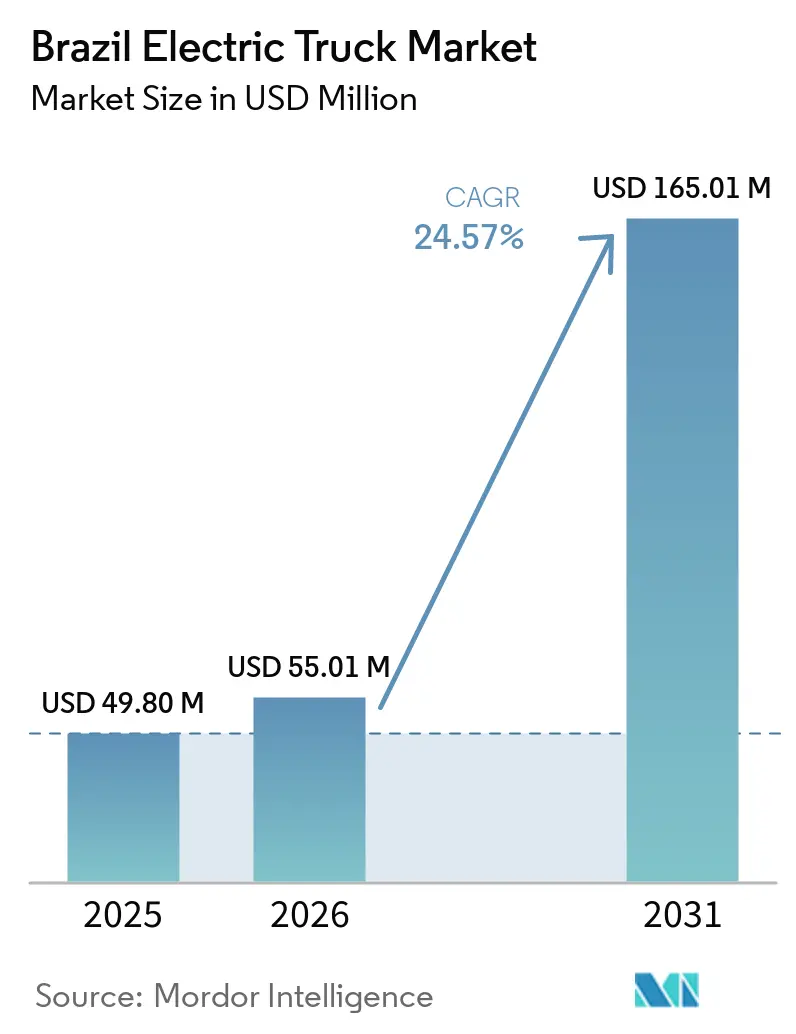
The Brazil electric truck market size was valued at USD 49.80 million in 2025, is estimated at USD 55.01 million in 2026, and is projected to reach USD 165.01 million by 2031, growing at a CAGR of 24.57% from 2026 to 2031. Brazil’s renewable electricity mix supports lower operating emissions for charged commercial vehicles, which improves the case for electric fleets on regular urban routes. Zero-emission heavy-duty vehicle sales reached 1,265 units in 2025, rising 48% from the prior year, although electric trucks represented only 0.4% of total truck sales[1]“Zero-Emission Bus and Truck Market in Brazil 2025,” International Council on Clean Transportation, theicct.org . This pattern favors controlled depot operations, where route predictability, energy planning, and vehicle utilization can be managed together. The Brazilian electric truck market, therefore, remains centered on early commercial uses, while policy continuity, charging access, and local production will determine how quickly it reaches longer freight routes.
Key Report Takeaways
- By propulsion type, battery electric vehicles held 94.12% of the Brazilian electric truck market share in 2025, while fuel-cell electric vehicles are forecast to grow at a 30.64% CAGR through 2031.
- By truck type, heavy-duty trucks accounted for 44.26% of the Brazilian electric truck market size in 2025, while medium-duty trucks are projected to grow at a 28.17% CAGR through 2031.
- By application, logistics and parcel held 48.01% of the Brazilian electric truck market share in 2025, while construction and mining are forecast to expand at a 26.34% CAGR through 2031.
- By driving range, the 150-300 km category held 45.33% of the Brazilian electric truck market share in 2025, while the more than 500 km category is forecast to grow at a 31.26% CAGR through 2031.
- By battery capacity, the 301-500 kWh category held 40.12% of the Brazilian electric truck market share in 2025, while the more than 500 kWh category is forecast to grow at a 29.33% CAGR through 2031.
- By motor architecture, dual-motor configurations held 43.22% of the Brazilian electric truck market share in 2025, while tri- and quad-motor configurations are forecast to grow at a 25.18% CAGR through 2031.
- By geography, Southeast Brazil held 65.05% of the Brazilian electric truck market share in 2025, while Central-West Brazil is set to grow at a 26.85% CAGR through 2031.
Note: Market size and forecast figures in this report are generated using Mordor Intelligence’s proprietary estimation framework, updated with the latest available data and insights as of January 2026.
Brazil Electric Truck Market Trends and Insights
Drivers Impact Analysis*
| Driver | (~) % Impact on CAGR Forecast | Geographic Relevance | Impact Timeline |
|---|---|---|---|
| Federal and State Incentives | +4.5% | National, with state activity in São Paulo, Minas Gerais, and Bahia | Medium term (2-4 years) |
| Last-Mile Delivery Electrification | +4.0% | Southeast Brazil, with expansion into South Brazil | Short term (≤ 2 years) |
| Fleet Decarbonization Commitments | +3.5% | National, with early activity in São Paulo and Minas Gerais | Short term (≤ 2 years) |
| Local Assembly and Price Competition | +3.0% | National, with manufacturing activity in São Paulo, Rio de Janeiro, Bahia, and Minas Gerais | Medium term (2-4 years) |
| Diesel Price Volatility and Electricity Advantage | +2.8% | National, with a stronger effect in high-diesel-cost states | Medium term (2-4 years) |
| Predictable Urban Route Charging | +2.3% | Southeast and South Brazil, with emerging use in Central-West Brazil | Medium term (2-4 years) |
| Source: Mordor Intelligence | |||
Federal and State-Level Electromobility Incentives
Brazil’s MOVER program, established under Lei 14.902/2024 and regulated through Decreto 12.435/2025, replaced Rota 2030 with carbon dioxide reduction requirements and research-linked tax incentives. The program included USD 4.8 billion in tax credits through 2028 and had supported more than USD 26 billion in announced automotive investments by 2025 [2]“Brazil Automotive Incentives for EV Competition and Innovation,” International Trade Administration, trade.gov . The research spending requirement encourages manufacturers to adapt battery conditioning and thermal management for local conditions, which is important for fleet reliability in high temperatures and can make electric vehicles more suitable for a broader set of commercial operating patterns. These measures reduce uncertainty around investment planning, although individual fleet projects still depend on local network capacity and financing terms. The Brazilian electric truck market benefits when regulatory standards, tax treatment, charging investment, domestic research commitments, and vehicle financing progress on similar timelines rather than leaving carriers to manage each element separately.
Urban Last-Mile Delivery Electrification
Urban delivery fleets in São Paulo are moving first because their vehicles return to fixed depots and operate on repeatable routes. Amazon Brasil expanded its electric delivery operations in 2025, with zero-emission stations serving several cities in São Paulo and Minas Gerais. Carrefour Brasil electrified its Express logistics fleet in Greater São Paulo in 2026, reporting a 33% increase in productivity and significant annual savings [3]“Carrefour Eletrifica Frota do Express na Grande São Paulo,” ABRALOG, abralog.com.br. The program also removed a significant volume of carbon dioxide equivalent from the operation, linking delivery performance with fleet decarbonization and showing why large urban operators can assess electric vehicles through both service outcomes and their wider emissions commitments. Large shippers are increasingly seeking low-carbon transport options from carriers, making vehicle electrification relevant to contract renewal and fuel costs. These operating conditions make last-mile fleets a practical entry point into the Brazilian electric truck market, especially when depot power upgrades, vehicle replacement schedules, route assignments, and charging windows can be planned as a single operating decision.
Corporate Fleet Decarbonization Commitments
Large shippers across the retail, food and beverage, pulp and paper, and steel industries are incorporating verified emissions reductions into long-term logistics contracts. Bracell’s target to reduce carbon emissions per tonne of cellulose by 75% is increasing demand for high-capacity electric trucks in its logistics operations. Access to renewable electricity and volatile diesel prices further intensify procurement pressures, prompting fleet operators to evaluate fleet economics over the vehicle operating life rather than focusing solely on purchase price. Lower operating emissions also enable operators to meet the requirements of large customers.
Local Assembly and Chinese OEM Price Competition
Chinese manufacturers have expanded the range of electric trucks available in Brazil and placed greater emphasis on pricing. Foton linked its local production plans to output approaching 220 units per month, indicating a move beyond limited import activity. In May 2026, XCMG announced plans to assemble electric trucks in Pouso Alegre, Minas Gerais, between late 2026 and early 2027. Local assembly may improve access to domestic financing lines that require national content. Therefore, manufacturing location is a key factor in the Brazilian electric truck industry, influencing tariffs, credit availability, service support, parts availability, thermal adaptation, and total fleet costs. These factors are particularly important for customers who require financing, reliable maintenance, replacement parts, and practical technical support throughout a vehicle’s operating life to maintain commercial uptime.
Restraints Impact Analysis*
| Restraint | (~) % Impact on CAGR Forecast | Geographic Relevance | Impact Timeline |
|---|---|---|---|
| Vehicle and Charging-System Costs | -2.1% | National, especially smaller fleets and locations outside São Paulo | Medium term (2-4 years) |
| Limited Heavy-Truck Charging Coverage | -1.6% | North, Northeast, Central-West, and rural freight corridors | Long term (≥ 4 years) |
| Grid-Connection and Depot-Upgrade | -1.2% | National, with longer approval periods in North and Northeast Brazil | Medium term (2-4 years) |
| Battery Degradation Under Heat and Heavy Loads | -1.0% | North Brazil, tropical Northeast Brazil, and demanding routes | Long term (≥ 4 years) |
| Source: Mordor Intelligence | |||
High Upfront Vehicle and Charging-System Costs
Electric trucks still cost more than comparable diesel vehicles, particularly in heavy-duty configurations with battery packs above 400 kWh. The premium narrowed significantly in the light and medium segments, reflecting changes in battery costs and increased competition. Charging projects add grid upgrades, civil works, transformer replacement, permitting, site design, and utility coordination to the vehicle purchase decision. Hence, the commercial case depends as much on infrastructure execution as on the truck specification itself. Smaller carriers may not have the fleet scale needed to spread those fixed costs across many vehicles. Approval periods of 8-14 months outside major cities can also delay charging projects after a fleet decision has already been made, slowing the Brazil electric truck market, even where demand is present and where an operator has suitable routes, committed customers, and planned vehicle deliveries.
Limited Heavy-Truck Charging Coverage Outside Urban Hubs
The Brazilian freight network carries substantial commodity volumes along routes that lack dedicated heavy-truck charging infrastructure. The São Paulo-Rio de Janeiro e-Dutra corridor is the first structured zero-emission freight route, demonstrating the planning required for regional routes to scale. Tropical heat and heavy loading can accelerate battery aging, increasing the importance of thermal management in commercial packs and requiring operators to consider battery condition, maintenance practices, and vehicle use intensity over the full operating life. These conditions increase technical and financial requirements for operators outside established urban hubs. Until corridor charging and durable battery systems expand, diesel will retain a strong position on routes beyond 300 km, especially where freight schedules are tight, payloads are high, and a vehicle cannot remain idle for extended charging periods.
*Our forecasts treat driver/restraint impacts as directional, not additive. The impact forecasts reflect baseline growth, mix effects, and variable interactions.
Segment Analysis
By Propulsion Type: Battery Electric Vehicles Lead Current Deployment While Fuel-Cell Models Target Longer Routes
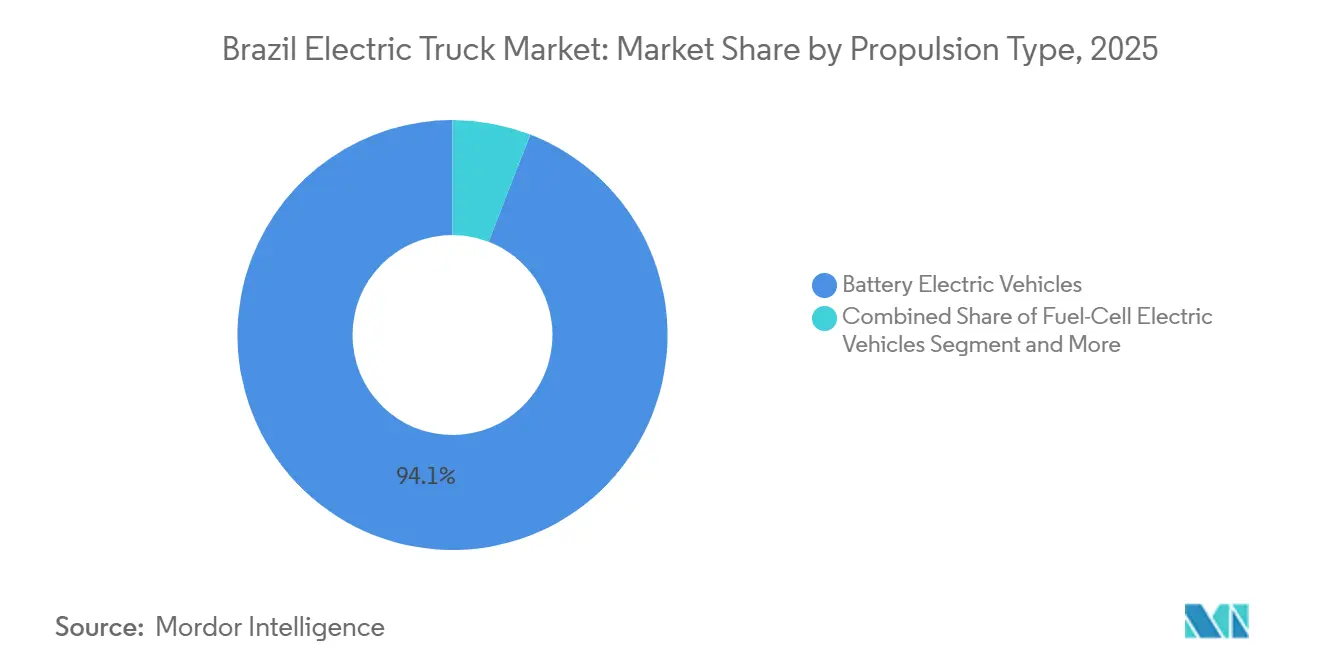
Battery electric vehicles accounted for 94.12% of the Brazilian electric truck market share in 2025, reflecting the availability of models for urban and regional work. Their lead is supported by depot charging, controlled daily distance, and the ability to return to base for planned charging, thereby avoiding reliance on a public network that remains unevenly distributed across Brazilian freight corridors and regional cities. JAC’s iEV1200T and E-JT 12.5-tonne models, along with Foton’s iBlue, are intensifying competition in the 5-14-tonne category. These vehicles are well-suited for routes where operators can schedule charging without disrupting deliveries. Battery electric vehicles, therefore, remain the principal commercial option for the Brazilian electric truck market in the near term, because their commercial case is clearest where fleets can control departure times, daily distance, depot access, and vehicle turnaround.
Fuel-cell electric vehicles are the fastest-growing propulsion category, set to advance with a CAGR of 30.64% through 2031. The category begins from a small base, so early demonstrations carry significant weight in its growth profile. In August 2026, GWM Hydrogen completed South America’s first cargo transport using a fuel-cell truck. The 544 hp vehicle has a stated range of 500 km and uses green hydrogen produced at SENAI Cimatec Park in Camaçari, Bahia. Plug-in hybrid models remain a limited transitional option, while limited charging infrastructure constrains the broader adoption of fully battery-electric vehicles. MOVER’s broad zero-emission framework supports both battery and fuel-cell systems, rather than treating one technology as a replacement for the other, allowing operators to select propulsion based on route length, refueling access, payload, and duty cycle.



By Truck Type: Heavy-Duty Trucks Hold the Largest Position While Medium-Duty Trucks Expand Faster
Heavy-duty trucks accounted for 44.26% of the Brazilian electric truck market in 2025, supported by controlled industrial, mining, pulp, and retail logistics operations. These settings have defined distances, established depots, and fleet owners who can manage charging infrastructure, enabling energy demand, maintenance, vehicle availability, and route timing to be monitored within a single industrial or logistics operation. Heavy-duty adoption will remain limited by payload, charging time, longer route requirements, and the need for dependable depot or corridor infrastructure, even when fleet owners operate from managed industrial locations.
Medium-duty trucks are the fastest-growing truck type, with a 28.17% CAGR expected through 2031. This category aligns closely with urban distribution cycles, which offer predictable mileage and return-to-depot charging. Light trucks continue to serve last-mile delivery and municipal operations, where smaller packs can reduce purchase costs. Farizon’s H9E and BYD’s T35 added options for operators focused on urban tasks. Tractor-trailers remain more difficult to electrify because gross combination weights exceed 40 tonnes and routes often extend beyond the available charging infrastructure. BYD’s planned 60-tonne tractor for port routes showed the competitive interest in that remaining gap. PROCONVE P8 and MOVER targets affect fleet renewal across each truck category. Still, their commercial impact is strongest where use patterns are well defined, charging can be installed at a known location, and vehicle downtime can be incorporated into dispatch planning.
By Application: Logistics and Parcel Lead; Construction and Mining Gain Pace
Logistics and parcel accounted for 48.01% of the Brazilian electric truck market share in 2025, making it the largest application segment. E-commerce volumes and corporate fleets support demand for predictable urban and hub-to-hub routes. In January 2026, Grupo DPSP launched an EVMOB partnership in São Paulo and Rio de Janeiro, covering over 6 million kilometers over six years using renewable energy from its distribution centers. Mercado Livre reported lower operating costs for electric trucks on predictable urban routes. Retail and FMCG deliveries share similar conditions, while municipal and utility applications remain earlier-stage due to different procurement, reliability, and route requirements.
Construction and mining will emerge as the fastest-growing application, with a forecast CAGR of 26.34% through 2031. The category is advancing through pilot projects that test payload capacity, terrain performance, and energy recovery under site-specific conditions. Cedro Mineração is scheduled to begin electric dump truck trials in Nova Lima, Minas Gerais, in April 2026. Industrial deployment depends on route planning, charging infrastructure, and vehicle durability. The application is most relevant for controlled routes where operators can recover energy downhill, integrate charging into site operations, and assess vehicle performance before expanding pilot fleets.
By Driving Range: The 150-300 km Category Leads Current Use While Long-Range Systems Develop
The 150-300 km driving-range category held 45.33% of the Brazilian electric truck market share in 2025. This range matches depot-to-depot operations, municipal logistics, and distribution-center movements within metropolitan areas. It is the operating range where charging schedules are most manageable and daily route risk is lowest, because fleets can return to known facilities rather than rely on public chargers during deliveries or make route decisions around uncertain charging availability. Scania’s 30G offered a loaded range of 250 km, placing it within this established operational band. Vehicles covering less than 150 km handle short urban delivery and last-mile operations. The 301-500 km range category is gaining use as manufacturers offer larger packs, and private charging expands along selected routes. Range choice remains tied to route certainty, payload requirements, the time available for charging, the location of vehicle stops, and the degree to which a fleet can adjust delivery schedules around charging periods.
The more than 500 km category is forecast to grow at a 31.26% CAGR through 2031. This range represents the threshold for a larger share of interstate and long-haul freight activity. GWM’s fuel-cell truck reported a range of up to 500 km with a 20-minute refueling time. The stated capability creates an alternative to long-duration battery charging on freight routes where downtime is difficult to accommodate. Mercedes-Benz documented a 476 km single-charge eActros 400 journey between São Bernardo do Campo and Curitiba. Imported heavy new-energy trucks also face local battery testing requirements under INMETRO Portaria 142/2026. These requirements raise the importance of durability under heat and humidity. The Brazilian electric truck market will need more reliable corridor charging or refueling before this range band can serve freight volumes at scale, because interstate logistics requires predictable energy access between freight nodes as well as reliable performance in loaded operation.
By Battery Capacity: 301-500 kWh is the Standard as Larger Packs Gain Adoption
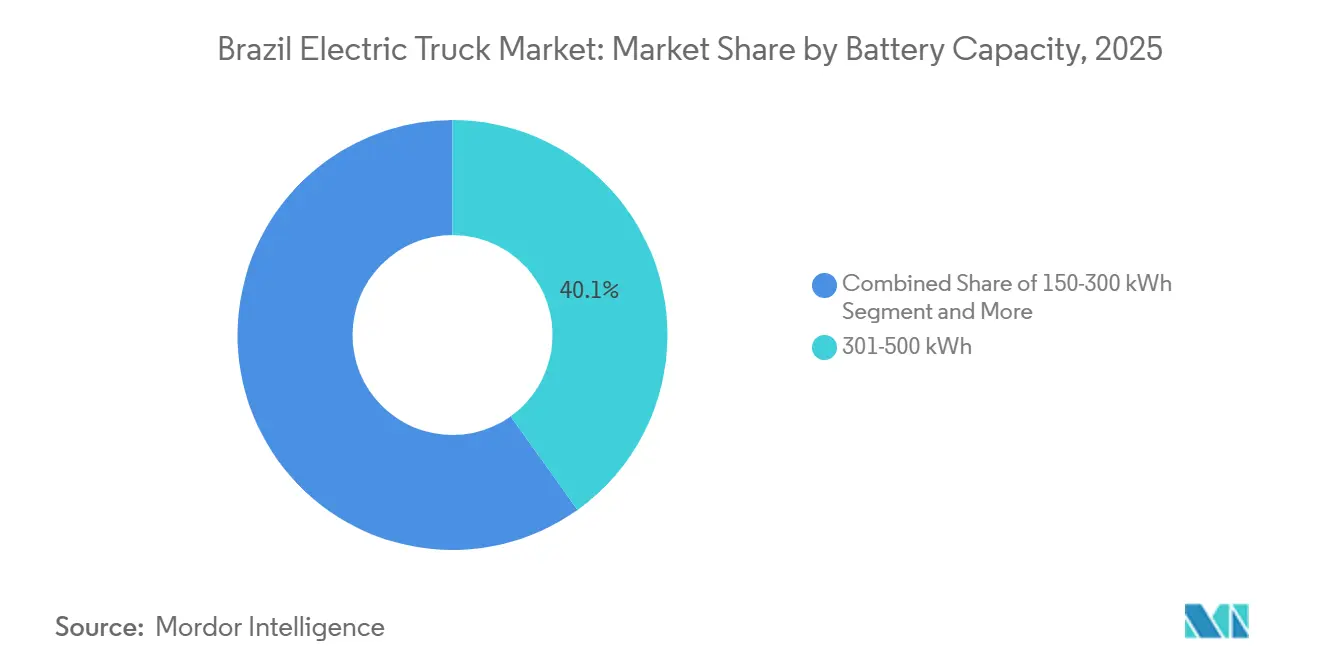
The 301-500 kWh category held 40.12% of the Brazilian electric truck market share in 2025. It represents a workable capacity band for medium-to-heavy battery-electric trucks used in urban and regional settings, balancing the need for usable driving range with the added cost, mass, charging requirement, and thermal management burden associated with larger battery packs. Scania’s 30G uses a 416 kWh NMC battery, positioning the vehicle within this band. Volkswagen Caminhões e Ônibus e-Delivery 17 and Mercedes-Benz eActros 300 models also fit the operating profile associated with this capacity range. The 150-300 kWh category serves lighter urban trucks and delivery vans where price remains important. Less-than-150-kWh models serve last-mile and micro-logistics routes with lower daily energy needs. JAC’s 64 kWh and 107 kWh offerings remain relevant where smaller packs are sufficient for local duty cycles. Battery capacity selection is therefore shaped by vehicle weight, route length, payload, charging access, daily utilization, thermal conditions, and the willingness to accept a higher upfront cost for additional operating flexibility.
More than 500 kWh is the fastest-growing battery capacity category, with a 29.33% CAGR forecast through 2031. Research conducted under equatorial conditions indicates that higher temperatures accelerate lithium-ion battery aging, reinforcing the need for liquid-cooled thermal management systems. Local certification requirements also make thermal durability a critical consideration before high-capacity vehicles enter commercial service. Although larger battery packs can expand application potential, their cost, weight, thermal management requirements, certification needs, and impact on vehicle design remain significant constraints for operators evaluating heavy-freight and industrial duty cycles.
By Motor Architecture: Dual-Motor Vehicles Lead While Tri and Quad-Motor Systems Address Demanding Routes
Dual-motor configurations held 43.22% of the Brazilian electric truck market share in 2025. The architecture offers a balance of torque, vehicle control, and redundancy for medium-duty urban work, where vehicles repeatedly accelerate, brake, handle varying payloads, and must remain available for commercial routes with limited tolerance for mechanical disruptions. Volkswagen’s second-generation e-Delivery motor delivered 280 kW and 2,300 Nm from a standstill. Dual-motor systems are well-suited to stop-and-go logistics because they deliver responsive performance at lower speeds. Single-motor configurations remain relevant for light trucks where torque requirements are lower. They also serve purchasers who place greater weight on initial vehicle cost. Motor architecture choices therefore differ according to payload, terrain, route frequency, maintenance requirements, expected downhill energy recovery, and the degree of traction control needed during daily commercial operation.
Tri- and quad-motor configurations are forecast to grow at a 25.18% CAGR through 2031. Demand is linked to mining, construction, and steep-route applications that require strong traction and regenerative braking. GWM’s fuel-cell truck provides 400 kW and 2,700 Nm through its multi-motor system. The configuration can also recover energy during braking on downhill routes, which is relevant to Brazil’s coastal escarpments. Independent motor control can support vehicle handling in more demanding terrain than urban delivery conditions. These systems are likely to remain focused on high-value industrial duties because their value is greatest where operational complexity is high. Their growth should therefore accompany site-specific vehicle trials rather than broad use across all truck categories, because the operational benefit is most evident where gradients, loads, braking events, and surface conditions create a clear performance requirement.
Geography Analysis
Southeast Brazil held 65.05% of the Brazilian electric truck market share in 2025, making it the leading regional base. The region combines São Paulo’s logistics density, corporate compliance pressure, a concentrated highway network, and a high concentration of fleet operators that can test new vehicles on repeat routes while coordinating depot charging, service support, and customer reporting requirements, which provides a durable early base for commercial deployment. The e-Dutra coalition connects São Paulo and Rio de Janeiro and aims to reach 1,000 daily electric-truck trips by 2030.
Espírito Santo is an industrial activity center within the Southeast because Suzano has tested heavy electric trucks at Aracruz. South Brazil holds a secondary position, supported by industrial demand and its connection with Southeast manufacturing and logistics. Santa Catarina’s Electric Route program expanded from 35 to 100 charging stations. This infrastructure is relevant to regional industrial freight. However, it does not remove charging constraints on every intercity route or eliminate the need for fleet-specific planning around vehicle range, delivery timing, and local grid capacity.
Northeast Brazil combines vehicle production potential with limited charging coverage beyond major urban areas. BYD’s Camaçari facility in Bahia, inaugurated in October 2025, has an annual production capacity of 150,000 electrified vehicles. GWM’s Camaçari activities add hydrogen production and truck testing to the region’s clean-mobility base. Central-West Brazil is forecast to grow at a 26.85% CAGR through 2031, driven by agribusiness freight associated with soy, beef, and sugar-ethanol production. However, early adoption is expected to remain concentrated in short-haul operations at agro-industrial sites rather than along long-distance commodity routes. Longer grid approval times and higher ambient temperatures continue to increase the requirements for reliable electric truck deployment in the North, where technical adaptation, charging investment, and fleet confidence must develop together.
Competitive Landscape
The Brazilian electric truck market is moderately concentrated within individual truck categories, but competition is increasing across the full product range. JAC Motors, Volkswagen, Daimler Truck, AB Volvo, and Foton dominated the market. This competitive structure highlights the rapid progress of Chinese brands, which introduced additional electric models, localized strategies, and competitively priced offerings in Brazil’s still-small commercial vehicle market. The landscape also reflects early adoption in construction and industrial applications, where vehicle availability and site-specific support are critical. In these applications, buyers can evaluate vehicle performance under defined operating conditions rather than requiring immediate coverage across Brazil’s extensive and diverse highway freight network. Scania’s commercial delivery of its 30G electric truck to Reiter Log marked the entry of a European heavy-duty electric tractor into the market’s commercial phase.
BYD advanced multiple initiatives simultaneously, including testing heavy 6×2 tractors, developing the T35 urban chassis, and preparing a 60-ton fuel-cell truck. Volkswagen expanded e-Delivery weight classes in 2026, while Scania is preparing its São Bernardo do Campo facility for future domestic production. These developments indicate that local manufacturing, product portfolios, and access to financing are increasingly interconnected competitive factors. Companies with tailored service networks and local technical capabilities are better positioned to support fleets operating in tropical conditions, particularly as customers require durable batteries, rapid maintenance response, charging coordination at operational sites, and practical support for new vehicle technologies.
The Brazilian electric truck industry has openings for medium- and long-haul fuel-cell trucks and purpose-built vehicles for agribusiness and mining. These applications lie outside the most established São Paulo-Rio de Janeiro urban freight corridor. Imported new-energy trucks must meet local battery testing requirements, thereby strengthening the value of locally adapted vehicles and testing partnerships. The competitive environment, therefore, favors firms that can combine vehicle supply with infrastructure planning, domestic financing access, thermal adaptation, local testing, parts availability, and aftersales support for fleets that cannot accept disruptions to daily freight operations, especially when new truck technology is deployed beyond the most established metropolitan logistics corridors.
Brazil Electric Truck Industry Leaders
Volkswagen Trucks & Buses
BYD Auto Co., Ltd.
JAC Motors
Daimler Truck Holding AG
AB Volvo
- *Disclaimer: Major Players sorted in no particular order


Recent Industry Developments
- August 2026: Scania’s 30G 4×2 electric tractor entered commercial operation in Reiter Log’s fleet in the São Paulo metropolitan region. The truck features a 416 kWh NMC battery, delivers 410 hp, and offers a loaded range of 250 km.
- August 2026: Tonly delivered DTH145 hybrid mining trucks with a 91-tonne payload capacity to R&D Mineração e Construção, a mining and construction company based in Juiz de Fora, Minas Gerais. The delivery expanded the deployment of hybrid mining truck technology at the company’s operations in the region.
- May 2026: BYD tested 10 heavy-duty 6×2 electric tractors at its Camaçari factory in Bahia, advancing its expansion into electrified heavy-duty road freight. The testing program evaluated the vehicles’ performance and operational capabilities for commercial freight applications, supporting BYD’s strategy to strengthen its presence in Brazil’s electrified heavy-duty transport segment.


Brazil Electric Truck Market Report Scope
The scope includes segmentation by propulsion type (battery electric vehicles, fuel-cell electric vehicles, and plug-in hybrid electric vehicles), truck type (light truck (less than or equal to 3.5 t GVW), medium-duty truck (3.6–12 t), heavy-duty truck (more than 12 t), and tractor-trailer), application (logistics and parcel), municipal services (waste, street-sweep), construction and mining, retail and FMCG delivery, and utility and other industrial), driving range (less than 150 km, 150-300 km, 301-500 km, and more than 500 km), battery capacity (less than 150 kWh, 150-300 kWh, 301-500 kWh, and more than 500 kWh), motor architecture (single-motor, dual-motor, and tri/quad-motor). The analysis also covers regional-level segmentation, including Southeast Brazil, South Brazil, Northeast Brazil, Central-West Brazil, and North Brazil. Market size and growth forecasts are presented by value in USD and volume in Units.
| Battery Electric Vehicles |
| Fuel-Cell Electric Vehicles |
| Plug-in Hybrid Electric Vehicles |
| Light Truck (Less than or equal to 3.5 t GVW) |
| Medium-Duty Truck (3.6–12 t) |
| Heavy-Duty Truck (More than 12 t) |
| Tractor-Trailer |
| Logistics and Parcel |
| Municipal Services (Waste, Street-sweep) |
| Construction and Mining |
| Retail and FMCG Delivery |
| Utility and Other Industrial |
| Less Than 150 km |
| 150-300 km |
| 301-500 km |
| More Than 500 km |
| Less Than 150 kWh |
| 150-300 kWh |
| 301-500 kWh |
| More Than 500 kWh |
| Single-Motor |
| Dual-Motor |
| Tri/Quad-Motor |
| Southeast Brazil |
| South Brazil |
| Northeast Brazil |
| Central-West Brazil |
| North Brazil |
| By Propulsion Type | Battery Electric Vehicles |
| Fuel-Cell Electric Vehicles | |
| Plug-in Hybrid Electric Vehicles | |
| By Truck Type | Light Truck (Less than or equal to 3.5 t GVW) |
| Medium-Duty Truck (3.6–12 t) | |
| Heavy-Duty Truck (More than 12 t) | |
| Tractor-Trailer | |
| By Application | Logistics and Parcel |
| Municipal Services (Waste, Street-sweep) | |
| Construction and Mining | |
| Retail and FMCG Delivery | |
| Utility and Other Industrial | |
| By Driving Range | Less Than 150 km |
| 150-300 km | |
| 301-500 km | |
| More Than 500 km | |
| By Battery Capacity | Less Than 150 kWh |
| 150-300 kWh | |
| 301-500 kWh | |
| More Than 500 kWh | |
| By Motor Architecture | Single-Motor |
| Dual-Motor | |
| Tri/Quad-Motor | |
| By Geography | Southeast Brazil |
| South Brazil | |
| Northeast Brazil | |
| Central-West Brazil | |
| North Brazil |


Key Questions Answered in the Report
What is driving electric truck adoption in Brazil?
Urban depot fleets, corporate decarbonization commitments, renewable electricity, and MOVER-related investment support are advancing adoption.
How large is Brazil’s electric truck market in 2026?
The Brazil electric truck market is valued at USD 55.01 million in 2026 and is forecast to reach USD 165.01 million by 2031.
Which electric truck propulsion system leads in Brazil?
Battery electric vehicles led with 94.12% of revenue in 2025 because they suit predictable urban and regional depot routes.
Which truck application is growing the fastest?
Construction and mining is forecast to grow at a 26.34% CAGR through 2031 as industrial pilots expand.
Page last updated on:





