
Brazil Air Purifier Market Size and Share
| Study Period | 2019 - 2030 |
| Forecast Data Period | 2025 - 2030 |
| Historical Data Period | 2019 - 2023 |
| Market Size (2025) | USD 271.10 Million |
| Market Size (2030) | USD 391.30 Million |
| CAGR (2025 - 2030) | 7.62% |
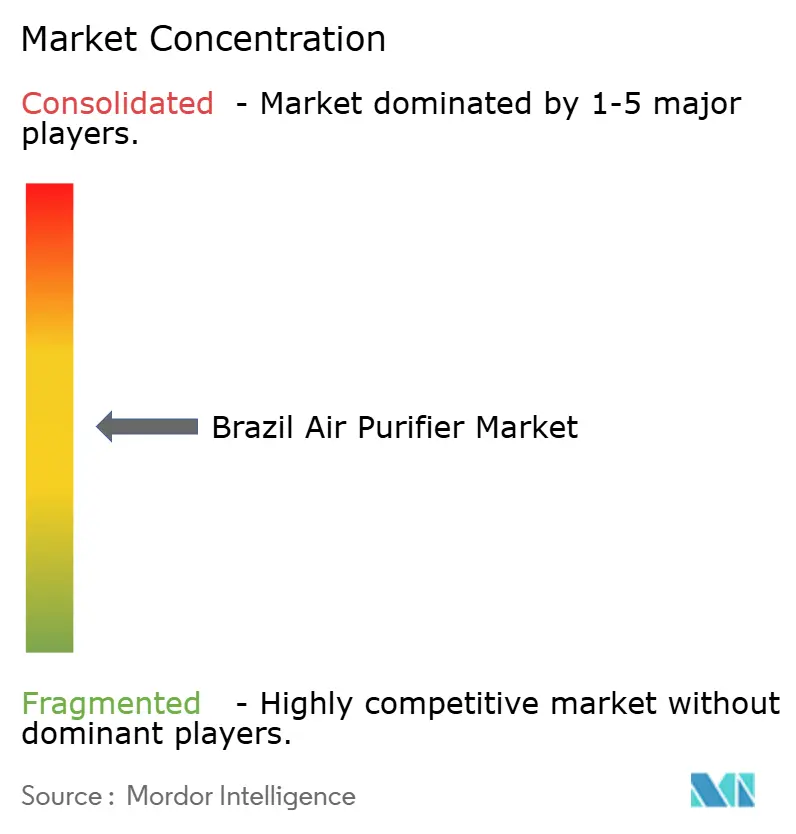
| Market Concentration | Medium |
Major Players *Disclaimer: Major Players sorted in no particular order |
Brazil Air Purifier Market Analysis by Mordor Intelligence
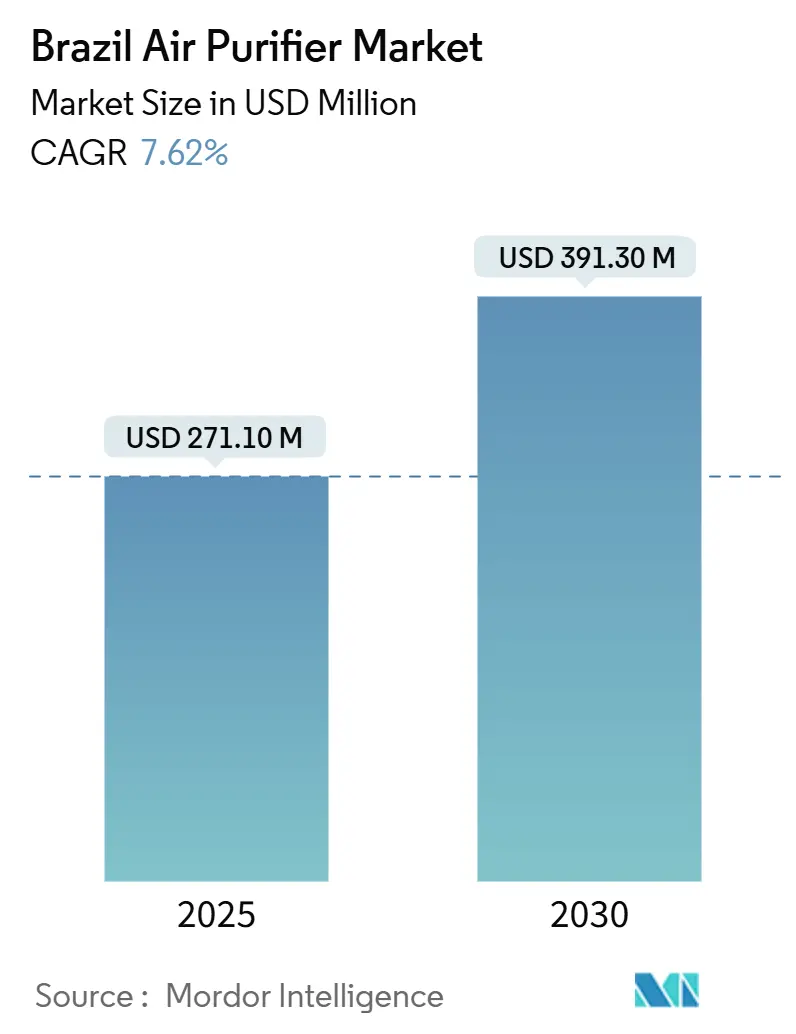
The Brazil Air Purifier Market size is estimated at USD 271.10 million in 2025, and is expected to reach USD 391.30 million by 2030, at a CAGR of 7.62% during the forecast period (2025-2030).
- Over the medium term, factors such as increasing airborne diseases giving rise to growing consumer health consciousness and rising emissions due to industrial activities coupled with rising air pollution are expected to drive the brazil air purifier Market.
- On the other hand, despite the various technological developments, owing to the high price, installation, and maintenance costs of air purifiers are expected to restrain the Brazil air purifier market.
- Nevertheless, as Brazil grapples with rising GHG emissions, the emergence of innovations like smart air purifiers is poised to unlock numerous opportunities in the air purifier market over the coming years.
Brazil Air Purifier Market Trends and Insights
The High-efficiency Particulate Air (HEPA) Segment is Expected to Dominate the Market
- Mechanical air filters, like HEPA filters, capture airborne particles on their filter materials. These filters effectively trap larger particles, including dust, pollen, mold spores, and allergens from dust mites and cockroaches. In Brazil, where air quality is a persistent challenge, HEPA filter technologies have become indispensable, especially from a healthcare perspective.
- HEPA filters outshine electrostatic precipitators (ESPs) and ionizers in capturing airborne particles. While ESPs utilize electrostatic forces for particle removal, they also produce ozone. Ionizers, on the other hand, can cause particles to settle on surfaces. HEPA filters, characterized by their extended surface area, boast higher efficiencies in removing both large and small airborne particles. Furthermore, they outperform pleated filters in eliminating respirable particles. HEPA air purifiers typically adhere to two prevalent standards: the European Standard mandates a 99.95% removal rate for particles ≥ 0.3 micrometers, while the ASME Standard sets the bar at 99.97%.
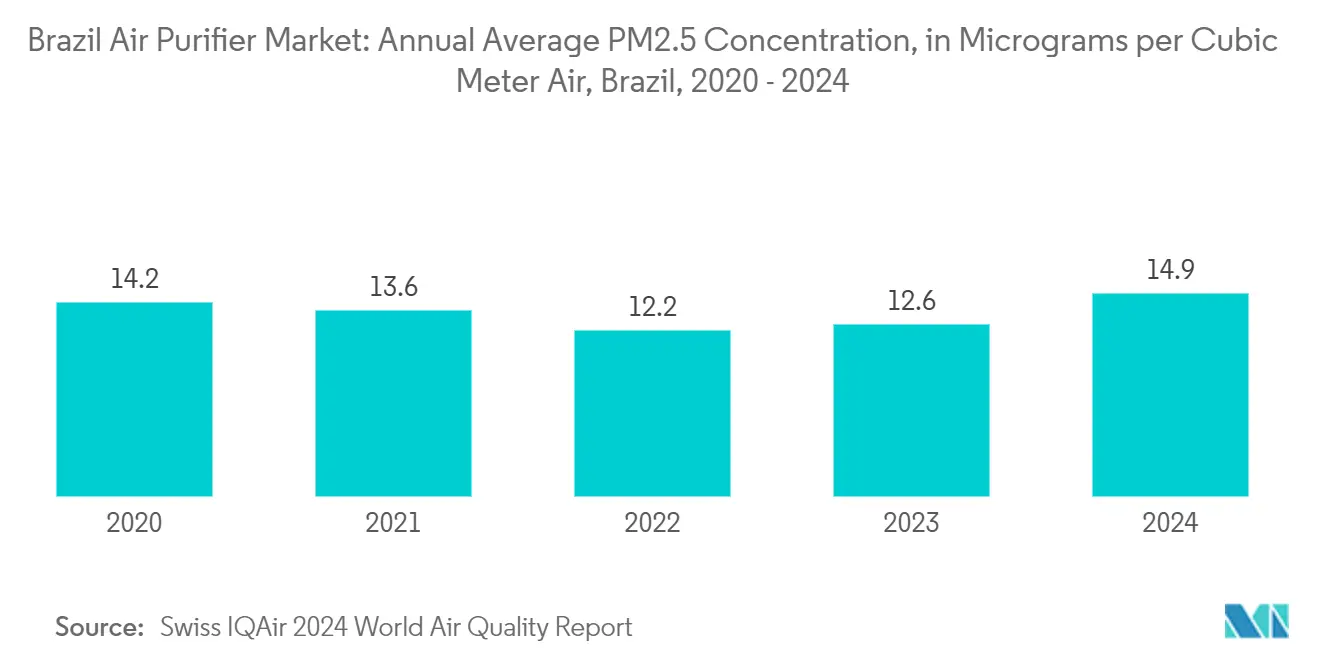
- According to a 2024 report by Swiss IQAir, Brazil's rising PM2.5 levels underscore the urgent need for HEPA air purifiers. Data indicates that Brazil's annual average PM2.5 concentration climbed from 12.6 μg/m³ in 2023 to 14.9 μg/m³ in 2024. Alarmingly, the 2024 figure is two to three times above the permissible limit, fueling the demand for HEPA technology in the nation.
- In Brazil, the World Health Organization (WHO) reported that lower respiratory infections ranked as the fourth leading cause of death, averaging 38.3 deaths per 100,000 individuals. This statistic underscores the growing demand for HEPA air purifier technology in the country.
- Respiratory diseases, notably Tuberculosis, have further spurred the demand for HEPA air purifiers in Brazil. WHO data reveals a rise in Tuberculosis cases, from 40 per 100,000 in 2020 to 45 per 100,000 in 2023. Those affected often find HEPA air purifiers essential for daily use.
- In June 2024, Ahlstrom Oyj made headlines with a EUR 2 million investment in a new laminator at its Louveira plant in Brazil. This strategic move expands Ahlstrom's South American product offerings, focusing on industrial air, liquid, and fuel filtration. Notably, these products were previously sourced from Europe and North America. The lamination process enhances filtration materials, leading to better efficiency, extended service intervals, and reduced energy consumption.
- Ahlstrom's investment is synchronized with upgrades to its Fine Fiber platform in Turin, which is set to produce HEPA filtration layers. By merging Fine Fiber media with molecular filtration materials, Ahlstrom aims to bolster protection against even the smallest particles. With such advancements, HEPA technology is set to dominate Brazil's air purifier market.
- Given the aforementioned factors, the High-efficiency Particulate Air (HEPA) segment is poised to lead the air purifier market in Brazil during the forecast period.
Growing Air Pollution snd GHG Emissions will Likely Create Several Future Opportunities
- Brazil, one of the world's largest energy consumers, has been witnessing a gradual economic growth. In 2023, Brazil emerged as the world's 5th largest emitter of greenhouse gases (GHG), accounting for roughly 2.5% of global emissions. These emissions were predominantly driven by sectors such as agriculture, industry, power generation, and changes in land use.
- Data from the 2023 SEEG - Sistema de Estimativa de Emissão de Gases highlights that in Brazil, the sector contributing the most to GHG emissions was land use and forestry changes. This was followed by emissions from agriculture and livestock, energy, waste management, and industrial processes. In Brazil's energy sector, the majority of CO2 emissions stem from burning fossil fuels—coal, oil, and natural gas—primarily for power generation and fueling vehicles.
- According to the same 2023 SEEG dataset, the Brazilian state of Para topped the list for maximum GHG emissions, followed by Mato Grosso, Maranhao, Minas Gerais, Sao Paulo, and others. Given their high GHG emissions, these states are anticipated to dominate Brazil's air purifiers market.
- Moreover, in November 2024, Brazil made headlines by importing a staggering 900,000 metric tons of thermal coal—three times the monthly average for the year, as per ship-tracking firm Kpler. This spike in coal imports came on the heels of a persistent drought, which slashed hydropower output to a three-year low. Consequently, as the country approached its hottest months—typically a peak demand period for electricity—power producers faced dwindling fuel supplies. This intensified reliance on fossil fuels is set to push GHG emissions in Brazil's power sector even higher, further fueling the demand for air purifiers.
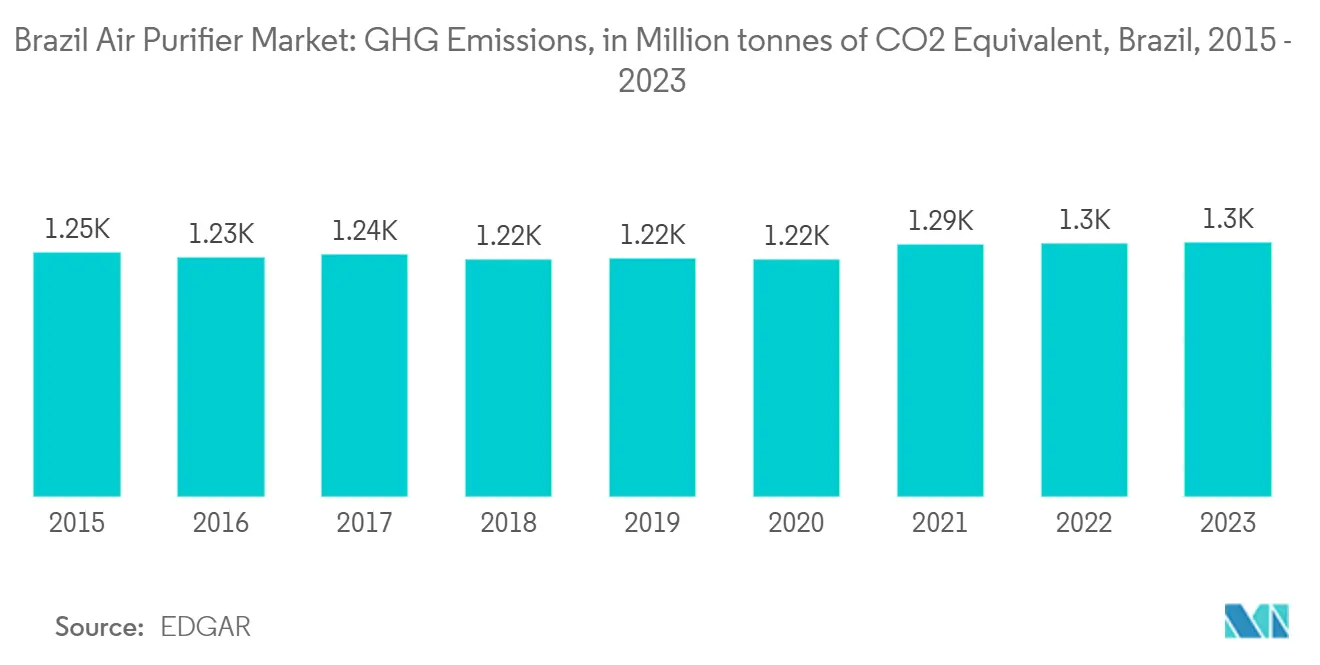
- Data from the European Commission EDGAR (Emissions Database for Global Atmospheric Research) for 2024 indicates a rising trend in Brazil's GHG emissions. Emissions in 2022 were recorded at 1,298.49 million tonnes of CO2 equivalent, inching up to 1,300.17 million tonnes in 2023. This upward trajectory signals burgeoning opportunities for air purifier manufacturers in Brazil.
- In conclusion, the escalating air pollution and GHG emissions in Brazil present a promising landscape for the country's air purifier market.
Competitive Landscape
The Brazil air purifier market is semi-consolidated. Some key players in this market (not in a particular order) include Xiaomi Corporation, The Camfil Group, Dyson Limited, LG Electronics Inc. and Koninklijke Philips N.V., among others
Brazil Air Purifier Industry Leaders
-
Xiaomi Corporation
-
The Camfil Group
-
Dyson Limited
-
LG Electronics Inc.
-
Koninklijke Philips N.V.
- *Disclaimer: Major Players sorted in no particular order
Recent Industry Developments
- October 2024: Hengst Filtration has made its second acquisition in Brazil's air filter market, purchasing São Paulo-based Aeroglass, an air filter specialist. This follows Hengst's acquisition of Linter in 2022.
- October 2024: Camfil, a global leader in air filtration solutions, has launched the Absolute VG V-Bank HEPA filter family, targeting global air purifier markets, notably in South America and Brazil. This innovative product caters to industries demanding stringent air purity standards, such as life sciences, healthcare, and microelectronics. The Absolute VG HEPA Family boasts a lightweight yet durable design, emphasizing energy efficiency, and is now offered with both seamless polyurethane and gel seal gaskets.
Brazil Air Purifier Market Report Scope
Air purifiers enhance indoor air quality by eliminating contaminants like dust, pollen, pet dander, and pollutants. These devices play a vital role in reducing respiratory risks, alleviating allergies, and fostering well-being across residential, commercial, and industrial environments.
The Brazil air market is segmented by filtration technology, type, and end user. By filtration technology, the market is segmented into high-efficiency particulate air (HEPA) and other filtration technologies (electrostatic precipitators (ESPs), ionizers, and ozone generators). By type, the market is segmented into stand-alone and in-duct. By end users, the market is segmented into residential, commercial, and industrial.
For each segment, the market sizing and forecasts have been done based on revenue (USD).
| High-Efficiency Particulate Air (HEPA) |
| Other Filtration Technologies (Electrostatic Precipitators (ESPs), Ionizers, and Ozone Generators) |
| Stand-Alone |
| In-Duct |
| Residential |
| Commercial |
| Industrial |
| Filter Technology | High-Efficiency Particulate Air (HEPA) |
| Other Filtration Technologies (Electrostatic Precipitators (ESPs), Ionizers, and Ozone Generators) | |
| Type | Stand-Alone |
| In-Duct | |
| End User | Residential |
| Commercial | |
| Industrial |
Key Questions Answered in the Report
How big is the Brazil Air Purifier Market?
The Brazil Air Purifier Market size is expected to reach USD 271.10 million in 2025 and grow at a CAGR of 7.62% to reach USD 391.30 million by 2030.
What is the current Brazil Air Purifier Market size?
In 2025, the Brazil Air Purifier Market size is expected to reach USD 271.10 million.
Who are the key players in Brazil Air Purifier Market?
Xiaomi Corporation, The Camfil Group, Dyson Limited, LG Electronics Inc. and Koninklijke Philips N.V. are the major companies operating in the Brazil Air Purifier Market.
What years does this Brazil Air Purifier Market cover, and what was the market size in 2024?
In 2024, the Brazil Air Purifier Market size was estimated at USD 250.44 million. The report covers the Brazil Air Purifier Market historical market size for years: 2019, 2020, 2021, 2022, 2023 and 2024. The report also forecasts the Brazil Air Purifier Market size for years: 2025, 2026, 2027, 2028, 2029 and 2030.
Brazil Air Purifier Market Report
Statistics for the 2025 Brazil Air Purifier market share, size and revenue growth rate, created by Mordor Intelligence™ Industry Reports. Brazil Air Purifier analysis includes a market forecast outlook for 2025 to 2030 and historical overview. Get a sample of this industry analysis as a free report PDF download.