
Europe Air Purifier Market Size and Share
| Study Period | 2019 - 2030 |
| Forecast Data Period | 2025 - 2030 |
| Historical Data Period | 2019 - 2023 |
| Market Size (2025) | USD 4.86 Billion |
| Market Size (2030) | USD 6.32 Billion |
| CAGR (2025 - 2030) | 5.37% |
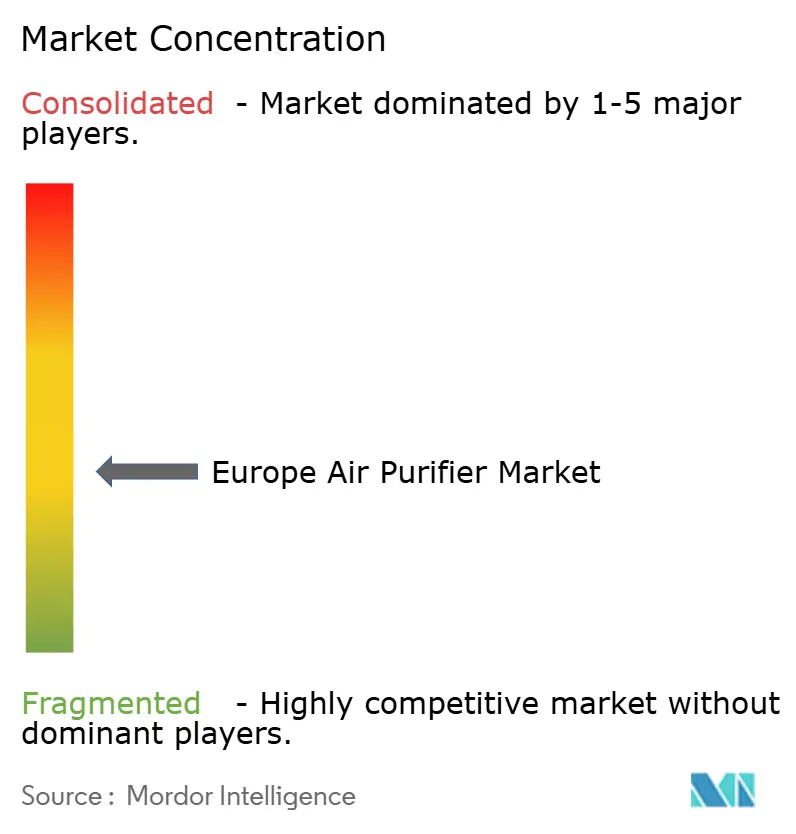
| Market Concentration | Medium |
Major Players *Disclaimer: Major Players sorted in no particular order |
Europe Air Purifier Market Analysis by Mordor Intelligence
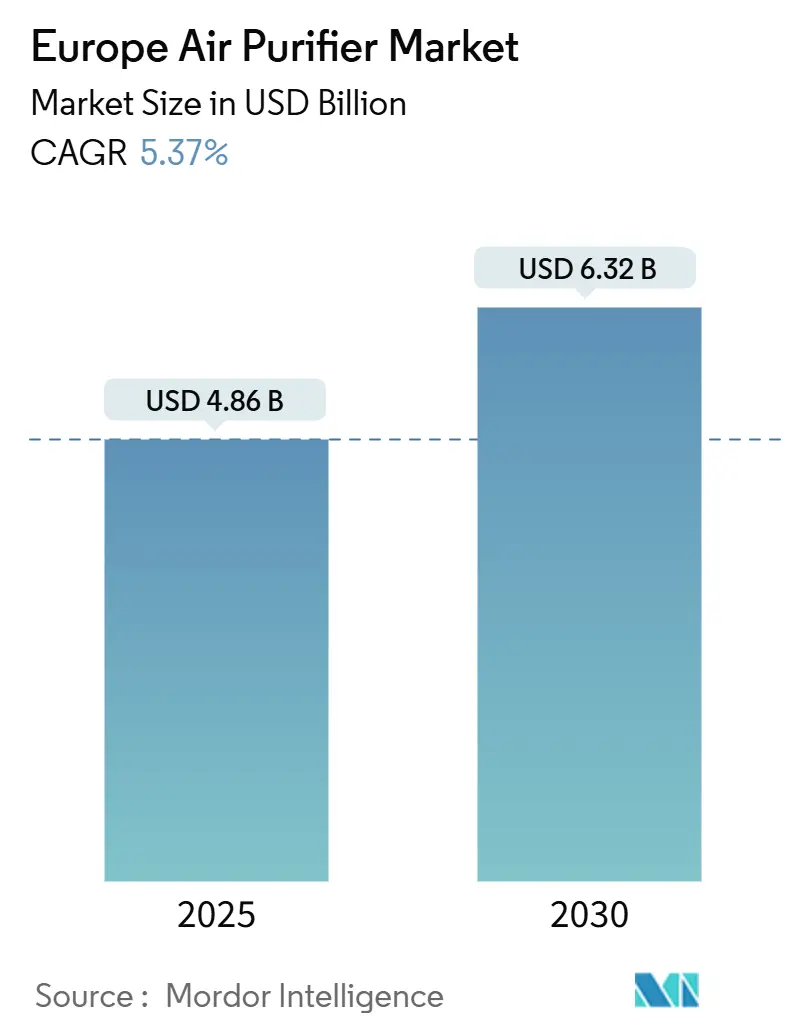
The Europe Air Purifier Market size is estimated at USD 4.86 billion in 2025, and is expected to reach USD 6.32 billion by 2030, at a CAGR of 5.37% during the forecast period (2025-2030).
- Over the medium term, many European cities grapple with severe air pollution issues, marked by elevated levels of particulate matter and volatile organic compounds (VOCs). This predicament has heightened the demand for air purification solutions. Furthermore, as consumers become increasingly aware of the health repercussions of air pollution, the demand for air purifiers has surged, with individuals striving to enhance their air quality.
- However, air purifiers, particularly those boasting cutting-edge features like HEPA filters and smart controls, often come with a hefty price tag. Such a steep initial cost can dissuade some consumers across Europe. Additionally, air purifiers tend to be energy-intensive, potentially inflating electricity bills. This poses a dilemma for eco-conscious consumers and those keen on curbing their energy expenses.
- Nevertheless, ongoing innovations in air purification, including the creation of more efficient HEPA and activated carbon filters, as well as the rise of smart air purifiers, present manufacturers with a golden opportunity to roll out enhanced products.
- Germany's advanced industrial base, rising pollution levels, and heightened consumer awareness of air quality issues have propelled it to the forefront of Europe's air purifier market. Additionally, the nation's emphasis on technological innovation and its stringent environmental regulations further solidify its dominant market position.
Note: Market size and forecast figures in this report are generated using Mordor Intelligence’s proprietary estimation framework, updated with the latest available data and insights as of January 2026.
Europe Air Purifier Market Trends and Insights
The High-efficiency Particulate Air (HEPA) Segment is Expected to Dominate the Market
- Mechanical air filters, such as HEPA filters, capture airborne particles effectively. They trap larger particles, including dust, pollen, mold spores, and animal dander, along with allergens from dust mites and cockroaches.
- HEPA filters, with their extended surface area, excel at removing both large and small airborne particles. They surpass pleated filters in capturing respirable particles. HEPA air purifiers typically meet two main standards: the European Standard, which mandates a 99.95% removal rate, and the ASME Standard, requiring 99.97% removal, both for particles sized at 0.3 micrometers or larger.
- In the last decade, HEPA filters have significantly reduced the spread of airborne particles and organisms, including viruses and bacteria, in various healthcare and life sciences settings. Prominent engineering organizations endorse HEPA filters for hospitals, infection control clinics, and other medical facilities, highlighting their effectiveness in neutralizing harmful microbes and particles.
- In Europe's multifaceted economy, industries like manufacturing, construction, and healthcare emphasize respiratory protection, both to shield workers and to comply with regulations. Stringent health and safety mandates across Europe enforce respiratory protection in numerous workplaces.
- European governments, in their quest to enhance air quality, are implementing rigorous environmental regulations. These initiatives are driving the adoption of air purifiers across industrial, residential, and commercial sectors. Technological advancements, particularly in high-efficiency particulate air (HEPA) and activated carbon filters, have not only improved product efficiency but also increased their appeal to consumers. For instance, in January 2024, Airthings launched two products: 'Renew', its first smart air purifier featuring a 4-stage HEPA filter and app connectivity, and 'Wave Enhance', a stylish air quality monitor that assesses sleep quality using CO2 and volatile organic compounds (VOC) sensors.
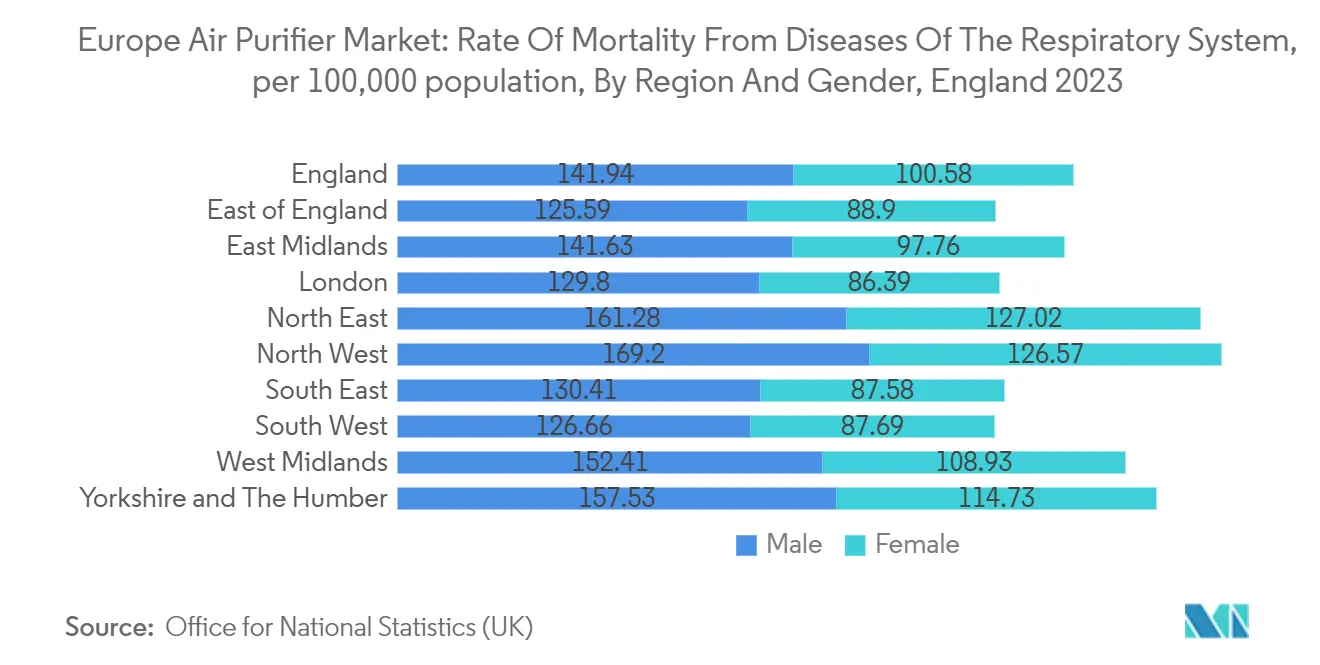
- In 2023, respiratory diseases claimed the lives of nearly 142 men and 101 women per 100,000 population in England. The North West region reported the highest male mortality rate from respiratory diseases, at approximately 169 per 100,000. In contrast, the North East region recorded the highest female mortality rate, with 127 deaths per 100,000 population. By enhancing indoor air quality, air purifiers can significantly mitigate the risk of respiratory infections. Specifically, air purifiers equipped with HEPA filters excel at eliminating airborne particles like dust, pollen, and pet dander, known triggers of respiratory issues.
- Furthermore, the emergence of energy-efficient and affordably priced models has broadened the accessibility of air purifiers, making them attractive to middle-income families. A growing consumer inclination towards eco-friendly and energy-efficient appliances reflects a wider movement towards sustainable living, driving both market growth and innovation. In light of these evolving preferences, manufacturers are significantly boosting their research and development investments, leading to heightened competition in the sector.
- Given these dynamics, high-efficiency particulate air (HEPA) technology is poised to lead the market in the coming years.


Germany is Expected to Dominate the Market
- In Germany, heightened awareness of air quality issues has fueled a robust demand for advanced air purifiers, particularly those equipped with HEPA filters and smart features. Urban air pollution poses challenges for German city authorities, especially as over 70% of millennials work indoors. With exhaust gases and fumes being primary sources of airborne fine dust, there's a pressing need to shield individuals from PM2.5 particles. In response, Germany is leaning towards adopting advanced air purification technologies, driving market growth in the region.
- Germany's high industrialization and urbanization levels exacerbate air pollution, intensifying the demand for air purifiers to ensure healthy indoor environments. Additionally, stringent environmental regulations and initiatives aimed at curbing air pollution bolster the growth of Germany's air purifier market.
- Moreover, following a court ruling deeming it essential to curb air pollution, several German cities have banned diesel engines on certain roads. While the government is taking measures to reduce emissions and avoid such bans, they acknowledge that an immediate solution for indoor air quality lies in portable air purifiers, despite the delayed impact on overall air quality from diesel bans.
- Further the country has witnessed significant developments in air purifier technology. In January 2025, ELECTROSTAR/starmix unveiled the Aeroxx 750, an innovative air purifier tailored for construction sites, marking a new segment in its product lineup. This compact device, equipped with a HEPA H13 filter, guarantees clean air in dust-heavy environments and operates in both recirculation and vacuum modes. Boasting the top air circulation performance in its class, the Aeroxx 750 made its debut at the BAU 2025 trade fair in Munich, Germany.
- Germany's air quality has seen marked improvements over the decades, largely attributed to EU air quality and emission standards. With the revised Ambient Air Quality Directive (AAQD) in play, Germany is seizing the chance to adopt innovative measures that not only enhance air quality but also align with broader climate, environmental, and public health goals.
- Furthermore, emissions from Germany's automotive, food processing, and iron, steel, and cement industries are directly responsible for the country's declining air quality. This deterioration poses significant risks to human health. In response, the German government is rolling out regulations and initiatives aimed at monitoring and curbing air pollution. Notable among these are 'A Clean Air Programme for Europe' and 'The EU’s air quality directives (DIRECTIVE 2008/50 /EC and DIRECTIVE 2004/107 /EC)', which not only assess and manage air quality but also establish thresholds for pollutant concentrations that must not be surpassed.
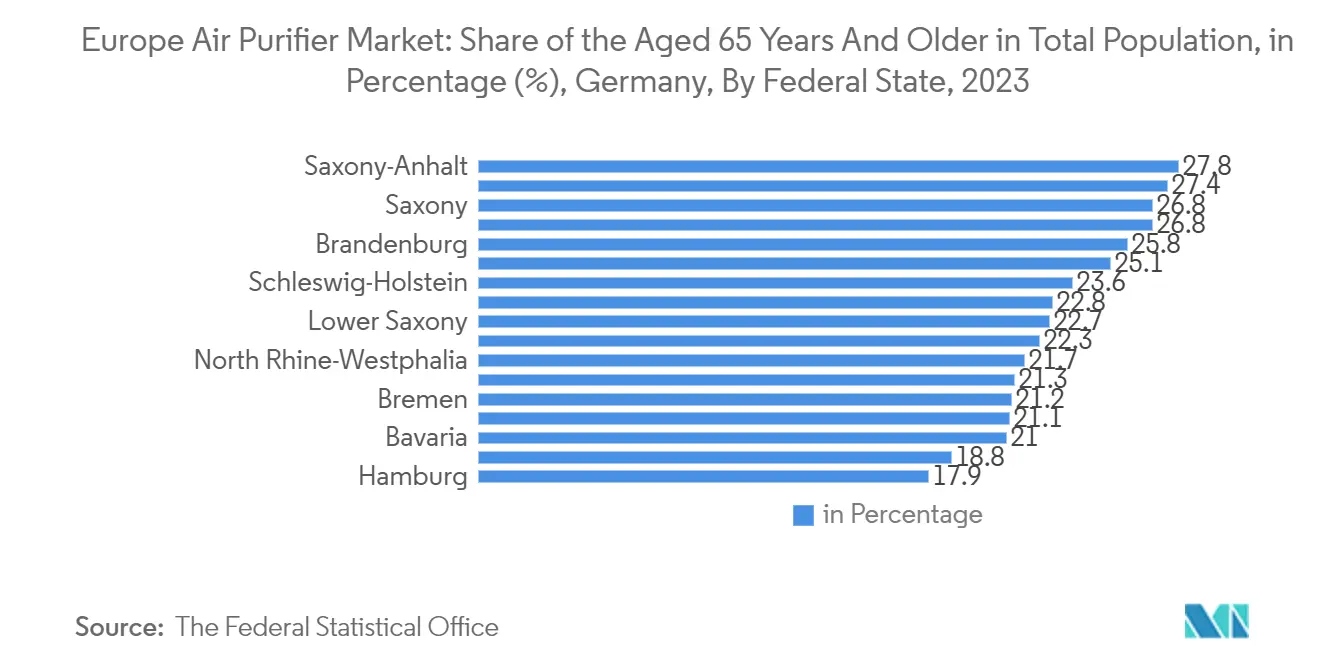
- In 2023, Saxony-Anhalt led all 16 German federal states with approximately 27.8% of its population aged 65 and older. Thuringia and Saxony trailed closely behind, with 27.4% and 26.8% respectively. As individuals age, their immune systems weaken, making them more vulnerable to respiratory infections such as the flu and pneumonia. This heightened susceptibility underscores the growing demand for air purifiers to help mitigate these risks.
- Owing to the above points, Germany is expected to dominate the European air purifier market.

Competitive Landscape
The Europe air purifier market is semi-consolidate. Some of the major players (in particular order) operating in the market include Honeywell International, Inc., Koninklijke Philips N.V, Sharp Electronics Corporation, Samsung Electronics Co., Ltd., and Panasonic Industry Europe GmbH, among others.
Europe Air Purifier Industry Leaders
Honeywell International, Inc.,
Koninklijke Philips N.V,
Sharp Electronics Corporation
Samsung Electronics Co., Ltd
Panasonic Industry Europe GmbH.
- *Disclaimer: Major Players sorted in no particular order

Recent Industry Developments
- June 2024: Coway UK, a prominent player in wellness technology, unveiled the Airmega 100 air purifier. This marks Airmega's inaugural cylindrical model, tailored as an affordable yet robust solution for compact spaces in its European lineup. Coway is rolling out the Airmega 100, targeting Europeans keen on safeguarding themselves from the prolonged hay fever and allergy seasons, which, as reported, have been extending over the past two decades due to climate change.
- February 2024: In a bid to combat air pollution, especially fine particulate matter and ozone, French air purification specialist Aérophile has set up five large, flying-saucer-like air purifiers around Paris's Athletes' Village.


Europe Air Purifier Market Report Scope
Air purifiers enhance indoor air quality by eliminating contaminants from room air. They effectively target pollutants like dust, pollen, pet dander, mold spores, and smoke. These devices prove especially advantageous for individuals with allergies, asthma, or other respiratory issues.
The Europe air purifier market is segmented by filter technology, type, end-user. By filter technology, the market is segmented into high-efficiency particulate air (HEPA), other filtration technologies (electrostatic precipitators (ESPs), oonizers, and ozone generators). By type, the market is segmented into stand-alone and in-duct. By end-user the market is segmented into residential, commercial, and industrial. The report also covers the market size and forecasts for the europe air purifier market across major countries in the region.
For each segment, the market sizing and forecasts have been done based on revenue (USD).
| High-Efficiency Particulate Air (HEPA) |
| Other Filtration Technologies (Electrostatic Precipitators (ESPs), Ionizers, and Ozone Generators) |
| Stand-Alone |
| In-Duct |
| Residential |
| Commercial |
| Industrial |
| Germany |
| United Kingdom |
| France |
| Italy |
| Spain |
| Turkey |
| Nordic Region |
| Russia |
| Rest of the Europe |
| Filter Technology | High-Efficiency Particulate Air (HEPA) |
| Other Filtration Technologies (Electrostatic Precipitators (ESPs), Ionizers, and Ozone Generators) | |
| Type | Stand-Alone |
| In-Duct | |
| End-User | Residential |
| Commercial | |
| Industrial | |
| By Country | Germany |
| United Kingdom | |
| France | |
| Italy | |
| Spain | |
| Turkey | |
| Nordic Region | |
| Russia | |
| Rest of the Europe |


Key Questions Answered in the Report
How big is the Europe Air Purifier Market?
The Europe Air Purifier Market size is expected to reach USD 4.86 billion in 2025 and grow at a CAGR of 5.37% to reach USD 6.32 billion by 2030.
What is the current Europe Air Purifier Market size?
In 2025, the Europe Air Purifier Market size is expected to reach USD 4.86 billion.
Who are the key players in Europe Air Purifier Market?
Honeywell International, Inc.,, Koninklijke Philips N.V,, Sharp Electronics Corporation, Samsung Electronics Co., Ltd and Panasonic Industry Europe GmbH. are the major companies operating in the Europe Air Purifier Market.
What years does this Europe Air Purifier Market cover, and what was the market size in 2024?
In 2024, the Europe Air Purifier Market size was estimated at USD 4.60 billion. The report covers the Europe Air Purifier Market historical market size for years: 2019, 2020, 2021, 2022, 2023 and 2024. The report also forecasts the Europe Air Purifier Market size for years: 2025, 2026, 2027, 2028, 2029 and 2030.
Page last updated on:
Europe Air Purifier Market Report
Statistics for the 2025 Europe Air Purifier market share, size and revenue growth rate, created by Mordor Intelligence™ Industry Reports. Europe Air Purifier analysis includes a market forecast outlook for 2025 to 2030 and historical overview. Get a sample of this industry analysis as a free report PDF download.





