
North America Air Purifier Market Size and Share
| Study Period | 2019 - 2030 |
| Forecast Data Period | 2025 - 2030 |
| Historical Data Period | 2019 - 2023 |
| Market Size (2025) | USD 4.5 Billion |
| Market Size (2030) | USD 6.06 Billion |
| CAGR (2025 - 2030) | 6.13% |
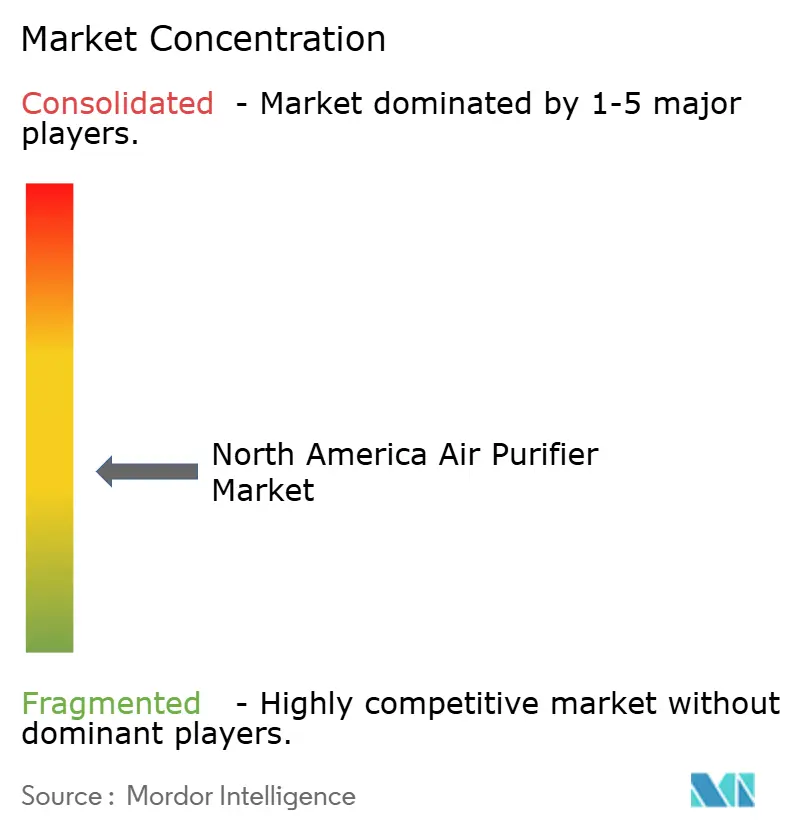
| Market Concentration | Medium |
Major Players *Disclaimer: Major Players sorted in no particular order |
North America Air Purifier Market Analysis by Mordor Intelligence
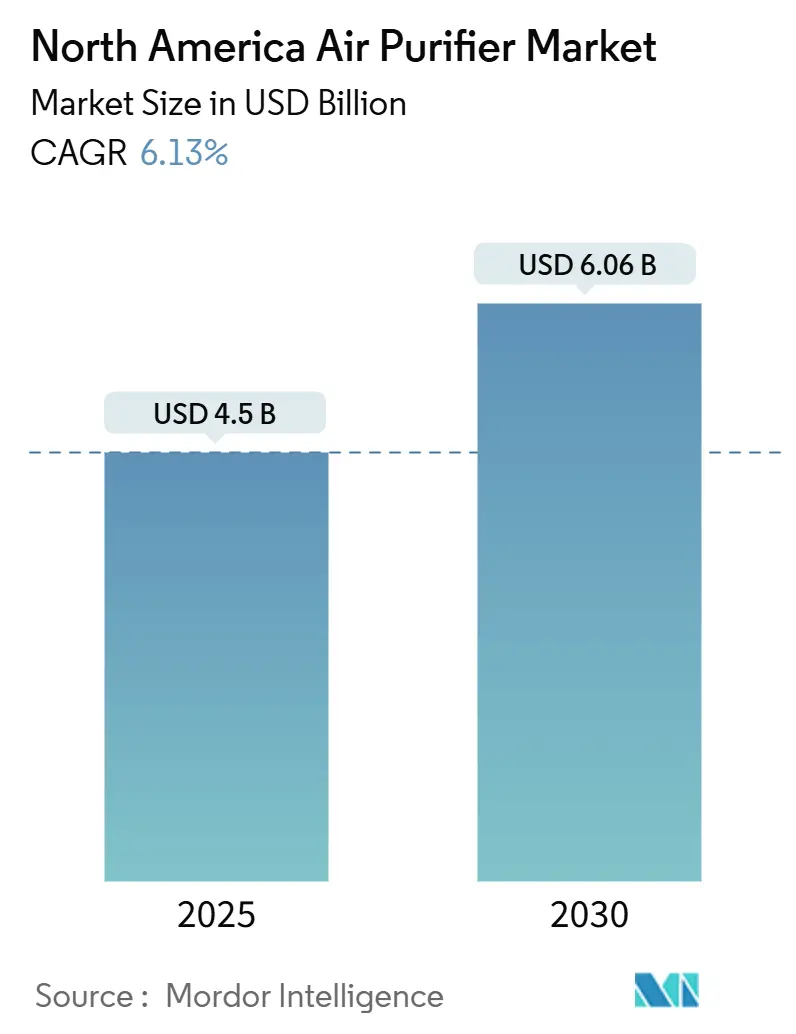
The North America Air Purifier Market size is estimated at USD 4.5 billion in 2025, and is expected to reach USD 6.06 billion by 2030, at a CAGR of 6.13% during the forecast period (2025-2030).
- Over the medium period, increasing airborne diseases, rising emissions due to industrial activities, and growing consumer health consciousness are driving the North America air purifier market.
- On the other hand, the high costs of premium air purifiers equipped with advanced filtration technologies limit their accessibility for price-sensitive consumers, hindering market growth during the forecast period.
- Nevertheless, as businesses and households respond to stricter air quality regulations and emission standards by investing in air purification solutions, a significant opportunity emerges in the forecast period.
- The United States is expected to be the fastest-growing region in the North America air purifier market during the forecast period.
North America Air Purifier Market Trends and Insights
The High-efficiency Particulate Air (HEPA) Segment is Expected to Dominate the Market
- Mechanical air filters, like HEPA filters, capture airborne particles on their filter materials. These filters effectively trap larger particles, including dust, pollen, mold spores, and allergens from dust mites and cockroaches. HEPA filters, characterized by their extended surface area, boast higher efficiencies in removing both large and small airborne particles. Compared to pleated filters, HEPA filters excel in capturing respirable particles. HEPA air purifiers typically adhere to two primary standards: the European Standard mandates a 99.95% particle removal efficiency, while the ASME Standard requires 99.97%, both for particles sized 0.3 micrometers and above.
- Over the past decade, HEPA filters have effectively curtailed the spread of airborne viruses and bacteria in healthcare settings. Leading engineering organizations advocate for HEPA filters in hospitals and clinics, underscoring their role in eliminating harmful microbes.
- In, United States, utilizing a comprehensive network of monitoring sites, the US Environmental Protection Agency (EPA) tracks ambient air quality trends, focusing on Particulate Matter (PM) pollution. PM2.5 refers to fine particles with diameters of 2.5 micrometers or smaller. As mandated by the Clean Air Act, the EPA establishes and periodically reviews national air quality standards for PM.
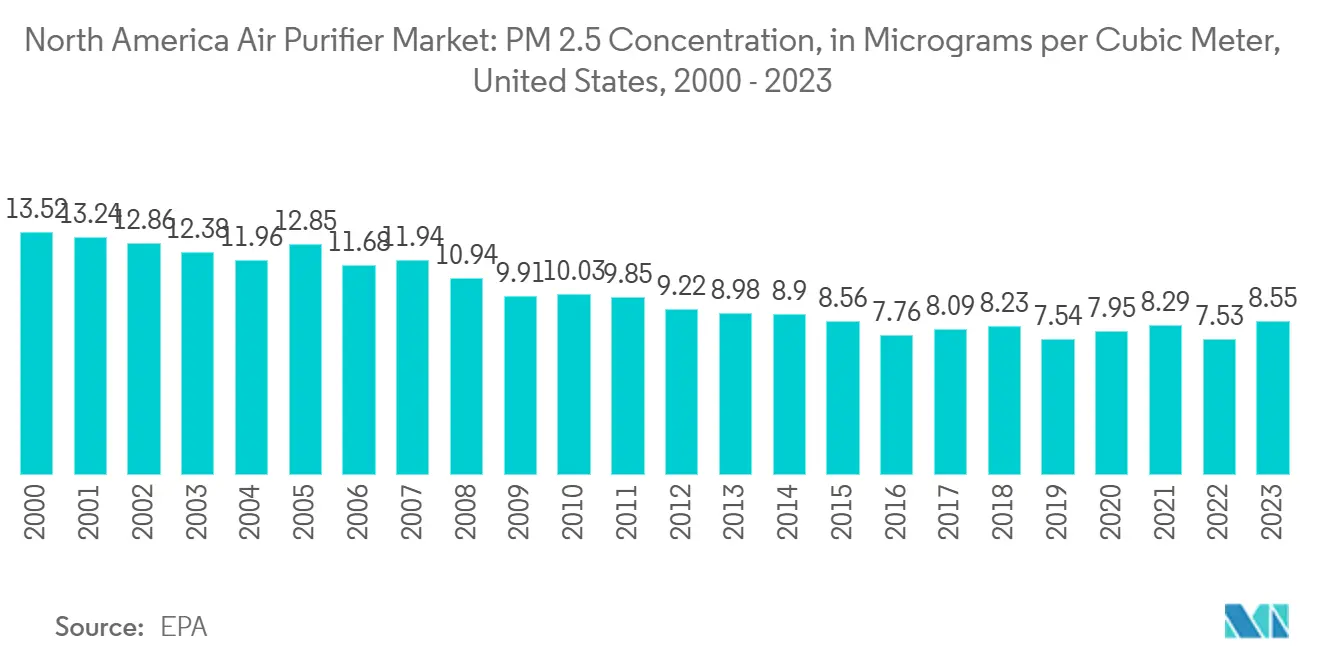
- Across the nation, air quality monitors gauge PM concentrations, with data utilized by the EPA and local agencies to safeguard public health and the environment. Nationally, average PM2.5 concentrations have seen a decline over the years. The EPA reported a significant 37% drop in the national average PM2.5 concentration, from 2000 levels to 8.55 ug/m3 in 2023. This downward trend, coupled with mandates from government agencies to utilize air purifiers, is poised to drive future adoption of HEPA filters.
- HEPA filters find applications across industrial, commercial, and residential sectors. In healthcare, they're integral to research labs, operating rooms, ICUs, and cleanrooms, ensuring the removal of airborne contaminants. Their presence is vital for maintaining cleanliness and preventing viral outbreaks, safeguarding patients and medical staff alike. Canadian hospitals, facing heightened threats from Healthcare Acquired Infections (HAI), are increasingly turning to HEPA filters.
- Technological advancements are making HEPA filters lighter and more cost-effective, presenting lucrative opportunities. For example, in October 2024, Camfil USA, a global frontrunner in air filtration, unveiled the Absolute(R) VG V-Bank HEPA filter family. This innovative filter caters to industries prioritizing air purity, such as life sciences and healthcare. The Absolute(R) VG HEPA Family stands out for its lightweight design, durability, and energy efficiency, now featuring both polyurethane seamless and gel seal gaskets.
- Given the rising concerns over air quality and heightened awareness, HEPA technology is poised to lead the market in the coming years.


United States of America is Expected to Grow Significantly
- In recent years, the United States air purifier market has surged, fueled by a growing awareness of indoor air quality and its health implications. Rising pollution levels further bolster this upward trajectory, the spread of airborne diseases, and notable technological advancements.
- In a bid to curb air pollution, the U.S. government has been proactive, especially in promoting air filters. A case in point: In February 2024, the Environmental Protection Agency (EPA) tightened its regulations on fine particulate matter. The new directive slashes the annual permissible limit from 12 micrograms to 9 micrograms per cubic meter of air. Many experts view this as the EPA's most pivotal move in a decade, with the agency projecting it will avert 4,500 premature deaths each year, reclaim 290,000 lost workdays, and yield net health benefits worth up to USD 46 billion.
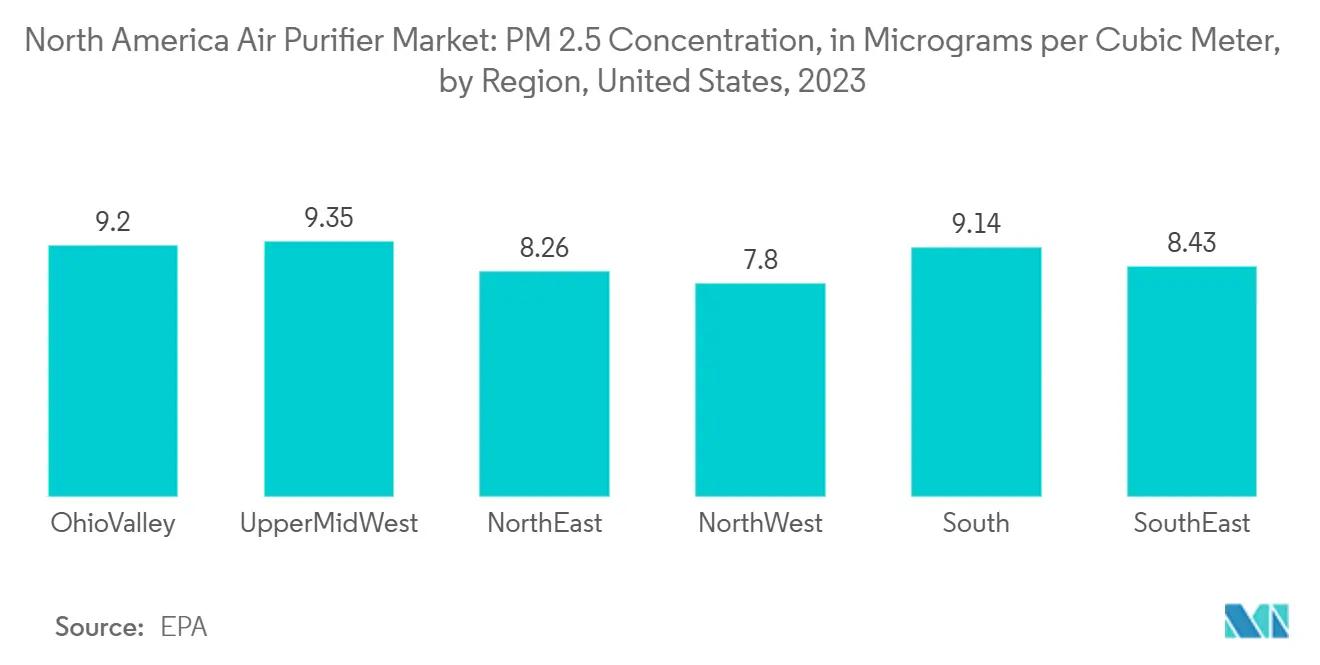
- Moreover, a decade-long analysis reveals a regional decline in fine particulate concentrations. Data from the U.S. EPA highlights that in 2023, the Ohio Valley recorded a concentration of 9.2 ug/m3, while the Upper Midwest noted 9.35 ug/m3. This downward trend in air pollution can be attributed to heightened awareness about the health dangers of indoor air pollution, such as respiratory ailments and allergies, leading to a surge in air purifier adoption across homes and businesses.
- Beyond industrial applications, the push for air filters has permeated commercial spaces, including schools, hospitals, and shopping complexes. In a notable move, the Connecticut Bond Commission, in October 2024, greenlit a USD 11.5 million initiative for DIY air purifiers in schools statewide. This initiative, backed by EPA certification, boasts a UConn-originated fan system that can eliminate 99.4% of infectious respiratory aerosols within an hour.
- Technological innovations are addressing challenges, such as the high power consumption of traditional fiber filters in HVAC systems. For instance, in December 2024, researchers at Purdue University unveiled a groundbreaking system harnessing acoustic standing waves. This innovation amplifies the efficacy of fiber filters by 1-2 orders of magnitude, optimizes low-pressure filter performance, curtails HVAC power use, and eradicates hazardous byproducts, making it suitable for both industrial and residential HVAC systems.
- Given the surge in research and development and heightened public awareness, the U.S. air purifier market is poised for substantial growth.

Competitive Landscape
The North America air purifier market is semi-consolidated. Some of the major players in the market (in no particular order) include Daikin Industries, Ltd., Aclima Inc., Sharp Corporation, IQAir, and LG Electronics Inc., among others.
North America Air Purifier Industry Leaders
Daikin Industries, Ltd.
Aclima Inc.
Sharp Corporation
IQAir
LG Electronics Inc.
- *Disclaimer: Major Players sorted in no particular order

Recent Industry Developments
- June 2024: Rensa Filtration, a pioneer in cutting-edge air filtration solutions, commenced the production of its high-performance HEPA filters at its headquarters and manufacturing facility in Aurora, Illinois, United States. Utilizing advanced mini-pleat technology, Rensa's SuperFlo HEPA filters deliver superior dust loading and reduced airflow resistance at 250 FPM, 500 FPM, and 600 FPM, outpacing traditional aluminum separator-style HEPA filters.
- March 2024: American Air Filter Co., Inc., a global air filtration leader for over a century, acquired Northeast Air Solutions, Inc., which has been delivering clean air solutions to New England since 1946.


North America Air Purifier Market Report Scope
Air purifiers, often referred to as air cleaners, enhance indoor air quality by eliminating pollutants and contaminants from room air. These devices intake air, filter out pollutants such as dust, pollen, smoke, and allergens, and subsequently release purified air back into the environment. Most air purifiers utilize filters, such as HEPA filters, to capture particles. Additionally, some models incorporate technologies like activated carbon filters, which are effective in removing gases and odors.
The North America air purifier market is segmented by filter technology, type, end-user, and geography. By filter technology, the market is segmented into high-efficiency particulate air (HEPA), other filtration technologies (electrostatic precipitators (ESPs), ionizers, and ozone generators). By type, the market is segmented into stand-alone and in-duct. By end-user, the market is segmented into residential, commercial, and industrial. The report also covers the market size and forecasts for the North America air purifier market across major countries in the region.
For each segment, the market sizing and forecasts have been done based on revenue (USD).
| High-Efficiency Particulate Air (HEPA) |
| Other Filtration Technologies (Electrostatic Precipitators (ESPs), Ionizers, and Ozone Generators) |
| Stand-Alone |
| In-Duct |
| Residential |
| Commercial |
| Industrial |
| United States |
| Canada |
| Rest of the North America |
| Filter Technology | High-Efficiency Particulate Air (HEPA) |
| Other Filtration Technologies (Electrostatic Precipitators (ESPs), Ionizers, and Ozone Generators) | |
| Type | Stand-Alone |
| In-Duct | |
| End-User | Residential |
| Commercial | |
| Industrial | |
| Geography | United States |
| Canada | |
| Rest of the North America |


Key Questions Answered in the Report
How big is the North America Air Purifier Market?
The North America Air Purifier Market size is expected to reach USD 4.5 billion in 2025 and grow at a CAGR of 6.13% to reach USD 6.06 billion by 2030.
What is the current North America Air Purifier Market size?
In 2025, the North America Air Purifier Market size is expected to reach USD 4.5 billion.
Who are the key players in North America Air Purifier Market?
Daikin Industries, Ltd., Aclima Inc., Sharp Corporation, IQAir and LG Electronics Inc. are the major companies operating in the North America Air Purifier Market.
What years does this North America Air Purifier Market cover, and what was the market size in 2024?
In 2024, the North America Air Purifier Market size was estimated at USD 4.22 billion. The report covers the North America Air Purifier Market historical market size for years: 2019, 2020, 2021, 2022, 2023 and 2024. The report also forecasts the North America Air Purifier Market size for years: 2025, 2026, 2027, 2028, 2029 and 2030.
Page last updated on:
North America Air Purifier Market Report
Statistics for the 2025 North America Air Purifier market share, size and revenue growth rate, created by Mordor Intelligence™ Industry Reports. North America Air Purifier analysis includes a market forecast outlook for 2025 to 2030 and historical overview. Get a sample of this industry analysis as a free report PDF download.





