
Branded Content Services Market Size and Share
Market Overview
| Study Period | 2020 - 2031 |
|---|---|
| Market Size (2026) | USD 90.35 Billion |
| Market Size (2031) | USD 152.21 Billion |
| Growth Rate (2026 - 2031) | 10.99 % |
| Fastest Growing Market | Asia-Pacific |
| Largest Market | North America |
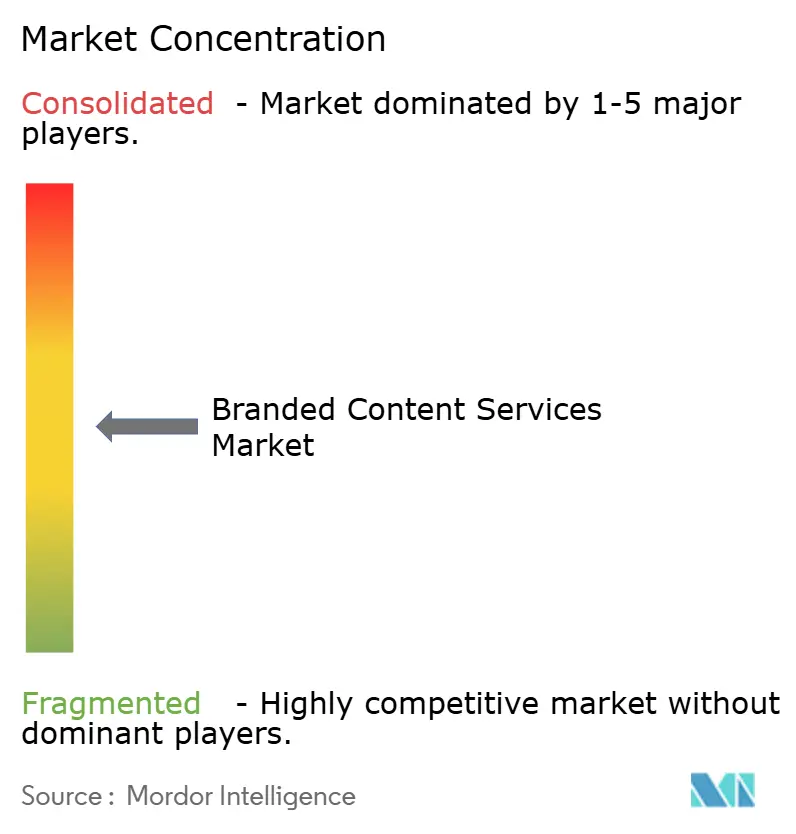
| Market Concentration | Medium |
Major Players *Disclaimer: Major Players sorted in no particular order Image © Mordor Intelligence. Reuse requires attribution under CC BY 4.0. | |
Branded Content Services Market Analysis by Mordor Intelligence
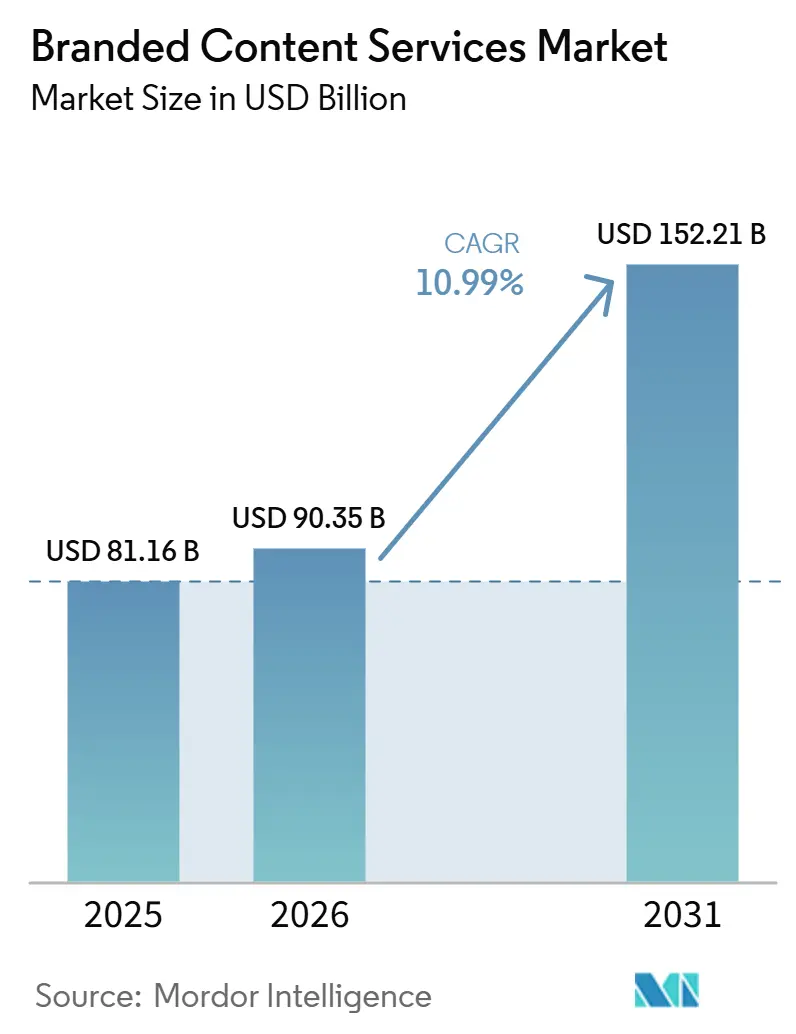
The branded content services market size is projected to expand from USD 81.16 billion in 2025 and USD 90.35 billion in 2026 to USD 152.21 billion by 2031, registering a CAGR of 10.99% between 2026 to 2031. Growth reflects a continued shift in advertising budgets from interruptive formats toward publisher-integrated and creator-led content that seeks attention through relevance. The end of Google's Privacy Sandbox APIs, stricter transparency rules, and the greater role of creators in paid media are changing how advertisers plan content programs. These changes favor formats that use contextual relevance, verified publisher audiences, and commerce links rather than third-party identifiers. Competition is moving toward premium editorial integrations on one side and lower-cost AI-assisted production on the other. This leaves fewer clear options for mid-sized providers that cannot compete on either editorial scale or production efficiency.
Key Report Takeaways
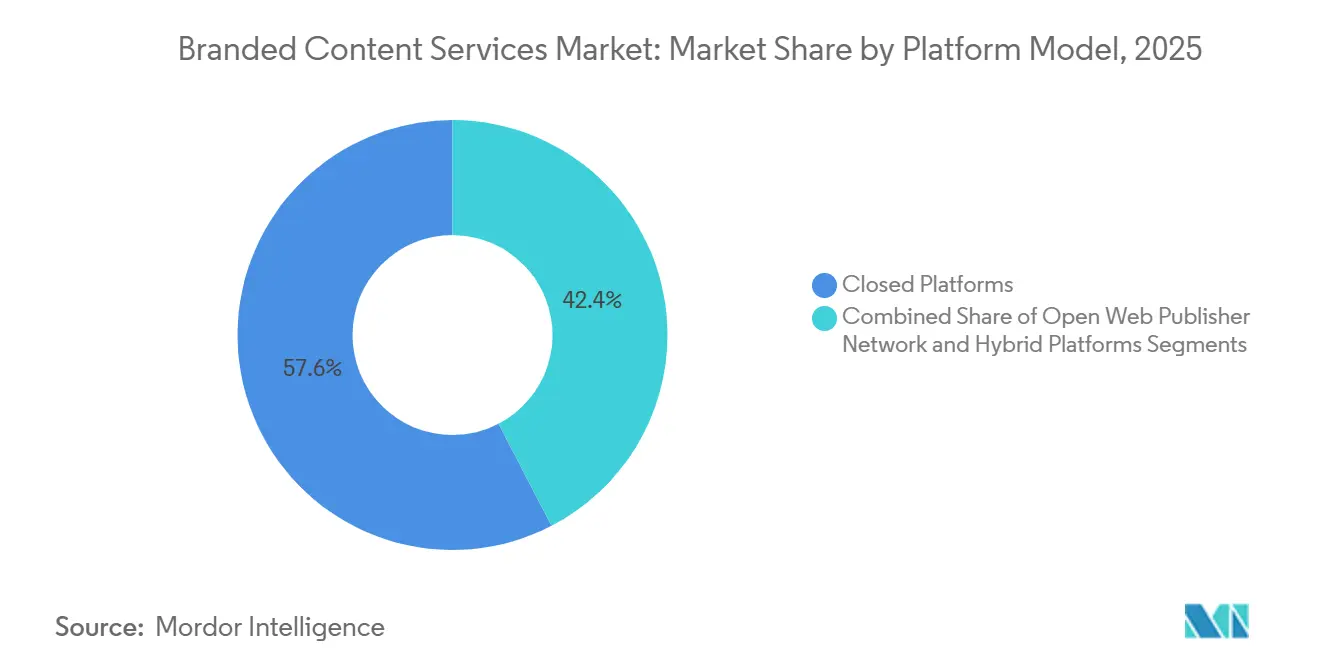
- By platform model, closed platforms held 57.62% of the branded content services market share in 2025, while hybrid platforms are projected to expand at an 11.63% CAGR through 2031.
- By device, mobile accounted for 54.72% of the branded content services market share in 2025, while connected TV is projected to grow at an 11.73% CAGR through 2031.
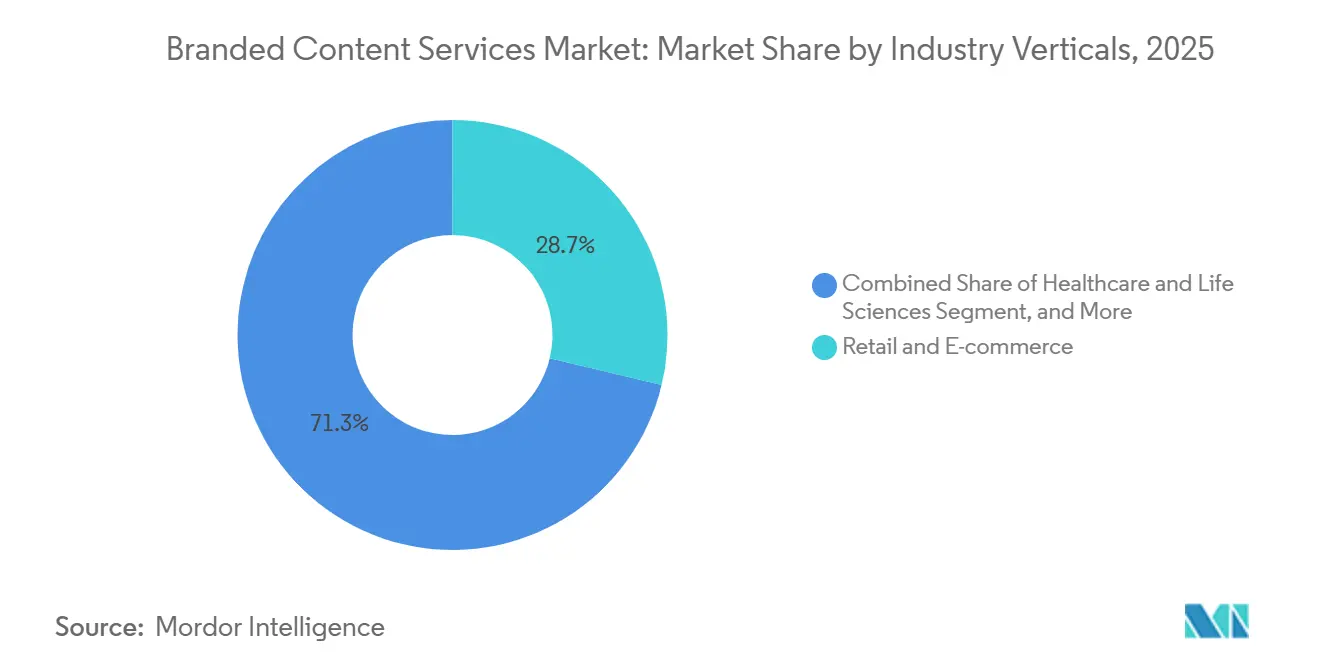
- By industry vertical, retail and e-commerce held 28.73% of the branded content services market share in 2025 and is projected to advance at an 11.34% CAGR through 2031.
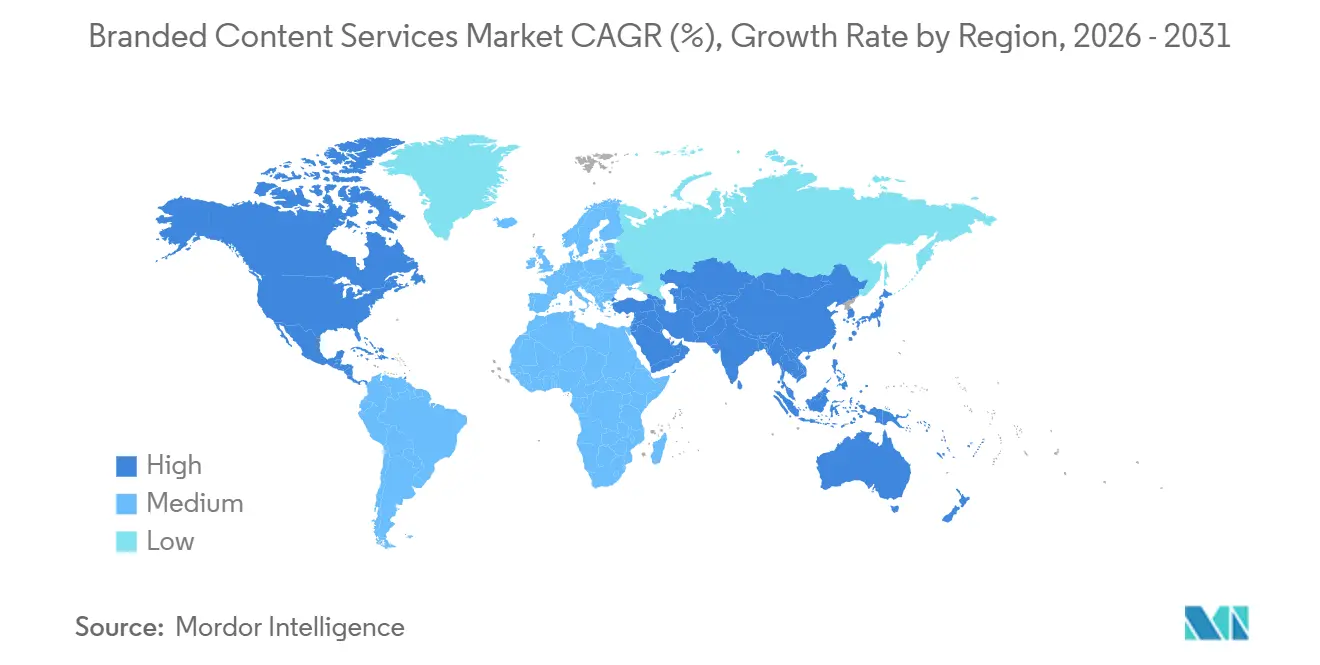
- By geography, North America held 37.62% of the branded content services market share in 2025, while Asia-Pacific is projected to expand at a 12.43% CAGR through 2031.
Note: Market size and forecast figures in this report are generated using Mordor Intelligence’s proprietary estimation framework, updated with the latest available data and insights as of January 2026.
Market Trends and Insights
Drivers Impact Analysis of Branded Content Services Market*
| Driver | (~) % Impact on CAGR Forecast | Geographic Relevance | Impact Timeline |
|---|---|---|---|
| Shift Toward Non-Intrusive Advertising Formats | +2.8% | Global, with the strongest concentration in North America and Europe | Short term (≤ 2 years) |
| Video-First Content Consumption Across Publisher and Social Environments | +2.3% | North America and Asia-Pacific, with spillover to Europe and the Middle East | Short term (≤ 2 years) |
| First-Party and Contextual Targeting Demand in a Cookieless Media Mix | +1.9% | North America and Europe, with expansion to Asia-Pacific | Medium term (2–4 years) |
| Creator Economy Scaling Into Always-On Brand Programs | +1.5% | North America and Asia-Pacific, with early adoption in Europe and South America | Medium term (2–4 years) |
| Retail Media and Commerce Content Convergence | +1.3% | North America, with growth in Asia-Pacific and Europe | Medium term (2–4 years) |
| AI-Led Creative Adaptation and Performance Measurement | +1.0% | Global, with fastest adoption in North America and Asia-Pacific | Long term (≥ 4 years) |
| Source: Mordor Intelligence | |||
Shift Toward Non-Intrusive Advertising Formats
Consumer resistance to interruptive advertising has made less disruptive formats a core requirement for effective brand communication, especially where audiences can skip, block, or ignore standard ad units. U.S. digital advertising revenue exceeded USD 150 billion in 2024, although broad reach did not resolve declining engagement with standard display and pre-roll formats.[1]Interactive Advertising Bureau, “Creator Economy Ad Spend and Strategies Report,” IAB, iab.com The branded content services market benefits when advertising is presented in a form that fits the editorial setting, the subject matter, and the audience's viewing behavior. Native articles and creator-hosted formats can support longer engagement and stronger recall because they reduce the disruption associated with conventional advertising. Premium publishers are also raising editorial standards to protect audience trust, which increases the quality expected from sponsored work and makes execution more dependent on editorial planning. This supports experienced studios and gives publishers more leverage when they negotiate commercial programs.
Video-First Content Consumption Across Publisher and Social Environments
Video is gaining importance because social feeds, connected TV, and short-form video applications are designed for video viewing and make video assets easier to distribute repeatedly. Connected TV advertisers are increasing their spending plans, with 70% expecting to raise spending by an average of 17% in 2026.[2]Premion, “2026 CTV and OTT Advertiser Survey,” Premion, premion.com This supports the branded content services market by moving premium brand budgets toward addressable digital video environments where content can be integrated into the viewing experience. Creator video can also be used as paid media against a brand's own audience data, which makes it more useful beyond a single organic post. The production and distribution systems for creator video are becoming more closely connected across social platforms, allowing a successful asset to be adapted across several placements. As a result, video content is becoming part of a recurring media investment cycle rather than a separate creative experiment.
First-Party and Contextual Targeting Demand in a Cookieless Media Mix
The end of the Privacy Sandbox APIs in October 2025 made first-party data and contextual targeting more important for advertisers that had expected another common replacement for third-party identifiers. The branded content services market is positioned to benefit because editorial placements can be selected for contextual fit without relying on individual behavioral profiles. Publishers with authenticated audiences can combine contextual relevance with audience verification in their commercial offerings and provide a clearer view of the environment where a message appears. The IAB Tech Lab's standards for authenticated audiences support identity approaches based on first-party email relationships. This approach places more value on the direct relationship between the advertiser and publisher, particularly when audience access is limited outside closed platforms. It also makes publisher-based branded content more distinct from cookie-dependent display activity.
Creator Economy Scaling Into Always-On Brand Programs
Creator activity has moved from experimental campaigns into ongoing brand media plans, with creators increasingly used for repeated production rather than isolated endorsements. The IAB projected U.S. creator economy advertising spend would reach USD 43.9 billion in 2026, up from USD 37.1 billion in 2025. The branded content services market is supported by this change because creators provide both the content asset and a route to a defined audience. Smaller creators are particularly useful when brands need focused communities, recognizable voices, and frequent content updates. Creator content is now used across organic and paid media, reducing the separation between social publishing and advertising creative. AI-assisted user-generated content can lower per-asset production costs, allowing brands to refresh content more often than conventional studio processes allowed.
Restraints Impact Analysis of Branded Content Services Market*
| Restraint | (~) % Impact on CAGR Forecast | Geographic Relevance | Impact Timeline |
|---|---|---|---|
| Disclosure and Trust Scrutiny Around Sponsored Editorial Content | -2.1% | Global, with the strongest enforcement in the United States and European Union | Short term (≤ 2 years) |
| ROI Attribution Fragmentation Across Publishers, Creators, and Platforms | -1.8% | Global, most acute in North America and Europe | Medium term (2–4 years) |
| Rights Management Risk for AI-Generated Assets and Talent Likeness | -1.3% | North America and the European Union | Medium term (2–4 years) |
| Editorial Firewall and Governance Constraints at Premium Publishers | -0.9% | North America and Europe | Long term (≥ 4 years) |
| Source: Mordor Intelligence | |||
Disclosure and Trust Scrutiny Around Sponsored Editorial Content
Disclosure requirements are becoming more demanding across major advertising jurisdictions, so legal, platform, and publisher reviews increasingly occur before content can be released. The Federal Trade Commission provides guidance on clear and conspicuous disclosures for endorsements, influencer content, and reviews.[3]Federal Trade Commission, “Endorsements, Influencers, and Reviews,” Federal Trade Commission, ftc.gov The European Commission's AI Act framework also sets transparency duties for certain AI-generated content. The branded content services market faces longer approval cycles when programs include sponsored editorial work or AI-assisted creative, particularly when a campaign is intended for several jurisdictions. These checks can limit the use of synthetic likenesses in campaigns that need to move quickly and can require earlier coordination between creative, legal, and publisher teams. Clear labeling remains important because unclear sponsored content can damage both the advertiser relationship and the publisher's audience trust.
ROI Attribution Fragmentation Across Publishers, Creators, and Platforms
Measurement systems have not kept pace with campaigns that run across publishers, creators, retail networks, and social platforms, where the same consumer may encounter several related assets. Many content teams still lack a reliable way to connect a specific content asset with revenue, which makes it harder for advertisers to defend reinvestment through normal budget reviews. AI-mediated search also makes traditional click-based measurement less complete when content influences an audience without producing a direct referral. The branded content services market can therefore be undercredited when brand influence and assisted conversions occur across several channels and are recorded in different reporting systems. Cross-platform measurement standards will remain important for firms that need to show performance in financial terms. Without common methods, providers and advertisers may interpret campaign results differently and delay decisions on further investment.
*Our forecasts treat driver/restraint impacts as directional, not additive. The impact forecasts reflect baseline growth, mix effects, and variable interactions.
Branded Content Services Market Segment Analysis
By Platform Model:
Closed Platforms Anchor Revenue, Hybrid Formats AccelerateClosed platforms held 57.62% of branded content services market size in 2025. Meta, TikTok, YouTube, and LinkedIn combine large audiences with mature creator-to-brand monetization systems. Their in-feed formats make sponsored content easier to distribute alongside ordinary audience activity, reducing the separation between a paid placement and the surrounding viewing experience. Meta's partnership advertising format reached an annualized revenue run rate of USD 10 billion in the first quarter of 2026, which showed the growing commercial role of creator-produced content. LinkedIn launched its Creator Marketplace in June 2026, extending branded content infrastructure to professional audiences as closed platforms continue to attract budgets by linking content creation, targeting, distribution, and reporting within a single operating environment.
Open web publisher networks compete through editorial quality, brand safety, and verified first-party audiences rather than raw reach. The New York Times T Brand Studio, BBC StoryWorks, Guardian Labs, Financial Times Commercial, and Hearst studios use these strengths to support premium integrations. Hybrid platforms bridge programmatic distribution with publisher-native placements through firms such as Taboola, Outbrain, MGID, and TripleLift. Hybrid platforms are projected to grow at an 11.63% CAGR from 2026 to 2031. In June 2026, Taboola opened the monetization system behind DeeperDive to external AI companies, chatbot developers, and virtual assistant providers, showing how hybrid operators are adapting from content recommendation to infrastructure for AI-mediated discovery.



By Device:
Mobile Dominates Volume, Connected TV Commands Premium GrowthMobile accounted for 54.72% of the branded content services market share in 2025. Social in-feed placements, short-form video, and creator content are largely consumed on smartphones, which explains the device's leading position. Mobile volume reflects audience behavior more than a simple preference for one creative format. The branded content services market continues to use mobile for fast distribution across both social and open web environments. Mobile campaigns can be refreshed frequently, which suits creator-led programs and commerce-linked formats while allowing advertisers to test varied messages without changing the core audience setting.
Connected TV is projected to record an 11.73% CAGR from 2026 to 2031. The device combines a broad storytelling format with digital targeting and performance measurement. Connected TV upfront spending in the United States reached USD 17.73 billion in 2026, exceeding USD 16.98 billion for primetime linear television upfront spending. Retail media networks, including Walmart's Vizio operation, are developing shoppable video formats that connect viewing with transaction data. Desktop and laptop devices remain useful for longer articles and B2B integrations, while tablets serve a smaller role in premium household content viewing and the separate attribution systems used by connected TV and mobile require advertisers to coordinate reporting across device environments.
By Industry Verticals:
Retail Commerce Drives Dual Leadership in Share and GrowthRetail and e-commerce held 28.73% of branded content services market size in 2025 and is projected to grow at an 11.34% CAGR from 2026 to 2031. Retail media networks bring shopper data, content, and transaction signals into the same operating environment. Walmart, Kroger, Amazon, Albertsons, and Instacart have expanded creative services or content capabilities for advertisers. This gives retailers a way to monetize first-party shopper data through branded formats instead of conventional display inventory. The branded content services market is therefore increasingly connected with shoppable formats and sales-linked measurement, while consumer packaged goods firms with strong retailer relationships can direct more creative budgets to retailer-managed studios.
Media and entertainment remains a major vertical because publisher content studios continue to depend on branded work as a meaningful revenue source. Healthcare and life sciences grows more gradually because promotional rules and medical-legal reviews slow content approval. Travel and hospitality is returning toward earlier investment levels as experience-led brands renew editorial storytelling for high-intent audiences. Consumer goods, BFSI, education, automotive, IT, and telecom are also increasing branded content allocations. These categories see publisher partnerships and owned editorial content as more valuable when AI Overviews weaken search referral traffic, supporting audience acquisition beyond formats that rely entirely on search visibility.
Geography Analysis
North America Branded Content Services Market
North America held 37.62% of the branded content services market share in 2025. The region has a high concentration of native advertising platforms, premium publisher studios, and retail media networks. U.S. creator economy advertising spend reached USD 37.1 billion in 2025 and is projected to reach USD 43.9 billion in 2026. This makes the region the largest setting for creator-led branded content programs, while publisher consolidation is changing the competitive structure.
The Americas and Europe Branded Content Services Market
In July 2026, Lupa Systems completed its acquisition of New York Magazine, the Vox Media Podcast Network, and Vox. Penske Media Corporation acquired the remaining Vox Media digital brand portfolio, including The Verge, Eater, SB Nation, Popsugar, Punch, and Thrillist. South America remains smaller but is growing in Brazil and Argentina as social video use and local retail media networks expand. Measurement infrastructure and creator monetization gaps limit institutional brand investment in the region. Europe has growing demand in Germany, the United Kingdom, and France, but data protection and AI transparency obligations add execution requirements.
EMEA and APAC Branded Content Services Market
Premium publishing groups in the United Kingdom continue to provide strong studio infrastructure for quality-engaged audiences. Asia-Pacific is projected to grow at a 12.43% CAGR from 2026 to 2031, supported by video consumption, super-app commerce systems in China, and connected TV adoption in India and South Korea. Japan's internet advertising market reached JPY 4.0459 trillion in 2025 (USD 26.79 billion), and internet ad media fees are estimated at JPY 3.584 trillion (USD 23.74 billion), in 2026. Video advertising in Japan recorded 14.7% year-on-year growth, while TikTok surpassed 42 million monthly users in the country in 2026. The Middle East is emerging through sovereign media investments and luxury campaigns, while Africa remains earlier stage, led by South Africa and Nigeria.

Competitive Landscape
The branded content services market is moderately fragmented across native advertising platforms and publisher-based content studios. Taboola, Outbrain, MGID, TripleLift, and Revcontent operate alongside New York Times T Brand Studio, BBC StoryWorks, Guardian Labs, Financial Times Commercial, Hearst Studios, and Dotdash Meredith's branded content operations. The groups compete through different strengths, including distribution, editorial quality, audience verification, and brand safety. Taboola launched an advertising platform for AI answer engines in June 2026, extending its DeeperDive system to external AI companies, chatbots, and virtual assistants. The move places native advertising within AI-mediated content environments and gives the company a route to monetize publisher-linked answers beyond conventional recommendation placements.
Publisher studios continue to focus on verified audiences, editorial safeguards, and context quality. Outbrain partnered with DoubleVerify in January 2026 to add automated brand safety scoring to its native advertising creative approval workflow. The longer 48-72 hour approval period was a deliberate trade-off intended to protect inventory quality and premium publisher relationships. Taboola and Outbrain have scale advantages through their combined distribution networks, while publishers compete through audience quality and editorial credibility. This creates room for providers that can standardize cross-platform measurement or link creators and retailers for mid-sized brands, while AI-powered personalization may reduce manual work in some editorial formats without removing the need for human editorial judgment.
Mergers and acquisitions are a practical response for smaller publishers and regional operators that cannot match large distribution networks. Lupa Systems acquired New York Magazine, the Vox Media Podcast Network, and Vox in July 2026, while Penske Media Corporation acquired other Vox Media digital brands. Allen Family Digital closed its majority stake acquisition of BuzzFeed in May 2026, with plans connected to free-streaming video, FAST channels, local broadcast affiliates, and AI-supported content distribution. AI-native providers can reduce production costs, but their position in premium work is limited by ownership and rights issues. The U.S. Copyright Office has stated that copyright protection applies to human-authored portions of works containing AI-generated material, a constraint that matters where brand exclusivity and copyright ownership are part of the client agreement.
Branded Content Services Industry Leaders
Taboola.com Ltd.
Teads
MGID Inc.
Revcontent, LLC
TripleLift, Inc.
- *Disclaimer: Major Players sorted in no particular order
Branded Content Services Market Companies Covered in this Report
- Taboola.com Ltd.
- Outbrain Inc.
- MGID Inc.
- TripleLift, Inc.
- Life360, Inc.
- Revcontent, LLC
- Thomson Reuters Corporation
- The New York Times Company
- Vox Media, LLC
- Hearst Communications, Inc.
- BBC Studios Limited
- Future plc
- Penske Media Corporation
- Gannett Co., Inc.
- Dotdash Meredith, Inc.
- Advance Magazine Publishers Inc.
- Guardian News & Media Limited
- Financial Times Limited
- A360media LLC
- BuzzFeed, Inc.

Recent Industry Developments in Branded Content Services Market
- July 2026: Lupa Systems, James Murdoch's media and technology holding company, completed the acquisition of New York Magazine, the Vox Media Podcast Network, and Vox, with the 3 divisions operating as a new subsidiary under the Vox Media name. The transaction signals continued M&A-driven consolidation of premium editorial assets into strategic holding structures that value branded content studio capabilities alongside editorial brand equity.
- July 2026: Penske Media Corporation completed the acquisition of the remaining Vox Media digital brand portfolio, including The Verge, Eater, SB Nation, Popsugar, Punch, and Thrillist, following Lupa Systems' separate acquisition of New York Magazine and Vox. The deal creates a multi-vertical digital publisher capable of delivering branded content programs across entertainment, technology, lifestyle, sports, and food categories.
- June 2026: Taboola opened the monetization engine behind DeeperDive, its generative AI answer engine embedded across publisher websites, to external AI companies, chatbot developers, and virtual assistant providers. DeeperDive generated tens of millions of AI-powered answers monthly for over 7 million users at the time of launch.
- May 2026: Allen Family Digital, an affiliate of Byron Allen's family office, closed its majority stake acquisition of BuzzFeed, with Allen becoming chairman and CEO. The strategy focused on free-streaming video through Allen Media Group's Local Now platform, 650 FAST channels, and 400 local broadcast affiliates, with AI supporting content creation, distribution, and discovery.


Global Branded Content Services Market Report Scope
The Branded Content Services Market comprises agencies, media companies, digital marketing firms, content studios, and specialized service providers that create, distribute, manage, and optimize branded content designed to engage target audiences through storytelling rather than direct advertising.
The Branded Content Services Market Report is Segmented by Platform Model (Closed Platforms, Open Web Publisher Networks, and Hybrid Platforms), Device (Mobile, Desktop and Laptop, Connected TV, and Tablet), Industry Verticals (Retail and E-commerce, Media and Entertainment, Healthcare and Life Sciences, Travel and Hospitality, Consumer Goods, and Other Industry Verticals (BFSI, Education, Automotive & IT and Telecom )), and Geography (North America, South America, Europe, Asia-Pacific, Middle East, and Africa). The Market Forecasts are Provided in Terms of Value (USD).
| Closed Platforms |
| Open Web Publisher Networks |
| Hybrid Platforms |
| Mobile |
| Desktop and Laptop |
| Connected TV |
| Tablet |
| Retail and E-commerce |
| Media and Entertainment |
| Healthcare and Life Sciences |
| Travel and Hospitality |
| Consumer Goods |
| Other Industry Verticals (BFSI, Education,Automotive & IT and Telecom ) |
| North America | United States |
| Canada | |
| Mexico | |
| South America | Brazil |
| Argentina | |
| Chile | |
| Rest of South America | |
| Europe | Germany |
| United Kingdom | |
| France | |
| Italy | |
| Spain | |
| Rest of Europe | |
| Asia-Pacific | China |
| Japan | |
| India | |
| South Korea | |
| Australia | |
| Rest of Asia-Pacific | |
| Middle East | Saudi Arabia |
| United Arab Emirates | |
| Qatar | |
| Rest of Middle East | |
| Africa | South Africa |
| Egypt | |
| Nigeria | |
| Rest of Africa |
| By Platform Model | Closed Platforms | |
| Open Web Publisher Networks | ||
| Hybrid Platforms | ||
| By Device | Mobile | |
| Desktop and Laptop | ||
| Connected TV | ||
| Tablet | ||
| By Industry Verticals | Retail and E-commerce | |
| Media and Entertainment | ||
| Healthcare and Life Sciences | ||
| Travel and Hospitality | ||
| Consumer Goods | ||
| Other Industry Verticals (BFSI, Education,Automotive & IT and Telecom ) | ||
| By Geography | North America | United States |
| Canada | ||
| Mexico | ||
| South America | Brazil | |
| Argentina | ||
| Chile | ||
| Rest of South America | ||
| Europe | Germany | |
| United Kingdom | ||
| France | ||
| Italy | ||
| Spain | ||
| Rest of Europe | ||
| Asia-Pacific | China | |
| Japan | ||
| India | ||
| South Korea | ||
| Australia | ||
| Rest of Asia-Pacific | ||
| Middle East | Saudi Arabia | |
| United Arab Emirates | ||
| Qatar | ||
| Rest of Middle East | ||
| Africa | South Africa | |
| Egypt | ||
| Nigeria | ||
| Rest of Africa | ||


Key Questions Answered in the Report
What is the branded content services market size?
The branded content services market is projected to grow from USD 90.35 billion in 2026 to USD 152.21 billion by 2031, at a CAGR of 10.99%. The forecast reflects broader use of publisher-integrated, creator-led, and commerce-linked content formats. It also reflects greater demand for contextual placements, verified publisher audiences, and content that can link audience engagement with commerce activity. Advertisers are using these formats across mobile, connected TV, publisher environments, and retail media networks, creating multiple routes to reach audiences without depending entirely on standard display placements.
Which platform model leads branded content services?
Closed platforms led with a 57.62% market share in 2025 because they combine large audiences, creator tools, paid distribution, and reporting in a single environment. This segment also provides advertisers with a direct connection between paid creator assets and platform-based content delivery.
Which device is growing fastest for branded content services?
Connected TV is projected to grow at an 11.73% CAGR through 2031 as advertisers combine premium video storytelling with digital targeting, campaign delivery, and performance measurement capabilities.
Why is retail and e-commerce important for branded content?
Retail and e-commerce accounted for 28.73% of the market share in 2025 and is projected to grow at an 11.34% CAGR. Growth is driven by retail media networks that connect branded content with shopper data, commerce environments, and transaction signals.
Which region will grow fastest through 2031?
Asia-Pacific is projected to grow at a 12.43% CAGR through 2031, supported by increasing video consumption, social commerce adoption, super-app ecosystems, and connected TV penetration. These factors encourage more frequent commerce-linked content activity across the region.
What limits adoption of branded content services?
Key constraints include disclosure requirements, fragmented cross-platform measurement, and challenges in revenue attribution across advertisers, publishers, creators, and retail media networks. Additionally, rights management for AI-generated assets and editorial governance requirements at premium publishers can extend review and approval processes.
Page last updated on:





