
Bonded Warehousing and FTZ Storage Market Size and Share
Market Overview
| Study Period | 2020 - 2031 |
|---|---|
| Market Size (2026) | USD 28.41 Billion |
| Market Size (2031) | USD 36.63 Billion |
| Growth Rate (2026 - 2031) | 5.21 % |
| Fastest Growing Market | Asia-Pacific |
| Largest Market | North America |
| Market Concentration | Medium |
Major Players *Disclaimer: Major Players sorted in no particular order Image © Mordor Intelligence. Reuse requires attribution under CC BY 4.0. | |
Bonded Warehousing and FTZ Storage Market Analysis by Mordor Intelligence
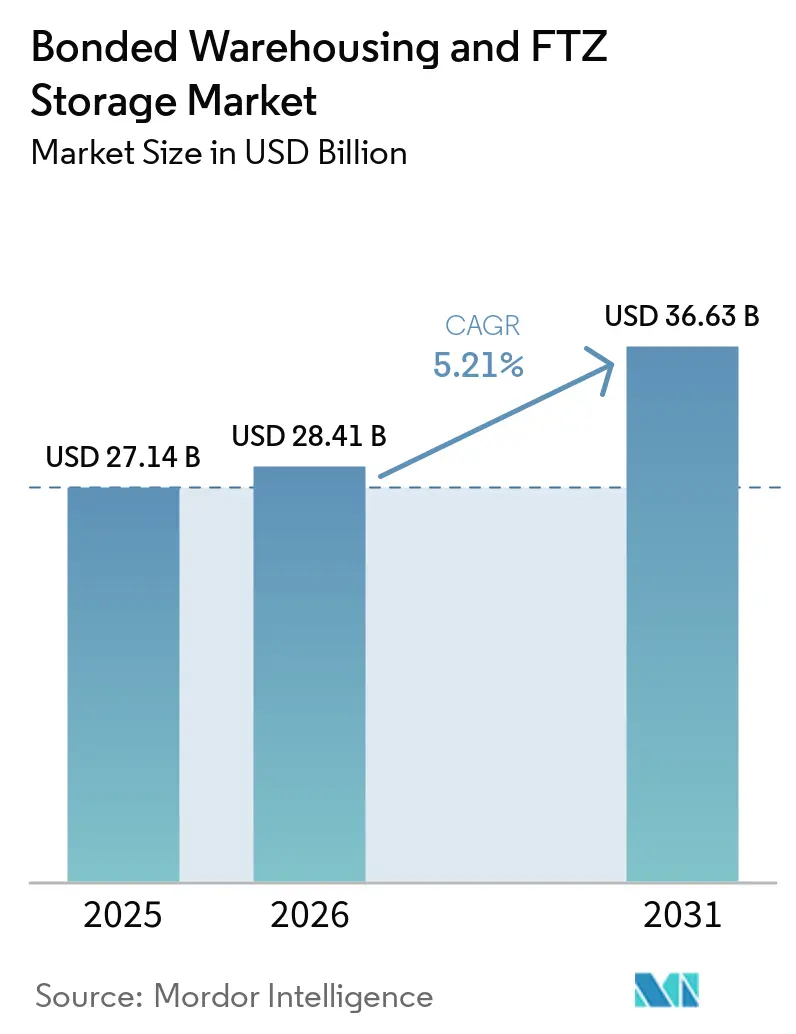
The bonded warehousing and FTZ storage market size was valued at USD 27.14 billion in 2025 and estimated to grow from USD 28.41 billion in 2026 to reach USD 36.63 billion by 2031, at a CAGR of 5.21% during the forecast period (2026-2031).
Higher tariff exposure has made duty deferral a more central consideration in inventory planning, especially for importers that need flexibility around the date goods enter domestic commerce. The bonded warehousing and FTZ storage market is also benefiting from cross-border e-commerce, because operators need local inventory positions that can support faster delivery without immediate duty payment. Port, airport, and rail links are becoming more important as facilities compete to reduce handling steps and customs delays. Manufacturers are using special-purpose FTZs for production activity, while logistics providers are adding cold-chain capacity and handling services that create higher-value work inside bonded locations. These conditions create opportunities for operators that can combine customs knowledge, reliable inventory control, and access to major trade corridors.
Key Report Takeaways
- By service type, warehousing and storage held 52.45% of the bonded warehousing and FTZ storage market share in 2025, while value-added services are forecast to register a 7.01% CAGR through 2031.
- By facility type, public bonded warehouses held 42.15% of the bonded warehousing and FTZ storage market size in 2025, while special-purpose FTZs and subzones are forecast to register a 7.18% CAGR through 2031.
- By temperature, non-temperature-controlled storage held 70.10% of the bonded warehousing and FTZ storage market share in 2025, while temperature-controlled storage is forecast to register a 6.92% CAGR through 2031.
- By end-user industry, manufacturing held 31.55% of the bonded warehousing and FTZ storage market share in 2025, while wholesale and retail trade is forecast to register a 6.78% CAGR through 2031.
- By geography, North America held 30.20% of the bonded warehousing and FTZ storage market share in 2025, while Asia-Pacific is forecast to register a 7.15% CAGR through 2031.
Note: Market size and forecast figures in this report are generated using Mordor Intelligence’s proprietary estimation framework, updated with the latest available data and insights as of January 2026.
Global Bonded Warehousing and FTZ Storage Market Trends and Insights
Drivers Impact Analysis*
| Driver | (~) % Impact on CAGR Forecast | Geographic Relevance | Impact Timeline |
|---|---|---|---|
| Duty Deferral and Working-Capital Optimization | +1.2% | Global, strongest in North America and Europe | Short term (≤ 2 years) |
| Cross-Border E-Commerce and Inventory Localization | +1.0% | Asia-Pacific, North America, and Europe | Short term (≤ 2 years) |
| Manufacturing Nearshoring and Regional Distribution Hubs | +0.8% | Americas, Southeast Asia, the Middle East, and Africa | Medium term (2-4 years) |
| Integrated Port, Airport, FTZ, and Customs Infrastructure | +0.6% | Middle East and Africa, Southeast Asia, South Asia, and the Caribbean | Medium term (2-4 years) |
| Customs-Data Interoperability and Faster Release Cycles | +0.4% | Europe, North America, and the Asia-Pacific | Medium term (2-4 years) |
| High-Value, Time-Sensitive, and Regulated Cargo Specialization | +0.3% | Global, concentrated in pharmaceutical logistics hubs | Long term (≥ 4 years) |
| Source: Mordor Intelligence | |||
Duty Deferral and Working-Capital Optimization
United States bonded warehouses can hold dutiable goods for as long as 5 years, with duty assessed when goods are withdrawn rather than when they are imported. This timing gives importers a practical choice when tariff rates are changing or when demand is uncertain. A company can release goods before a planned duty increase or hold them while it waits for a more favorable commercial decision. The approach moves bonded storage beyond a narrow compliance role and makes it part of working-capital planning. CBP’s trade advisory work in 2025 addressed FTZ and warehouse processes, including ACE modernization and trade-facing digital processes for permit activity.[1] The bonded warehousing and FTZ storage market, therefore, benefits when importers need both cash-flow flexibility and reliable customs control.
Cross-Border E-Commerce and Inventory Localization
Cross-border e-commerce favors inventory that is held closer to the destination customer, particularly when sellers need faster fulfillment and more control over release decisions. China expanded comprehensive bonded zone functions through 24 measures announced in April 2026, including broader support for bonded repair, energy and mineral distribution, and better links between zones, airports, and rail networks. Shanghai completed testing of a maritime export pre-warehouse in the Fengxian Comprehensive Bonded Zone in June 2026, connecting inland bonded storage with Yangshan Port export operations. These steps support an operating model in which goods are stored, prepared, and released closer to the shipping lane. The bonded warehousing and FTZ storage market gains from this model because e-commerce sellers need facilities that can manage inventory records, customs status, and rapid order fulfillment in the same location. The demand is likely to extend beyond China as sellers use bonded facilities in destination markets for regional stockholding.
Manufacturing Nearshoring and Regional Distribution Hubs
Nearshoring has increased the importance of FTZs located near production centers, ports, and large consumption markets. DP World signed a USD 760 million memorandum of understanding with the Dominican Republic in May 2025 for Port Caucedo and FTZ expansion, then committed a further USD 100 million in May 2026 for warehouse and logistics infrastructure. Ho Chi Minh City established a 4,174-hectare FTZ connected to the Cai Mep Ha port, Long Thanh International Airport, and the Cai Mep-Thi Vai deep-water complex. The Busan-Jinhae Free Economic Zone Authority also began a full-scale effort in June 2026 to attract global logistics firms ahead of its Tri-Port development. These investments help manufacturers place imported components and finished goods close to regional production and distribution networks. They also support the shift toward dedicated subzones where companies seek production authority and duty treatment that fit a specific manufacturing process.
Integrated Port, Airport, FTZ, and Customs Infrastructure
Integrated infrastructure reduces the number of transfers between arrival, storage, processing, and onward distribution. DHL Supply Chain committed EUR 130 million (USD 152.92 million) in 2025, for a 53,000 m² logistics hub at Saudi Arabia’s Special Integrated Logistics Zone in Riyadh. India has reported that 5 multimodal logistics parks are under development across FY 2025-26 and FY 2026-27, including projects in Bengaluru, Chennai, and Nagpur.[2] The Federal Register in the United States recorded a 2025 application by Grand River Aseptic Manufacturing for production authority in FTZ 189 Subzone 189H in Michigan.[3] Connected facilities can shorten dwell time and make customs supervision easier to manage. Faster data exchange and release processing strengthen this advantage, especially where port authorities and customs agencies use common digital procedures.
Restraints Impact Analysis*
| Restraint | (~) % Impact on CAGR Forecast | Geographic Relevance | Impact Timeline |
|---|---|---|---|
| Fragmented Customs Rules and Licensing Requirements | -0.5% | Global, especially multi-jurisdictional operations | Short term (≤ 2 years) |
| Energy, Labor, and Compliance-Cost Inflation | -0.4% | Global, especially North America, Europe, and the Asia-Pacific | Medium term (2-4 years) |
| Bonded-Inventory Reconciliation and Audit Exposure | -0.3% | Global, with heightened exposure in the United States and Europe | Short term (≤ 2 years) |
| Tariff-Policy Volatility and Uncertain Duty Economics | -0.2% | Global, especially major United States trade lanes | Short term (≤ 2 years) |
| Source: Mordor Intelligence | |||
Fragmented Customs Rules and Licensing Requirements
Different national rules create a material operating burden for companies that manage bonded networks across several jurisdictions. CBP’s 2025 FTZ and Warehouse Working Group noted inconsistent application of procedures under 19 CFR Part 19 and recommended standardized guidance, training, and more digital permit processes.[4] Canada applies a separate framework for customs bonded warehouses under Memorandum D7-4-4 and the Customs Bonded Warehouses Regulations. The European Union has its own implementation timetable for interoperable customs systems under Commission Implementing Regulation 2025/512. This means that operators serving the United States, Canada, and Europe often need different workflows, controls, and staff expertise. The bonded warehousing and FTZ storage market faces a practical limit on expansion when smaller operators cannot absorb these parallel compliance requirements.
Energy, Labor, and Compliance-Cost Inflation
Labor, energy, inventory controls, and data systems can weigh on the economics of bonded storage. The United States Bureau of Labor Statistics reported average warehouse starting wages of USD 16.41 per hour in 2025 and average management salaries of USD 58,529 annually in the warehousing and storage sector. Bonded facilities require detailed inventory records, so labor accuracy and training have a direct effect on operating costs. The International Chamber of Commerce reported in 2025 that interoperable digital trade processes might require substantial upfront investment in application programming interfaces, digital trust services, and electronic records management. The World Customs Organization and Universal Postal Union also updated electronic advance data guidance in 2025, increasing data-handling requirements for operators connected to postal flows. These costs are higher for smaller warehouses and for temperature-controlled sites that need continuous monitoring and refrigeration.
*Our forecasts treat driver/restraint impacts as directional, not additive. The impact forecasts reflect baseline growth, mix effects, and variable interactions.
Segment Analysis
By Service Type: Value-Added Services Gain Ground Inside Bonded Zones
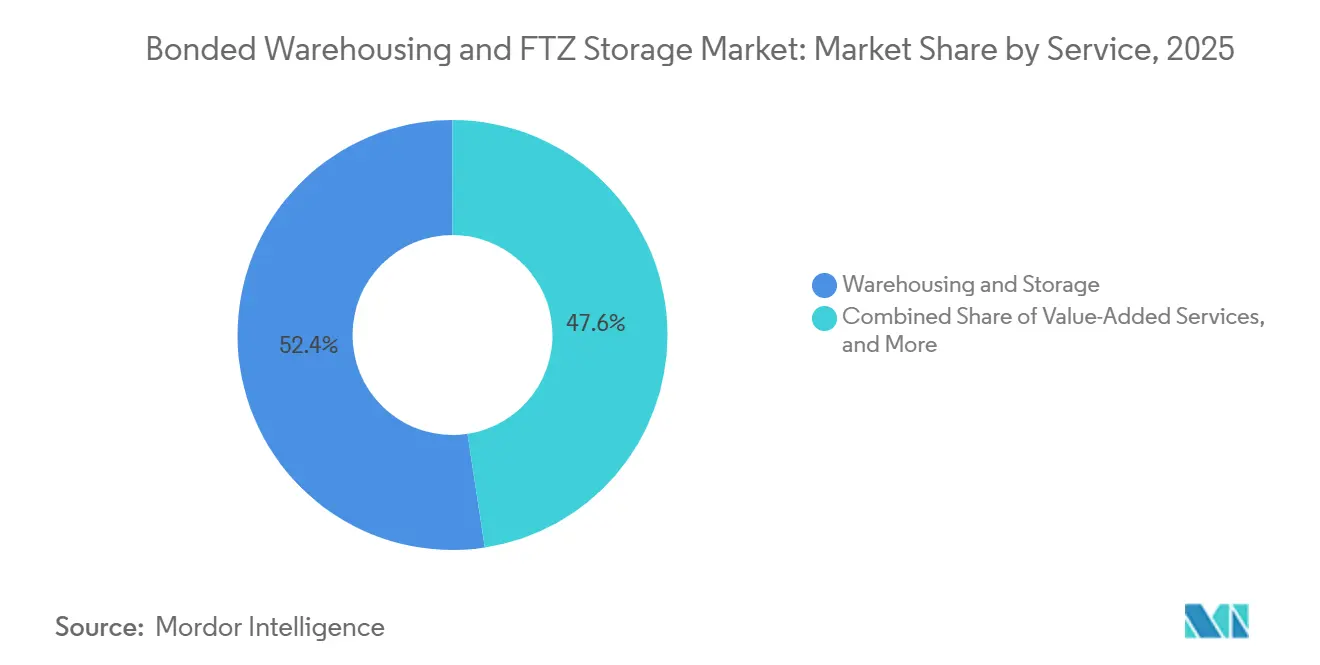
Warehousing and storage held 52.45% of the bonded warehousing and FTZ storage market share in 2025, reflecting the continuing need to keep goods under duty suspension before domestic release. The segment serves a wide range of merchandise, including electronics, textiles, industrial inputs, and consumer goods. Its role remains central because many importers only need secure storage, customs oversight, and the ability to release goods in line with demand. Inbound and outbound handling adds a faster-moving service layer at port-adjacent facilities. This work includes receiving, movement control, loading, and dispatch, and it is increasingly affected by warehouse automation. The main commercial value comes from keeping cargo moving accurately while preserving the goods’ customs status.
Value-added services are forecast to register at a 7.01% CAGR through 2031, the fastest rate within the service segmentation. The bonded warehousing and FTZ storage market size for this service is supported by in-bond repackaging, palletizing, labeling, and other work that can be completed before goods enter domestic commerce. Manufacturers can use these services to postpone final preparation until an order or distribution decision is clear. This increases revenue per m² for facilities that have the right systems and customs permissions. It also makes operators more important to customers because storage, product handling, and release controls are managed at one site. As these services become more common, the distinction between a basic warehouse and a bonded logistics platform becomes clearer.
By Facility Type: Special-Purpose FTZ Subzones Attract Manufacturing Investment
Public bonded warehouses held 42.15% of the bonded warehousing and FTZ storage market size in 2025, supported by a multi-user model that lowers the entry barrier for importers. Companies can gain duty-deferral benefits without building their own private facility or taking on all activation costs. This format is useful for retailers, light manufacturers, agricultural importers, and businesses with variable volumes. Private bonded warehouses remain important for large importers that need greater control over operations and inventory access. General-purpose FTZs also provide broader duty-deferral options for manufacturers and distributors. Their value lies in handling many customers or activities inside an established customs-supervised area.
Special-purpose FTZs and subzones are forecast to register a 7.18% CAGR through 2031. These locations are designed for companies that need a site-specific authority for manufacturing or other defined activities. The 2025 Grand River Aseptic Manufacturing application for FTZ 189 Subzone 189H showed how pharmaceutical producers used the production-authority pathway. Similar structures can support semiconductor, battery, aerospace, and energy-related activities where the goods and production steps require close customs management. Dedicated subzones can also support duty inversion when a company can pay duty on the lower-rate finished product rather than on imported components. This explains why special-purpose facilities are gaining attention as nearshoring projects move closer to major consumer markets.
By Temperature: Pharma Cold Chains Drive Temperature-Controlled Growth
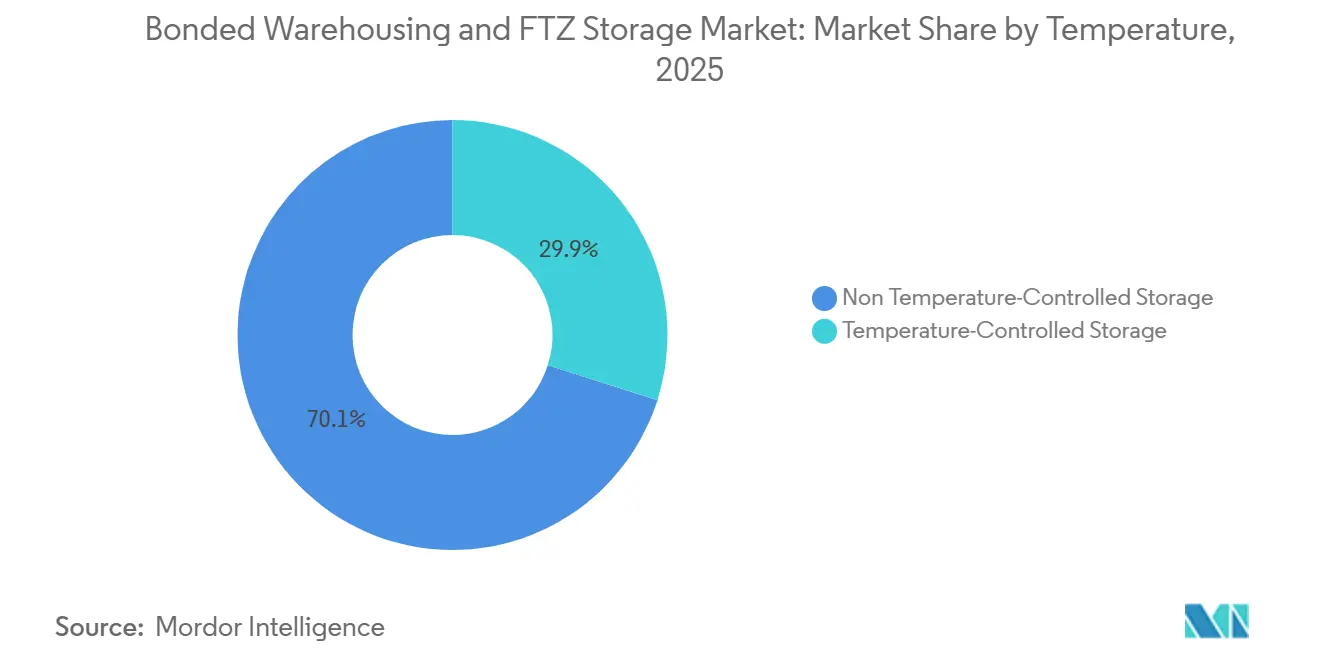
Non-temperature-controlled storage held 70.10% of the bonded warehousing and FTZ storage market share in 2025. Electronics, textiles, machinery, industrial products, and many consumer goods do not need climate control while held in bond. This gives ambient facilities a broad and stable cargo base across major seaports and inland logistics corridors. Operators in this segment focus on capacity, inventory accuracy, security, and efficient release activity. The segment also benefits from e-commerce flows that need general merchandise stored near destination markets. Its scale makes it the core temperature category in the bonded warehousing and FTZ storage market.
Temperature-controlled storage is forecast to register a 6.92% CAGR through 2031. The segment covers ambient, chilled, and frozen conditions, with demand linked to pharmaceutical, biotechnology, food, and premium consumer shipments. GEODIS opened a healthcare cold-chain cross-dock facility near Chicago O’Hare in April 2026 with dedicated temperature zones for biologics and controlled-room-temperature healthcare products. Movianto, part of Yusen Logistics, expanded its Belgian Aalst facility from 14,000 to 25,000 temperature-controlled pallet positions in June 2026 and added GMP-licensed secondary packaging. These examples show why regulated cargo can support a more specialized class of bonded facility. Operators need both customs controls and documented temperature performance, which creates higher barriers to entry than in ambient storage.
By End-User Industry: Retail and Trade Emerge as a Growth Catalyst
Manufacturing held 31.55% of the bonded warehousing and FTZ storage market share in 2025, making it the largest end-user category. Automotive, electronics, and industrial equipment producers use bonded locations to defer duty on imported components before finished goods move into domestic distribution. This helps companies match duty payments more closely with production and sales schedules. Construction materials, oil and gas, and mining users also need storage for imported equipment and strategic inputs. Their demand is often linked to major projects and dedicated production authority in coastal FTZs. The bonded warehousing and FTZ storage market, therefore, remains closely tied to industrial supply chains as well as consumer imports.
Wholesale and retail trade is forecast to register a 6.78% CAGR through 2031, the fastest rate across the end-user segmentation. Retailers are placing duty-in-transit inventory in FTZ-linked fulfillment centers and releasing goods against confirmed orders. This can improve inventory flexibility and make returns handling easier when products are not yet entered into domestic commerce. Agriculture, fishing, and forestry users also rely on bonded cold and ambient facilities for imported food and seafood. Lineage and the Port of New Orleans certified Louisiana’s first Class 3 public bonded refrigerated warehouse with on-site USDA I-House inspection capability in August 2025. The service model is becoming more accessible as warehouse management systems combine customs functions with daily inventory operations.
Geography Analysis
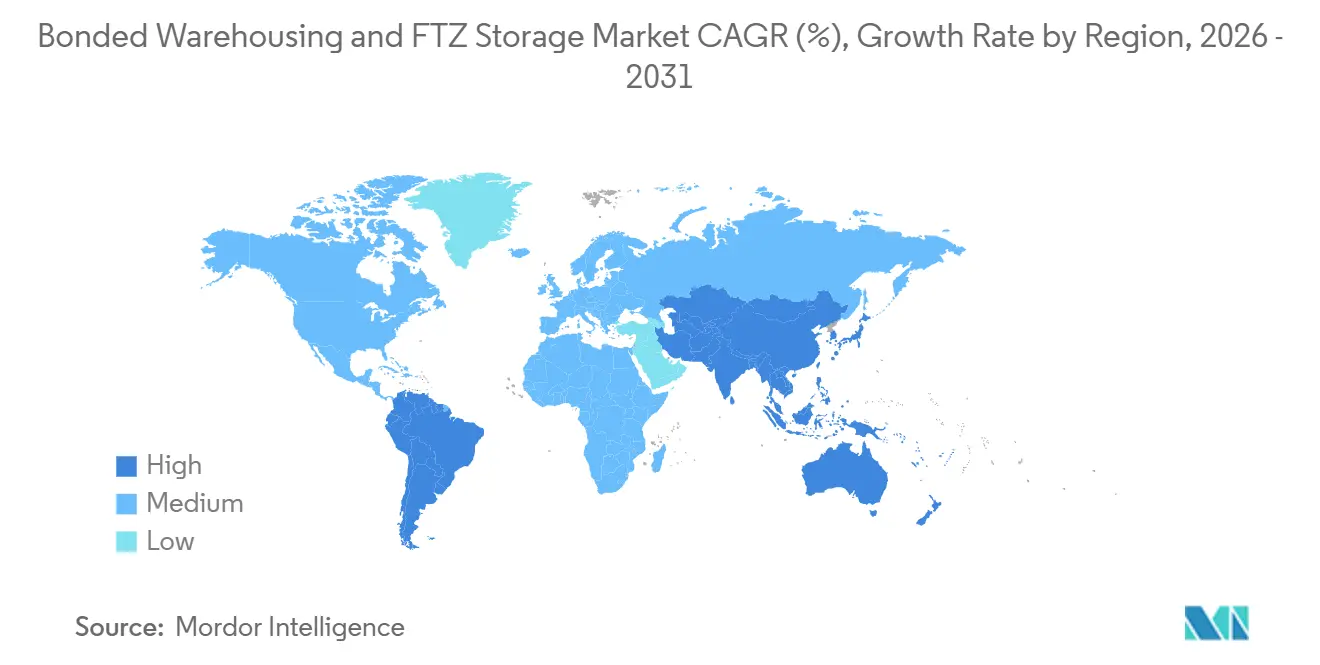
North America held 30.20% of the bonded warehousing and FTZ storage market share in 2025. The United States has a mature customs-supervised network, and tariff-management needs have increased interest in bonded storage and FTZ use. Canada complements this network through its Customs Bonded Warehouses program and regulations, which apply a separate licensing and operating framework. The region’s demand is supported by large import volumes, close links between manufacturing and retail supply chains, and established port and inland logistics assets. In the Caribbean, DP World’s commitments at Caucedo point to a larger role for port-integrated FTZ capacity in serving nearshoring manufacturers.
Europe has a stable demand around the Rotterdam, Antwerp, and Hamburg corridor, where dense multimodal infrastructure supports customs-supervised logistics. The Port of Antwerp-Bruges brought its Inbound Release Platform fully live in December 2025, replacing the PLDA customs system with an automated data-exchange framework for arrival and temporary-storage events. Maersk opened a GDP-certified cold-store at Rotterdam Maasvlakte in July 2026, close to APM Terminals Maasvlakte II. The European framework favors operators that can meet common digital expectations while navigating country-level implementation. The United Kingdom, Germany, France, and Belgium remain important locations for bonded demand because of their trade volumes and industrial bases.
Asia-Pacific is forecast to register a 7.15% CAGR through 2031, giving it the fastest regional growth rate in the bonded warehousing and FTZ storage market. China’s April 2026 measures expanded the operating scope of comprehensive bonded zones and strengthened links between zones and transport infrastructure. India’s planned multimodal logistics parks are intended to integrate customs-bonded storage into national freight infrastructure. Southeast Asian FTZ development in Vietnam and South Korea also supports the region’s role in manufacturing and regional distribution. The Middle East and Africa remain important emerging areas, led by JAFZA, Saudi Arabia’s SILZ, and the Suez Canal Economic Zone. DP World’s 50-year concession with the Fujairah Ports Authority in July 2026 announced to develop 2 UAE east-coast terminals and raise national container capacity from 19.4 million to nearly 22 million TEUs.
Competitive Landscape
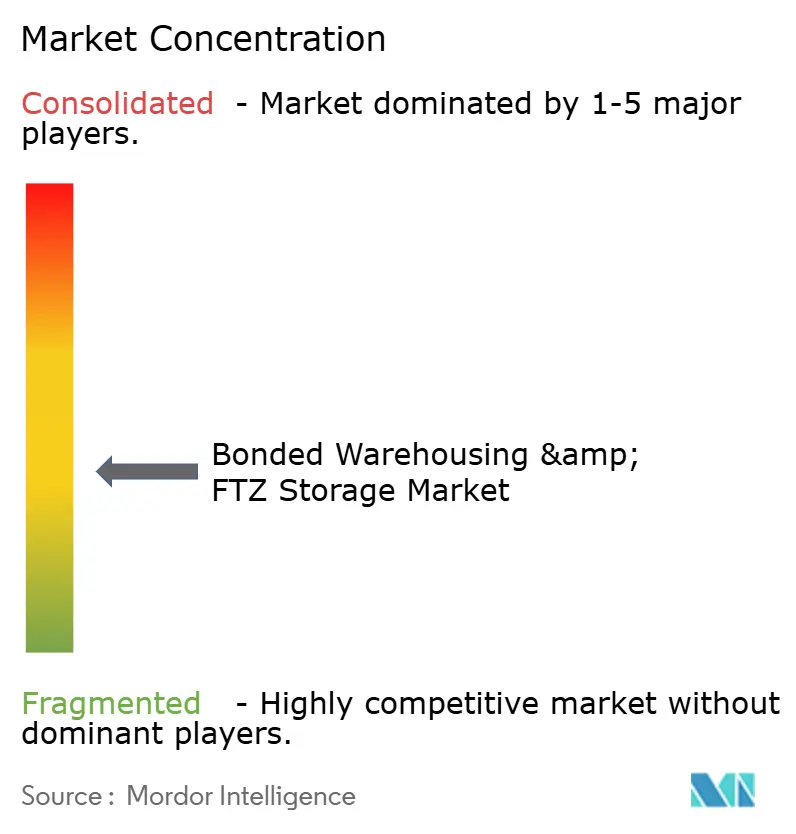
The bonded warehousing and FTZ storage market is moderately fragmented. Large third-party logistics providers operate broad port-adjacent networks, while specialized regional firms focus on regulated, temperature-controlled, or high-value cargo. Competition is shaped by site location, customs capability, available warehouse systems, and access to capital for expansion. The leading providers are seeking a wider presence in fast-growing FTZ corridors rather than relying on a single national network. They are also adding services that make a facility harder to replace, including bonded cold storage, production support, and customs data integration. This structure gives established global operators an advantage, but it leaves room for smaller companies with local regulatory knowledge or specialized handling capabilities.
DHL’s EUR 130 million (USD 152.92 billion) investment in a Riyadh facility within SILZ is one example of a strategy built around integrated trade infrastructure and sector-specific logistics. DP World’s further investment at Caucedo is another example, combining port capacity, warehousing, and FTZ development to attract manufacturing and distribution customers. Maersk’s 2026 GDP-certified cold-store at Rotterdam illustrates the value of combining location with regulated pharmaceutical handling. These moves show that leading providers are not competing only for space. They are competing for customers who need a complete operating environment, including transport links, compliance controls, and specialized services.
The bonded warehousing and FTZ storage market also has opportunities in areas where dedicated cold-chain capacity is limited, including parts of West Africa, South Asia, and the Caribbean. Data-center component logistics is another developing niche because high-value hardware may require careful timing of customs entry and onward delivery. DHL announced 10 dedicated data-center logistics warehouse sites across North America in January 2026, totaling more than 7 million ft² and including specialized capabilities for IT equipment. Shared-service models can help mid-sized importers use FTZ benefits without establishing a dedicated subzone. Technology investment is likely to remain important as customs agencies move toward more digital permits, electronic records, and interoperable data. The result is a field where scale helps, but sector knowledge and reliable execution remain important sources of differentiation.
Bonded Warehousing and FTZ Storage Industry Leaders
-
DHL Group
-
United Parcel Service, Inc.
-
A.P. Moller - Maersk
-
Kuehne + Nagel International AG
-
DSV A/S
- *Disclaimer: Major Players sorted in no particular order
Recent Industry Developments
- September 2026: A.P. Moller Maersk launched a 71,800 m² logistics center in Herleshausen, Germany, on the A4 motorway, supporting a major online retailer’s distribution across Central Europe with up to 1,000 employees at peak capacity.
- July 2026: DP World signed a 50-year concession with the Fujairah Ports Authority to develop 2 new UAE terminals, expanding UAE container-handling capacity from 19.4 million to nearly 22 million TEUs.
- May 2026: GEODIS opened a GDP-compliant, temperature-controlled pharmaceutical warehouse near Manchester Airport with 2,000 pallet positions across ambient and chilled zones for pharmaceutical imports.
- January 2026: DHL Group announced 10 dedicated data-center logistics warehouse sites across North America, totaling more than 7 million ft².
Global Bonded Warehousing and FTZ Storage Market Report Scope
| Warehousing and Storage |
| Inbound & Outbound Handling |
| Value-Added Services (Packaging, Palletiizing, Labelling, etc.) |
| Public Bonded Warehouses |
| Private Bonded Warehouses |
| General-Purpose FTZs |
| Special-Purpose FTZs and Subzones |
| Temperature-Controlled Storage | Ambient |
| Chilled | |
| Frozen | |
| Non Temperature-Controlled Storage |
| Manufacturing |
| Oil and Gas, Mining and Quarrying |
| Wholesale and Retail Trade |
| Others |
| North America | United States |
| Canada | |
| Mexico | |
| South America | Brazil |
| Argentina | |
| Peru | |
| Chile | |
| Rest of South America | |
| Europe | Germany |
| United Kingdom | |
| France | |
| Italy | |
| Spain | |
| Russia | |
| Nordics (Denmark, Finland, Iceland, Norway, and Sweden) | |
| Rest of Europe | |
| Asia-Pacific | China |
| India | |
| Japan | |
| South Korea | |
| Australia | |
| Southeast Asia (ASEAN) | |
| Rest of Asia-Pacific | |
| Middle East and Africa | Saudi Arabia |
| United Arab Emirates | |
| Qatar | |
| South Africa | |
| Nigeria | |
| Egypt | |
| Rest of Middle East and Africa |
| By Service Type | Warehousing and Storage | |
| Inbound & Outbound Handling | ||
| Value-Added Services (Packaging, Palletiizing, Labelling, etc.) | ||
| By Facility Type | Public Bonded Warehouses | |
| Private Bonded Warehouses | ||
| General-Purpose FTZs | ||
| Special-Purpose FTZs and Subzones | ||
| By Temperature | Temperature-Controlled Storage | Ambient |
| Chilled | ||
| Frozen | ||
| Non Temperature-Controlled Storage | ||
| By End User Industry | Manufacturing | |
| Oil and Gas, Mining and Quarrying | ||
| Wholesale and Retail Trade | ||
| Others | ||
| By Geography | North America | United States |
| Canada | ||
| Mexico | ||
| South America | Brazil | |
| Argentina | ||
| Peru | ||
| Chile | ||
| Rest of South America | ||
| Europe | Germany | |
| United Kingdom | ||
| France | ||
| Italy | ||
| Spain | ||
| Russia | ||
| Nordics (Denmark, Finland, Iceland, Norway, and Sweden) | ||
| Rest of Europe | ||
| Asia-Pacific | China | |
| India | ||
| Japan | ||
| South Korea | ||
| Australia | ||
| Southeast Asia (ASEAN) | ||
| Rest of Asia-Pacific | ||
| Middle East and Africa | Saudi Arabia | |
| United Arab Emirates | ||
| Qatar | ||
| South Africa | ||
| Nigeria | ||
| Egypt | ||
| Rest of Middle East and Africa | ||
Key Questions Answered in the Report
What is driving growth in bonded warehousing and FTZ storage?
Duty deferral, cross-border e-commerce, nearshoring, and integrated transport infrastructure support growth from USD 28.41 billion in 2026 to USD 36.63 billion by 2031.
Which service is growing fastest in bonded facilities?
Value-added services are forecast to register at a 7.01% CAGR through 2031 as customers use bonded sites for repackaging, labeling, and other pre-release work.
Why are special-purpose FTZs becoming more important?
They allow manufacturers to seek site-specific production authority and can support duty treatment that is better suited to a defined production process.
Which temperature category is growing fastest?
Temperature-controlled storage is forecast to register a 6.92% CAGR through 2031, supported by pharmaceutical and biotechnology supply chains.
Which region has the fastest projected growth?
Asia-Pacific is forecast to register a 7.15% CAGR through 2031, supported by bonded-zone expansion and logistics investment across China, India, Vietnam, and South Korea.