
Market Overview
| Study Period | 2020 - 2031 |
|---|---|
| Forecast Data Period | 2026 - 2031 |
| Base Year Market Size (2025) | USD 2.35 Billion |
| Market Size (2026) | USD 2.84 Billion |
| Market Size (2031) | USD 5.26 Billion |
| Growth Rate (2026 - 2031) | 13.16 % |
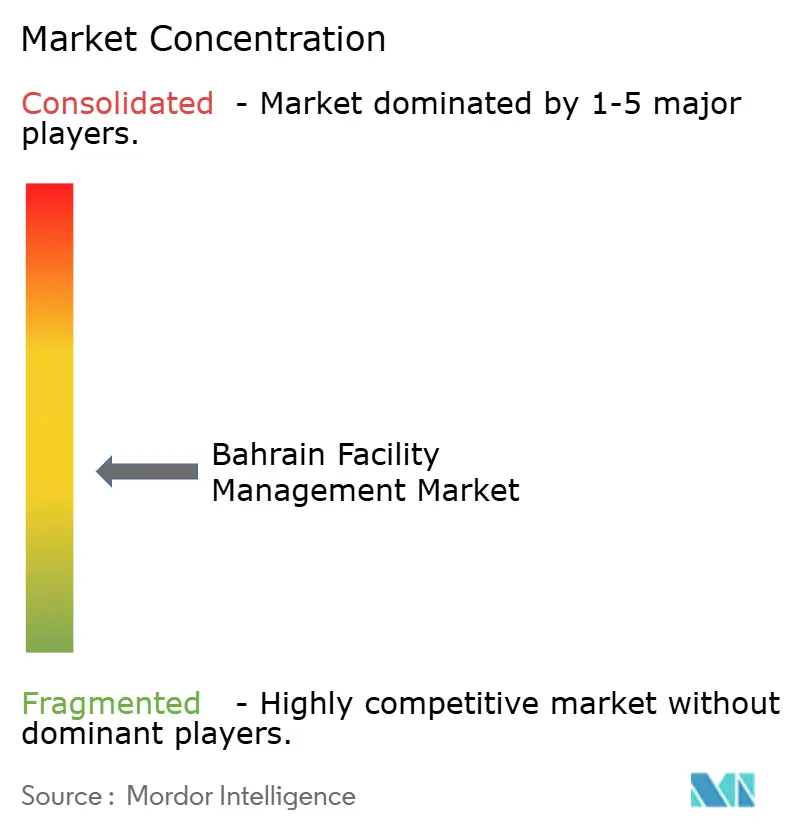
| Market Concentration | Medium |
Major Players *Disclaimer: Major Players sorted in no particular order Image © Mordor Intelligence. Reuse requires attribution under CC BY 4.0. | |
Bahrain Facility Management Market Analysis by Mordor Intelligence
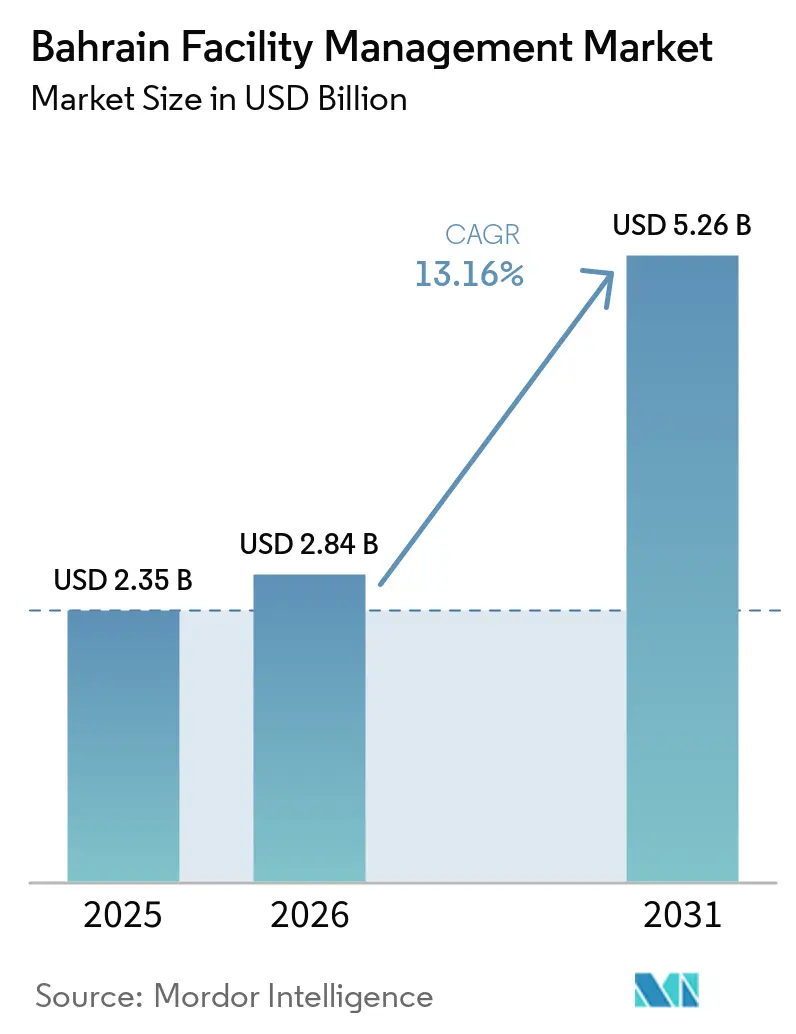
The Bahrain Facility Management Market size is expected to grow from USD 2.35 billion in 2025 to USD 2.84 billion in 2026 and is forecast to reach USD 5.26 billion by 2031 at 13.16% CAGR over 2026-2031.
Sustained government spending on large-scale transport, energy, and mixed-use projects, led by the USD 30 billion Vision 2030 pipeline, underpinned the market’s rapid growth through 2025 while creating a visible backlog of new assets that will require integrated operations and maintenance services across the forecast horizon.[1]The Daily Tribune, “Bahrain to invest in 22 major infrastructure projects, including five artificial islands,” newsofbahrain.com Private developers increasingly outsourced hard and soft services to specialist vendors, accelerating demand for bundled and integrated delivery models. Heightened ESG regulations triggered strong investment in energy-efficient retrofits and green-building certifications, favouring providers with IoT-enabled maintenance and AI-based energy-optimisation platforms. The technology adoption wave also narrowed cost differentials between in-house and outsourced models, encouraging corporates to sign outcome-based, multi-year contracts that secure predictable operating costs and performance guarantees.
Key Report Takeaways
- By service type, hard services led with 57.65% of the Bahrain facility management market share in 2025, and soft services are projected to advance at an 18.04% CAGR to 2031.
- By offering type, the outsourced model commanded a 61.80% share of the Bahrain facility management market size in 2025, while integrated service portfolios are forecast to expand at an 18.22% CAGR through 2031.
- By end-user industry, commercial facilities accounted for 39.10% share of the Bahrain facility management market size in 2025, and the industrial and process segment is growing the fastest at 18.39% CAGR, thanks to new aluminium and petrochemical capacity additions.
Note: Market size and forecast figures in this report are generated using Mordor Intelligence’s proprietary estimation framework, updated with the latest available data and insights as of 2026.
Bahrain Facility Management Market Trends and Insights
Drivers Impact Analysis*
| Driver | (~) % Impact on CAGR Forecast | Geographic Relevance | Impact Timeline |
|---|---|---|---|
| Vision 2030 infrastructure development and a USD 30 billion project pipeline | +4.2% | National, concentrated in Manama and industrial zones | Medium term (2-4 years) |
| Digital transformation and IoT integration in facility operations | +3.8% | Global, with early adoption in commercial and healthcare sectors | Short term (≤ 2 years) |
| Outsourcing trend acceleration and integrated service delivery models | +3.1% | Regional GCC spillover, strongest in Bahrain urban centers | Medium term (2-4 years) |
| ESG compliance requirements and net-zero emissions targets by 2060 | +2.9% | National regulatory mandate with international standards alignment | Long term (≥ 4 years) |
| Healthcare sector expansion and specialized facility requirements | +2.4% | National, with a concentration in Manama and emerging medical districts | Medium term (2-4 years) |
| Industrial manufacturing growth and Alba-BAPCO partnership initiatives | +1.7% | Industrial zones, particularly Sitra and Alba facilities | Long term (≥ 4 years) |
| Source: Mordor Intelligence | |||
Vision 2030 Infrastructure Development Catalyses Market Expansion
The state’s USD 30 billion commitment to 22 flagship projects—including the USD 3.5 billion King Hamad Causeway and the USD 2 billion Bahrain Metro—dramatically expanded the Bahrain facility management market by adding high-spec assets that need round-the-clock technical upkeep. The USD 1.1 billion airport modernisation programme alone introduced complex passenger-flow, security, and energy-management systems that require integrated FM from day one. Public-private partnership structures lock in long-term O&M contracts, granting vendors revenue visibility while increasing customer expectations around service-level guarantees. As construction proceeds, refurbishment of legacy buildings further multiplies addressable spend, reinforcing the Bahrain facility management market’s double-digit trajectory.
Digital Transformation Accelerates Operational Efficiency
Bahrain’s cloud-first policy, nationwide 5G, and international fibre-optic links allowed FM firms to shift from reactive to predictive maintenance models. IoT sensors continuously capture HVAC runtime, vibration, and energy-use data; AI analytics pre-empt failures and cut unplanned downtime by up to 30 percent, lowering total cost of ownership and improving tenant satisfaction. IBM’s Maximo deployment in the King Abdullah Financial District pushed work-order closure rates above 95% and trimmed annual maintenance spend, a benchmark now mirrored by Manama’s Grade-A office towers. Local innovators such as ARRAY Innovation signed 2025 agreements with Alba and NBB to overlay AI algorithms on large industrial campuses, setting a new service baseline across the Bahrain facility management market.
Outsourcing Acceleration Drives Service Integration
Corporate tenants prioritised core business functions and transferred non-core services—including security, cleaning, MEP, and cafeteria operations—to external specialists. Government rules permitting 100% foreign ownership and fast-track licensing attracted global FM majors and regional incumbents, amplifying competition and capability depth. Landmark Hospitality’s 2025 GCC-wide IT outsourcing deal with Gulf Business Machines illustrated a shift toward bundled, outcome-based contracts that place performance risk with the vendor. The model favours firms that couple field staff with cloud dashboards, resulting in longer contract tenures and higher switching costs within the Bahrain facility management market.
ESG Compliance Requirements Transform Service Delivery
Bahrain pledged net-zero emissions by 2060 and interim renewable-energy targets of 5% in 2025 and 10% in 2035, compelling asset owners to retrofit lighting, chillers, and water systems. The Alba-BAPCO green-industrial alliance designed hydrogen-reuse and zero-waste projects that demand specialist FM oversight, elevating vendors proficient in environmental compliance and energy dashboards. Mumtalakat’s capital-allocation policy embedded ESG clauses into procurement, pushing FM providers to publish Scope 1-3 emissions baselines and annual reduction plans. These mandates turned sustainability performance from a nice-to-have into a core contract requirement across the Bahrain facility management market.
Restraints Impact Analysis*
| Restraint | (~) % Impact on CAGR Forecast | Geographic Relevance | Impact Timeline |
|---|---|---|---|
| Skilled labor shortages and workforce development challenges | -2.8% | National, with acute shortages in technical and digital skills | Short term (≤ 2 years) |
| Supply chain volatility and material cost inflation | -2.1% | Regional GCC impact with global supply chain dependencies | Medium term (2-4 years) |
| Regulatory compliance complexity and evolving safety standards | -1.4% | National regulatory framework with international alignment requirements | Medium term (2-4 years) |
| Economic uncertainty and oil price volatility are affecting investment decisions | -1.2% | Regional GCC economic conditions with global commodity exposure | Short term (≤ 2 years) |
| Source: Mordor Intelligence | |||
Skilled Labour Shortages Constrain Service Capacity
Despite the Ministry of Labor surpassing its 2024 hiring target with 27,147 citizen placements, FM employers struggled to secure technicians adept at BMS programming, sensor calibration, and data analytics.[2]Ministry of Labor, “Ministry of Labor,” mol.gov.bh Competing demand from fintech and cloud-services firms intensified wage pressures, while visa processes for expatriate specialists elongated mobilisation timelines. Tamkeen’s 2024 skills report highlighted gaps in digital literacy within vocational programmes, forcing FM firms to invest in in-house academies and remote-support platforms. Until training pipelines catch up, staff shortages will cap near-term growth in the Bahrain facility management market.
Supply-Chain Volatility Pressures Operating Costs
Rising global freight rates, extended delivery lead times, and commodity price swings inflated HVAC spares, elevator parts, and cleaning chemicals budgets. Strategy& estimated that better procurement planning could save GCC contractors 10-20%, but FM firms still faced year-on-year cost hikes that eroded fixed-price contract margins. CBRE recorded a peak in FM cost inflation in late 2022, and although pressures moderated, vendors adopted “just-in-case” inventory buffers, tying up working capital. The need to renegotiate escalation clauses became routine across the Bahrain facility management market.
*Our forecasts treat driver/restraint impacts as directional, not additive. The impact forecasts reflect baseline growth, mix effects, and variable interactions.
Segment Analysis
By Offering Type: Outsourced Model Widens its Lead
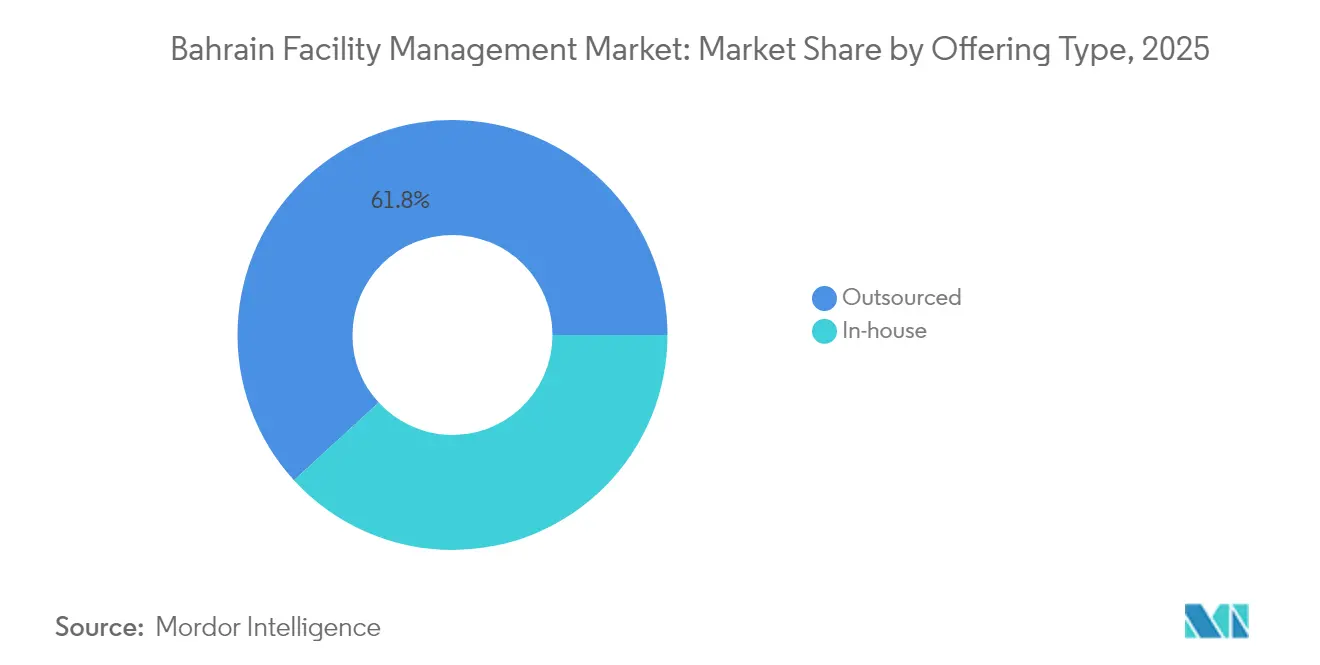
Outsourced vendors controlled 61.80% of the Bahrain facility management market size in 2025 as corporates shifted capex and HR risks to external partners. Multi-site portfolios spanning offices, warehouses, and retail outlets increasingly favoured single-invoice providers who could guarantee service-level compliance nationwide. Internally, FM buyers pivoted to integrated platforms that merge help-desk, work-order, and asset-life-cycle analytics, reinforcing dependence on technology-enabled outsourcers. The Bahrain facility management industry also saw higher RFP scoring for ISO 41001-certified providers, pushing smaller firms toward consolidation.
In-house operations, with a 38.20% share, persisted mainly in sensitive government and defence installations such as Isa Air Base, where a USD 29.85 million 2024 BOS contract option underscored the value placed on direct oversight. Yet rising wage costs and technology complexity led many agencies to test hybrid models where they retain strategic command while subcontracting field services, realigning spending patterns inside the Bahrain facility management market.



By End-User Industry: Commercial Core Faces Industrial Upswing
Commercial facilities produced 39.10% of the Bahrain facility management market size in 2025, underwritten by telecom, IT parks, and a burgeoning logistics sector. DHL’s EUR 218 million (USD 239.8 million) 2024 hub expansion at Bahrain International Airport exemplified the scale of new FM opportunities in temperature-controlled warehousing and time-critical aircraft handling.Retail developers redesigned malls into mixed-use destinations, adding entertainment and coworking attributes that increased cleaning and security complexity.
Industrial and process manufacturing assets are expected to grow fastest at 18.39% CAGR, thanks to Alba’s line-7 aluminium capacity and the Alba-BAPCO green-hydrogen initiative. These heavy-industry plants require high-reliability electrical, conveyor, and environmental systems, raising demand for predictive vibration analysis and hazardous-area maintenance. Healthcare facilities also expanded rapidly; specialised FM vendors now manage sterile areas, negative-pressure rooms, and backup-power infrastructure at King Hamad American Mission Hospital, elevating service margins for clinical-grade operators.
By Service Type: Hard-Service Dominance and Soft-Service Momentum
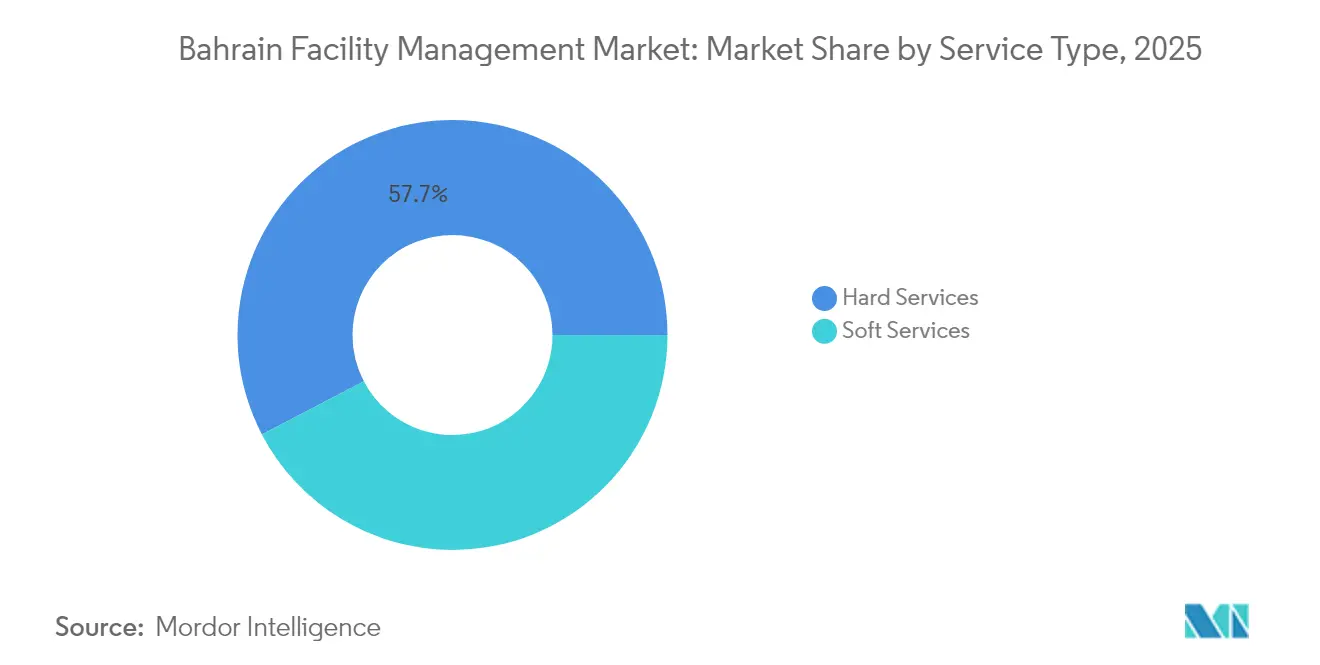
Hard services held 57.65% of the Bahrain facility management market share in 2025, anchored by complex MEP, HVAC, and fire-safety systems embedded in new transport, petrochemical, and metro projects. The USD 7 billion BAPCO modernisation alone added thousands of assets requiring lifecycle management. Continuous high-temperature conditions and stricter fire codes raised the frequency of preventive checks, cementing recurring revenue for technical specialists. Asset-management software uptake also increased ticket volumes while improving first-time-fix rates, strengthening vendor lock-in across government and private portfolios.
Soft services are projected to grow at an 18.04% CAGR, fuelled by the hospitality and healthcare boom. Luxury openings such as Raffles Al Areen Palace and Kempinski Bahrain Harbour elevated benchmarks for cleaning, concierge, and catering standards. The Amana Healthcare centre, scheduled for 2025, demands infection-control protocols aligned with international accreditation, boosting specialised cleaning contract values. Corporates also adopted hybrid-workplace models that blend facilities services with workplace-experience apps, expanding the scope of soft-service deliverables within the Bahrain facility management market.
Geography Analysis
The Manama metropolitan area anchored the largest cluster of assets within the Bahrain facility management market, driven by the concentration of ministries, financial institutions, and premium mixed-use towers across Bahrain Bay, Seef, and the Diplomatic Area. Grade-A offices demanded advanced BMS platforms, while high-footfall retail complexes required expanded soft-service headcounts. Traffic-dense locations compelled providers to establish rapid-response hubs along the King Fahd Causeway corridor for 24/7 coverage, consolidating economies of scale.
Industrial zones in Sitra and around the Alba smelter formed the fastest-growing sub-market, booking a double-digit rise in outsourced technical contracts. Green-industrial initiatives, including hydrogen-reuse pilots, necessitated specialist safety skills and environmental monitoring equipment, differentiating vendors who could supply certified technicians on short notice. Proximity to Khalifa Bin Salman Port shortened spare parts lead times, enhancing service-level compliance for process industries.
The northern and southern coastal developments—including the artificial islands, Marassi Al Bahrain, and Digital City in Hamala—broadened residential and hospitality workloads. Aecom’s 2024 appointment as master planner for the 380,000 m² Digital City intensified FM tender activity for smart-parking, district-cooling, and medical-facility maintenance. Muharraq’s heritage restoration projects added specialist stone conservation and crowd-management responsibilities, while the airport precinct demanded aviation-compliant cleaning, waste, and GSE-equipment services. Compact national geography enabled central dispatching, allowing providers to service multi-region portfolios economically and enhance competitiveness inside the Bahrain facility management market.
Regulatory Landscape
Facility management activities in Bahrain operate under a mix of building and public-works standards, permitting rules, and ICT governance requirements that affect FM procurement and operating procedures. The Ministry of Works maintains the Standard Specifications for Construction Works (2019 edition) and standard contract conditions used across construction and maintenance scopes, shaping service specifications, QA/QC, and HSE requirements for hard-services providers working on public and quasi-government assets.
On the digital side, the Information and eGovernment Authority (iGA) sets public-sector IT governance through the National Enterprise Architecture (NEA) framework and a government Cloud-First Policy. This pushes FM vendors supporting government entities to align with security and interoperability expectations, where ISO 27001 and related assurance frameworks are commonly referenced in cloud procurement. For connected facilities and telecom-adjacent infrastructure, the Telecommunications Regulatory Authority (TRA) issues guidance and position papers, including telecommunications sector cybersecurity controls (February 2025), which raise the compliance bar for IoT-enabled maintenance, remote monitoring, and data-handling in integrated FM contracts.
Value Chain Analysis
Demand comes from government entities and sovereign-linked asset owners managing large transport, energy, and mixed-use portfolios, alongside private developers, industrial operators, and operators of critical facilities such as airports and data centers. Procurement typically follows RFPs and tendering for bundled or integrated scopes that combine hard services (MEP, HVAC, fire systems) with soft services (cleaning, security, catering), with service-level and reporting obligations increasingly tied to digital work-order systems and asset registers.
Upstream inputs include OEMs and distributors for MEP and building-automation equipment, spares suppliers routed through local logistics corridors (including the airport and seaports), and specialist subcontractors for niche works. Delivery is handled by FM prime contractors and specialists that mobilize field technicians, helpdesks, and CAFM/CMMS platforms, with growing participation from telecom and digital infrastructure players that enable connectivity for smart buildings. Recent project activity reflects this ecosystem, including Bapco Energies launching the Bapco Modernisation Program in December 2024 and Bapco Refining issuing a Tender Board tender (26/2024/BAPCO) for comprehensive FM services for Awali Township, which expands the pipeline for technical O&M, compliance services, and digital asset management across large, complex sites.
Competitive Landscape
The Bahrain facility management market displayed moderate fragmentation, with local champions BMMI Group and Almoayyed Contracting controlling diversified hard- and soft-service lines, but each below a 10% revenue share. Mid-tier specialists such as VATES shifted into healthcare and complex industrial niches, while Renaissance Services leveraged pan-GCC scale to win integrated catering-and-maintenance packages for 70 clinic and hotel sites. Competitive intensity rose as global entrants formed joint ventures or technology alliances, keen to transfer best-practice analytics and robotic cleaning platforms.
Digital capabilities became the decisive battleground. ARRAY Innovation’s 2025 AI agreements with Alba and NBB front-loaded data-science competencies as a purchasing criterion, squeezing firms reliant on manual workflows.[4]The Daily Tribune, “ARRAY Innovation Strengthens Commitment to Bahrain's Digital Transformation,” newsofbahrain.com FM bidders increasingly needed ISO 27001, ISO 41001, and cyber-security compliance to win banking, data-centre, and defence contracts. To close gaps, incumbents accelerated M&A and talent-acquisition programmes focused on data engineers and sustainability consultants.
Sustainability credentials also shaped vendor shortlists. Companies that quantified carbon-reduction roadmaps secured renewals at premium margins, especially on sovereign-wealth-funded projects. The arrival of performance-linked payment clauses aligned provider remuneration with energy-saving outcomes, rewarding firms that invested early in smart meters and AI-optimisation tools. Overall, the Bahrain facility management market continued trending toward a technology-intensive, partnership-driven structure.
Bahrain Facility Management Industry Leaders
ATLANTIS Engineering
ASF Facility Management
Royal Ambassador Property and Facility Management Co
Metropolitan Holding CO WLL
HomeFix
- *Disclaimer: Major Players sorted in no particular order

Market Opportunities and Future Outlook
Whitespace is emerging in technology-led integrated FM where owners want measurable outcomes (energy performance, uptime, and compliance reporting) rather than labor-only service delivery. Seef Properties' launch of its WhatsApp-integrated smart assistant, Sara (April 2026), shows how asset owners are operationalizing automation for permits, data capture, and workflow handling, and it gives FM providers a clearer path to bundle on-site delivery with digital layers such as CAFM/CMMS integrations, remote triage, and analytics.
A second opportunity area is critical digital infrastructure, particularly for specialized FM around high-availability environments such as data centers, telecom hubs, and digitally enabled mixed-use precincts. In July 2026, Batelco announced a lease arrangement for a 6,000 sqm edge data center at its Data Oasis campus with Qareeb Data Centers. Beyon Group also disclosed a USD 250 million program covering subsea cables (SEA-ME-WE 6 and Al Khaleej) and a new large-scale data center facility at Data Oasis, planned to be powered by a company-owned solar park. Alongside BNET and Bahrain Marina Development Company completing phase one of a fiber infrastructure project connecting more than 120 retail outlets (May 2026), these moves support FM contract demand that combines resilient MEP maintenance, cyber-aware operating processes, and sustainability-linked operations.
Recent Industry Developments
- July 2026: Beyon Group (Batelco) announced a USD 250 million investment covering two new subsea cables (SEA-ME-WE 6 and Al Khaleej) and a new large-scale data center facility at the Data Oasis hub in southern Bahrain, with power planned from a company-owned solar park. The expansion increases the addressable base for high-reliability hard services (power, cooling, fire systems) and raises demand for data-center-grade FM providers covering maintenance, reporting, and sustainability operations.
- May 2026: BNET and Bahrain Marina Development Company announced completion of phase one of a digital infrastructure program that connected more than 120 retail outlets with fiber broadband at Bahrain Marina. This connectivity supports broader deployment of IoT-ready building systems and central monitoring, which in turn underpins integrated FM contracts that depend on always-on networks and digital work-order workflows.
- December 2024: Bapco Refining issued Tender Board tender 26/2024/BAPCO for comprehensive facility management services covering Awali Township and adjacent areas. The tender points to continued outsourcing of multi-asset portfolios by major industrial owners, reinforcing demand for bundled hard and soft services and stronger vendor capability in asset registers and planned maintenance across large sites.


Research Methodology Framework and Report Scope
Market Definition and Coverage
For this study, the Bahrain facility management market is defined as the revenue earned from managing, operating, and maintaining buildings and sites through hard and soft services, across commercial, public, and industrial facilities within Bahrain.
Scope exclusions: We exclude spending that sits outside facility management delivery, such as new building construction, standalone equipment sales, and real estate leasing activities.
Segmentation Overview
- By Offering Type
- In-house
- Outsourced
- Single FM
- Bundled FM
- Integrated FM
- By End-user Industry
- Commercial (IT and Telecom, Retail and Warehouses, etc.)
- Hospitality (Hotels, Eateries, Large-scale Restaurants)
- Institutional and Public Infrastructure (Govt, Education, Transportation)
- Healthcare (Public and Private Facilities)
- Industrial and Process (Manufacturing, Energy, Mining)
- Other End-user Industries (Multi-housing, Entertainment, Sports and Leisure)
- By Service Type
- Hard Services
- Asset Management
- MEP and HVAC Services
- Fire Systems and Safety
- Other Hard FM Services
- Soft Services
- Office Support and Security
- Cleaning Services
- Catering Services
- Other Soft FM Services
- Hard Services
Data Sources, Market Sizing, and Validation
Desk Research
Desk research helped us map the demand base for managed buildings in Bahrain and the rules that influence service needs. We referenced public sources such as Bahrain official statistics, the Central Bank of Bahrain for macro indicators, and relevant ministries for infrastructure and public works updates, followed by labor and safety guidance that affects FM staffing and compliance expectations.
We also reviewed company annual reports, investor presentations, and reputable press coverage to understand outsourcing preferences, contract length patterns, and service bundling trends in the country. Where available, paid databases were used only for company financials and news intelligence, and for cross-checking contract and tender announcements at a high level. These desk inputs are directional, and the sources mentioned here are illustrative only, since many other public and paid references were also used for data collection, validation, and clarification.
Primary Interviews and Surveys
Primary interviews and surveys were used to confirm how FM revenues are booked in Bahrain, especially the split between in-house delivery and outsourced contracts across customer types. We spoke with a mix of service providers, subcontractors, and large buyers of FM services, which helped tighten assumptions on contract scope (single-service, bundled, and integrated), typical service frequency, and pricing movement in USD-linked contracts.
Distribution of primary research fieldwork respondents
| Company type | Respondent position |
|---|---|
| Top tier: 35% | CXOs: 12% |
| Mid tier: 51% | Functional/Unit leaders: 31% |
| Smaller Players: 14% | Managers: 57% |
Market-Sizing & Forecasting
Market sizing was built using a top-down and bottom-up blend. The top-down path reconstructs the serviceable revenue pool from Bahrain's active built-up base and outsourcing penetration, then assigns spend intensity by facility type. After the demand pool was created, we validated it using selective bottom-up checks from provider revenue splits, sampled contract values, and channel discussions on typical price bands.
Key inputs used in the model include the pipeline and stock of commercial and public infrastructure, outsourcing share by end user, staffing intensity for soft services, planned maintenance cycles for hard services, and the mix shift from single-service to bundled or integrated contracts. When bottom-up visibility was uneven, gaps were handled by using conservative ranges for contract scope, then narrowing them using interview feedback and tender signals.
For forecasting, scenario analysis was applied around drivers that swing FM spend in Bahrain, such as new project handovers, public infrastructure upkeep requirements, wage and staffing availability, and compliance-driven upgrades. Assumptions were pressure-tested with practitioners, then translated into year-by-year growth rates that reflect realistic contract renewal behavior and service frequency changes.
Data Validation & Update Cycle
Validation was done through repeated cross-checks across independent signals, followed by analyst review before final sign-off. We compared modeled totals against outside markers like tender activity, known outsourcing patterns by sector, and the implied revenue per managed square meter, then investigated outliers that did not fit Bahrain's service delivery reality.
If a major variance surfaced, assumptions were revisited and targeted callbacks were triggered to re-check pricing, scope boundaries, and adoption rates. The report is refreshed annually, and interim updates are made when material events occur, such as policy changes, major contract awards, or sharp shifts in project handovers. Before delivery, a final pass is completed so the numbers reflect the latest available developments.
Mordor Intelligence's Bahrain Facility Management Market Size Measured Against Other Published Estimates
Published market estimates for Bahrain facility management can differ because the underlying scope and counting rules are not always the same, and the same contract can be booked in different ways. Differences also show up when one study focuses only on outsourced services, while another includes in-house delivery that is captured inside operating budgets.
By tracking contract scope boundaries and refreshing pricing and outsourcing assumptions through interviews, Mordor Intelligence keeps the market value tied to Bahrain-only FM revenues across hard and soft services, rather than mixing in adjacent activities like construction work or pure staffing. Some estimates also use older base years, apply aggressive growth paths without checking renewal cycles, or convert currencies at different points in time, which can move the USD number even when local demand is unchanged.
Benchmark comparison
| Source | Market Size | Gaps in Research Methodology |
|---|---|---|
| Mordor Intelligence | USD 2.00 B (2025) | |
| Regional Consultancy A | USD 1.55 B (2024) | Uses an earlier base year and typically centers on outsourced contracts, which can undercount in-house FM delivery and multi-service bundles that sit inside broader OPEX lines. |
| Industry Advisory B | USD 2.30 B (2025) | Appears to apply a wider scope that can blend FM with adjacent site services and project-related maintenance, and it may rely on faster ASP progression without checking tender rate cards and renewal-driven pricing. |
The spread across sources is mainly explained by what is counted as FM revenue, whether in-house activity is included, and how pricing is carried forward year to year. Our approach stays traceable to clear levers like outsourcing share, contract scope, and service intensity, which makes the final number easier to reproduce and explain.


Key Questions Answered in the Report
What is the current size of the Bahrain facility management market?
The Bahrain facility management market size reached USD 2.84 billion in 2026.
How fast is the Bahrain facility management market expected to grow?
It is forecast to expand at a 13.16% CAGR between 2026 and 2031, reaching USD 5.26 billion.
Which segment is growing the fastest?
Soft services are projected to record an 18.04% CAGR, driven by healthcare and hospitality demand.
Why are outsourced models so popular in Bahrain?
Corporates prefer specialised vendors that supply integrated hard- and soft-service bundles, achieving cost savings and compliance with Bahrain’s cloud-first and ESG regulations.
What is the main restraint facing FM providers?
A shortage of technicians skilled in IoT and building-automation systems is limiting short-term capacity.
How do ESG targets affect facility management contracts?
Net-zero pledges require energy-efficient retrofits and carbon-tracking dashboards, so clients increasingly award contracts to FM firms with proven sustainability expertise.
Page last updated on:





