
Baby Drink Market Size and Share
Market Overview
| Study Period | 2021 - 2031 |
|---|---|
| Market Size (2026) | USD 21.26 Billion |
| Market Size (2031) | USD 25.57 Billion |
| Growth Rate (2026 - 2031) | 3.76 % |
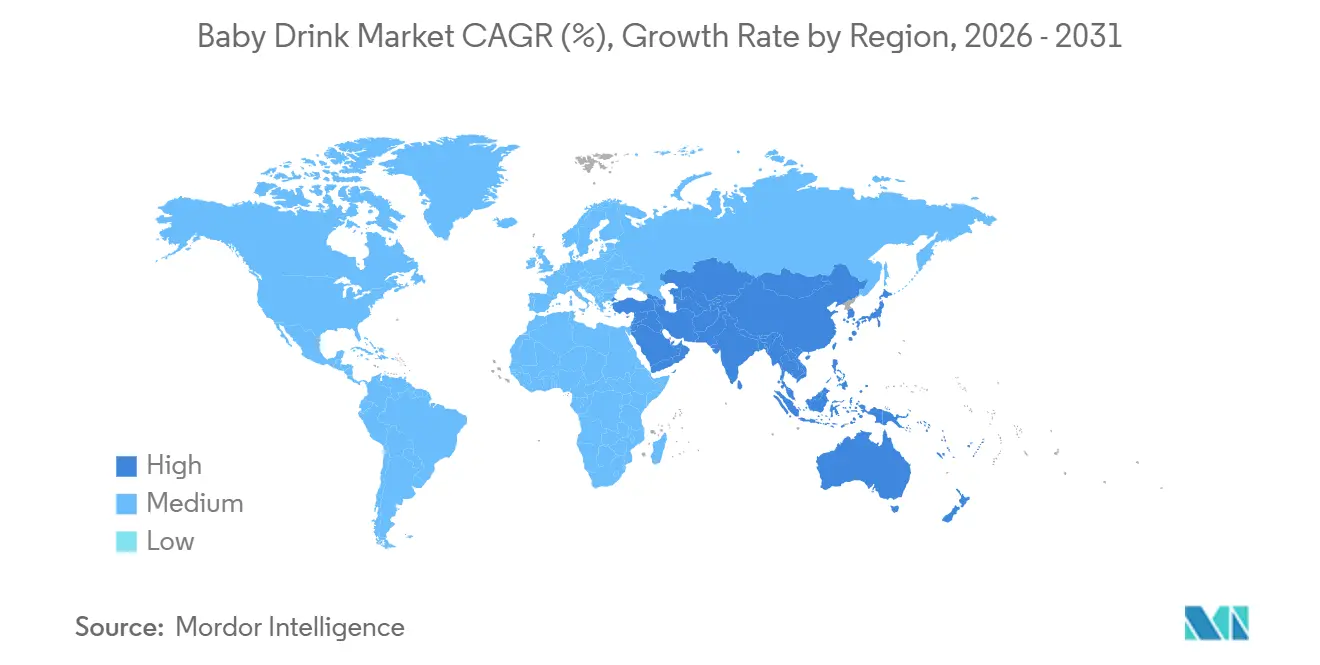
| Fastest Growing Market | Asia-Pacific |
| Largest Market | Asia-Pacific |
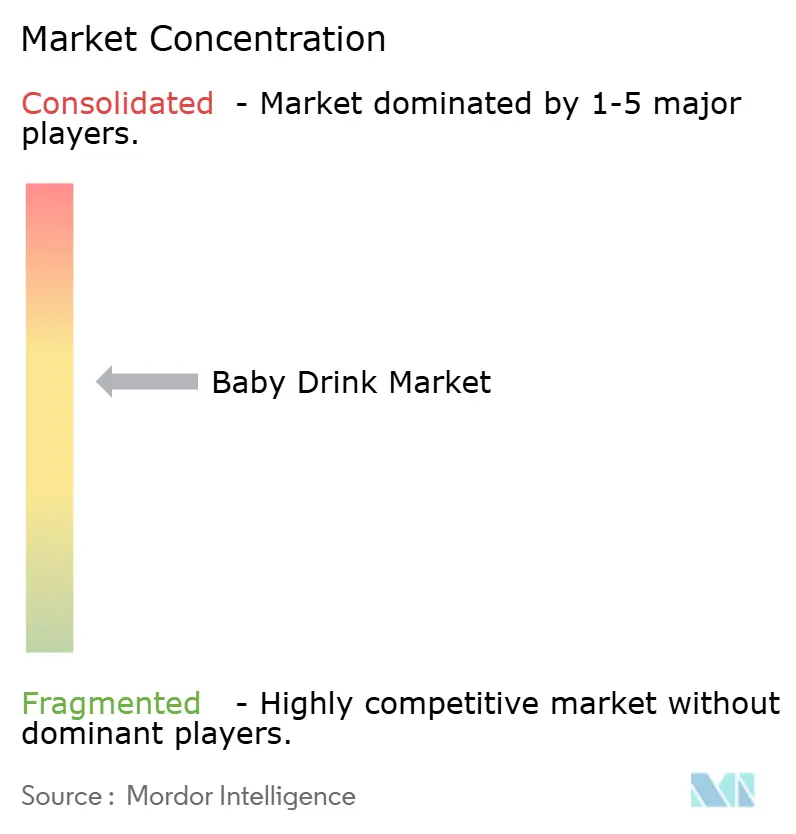
| Market Concentration | Medium |
Major Players *Disclaimer: Major Players sorted in no particular order Image © Mordor Intelligence. Reuse requires attribution under CC BY 4.0. | |
Baby Drink Market Analysis by Mordor Intelligence
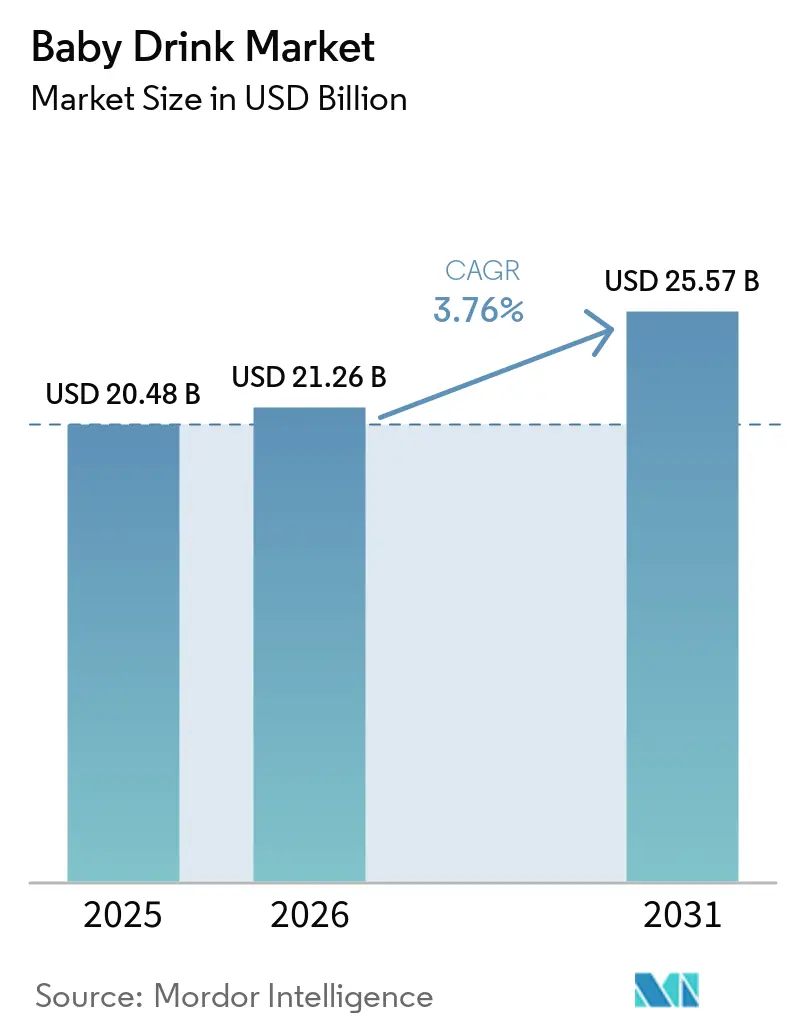
The baby drink market size was valued at USD 20.48 billion in 2025 and is estimated to grow from USD 21.26 billion in 2026 to reach USD 25.57 billion by 2031, at a CAGR of 3.76% during the forecast period (2026-2031). The baby drink market is expanding as household spending rises, despite moderating birth rates across several developed economies. Parents are increasingly willing to spend on premium nutrition products that offer convenience, safety, and perceived health benefits. Certified organic products, bioactive formulations, and subscription-based replenishment models are reshaping purchasing patterns by addressing demand for clean-label ingredients, functional nutrition, and reliable product availability. Dual-income households increasingly prioritize ready-to-feed options that reduce preparation time, while digital channels provide specialist brands with direct access to parents through e-commerce platforms, brand websites, and subscription services. Safety controls, labeling regulations, and formula registration requirements remain critical considerations for product launches and international expansion, particularly as regulatory standards vary across countries. Recent product recalls have further intensified scrutiny of the baby drink market, making traceability, ingredient transparency, and quality assurance essential to maintaining brand credibility and consumer trust.
Key Report Takeaways
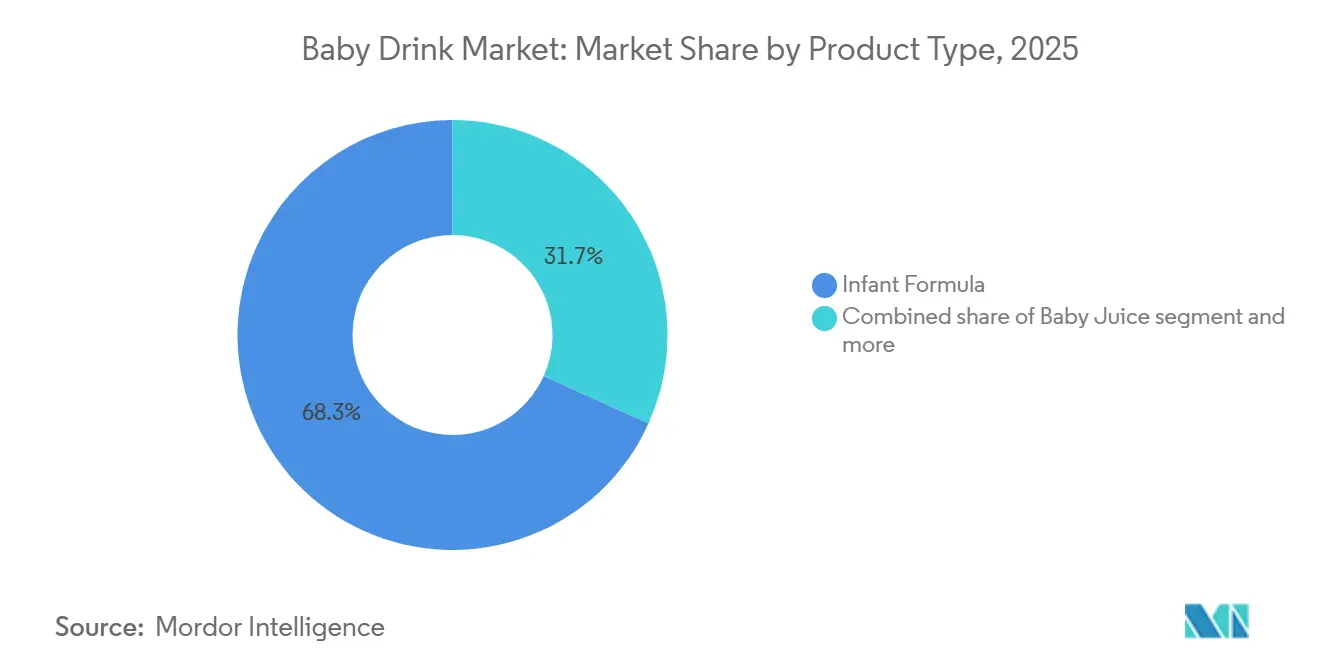
- By product type, infant formula accounted for the largest share of the baby drink market, at 68.26% in 2025, while baby juice is projected to grow at the fastest CAGR of 6.77% during 2026-2031.
- By packaging type, bottles accounted for the largest share of the baby drink market, at 61.37% in 2025, while pouches and others are projected to grow at the fastest CAGR of 6.92% during 2026-2031.
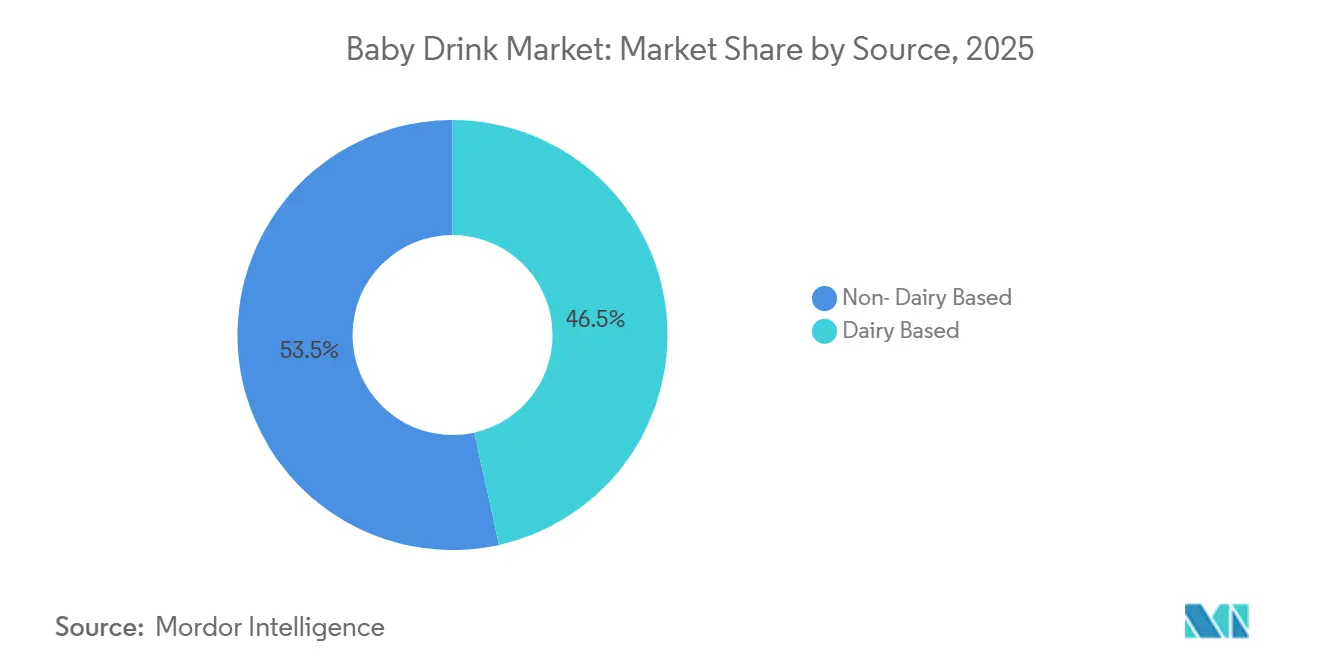
- By source, non-dairy-based products accounted for the largest share of the baby drink market, at 53.47% in 2025, and are projected to grow at the fastest CAGR of 6.45% during 2026-2031.
- By distribution channel, supermarkets/hypermarkets accounted for the largest share of the baby drink market, at 58.77% in 2025, while online retail stores are projected to grow at the fastest CAGR of 7.47% during 2026-2031.
- By geography, Asia-Pacific accounted for the largest share of the baby drink market, at 45.38% in 2025, while Asia-Pacific is projected to grow at the fastest CAGR of 5.42% during 2026-2031.
Note: Market size and forecast figures in this report are generated using Mordor Intelligence’s proprietary estimation framework, updated with the latest available data and insights as of January 2026.
Market Trends and Insights
Drivers Impact Analysis of Baby Drink Market*
| Driver | (~) % Impact on CAGR Forecast | Geographic Relevance | Impact Timeline |
|---|---|---|---|
| Working-parent demand for convenient feeding | +0.8% | Global, concentrated in North America, Western Europe, and urban Asia-Pacific | Short term (≤ 2 years) |
| Premiumization of organic and functional nutrition | +0.7% | North America, Western Europe, and premium Asia-Pacific markets | Medium term (2-4 years) |
| E-commerce, direct-to-consumer, and subscription replenishment | +0.6% | Global, with high penetration in North America, China, and Southeast Asia | Short term (≤ 2 years) |
| Transition nutrition after exclusive breastfeeding | +0.5% | Global, with faster uptake in Asia-Pacific, South America, and Middle East and Africa | Medium term (2-4 years) |
| Qr-level traceability as a trust purchase cue | +0.3% | China, Hong Kong, Europe, and North America | Long term (≥ 4 years) |
| Localized specialty formulas for allergy and intolerance management | +0.4% | North America, Europe, Asia-Pacific, and Middle East and Africa | Medium term (2-4 years) |
| Source: Mordor Intelligence | |||
Working-Parent Demand for Convenient Feeding
Rising dual-income households are increasing demand for convenient and consistent feeding products. This trend is particularly relevant in urban areas of South and Southeast Asia, where higher female workforce participation can reduce the practical duration of exclusive breastfeeding. According to the World Health Organization, complementary foods become necessary at 6 months, creating a feeding period during which formula use can overlap with other products[1]. Ready-to-feed formats help parents manage limited preparation time and may support higher spending per feeding occasion. Their convenience can lessen the importance of price as the sole purchasing factor for families with demanding work schedules. The baby drink market benefits when manufacturers offer reliable formats that align with evolving household routines. As urban households continue to prioritize time-saving solutions, demand for convenient baby drink formats is likely to strengthen.
Premiumization of Organic and Functional Nutrition
Parents in North America and Western Europe increasingly prefer infant nutrition products with organic certification, functional ingredients, and transparent labeling. Certified organic products can command premiums of 35% to 65% compared with conventional alternatives. Human milk oligosaccharides, probiotics, and other bioactive ingredients are becoming increasingly prominent in product positioning. This trend allows established manufacturers and specialist brands to differentiate their formula offerings beyond basic nutrition claims. The baby drink market can capture additional value when parents recognize clear nutritional or quality differences between products. However, manufacturers must substantiate product claims with evidence and ensure labeling compliance when introducing premium ingredients. Continued demand for premium, evidence-based products is expected to support innovation and value growth in the baby drink market.
E-Commerce, Direct-to-Consumer, and Subscription Replenishment
Online retail stores are forecast to grow at a CAGR of 7.47% through 2031, making them the fastest-growing distribution channel in the baby drink market. Subscription services support repeat purchases among families that regularly buy formula and toddler nutrition products. The draft indicates that Bobbie Baby surpassed USD 200 million in annualized revenue by mid-2026 and averaged 3.4 deliveries during the first four months of a subscription. It also reports a 6–9% conversion rate from physical retail purchasers to online subscribers within 90 days. These models can extend customer relationships beyond the initial formula purchase. In China and Southeast Asia, online platforms also help imported brands address consumer concerns related to product origin and authenticity verification. As a result, online retail and subscription models are likely to strengthen brand loyalty and improve customer lifetime value in the baby drink market.
Transition Nutrition After Exclusive Breastfeeding
The transition to complementary feeding increases demand for additional beverages and nutritional formats after the first 6 months of life. The World Health Organization identifies 6 months as the stage at which infants require complementary foods alongside breast milk. Families may continue using formula while introducing products that support hydration, digestive comfort, and micronutrient intake. This overlap can increase the number of products purchased per household during the feeding transition. Therefore, the baby drink market offers opportunities for products tailored to specific age groups and clearly defined nutritional needs. Manufacturers can capitalize on this opportunity by developing age-appropriate formulations that address evolving infant nutritional requirements.
Restraints Impact Analysis of Baby Drink Market*
| Restraint | (~) % Impact on CAGR Forecast | Geographic Relevance | Impact Timeline |
|---|---|---|---|
| Breastfeeding promotion and ethical-marketing restrictions | -0.5% | Global, with restrictive rules in countries that apply the WHO Code | Short term (≤ 2 years) |
| Product safety, recall, and contaminant-testing exposure | -0.4% | North America, Europe, and Asia-Pacific | Short term (≤ 2 years) |
| Premium price and affordability pressure | -0.3% | South America, Middle East and Africa, and lower-income groups in Asia-Pacific | Medium term (2-4 years) |
| Formula-variant registration and reformulation friction | -0.2% | Global, especially China, the European Union, and the United States | Long term (≥ 4 years) |
| Source: Mordor Intelligence | |||
Breastfeeding Promotion and Marketing Restrictions
The World Health Assembly adopted the WHA78 Resolution on May 27, 2025, calling for stronger controls on the digital marketing of breast-milk substitutes[2].The resolution addresses digital communications, including influencer content, personalized advertising, and cross-border social media activities. The World Health Organization’s 2026 status report reviews legal frameworks in 194 countries and highlights ongoing efforts to align national regulations with the International Code of Marketing of Breast-milk Substitutes. New national regulations may require companies to revise product labeling, consumer communications, and third-party marketing arrangements. These requirements hold particular significance for brands that rely on targeted online customer acquisition. The baby drink market must continue to comply with public health regulations that promote breastfeeding and responsible marketing practices. Companies will need to monitor regulatory developments closely to ensure that their digital marketing strategies remain compliant across markets.
Safety, Affordability, and Registration Requirements
Powdered infant formula presents ongoing safety risks that can affect consumer confidence and increase manufacturing costs. The Centers for Disease Control and Prevention reported 28 confirmed and 20 probable cases of infant botulism in the 2025 outbreak linked to infant formula, and the related investigation closed in March 2026[3]. The incident prompted ByHeart to recall its Whole Nutrition formula products across all lot numbers and package sizes. Routine testing and recall preparedness remain essential, including for companies operating through direct-to-consumer channels. Higher prices may also restrict access to premium organic and specialty products, particularly in South America, the Middle East and Africa, and lower-income parts of Asia-Pacific. Additionally, registration and reformulation requirements in China, the European Union, and the United States can prolong the time required to launch new formula variants. These factors may constrain market growth by increasing compliance costs and delaying product availability.
*Our forecasts treat driver/restraint impacts as directional, not additive. The impact forecasts reflect baseline growth, mix effects, and variable interactions.
Baby Drink Market Segment Analysis
By Product Type:
Infant Formula Holds the Largest Position and Baby Juice Leads GrowthInfant formula is projected to account for 68.26% of the global baby drink market value in 2025, supported by its essential role in infant nutrition and its capacity to incorporate premium features without significant volume erosion. Product differentiation increasingly includes organic certification, human milk oligosaccharide (HMO) supplementation, and hypoallergenic formulations. The category is also advancing toward precision-fermented bioactive proteins. Nestlé’s planned June 2026 partnership with Helaina to develop human-identical lactoferrin, known as effera, signals the potential emergence of a new tier of formulation performance. This innovation could help mitigate supply constraints and price volatility associated with bovine-sourced lactoferrin. As premiumization and ingredient innovation accelerate, leading formula manufacturers are expected to strengthen their positions against established competitors and direct-to-consumer brands through 2031.
Baby juice is projected to be the fastest-growing product type in the global baby drink market, registering a forecast CAGR of 6.77% through 2031. Growth is supported by the transition to complementary nutrition following the World Health Organization (WHO)-recommended six-month period of exclusive breastfeeding, which creates recurring demand for supplemental beverages alongside continued formula consumption. Millennial and Gen Z parents are also shaping demand by increasingly avoiding added sugar and favoring cold-pressed, minimally processed, and developmentally appropriate juice products for infants. Baby electrolyte solutions are expected to maintain a specialized role in managing acute dehydration, while functional and herbal drinks appeal to parents seeking probiotic or botanical supplementation. Brands that differentiate through bioactive ingredients, reduced sugar content, or processing quality are likely to capture growth as competition intensifies across the category.

By Packaging Type:
Bottles Lead Current Demand and Pouches and Others Expand FasterBottles are projected to account for 61.37% of the baby drink market share in 2025, supported by demand for powdered formula containers and ready-to-feed formats. Parents value packaging that enables portion control, storage, and product protection. These requirements are particularly relevant for formula distributed over long distances from established exporting countries. Cans also retain an important role in shelf-stable distribution, as they support storage and transportation. Bottles are familiar to consumers across developed and emerging markets, and their ability to protect sensitive nutritional products during handling further reinforces their role. Consequently, the largest packaging segment continues to benefit from established supply chains and widespread consumer familiarity. Bottles remain central to the baby drink market size by packaging format.
Pouches and other packaging formats are forecast to grow at a CAGR of 6.92% during 2026-2031, the fastest growth rate among packaging types. Portable formats appeal to working parents seeking products that are easier to carry and use outside the home. The supplied draft also identifies mono-material recyclable designs as a response to convenience and sustainability requirements. According to the supplied draft, the United Kingdom’s Extended Producer Responsibility scheme began in 2025 and will impose surcharges of up to GBP 1,000 per tonne on non-recyclable laminates. This policy environment may encourage suppliers to reduce the use of multi-layer packaging. However, pouch manufacturers must continue to maintain the barrier properties required to protect infant nutrition products. The faster growth of these formats reflects efforts to balance convenience, retail requirements, and material recovery.
By Source:
Non-Dairy Based Products Lead Both Scale and GrowthNon-Dairy-Based products are expected to hold a 53.47% share of the baby drink market in 2025, placing them ahead of Dairy-Based products. This segment includes soy-based, rice protein-based, oat-based, and amino acid-based alternatives. Demand is supported by households managing lactose intolerance, galactosemia, allergies, and dietary preferences. Soy-based formula remains a significant component of the category due to its established use in specialized feeding. Dairy-Based formulations continue to play a substantial role in markets where consumers are familiar with cow milk-based nutrition. Goat milk-based products are also gaining attention in Australia and selected Southeast Asian markets. The segment's leading position highlights the importance of specialized feeding needs in the baby drink market.
Non-Dairy-Based products are projected to grow at a CAGR of 6.45% during 2026-2031, making them the fastest-growing source segment. According to the supplied draft, cow milk protein allergy affects 2-3% of infants globally. Earlier screening and diagnosis can reduce the time between symptom onset and the transition to specialty formula, increasing demand for products that address specific medical and dietary needs. Manufacturers with established specialty portfolios and strong relationships with medical channels are well positioned to meet this demand. Product availability, clinical suitability, and clear guidance remain critical to building parent confidence. Non-Dairy-Based products combine the largest market share with the highest growth rate, indicating sustained demand for specialized alternatives. This performance supports further portfolio investment in source segments within the baby drink market.
By Distribution Channel:
Supermarkets and Hypermarkets Lead Sales While Online Retail Stores Grow FasterSupermarkets and hypermarkets accounted for 58.77% of the baby drinks market value in 2025, supported by the strong product adjacency between infant formula and routine household grocery purchases. Parents who consolidate shopping trips are more likely to purchase formula and other baby beverages through these large-format retail outlets. Convenience and grocery stores continue to cater to top-up and emergency purchases; however, their share growth remains constrained as online retailers increasingly mitigate stockouts that previously drove consumers to nearby stores. Pharmacies and specialist baby retailers remain important in markets such as Germany and France, where parents place significant trust in pharmacy-based recommendations for infant nutrition. Nevertheless, supermarkets and hypermarkets are expected to maintain their leading position due to their broad product assortments, established shopping routines, and extensive household reach.
Online retail stores are projected to be the fastest-growing distribution segment, registering a CAGR of 7.47% through 2031. Direct-to-consumer (DTC) brands are driving this growth by using subscription platforms to convert initial purchases into recurring revenue streams. Bobbie Baby’s retail-to-subscription funnel, introduced in mid-2026, reportedly converted 6–9% of physical retail purchasers into online subscribers within 90 days, demonstrating how store shelves can serve as customer acquisition channels for DTC businesses. This shift indicates that distribution strategy increasingly influences profitability, customer retention, and margin structures, rather than serving solely as a logistical function. Established brands that do not develop competitive online subscription capabilities may lose premium-tier consumers to challenger brands with stronger DTC ecosystems.
Geography Analysis
APAC Baby Drink Market
Asia-Pacific accounted for 45.38% of the baby drink market share in 2025, making it the largest regional segment. China remains the region’s largest national market, although growth has moderated to mid-single digits following formula registration consolidation by the State Administration for Market Regulation. The policy reduced the number of approved variants and favored suppliers that met registration requirements. India is gaining importance as packaged infant nutrition reaches Tier 2 and Tier 3 cities. Rising disposable incomes, increasing female workforce participation, and broader access to modern retail support this expansion. Indonesia, Thailand, and Vietnam also contribute to demand as maternal employment rises and healthcare networks increase engagement with early childhood nutrition. Asia-Pacific represents the largest current base for the baby drink market.
Asia-Pacific is projected to grow at a CAGR of 5.42% during 2026-2031, the fastest rate among all geographic segments. Urbanization across South and Southeast Asia supports demand for convenient feeding formats and broader retail availability. Premium products also drive value growth in urban China, India, and Southeast Asian cities. According to the supplied draft, parents in these locations purchase certified organic formula at premiums of 35-65% over conventional products. In June 2026, Danone entered into a definitive agreement to acquire MADE Group and the remaining 49% stake in its Saputo Dairy Australia joint venture, strengthening its nutrition position in Asia-Pacific. The transaction demonstrates how established suppliers use acquisitions to expand their regional presence. Faster regional growth depends on the availability of accessible nutrition products and compliance with local registration and marketing regulations.
The Americas and EMEA Baby Drink Market
North America and Europe generate significant value through demand for premium products rather than rapid volume growth.I n November 2025, Perrigo announced a strategic review of its infant formula business to improve cash flow and sharpen its portfolio focus. The review includes a reassessment of the company’s previously announced USD 240 million investment in the segment. The investment aimed to strengthen domestic manufacturing resilience following supply disruptions identified in the supplied draft. In Europe, Germany, France, and the United Kingdom remain key markets for organic and premium infant nutrition. South America remains price-sensitive despite growing awareness of specialized nutrition, with Brazil and Argentina accounting for a substantial share of regional consumption. Saudi Arabia and the UAE demonstrate strong demand for imported formula, while Nigeria and Egypt face distribution and affordability constraints. Turkey represents an additional opportunity in the Middle East and Africa as healthcare engagement with pediatric nutrition develops. Collectively, these regions demonstrate that the baby drink market combines mature demand for premium products with early-stage opportunities to improve access.
Competitive Landscape
The baby drinks market is moderately consolidated, with Nestlé, Danone, Abbott Laboratories, and Reckitt Benckiser holding a significant combined market value share. A growing group of organic specialists, direct-to-consumer (DTC) brands, and regional players competes for premium-tier positioning through ingredient differentiation and channel innovation. Leading players increasingly focus on two strategic priorities: acquisition-led capability expansion and control over bioactive ingredients. Danone’s exploratory discussions regarding the potential acquisition of Mead Johnson from Reckitt Benckiser, which generates approximately GBP 2.1 billion annually, could materially reshape the North American competitive landscape if completed.
Such a transaction would likely prompt defensive portfolio reviews by Abbott and Friesland Campina. On the ingredient front, the planned June 2026 collaboration between Nestlé and Helaina on precision-fermented lactoferrin illustrates how intellectual property related to bioactive ingredient supply chains could become a durable competitive advantage. This development also reinforces the strategic relevance of patent filings as a leading indicator of the category’s innovation trajectory. White-space opportunities exist across three strategic areas: premium specialty formulas for underdiagnosed allergy conditions in the Middle East and Africa (MEA) and Southeast Asian markets; DTC subscription infrastructure in Europe, where digital commerce maturity remains below that of North America; and affordable premium segments in South America.
In South America, functional nutrition claims are gaining parental interest, but brand infrastructure remains limited. Chinese domestic specialists, including Feihe, Yili, and Ausnutria, are defending their home-market share through localized formulations and SAMR-compliant registrations. However, their international presence remains limited outside diaspora channels, creating a structural gap as imported premium brands expand their cross-border e-commerce distribution in China. Smaller organic challengers, such as HiPP, Holle, and Bobbie Baby, are gaining premium shelf space and digital mindshare in segments where major product recalls have weakened consumer trust in established brands. For incumbent companies, recall-driven trust deficits, increasing DTC brand competition, and competition for access to bioactive ingredients create a multifront strategic challenge that no single capability investment can fully address.
Baby Drink Industry Leaders
-
Nestlé S.A.
-
Danone S.A.
-
Abbott Laboratories
-
Reckitt Benckiser Group plc
-
Friesland Campina N.V.
- *Disclaimer: Major Players sorted in no particular order
Baby Drink Market Companies Covered in this Report
- Nestlé S.A.
- Abbott Laboratories
- Danone S.A.
- Reckitt Benckiser Group plc
- Friesland Campina N.V.
- The Kraft Heinz Company
- Arla Foods amba
- Meiji Holdings Co., Ltd.
- HiPP GmbH & Co. Vertrieb KG
- Perrigo Company plc
- Inner Mongolia Yili Industrial Group Co., Ltd.
- Ausnutria Dairy Corporation Ltd.
- Feihe International Inc.
- Beingmate Group Co., Ltd.
- Bubs Australia Ltd.
- Bellamy’s Organic
- The Hain Celestial Group, Inc.
- Holle baby food AG
- Morinaga Milk Industry Co., Ltd.
- Bobbie Baby, Inc.
Recent Industry Developments in Baby Drink Market
- March 2026: Danone entered into a definitive agreement to acquire Huel, a producer of nutritionally balanced meal solutions in ready-to-drink and powdered formats. The acquisition expands Danone’s functional nutrition portfolio and strengthens its direct-to-consumer capabilities across the United Kingdom, Europe, and the United States.
- November 2026: Munchkin entered the infant formula category with two products: Original, priced at USD 35.99, and Made with Organic Milk, priced at USD 39.99. The latter contains USDA-certified organic milk sourced from New Zealand. It is available on munchkin.com through a subscription option and will be sold exclusively at Target stores beginning in mid-March 2026.
- November 2025: ByHeart recalled all Whole Nutrition infant formula products on November 11, 2025, in response to an FDA mandate following an outbreak linked to 28 confirmed and 20 probable cases of infant botulism across multiple U.S. states. The CDC closed its investigation in March 2026, while the FDA continued its root-cause analysis.
- August 2024: Perrigo invested about USD 170 million in strategic investments, including the acquisition of Nestlé’s Gateway infant formula plant in Eau Claire, Wisconsin, and the rights to the Good Start brand. The investment also included an immediate USD 60 million capacity expansion, which the company stated would add 7 million pounds of annual production capacity.
Global Baby Drink Market Report Scope
Segmentation Overview
| Infant Formula |
| Baby Juice |
| Baby Electrolyte Solutions |
| Functional and Herbal Drinks |
| Bottles |
| Cans |
| Pouches and others |
| Non-Dairy Based |
| Dairy Based |
| Supermarkets/Hypermarkets |
| Convenience/Grocery Stores |
| Online Retail Stores |
| Other Distribution Channel |
| North America | United States |
| Canada | |
| Mexico | |
| Rest of North America | |
| Europe | Germany |
| United Kingdom | |
| Italy | |
| France | |
| Spain | |
| Netherlands | |
| Poland | |
| Belgium | |
| Sweden | |
| Rest of Europe | |
| Asia-Pacific | China |
| India | |
| Japan | |
| Australia | |
| Indonesia | |
| South Korea | |
| Thailand | |
| Singapore | |
| Rest of Asia-Pacific | |
| South America | Brazil |
| Argentina | |
| Colombia | |
| Chile | |
| Peru | |
| Rest of South America | |
| Middle East and Africa | South Africa |
| Saudi Arabia | |
| United Arab Emirates | |
| Nigeria | |
| Egypt | |
| Morocco | |
| Turkey | |
| Rest of Middle East and Africa |
| By Product Type | Infant Formula | |
| Baby Juice | ||
| Baby Electrolyte Solutions | ||
| Functional and Herbal Drinks | ||
| By Packaging Type | Bottles | |
| Cans | ||
| Pouches and others | ||
| By Source | Non-Dairy Based | |
| Dairy Based | ||
| By Distribution Channel | Supermarkets/Hypermarkets | |
| Convenience/Grocery Stores | ||
| Online Retail Stores | ||
| Other Distribution Channel | ||
| By Geography | North America | United States |
| Canada | ||
| Mexico | ||
| Rest of North America | ||
| Europe | Germany | |
| United Kingdom | ||
| Italy | ||
| France | ||
| Spain | ||
| Netherlands | ||
| Poland | ||
| Belgium | ||
| Sweden | ||
| Rest of Europe | ||
| Asia-Pacific | China | |
| India | ||
| Japan | ||
| Australia | ||
| Indonesia | ||
| South Korea | ||
| Thailand | ||
| Singapore | ||
| Rest of Asia-Pacific | ||
| South America | Brazil | |
| Argentina | ||
| Colombia | ||
| Chile | ||
| Peru | ||
| Rest of South America | ||
| Middle East and Africa | South Africa | |
| Saudi Arabia | ||
| United Arab Emirates | ||
| Nigeria | ||
| Egypt | ||
| Morocco | ||
| Turkey | ||
| Rest of Middle East and Africa | ||
Key Questions Answered in the Report
What is the projected growth rate for the baby drink market?
The baby drink market is projected to grow at a 3.76% CAGR from 2026 to 2031, reaching USD 25.57 billion by 2031.
Which baby drink product type holds the largest share?
Infant Formula held the largest product-type share at 68.26% in 2025.
Which baby drink product type is growing the fastest?
Baby Juice is projected to record the fastest product-type growth at a 6.77% CAGR during 2026-2031.
Which sales channel is expanding fastest for baby drinks?
Online Retail Stores are projected to grow at a 7.47% CAGR during 2026-2031, supported by direct-to-consumer subscriptions.