
Automotive Glow Plugs Market Size and Share
Market Overview
| Study Period | 2020 - 2031 |
|---|---|
| Market Size (2026) | USD 4.36 Billion |
| Market Size (2031) | USD 5.07 Billion |
| Growth Rate (2026 - 2031) | 3.07 % |
| Fastest Growing Market | Asia-Pacific |
| Largest Market | Asia-Pacific |
| Market Concentration | Medium |
Major Players *Disclaimer: Major Players sorted in no particular order Image © Mordor Intelligence. Reuse requires attribution under CC BY 4.0. | |
Automotive Glow Plugs Market Analysis by Mordor Intelligence
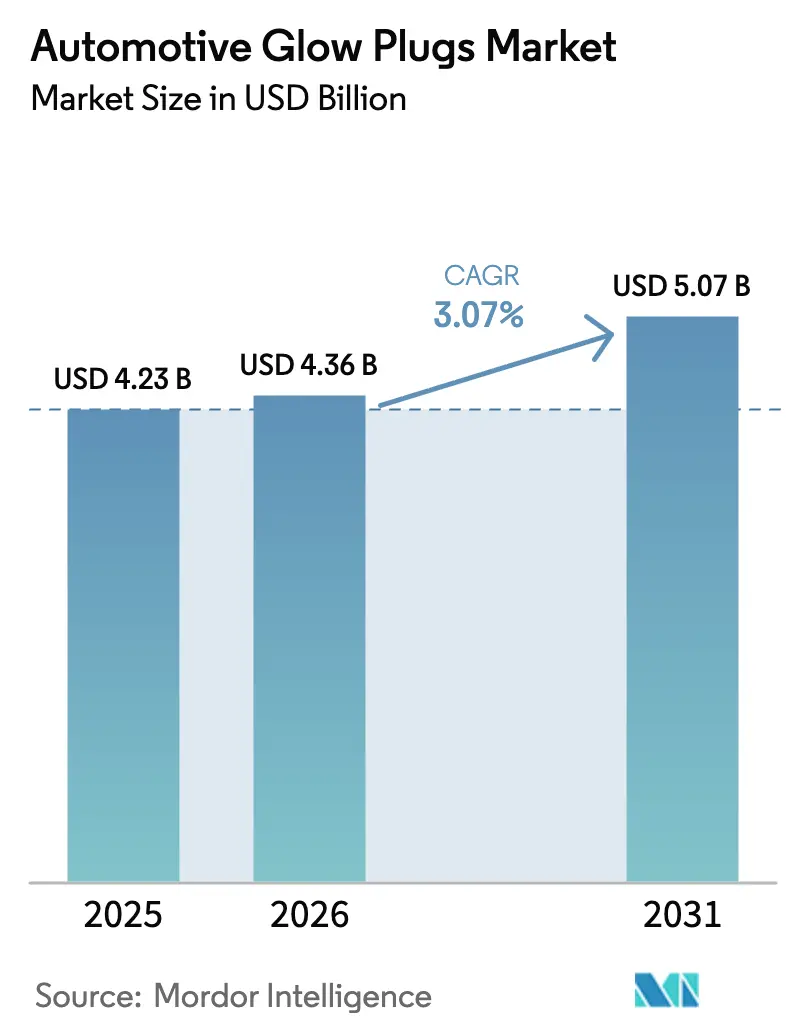
The Automotive Glow Plugs Market size is expected to grow from USD 4.23 billion in 2025 to USD 4.36 billion in 2026 and is forecast to reach USD 5.07 billion by 2031 at 3.07% CAGR over 2026-2031. The expansion is propelled by looming Euro 7 and U.S. EPA cold-start rules, a resilient medium-duty truck cycle, and expanding 48 V mild-hybrid diesel adoption. Commercial vehicles retain diesel powertrains for payload and range, keeping glow plugs indispensable even as passenger-car diesel demand retreats. Simultaneously, aftermarket e-commerce platforms increase product visibility, improve margins, and diminish dependence on brick-and-mortar distributors.
Key Report Takeaways
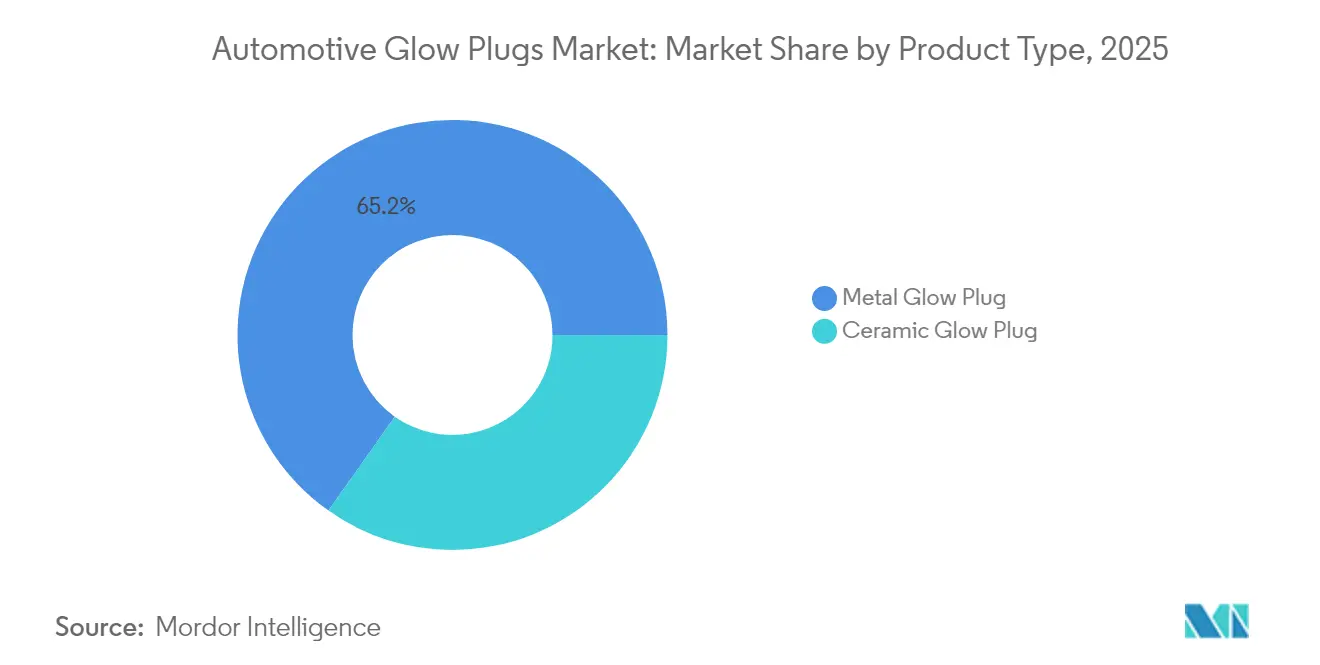
- By product type, metal variants led with 65.21% revenue share in 2025, while ceramic alternatives are forecast to post the fastest 3.78% CAGR through 2031.
- By vehicle type, commercial vehicles captured 59.42% of the automotive glow plugs market share in 2025 and are expanding at a 3.18% CAGR to 2031.
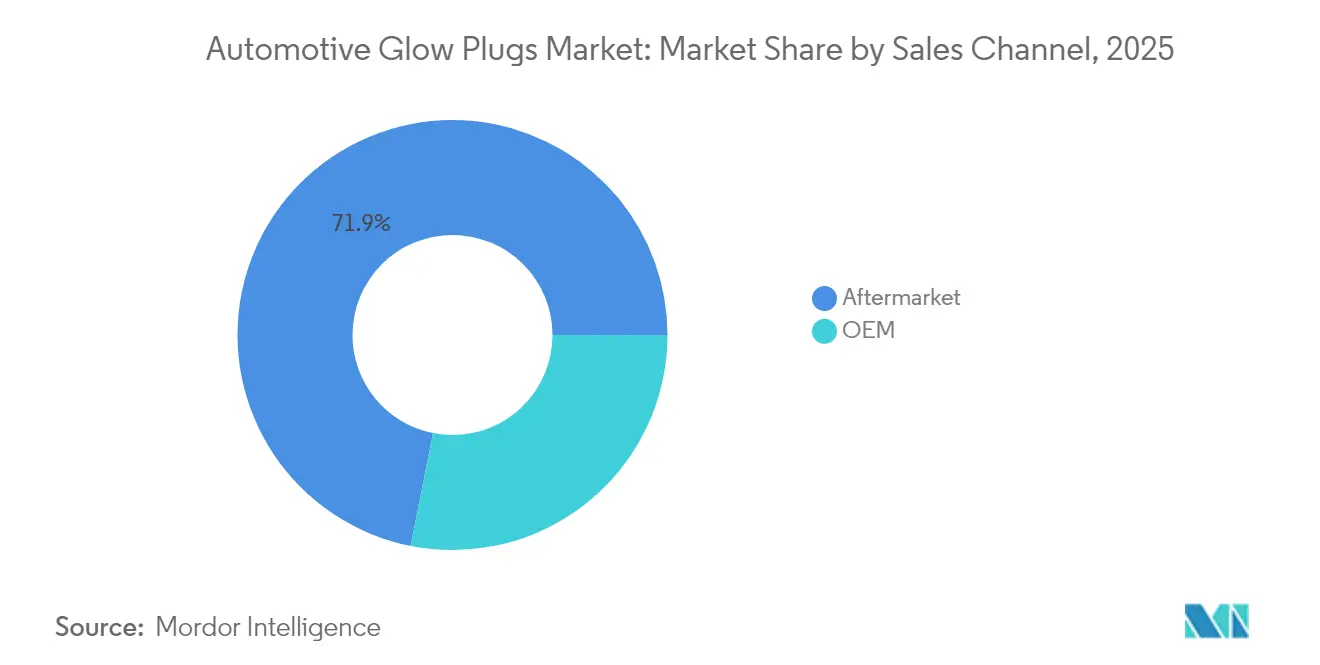
- By sales channel, the aftermarket commanded 71.88% of the automotive glow plugs market size in 2025 and is projected to grow 3.2% annually through 2031.
- By heating technology, single-coil plugs held 48.12% of the revenue share in 2025 and recorded the highest projected 3.52% CAGR in 2031.
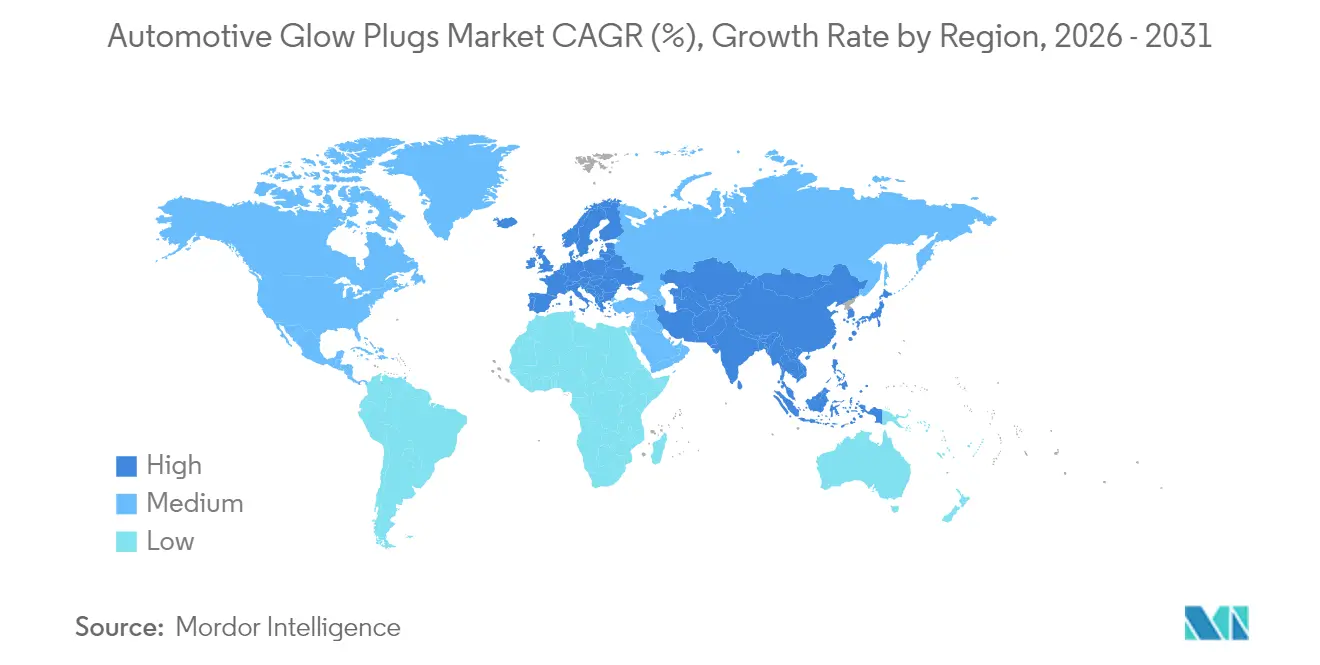
- By geography, Asia-Pacific accounted for 36.08% of 2025 revenue and is advancing at a 3.35% CAGR through 2031.
Note: Market size and forecast figures in this report are generated using Mordor Intelligence’s proprietary estimation framework, updated with the latest available data and insights as of 2026.
Market Trends and Insights
Drivers Impact Analysis of Automotive Glow Plugs Market*
| Driver | (~) % Impact on CAGR Forecast | Geographic Relevance | Impact Timeline |
|---|---|---|---|
| Tightening Euro 7 & U.S. EPA Diesel | +0.8% | Europe, North America | Medium term (2-4 years) |
| Global Medium-Duty Diesel-Truck Production | +0.6% | Global, APAC core | Short term (≤ 2 years) |
| Growth of 48V Mild-Hybrid Diesel | +0.5% | Europe, North America | Medium term (2-4 years) |
| Stricter OBD-III In-Cylinder Temperature Mandates | +0.4% | Global, with EU leadership | Long term (≥ 4 years) |
| Rise of Direct-to-Consumer E-commerce | +0.3% | Global | Short term (≤ 2 years) |
| Off-road Retrofit Programs | +0.2% | North America, Europe | Long term (≥ 4 years) |
| Source: Mordor Intelligence | |||
Tightening Euro 7 & U.S. EPA diesel cold-start norms
Euro 7 rules, effective November 2026, require continuous cold-start monitoring rather than static lab tests, forcing glow plugs to achieve peak temperature in under two seconds.[1] Ceramic elements meet this threshold at 1,300 °C, giving them a clear edge over metal peers. Parallel EPA 2027 limits trim heavy-duty NOx to 35 mg/hp-hr, obliging OEMs to sustain aftertreatment temperatures even in sub-zero starts. The trans-Atlantic harmonization removes regional design deviations, letting suppliers amortize R&D over larger production runs and accelerating global uptake of instant-heat dual-coil and pressure-sensor glow plugs.
Global medium-duty diesel-truck production rebound
Medium-duty truck output is rising due to infrastructure spending and e-commerce distribution. The Inflation Reduction Act stimulates Class 5 utility trucks, segments that cannot yet be electrified because of duty cycle demands. Every new diesel truck contains at least four glow plugs, and large-bore engines amplify replacement revenues in the aftermarket. OEMs prioritize commercial applications to compensate for shrinking passenger-diesel lines, reinforcing component demand.
Growth of 48 V mild-hybrid diesel architectures
Mild hybrids cycle engines hundreds of times daily in city duty, pushing glow plugs to deliver repeatable ignition within seconds. Bosch’s technology-neutral roadmap places 48 V systems at the core of fuel-efficiency gains until battery costs fall further. Dual-coil glow plugs synergize with a 48 V power supply, slashing heat-up time and lowering ceramic stress.[2] Consequently, hybridization reframes glow plugs as efficiency enablers rather than legacy parts, supporting value-added pricing.
Stricter OBD-III in-cylinder temperature-sensing mandates
OBD-III turns glow plugs into active diagnostic nodes by demanding real-time fault detection. Pressure-sensor and catalyst-coated variants, holding 23.10% 2024 share, embed miniature thermocouples that feed data to engine control units, generating premium margins. California’s 2022 amendments already extend the requirement to light-duty diesels, while the EPA’s 40 CFR 86.010-18 brings heavy-duty engines into scope. Predictive maintenance enabled by sensor data curbs fleet downtime and rapidly becomes a differentiator for OEM procurement teams.
Restraints Impact Analysis of Automotive Glow Plugs Market*
| Restraint | (~) % Impact on CAGR Forecast | Geographic Relevance | Impact Timeline |
|---|---|---|---|
| ICE Rationalization | -0.7% | Europe, with spillover to other regions | Medium term (2-4 years) |
| Platinum-Alloy Coil Price Volatility | -0.4% | Global | Short term (≤ 2 years) |
| Counterfeit Glow-Plug Proliferation | -0.3% | Global, concentrated in emerging markets | Short term (≤ 2 years) |
| Accelerated Electrification Targets | -0.3% | China, EU | Long term (≥ 4 years) |
| Source: Mordor Intelligence | |||
ICE rationalization (Less than 15% diesel mix in new-EU cars)
Diesel penetration in European passenger cars slid below 15% in 2024 and keeps falling as OEM CO₂ targets tighten. This limits volume opportunities for light-duty glow plugs and reallocates engineering budgets toward battery-electric platforms. However, the remaining demand shifts up-market to premium ceramic systems that can secure Euro 7 compliance warranties, partially offsetting volume declines with higher average selling prices.
Counterfeit glow-plug proliferation is harming OEM brands
Unauthorized plugs containing low-grade nickel electrodes fail to hit mandated temperatures, causing misfires and post-combustion fuel penalties. NGK’s authenticated packaging initiative shows how brand owners tackle the problem with QR-code verification, but persistent grey-market imports still erode margins. Emerging markets bear the brunt where price sensitivity overrides safety, compelling legitimate suppliers to boost distributor vetting and customer education spending.
*Our forecasts treat driver/restraint impacts as directional, not additive. The impact forecasts reflect baseline growth, mix effects, and variable interactions.
Automotive Glow Plugs Market Segment Analysis
By Product Type:
Ceramic Technology Drives Premium ShiftMetal designs retained the bulk of 2025 shipments, capturing 65.21% market share in 2025, yet ceramic variants generated the swiftest top-line gains with a 3.78% CAGR outlook.Ceramic heating elements hit 1,300 °C in under two seconds, satisfying Euro 7 durability cycles and cutting white smoke by 70%. They also survive up to 200,000 thermal cycles, double that of metal equivalents, trimming warranty claims for OEMs.
Adoption widens as commercial fleets chase uptime and cleaner exhaust gas, especially in temperature-sensitive refrigerated transport. DENSO and Bosch capitalize by co-developing alumina-silicate formulations that minimise brittleness. While metal plugs stay relevant for cost-driven retrofits, their share will erode as regulations bite. Suppliers are shifting line capacity toward ceramic sintering, which demands high capital yet offers stickier margins once certified, underpinning long-term revenue visibility.

By Vehicle Type:
Commercial Dominance IntensifiesCommercial vehicles held 59.42% revenue in 2025 and are expected to grow at a CAGR of 3.18% through 2031, reflecting diesel’s 76% fleet prevalence. Within this pool, the automotive glow plugs market share is expected to reach around three fifth of the share by 2031 as medium-duty manufacturing rebounds. Fleet buyers prefer premium glow plugs that assure sub-zero starts without external heaters, improving duty-cycle efficiency. Government infrastructure spending and last-mile delivery growth further elevate unit demand.
Passenger-car diesel retreat narrows volumes yet nudges the segment toward upscale plug configurations embedded with temperature sensors. Despite shrinking volumes, suppliers still court OEMs for high-margin specialty variants used in light-duty pickups and SUVs. The bifurcated landscape reinforces commercial-vehicle centric R&D agendas, catalysing more robust testing protocols that trickle down to passenger models once cost curves mature.
By Sales Channel:
Aftermarket E-Commerce ExpansionThe aftermarket represented 71.88% of 2025 revenue and is climbing at a 3.2% CAGR. Online platforms permit direct-to-consumer outreach, letting manufacturers bypass intermediaries and collect real-time feedback. Millennials and Gen Z, comfortable with DIY maintenance, rely on video tutorials and product configurators, a trend that multiplies glow-plug basket sizes. Loyalty programs tied to online authentication also blunt counterfeit threats.
OEM channels focus on warranty cycles and first-fit production, accounting for 28.12% of sales. As vehicle populations age beyond 10 years, 80,000-120,000 km replacement intervals sustain predictable aftermarket spikes. Manufacturers leverage e-commerce data to forecast inventory and refine SKU portfolios, enhancing working-capital efficiency. Digital penetration reshapes the automotive glow plugs market by rewarding brands that combine product quality with transparent online engagement.
By Heating Technology:
Single-Coil Maintains Lead Amid Rapid InnovationSingle-coil plugs controlled 48.12% of revenue in 2025 and are also the fastest-growing tier at a 3.52% CAGR, due to cost advantages and established supply chains. Instant-heat dual-coil designs, however, are eroding the gap as Euro 7 and EPA provisions make sub-2-second ignition non-negotiable. Dual-coil heat path redundancy improves glow duration by 30%, cutting post-start fuel enrichment and lowering NOx peaks.
Pressure-sensor and catalyst-coated variants serve telematics-enabled fleets that value predictive maintenance data. While these account for more than two fifth of revenue combined, their premium prices lift segment profitability. Bosch’s Duraterm platform exemplifies self-regulating current draw, capping plug tip temperature to 1,100 °C and preventing ceramic fracture. Technological heterogeneity collectively ensures suppliers can tailor offerings to regional compliance needs without bloating inventories.
Geography Analysis
APAC Automotive Glow Plugs Market
Asia-Pacific headed the 2025 leaderboard with 36.08% revenue and a 3.35% CAGR outlook. China’s reinstated truck subsidies and India’s Bharat Stage VI/VII enforcement stimulate OEM demand for ceramic and pressure-sensor plugs. Local manufacturers partner with global leaders for technology licensing deals, speeding homologation timelines. Cross-border e-commerce also facilitates aftermarket penetration into Southeast Asian right-hand-drive markets where diesel pickups dominate.
Europe Automotive Glow Plugs Market
Europe followed despite passenger-car diesel attrition. Euro 7 engines rolling out in 2026 require integrated diagnostics, compelling aftermarket replacements for older vehicles to meet periodic inspection standards. Germany hosts BorgWarner’s BERU plant, anchoring regional supply and supporting 95% OE coverage for diesel cars. Retrofit requirements for off-road machinery under Stage V further buoy plug demand in the agriculture and construction segments.
North America Automotive Glow Plugs Market
North America riding a medium-duty truck upswing driven by infrastructure spending and e-commerce parcel growth. EPA 2027 rules hasten migration to instant-heat plugs, while California’s proposed Tier 5 mandates unlock retrofit demand in non-road engines. The North American aftermarket automotive glow plugs market size is projected to grow as fleets tighten compliance cycles. OEMs mmins incorporate software-updatable glow-plug controllers, marrying hardware and digital ecosystems.
Regulatory Landscape
Regulation (EU) 2024/1257 (Euro 7) raises compliance pressure on diesel cold-start performance by introducing tougher emission requirements and real-driving emissions testing for light-duty vehicles, with application beginning 29 November 2026. That change moves validation from purely lab-based cycles toward more continuous monitoring and durability performance, increasing the need for fast heat-up and consistent combustion support from glow plug systems.
In the United States, the EPA is progressing amendments to compliance provisions and test procedures for model year 2027 and later heavy-duty highway engines, along with updates to warranty-related provisions and nonconformance penalties (proposed in July 2026). On the trade side, Section 232 duties on certain automobile parts and the related inclusions process (with the April 2026 submission window opening 1 April 2026) add cost and sourcing uncertainty for powertrain components, reinforcing North American localization and USMCA-aligned sourcing strategies that influence glow plug manufacturing footprints and distribution.
Value Chain Analysis
The value chain begins with raw materials and subcomponents, including high-temperature alloys for heating coils and metallic housings, plus ceramic materials and insulating elements for ceramic designs. These inputs flow into forming, machining, joining/assembly, and calibration-intensive production steps, followed by end-of-line electrical and thermal testing to confirm heat-up behavior and durability before parts are released for OE or aftermarket supply.
On the manufacturing side, vertical integration is a differentiator, especially where ceramic processing and critical assembly know-how are kept in-house, as seen with Hidria d.o.o., which highlights 100% in-house glow plug manufacturing at its Tolmin, Slovenia facility, and Niterra (formerly NGK Spark Plug), which operates a global production and sales network centered on ceramic and ignition technologies. Downstream, distribution splits into OEM supply for engine and vehicle assembly, and the larger aftermarket, where catalog breadth, vehicle parc coverage, and trusted channels (including official online storefronts) matter for inventory efficiency and counterfeiting risk control.
Competitive Landscape
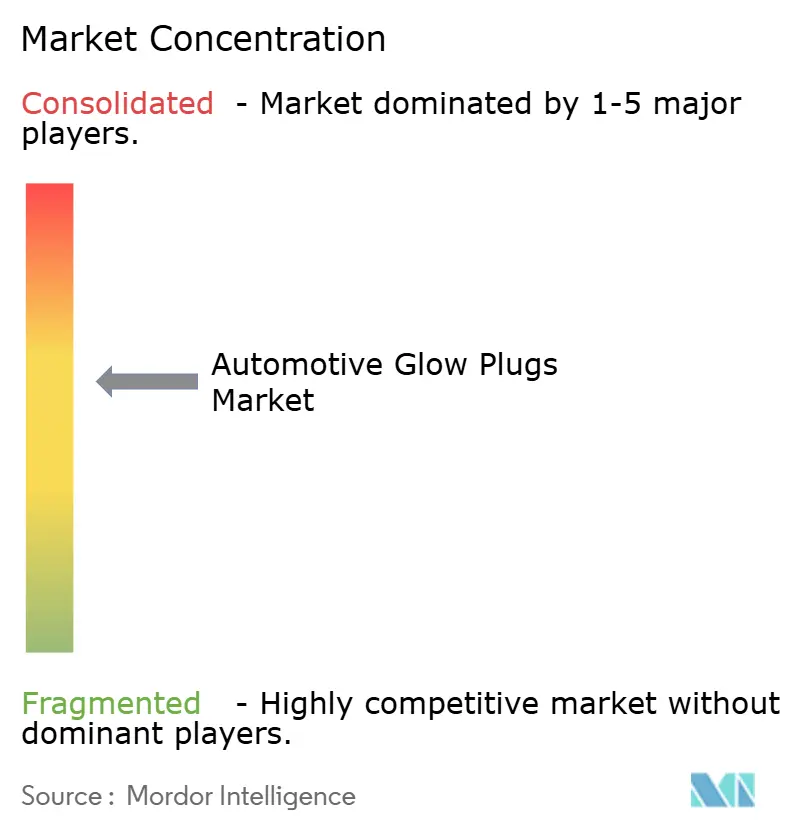
The automotive glow plugs market is moderately concentrated, few top vendors control significant chunk of global revenue. NGK Spark Plug Co. Ltd. is one of the leading player, leveraging in-house ceramic sintering lines and anti-counterfeit programs. Denso, bundling glow plugs with engine-management systems to lock in OEM contracts. BorgWarner’s BERU division couples high European OE penetration with a broad aftermarket catalogue.
Strategic playbooks accentuate vertical integration and co-development agreements. NGK partners with platinum recyclers to hedge raw-material volatility, while Bosch licenses its Duraterm algorithm to heavy-duty OEMs in exchange for long-term supply commitments. Suppliers also court e-commerce giants to create official storefronts that counter grey-market dilution. Patent filings cluster around ceramic-heater compositions and integrated pressure sensors, signalling sustained innovation aimed at compliance rather than price wars.
Niche sensor specialists become acquisition targets for glow-plug majors seeking diagnostic know-how. Joint ventures emerge in India and Indonesia to localize assembly, dodge tariffs, and accelerate homologation. Across the board, premiumisation offsets flattish volumes in mature regions, enabling steady top-line expansion even as fixed-cost absorption improves via global platform strategies.
Automotive Glow Plugs Industry Leaders
-
Denso Corporation
-
NGK Spark Plug Co. Ltd
-
Robert Bosch GmbH
-
BorgWarner Inc.
-
Tenneco Inc.
- *Disclaimer: Major Players sorted in no particular order
Automotive Glow Plugs Market Companies Covered in this Report
- BorgWarner Inc.
- NGK Spark Plug Co. Ltd
- Robert Bosch GmbH
- Denso Corporation
- Valeo SA
- Tenneco Inc.
- Autolite
- ACDelco
- Hidria d.o.o.
- Delphi Technologies
- Magneti Marelli
- Weichai Power Co.
- Hyundai Mobis
Market Opportunities and Future Outlook
Regulation-driven technology upgrading creates room for higher-value glow plug formats that combine heating with sensing and closed-loop combustion control. Pressure sensor glow plugs (PSG), which integrate a piezo sensor to provide in-cylinder pressure data to the ECU, are positioned as an upgrade path for diesel platforms working through tighter real-driving compliance regimes, supported by in-scope product activity such as NGK Ignition Parts (Niterra) launching an intelligent sensor-technology PSG reference (Y1078PS) in June 2026.
Aftermarket expansion is also an opportunity because it holds the majority of demand in this market, and suppliers are widening coverage with new references designed for plug-and-play fitment and broader application mapping. DENSO Aftermarket Europe added nine glow plug part numbers in December 2024 (covering 42 OE part numbers and 751 applications, stated to reach over 12 million vehicles in Europe) and Hidria announced plug-and-play PSG variants to complete coverage for VW engine ranges (January 2026). Together, these moves point to growth through catalogue completeness, verified authenticity, and diagnostic-capable offerings that can lift average selling prices and support service differentiation for independent workshops and fleets.
Recent Industry Developments in Automotive Glow Plugs Market
- June 2026: NGK Ignition Parts (Niterra) launched a pressure sensor glow plug (PSG) reference, Y1078PS, featuring integrated piezo sensor technology for real-time combustion pressure measurement. The launch pushes glow plugs further into the diagnostics and engine-management domain, aligning product development with tighter emissions compliance requirements and premiumizing replacement demand. The new PSG design enables ECU data access and more granular diagnostic feedback for service providers.
- May 2026: NGK Ignition Parts (Niterra) released a new glow plug reference aimed at increasing car parc coverage in the Nordic market. The added reference supports broader application fitment for independent workshops and distributors, strengthening aftermarket penetration where cold-start reliability is a core purchase driver. The Nordic expansion aligns with NGK's strategy to broaden diagnostics-enabled offerings across Europe.
- January 2026: Hidria announced plug-and-play PSG variants to complete coverage for VW engine ranges. The variants expand Hidria's aftermarket catalog and simplify fitment for installers, enabling broader coverage across VW diesel and gasoline lineups. This strengthens Hidria's aftermarket footprint and supports enhanced in-service monitoring through integrated sensing.
Automotive Glow Plugs Market Report Scope and Research Methodology
Market Definition and Coverage
For this methodology, the market covers revenues from glow plugs used in diesel engines to support cold starting and stable combustion, counted across OEM fitment and aftermarket replacement for passenger and commercial vehicles.
Scope exclusions: Gasoline spark plugs, standalone catalytic heaters, and non-glow-plug heating elements used inside hybrid or other adjacent systems are not counted.
Segments Covered in This Report
- By Product Type
- Metal Glow Plug
- Ceramic Glow Plug
- By Vehicle Type
- Passenger Cars
- Commercial Vehicles
- By Sales Channel
- OEM
- Aftermarket
- By Heating Technology
- Single-Coil
- Dual-Coil / Instant-Heat
- Pressure-Sensor
- Catalyst-Coated
- By Geography
- North America
- United States
- Canada
- Rest of North America
- South America
- Brazil
- Argentina
- Rest of South America
- Europe
- Germany
- United Kingdom
- France
- Italy
- Spain
- Russia
- Rest of Europe
- Asia-Pacific
- China
- Japan
- South Korea
- India
- Rest of Asia-Pacific
- Middle East and Africa
- Saudi Arabia
- United Arab Emirates
- Turkey
- South Africa
- Egypt
- Rest of Middle East and Africa
- North America
Data Sources, Market Sizing, and Validation
Desk Research
Desk work starts by building the demand pool for diesel vehicles and then translating it into glow plug needs over the vehicle life cycle. We typically use public vehicle production and registration statistics, along with trade and pricing signals, so the model has a grounded starting point before any assumptions are applied.
Sources referenced for inputs and cross-checks include non-paywalled statistics and technical publications such as OICA vehicle production data, the International Energy Agency for fleet and fuel related indicators, UN Comtrade for import and export flows, U.S. EPA and EU type approval related publications for diesel and emissions context, and SAE technical papers for technology adoption cues (metal vs ceramic and heating speed). We also review company annual reports, investor presentations, and reputable automotive press, and we selectively use a paid subscription for company financials, news screening, and patent searching to confirm timing of technology shifts. These examples are not exhaustive, and many other sources are consulted to collect data, validate assumptions, and clarify open questions.
Primary Interviews and Surveys
Primary work is used to confirm the real-world split between OEM and replacement demand, and to sanity check replacement intervals and average selling price movement by vehicle class. We speak with a mix of component manufacturers, distributors, service channels, and industry specialists across major vehicle producing and consuming regions so that gaps left by public datasets can be closed and the final totals can be stress-tested.
Distribution of primary research fieldwork respondents
| Company type | Respondent position | Region |
|---|---|---|
| Top tier: 30% | CXOs: 12% | APAC: 47% |
| Mid tier: 56% | Functional/Unit leaders: 42% | EMEA: 29% |
| Smaller Players: 14% | Managers: 46% | Americas: 24% |
Market-Sizing & Forecasting
Sizing is built using top-down logic, where vehicle parc, diesel share, and service life assumptions are used to reconstruct annual glow plug demand by OEM fitment and replacement, which is then translated into value using price bands by technology type. Once the demand pool is formed, we corroborate it with selective bottom-up approximations, such as sampled price checks across channels and supplier revenue directionality, and then adjust totals when the two views do not reconcile.
Key inputs that move the model include diesel passenger car and commercial vehicle parc by region, typical plugs per engine proxy using cylinder patterns, replacement frequency by duty cycle and climate, OEM production volumes, the split of metal versus ceramic adoption, and channel-level pricing progression. For forecasting, we run scenario analysis so growth can flex with diesel mix changes, emissions pressure, and vehicle production cycles, and then align the final path to what experts describe as the most probable base case.
Data Validation & Update Cycle
Validation is done through repeated variance checks across independent signals, including vehicle production trends, trade direction for related components, and the implied replacement volume versus parc size. When a number looks out of pattern, assumptions are revisited, and targeted re-contacts are triggered to confirm whether the change is real or just a data artifact.
Before sign-off, the model and write-up go through multi-step internal reviews to keep calculation logic, unit consistency, and currency treatment aligned across regions. Reports are refreshed annually, and interim updates are added when material events occur that can change diesel output, pricing, or replacement behavior, followed by a final pre-delivery pass to ensure clients receive the latest view.
Mordor Intelligence's Automotive Glow Plugs Market Size Compared Against Other Published Estimates
Published market values for glow plugs can look different even when the topic sounds the same, because the counted products and demand events are not always identical. Differences usually come from what is treated as part of the market, how replacement is modeled, and how prices are converted and updated over time.
Some estimates broaden the scope into adjacent ignition parts or combine gasoline spark plugs with diesel glow plugs, which pushes the total upward even if end-use overlap is limited. Others lean on a single year of list prices or a fixed currency rate, then apply a smooth growth profile without rechecking diesel vehicle parc and replacement timing. A common split in definitions shows up here: some figures fold in spark plugs and related ignition items, while Mordor Intelligence limits the total to diesel-engine glow plugs sold through OEM fitment and aftermarket replacement only.
Benchmark comparison
| Source | Market Size | Gaps in Research Methodology |
|---|---|---|
| Mordor Intelligence | USD 4.36 B (2026) | |
| Industry Research Outlet A | USD 4.53 B (2024) | The scope appears to mix glow plugs with a wider ignition component set, and the year basis is earlier, which can lift the total even before technology and channel splits are validated. |
| Trade Journal B | USD 3.36 B (2024) | The estimate seems to lean on simplified pricing conversion and limited replacement modeling, which can undercount aftermarket volumes when parc size and service intervals are not rebuilt each year. |
The spread in the table is mainly explained by scope choice and by how replacement demand is reconstructed from the diesel parc. When the product set is kept tight and the OEM and replacement math is tied to vehicle counts, intervals, and price bands, the market size becomes easier to trace and repeat year to year.
Key Questions Answered in the Report
How big is the automotive glow plugs market in 2026?
The Automotive Glow Plugs Market is valued at USD 4.36 billion in 2026 and is on track to reach roughly USD 5.07 billion by 2031 at a 3.07% CAGR.
Which region leads to the demand for glow plugs?
Asia-Pacific leads with 36.08% revenue in 2025 and is expanding at 3.35% annually, thanks to strong commercial-vehicle production and tightening emission rules.
Why are ceramic glow plugs gaining traction?
Ceramic designs hit 1,300 °C in under two seconds, matching Euro 7 cold-start rules and offering double the lifecycle of metal variants, which spurs their 3.78% CAGR.
What share does the aftermarket hold?
The aftermarket captures 71.88% of revenue in 2025 due to aging vehicle fleets and growing direct-to-consumer e-commerce channels that simplify replacement purchases.
Which companies dominate the competitive landscape?
NGK Spark Plug Co. Ltd., Denso Corp., and BorgWarner’s BERU division jointly account for half of global revenue, underscoring a moderately concentrated field.