
Authorization As A Service Market Size and Share
Market Overview
| Study Period | 2021 - 2032 |
|---|---|
| Market Size (2027) | USD 3.07 Billion |
| Market Size (2032) | USD 6.99 Billion |
| Growth Rate (2027 - 2032) | 17.89 % |
| Fastest Growing Market | Asia-Pacific |
| Largest Market | North America |
| Market Concentration | Low |
Major Players *Disclaimer: Major Players sorted in no particular order Image © Mordor Intelligence. Reuse requires attribution under CC BY 4.0. | |
Authorization As A Service Market Analysis by Mordor Intelligence
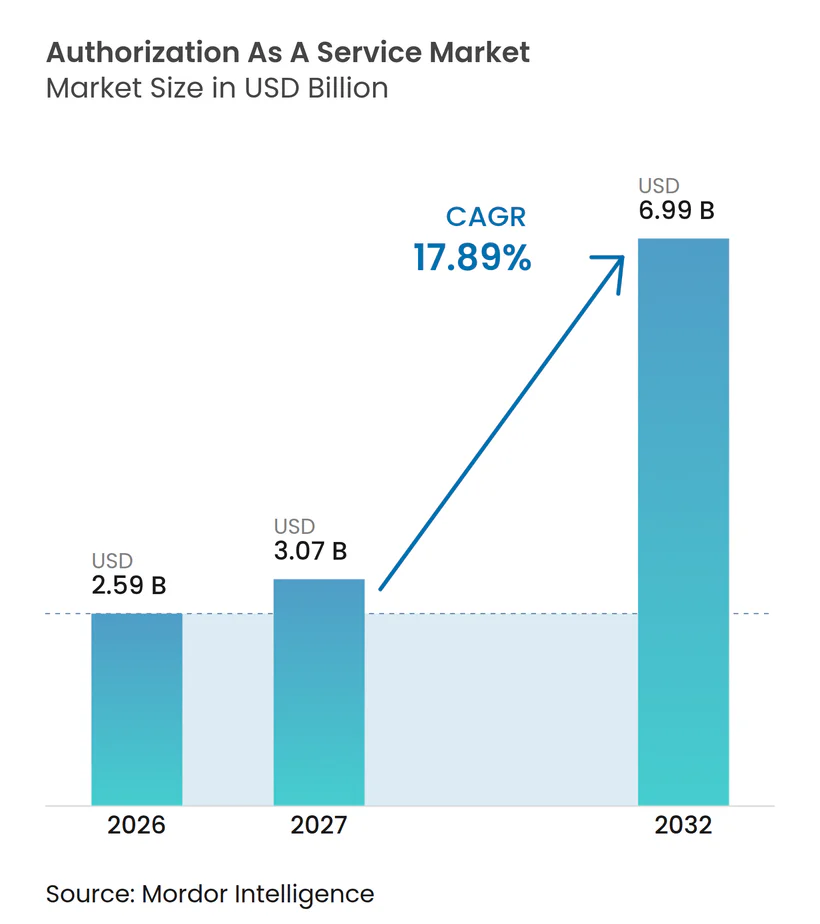
The Authorization As A Service Market size was valued at USD 2.59 billion in 2026 and is estimated to grow from USD 3.07 billion in 2027 to reach USD 6.99 billion by 2032, at a CAGR of 17.89% during the forecast period (2027-2032). Demand is shifting from access rules embedded in applications toward separate policy services that can make decisions across many systems. Zero-trust programs, cloud-native applications, and AI agents are increasing the number and variety of access decisions that organizations must manage. Vendors are responding with policy engines, managed services, relationship-based controls, and tools for delegated permissions. Open standards can make it easier to connect policy decision points with enforcement points, while also reducing barriers for customers to change providers. This leaves room for suppliers that can offer stronger policy design, audit support, and controls for non-human identities.
Key Report Takeaways
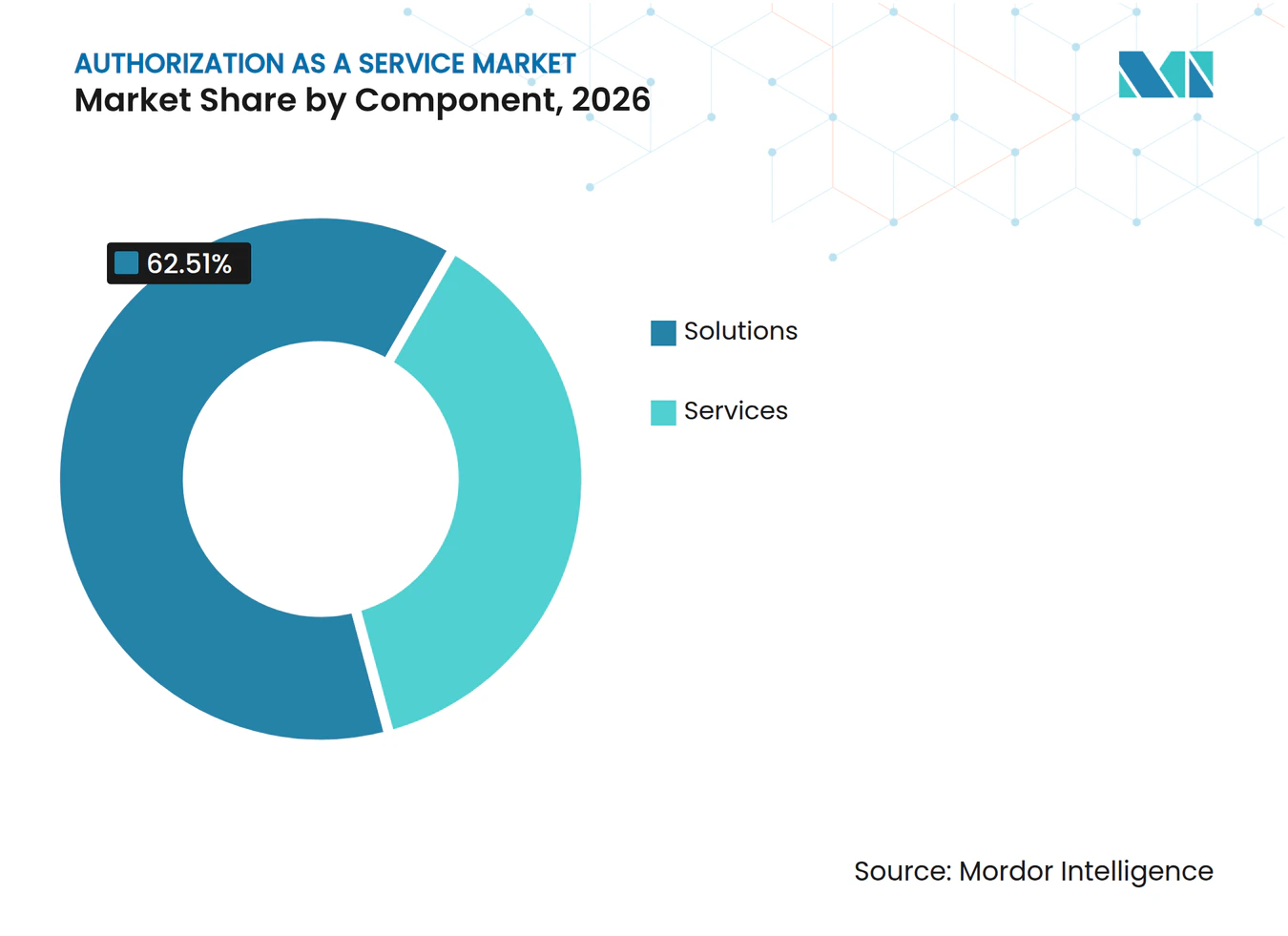
- By component, solutions accounted for 62.51% of the authorization-as-a-service market share in 2026, while services are projected to expand at a 23.83% CAGR through 2032.
- By deployment mode, cloud held 71.84% of the authorization-as-a-service market share in 2026 and is projected to expand at a 23.81% CAGR through 2032.
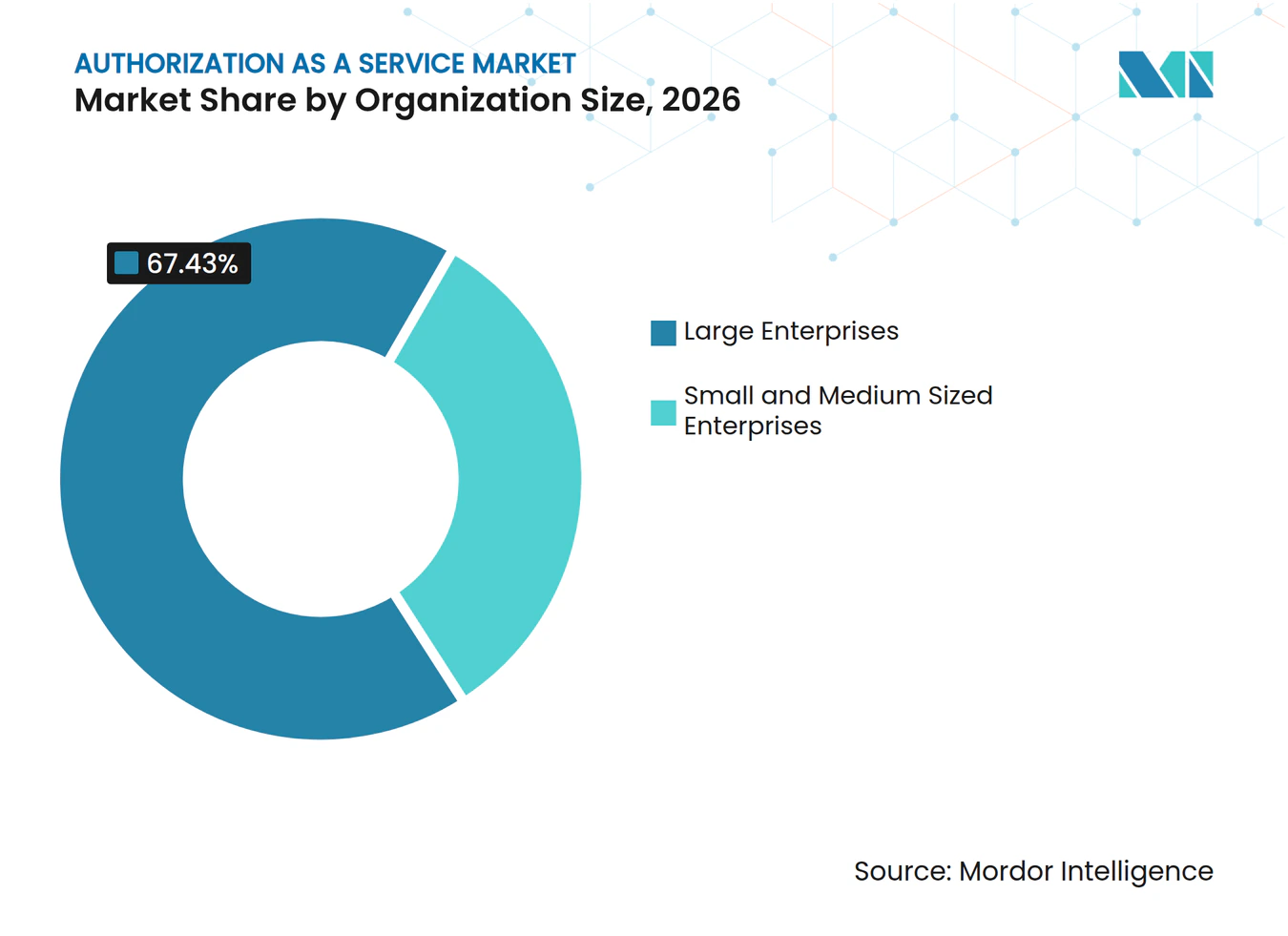
- By organization size, large enterprises held 67.43% of revenue in 2026, while small and medium-sized enterprises are projected to expand at a 23.79% CAGR through 2032.
- By authorization model, RBAC held 48.09% of revenue in 2026, while AI-agent identity authorization is projected to expand at a 24.41% CAGR through 2032.
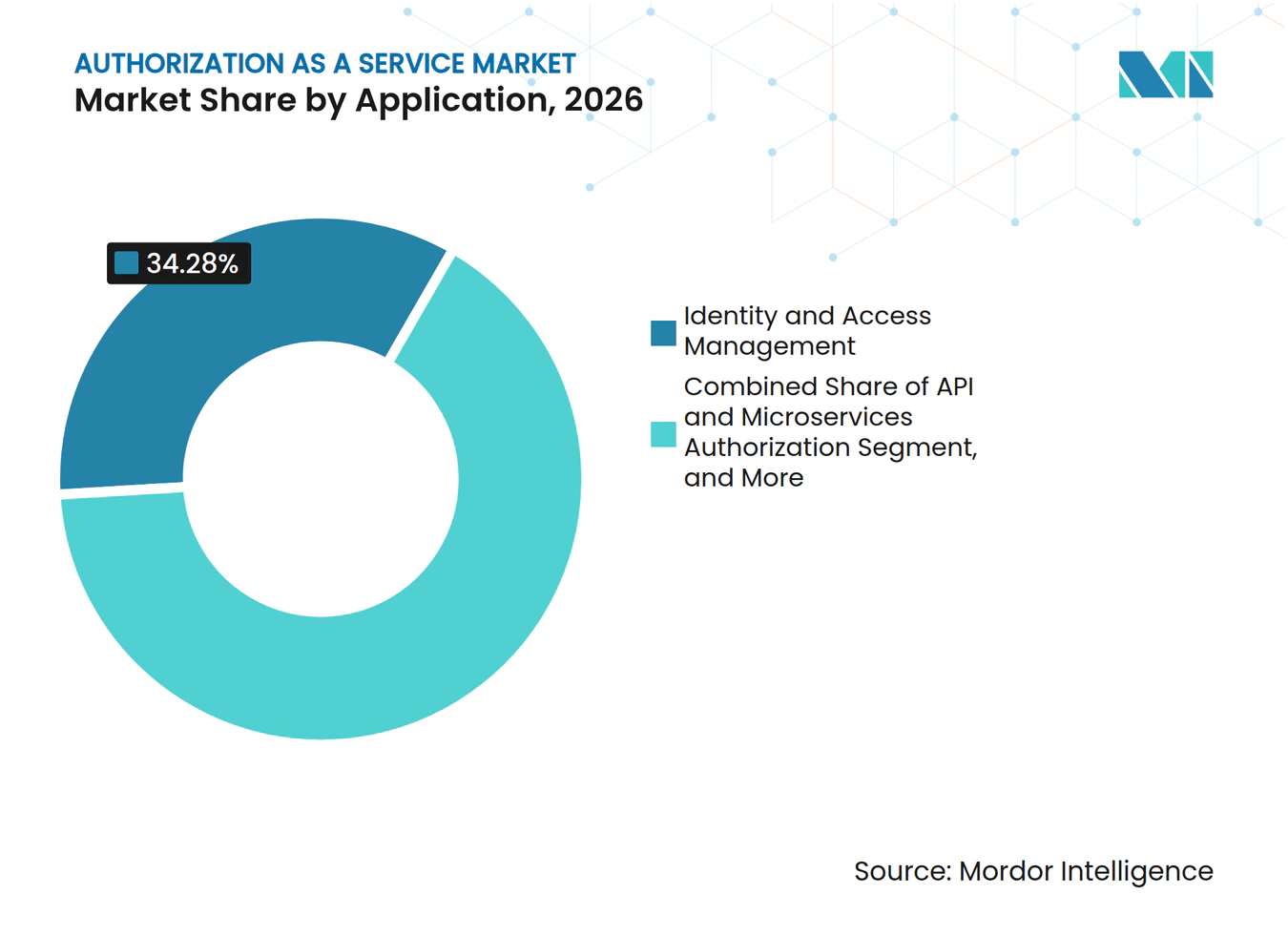
- By application, identity and access management held 34.28% of revenue in 2026, while healthcare and life sciences are projected to expand at a 24.49% CAGR through 2032.
- By end user, BFSI accounted for 23.68% of revenue in 2026, while healthcare and life sciences are projected to expand at a 24.49% CAGR through 2032.
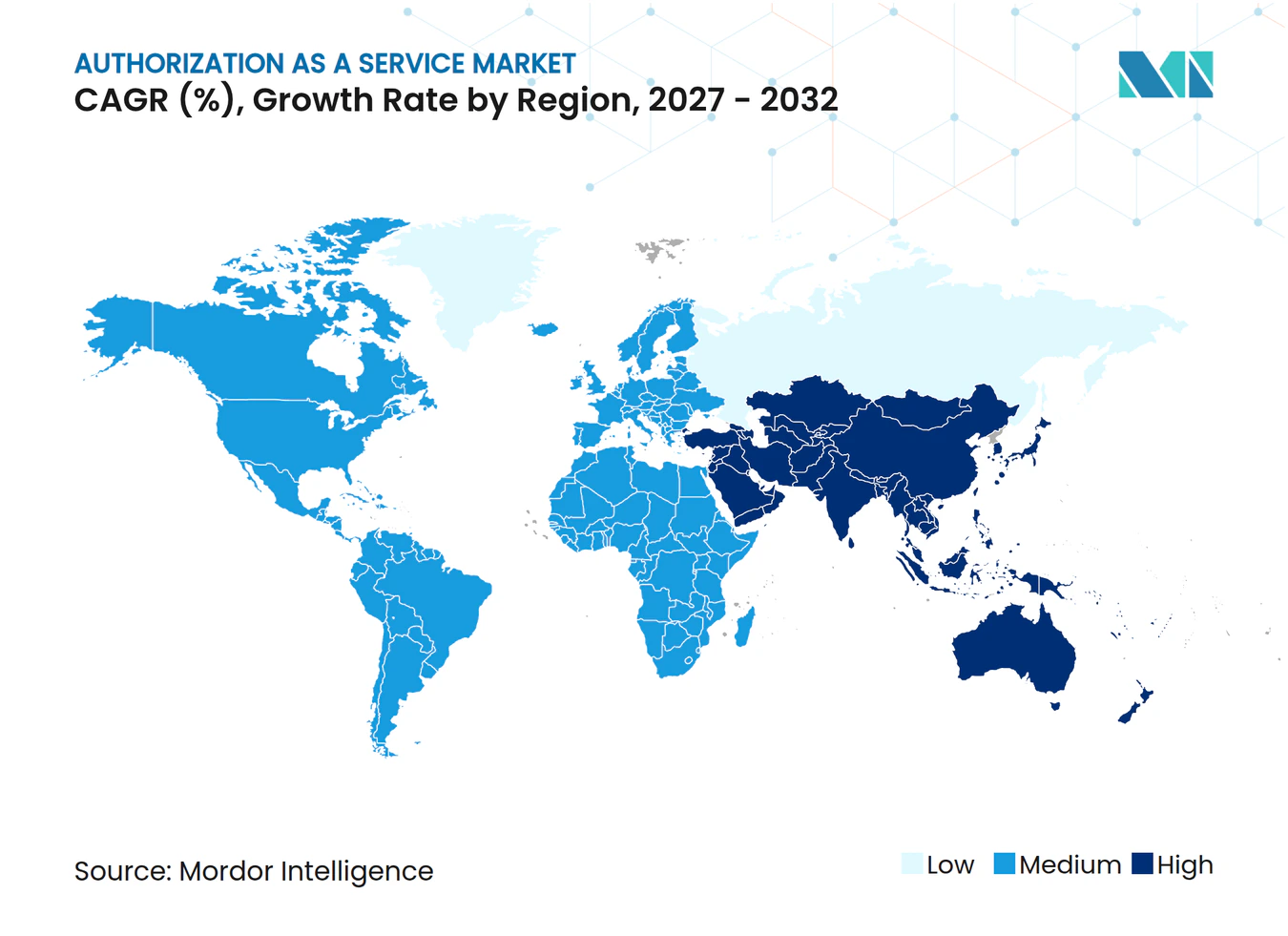
- By geography, North America held 38.47% of revenue in 2026, while Asia-Pacific is projected to expand at a 24.37% CAGR through 2032.
Note: Market size and forecast figures in this report are generated using Mordor Intelligence’s proprietary estimation framework, updated with the latest available data and insights as of January 2026.
Market Trends and Insights
Drivers Impact Analysis of Authorization As A Service Market*
| Driver | (~) % Impact on CAGR Forecast | Geographic Relevance | Impact Timeline |
|---|---|---|---|
| Zero-Trust Adoption Expands Continuous Authorization Requirements | +5.2% | Global | Short term (≤ 2 years) |
| AI Agents and Non-Human Identities Require Delegated Authorization | +4.5% | North America, Asia-Pacific | Short term (≤ 2 years) |
| API-First and Microservices Architectures Multiply Fine-Grained Permission Checks | +4.1% | Global | Medium term (2-4 years) |
| Regulatory Demand for Auditable and Contextual Access Decisions | +3.3% | Europe, North America, Asia-Pacific | Medium term (2-4 years) |
| Hybrid and Multi-Cloud Entitlement Complexity | +2.8% | North America and Europe, spillover to Asia-Pacific | Medium term (2-4 years) |
| Authorization Decisioning Moves Closer to the Application Edge | +1.7% | North America, Asia-Pacific | Long term (≥ 4 years) |
| Source: Mordor Intelligence | |||
Zero-Trust Adoption Expands Continuous Authorization Requirements
Zero trust changes authorization from a decision made at login into a decision made for each request and resource. This makes an external policy service more relevant when users, workloads, and devices move between applications, and the authorization-as-a-service market benefits when a single policy must be applied consistently across internal applications, APIs, cloud workloads, and resources that would otherwise maintain separate permissions. The authorization-as-a-service market benefits when organizations need consistent rules across internal systems rather than separate permissions for each application. ISO/IEC 27001 access control requirements and Article 21(2)(i) of the NIS2 Directive add compliance pressure in Europe and influence global procurement practices. The European Commission has described NIS2 as a measure that strengthens cybersecurity requirements for critical entities and digital providers. Continuous authorization also supports access reviews because each decision can be tied to the requesting identity, the resource, and the context.
AI Agents and Non-Human Identities Require Delegated Authorization
AI agents can access data stores, APIs, and internal tools without direct human intervention for each request. Their delegated permissions need limits that define who authorized the agent, which actions it can take, and how long that authority remains valid, giving the authorization-as-a-service market a role in recording the chain of authority and restricting actions when the delegated purpose or period has ended. NIST and Carnegie Mellon University identified software and AI agent identity and authorization as a priority for accelerating secure adoption.[1] The authorization-as-a-service market is supported by this need, as it provides a separate control layer for machine-speed requests. The OpenID Foundation also described agent-centric authorization and chain-aware delegation as central identity management issues for agentic. Suppliers that link agent actions to a human sponsor can provide organizations with clearer accountability when an automated task reaches sensitive systems.
API-First and Microservices Architectures Multiply Fine-Grained Permission Checks
A single business action can pass through several services when an application uses a microservices architecture. Each service needs to decide whether the caller can perform a specific operation on a specific resource. Separate authorization logic can produce inconsistent rules, slow audits, and make policy changes harder to test, making the authorization-as-a-service market relevant when organizations need a single policy method across services developed, released, and maintained by different teams. The Cloud Native Computing Foundation has published deployment guidance for Open Policy Agent that addresses centralized policy practices and secure implementation. The authorization-as-a-service market gains relevance when organizations separate policies from application releases. AuthZEN provides a vendor-neutral interface for authorization requests and decisions between policy enforcement points and policy decision points.
Regulatory Demand for Auditable and Contextual Access Decisions
Regulators increasingly expect evidence that access controls work at the level of a specific user, workload, resource, and decision. The NIS2 implementing regulation requires documented access-control policies, rights management reviews, privileged-account governance, and multifactor authentication for privileged access. The European Commission proposed targeted NIS2 amendments in January 2026 to simplify compliance for 28,700 companies, including 6,200 micro and small enterprises.[2] In the United States, the CMS Interoperability and Prior Authorization Final Rule requires healthcare payers to log authorization decisions at the granularity of FHIR resources as of January 2026. These requirements make audit trails and contextual policy decisions relevant to healthcare, financial services, and other regulated buyers, and they give the authorization-as-a-service market a route into programs where the buyer needs documented evidence of control rather than a general statement of access capability. The authorization-as-a-service market, therefore, offers an opportunity in which access control spending is tied to mandatory evidence rather than discretionary software upgrades.
Restraints Impact Analysis of Authorization As A Service Market*
| Restraint | (~) % Impact on CAGR Forecast | Geographic Relevance | Impact Timeline |
|---|---|---|---|
| Authorization Bundling by Hyperscalers and IAM Suites | -2.4% | Global, concentrated in North America | Short term (≤ 2 years) |
| Integration Complexity Across Legacy Applications and Identity Stores | -1.8% | Global, pronounced in Europe and South America | Medium term (2-4 years) |
| Authorization Policy Semantics Are Difficult to Standardize Across Teams | -1.3% | Global | Medium term (2-4 years) |
| Decision-Latency and Availability Requirements Limit Centralized Cloud Deployment | -0.9% | Global, especially Asia-Pacific and Middle East and Africa | Long term (≥ 4 years) |
| Source: Mordor Intelligence | |||
Authorization Bundling by Hyperscalers and IAM Suites
Cloud platforms and IAM suites can include basic authorization functions as part of broader subscriptions. AWS describes Amazon Verified Permissions as a fully managed authorization service that uses the Cedar policy language. For customers who have standardized on a single provider, these features may meet common use cases without requiring a separate vendor evaluation. This can limit pricing flexibility for independent providers in the authorization-as-a-service market, especially when the customer views authorization as an extension of its existing cloud environment rather than as a specialized control layer that can operate across multiple clouds and application types. Pure-play vendors are responding with relationship-based controls, policy-as-code, and delegated authorization for AI agents. The position remains difficult in smaller organizations where a no-additional-cost service can appear adequate until access requirements become more complex.
Integration Complexity Across Legacy Applications and Identity Stores
Enterprise environments often combine cloud-native services, legacy applications, packaged software, and several identity stores. An external policy service may require directory synchronization, attribute sources, and connectors for each system type. This increases implementation time and makes it harder for organizations to demonstrate value quickly, which can delay adoption in the authorization-as-a-service market until the buyer has mapped identity attributes, directory records, policy sources, and the interfaces required for each legacy or cloud application. The issue is more acute for mid-sized organizations that lack dedicated identity engineering teams. It can delay projects in the authorization-as-a-service market, even when compliance needs are clear. Hybrid adoption can reduce disruption, but it also requires policies that work across on-premises and cloud enforcement points.
*Our forecasts treat driver/restraint impacts as directional, not additive. The impact forecasts reflect baseline growth, mix effects, and variable interactions.
Authorization As A Service Market Segment Analysis
By Component:
Services Expand as Policy Complexity IncreasesSolutions held 62.51% of revenue in 2026, making software platforms the largest component. These platforms include policy decision-point engines, policy administration consoles, and authorization management systems that separate permissions from application code, so policy owners can apply the same rule across multiple applications, distinguish a request from an approved action, and maintain a clearer record of how a decision was made. They allow policy teams to revise rules without requiring a code change in every application that uses the rule. This operating model helps organizations test, version, approve, and audit policies independently from application release cycles, which is especially important when a policy change must be checked against many resources, identity attributes, and application behaviors before it reaches production. OPA-based platforms, Cedar-native services, and Zanzibar-inspired relationship-based platforms form the technical base for many deployments.
Services are projected to expand at a 23.83% CAGR through 2032, the highest rate within the component split. Policy design, test coverage, attribute mapping, and lifecycle management require skills that security and development teams may not have in-house. Professional services can support the first deployment, while managed operations can handle policy administration after the initial implementation, including translating business requirements into policy language, validating outcomes with application owners, preparing controls for audit, and maintaining rules as teams, resources, and access conditions change. Vendors increasingly combine identity-source connectors, audit dashboards, policy-as-code tools, and managed support into a single offering. This narrows the boundary between software and services while making implementation capability an important element of the authorization-as-a-service industry.


By Deployment Mode:
Cloud Centralizes Policy ManagementCloud accounted for 71.84% of revenue in 2026 and is projected to grow at a 23.81% CAGR through 2032. Cloud control planes can distribute policy updates across large numbers of enforcement points without requiring an application restart. This supports organizations that operate digital services across several regions and need the same access rule to apply at each service boundary. Centralized administration also gives compliance teams a single record of policy versions and changes. The cloud model aligns with the broader use of cloud-native identity, security, and application management tools because policy teams can use a common administration layer while enforcement remains close to the applications and services that require fast responses.
On-premises deployment remains relevant for government, defense, and financial services where data sovereignty or air-gap requirements limit cloud connectivity. Cerbos supports air-gapped on-premises deployment through Cerbos Hub Enterprise, which addresses these operational requirements. Hybrid deployment is important for organizations moving legacy systems to cloud infrastructure in stages rather than replacing every application at once. These organizations need policies that span on-premises enforcement points and cloud-based decision services without creating different rules for the same user, workload, or service account, since different results for the same request can create operational confusion and make an access-control review harder to complete. The need to support both environments creates a demanding use case that remains underserved by some providers, while also allowing the authorization-as-a-service market to support customers who need the same governance and policy logic across the stages of a gradual migration, rather than only in fully cloud-native environments.
By Organization Size:
Large Enterprises Anchor Revenue and SMEs Add DemandLarge enterprises accounted for 67.43% of revenue in 2026, driven by complex application portfolios, multi-cloud environments, and formal audit requirements. A large authorization deployment can connect a policy engine with several identity stores, multiple applications, and distributed policy decision points. It can also include policy-change controls, access-certification workflows, and evidence for internal or external review. This scope supports spending on both platform subscriptions and professional services, since a program may require work across policy design, source data quality, technical integration, user acceptance testing, documentation, and formal approval processes before a new access rule is used. Large organizations can use specialized authorization tools when the IAM suite functions do not cover every application, workload, or resource type.
Small and medium-sized enterprises are projected to expand at a 23.79% CAGR through 2032. Consumption-based pricing reduces the infrastructure commitment that has historically limited smaller buyers, allowing them to begin with limited policy evaluations or a narrow service environment rather than making a large initial commitment to systems and specialist operating teams. Open-source policy engines can provide a low-friction entry point before an organization adopts a commercial hub, enterprise support, or a managed service. This route lets a small team begin with a defined application use case and broaden controls as its application estate changes, enabling a staged approach in which the organization first addresses a known permission issue, then adds more applications, resources, workflows, and operating controls when internal capability develops. The authorization-as-a-service industry can reach these buyers when providers reduce integration work and make policy operations easier for teams with limited specialist capacity.

By Authorization Model:
RBAC Remains Established as AI-Agent Controls EmergeRBAC accounted for 48.09% of revenue in 2026, reflecting its long-standing use in enterprise applications. Many existing systems were designed around roles as the primary means of assigning access. Replacing those rules can require policy migration, application changes, and careful validation, which organizations may postpone. RBAC remains useful for workforce permissions and predictable access patterns that do not depend heavily on changing context. Its continued position reflects installed systems and operating familiarity, rather than a complete answer to newer access requirements, because access decisions increasingly depend on the resource, transaction, relationship, device, time, and other changing conditions that a role alone cannot capture.
AI-agent identity authorization is projected to expand at a 24.41% CAGR through 2032. Attribute-based and relationship-based access control are also gaining relevance in multi-tenant software, fine-grained data access, and delegated work. The Cloud Security Alliance has stated that agentic AI requires controls that account for autonomy, ephemeral identities, and delegation. The authorization-as-a-service market can evaluate context, relationships, and resource attributes outside the application rather than relying on a static role alone, giving organizations a way to express fine-grained permissions without embedding every variation of access logic in application code. AI-agent controls can define limits on permission duration, action scope, and delegation that traditional role assignments do not provide.
By Application:
IAM Leads as Specialized Uses DevelopIdentity and access management held 34.28% of revenue in 2026, making it the largest application area. Authorization is often first purchased through access certification, joiner-mover-leaver provisioning, or privilege governance programs. These workflows provide a practical route for connecting policy decisions to named identities, access reviews, and broader governance processes. The authorization-as-a-service market size for this application is driven by the need to govern access throughout the employee lifecycle. IAM remains a common point of entry because it has established executive ownership, budget structures, and operating processes in many organizations, and it connects authorization decisions to employee records, certification reviews, privileged access workflows, and the routine administration of user accounts.
Healthcare and life sciences are projected to expand at a 24.49% CAGR through 2032. API and microservices authorization is also gaining relevance as service-to-service trust boundaries increase in cloud-native applications. Cloud infrastructure entitlement management addresses excessive permissions in cloud environments, while payment authorization supports controls over transaction actions. The CMS rule creates a particular need in healthcare for FHIR-level access controls and decision logs, since payers need to manage requests at a detailed resource level while retaining records that support reporting, demonstrate consistent policy application, and help administrators examine decision timing and outcomes. AI-agent authorization, data authorization, payment authorization, and compliance governance extend the use of authorization beyond workforce access alone, reflecting a broader need to control actions initiated by software, automated workflows, third-party connections, and service accounts, as well as actions performed directly by an employee.

By End User:
BFSI Leads While Healthcare Gains MomentumBFSI held 23.68% of revenue in 2026, the largest share among end-user sectors. Financial institutions operate under access-control requirements linked to SOX, PCI-DSS, GDPR Article 32, and GLBA. These organizations need real-time decisions, preventive policy enforcement, and time-bound privileged access for systems that handle sensitive customer and transaction data. The leading position reflects the need for evidence at the level of a particular decision, not only a record that a user logged in, because regulated institutions may need to show the permitted action, related policy, resource, identity, and operating context when an access decision is reviewed. Specialized services can complement IAM systems where static roles do not provide the required context or audit detail.
Healthcare and life sciences are projected to expand at a 24.49% CAGR through 2032. CMS FHIR requirements and patient data protection needs support detailed authorization across multi-cloud electronic health record environments. IT and telecommunications providers use externalized controls for multi-tenant software and service-to-service access. Government and defense organizations prioritize attribute-based and mandatory access controls for classified systems. Retail, e-commerce, energy, and utilities use authorization services for payments, fraud signals, and operational technology that is connecting to cloud systems.
Geography Analysis
North America Authorization As a Service Market
North America accounted for 38.47% of revenue in 2026, the largest regional share in the authorization-as-a-service market. The region has a high concentration of cloud-native technology companies, established zero-trust programs, and externalized authorization deployments, creating a customer base that is more likely to run distributed applications and require consistent policy decisions across multiple cloud services. U.S. federal guidance has also supported demand for these controls across agencies, while the United States provides most of the regional revenue. Canadian financial services and government deployments are driving cloud demand, and Mexico’s fintech sector is beginning to adopt consumption-based services.
APAC Authorization As a Service Market
Asia-Pacific is projected to expand at a 24.37% CAGR through 2032, the highest regional rate. Digital public infrastructure programs, government cloud procurement, and fintech platforms are increasing the need for fine-grained policies across the region. China’s Data Security Law and Personal Information Protection Law support localized deployments, although data sovereignty can favor private cloud and on-premises configurations. Australia’s Critical Infrastructure Act supports stronger access governance in energy, financial services, and telecommunications. India’s Account Aggregator framework creates API-level authorization needs for fintech organizations, while Japan’s Society 5.0 initiative and South Korea’s cloud-first public procurement approach support regional adoption.
EMEA and South America Authorization As a Service Market
Europe has a significant position due to GDPR Article 32, NIS2 access-control obligations, and DORA requirements for financial services. Germany, the United Kingdom, and France lead regional adoption, with industrial technology, open banking, and regulated services providing important use cases. South America remains an emerging opportunity, where Brazil’s LGPD supports access governance spending in financial services and healthcare. Saudi Arabia and the United Arab Emirates are investing in cloud authorization infrastructure as part of digital transformation programs. South Africa’s financial services sector and Nigeria’s fintech ecosystem account for much of Africa’s current adoption of fintech.
Competitive Landscape
Market Concentration
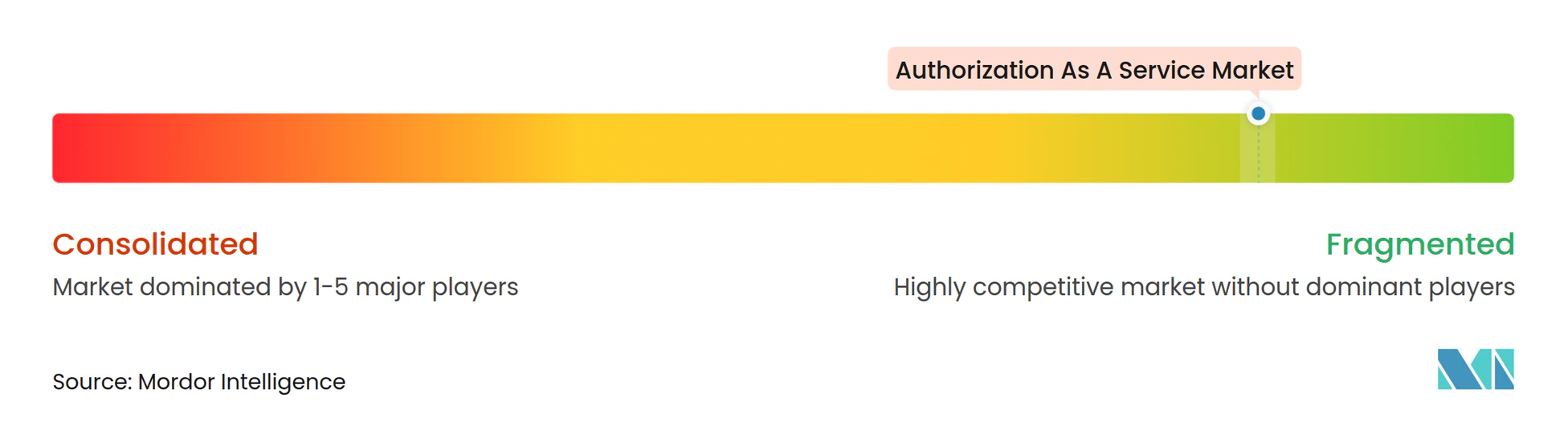
The authorization-as-a-service market is fragmented among pure-play providers, with no single supplier holding a commanding position, as customers can choose among specialist providers, open-source-backed offerings, larger identity-security platforms, and cloud-native services, each approaching the authorization problem from a different product category. The field includes policy-as-code platforms, relationship-based services, ABAC and XACML engines, and developer-focused authorization APIs, with suppliers differing in how they model permissions, connect identity data, support enforcement patterns, and provide governance for policy creation and ongoing review. AWS Verified Permissions provides AWS-native customers with a managed service that can reduce some self-hosting work.[3] This bundled option provides a direct point of comparison for providers selling standalone platforms, particularly when a customer already uses one cloud platform and expects its native services to meet standard authorization requirements without a separate procurement process.
The fragmented structure means companies must differentiate through integration, policy depth, operational support, and compliance expertise, and the authorization as a service market therefore rewards providers that can help customers move from broad access principles to clear policies for individual applications, resources, requests, and identities, while also showing how a rule was authored, tested, approved, applied, changed, and reviewed over time rather than only offering a basic access decision at the point of request. Developer-first suppliers such as AuthZed, Cerbos, Permit.io, and Ory use open-source adoption as a route to commercial subscriptions and managed services. The AuthZEN standard can reduce the effort required to connect to an external policy decision point, helping this group reach more applications. Enterprise suppliers such as PlainID, Axiomatics, and NextLabs compete on expressive policies and audit tooling for regulated customers. CrowdStrike announced a definitive agreement in January 2026 to acquire SGNL.ai for USD 740 million, combining continuous authorization with identity security for human, non-human, and AI-agent identities.
Leonardo acquired Axiomatics in July 2025, adding authorization capabilities to its cybersecurity offering. AI-agent controls are a developing area of competition because conventional role assignments may not govern delegated, short-lived machine actions. Ory introduced Agent Security in June 2026 to place identity, authorization, and governance controls in the agent harness. Permit.io introduced its MCP Gateway in March 2026 for real-time authorization, delegation tracking, and audit trails for AI agents. AuthZed made Materialize generally available in September 2026 to precompute demanding portions of relationship graphs for large deployments.
Authorization As A Service Industry Leaders
-
PlainID Ltd.
-
Axiomatics AB
-
Permit.io, Inc.
-
AuthZed, Inc.
-
Cerbos Technology Limited
- *Disclaimer: Major Players sorted in no particular order
Authorization As A Service Market Companies Covered in this Report
- Aserto, Inc.
- AuthZed, Inc.
- Axiomatics AB
- Cerbos Technology Limited
- Cloudentity, Inc.
- InferaDB, Inc.
- NextLabs, Inc.
- Oso Security, Inc.
- Ory Corp.
- Permit.io, Inc.
- PlainID Ltd.
- PolicyArc, Inc.
- SGNL.ai, Inc.
- Styra, Inc.
- Warrant, Inc.
- Authorizer Technologies, Inc.
- Authress, Inc.
- Permify, Inc.
- FusionAuth, Inc.
- ZITADEL AG
Recent Industry Developments in Authorization As A Service Market
- October 2026: PlainID launched AI-Ready Gateway Enforcement and rebranded as the Runtime Authorization Platform for the AI era, enabling existing API gateways, MCP servers, and AI gateways to enforce identity-, agent-, and intent-aware authorization without code changes. The announcement positioned PlainID as the first enterprise platform to bind the initiating human's identity to the AI agent acting on their behalf at the gateway layer, addressing a significant gap in enterprise AI governance.
- September 2026: AuthZed announced the general availability of AuthZed Materialize for AuthZed Dedicated Cloud, a capability that precomputes expensive portions of the SpiceDB relationship graph to scale authorization across deployments with billions of relationships. Materialize had supported production workloads for select customers since 2024 and is now broadly available as a first-class managed service tier.
- June 2026: Ory launched Ory Agent Security, described as the first Agent IAM control plane for enterprise AI, embedding identity, authorization, and governance controls directly into the agent harness that connects AI agents to tools, APIs, files, and enterprise systems, enabling policy enforcement before agent actions execute.
- June 2026: Cerbos entered private beta for Cerbos Cloud, a cloud-hosted control plane for policy development, testing, and GitOps-style distribution, and simultaneously closed a USD 7.5 million extended seed round, bringing total funding to USD 11 million. The company reported 4x demand growth for its authorization management platform in 2025 and recognition from Gartner as an authorization platform vendor.
Global Authorization As A Service Market Report Scope
The Authorization as a Service market refers to cloud-based and on-premises solutions and services that enable organizations to define, enforce, manage, and monitor access permissions across applications, data, APIs, infrastructure, and digital resources. These services help organizations determine who or what can access specific resources, under which conditions, and with what level of permission, using authorization models such as role-based access control (RBAC), attribute-based access control (ABAC), relationship-based access control (ReBAC), policy-based access control, and fine-grained authorization.
The Authorization as a Service Report is Segmented by Component (Solutions and Services), Deployment Mode (Cloud, On-Premises, and Hybrid), Organization Size (Large Enterprises and Small and Medium-Sized Enterprises), Authorization Model (Role-Based Access Control, Attribute-Based Access Control, Relationship-Based Access Control, Policy-Based Access Control, and Fine-Grained and Resource-Level Authorization), Application (Identity and Access Management, API and Microservices, Data and Document Authorization, Cloud Infrastructure Entitlement Management, AI Agent and Machine Identity Authorization, and Compliance and Access Governance), End User (BFSI, Healthcare and Life Sciences, IT and Telecom, Government and Defense, Retail and E-Commerce, Energy and Utilities, and Other End Users), and Geography (North America, South America, Europe, Asia-Pacific, Middle East, and Africa). The Market Forecasts are Provided in Terms of Value (USD).
Segmentation Overview
| Solutions |
| Services |
| Cloud |
| On-Premises |
| Hybrid |
| Large Enterprises |
| Small and Medium-Sized Enterprises |
| Role-Based Access Control |
| Attribute-Based Access Control |
| Relationship-Based Access Control |
| Policy-Based Access Control |
| Fine-Grained and Resource-Level Authorization |
| Identity and Access Management |
| API and Microservices Authorization |
| Data and Document Authorization |
| Payment Authorization |
| Cloud Infrastructure Entitlement Management |
| AI Agent and Machine Identity Authorization |
| Compliance and Access Governance |
| BFSI |
| Healthcare and Life Sciences |
| Information Technology and Telecommunications |
| Government and Defense |
| Retail and E-Commerce |
| Energy and Utilities |
| Other End Users |
| North America | United States |
| Canada | |
| Mexico | |
| South America | Brazil |
| Argentina | |
| Rest of South America | |
| Europe | United Kingdom |
| Germany | |
| France | |
| Italy | |
| Spain | |
| Rest of Europe | |
| Asia-Pacific | China |
| India | |
| Japan | |
| South Korea | |
| Australia | |
| Southeast Asia | |
| Rest of Asia-Pacific | |
| Middle East | Turkey |
| Israel | |
| Saudi Arabia | |
| United Arab Emirates | |
| Rest of Middle East | |
| Africa | South Africa |
| Nigeria | |
| Egypt | |
| Rest of Africa |
| By Component | Solutions | |
| Services | ||
| By Deployment Mode | Cloud | |
| On-Premises | ||
| Hybrid | ||
| By Organization Size | Large Enterprises | |
| Small and Medium-Sized Enterprises | ||
| By Authorization Model | Role-Based Access Control | |
| Attribute-Based Access Control | ||
| Relationship-Based Access Control | ||
| Policy-Based Access Control | ||
| Fine-Grained and Resource-Level Authorization | ||
| By Application | Identity and Access Management | |
| API and Microservices Authorization | ||
| Data and Document Authorization | ||
| Payment Authorization | ||
| Cloud Infrastructure Entitlement Management | ||
| AI Agent and Machine Identity Authorization | ||
| Compliance and Access Governance | ||
| By End User | BFSI | |
| Healthcare and Life Sciences | ||
| Information Technology and Telecommunications | ||
| Government and Defense | ||
| Retail and E-Commerce | ||
| Energy and Utilities | ||
| Other End Users | ||
| By Geography | North America | United States |
| Canada | ||
| Mexico | ||
| South America | Brazil | |
| Argentina | ||
| Rest of South America | ||
| Europe | United Kingdom | |
| Germany | ||
| France | ||
| Italy | ||
| Spain | ||
| Rest of Europe | ||
| Asia-Pacific | China | |
| India | ||
| Japan | ||
| South Korea | ||
| Australia | ||
| Southeast Asia | ||
| Rest of Asia-Pacific | ||
| Middle East | Turkey | |
| Israel | ||
| Saudi Arabia | ||
| United Arab Emirates | ||
| Rest of Middle East | ||
| Africa | South Africa | |
| Nigeria | ||
| Egypt | ||
| Rest of Africa | ||
Key Questions Answered in the Report
What is the size of the authorization as a service market?
The authorization-as-a-service market is valued at USD 2.59 billion in 2026 and is projected to reach USD 6.99 billion by 2032, at a 17.89% CAGR.
What is driving demand for authorization as a service?
Zero-trust adoption, microservices, auditable regulatory controls, and delegated access for AI agents are increasing demand for separate policy services.
Which deployment mode leads authorization as a service adoption?
Cloud leads with 71.84% share in 2026 and is projected to expand at a 23.81% CAGR through 2032.
Which organizations are adopting authorization services most quickly?
Small and medium-sized enterprises are projected to expand at a 23.79% CAGR through 2032, supported by consumption-based pricing and open-source entry points.
Why are AI agents changing authorization requirements?
AI agents need limits on delegated permissions, action scope, duration, and accountability when they access tools and enterprise data.
Which region is advancing most rapidly in authorization services?
Asia-Pacific is projected to expand at a 24.37% CAGR through 2032, supported by digital infrastructure, cloud programs, and fintech adoption.