
Australia Extended Stay Hotel Market Size and Share
Market Overview
| Study Period | 2021 - 2031 |
|---|---|
| Forecast Data Period | 2026 - 2031 |
| Base Year Market Size (2025) | USD 2.36 Billion |
| Market Size (2026) | USD 2.48 Billion |
| Market Size (2031) | USD 3.19 Billion |
| Growth Rate (2026 - 2031) | 5.16 % |
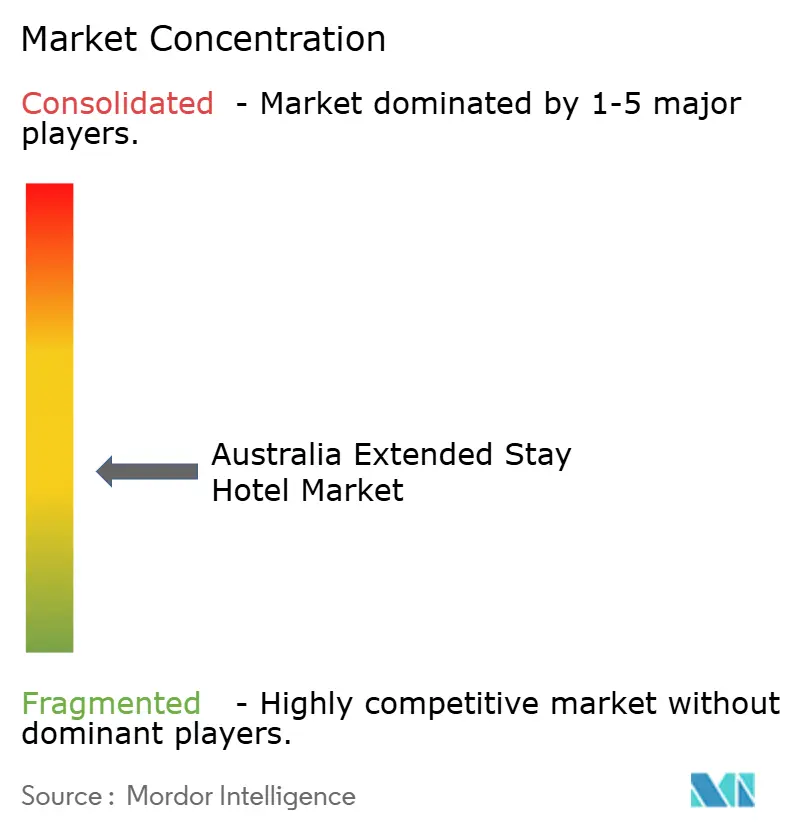
| Market Concentration | Medium |
Major Players *Disclaimer: Major Players sorted in no particular order Image © Mordor Intelligence. Reuse requires attribution under CC BY 4.0. | |
Australia Extended Stay Hotel Market Analysis by Mordor Intelligence
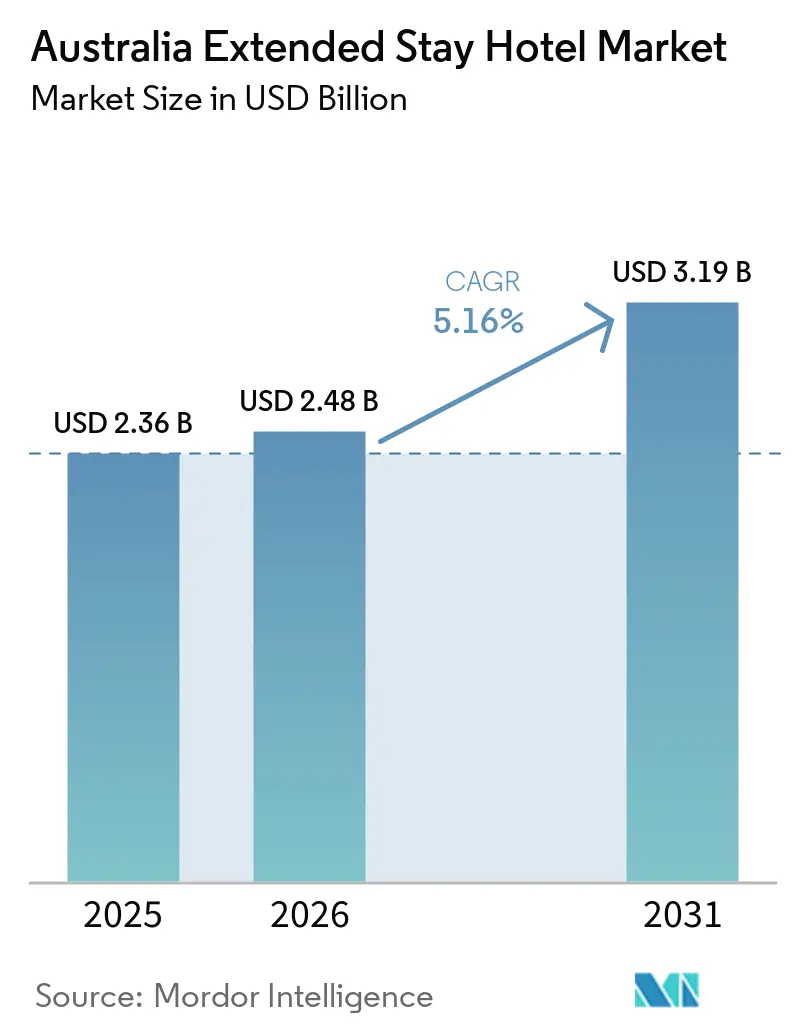
The Australian Extended Stay Hotel Market was valued at USD 2.36 billion in 2025 and estimated to grow from USD 2.48 billion in 2026 to reach USD 3.19 billion by 2031, at a CAGR of 5.16% during the forecast period (2026–2031). Growth is driven by a recovery in corporate travel, where longer work trips and blended work-leisure travel increase demand for apartment-style stays over traditional hotels[1]. The housing shortage in Australia is also boosting temporary accommodation needs for relocating workers, new migrants, and insurance-displaced households unable to secure long-term rentals. Apartment-style units with kitchens, laundry facilities, and workspaces are preferred as they combine living and working needs under one rate. Branded operators are responding with long-stay packages and flexible terms. In 2024, national commercial accommodation occupancy averaged 71%, despite a record inventory of 335,000 rooms, indicating strong demand. The fragmented competitive landscape offers opportunities for chains and specialist operators to enhance returns through brand-led expansion, improved direct booking systems, and better utilization of guest data over extended booking periods.
Key Report Takeaways
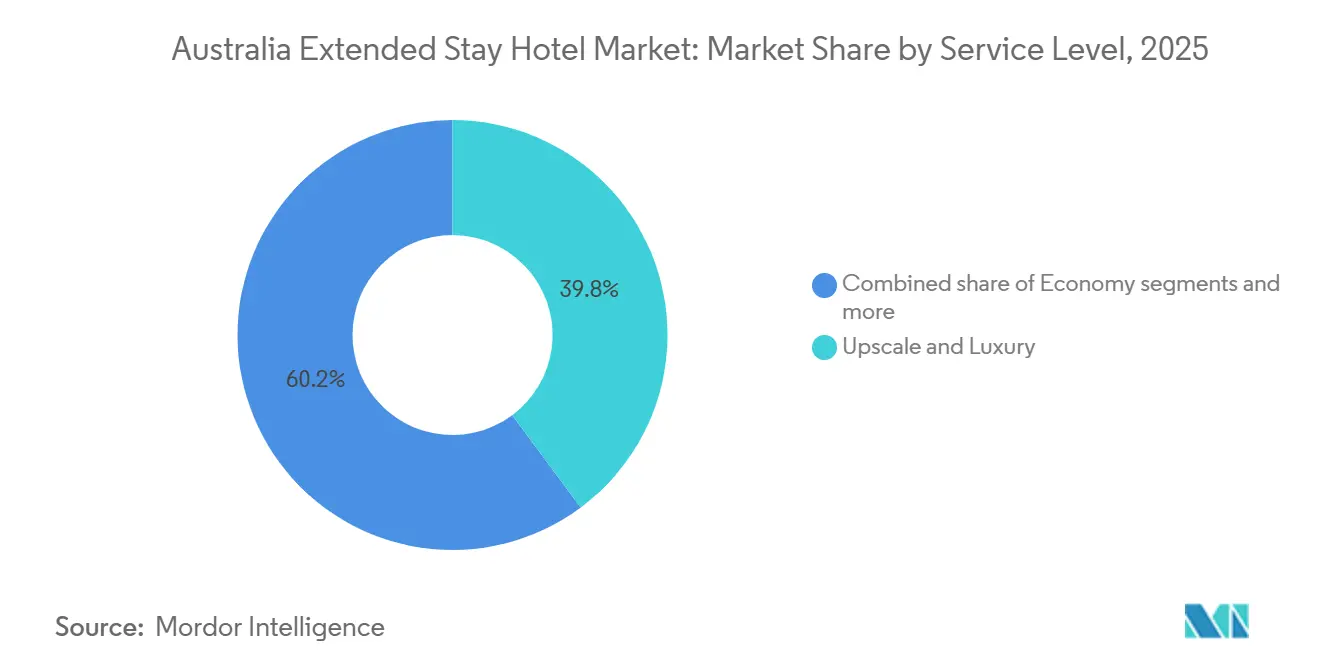
- By service level, Upscale and Luxury held 39.83% of the Australia Extended Stay Hotel Market in 2025, while Mid-range is forecast to expand at a 5.53% CAGR through 2031.
- By stay duration, Monthly stays accounted for 44.91% of the Australia Extended Stay Hotel Market in 2025, while Quarterly and Longer-term stays are projected to grow at a 7.17% CAGR through 2031.
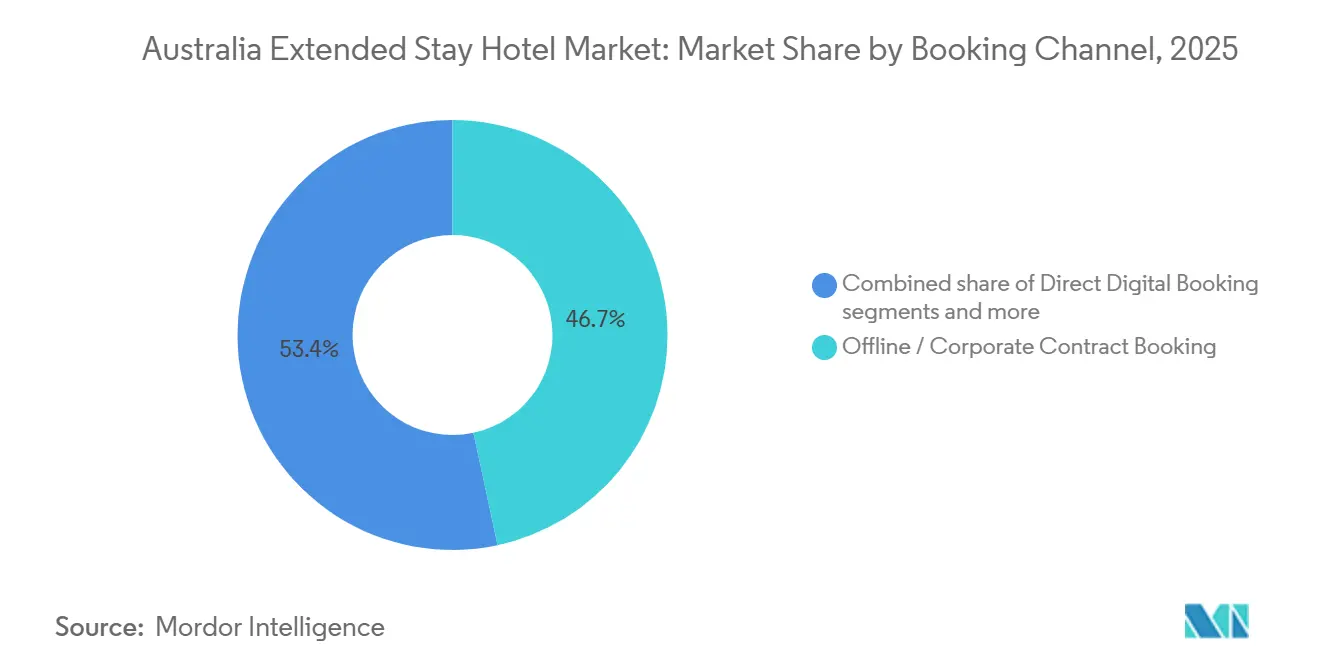
- By booking channel, Offline and corporate contract booking held 46.65% of the Australia Extended Stay Hotel Market in 2025, while Direct Digital booking is expected to rise at a 6.09% CAGR through 2031.
- By end user, Business customers represented 48.72% of the Australia Extended Stay Hotel Market in 2025, while Relocating residents and insurance-displaced guests are forecast to expand at a 6.71% CAGR through 2031.
- By geography, New South Wales held 35.34% of the Australia Extended Stay Hotel Market in 2025, while Queensland is projected to record the fastest state-level CAGR at 6.06% through 2031.
Note: Market size and forecast figures in this report are generated using Mordor Intelligence’s proprietary estimation framework, updated with the latest available data and insights as of January 2026.
Australia Extended Stay Hotel Market Trends and Insights
Drivers Impact Analysis*
| Driver | (~) % Impact on CAGR Forecast | Geographic Relevance | Impact Timeline |
|---|---|---|---|
| Corporate travel and bleisure recovery | +1.3% | National, concentrated in Sydney, Melbourne, Brisbane, and regional Queensland | Short term (≤ 2 years) |
| Apartment-style preference for value and flexibility | +0.8% | Global, strongest in metro Australia, including Sydney, Melbourne, and Perth CBDs | Medium term (2-4 years) |
| Skilled migration and relocation-led temporary housing | +1.0% | National, concentrated in Sydney, Melbourne, Perth, and Brisbane | Medium term (2-4 years) |
| Regional project workforce accommodation demand | +0.7% | Regional Australia, especially Bowen Basin Queensland, Pilbara Western Australia, and the CopperString Queensland energy corridor | Medium term (2-4 years) |
| Insurance-displacement and disaster-recovery stays | +0.4% | National, elevated in New South Wales Mid North Coast, SE Queensland, and Northern Rivers | Short term (≤ 2 years) |
| Rental tightness extending temporary-stay demand | +0.9% | National, acute in Perth, Adelaide, and Brisbane where vacancy rates remain below 1.5% | Medium term (2-4 years) |
| Source: Mordor Intelligence | |||
Corporate travel and bleisure recovery
The corporate travel recovery in Australia is transforming the extended stay hotel market by shifting booking patterns toward longer stays. Flight Centre Travel Group data indicates that most Australian business travelers combine work and leisure. SME travelers are staying longer per trip, with durations expected to increase further. Travel to non-capital cities among SME travelers has grown, expanding demand for serviced accommodations in regional areas beyond Sydney and Melbourne[2]. A recent report says that a significant portion of corporate clients plan to increase travel spending, while only a small percentage expect reductions. Longer trips align better with weekly pricing thresholds, enabling operators to secure higher booking values even with moderated nightly rates. These trends highlight how the market is benefiting from the rise of bleisure and project travel.
Apartment-style preference for value and flexibility
The extended stay hotel market in Australia is expanding due to a preference for apartment-style units that integrate sleeping, cooking, laundry, and workspace functions. Surveys of business travelers highlight demand for accommodation with kitchenettes and additional space, along with a focus on convenient locations. Operators have formalized long-stay offerings, as demonstrated by The Sebel and Mantra, which promote dedicated extended-stay packages[3]. Choice Hotels Asia-Pac advanced this trend by introducing MainStay Suites in Australia, targeting corporate clients, FIFO workers, government personnel, and relocating families. Bundled tariffs simplify approvals for procurement teams, HR departments, and insurers compared to separate charges for rooms, food, laundry, and workspace. This shift supports the market by enhancing booking conversions and guest retention for extended stays.
Skilled migration and relocation-led temporary housing
Migration-led housing pressures are driving structural demand in the Australia extended stay hotel market, moving beyond short-term cyclical trends. Elevated migration after the pandemic has significantly contributed to housing demand, with the 'Skills in Demand' visa playing a key role. This visa enhances labor mobility for skilled migrants and provides clearer pathways to permanent residency, often delaying transitions to private rentals. Temporary visa holders in regional and rural areas frequently lack access to housing support, prompting employers to rely on arranged accommodation contracts instead of traditional rentals. This shift has made block bookings and relocation programs more stable revenue sources compared to individual reservations. As a result, the extended stay hotel market in Australia is increasingly tied to labor mobility and relocation challenges in urban and regional centers.
Regional project workforce accommodation demand
The Australia extended stay hotel market is expanding due to regional projects, particularly in areas with energy and resource investments that drive long-term labor demand. In Queensland's Bowen Basin, the non-resident resource workforce increased between mid-2023 and mid-2024, with significant workforce accommodation already in place. In Western Australia, the approval of a large workforce camp for a mine expansion highlights the ongoing need for extended accommodation. Additionally, a major integrated services contract in the region, effective early 2025, demonstrates how operators with established regional supply can secure substantial workforce accommodation commitments in advance. This trend impacts on the extended stay hotel market, as specialist camp operators often capture a significant share of project demand before commercial apartment-hotel brands can establish a presence. While regional growth offers opportunities, access to these markets varies among operators.
Restraints Impact Analysis*
| Restraint | (~) % Impact on CAGR Forecast | Geographic Relevance | Impact Timeline |
|---|---|---|---|
| Labor shortages and servicing cost inflation | -0.8% | National, acute in regional Queensland and Western Australia where competition for hospitality staff intensifies | Long term (≥ 4 years) |
| Corporate budget discipline and rate sensitivity | -0.6% | Global, particularly ANZ corporate travel programs with tighter travel policy frameworks | Short term (≤ 2 years) |
| Project approval delays in regional corridors | -0.4% | Regional Queensland and Western Australia, especially energy transition and resources infrastructure corridors | Medium term (2-4 years) |
| Competition from corporate housing and furnished rentals | -0.5% | National, especially Sydney, Melbourne, and Brisbane where corporate housing inventories are deepest | Long term (≥ 4 years) |
| Source: Mordor Intelligence | |||
Labor shortages and servicing cost inflation
Labor availability remains a significant constraint on operator profitability in the Australian extended stay hotel market. Employment in the accommodation sector increased year-on-year, yet the industry continues to face thousands of unfilled vacancies. While extended-stay properties require less frequent housekeeping than full-service hotels, they still depend on staff for cleaning, maintenance, food service, and front office operations, driving up fixed costs[4]. Regional areas, such as Queensland and Western Australia, experience additional pressure due to competition for workers from mining, construction, and energy projects. Rising payroll costs outpacing room rate increases erode the pricing flexibility essential for apartment-style accommodations. Technology and workflow automation offer some relief, but fragmented independent operators adopt these tools inconsistently.
Corporate budget discipline and rate sensitivity
Corporate demand in the Australian extended stay hotel market remains strong, but procurement practices limit room rate increases. Booking data indicates a growing focus on negotiated rates and earlier reservations, reducing late-booked inventory that operators can price higher. This trend impacts CBD properties serving managed travel programs, with upscale and luxury hotels facing added pressure due to comparisons with nearby furnished corporate apartments. Surveys show corporate travel spending is not expected to decline significantly, though tighter cost controls are evident. Operators offering value through loyalty programs, workspace access, and fixed weekly rates are better positioned than those relying solely on nightly rate increases.
*Our forecasts treat driver/restraint impacts as directional, not additive. The impact forecasts reflect baseline growth, mix effects, and variable interactions.
Segment Analysis
By Service Level: Luxury Supply Anchors Revenue While Mid-Range Accelerates
Upscale and luxury segments held 39.83% of Australia's extended stay hotel market share in 2025, making it the largest service tier. This reflects a preference among corporates for full-amenity apartments in major CBDs, prioritizing security, brand reliability, and central access over cost. In Sydney and Melbourne, limited premium inventory helps operators maintain occupancy and rates despite new room additions. Meriton Suites and Quest properties attract government, legal, financial services, and pharmaceutical clients for project work, training, and relocations. Accor’s The Sebel and Mantra brands support this tier with extended-stay pricing discounts at 14, 28, and 90-night thresholds, demonstrating efforts to retain their position in the long-stay segment.
The mid-range tier is the fastest-growing, with a projected 5.53% CAGR through 2031. Growth is driven by skilled migrants, trainers, trainees, relocation cases, and insurance-displaced guests seeking apartment-style functionality at lower costs. The October 2025 launch of MainStay Suites by Choice Hotels Asia-Pac and Extended Stay Australasia highlights the formalization of branded upper-midscale extended stays for national rollout, addressing a gap between luxury apartment hotels and remote workforce accommodations. The economy tier remains smaller, concentrated in regional and mining-linked areas where price sensitivity and labor cost inflation challenge margins. This creates a market dynamic where higher-end assets generate more revenue currently, but standardized mid-range formats are expected to grow faster during the forecast period.

By Stay Duration: Monthly Stays Command Market Share, Long-Term Demand Deepening
Monthly stays accounted for 44.91% of revenue in 2025, becoming the primary billing rhythm in Australia's extended stay hotel market. This trend aligns with corporate assignments, relocation schedules, and insurance displacement cases, which typically last beyond a week but are not permanent. Hotels focused on monthly stays benefit from reduced cleaning frequency, streamlined staffing, and fewer re-booking gaps compared to those reliant on weekly turnovers. Mantra’s Live@ program, requiring a 28-night minimum stay, highlights how operators are prioritizing monthly occupancy. Skilled migrants and relocated workers also drive this trend, as they often need weeks for documentation, neighborhood searches, and rental applications before securing private leases.
Quarterly and longer-term stays represent the fastest-growing segment in the Australia extended stay hotel market, with a projected 7.17% CAGR through 2031. This growth is tied to relocation schedules, insurer-funded displacements, and project workforce needs extending up to six months or more. AAMI emphasizes temporary accommodation for homes rendered uninhabitable by emergencies, while QBE’s guide supports serviced apartments for medium-term claims. Insurer backing enables longer stays that many households could not afford independently. Weekly stays remain the smallest and slowest-growing segment, driven by airport, industrial, and FIFO transit demand. The market is shifting toward longer commitments, improving revenue visibility for operators.
By Booking Channel: Corporate Contracts Dominate as Direct Digital Gains Momentum
Offline and corporate contract bookings contributed 46.65% of revenue in 2025, making negotiated channels the largest demand source in Australia's extended stay hotel market. This reflects reliance on travel managers, HR relocation teams, project employers, and government procurement systems rather than consumer-driven hotel selection. Contracted demand provides operators with better volume visibility, lower commission costs, and improved occupancy planning. A recent data shows 34% of ANZ corporate bookings in 2025 were made 21 days or more in advance, highlighting the forward-contract model's strength. Quest, Astra Apartments, and Aligned Corporate Residences benefit from this structure, where negotiated and repeat accounts outweigh one-off discovery traffic in long-stay formats.
Direct digital bookings are growing at a 6.09% CAGR through 2031, reflecting operators' efforts to strengthen guest relationships. A recent report says that in 2024, hotel website bookings in Australia averaged AUD 778 (USD 521.37), an 8.5% year-on-year increase, compared to AUD 480 (USD 321.67) for OTA bookings. This indicates a clear value and margin gap between direct and intermediary channels. OTA platforms, with Booking.com and Expedia as the top two channels in Oceania for 2025, remain important for discovery. However, direct digital channels are better suited for longer stays, allowing brands to present weekly and monthly rates more effectively, capture richer guest data, and avoid high commission costs on valuable bookings. The Australia extended stay hotel market is expected to prioritize direct digital investments over deeper OTA reliance.
By End User: Business Demand Anchors Market as Displacement Stays Reshape Margins
Business customers contributed 48.72% of revenue in 2025, remaining the primary demand group in Australia's extended stay hotel market. 44% of Australian business travelers prefer apartment-style accommodations with kitchenettes and more space, while 83% prioritize convenient locations. Corporate Traveller found 75% of business travelers combine work and leisure, increasing the alignment between business travel and apartment-hotel formats. Government and defense personnel form a stable sub-segment due to travel tied to projects, relocations, and formal procurement channels. Trainers and trainees, though smaller in number, provide recurring bookings in education precincts, regional programs, and employer-led placements.
Relocating residents and insurance-displaced guests represent the fastest-growing user group, with a projected 6.71% CAGR through 2031. The 2025 east coast floods in NSW prompted a AUD 50 million (USD 33.51 million) housing support package, highlighting the role of temporary accommodations for affected households. QBE and AAMI recognize serviced apartments as part of temporary accommodation pathways, allowing claims-funded demand to flow into extended-stay supply instead of standard hotels. This group is commercially significant, as stays are often rate-indifferent and can last months during repairs or relocations. These trends are shifting the end-user mix in the extended stay hotel market, adding a stable non-corporate revenue stream. Operators in flood- and fire-prone areas are experiencing a distinct demand profile compared to inner-city counterparts.
Geography Analysis
New South Wales accounted for 35.34% of Australia's extended stay hotel market share in 2025, maintaining its leading position. Sydney drives demand with its strong corporate base and key healthcare, education, and legal sectors, supporting project and relocation stays. Meriton Suites’ presence in Sydney CBD, North Sydney, and Parramatta aligns with areas of high long-stay demand. An official data reported that,18.7% year-on-year rise in accommodation employment in tourism-related industries during the June 2025 quarter, reflecting increased demand. Skilled migrants and displaced households seeking temporary lodging further sustain the serviced apartment sector beyond corporate travel.
Queensland is projected to grow at a 6.06% CAGR in the extended stay hotel market through 2031. Brisbane’s infrastructure development and preparations for the 2032 Olympic Games are diversifying travel demand. The Property Council of Australia’s 2026 Queensland Hotel Market Outlook indicates the state will deliver only 24% of the 14,700 rooms needed by 2032, creating a significant room gap. This shortfall supports occupancy and pricing for existing operators. Victoria remains competitive, with Melbourne’s corporate base and healthcare focus, such as Punthill Epping’s development near Northern Hospital Epping, and driving demand. The balance between Queensland and Victoria will influence future long-stay capacity additions.
Western Australia benefits from strong project-linked demand. Perth’s RevPAR grew 11.6% year-on-year in 2025, driven by mining, energy investments, and a tight rental market. The WA government’s acquisition of Fraser Suites Perth for social housing reduced commercial supply, tightening availability for corporate and relocating guests. South Australia is expanding its long-stay profile, with Adelaide’s RevPAR rising 6.8% in 2025 and new apartment-hotel developments signaling confidence in demand. These trends highlight the growing influence of resource and infrastructure corridors on Australia’s extended stay hotel market.
Competitive Landscape
The top operators in Australia's extended-stay hotel market collectively held a significant share in 2025, indicating no single chain dominated the national supply. Quest Apartment Hotels led, followed by Meriton Suites, Accor’s extended-stay brands, Minor Hotels, and TFE Hotels. The remaining market share was distributed among independents, corporate-housing providers, and emerging operators, driving competition in metro and regional areas. Scale is being achieved through franchise growth, partnerships, and selective developments in high-demand areas, favoring operators with flexible, asset-light expansion strategies.
Quest’s parent company, Ascott Limited, announced multiple new signings in Australia during 2025, reflecting ongoing domestic expansion. M/Group confirmed another Quest development in Western Australia in early 2026, highlighting sustained interest in franchised assets in growth corridors. Minor Hotels continued its asset-light approach, expanding its portfolio with Oaks-branded properties through franchising. These strategies focus on scalable operating platforms rather than singular high-value assets, enabling competitive expansion across mid-sized opportunities.
Innovation is reshaping the market, with brands targeting niches between serviced apartments and long-stay living solutions. Choice Hotels Asia-Pac introduced MainStay Suites in late 2025, catering to corporate, FIFO, government, and relocating-family demand. Veriu Group continued its apartment-hotel rollout in 2026, with new openings and a growing pipeline. Competitive advantage is shifting to operators effectively managing pricing, distribution, and guest profiling across diverse demand sources. Opportunities remain strongest in hospital-adjacent areas, secondary Queensland cities, and regional Western Australia, where demand growth outpaces branded supply.
Australia Extended Stay Hotel Industry Leaders
-
Quest Apartment Hotels
-
Meriton Suites
-
Accor
-
Minor Hotels
-
TFE Hotels
- *Disclaimer: Major Players sorted in no particular order
Recent Industry Developments
- April 2026: Veriu Group opened Punthill Narrabundah in Canberra with 86 keys. It confirmed this as its second Canberra apartment hotel and announced eight more hotels under construction nationwide, including locations in Adelaide, Ryde, Epping, Shepparton, South Yarra, and Albury.
- February 2026: M/Group has announced its third Quest Apartment Hotel in Western Australia, highlighting continued developer interest in franchised Quest assets within growth corridors.
- February 2026: Ascott Limited plans 5 new Quest signings in Australia in 2025, contributing to a global milestone of 19,000 units and supporting its goal of 200 properties by 2030.
- October 2025: Choice Hotels Asia-Pac, in partnership with Extended Stay Australasia, introduced MainStay Suites in Australia, targeting corporate, FIFO, government, and relocating-family segments with an upper-midscale extended-stay format.
Australia Extended Stay Hotel Market Report Scope
| Economy |
| Mid-range |
| Upscale and Luxury |
| Weekly |
| Monthly |
| Quarterly and Longer-term |
| Online Travel Agencies (OTAs) |
| Direct Digital Booking |
| Offline / Corporate Contract Booking |
| Business Customers |
| Trainers and Trainees |
| Government and Defense Personnel |
| Leisure Travelers and Families |
| Relocating Residents and Insurance-displaced Guests |
| New South Wales |
| Victoria |
| Queensland |
| Western Australia |
| South Australia |
| By Service Level | Economy |
| Mid-range | |
| Upscale and Luxury | |
| By Stay Duration | Weekly |
| Monthly | |
| Quarterly and Longer-term | |
| By Booking Channel | Online Travel Agencies (OTAs) |
| Direct Digital Booking | |
| Offline / Corporate Contract Booking | |
| By End User | Business Customers |
| Trainers and Trainees | |
| Government and Defense Personnel | |
| Leisure Travelers and Families | |
| Relocating Residents and Insurance-displaced Guests | |
| By Geography | New South Wales |
| Victoria | |
| Queensland | |
| Western Australia | |
| South Australia |
Key Questions Answered in the Report
How large is the Australia extended stay hotel sector in 2026?
The sector is valued at USD 2.48 billion in 2026 and is forecast to reach USD 3.19 billion by 2031, growing at a 5.16% CAGR over 2026-2031.
What is driving longer bookings in serviced apartment formats across Australia?
Corporate bleisure travel, migration-led relocation needs, insurer-funded displacement, and tight rental markets are all extending stays from weekly formats toward monthly and quarterly commitments.
Which state leads demand today and which one is growing fastest?
New South Wales led with 35.34% share in 2025, while Queensland is expected to grow fastest at a 6.06% CAGR through 2031.
Why are monthly and quarterly stays becoming more important for operators?
Monthly stays already account for 44.91% of revenue, and quarterly and longer-term stays are forecast to grow fastest at 7.17% CAGR, which improves occupancy visibility and reduces turnover costs.
Which customer group contributes the most revenue?
Business travelers remain the largest end-user group with 48.72% of revenue in 2025, but relocating residents and insurance-displaced guests are the fastest-growing cohort at 6.71% CAGR.
How concentrated is competition among major brands?
The top 5 operators held 46% share in 2025, so the field remains fragmented even though Quest, Meriton Suites, Accor, Minor Hotels, and TFE Hotels are the most visible branded players.