
Asthma And COPD Devices Market Size and Share
Market Overview
| Study Period | 2020 - 2031 |
|---|---|
| Market Size (2026) | USD 50.71 Billion |
| Market Size (2031) | USD 65.27 Billion |
| Growth Rate (2026 - 2031) | 5.18 % |
| Fastest Growing Market | Asia Pacific |
| Largest Market | North America |
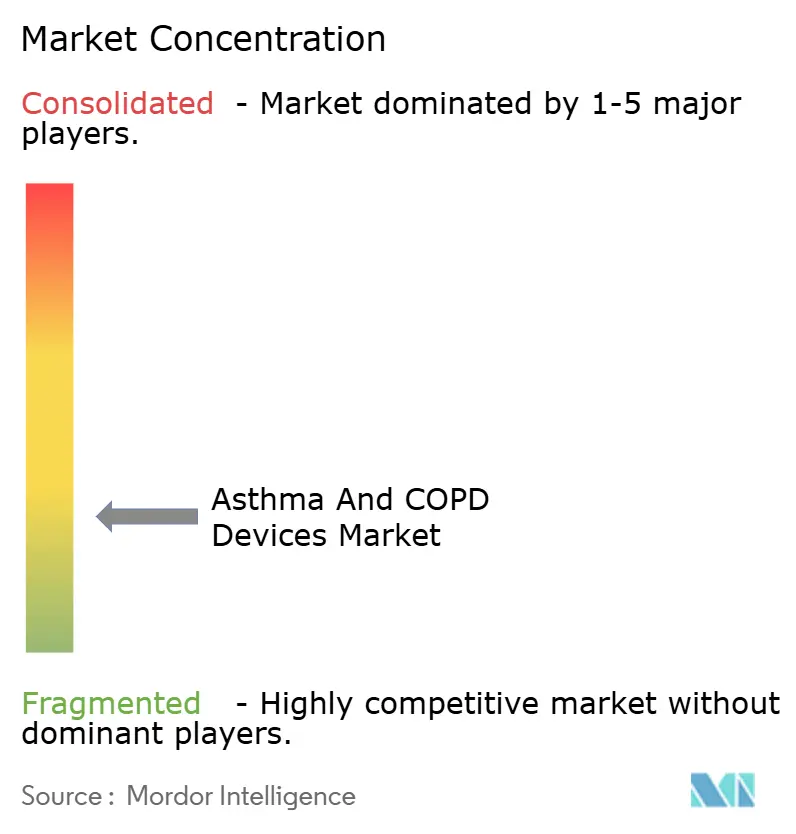
| Market Concentration | Low |
Major Players *Disclaimer: Major Players sorted in no particular order Image © Mordor Intelligence. Reuse requires attribution under CC BY 4.0. | |
Asthma And COPD Devices Market Analysis by Mordor Intelligence
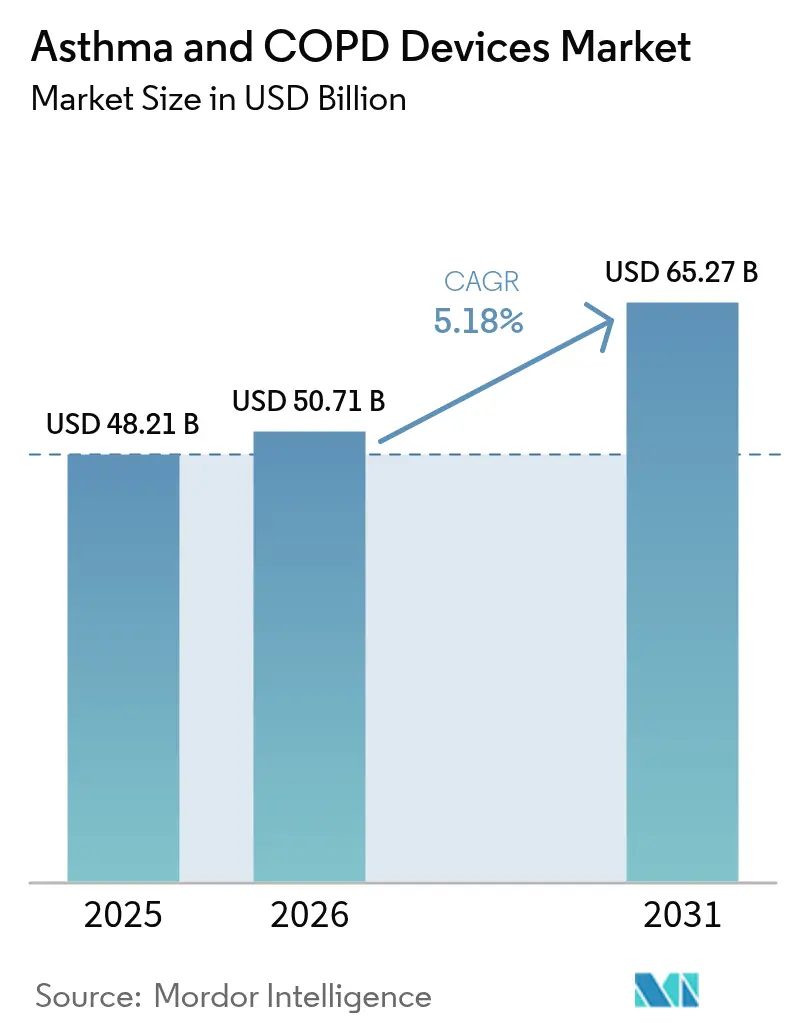
The Asthma and COPD devices market size was valued at USD 48.21 billion in 2025 and estimated to grow from USD 50.71 billion in 2026 to reach USD 65.27 billion by 2031, at a CAGR of 5.18% during the forecast period (2026-2031). Demographic aging, rising asthma and COPD prevalence, and tighter environmental rules around inhaler propellants are widening demand for both conventional and connected delivery systems. Vendors are weaving artificial-intelligence modules into inhalers and nebulizers, shifting respiratory care from episodic symptom relief toward data-driven, predictive interventions that fit remote-care models. Propellant reformulations with sharply lower global-warming potential are turning regulatory compliance into a source of product differentiation. Meanwhile, reimbursement caps on out-of-pocket drug spending in the United States and value-based payment frameworks in Europe are rewarding devices that tangibly improve adherence and cut exacerbations.
Key Report Takeaways
- By product category, inhalers led with 62.90% of the Asthma and COPD devices market share in 2025; mesh-platform nebulizers are on track to post the fastest 6.05% CAGR through 2031.
- By indication, asthma dominated with 65.30% revenue share in 2025, while COPD applications are projected to accelerate at a 6.18% CAGR to 2031.
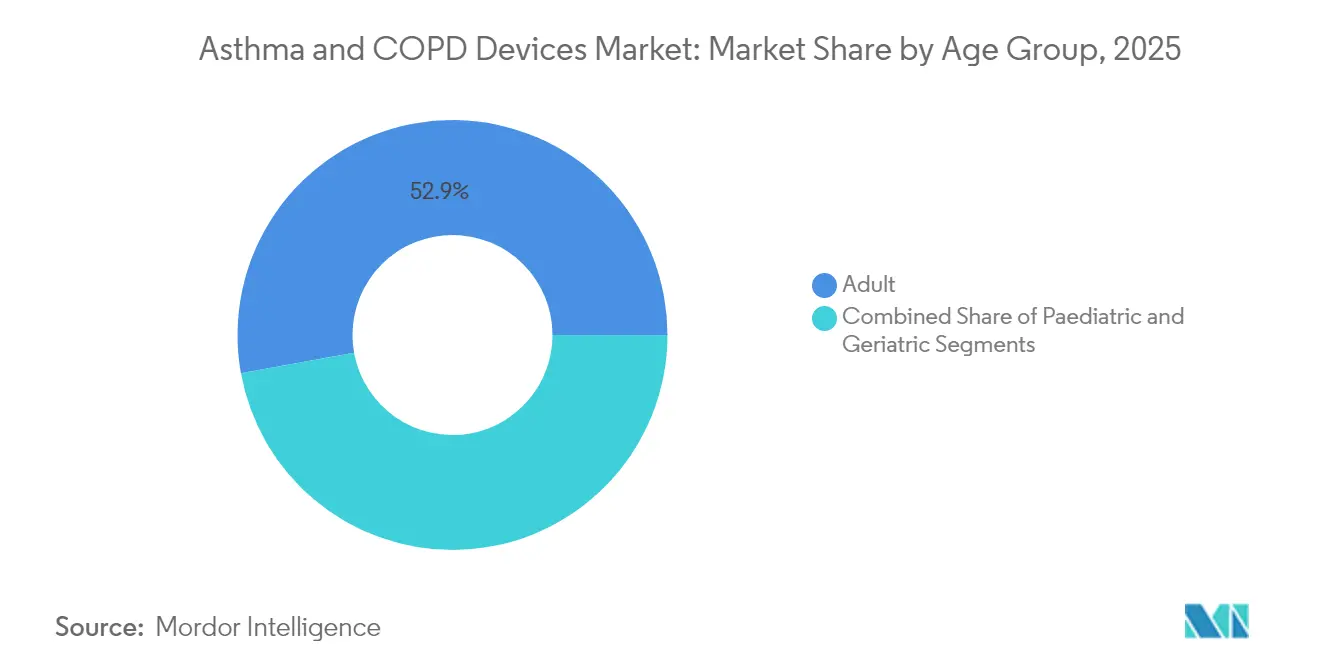
- By age group, adults accounted for 52.85% of the Asthma and COPD devices market size in 2025; pediatric applications are expanding at a 5.98% CAGR.
- By mode of operation, conventional devices held 74.60% share of the Asthma and COPD devices market size in 2025, but digital and connected systems are advancing at a 6.24% CAGR.
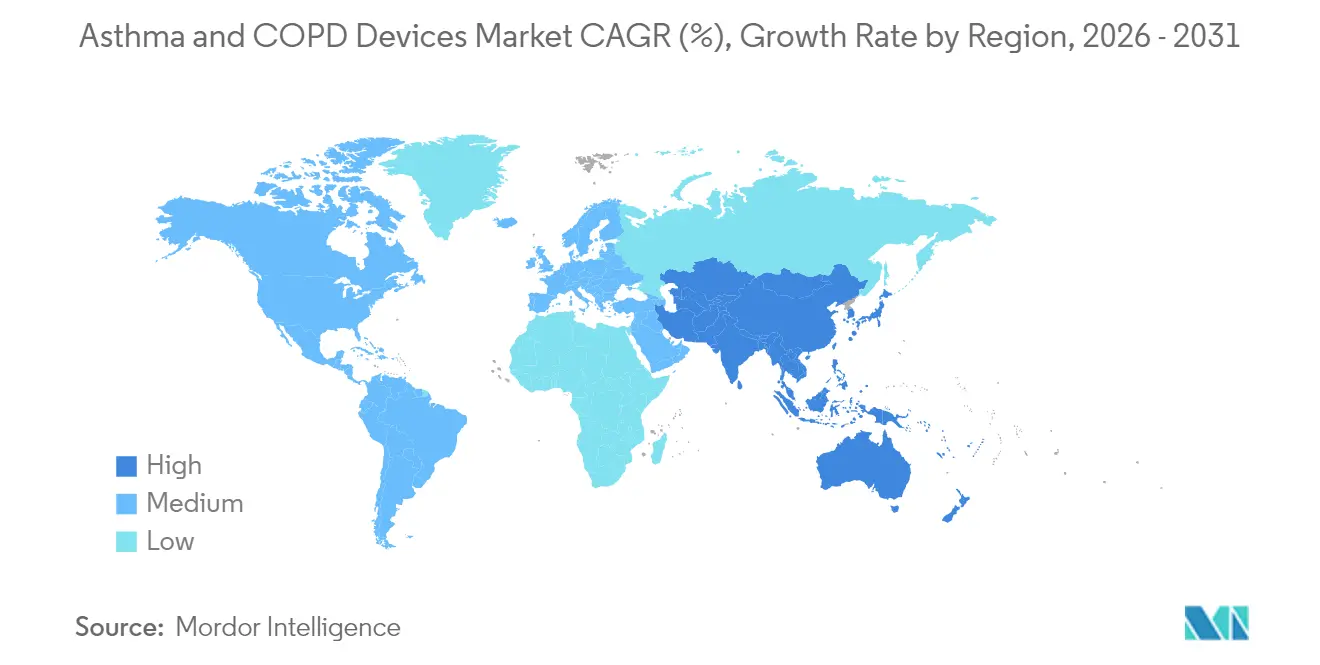
- By geography, North America retained a 39.10% share in 2025, whereas Asia-Pacific is forecast to expand at the fastest 6.22% CAGR to 2031.
Note: Market size and forecast figures in this report are generated using Mordor Intelligence’s proprietary estimation framework, updated with the latest available data and insights as of 2026.
Market Trends and Insights
Drivers Impact Analysis of Asthma And COPD Devices Market*
| Driver | (~) % Impact on CAGR Forecast | Geographic Relevance | Impact Timeline |
|---|---|---|---|
| Rising prevalence of asthma & COPD | +1.2% | Global, highest in Asia-Pacific | Long term (≥ 4 years) |
| Technological advancements in inhalation & nebulization | +1.0% | North America & EU | Medium term (2-4 years) |
| Growing geriatric population base | +0.8% | Global, developed markets | Long term (≥ 4 years) |
| Increasing indoor–outdoor air-pollution levels | +0.7% | Asia-Pacific urban hubs | Medium term (2-4 years) |
| Payer-driven adherence programs in developed markets | +0.5% | North America & EU | Short term (≤ 2 years) |
| AI-enabled smart inhalers integrated into tele-pulmonology | +0.6% | North America, EU, select Asia-Pacific markets | Medium term (2-4 years) |
| Source: Mordor Intelligence | |||
Rising prevalence of asthma & COPD
More than 545 million people now live with chronic respiratory diseases that could benefit from smart-inhaler technology. Urban migration, industrial emissions, and lifestyle changes are broadening patient pools far faster than clinic capacity. Asia-Pacific health systems feel the biggest strain, yet developed economies also face aging-related prevalence spikes. As a result, demand is swelling for affordable metered-dose inhalers, premium mesh nebulizers, and data-enabled adherence platforms that can be deployed at home or in virtual-care pathways. Connected-device alerts notifying clinicians of declining peak-flow scores exemplify how epidemiological pressure is catalyzing predictive care models [1].
Technological advancements in inhalation & nebulization
Mesh nebulizers achieve lung deposition rates more than triple those of jet units during non-invasive ventilation, making them the preferred platform for late-stage drug-device trials. Propellant reformulations such as HFA-152a cut carbon impact by over 90% while preserving therapeutic equivalence, allowing firms to satisfy both clinical-efficacy and sustainability mandates. Early adopters pairing environment-friendly propellants with Bluetooth-enabled dose trackers are commanding premium pricing in North America and Western Europe. The result is an innovation cycle in which device performance, eco-credentials, and digital connectivity reinforce one another.
Growing geriatric population base
Older patients frequently lack the dexterity to coordinate inhaler actuation and inhalation, so they gravitate toward nebulizers. Medicare records show that 28% of COPD beneficiaries used nebulizers in 2024, prompting suppliers to integrate voice prompts, auto-dosing, and large-display readouts. Aging accelerates comorbidity loads, making remote symptom monitoring attractive to caregivers and insurers. Device makers targeting geriatric users are embedding fall-detection sensors and real-time adherence dashboards that feed information into value-based reimbursement models.
Increasing indoor–outdoor air-pollution levels
Increasing indoor–outdoor air-pollution levelsIndustrial expansion and vehicular congestion raise particulate counts, especially across Asia-Pacific mega-cities. Governments are rolling out urban air-quality indices accessible through smartphone APIs; device makers link these feeds with inhaler-dosing algorithms that nudge patients to pre-empt exposure-triggered flare-ups. Portable PM2.5 sensors integrated into spacer chambers illustrate how pollution trends are spawning hybrid products that couple ambient monitoring with medication delivery.
Restraints Impact Analysis of Asthma And COPD Devices Market*
| Restraint | (~) % Impact on CAGR Forecast | Geographic Relevance | Impact Timeline |
|---|---|---|---|
| Stringent regulatory approval timelines | -0.8% | North America & EU | Medium term (2-4 years) |
| Inadequate reimbursement in developing regions | -0.6% | Asia-Pacific, MEA, Latin America | Long term (≥ 4 years) |
| Price sensitivity & generic competition | -0.5% | Global, price-sensitive markets | Short term (≤ 2 years) |
| Data-privacy concerns around connected devices | -0.3% | EU, North America, select Asia-Pacific markets | Medium term (2-4 years) |
| Source: Mordor Intelligence | |||
Stringent regulatory approval timelines
The United States FDA now requires comprehensive human-factor studies and digital-component validation before clearing combination inhalers [2]. Similar scrutiny from Europe’s Medical Device Regulation has elongated review cycles, lifting R&D budgets and delaying commercial launches. Large incumbents can absorb these costs, but start-ups often struggle to fund extended pivotal trials, leading to fewer novel entrants and a gradual up-tick in market concentration.
Inadequate reimbursement in developing regions
Even as prevalence rises, many lower-income countries offer minimal insurance coverage for branded inhalers and connected nebulizers. Procurement processes are fragmented, and patients frequently pay out of pocket, constraining uptake of premium technologies. Manufacturers addressing this gap are trialing pay-as-you-go models and low-cost device variants, yet commercial scale remains years away, tempering global growth.
*Our forecasts treat driver/restraint impacts as directional, not additive. The impact forecasts reflect baseline growth, mix effects, and variable interactions.
Asthma And COPD Devices Market Segment Analysis
By Product:
Mesh technology drives nebulizer renaissanceNebulizers generated a 6.05% CAGR outlook through 2031, the fastest within the Asthma and COPD devices market, even though inhalers retained a commanding 62.90% share in 2025. Mesh platforms improve drug delivery efficiency, trim treatment times, and run quietly enough for use during virtual consultations. Vendors pairing mesh chambers with digital-dose counters report 3-point gains in Asthma Control Test scores versus standard devices. Meanwhile, low-global-warming-potential propellants are rebooting the metered-dose inhaler line-up, and soft-mist inhalers now serve as a middle ground, offering high lung deposition without cold-gas plume discomfort .
Second-generation nebulizers capitalize on these shifts by bundling smartphone dashboards that visualize nebulization adherence trends for clinicians. The interplay of sustainability mandates, patient-experience imperatives, and biologic-drug compatibility ensures that both inhalers and nebulizers will coexist, but revenue momentum tilts toward mesh-equipped designs. Pharmaceutical partners co-developing fixed-dose triple therapies are specifying mesh units in clinical protocols, anchoring the segment’s growth runway.


By Indication:
COPD emerges as growth engineAsthma represented 65.30% of 2025 revenue, yet COPD devices are projected to grow faster at 6.18% CAGR, lifting their slice of the Asthma and COPD devices market over the next five years. COPD’s progressive pathology often necessitates dual-bronchodilator or steroid-combo inhalers, inflating per-patient spend. Late-stage trials of biologics such as IL-5 inhibitors show promise, and their delivery will require advanced inhaler platforms capable of precise microgram dosing and built-in error detection.
Asthma management is shifting toward phenotype-guided therapies and preventive monitoring, leveraging connected inhalers that record usage and transmit peak-flow trends. Both indications are converging on digitally tracked regimens, but COPD’s higher hospitalization burden aligns squarely with payers’ cost-offset goals, accelerating adoption of premium connected devices in that sub-segment.
By Age Group:
Pediatric innovation acceleratesAdults held 52.85% share in 2025, but the pediatric slice is growing at a 5.98% CAGR, aided by child-friendly mouthpieces, animated inhalation coaching, and dose-dispersion tolerances calibrated for smaller lungs. Device manufacturers responded quickly after a leading inhaled-steroid brand exited the market in 2024, rolling out spacer-compatible generics and nebulizer cup adaptors that restored accessibility within months. Digital whistles that provide real-time acoustic feedback ensure correct inhalation flow, boosting adherence in children.
The geriatric cohort cements its preference for nebulizers, elevating demand for lightweight, battery-operated designs with automated cleansing cycles. Engineers are including RFID-tagged consumable filters so caregivers receive replacement alerts before performance degrades, illustrating age-related differentiation in feature road-maps.
By Mode of Operation:
Digital transformation acceleratesDigital and connected devices will grow at 6.24% CAGR to 2031 while conventional platforms still supplied 74.60% of global shipments in 2025. Real-world studies show that Bluetooth-linked inhalers cut severe exacerbations by more than 20% compared with paper logbooks. Yet a 12% hardware-failure rate underscores the need for robust sensors and firmware. Vendors are standardizing over-the-air updates and secure cloud connectors to maintain reliability and comply with GDPR and HIPAA data-protection rules.
Economic considerations shape adoption curves: premium connected devices gain traction in value-based reimbursement regions, whereas cash-paying rural populations remain reliant on low-cost MDIs. Multi-tenant dashboards now integrate inhaler events, spirometry telemetry, and local air-quality feeds, supporting clinical decisions that align with pay-for-performance metrics.
Geography Analysis
North America Asthma and COPD Devices Market
North America commanded 39.10% of global revenue in 2025, aided by structured reimbursement and early uptake of connected inhalers. A USD 2,000 annual out-of-pocket drug cap effective in 2025 is expected to encourage therapy intensification and higher device-drug bundling, even as insurers press for real-world evidence of outcome gains. Leading manufacturers have introduced monthly price ceilings of USD 35 for core inhaler lines, illustrating competitive responses to affordability mandates.
APAC Asthma and COPD Devices Market
Asia-Pacific is the growth pacesetter with a 6.22% CAGR outlook to 2031. China’s medical-device expansion aligns with Made in China 2025 and Healthy China 2030 agendas that incentivize domestic production of advanced respiratory devices. India’s New Drugs, Medical Devices and Cosmetics Bill 2023 similarly targets faster approvals and quality enforcement, spurring local and multinational investments in mesh-nebulizer lines. Urban air-pollution spikes in Beijing, Delhi, Jakarta, and Bangkok amplify patient demand for portable, environment-aware inhalers.
Europe Asthma and COPD Devices Market
Europe shows consistent, albeit slower, expansion as sustainability regulations accelerate turnover of legacy CFC-propellant inhalers. The bloc’s Medical Device Regulation emphasizes lifecycle carbon accounting, and connected-device rollouts must satisfy stringent GDPR data-privacy thresholds. These rules raise compliance costs but reward firms delivering verified eco-performance and secure data architectures. New reimbursement paths tied to population-health metrics reinforce demand for adherence-tracking inhalers in markets such as Germany, the Nordics, and the Netherlands.
Regulatory Landscape
Regulation for asthma and COPD devices is increasingly influenced by closer scrutiny of drug-device combination performance, human factors, and digital components, with particular emphasis in the United States and Europe. In the United States, the FDA has increased expectations around validation for devices intended to deliver drugs and biologics, and in February 2026 the Quality Management System Regulation (QMSR) became effective, aligning device quality system requirements more closely with ISO 13485 and raising compliance demands for inhalers, nebulizers, and connected add-on sensors.
In Europe, the Medical Device Regulation framework continues to require deeper traceability and lifecycle controls. On 28 May 2026, the European Commission made the first four EUDAMED modules mandatory (Actor Registration, UDI/Devices Registration, Notified Bodies and Certificates, and Certificates), which increases the need for timely economic operator registration and device or UDI data readiness for both EU and non-EU manufacturers selling respiratory delivery hardware in the bloc.
Competitive Landscape
Global supply is fragmented. Multi-year M&A has produced vertically integrated models coupling molecule discovery, formulation, device engineering, and digital platforms. Molex’s pending acquisition of Vectura Group fortifies its in-house mesh and dry-powder inhaler pipelines, while AstraZeneca, GSK, and Boehringer Ingelheim retain strong proprietary respiratory portfolios complemented by device co-development alliances.
Competition now centers on three differentiation axes. First, sustainable propellants: AstraZeneca completed clinical programs for a 99.9% lower-GWP formulation for one of its triple therapies, aiming for rapid regulatory filings in 2025. Second, connectivity: ResMed spends 7% of revenue on integrating cloud analytics that span sleep-apnea and COPD devices, expanding cross-selling synergies. Third, indication expansion: late-phase COPD biologics portend platform extensions that could reshape device requirements toward higher drug loads and stricter dose accuracy.
Start-ups focusing solely on smart sensors struggle to clear regulatory and commercial hurdles unless they team up with incumbent manufacturers. Nevertheless, white-space remains in pediatric-specific devices and low-cost digital inhalers calibrated for emerging-market affordability thresholds. Intellectual-property clustering around mesh-generator geometries, algorithmic adherence scoring, and eco-propellants reinforces barriers for new entrants.
Asthma And COPD Devices Industry Leaders
-
AstraZeneca
-
Boehringer Ingelheim
-
GlaxoSmithKline
-
Merck & Co.
-
Philips Healthcare
- *Disclaimer: Major Players sorted in no particular order
Asthma And COPD Devices Market Companies Covered in this Report
- GlaxoSmithKline
- AstraZeneca
- Boehringer Ingelheim
- Teva Pharmaceutical Industries
- Koninklijke Philips
- Merck
- PARI Pharma GmbH
- OMRON
- Drive DeVilbiss Healthcare
- Invacare
- Recipharm
- Cipla
- Sunovion Pharmaceuticals
- Resmed
- Chiesi Farmaceutici
- Vectura Group plc
- Mundipharma International Ltd.
- Aerogen Ltd.
- Propeller Health
- Adherium Ltd.
Market Opportunities and Future Outlook
Indication broadening for established maintenance platforms is creating whitespace for device-enabled differentiation, particularly as triple-therapy inhalers move across both asthma and COPD. In April 2026, the FDA approved AstraZeneca's Breztri Aerosphere for maintenance treatment of asthma in patients aged 12 years and older, and in January 2026 China's NMPA approved GSK's Trelegy Ellipta for asthma in addition to COPD. These label expansions raise demand for inhaler platforms and accessories that support correct technique, adherence measurement, and scalable education across wider patient cohorts.
Sustainability and supply-chain compliance are also pointing to parallel opportunities, including low-GWP propellant transitions and non-drug airway-management adjuncts that sit alongside core inhalation hardware. The UK's MHRA approval in May 2025 of HFO-1234ze propellant for a triple COPD inhaler therapy reflects regulatory momentum around propellant substitution, and in February 2026 India saw Zydus Lifesciences launch PEPAIR as an affordable, drug-free OPEP device for mucus clearance in asthma and COPD. Alongside this, clinical and guideline attention to AI-enabled monitoring, including the 2026 GOLD report's focus on AI and emerging technologies, supports demand for connected inhalers, sensor add-ons, and home-use ecosystems that can integrate adherence and symptom data into remote-care workflows rather than relying only on conventional episodic use.
Recent Industry Developments in Asthma And COPD Devices Market
- July 2026: AstraZeneca entered a licensing agreement with Sino Biopharmaceutical for exclusive global rights (excluding China) to TQC3721, a clinical-stage dual PDE3/PDE4 inhibitor for COPD. The deal structure includes an upfront payment and milestone-based payments tied to development and commercialization progress. By strengthening the COPD pipeline, the agreement supports longer-term demand for compatible inhalation delivery platforms and potential new device requirements tied to future maintenance regimens.
- June 2025: Theravance Biopharma agreed to sell its remaining interest in Trelegy Ellipta to GSK for USD 225 million, with potential milestones up to USD 150 million. The transaction further consolidates economics around a major inhaler franchise under GSK. Greater commercial control can accelerate portfolio and lifecycle decisions around device format, adherence features, and geographic rollout priorities for the Trelegy platform.
- September 2024: Molex announced an agreement to acquire Vectura Group, expanding its capabilities in inhalation drug delivery development and manufacturing. This increases vertical integration across device engineering and inhalation technology assets. It also raises competitive pressure on standalone device and formulation partners by strengthening Molex's position in dry-powder and advanced inhalation delivery programs.
Asthma And COPD Devices Market Report Scope and Research Methodology
Market Definition and Coverage
This market covers revenues generated from devices used to deliver inhaled therapy for asthma and chronic obstructive pulmonary disease (COPD), across hospital, retail, and home settings. The sizing is counted at the device level, rather than by drug value.
Scope exclusions: Diagnostic-only respiratory monitoring devices, standalone oxygen therapy equipment, and pharmaceutical molecule sales are excluded from this sizing.
Segments Covered in This Report
- By Product
- Inhalers
- Metered-Dose Inhalers
- Dry-Powder Inhalers
- Soft-Mist Inhalers
- Nebulizers
- Compressor Nebulizers
- Ultrasonic Nebulizers
- Mesh Nebulizers
- Inhalers
- By Indication
- Asthma
- Chronic Obstructive Pulmonary Disease
- By Age Group
- Paediatric
- Adult
- Geriatric
- By Mode of Operation
- Digital / Connected Devices
- Conventional Devices
- By Geography
- North America
- United States
- Canada
- Mexico
- Europe
- Germany
- United Kingdom
- France
- Italy
- Spain
- Rest of Europe
- Asia-Pacific
- China
- Japan
- India
- Australia
- South Korea
- Rest of Asia-Pacific
- Middle East and Africa
- GCC
- South Africa
- Rest of Middle East and Africa
- South America
- Brazil
- Argentina
- Rest of South America
- North America
Data Sources, Market Sizing, and Validation
Desk Research
Desk research was used to set market boundaries and to build the starting demand pool for asthma and COPD device usage in each region. Public health statistics and burden-of-disease trends were reviewed using sources such as the World Health Organization, the US CDC, and the European Centre for Disease Prevention and Control, and these were aligned with treatment pathway guidance from the NIH and comparable national health agencies.
To keep the device mix realistic, we also used sources such as customs and trade statistics, select patent databases, peer-reviewed respiratory journals, and published regulatory databases for product clearances and labeling. Company annual reports, investor decks, and credible press releases helped confirm product focus and geographic exposure. In a few places, paid subscriptions were used only for company financials and news screening, plus patent lookups and shipment-level import and export checks. This list is illustrative, and many other public references were used to collect, cross-check, and clarify data points.
Primary Interviews and Surveys
Primary work focused on validating device category shares and price bands for inhalers, nebulizers, and spacer accessories, and then checking how adoption differs between hospital use and home care. We spoke with a mix of manufacturers, channel participants, clinicians, and respiratory care managers across APAC, EMEA, and the Americas to correct earlier desk research assumptions where they did not match observed buying and usage patterns.
Distribution of primary research fieldwork respondents
| Company type | Respondent position | Region |
|---|---|---|
| Top tier: 32% | CXOs: 13% | APAC: 47% |
| Mid tier: 49% | Functional/Unit leaders: 43% | EMEA: 33% |
| Smaller Players: 19% | Managers: 44% | Americas: 20% |
Market-Sizing & Forecasting
Sizing starts with a top-down build where prevalence and treated-patient pools are converted into device demand using prescription and refill behaviors, the split between inhaler formats and nebulization, and typical replacement cycles. Those regional totals are then corroborated with selective bottom-up checks, including sampled average selling price bands by device type multiplied by estimated volumes, plus channel checks for hospital versus retail mix. This combination helps adjust the final number without forcing a full supplier roll-up.
Key inputs used in the model include asthma and COPD prevalence trends, maintenance versus rescue therapy share, uptake of dry-powder versus metered-dose and soft-mist formats, nebulizer utilization in acute versus home settings, and price progression assumptions by region after currency normalization. Where product-level gaps existed, conservative proxy splits were applied using adjacent country patterns and then revisited during interviews.
For forecasting, scenario analysis is used around diagnosis and treatment rates, device mix shifts toward digital or connected devices, and expected price movements. The resulting path is then smoothed with time-series checks so year-to-year transitions remain consistent with adoption constraints.
Data Validation & Update Cycle
Validation is done in steps so obvious errors are caught early, while smaller variances are investigated before sign-off. Outputs are compared against independent signals such as respiratory disease burden trends, device approval activity, and observed pricing ranges by region. Any large jumps that do not align with known clinical or channel changes are re-checked.
Before publishing, the model and assumptions go through multiple analyst reviews, and respondents may be re-contacted when a variable moves outside the expected band. Reports are refreshed annually, with interim updates when material events occur, and a final pre-delivery review is completed so clients receive the latest view.
Mordor Intelligence's Asthma and Copd Devices Market Sizing Compared With Other Published Estimates
Published market sizes for asthma and COPD devices can differ even when they appear to cover similar products, because the counting rules are not always the same and the base year can also vary. Differences often come from whether spacer accessories are included, how digital add-on value is treated, and whether prices are captured at the manufacturer level versus downstream selling prices.
Key gap drivers usually relate to scope edges and model inputs. Some estimates use a broader respiratory-device boundary or include adjacent monitoring and oxygen equipment, which lifts totals. Others focus on inhalers and nebulizers only, then apply conservative replacement rates that reduce demand. By tracking device-type mix, replacement cycles, and regional pricing bands, Mordor Intelligence keeps the 2026 estimate anchored to a repeatable demand pool rather than relying on a single high-level growth curve.
Benchmark comparison
| Source | Market Size | Gaps in Research Methodology |
|---|---|---|
| Mordor Intelligence | USD 50.71 B (2026) | |
| Global Consultancy A | USD 53.68 B (2025) | Uses an earlier base year and a narrower product list that emphasizes inhalers and nebulizers by channel, which can shift totals depending on how pricing is captured and whether accessories are counted. |
| Industry Publisher B | USD 47.39 B (2024) | Anchors the model in 2024 with a different starting demand pool and may apply alternative adoption and replacement assumptions, which can lower the implied device volumes and revenue. |
The spread mainly reflects year selection and boundary decisions, followed by how price levels and replacement behavior are applied across regions. When scope and variables are made explicit and checked against real-world usage patterns, the resulting market size is easier to trace, explain, and update in a consistent way.
Key Questions Answered in the Report
What is the current size of the Asthma and COPD devices market?
The Asthma and COPD devices market stood at USD 50.71 billion in 2026 and is forecast to reach USD 65.27 billion by 2031.
Which product category is growing the fastest?
Mesh-platform nebulizers lead growth with a projected 6.05% CAGR, driven by superior drug deposition and rising use in combination-therapy trials.
Why is Asia-Pacific considered the key growth region?
Rapid urbanization, high pollution levels, and regulatory reforms that promote domestic manufacturing are propelling Asia-Pacific to a 6.22% CAGR.
How are environmental regulations influencing device design?
Propellant phasedowns are pushing firms toward low-GWP formulations such as HFA-152a, turning sustainability compliance into a product-differentiation lever.
What role do connected inhalers play in value-based care models?
Connected devices provide adherence and symptom data that payers use to verify outcome improvements, enabling reimbursement incentives for products that demonstrably reduce exacerbations.
Are COPD devices expected to outpace asthma devices in growth?
Yes, COPD applications are projected to expand at 6.18% CAGR through 2031, faster than asthma, due to aging demographics and therapy-intensification trends.