
Market Overview
| Study Period | 2019 - 2031 |
|---|---|
| Forecast Data Period | 2026 - 2031 |
| Base Year Market Size (2025) | USD 24.11 Billion |
| Market Size (2026) | USD 26.07 Billion |
| Market Size (2031) | USD 38.49 Billion |
| Growth Rate (2026 - 2031) | 8.11 % |
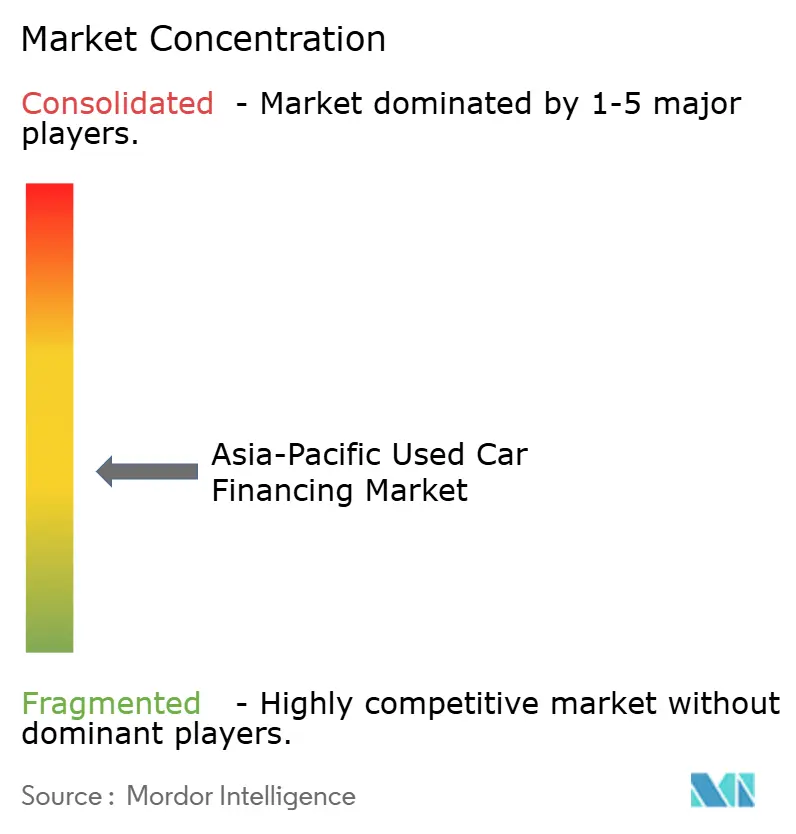
| Market Concentration | Medium |
Major Players *Disclaimer: Major Players sorted in no particular order Image © Mordor Intelligence. Reuse requires attribution under CC BY 4.0. | |
Asia-Pacific Used Car Financing Market Analysis by Mordor Intelligence
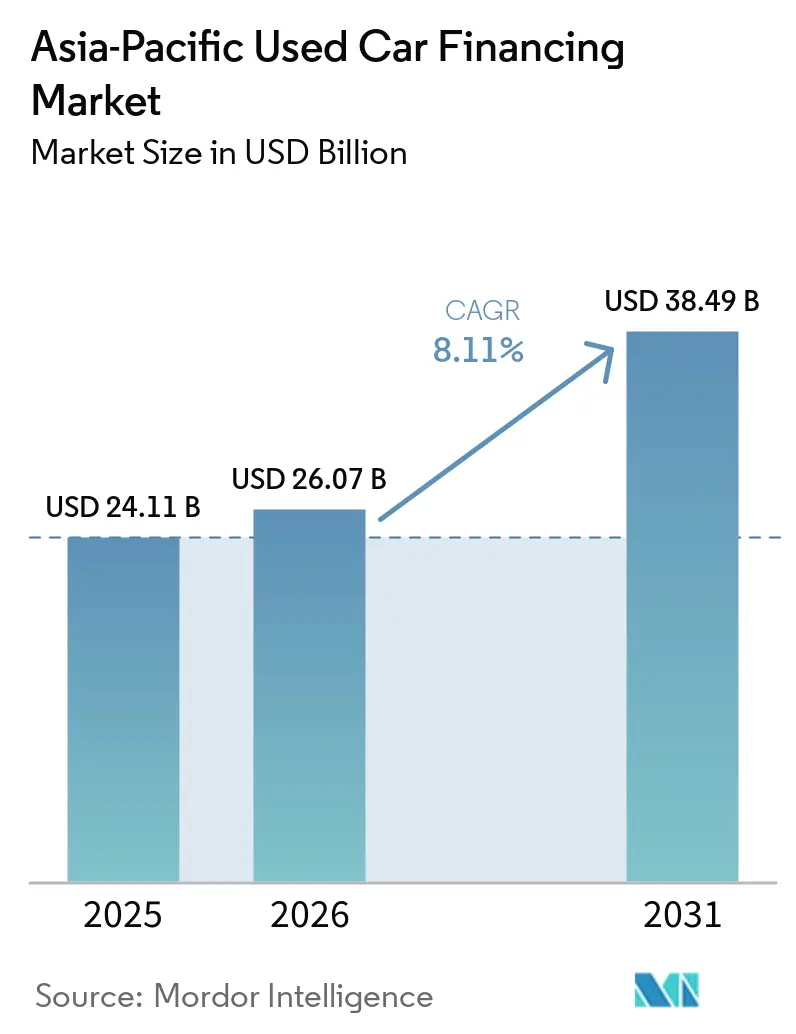
The Asia-Pacific Used Car Financing Market size was valued at USD 24.11 billion in 2025, is expected to reach USD 26.07 billion in 2026, and is projected to reach USD 38.49 billion by 2031, at a CAGR of 8.11% during the forecast period (2026-2031). Demand is pivoting toward certified pre-owned vehicles as post-pandemic affordability constraints persist, while instant digital approvals, warranty-backed collateral, and embedded finance inside super-apps reshape lender economics. Traditional banks still originate the bulk of prime loans, yet fintech challengers leverage API underwriting and alternative data to win price-sensitive, thin-file borrowers. OEM-linked financing arms deepen loyalty, especially where they couple certification with longer residual-value guarantees. Country growth differentials are widening: India leads in volume expansion, China retains scale advantage, and Southeast Asia offers fragmented but high-yield niches.
Key Report Takeaways
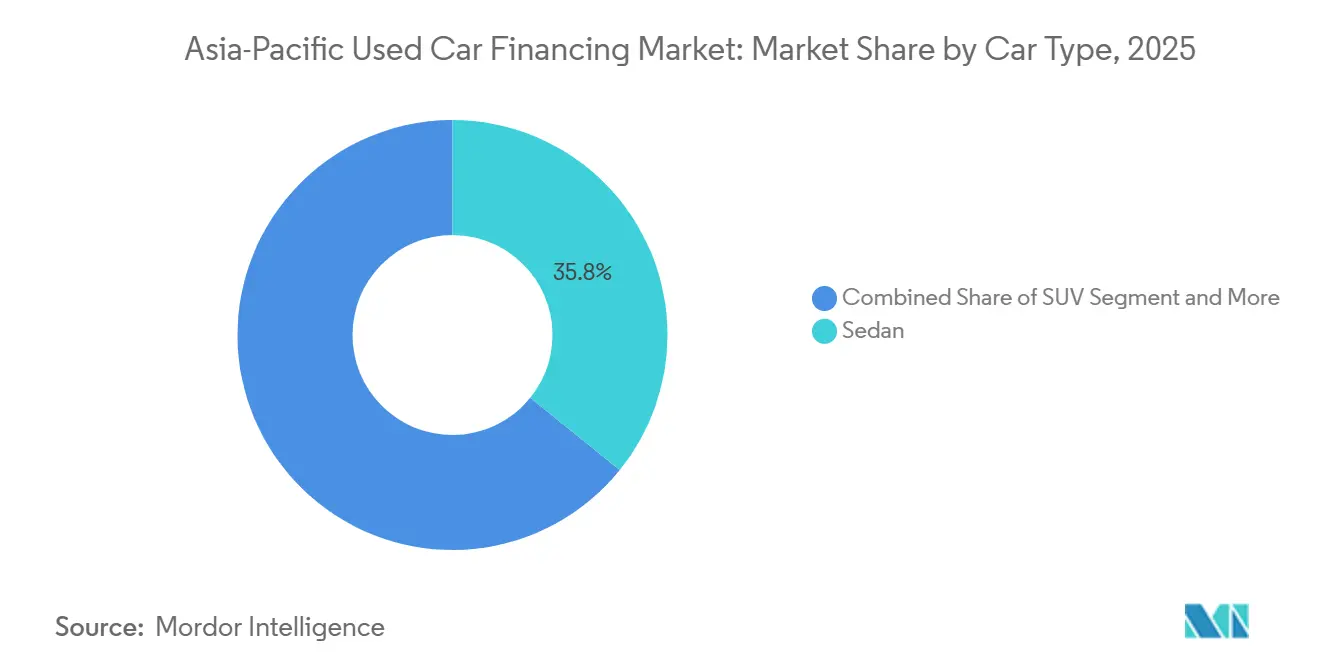
- By car type, sedans led with 35.81% of the Asia Pacific used-car financing market share in 2025, while SUVs are projected to expand at an 9.13% CAGR through 2031.
- By financier, banks controlled 45.56% share of the Asia Pacific used-car financing market size in 2025; OEM Captive Finance registered the fastest 9.21% CAGR to 2031.
- By channel, offline dealerships accounted for 73.37% of the Asia Pacific used-car financing market in 2025, yet online-only platforms are scaling at an 10.22% CAGR.
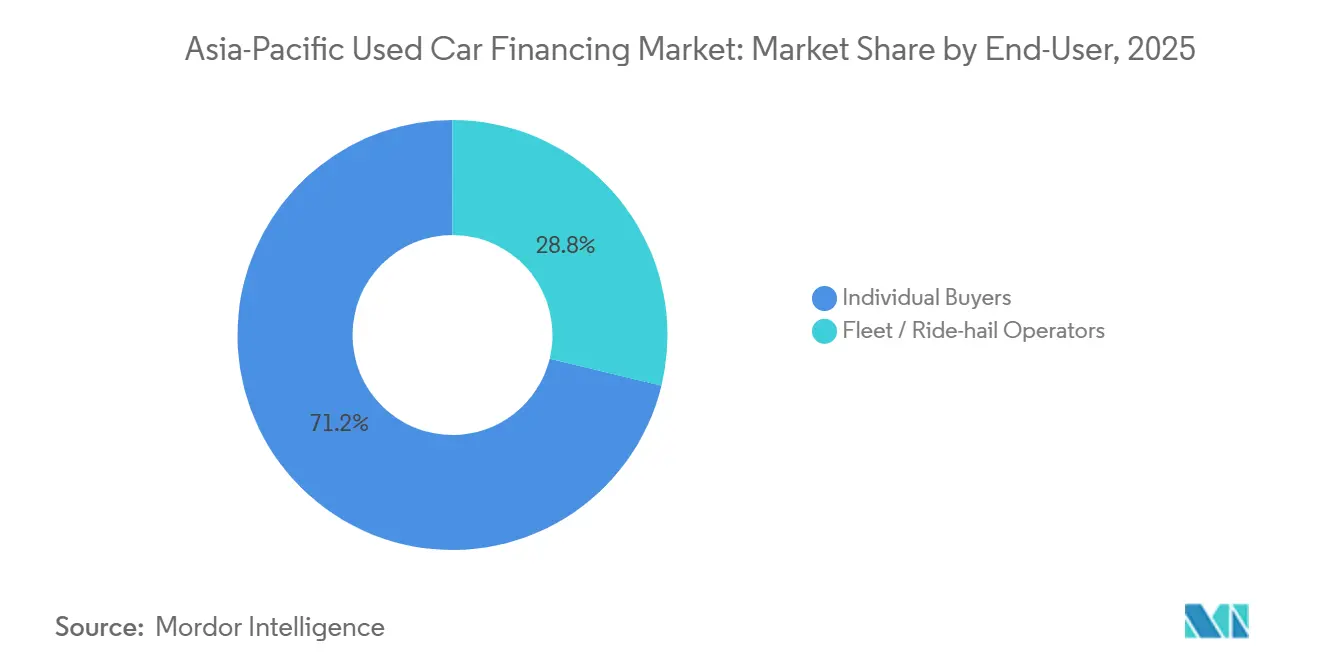
- By end-user, individual buyers represented a 71.23% share in 2025, while fleet and ride-hail operators posted an 10.15% CAGR to 2031.
- By vehicle age, 3–5-year inventory captured 48.75% share in 2025; sub-3-year units advance at an 10.18% CAGR on rising OEM trade-ins.
- By country, China captured 28.77% share in 2025; India advanced at an 9.17% CAGR through 2031.
Note: Market size and forecast figures in this report are generated using Mordor Intelligence’s proprietary estimation framework, updated with the latest available data and insights as of January 2026.
Market Trends and Insights
Drivers Impact Analysis of Asia-Pacific Used Car Financing Market*
| Driver | (~) % Impact on CAGR Forecast | Geographic Relevance | Impact Timeline |
|---|---|---|---|
| Rising Digitization and Online Loan Approvals | +1.4% | Southeast Asia core (Malaysia, Philippines, Singapore), spillover to India, China | Short term (≤ 2 years) |
| Post-Covid Affordability-Led Demand | +1.2% | Global, with concentration in India, Indonesia, Philippines, Vietnam | Medium term (2-4 years) |
| Affordability and Rising Disposable Incomes | +1.1% | India, Vietnam, Philippines, Indonesia | Long term (≥ 4 years) |
| OEM-Backed Certified Pre-Owned Programs | +1.0% | India, China, South Korea, Thailand | Medium term (2-4 years) |
| Embedded Finance Via Super-Apps | +0.9% | Southeast Asia (Indonesia, Singapore, Malaysia, Philippines, Vietnam, Thailand) | Short term (≤ 2 years) |
| Incentive-Driven Financing | +0.6% | China, India (state-level pilots), Australia, New Zealand | Long term (≥ 4 years) |
| Source: Mordor Intelligence | |||
Rising Digitization & Online Loan Approvals
API-based underwriting compresses decision cycles from days to minutes, raising conversion rates at the dealership point of sale. Platforms integrated with Malaysia’s MyInfo, the Philippines’ e-KYC, and Singapore’s SingPass now auto-populate income and bureau data, pushing approval times below 60 seconds. CIMB, BPI, UOB, and OCBC have rolled out instant workflows that secure borrowers before they cross-shop rival offers. Thai lenders SCB and Krungsri pilot AI models that ingest utility bill and mobile-wallet histories. Speed is eclipsing marginal rate advantages; lenders failing to match sub-two-minute approvals surrender high-intent prospects to faster rivals [1].
Post-COVID-19 Affordability-Led Demand for Personal Mobility
The pandemic skewed consumer preference to private transport, a trend that endured even after restrictions eased. Lower-income households substitute new cars with certified pre-owned units to hedge rising fuel and food costs. India’s vehicle stock is projected to more than double by 2050, with used vehicles accounting for much of the incremental volume [2]. Gig-economy workers in Indonesia and Vietnam draw on microloans to secure second-hand cars and motorcycles for ride-hail and delivery. Regional GDP growth is near minimal in 2025, supplying macro tailwinds, though inflation keeps price sensitivity acute.
OEM-Backed Certified Pre-Owned Programs
By offering manufacturer warranties, conducting multipoint inspections, and providing buy-back guarantees, lenders can now offer higher loan-to-value ratios at tighter spreads, effectively reducing information asymmetry. Recently, Hyundai Promise experienced notable growth in financing certified units. Similarly, Toyota's U Trust and Genesis CPO adopt this model, shifting the residual-value risk from lenders to the OEM. Captive finance arms monetize the ecosystem through insurance bundles and service contracts, while lenders enjoy lower default and repossession losses [3].
Embedded Finance Via Super-Apps for Driver Micro-Loans
Grab Financial significantly increased driver loan disbursements, reflecting strong growth. Within the app, earnings histories substitute for traditional credit files, enabling approval rates above typical bank averages. Similarly, Indonesia’s GoTo drove a substantial increase in transaction volumes. These super-apps have emerged as the primary touchpoints for auto finance, relegating banks to a secondary role unless they adopt white-label solutions on these platforms. Lenders that integrate through APIs benefit from this model, while those that resist face adverse selection.
Restraints Impact Analysis of Asia-Pacific Used Car Financing Market*
| Restraint | (~) % Impact on CAGR Forecast | Geographic Relevance | Impact Timeline |
|---|---|---|---|
| Elevated Credit-Risk Perception in SEA | -0.8% | Southeast Asia (Thailand, Philippines, Indonesia, Vietnam) | Short term (≤ 2 years) |
| Used Car Depreciation | -0.7% | Global, with higher impact in markets with older average fleet age (India, Indonesia, Philippines) | Medium term (2-4 years) |
| Fragmented Collateral-Valuation Standards | -0.6% | Global, with acute challenges in Indonesia, Philippines, Vietnam | Medium term (2-4 years) |
| Stricter KYC Due to Fintech Fraud | -0.5% | Indonesia, India, China | Short term (≤ 2 years) |
| Source: Mordor Intelligence | |||
Elevated Credit-Risk Perception in SEA
Both the Philippines and Indonesia continue to report default metrics that remain elevated relative to the period before the pandemic, reflecting persistent household debt stress, constrained disposable incomes, and inadequate welfare support. These conditions continue to affect borrowers’ ability to meet repayment obligations, particularly among lower- and middle-income households that remain vulnerable to economic volatility and rising living costs. As lenders tighten credit standards to manage repayment risks, first-time buyers and gig-economy drivers—key contributors to incremental volume—face greater difficulty accessing financing. The exclusion of these borrower segments reduces the total addressable demand and may constrain market expansion over the near term.
Used Car Depreciation
As EV adoption accelerates, older internal combustion engine vehicles experience a more rapid decline in residual value, which constrains the financing terms available to borrowers. This depreciation trend limits loan-to-value ratios, as lenders become more cautious about the collateral value of conventional vehicles amid shifting consumer preferences toward electric mobility. In India, the Asian Development Bank notes that used EVs face lower loan-to-value caps than comparable gasoline vehicles, reflecting lender concerns regarding battery condition, resale demand, and limited historical data on used EV values.
*Our forecasts treat driver/restraint impacts as directional, not additive. The impact forecasts reflect baseline growth, mix effects, and variable interactions.
Asia-Pacific Used Car Financing Market Segment Analysis
By Car Type:
Sedans Dominate, Electric SUVs AccelerateSedans held 35.81% of the Asia Pacific used-car financing market in 2025, driven by their compact size and fuel economy advantages in dense urban corridors. Hatchbacks follow but cede ground as certified sedans become affordable with extended tenures. SUVs grow as status symbols among upwardly mobile households, yet higher depreciation restrains loan ratios. Electric SUVs record the fastest 9.13% CAGR through 2031, as China, South Korea, and select Indian cities expand charging grids. The shift challenges lenders to master battery-health analytics to avoid adverse selection.
Volume migration toward electric SUVs enhances the Asia Pacific used-car financing market size opportunity but burdens underwriting models reliant on historical combustion data. Financiers adopting telematics and over-the-air diagnostics can maintain approval rates while containing default risk. Failure to adapt may trap conservative lenders in shrinking sedan pools even as borrower preferences evolve.

By Financier:
Banks Lead, Fintech Challengers GainBanks controlled 45.56% of the Asia Pacific used-car financing market share in 2025, reflecting deposit-funded cost advantages and branch reach. State Bank of India’s auto book and ICICI’s retail portfolio underscore scale. Yet OEM Captive Finance register an 9.21% CAGR, embedding credit in super-apps and dealership portals. Grab Financial’s disbursal exemplifies traction among thin-file, high-frequency borrowers.
OEM captives such as Hyundai Capital blend rate competitiveness with loyalty programs, while NBFCs like Mahindra Finance ride a high-yield curve in semi-urban India. Competitive gaps now hinge on underwriting speed and data depth, not just pricing. Banks integrating API decision engines can defend their share; laggards risk a gradual drift of prime customers to agile newcomers.
By Channel:
Offline Dealerships Prevail, Digital Platforms ScaleOffline dealerships accounted for 73.37% of the Asia Pacific used-car financing market in 2025, as physical inspection remains integral to purchase confidence. Walk-in traffic secures volume, yet high overhead compresses dealer margins. Online-only platforms such as Cars24, Carro, and OLX Autos expand at an 10.22% CAGR on the back of venture capital and integrated refurbishment centers. Hybrid click-and-brick models emerge, mixing online discovery with offline test drives.
Lenders exploit dealership pipelines for steady originations but plug APIs into digital platforms for data-rich leads and instant approvals. The Asia Pacific used-car financing market size tied to pure online channels is set to double by 2030, prompting traditional dealers to partner or launch white-label e-stores. Failure to digitize could strand inventory as younger buyers shift research and financing online.
By End-User:
Individual Buyers Dominate, Fleet Operators SurgeIndividual buyers generated 71.23% of loans in 2025, reflecting entrenched cultural aspirations for private mobility. Rising middle-class incomes in India and Vietnam sustain volume despite inflation-linked real wage squeezes. Fleet and ride-hail operators expand at 10.15% as gig platforms professionalize, bundling vehicles, insurance, and maintenance into lease-to-own contracts. Shriram Finance and other specialists tailor mileage-based repayment for small fleet owners, mitigating high usage risk.
Growth in fleet lending enlarges the Asia Pacific used-car financing market but introduces lumpy default exposure during demand shocks. Lenders refine cash-flow forecasting using platform trip data to cushion NPL spikes. Conventional banks slow to adopt such metrics may cap fleet exposure, conceding share to NBFCs and super-app captives.
By Vehicle Age:
3–5 Year Inventory Leads, Sub-3 Year GainsCars aged 3–5 years captured 48.75% of financed revenue in 2025, balancing affordability with mechanical reliability. Sub-3-year units grow at 10.18% as OEM trade-ins swell the certified inventory pool and warranty coverage remains intact. Hyundai Promise exemplifies the model, funneling fresh trade-ins into finance-ready stock. Vehicles older than 5 years see constrained credit due to steep depreciation and uncertain emission-zone regulations.
The lender that nails accurate residual-value forecasts for newer stock will widen risk-adjusted spreads. Conversely, those clinging to generic age-based heuristics may misprice fast-changing depreciation curves, especially where EV policy accelerates combustion phase-out timelines.
Geography Analysis
China Used Car Financing Market
China retained a 28.77% share of the Asia Pacific used-car financing market in 2025, bolstered by digital lenders like Yixin Group, which facilitated substantial loan volumes, and Uxin, recently celebrating a profitable quarter. Major players, including captive arms like SAIC Motor Finance, maintain large asset bases. However, with the macroeconomic landscape cooling to a modest GDP growth outlook, overall expansion remains tempered. Additionally, data-sharing restrictions from the People’s Bank of China create compliance challenges, inadvertently favoring licensed banks over fintechs.
India Used Car Financing Market
India posts the fastest 9.17% CAGR to 2031. This surge is driven by non-banking financial companies (NBFCs) like Mahindra Finance and Bajaj Finance, both of which have adeptly tapped into rural and subprime markets. While the Reserve Bank of India's new digital-lending regulations elevate governance standards, they also act as a deterrent against unscrupulous players, thereby stabilizing the market. However, the absence of a centralized vehicle-history bureau amplifies collateral risks, even as rising incomes help mitigate delinquency concerns.
Japan, South Korea and Australia Used Car Financing Market
In Japan, South Korea, and Australia, the market is characterized by maturity and high penetration, albeit with subdued growth. Here, captive finance arms reign supreme. For instance, Toyota Financial Services reported robust revenues, while Hyundai Capital maintains a strong asset base. In Australia, tax incentives predominantly favor new electric vehicles (EVs), curtailing the demand for loans on used EVs. Meanwhile, Southeast Asia, encompassing nations like Indonesia, Malaysia, the Philippines, and Vietnam, presents a fragmented yet promising landscape for nimble players. Bank Mandiri and Maybank underscore the strength of incumbents. Yet, inconsistencies in compliance and varied know-your-customer (KYC) protocols carve out opportunities for digital newcomers, provided they're ready to invest in local nuances.
Competitive Landscape
Competition in the Asia-Pacific used-car financing market remains moderate, with leading players holding significant market shares. Universal banks benefit from low-cost deposits but face margin pressure as fintechs attract rate-sensitive borrowers through instant approval processes. OEM captive finance companies balance risk management with customer loyalty by bundling financing with warranties and maintenance plans. In India, NBFCs target high-yield, higher-risk segments and accept elevated non-performing loan (NPL) levels to expand spreads.
Digital disruptors are transforming the market by integrating vehicle sourcing, refurbishment, financing, and after-sales services. This integrated model reduces customer acquisition costs and increases customer lifetime value. Cars24, supported by substantial funding, is expanding into new Southeast Asian markets. Similarly, Carro, backed by strong financial resources, operates across several countries in the region. Super-apps, including Grab and GoTo, embed credit offerings at the driver enrollment stage and use proprietary earnings data to improve underwriting accuracy. As regulators strengthen oversight, unlicensed lenders are exiting the market. This shift increases compliance costs for new entrants and may drive industry consolidation.
Despite these developments, gaps remain in fleet financing and residual-value modeling for used electric vehicles (EVs). Lenders that use telematics for risk-based pricing and blockchain technology for battery verification can establish differentiated market positions. However, traditional banks that do not adapt may lose access to attractive growth opportunities.
Asia-Pacific Used Car Financing Industry Leaders
-
Bajaj Finserv
-
The Bank of China
-
Sundaram Finance Ltd
-
Cholamandalam Investment and Finance Company Limited
-
HDFC Bank Ltd
- *Disclaimer: Major Players sorted in no particular order
Asia-Pacific Used Car Financing Market Companies Covered in this Report
- HDFC Bank Ltd
- State Bank of India
- ICICI Bank
- Mahindra Finance
- Bajaj Finserv
- Toyota Financial Services
- Hyundai Capital
- Grab Financial
- Shriram Finance
- Bank Mandiri
- Maybank
- Maruti Suzuki Financial Services
- Tata Motors Finance
- Sundaram Finance Ltd
- The Bank of China
- SAIC Motor Finance
- JD Auto Finance
- Cholamandalam Investment and Finance Company Limited
- Ping An Auto Finance
- Yixin Group
- Uxin Ltd
- Cars24
- Carro
- OLX Autos
Recent Industry Developments in Asia-Pacific Used Car Financing Market
- July 2026: Gurugram-headquartered Cars24 expanded its platform capabilities by integrating advanced OpenAI-powered agents. The deployment improved customer-support resolution rates by 50% and automated complex, conversation-driven sales funnels, enabling users to navigate localized used-car financing options more seamlessly.
- June 2026: Singapore-based online automotive company Carro acquired CarPlace, a leading Australian used-car platform operated by Autoleague. The acquisition expanded Carro’s presence to its eighth APAC market and provided an entry point for introducing its proprietary AI-driven fintech ecosystem, vehicle-inspection technology, and inventory-financing structures in Australia.
- August 2025: Carro, Southeast Asia’s largest online pre-owned auto marketplace, entered into a comprehensive fintech partnership with Hong Kong-listed SY Holdings. The partnership introduces technology-driven, API-based underwriting and supply chain AI capabilities to optimize vehicle floor-plan financing, strengthen risk controls, and automate credit scoring for used car dealers across the region.
- February 2025: Cars24 has unveiled Loans24, its new digital credit division, which promises instant approvals and comprehensive financing options covering the full cost of the vehicle, along with highly competitive and attractive interest rates to cater to a wide range of customers.
Asia-Pacific Used Car Financing Market Report Scope
The scope of the report includes Car Type (Hatchback and More), Financier (Banks and More), Channel (Offline Dealerships and Online-Only Platforms), End-User (Individual Buyers and More), Vehicle Age (Less Than 3 Years and More), and Geography.
Segmentation Overview
By Car Type
| Hatchback |
| Sedan |
| SUV |
| MPV |
By Financier
| Banks |
| OEM Captive Finance |
| NBFC & Independent Lenders |
By Channel
| Offline Dealerships |
| Online-only Platforms |
By End-User
| Individual Buyers |
| Fleet / Ride-hail Operators |
By Vehicle Age
| Less than 3 Years |
| 3-5 Years |
| More than 5 Years |
By Country
| China |
| India |
| Japan |
| South Korea |
| Australia |
| New Zealand |
| Indonesia |
| Malaysia |
| Philippines |
| Vietnam |
| Rest of Asia-Pacific |
| By Car Type | Hatchback |
| Sedan | |
| SUV | |
| MPV | |
| By Financier | Banks |
| OEM Captive Finance | |
| NBFC & Independent Lenders | |
| By Channel | Offline Dealerships |
| Online-only Platforms | |
| By End-User | Individual Buyers |
| Fleet / Ride-hail Operators | |
| By Vehicle Age | Less than 3 Years |
| 3-5 Years | |
| More than 5 Years | |
| By Country | China |
| India | |
| Japan | |
| South Korea | |
| Australia | |
| New Zealand | |
| Indonesia | |
| Malaysia | |
| Philippines | |
| Vietnam | |
| Rest of Asia-Pacific |
Key Questions Answered in the Report
How large is Asia Pacific used-car financing in 2025 and what value is expected by 2031?
Outstanding loans total USD 38.49 billion in 2031 and are projected to climb to USD 35.61 billion by 2031, implying an 8.11% CAGR.
Which vehicle segment is expanding fastest on the lending side?
Financing tied to electric SUVs is forecast to grow at an 9.13% CAGR through 2031, outpacing all other car types.
What role do fintech and online-only banks play in new loan origination?
These lenders currently hold a smaller base but are scaling at an 9.21% CAGR by embedding credit inside super-apps and delivering approvals in under 60 seconds.
Where are the most attractive geographic growth opportunities?
India shows the highest trajectory at a 9.17% CAGR to 2031, while Indonesia, Malaysia, the Philippines, and Vietnam offer fragmented yet high-yield niches for agile lenders.
What is the biggest operational challenge for cross-border lenders?
Fragmented collateral-valuation standards and the absence of unified vehicle-history databases in much of Southeast Asia raise repossession losses and slow securitization.
How are OEM certified pre-owned programs influencing loan risk and pricing?
Warranty-backed inspections reduce information asymmetry, allowing lenders to raise loan-to-value ratios and tighten spreads without compromising default performance.