
Market Overview
| Study Period | 2021 - 2031 |
|---|---|
| Forecast Data Period | 2026 - 2031 |
| Base Year Market Size (2025) | USD 297.76 Billion |
| Market Size (2026) | USD 312.11 Billion |
| Market Size (2031) | USD 395.02 Billion |
| Growth Rate (2026 - 2031) | 4.82 % |
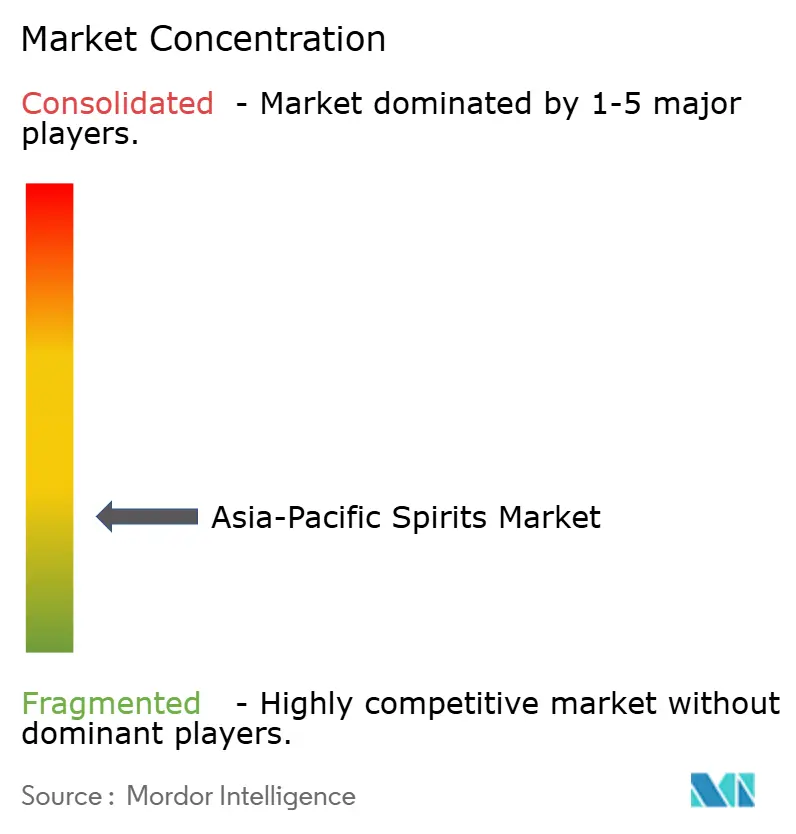
| Market Concentration | Low |
Major Players *Disclaimer: Major Players sorted in no particular order Image © Mordor Intelligence. Reuse requires attribution under CC BY 4.0. | |
Asia-Pacific Spirits Market Analysis by Mordor Intelligence
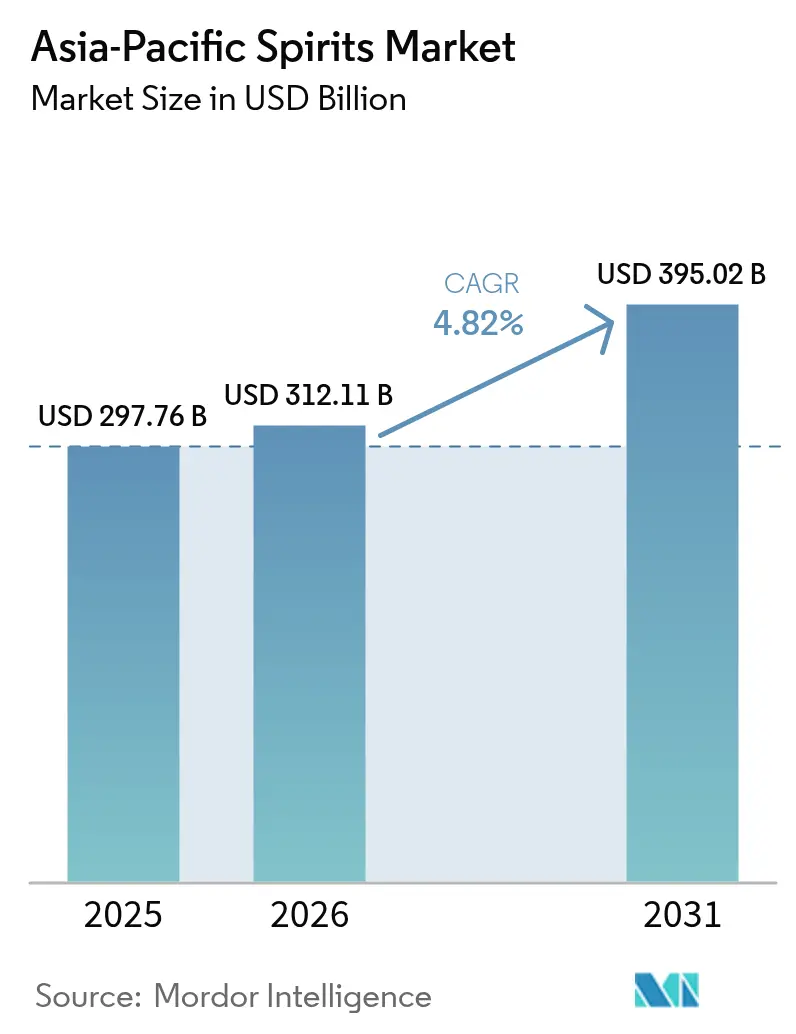
Asia-Pacific spirits market size in 2026 is estimated at USD 312.11 billion, growing from 2025 value of USD 297.76 billion with 2031 projections showing USD 395.02 billion, growing at 4.82% CAGR over 2026-2031. Rising disposable incomes, a shift towards premiumization, and an increasing preference for global spirit styles over traditional local options are driving this growth. Consumers are actively seeking novelty and authenticity, which has allowed whisky to maintain its category leadership while agave-based spirits and craft variations gain significant traction. The growing popularity of craft spirits reflects a broader consumer trend toward unique and high-quality products, with many buyers willing to pay a premium for these offerings. Digital commerce continues to expand, enabling brands to reach a wider audience and offer personalized experiences. On-trade sales are recovering strongly as consumers return to bars and restaurants, while the rebound in tourism is further boosting value growth by increasing demand for premium and exotic spirits. Companies are investing heavily in regional distilling capacities, reflecting their confidence in sustained long-term demand and their commitment to meeting evolving consumer preferences. The competitive landscape remains dynamic, as heritage producers, multinational corporations, and agile craft brands actively target segmented audiences by leveraging niche taste profiles and distinctive storytelling.
Key Report Takeaways
- By product type, whisky held 25.18% of the Asia-Pacific spirits market share in 2025, whereas tequila and mezcal are forecast to expand at a 5.12% CAGR through 2031.
- By end user, the male segment accounted for 79.02% share of the Asia-Pacific spirits market size in 2025, while female consumption is advancing at a 5.48% CAGR toward 2031.
- By distribution channel, off-trade captured 60.78% revenue in 2025; on-trade is projected to rise at a 5.88% CAGR to 2031.
- By geography, China accounted for 41.02% market share in 2025, Philippines is projected to grow at a CAGR of 5.79% through 2031.
Note: Market size and forecast figures in this report are generated using Mordor Intelligence’s proprietary estimation framework, updated with the latest available data and insights as of 2026.
Market Trends and Insights
Drivers Impact Analysis of Asia-Pacific Spirits Market*
| Driver | (~) % Impact on CAGR Forecast | Geographic Relevance | Impact Timeline |
|---|---|---|---|
| Consumers inclination towards craft spirits | +0.8% | Regional, with strong adoption in Japan, Australia, South Korea | Medium term (2-4 years) |
| Growing tourism and hospitality impact positive growth | +0.6% | Thailand, Philippines, Malaysia, with spillover to Vietnam, Indonesia | Short term (≤ 2 years) |
| Strategic marketing by major brands boosting awareness and demand | +0.5% | China, India, South Korea, with expansion to emerging markets | Medium term (2-4 years) |
| Surge in demand for premium alcoholic beverages | +0.9% | China, Japan, South Korea, Australia, with growth in urban centers | Long term (≥ 4 years) |
| Growing cocktail culture fueling the market growth | +0.7% | Urban centers across China, Japan, South Korea, Thailand, Philippines | Medium term (2-4 years) |
| Expanding culture of social gatherings and clubbing | +0.6% | Metropolitan areas in China, Japan, South Korea, Thailand, Malaysia | Short term (≤ 2 years) |
| Source: Mordor Intelligence | |||
Consumers inclination towards craft spirits
Consumers’ growing inclination towards craft spirits is emerging as a significant market driver for the Asia-Pacific spirits market. This trend is fueled by increasing consumer demand for unique, artisanal, and locally produced alcoholic beverages that emphasize authenticity, craftsmanship, and distinctive flavors. Millennials and Gen Z consumers, in particular, show a strong preference for small-batch, handcrafted spirits such as whiskey, gin, and rum, often seeking novel drinking experiences through cocktail culture and mixology. The rising urban nightlife scene, along with a growing number of craft distilleries in countries like China, Japan, India, and Vietnam, supports this trend by expanding consumer access to diverse craft products. The growth is also supported by investments in innovative production processes, incorporation of local botanicals, and strategic marketing efforts focused on promoting the artisanal value and story behind craft brands, further elevating consumer interest and driving market growth.
Surge in demand for premium alcoholic beverages
The Asia-Pacific spirits market is witnessing a notable surge in demand for premium alcoholic beverages, driven by rising disposable incomes and shifting consumer preferences toward quality and exclusivity. For instance, the National Bureau of Statistics of China reported that in 2024, the average annual per capita disposable income of Chinese households rose to approximately 41,300 yuan, up from 39,218 yuan in 2023 [1], highlighting stronger consumer purchasing power and a willingness to trade up to premium products. Middle-class and affluent consumers across China, India, Japan, and Southeast Asia increasingly view premium and super-premium spirits as symbols of lifestyle and social status, while younger demographics especially millennials and Gen Z are fueling the trend through cocktail culture and an appetite for authenticity and craftsmanship. Upscale hotels, fine-dining restaurants, and bars in cities such as Tokyo, Shanghai, and Singapore are reinforcing this premiumization by offering curated portfolios of high-value whiskies, vodkas, gins, and craft spirits. In response, leading players like Diageo, Pernod Ricard, and Beam Suntory are expanding their premium ranges and intensifying marketing investments, solidifying premiumization as a major growth engine for the Asia-Pacific spirits market.
Growing tourism and hospitality impact positive growth
The rapid expansion of tourism and hospitality is a key driver of growth in the Asia-Pacific spirits market, as the influx of international visitors directly boosts alcohol consumption in hotels, resorts, restaurants, and nightlife venues. In 2024, the Asia-Pacific region welcomed an impressive 316 million international tourists, with Northeast Asia including Macao leading at 146 million arrivals, followed by Southeast Asia with 121 million, and South Asia and Oceania attracting 33 million and 15 million visitors, respectively [2]. These rising numbers have increased demand for spirits, as travelers commonly associate leisure with premium dining, vibrant nightlife, and authentic cultural experiences. Popular hotspots such as Tokyo, Singapore, Phuket, and Bali have become centers where both global brands and indigenous spirits like sake, soju, baijiu, and arrack are prominently featured in upscale bars, themed restaurants, rooftop lounges, and resort events. Alongside this, the growth of luxury hotels, cruise tourism, and curated events is accelerating the premiumization trend, with international and local spirit brands benefiting significantly. To further fuel this growth, governments across the region are making strategic investments; for example, India allocated INR 2,541.06 crore in its 2025–26 Union Budget to enhance tourism infrastructure, aiming to attract more domestic and international visitors [3]. This coordinated push by both private and public sectors amplifies tourism’s role as a powerful engine for the Asia-Pacific spirits market expansion.
Strategic marketing by major brands boosting awareness and demand
Strategic marketing initiatives by major spirits brands are playing a pivotal role in boosting awareness and demand across the Asia-Pacific spirits market. Leading players are adopting digital-first campaigns, influencer collaborations, and targeted advertising to connect with younger demographics, while also investing in experiential marketing such as cocktail festivals, pop-up bars, and cultural events to strengthen brand engagement. Sponsorship of sports tournaments, music festivals, and lifestyle events further enhances visibility and consumer recall, aligning brands with evolving urban entertainment trends. Importantly, companies such as Diageo, Pernod Ricard, and Suntory significantly increased their marketing expenditures in Asia-Pacific, channeling investments into digital channels, localized brand campaigns, and premiumization-focused promotions tailored to markets like China, India, Japan, and Southeast Asia. These sustained marketing efforts, coupled with the growth of e-commerce and direct-to-consumer channels, are propelling competitive differentiation, driving premium spirit adoption, and supporting long-term market expansion across the region.
Restraints Impact Analysis of Asia-Pacific Spirits Market*
| Restraint | (~) % Impact on CAGR Forecast | Geographic Relevance | Impact Timeline |
|---|---|---|---|
| Health concern over excessive consumption | -0.4% | Regional, with particular focus in Japan, Australia, South Korea | Long term (≥ 4 years) |
| High governmental taxes and excise duties on spirits | -0.6% | Philippines, Thailand, Malaysia, India, with varying impact levels | Short term (≤ 2 years) |
| Shift toward low- or no-alcohol beverages among younger consumers | -0.3% | Japan, Australia, South Korea, urban China | Medium term (2-4 years) |
| Anti-alcohol campaigns hindering the growth | -0.2% | China, India, with government-led initiatives | Medium term (2-4 years) |
| Source: Mordor Intelligence | |||
High governmental taxes and excise duties on spirits
Excise duty structures across the Asia-Pacific region impose significant cost pressures on the spirits market, impacting pricing and accessibility, especially for price-sensitive consumers. For example, the Philippines set an excise duty of PHP 66 per liter in 2024, with planned increases expected to further raise costs for consumers and limit affordable market access. Thailand’s taxation is notably complex, combining excise duties with import tariffs that create substantial barriers for international brands while simultaneously protecting strong domestic players like Thai Beverage PLC. In Malaysia, the excise framework heavily affects premium imports, where duties can represent 30-40% of retail prices, making it difficult for international brands to penetrate the market effectively. These fiscal policies aim to balance revenue generation and public health goals but inadvertently create market distortions favoring local production over imports. Additionally, the increasing complexity and variation of tax regulations across countries raise compliance costs for international companies, necessitating specialized legal and tax advisory services to navigate the diverse regulatory landscape in Asia-Pacific. This layered excise duty environment therefore poses challenges to market expansion, pricing strategies, and competitive dynamics across the region.
Health concern over excessive consumption
Health concerns over excessive alcohol consumption represent a significant restraint on the Asia-Pacific spirits market. Increasing awareness among consumers and governments about the risks associated with heavy drinking, including chronic diseases, accidents, and social problems, has led to stricter regulations and public health campaigns aimed at reducing alcohol consumption. Various countries in the region have introduced measures such as mandatory health warnings on packaging, restrictions on advertising—especially targeting young adults—and limits on drinking hours and sale points. Industry-wide initiatives, like the Asia Pacific International Spirits and Wines Alliance (APISWA) Moderation Week campaign, promote responsible drinking to curb harmful consumption patterns. Despite these efforts supporting safer consumption, heightened public scrutiny and regulatory controls constrain market growth by limiting promotional activities and creating barriers for expanding alcohol availability. This growing health consciousness combined with tightening policies creates a challenging environment, particularly affecting price-sensitive and socially conscious consumer segments across Asia-Pacific.
*Our forecasts treat driver/restraint impacts as directional, not additive. The impact forecasts reflect baseline growth, mix effects, and variable interactions.
Asia-Pacific Spirits Market Segment Analysis
By Product Type:
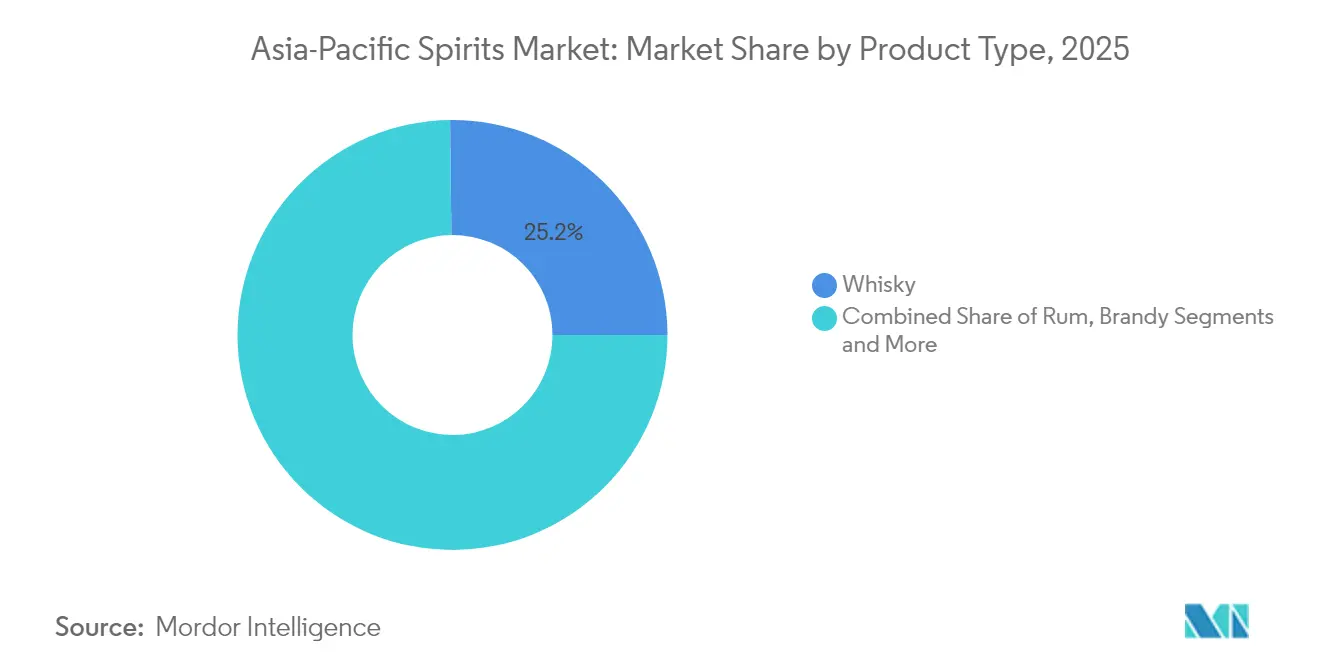
Whisky Dominance Amid Tequila EmergenceWhisky holds the largest market share in the Asia-Pacific spirits market, commanding a substantial 25.18% share in 2025. This dominant position is significantly supported by Scotland's strong export performance, which continues to reinforce Scotch whisky's global prestige and preference. Additionally, Japan has experienced a domestic renaissance in whisky production, drawing both local and international attention. The resurgence of Japanese whisky has added considerable momentum to the overall market, boosting consumer interest and sales. The cultural significance of whisky in the region, coupled with rising disposable incomes and evolving consumer preferences, has further cemented its leadership. Moreover, the trend towards premiumization and artisanal products has enabled whisky brands to capture affluent segments, driving growth and profitability.
On the other hand, tequila and mezcal stand out as the fastest-growing segment in the Asia-Pacific spirits market, with a notable CAGR of 5.12% projected through 2031. These agave-based spirits are gaining rapid popularity due to increasing consumer curiosity for innovative and exotic flavors. Driven by younger consumers and millennials who seek unique drinking experiences, tequila and mezcal are expanding their footprint beyond traditional markets. The rise of cocktail culture and mixology has also spurred the demand for these spirits in trendy bars and clubs. Importantly, the diversification in product offerings and improved distribution channels across the region support this accelerating growth. As awareness and appreciation for these authentic Mexican spirits grow, tequila and mezcal are positioned to continue their robust expansion well into the next decade.

By End User:
Male Dominance with Female AccelerationMale consumers hold the largest share of the Asia-Pacific spirits market, representing 79.02% of total consumption in 2025. This commanding lead reflects long-established cultural and social norms in the region, where men traditionally have been the primary consumers of alcoholic beverages. The dominance of male consumers is also fueled by targeted marketing efforts and product offerings tailored to masculine preferences. Spirits such as whiskey, rum, and brandy often align with male-centric social activities and gatherings, reinforcing this trend. Furthermore, this large market share emphasizes the sustained influence of male drinkers on the overall market dynamics and brand strategies across Asia-Pacific. Despite emerging changes, men currently shape the majority of consumption patterns, deeply embedded in the region’s liquor culture.
Conversely, female consumption of spirits in Asia-Pacific is the fastest-growing segment, accelerating at a CAGR of 5.48% through 2031. This rapid growth is driven by shifting demographics, changing social norms, and evolving lifestyle preferences among women. Women are increasingly exploring spirits categories like flavored vodkas, botanical gins, and low-alcohol beverages that cater to their tastes and wellness concerns. The rise of female consumers in on-trade and off-trade channels signals broader acceptance and inclusion in the traditionally male-dominated market. Marketing strategies are adapting by focusing on sophisticated packaging, lower alcohol content options, and diverse flavor profiles attractive to women. This surge in female consumption points towards fundamental demographic shifts that will significantly reshape the Asia-Pacific spirits market landscape over the coming years.
By Distribution Channel:
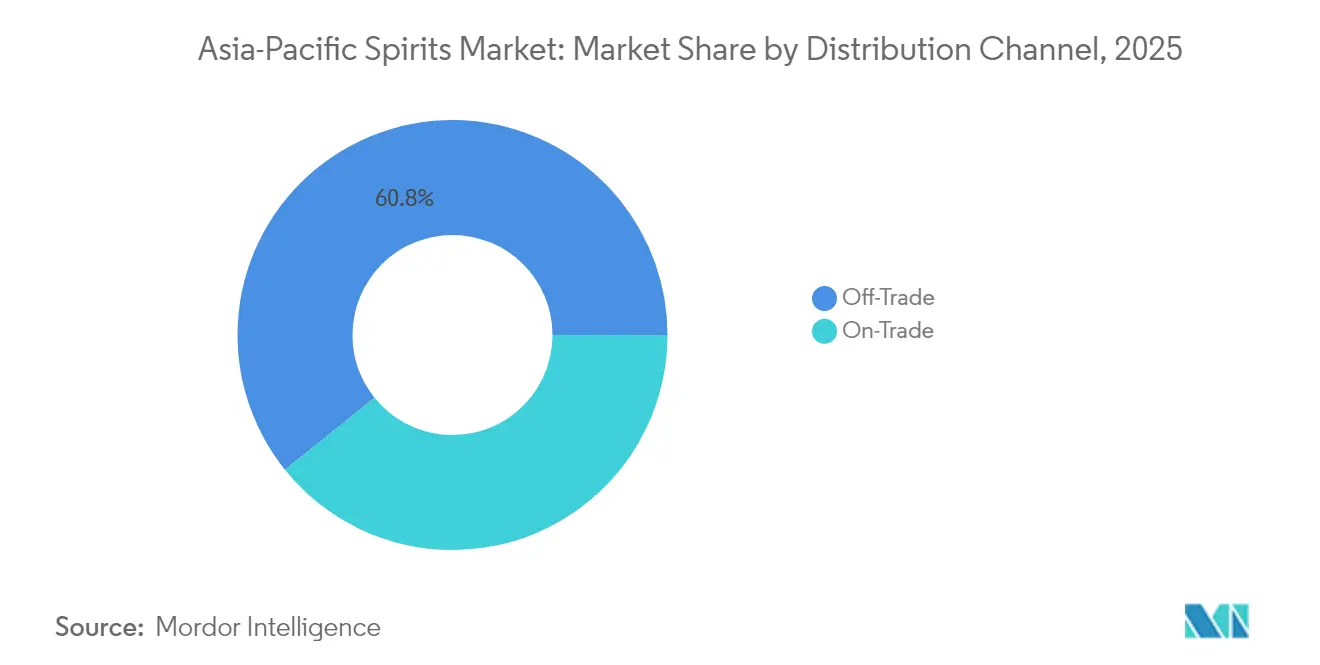
Off-Trade Leadership with On-Trade RecoveryOff-trade channels command a dominant market share of 60.78% in the Asia-Pacific spirits market in 2025. This large share reflects significant behavioral shifts induced by the pandemic, where consumers adapted to purchasing alcoholic beverages primarily for consumption at home. The growth of e-commerce platforms and modernization of retail infrastructures further contributed to the expansion of off-trade channels. Convenience, wider product availability, and competitive pricing attract a diverse consumer base, reinforcing off-trade’s preeminence in the region. With the increased penetration of online shopping and home delivery services, off-trade is poised to maintain a leading role in consumer purchasing habits. The persistence of hybrid consumption models and lifestyle changes fuel sustained demand through off-trade channels as manufacturers and retailers double down on digital engagement and personalized offerings.
Conversely, the on-trade segment, comprising bars, restaurants, hotels, and clubs, is experiencing a robust recovery and has emerged as the fastest-growing distribution channel with a projected CAGR of 5.88% through 2031. This resurgence is fueled by the reopening and revival of hospitality sectors as pandemic restrictions ease and tourism rebounds across key markets. Consumers are returning to social venues for premium and experiential drinking occasions, driving increased spend in on-trade environments. The growth is supported by rising disposable incomes, evolving consumer preferences for mixology and craft spirits, and intensified marketing efforts targeting on-premise sales. On-trade operators are enhancing customer experiences through innovative beverage offerings, themed events, and strategic partnerships with premium spirit brands. As social consumption regains prominence, the on-trade channel is expected to accelerate market expansion and contribute significantly to revenue growth in the coming years.
Geography Analysis
China Spirits Market
In 2025, China commands a dominant 41.02% share of the Asia-Pacific spirits market, highlighting its massive scale and ongoing transformation. Traditional baijiu consumption has been declining for the eighth consecutive year, signaling a shift in consumer preferences. This decline is attributed to changing lifestyles, health-conscious choices, and the growing influence of younger generations who are exploring alternatives to traditional spirits. At the same time, international spirits are gaining significant traction, driven by increasing exposure to global brands, rising disposable incomes, and the growing appeal of premium and imported products. Additionally, the expansion of e-commerce platforms and digital marketing strategies has made international spirits more accessible to Chinese consumers, further accelerating this shift. The growing trend of cocktail culture, particularly in urban areas, is also contributing to the rising demand for international spirits, as consumers seek diverse and innovative drinking experiences.
Philippines Spirits Market
The Philippines stands out as the market with the most rapid growth, boasting a 5.79% CAGR projected through 2031, buoyed by strong economic fundamentals. In the Philippines, spirits have overtaken beer and wine in popularity, mirroring cultural trends that prioritize higher-proof beverages for social gatherings and celebrations. Additionally, the rising disposable income and the growing influence of Western drinking habits are further fueling the demand for spirits in the country, particularly among urban consumers. The increasing penetration of international brands and the expansion of distribution networks are also contributing to the growth of the spirits market in the Philippines, making it a lucrative opportunity for both domestic and global players. Furthermore, the government's support for the tourism sector, coupled with the growing number of bars, restaurants, and nightlife establishments, is creating a favorable environment for the spirits market to thrive, particularly in metropolitan areas.
APAC Spirits Market
Japan, South Korea, and Australia showcase developed markets with unique growth trajectories. Meanwhile, Indonesia, Vietnam, and Malaysia present burgeoning opportunities, as urbanization and economic strides cultivate a middle class eager for premium alcohol experiences. In Indonesia, the rising urban population and increasing disposable incomes are driving demand for spirits, particularly among young professionals. Vietnam is witnessing a surge in premium spirits consumption, supported by the growing influence of Western culture and the expansion of modern retail channels. Malaysia, on the other hand, is experiencing a shift in consumer preferences toward premium and imported spirits, driven by the aspirational lifestyles of its middle-class population. Across these emerging markets, the growing presence of international brands, coupled with targeted marketing campaigns and the development of on-trade channels, is further fueling the demand for spirits.
Regulatory Landscape
Across Asia-Pacific, spirits regulation is increasingly shaped by tighter marketing controls, evolving product standards, and expanded labeling requirements, creating a compliance-heavy environment for both domestic producers and importers. Thailand’s Alcoholic Beverage Control Act (No. 2) B.E. 2568 took effect on November 8, 2025, strengthening restrictions around marketing, advertising, and digital promotion, which in turn affects brand-building in on-trade and online channels.
Labeling and technical standards are also moving. Food Standards Australia New Zealand updated the Food Standards Code in August 2025 to mandate energy content declarations on packaged alcoholic beverages (with a multi-year transition), while Malaysia published Food (Amendment) (No. 3) Regulations 2025, introducing updated standards including for tequila and mezcal that apply from April 1, 2026. In India, FSSAI actions in January 2026 reinforced product standards and composition parameters for alcoholic beverages and extended certain labeling enforcement timelines to July 1, 2026. Vietnam’s Ministry of Industry and Trade issued Circular No. 39/2026/TT-BCT, promulgating QCVN 30:2026/BCT effective from January 1, 2027, adding another layer of technical compliance for manufacturers and importers planning regional scale-up.
Competitive Landscape
The Asia-Pacific spirits market exhibits a moderate level of concentration, characterized by a concentration score of 3. This degree of concentration implies a balanced competitive environment where both global multinational corporations and emerging craft distilleries have opportunities to thrive. Leading multinational companies leverage their broad distribution networks, extensive brand portfolios, and significant marketing budgets to maintain a strong presence across various price tiers and regions. These established players benefit from economies of scale, brand recognition, and global supply chains that help them deliver products consistently to meet diverse consumer demands. Their ability to innovate with product variations, premium offerings, and marketing campaigns positions them as dominant forces within the market.
Simultaneously, the moderate concentration level fosters an inclusive environment for smaller, agile craft distillers to compete effectively. These emerging players capitalize on niche markets driven by consumer interest in artisanal, small-batch, and locally sourced spirits. Craft producers focus on innovation around flavor profiles, unique ingredients, and sustainable production methods to differentiate their brands. They often appeal to younger, urban consumers seeking authenticity and experiential drinking, thereby carving out meaningful market share despite competition from larger companies. This dynamic fuels diversity in product offerings and enriches consumer choices, spurring growth in premium and craft segments. The moderate concentration score thus reflects a marketplace where size alone does not guarantee success, but creativity and connection to local markets play a vital role.
Multinational conglomerates maintain dominance in developed economies such as Japan, South Korea, and Australia, where premiumization and luxury consumption are key trends. Meanwhile, craft distillers are particularly active in markets with burgeoning middle classes and evolving preferences, such as China, India, and Southeast Asia. The accessibility of digital platforms and e-commerce channels enables both large and small producers to reach consumers more efficiently, further intensifying competition. Overall, the moderate concentration fosters a vibrant market landscape where a mix of legacy brands and innovative newcomers influence industry evolution, making Asia-Pacific one of the most dynamic spirits markets globally.
Asia-Pacific Spirits Industry Leaders
-
Diageo PLC
-
Kweichow Moutai Co., Ltd.
-
Wuliangye Yibin Co., Ltd.
-
Bacardi Limited
-
Pernod Ricard SA
- *Disclaimer: Major Players sorted in no particular order
Asia-Pacific Spirits Market Companies Covered in this Report
- Kweichow Moutai Co., Ltd.
- Wuliangye Yibin Co., Ltd.
- Diageo PLC
- Pernod Ricard SA
- Bacardi Limited
- Suntory Holdings Limited
- HiteJinro Co., Ltd.
- Thai Beverage PLC
- Allied Blenders & Distillers
- Jiangsu Yanghe Brewery Joint-Stock Co.
- Anheuser-Busch InBev SA/NV
- Luzhou Laojiao Co., Ltd.
- Davide Campari-Milano N.V.
- Remy Cointreau SA
- Emperador Inc.
- San Miguel Corporation (Ginebra)
- Tanduay Distillers, Inc.
- Heineken Holding NV
- Brown-Forman Corp.
- Asahi Group Holdings Ltd.
Market Opportunities and Future Outlook
Investment-led capacity buildout and portfolio premiumization continue to open whitespace in locally produced and locally matured spirits, particularly whisky and craft segments that are gaining attention in urban Asia-Pacific. Pernod Ricard India broke ground in October 2024 on a large malt distillery and maturation facility in Butibori, Nagpur, with planned capacity up to 13 million pure alcoholic litres annually, while IndoBevs announced in March 2026 a Rs 200 crore greenfield malt distillery in Muzaffarnagar, Uttar Pradesh (peak capacity cited at 12,000 litres per day). In Japan, Karuizawa Distillers broke ground in June 2026 on a second facility, Furaliss Distillery in Furano, Hokkaido, in partnership with Seibu Group and Furano City, supporting a broader destination distilling push that links production with tourism-linked premium experiences.
There is also an operational and sustainability opportunity from efficiency upgrades and digitization across distilling and maturation operations as energy and compliance costs rise. In India, Radico Khaitan deployed DRAMS software for cask management across multiple sites to manage tens of thousands of casks, pointing to improved inventory visibility and quality control for aging-led categories. Technology pathways discussed in the industry, such as process optimization and energy-saving integrations in distillation, align with producer efforts to improve unit economics and ESG positioning while navigating varying excise and labeling regimes across markets. On the demand side, shifts toward higher-end whisky, tequila, and craft gin are reinforced by company moves including Diageo India (USL) taking a majority controlling stake in NAO Spirits in June 2025, expanding access to premium Indian craft gin brands and strengthening premium portfolios across both on-trade and off-trade channels.
Recent Industry Developments in Asia-Pacific Spirits Market
- July 2026: Kweichow Moutai raised the ex-factory price of its flagship 53-degree Feitian Moutai by 7.9% to 1,369 yuan and increased the iMoutai app retail price by 6.5% to 1,639 yuan, effective July 18, 2026. The change reinforces premium pricing power in China’s baijiu segment and affects trade terms and portfolio positioning across distributors and retail channels.
- June 2025: Diageo India (United Spirits Limited) agreed to acquire a majority controlling stake in NAO Spirits for INR 130 crore. The transaction expands Diageo’s exposure to premium Indian craft gin and supports faster scaling through established route-to-market capabilities across major Indian states.
- November 2024: Diageo launched the YunTuo Single Malt Whisky Distillery in Eryuan County, Yunnan Province, China, supported by a planned USD 120 million investment spread over nine years. Establishing whisky production in China strengthens local supply and premium storytelling, while increasing competitive pressure on imported single malt brands in key urban markets.
Asia-Pacific Spirits Market Report Scope and Research Methodology
Market Definition and Coverage
For this study, the Asia-Pacific spirits market is counted as the value of distilled alcoholic beverages sold for consumption across APAC, covering sales through on-trade venues and off-trade retail and e-commerce, measured in current USD.
Scope exclusions: Excludes beer, wine, cider, and non-alcoholic beverages, and it does not count non-beverage industrial alcohol uses.
Segments Covered in This Report
- By Product Type
- Whiskey
- Vodka
- Rum
- Brandy
- Gin
- Tequilla and Mezcel
- Other Spirit Types
- By End User
- Male
- Female
- By Distribution Channel
- On-Trade
- Off-Trade
- Specialty/Liquor Stores
- Other Off-Trade Channels
- By Geography
- China
- India
- Japan
- South Korea
- Australia
- New Zealand
- Indonesia
- Thailand
- Vietnam
- Malaysia
- Philippines
- Rest of Asia-Pacific
Data Sources, Market Sizing, and Validation
Desk Research
To anchor the model, we first map the market boundary using public definitions of spirits, channel structure, and country coverage across Asia-Pacific. Common starting points include official statistics and reference notes such as national customs and excise releases, FAO and UN Comtrade trade tables, IMF and World Bank macro series, and OECD consumer and price indicators, which help align currency and inflation context.
After that, desk work is used to build practical inputs that can be checked in interviews. We review company filings and investor presentations for category mix and pricing direction, industry association publications for category and channel trends, and reputable press coverage for policy changes, tax shifts, and duty-free movements. Where needed, we also use paid subscriptions for company financials and intelligence, broad news and financials tracking, and shipment-level import and export data to sanity-check direction and timing. These are illustrative sources only, and many other references were also used for collection, validation, and clarification.
Primary Interviews and Surveys
Primary work was used to pressure-test the desk assumptions on what is actually counted in spirits, how pricing is moving by category, and how on-trade versus off-trade splits are changing in key APAC countries. We spoke with a mix of producers, distributors, importers, and channel-side stakeholders (including retail and on-trade operators), then used follow-ups to reconcile gaps like duty-free timing, premiumization pace, and product substitution patterns.
Distribution of primary research fieldwork respondents
| Company type | Respondent position |
|---|---|
| Top tier: 36% | CXOs: 13% |
| Mid tier: 47% | Functional/Unit leaders: 43% |
| Smaller Players: 17% | Managers: 44% |
Market-Sizing & Forecasting
Sizing starts with a top-down build where country demand pools are reconstructed using consumption and trade direction, category mix signals, and channel splits, then converted to value using category-level pricing logic. The model is checked with selective bottom-up approximations such as sampled average selling price (ASP) by spirit type multiplied by estimated volume, plus distributor and channel checks, which helps correct obvious overcounts or missed pockets.
Inputs that matter in this market include category mix shifts (for example, whiskey versus local spirits), premiumization rate, on-trade recovery versus at-home occasions, duty-free contribution, and tax and excise impacts that can change retail pricing quickly. We also track macro indicators like disposable income and consumer spending direction, since spirits value can rise even when volumes are flat.
For forecasting, we rely on scenario analysis supported by a light multivariate view of the drivers that show up most consistently across countries, especially pricing, channel mix, and policy timing. Where data is thin for smaller markets, we apply peer-market benchmarks and then re-check the implied per-capita and price outcomes with interview feedback before finalizing.
Data Validation & Update Cycle
Outputs are validated through cross-checks across multiple signals, where the model totals are compared against independent trend markers like reported category growth, trade direction, and channel shifts. When a country result looks out of line, the assumptions are revisited and, if required, respondents are re-contacted to confirm whether the issue is pricing, channel mix, or a scope mismatch.
Before sign-off, the work is reviewed in steps, with internal checks on unit consistency, currency conversion timing, and year-over-year movement by category and country. The report is refreshed annually, and interim updates are made when material events occur, such as major tax changes, trade disruptions, or abrupt demand swings. Right before delivery, a final pass is completed so clients receive the most current view available.
Mordor Intelligence's Asia Pacific Spirits Market Growth Market Size Compared With Other Published Estimates
Published estimates for APAC spirits often do not line up because the included product list, channel coverage, and pricing basis can shift from one study to another, and those choices directly change the value total. Differences also show up when one source reports a volume-led view while another reports a value-led view that is more sensitive to premiumization and excise-driven price changes.
A frequent gap driver in this market is how local spirits, duty-free, and on-trade pricing are treated, since these can move differently across countries and time. When currency conversion is done using different averaging windows, and when ASP progression is updated at different times, the year figure can look higher or lower even with similar volume assumptions. By refreshing currency timing and ASP checks close to publication and re-validating outliers with channel interviews, the model keeps 2026 value aligned to the stated scope, which is reflected in Mordor Intelligence.
Benchmark comparison
| Source | Market Size | Gaps in Research Methodology |
|---|---|---|
| Mordor Intelligence | USD 312.11 B (2026) | |
| Global Consultancy A | USD 239.82 B (2026) | Uses a broader product list that blends in several local distilled beverages, yet applies a different pricing ladder and country weighting, which can compress the 2026 value when converted to USD using a different averaging window. |
| Industry Publisher B | USD 59.60 B (2025) | Appears to use a narrower counted scope and a different segmentation basis, and the estimate is reported in USD million for 2025, which makes comparisons sensitive to what is included as spirits and whether on-trade and duty-free are fully captured. |
The spread in the table is mainly explained by scope boundaries, the year used, and how pricing and currency timing are handled for APAC countries where premiumization is uneven. Our approach stays traceable because the same set of drivers, such as category mix, channel split, and ASP movement, are applied consistently and then checked back with market participants before final totals are finalized.
Key Questions Answered in the Report
What is the projected value of the Asia-Pacific spirits market by 2031?
It is expected to reach USD 395.02 billion, growing at a 4.82% CAGR.
Which product category currently leads regional sales?
Whisky holds the largest share, accounting for 25.18% of value in 2025.
Which country is forecast to grow fastest within the region?
The Philippines shows the highest forecast growth at a 5.79% CAGR through 2031.
How are premium trends influencing consumer behavior?
Rising affluence and social-status signaling push consumers toward higher-quality labels, lifting average spend per serve across channels.