
Market Overview
| Study Period | 2020 - 2031 |
|---|---|
| Forecast Data Period | 2026 - 2031 |
| Base Year Market Size (2025) | USD 1.97 Billion |
| Market Size (2026) | USD 2.13 Billion |
| Market Size (2031) | USD 3.12 Billion |
| Growth Rate (2026 - 2031) | 7.94 % |
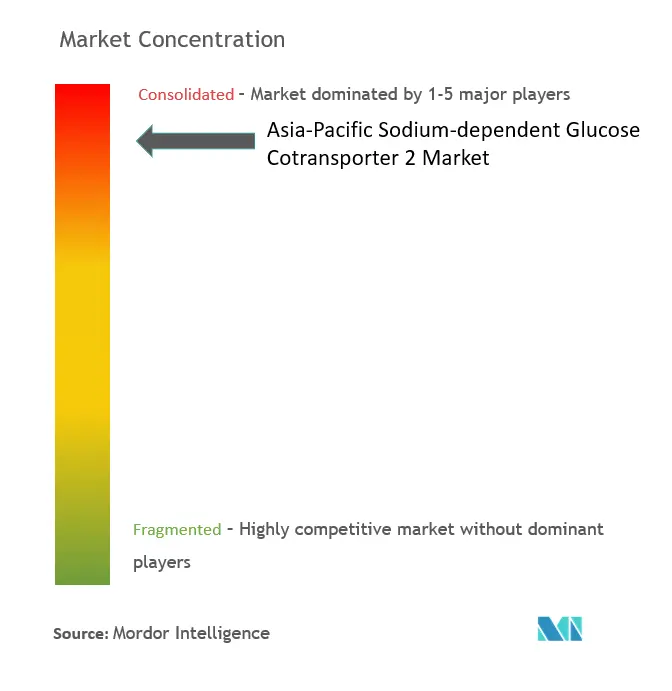
| Market Concentration | Low |
Major Players *Disclaimer: Major Players sorted in no particular order Image © Mordor Intelligence. Reuse requires attribution under CC BY 4.0. | |
Asia-Pacific Sodium-dependent Glucose Cotransporter 2 Market Analysis by Mordor Intelligence
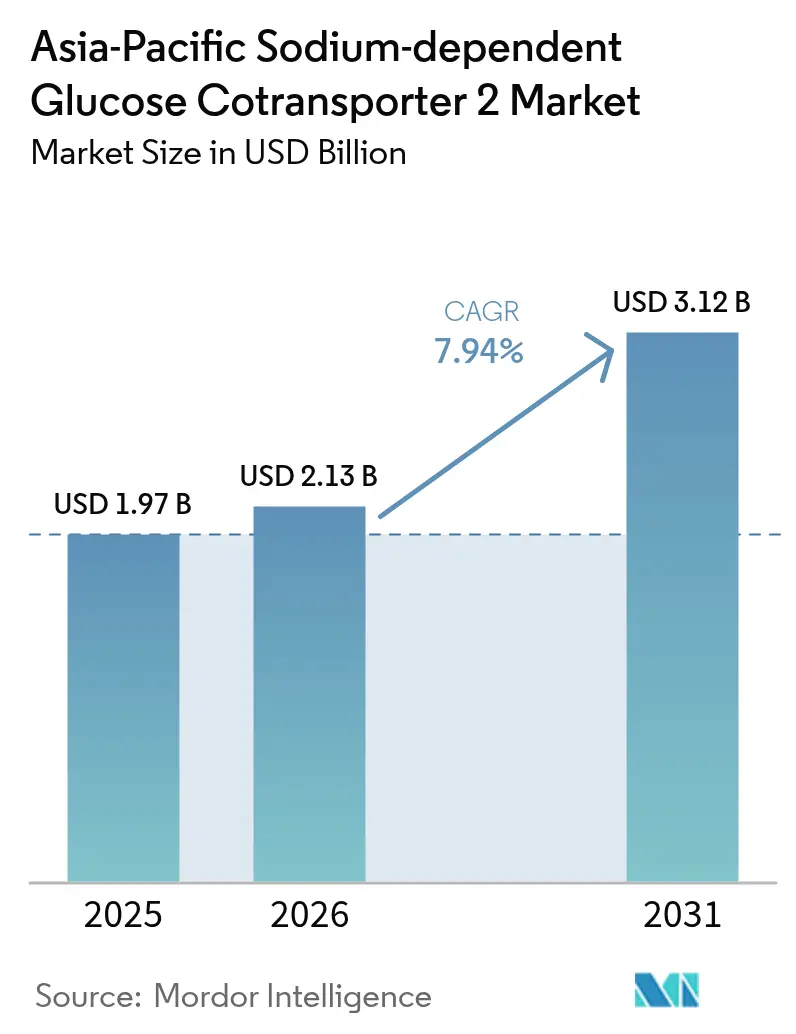
The Asia-Pacific Sodium-dependent Glucose Cotransporter 2 Market size was valued at USD 1.97 billion in 2025 and estimated to grow from USD 2.13 billion in 2026 to reach USD 3.12 billion by 2031, at a CAGR of 7.94% during the forecast period (2026-2031).
Sodium-dependent Glucose Cotransporter 2 (SGLT-2) inhibitors also called gliflozins are a class of medicine used to lower high blood glucose levels in people with type 2 diabetes. SGLT-2 drugs have a significant role in managing cardiovascular risk factors including blood pressure, glycemia, weight, cardiac function, and antiinflammatory activity. Diabetic drugs have been potential candidates for treating diabetic patients affected by SARS-CoV-2 infection during the COVID-19 pandemic.
The Asia-pacific region had witnessed an alarming increase in the prevalence of diabetes, in recent years. Diabetes is associated with many health complications. Patients with diabetes require many corrections throughout the day for maintaining nominal blood glucose levels, such as medications or ingestion of additional carbohydrates by monitoring their blood glucose levels.
Diabetes mellitus has been of wide concern with its high prevalence, resulting in increased financial burdens for clinical systems, individuals, and governments. The market players are adopting various strategies such as collaborations, partnerships, mergers, acquisitions, and expansions to increase market share. Technological advancements have increased over the period leading to several modifications either in the SGLT-2 inhibitors or the formulations being developed.
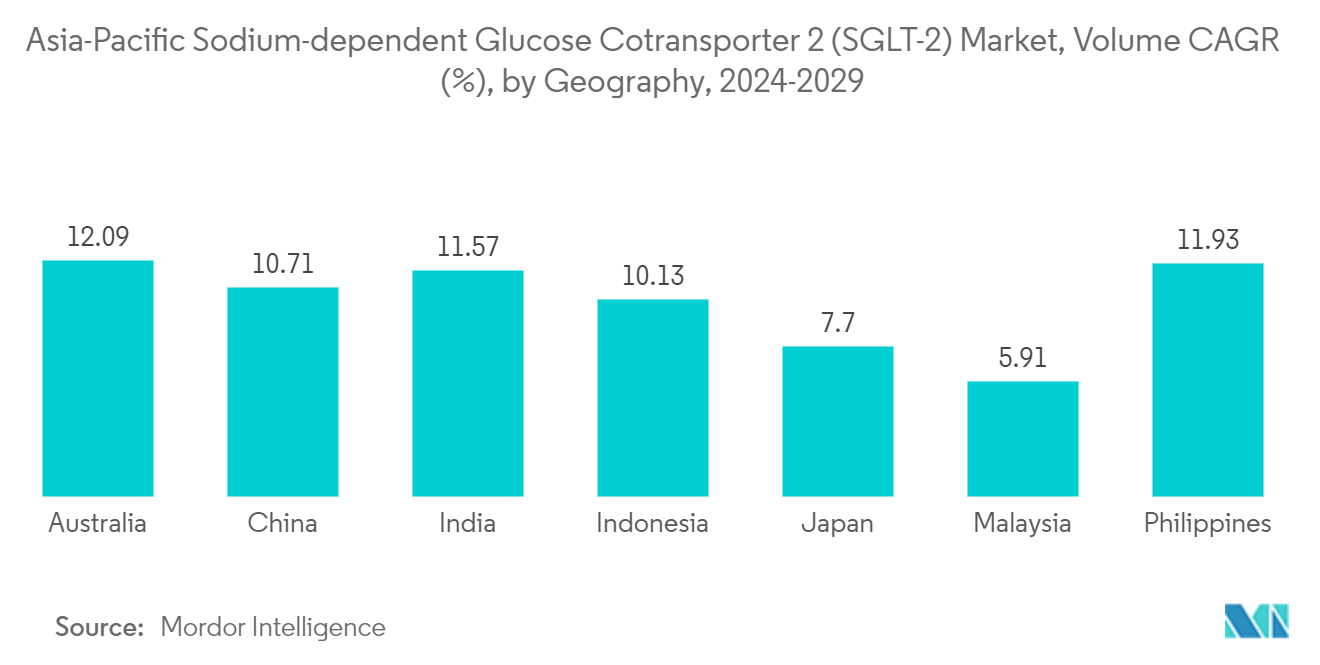
According to International Diabetes Federation, 90 million adults were living with diabetes in the IDF South-East Asia Region. This figure is estimated to increase to 152 million by 2045, and 206 million adults were living with diabetes in the IDF Western Pacific Region, which is estimated to increase to 260 million by 2045. The Asia-Pacific region witnessed an alarming increase in the prevalence of diabetes in recent years. In developing countries, such as China and India, the rate of diabetes is at an all-time high. Also, the use of oral anti-diabetes drugs is rising because new-generation drugs reduce the rate of CV risk in diabetes patients. Leading manufacturers are focusing on technological innovations and developing advanced products to gain a substantial market share.
Therefore, due to increased prevalence and the aforementioned factors, the studied market is anticipated to witness growth over the analysis period.
Note: Market size and forecast figures in this report are generated using Mordor Intelligence’s proprietary estimation framework, updated with the latest available data and insights as of 2026.
Asia-Pacific Sodium-dependent Glucose Cotransporter 2 Market Trends and Insights
Jardiance Segment holds the highest market share in the Asia-Pacific Sodium-dependent Glucose Cotransporter 2 Market in the current year
Jardiance holds the highest market share of about 43.3% in the Asia-Pacific Sodium-dependent Glucose Cotransporter 2 Market in the current year.
Jardiance is a prescription medicine to lower blood sugar, diet, and exercise in adults with type 2 diabetes. It reduces the risk of cardiovascular death in adults with type 2 diabetes, including cardiovascular disease. Jardiance also reduces the risk of cardiovascular death and hospitalization for heart failure in adults when the heart cannot pump enough blood to the rest of the body. It is not for people with type 1 diabetes.
SGLT-2 inhibitor drugs are available internationally and are recommended for use when escalation of treatment for type 2 diabetes is required, along with lifestyle management. Oral agents are typically the first medications used in treating type 2 diabetes due to their wide range of efficacy, safety, and mechanisms of action. SGLT-2 inhibitor drugs help diabetes patients control their condition and lower the risk of diabetes complications. People with diabetes may need to take antidiabetic drugs for their whole lives to control their blood glucose levels and avoid hypoglycemia and hyperglycemia. These agents present the advantages of easier management and lower cost. So they became an attractive alternative to insulin with better acceptance, which enhances adherence to the treatment.
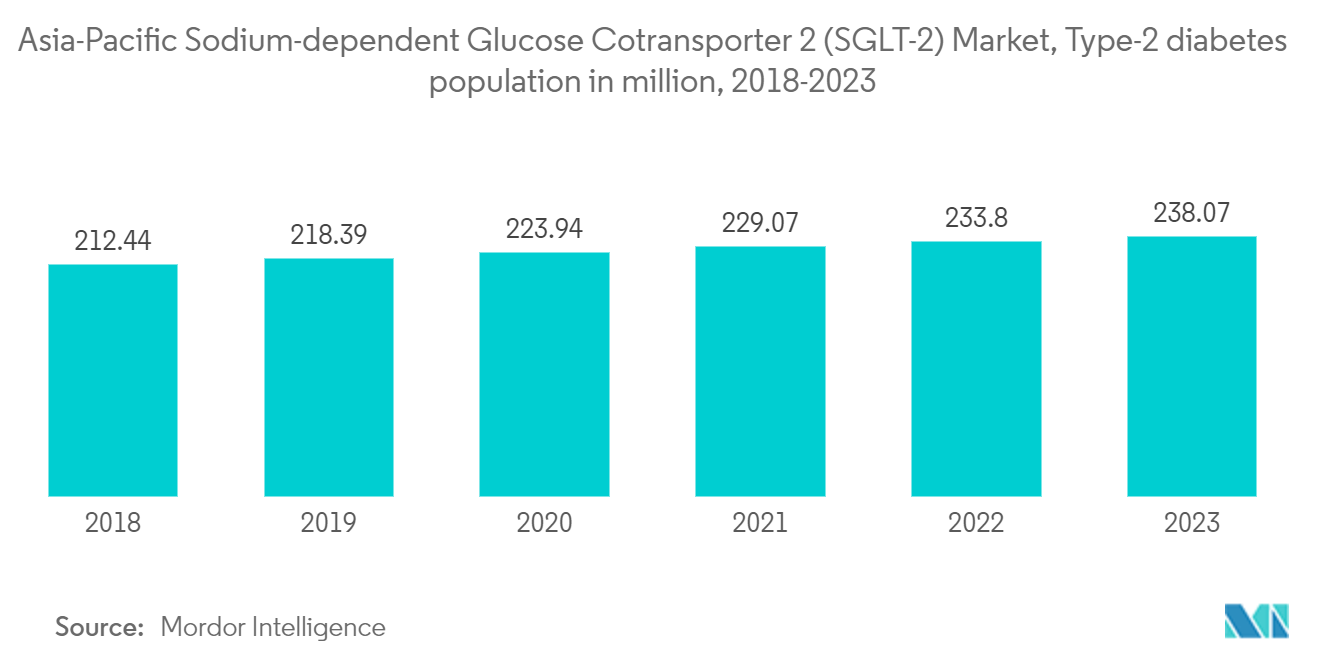


Japan is expected to dominate Asia-Pacific Sodium-dependent Glucose Cotransporter 2 Market over the forecast period
Japan holds the highest market share in the Asia-Pacific Sodium-dependent Glucose Cotransporter 2 Market in the current year and is expected to grow with a CAGR of about 8% over the forecast period.
Japan includes around 11 million people with diabetes, according to IDF data. While Type 1 diabetes is caused by an immune system malfunction, Type 2 diabetes is linked to leading a sedentary lifestyle, resulting in inherent resistance to insulin. Japan contains one of the largest elderly populations in the world, which is more susceptible to the onset of type 2 diabetes. As Japan's population continues to age, the prevalence of diabetes also increases. The rise in the number of people with type 2 is driven by a complex interplay of socio-economic, demographic, environmental, and genetic factors. Key contributors include urbanization, an aging population, decreasing levels of physical activity, and increased levels of overweight and obesity.
Much can be done to reduce the impact of diabetes. Evidence suggests that type 2 diabetes can often be prevented. In contrast, early diagnosis and access to appropriate care for all types of diabetes can avoid or delay complications in people with the condition. When diabetes is undetected or inadequately treated, people with diabetes are at risk of serious and life-threatening complications, such as heart attack, stroke, kidney failure, blindness, and lower-limb amputation. These result in reduced quality of life and higher healthcare costs.
Diabetes is identified as a healthcare priority by the Ministry of Health, Labour, and Welfare. The costs of diabetes are increased in patients with co-morbidities such as hypertension and hyperlipidemia and in patients who develop complications. Costs increase with an increasing number of complications. Well-organized medical insurance systems cover all medical fees for diabetes mellitus, and people with diabetes can visit doctors freely in Japan.
Therefore, owing to the factors above, the growth of the studied market is anticipated in the Asia-Pacific Region.
Competitive Landscape
The Asia-Pacific Sodium-dependent Glucose Cotransporter 2 Market is highly consolidated, with major manufacturers, namely Eli Lilly, Sanofi, and Novo Nordisk, with a global and regional market presence. The joint ventures that occurred between players in the recent past helped the companies strengthen their market presence. For example, Eli Lilly and Boehringer Ingelheim make Jardiance together, which is a very popular SGLT-2 class drug.
Asia-Pacific Sodium-dependent Glucose Cotransporter 2 Industry Leaders
Eli Lilly
Boehringer Ingelheim
Janssen Pharmaceuticals
AstraZeneca
Bristol Myers Squibb
- *Disclaimer: Major Players sorted in no particular order

Recent Industry Developments
- June 2026: Mitsubishi Tanabe Pharma Corporation received marketing authorization in Thailand for CANALIA tablets, a fixed-dose combination of teneligliptin and canagliflozin. The approval expands availability of SGLT-2 inhibitor combination therapy in ASEAN and strengthens the company’s commercial footprint for its diabetes portfolio in the region.
- February 2026: Ono Pharmaceutical announced the termination of its marketing and co-promotion agreement for Forxiga (dapagliflozin) in Japan, transferring distribution and sales responsibilities to AstraZeneca. The change consolidates go-to-market control under AstraZeneca in a major Asia-Pacific market and simplifies the commercialization model for a leading SGLT-2 inhibitor brand.
- May 2025: Mitsubishi Tanabe Pharma Corporation disclosed progress related to the marketing of CANAGLU (canagliflozin) in Thailand. This supported deeper regional access for an established SGLT-2 inhibitor and provided a foundation for subsequent lifecycle expansion, including combination formats, in Southeast Asia.


Research Methodology Framework and Report Scope
Market Definition and Coverage
This market covers prescription SGLT2 inhibitor medicines sold across Asia Pacific for diabetes care and related cardio-renal use in clinical practice, measured as manufacturer level revenue in USD for the period under study.
Scope exclusions: We exclude non-SGLT2 diabetes drug classes, non-prescription supplements, and diagnostics and devices used for glucose monitoring.
Segmentation Overview
- Invokana (Canagliflozin)
- Jardiance (Empagliflozin)
- Farxiga/Forxiga (Dapagliflozin)
- Suglat (Ipragliflozin)
- Geography
- Japan
- South Korea
- China
- India
- Australia
- Vietnam
- Malaysia
- Indonesia
- Philippines
- Thailand
- Rest of Asia-Pacific
Data Sources, Market Sizing, and Validation
Desk Research
Desk work starts with building the country demand context and the clinical boundary for SGLT2 use. We reference public health statistics and epidemiology updates (for example, International Diabetes Federation releases, WHO country profiles, and OECD health data where available) to understand diabetes burden and treated population signals.
Next, the supply and access picture is checked using sources such as national reimbursement and formulary updates, health ministry notifications, and regulator websites that publish labeling and safety communications. We also use company annual reports, investor presentations, and credible press coverage to understand product mix and regional exposure. In parallel, we supplement with paid subscriptions for company financials and news, patent databases, and an import-export shipment-level database when trade flows help validate assumptions. This list is illustrative, and many other public sources are also reviewed to collect data, cross-check, and clarify open points.
Primary Interviews and Surveys
Primary conversations are used to stress-test what desk sources cannot show clearly, especially net pricing behavior, prescribing shifts, and access timing by country. We speak with a mix of manufacturers, distributors, hospital pharmacy buyers, and practicing clinicians across key Asia Pacific markets, so our assumptions on uptake, switching, and persistence are anchored in how patients are actually treated.
Distribution of primary research fieldwork respondents
| Company type | Respondent position |
|---|---|
| Top tier: 33% | CXOs: 14% |
| Mid tier: 46% | Functional/Unit leaders: 38% |
| Smaller Players: 21% | Managers: 48% |
Market-Sizing & Forecasting
The model starts with a top-down demand pool build using diabetes prevalence and treated patient signals by country, then it is adjusted using therapy intensity and expected SGLT2 penetration over time. To keep the number practical, we translate patient pools into sales using a small set of traceable inputs such as annual therapy days, adherence and persistence patterns, typical dose mix, and net price levels after channel and reimbursement effects.
Those totals are corroborated with selective bottom-up approximations, like sampling country level product revenues from public disclosures, checking channel feedback on volume direction, and running ASP times volume spot checks for major markets where data is more visible. When gaps show up, they are handled through conservative interpolation using nearby country benchmarks (similar access and epidemiology profiles) and then rechecked with interview feedback.
For forecasting, we mainly apply scenario analysis because policy, reimbursement expansion, and label driven adoption can move faster than simple trend lines. The scenarios are anchored to variables that respondents typically agree on, including guideline adoption pace, cardiology and nephrology usage growth, generic entry timing where applicable, and currency and inflation expectations that influence net pricing.
Data Validation & Update Cycle
Validation is done through stepwise cross-checks before the final values are signed off. We compare modeled revenue with independent signals like diabetes drug market direction in the region, country level access milestones, and visible company exposure statements, and then we review any outliers at the country and year level.
If a variance is material, analysts re-open the driver, re-check the desk evidence, and re-contact relevant interviewees to confirm whether the change is real or a gap in an assumption. Reports are refreshed annually, and interim updates are made when major regulatory, reimbursement, or safety events could change the market trajectory. Before delivery, one more pass is completed so the view reflects the latest public updates.
Mordor Intelligence's Asia Pacific Sodium Dependent Glucose Cotransporter 2 Market Estimate Compared With Other Published Estimates
It is normal to see different market sizes for the same drug class because the scope boundary is not always identical across studies, and the year chosen as the base can also shift the number. Differences also come from how net pricing is treated, which channel level is counted, and how quickly updates are made when access and labeling change.
By tracking net price progression and country level reimbursement timing, Mordor Intelligence keeps the Asia Pacific SGLT2 estimate aligned to when demand becomes payable in each market, which can diverge from approaches that rely on list prices or assume uniform uptake across the region.
Benchmark comparison
| Source | Market Size | Gaps in Research Methodology |
|---|---|---|
| Mordor Intelligence | USD 1.97 B (2025) | |
| Global Consultancy A | USD 1.82 B (2024) | Uses an earlier base year and may apply broader gross-to-net assumptions that do not fully reflect country reimbursement stages, which can pull the reported value down versus a net realized view. |
| Industry Publisher B | USD 1.97 B (2025) | Often includes additional indication expansion and channel scope detail in the same headline number without clearly separating patient pool growth from price effects, which can blur like-for-like comparisons across years. |
Overall, the spread mostly comes from base year choice, net price treatment, and how strictly Asia Pacific access timing is applied in the model. When the scope is kept consistent and inputs are tied back to treated patients, uptake, and net pricing logic, the resulting market size stays easier to audit and repeat over time.


Key Questions Answered in the Report
How big is the Asia-Pacific Sodium-dependent Glucose Cotransporter 2 Market?
The Asia-Pacific Sodium-dependent Glucose Cotransporter 2 Market size is expected to reach USD 2.13 billion in 2026 and grow at a CAGR of 7.94% to reach USD 3.12 billion by 2031.
What is the current Asia-Pacific Sodium-dependent Glucose Cotransporter 2 Market size?
In 2026, the Asia-Pacific Sodium-dependent Glucose Cotransporter 2 Market size is expected to reach USD 2.13 billion.
Who are the key players in Asia-Pacific Sodium-dependent Glucose Cotransporter 2 Market?
Eli Lilly, Boehringer Ingelheim, Janssen Pharmaceuticals, AstraZeneca and Bristol Myers Squibb are the major companies operating in the Asia-Pacific Sodium-dependent Glucose Cotransporter 2 Market.
What years does this Asia-Pacific Sodium-dependent Glucose Cotransporter 2 Market cover, and what was the market size in 2025?
In 2025, the Asia-Pacific Sodium-dependent Glucose Cotransporter 2 Market size was estimated at USD 2.13 billion. The report covers the Asia-Pacific Sodium-dependent Glucose Cotransporter 2 Market historical market size for years: 2019, 2020, 2021, 2022, 2023 and 2024. The report also forecasts the Asia-Pacific Sodium-dependent Glucose Cotransporter 2 Market size for years: 2025, 2026, 2027, 2028, 2029 and 2030.
Page last updated on:


 Your data is secure and never sold or shared.


