
Asia-Pacific Roads and Highways Infrastructure Construction Market Size and Share
Market Overview
| Study Period | 2020 - 2031 |
|---|---|
| Forecast Data Period | 2026 - 2031 |
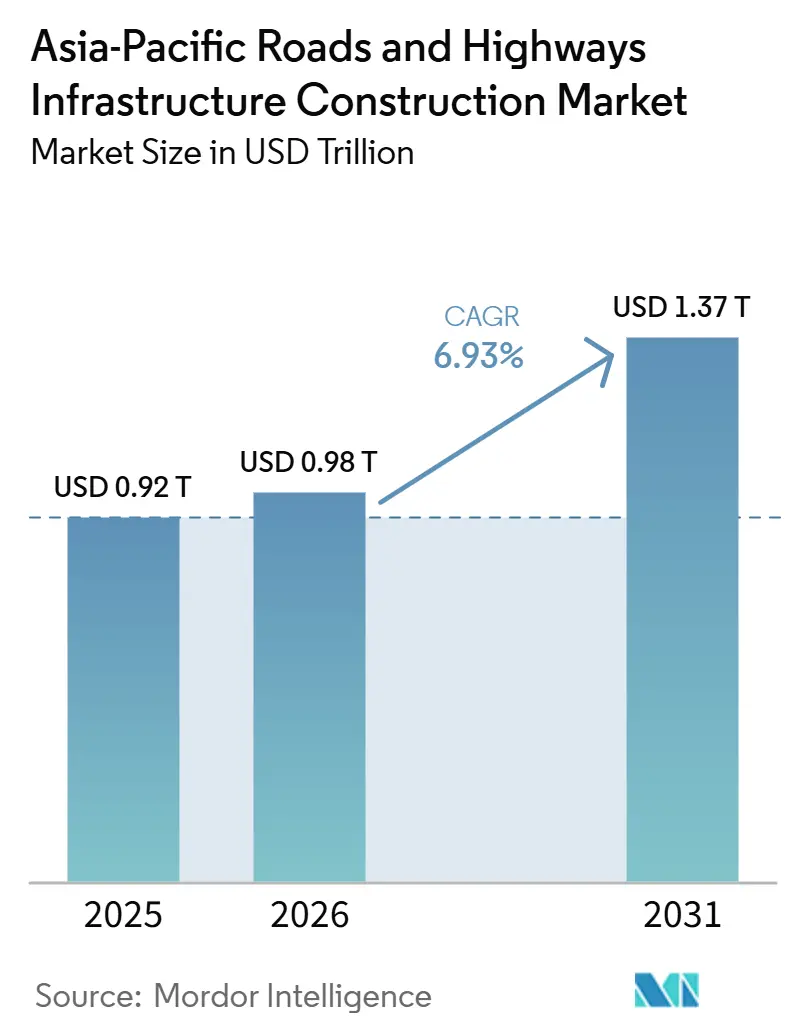
| Base Year Market Size (2025) | USD 0.92 Trillion |
| Market Size (2026) | USD 0.98 Trillion |
| Market Size (2031) | USD 1.37 Trillion |
| Growth Rate (2026 - 2031) | 6.93 % |
| Market Concentration | Medium |
Major Players *Disclaimer: Major Players sorted in no particular order Image © Mordor Intelligence. Reuse requires attribution under CC BY 4.0. | |
Asia-Pacific Roads and Highways Infrastructure Construction Market Analysis by Mordor Intelligence
The Asia-Pacific Roads And Highways Infrastructure Construction Market size is projected to be USD 0.92 trillion in 2025, USD 0.98 trillion in 2026, and reach USD 1.37 trillion by 2031, growing at a CAGR of 6.93% from 2026 to 2031.
The Asia-Pacific roads and highways infrastructure construction market is supported by a large structural investment gap in new road construction and maintenance, which continues to sustain long-term project demand across the region. Vehicle growth is rising faster than network expansion, putting pressure on governments to add corridors, widen existing links, and improve road quality for both freight and commuter traffic. China remains the largest country market in value terms, while India is set to record the fastest growth as national highway programs move from planning to execution. Competitive activity remains uneven across the region, with Chinese state-owned enterprises leading large domestic and cross-border projects, Japanese firms staying strong in renewal work, and Indian and Southeast Asian contractors competing actively for national and provincial awards. Cost inflation in materials and delays in right-of-way acquisition continue to affect delivery. Still, the Asia-Pacific roads and highways infrastructure construction market remains an opportunity in complex bridges, rehabilitation work, and privately financed concessions.
Key Report Takeaways
- By component, road works held 71.50% of the Asia-Pacific roads and highways infrastructure construction market share in 2025, while bridges/overpasses are forecast to expand at 7.80% CAGR through 2031.
- By construction type, new construction accounted for 78.60% of the Asia-Pacific roads and highways infrastructure construction market size in 2025, while renovation is projected to grow at 7.20% CAGR through 2031.
- By investment source, public funding led the Asia-Pacific roads and highways infrastructure construction market with a 76.80% share in 2025, while public-private partnership financing is expected to grow at 8.30% CAGR through 2031.
- By type, national roads accounted for 61.20% of the Asia-Pacific roads and highways infrastructure construction market in 2025, while state-level roads are projected to record the fastest CAGR of 7.10% through 2031.
- By country, China held 46.80% of the Asia-Pacific roads and highways infrastructure construction market share in 2025, while India is projected to record the fastest growth at an 8.50% CAGR through 2031.
Note: Market size and forecast figures in this report are generated using Mordor Intelligence’s proprietary estimation framework, updated with the latest available data and insights as of January 2026.
Market Trends and Insights
Drivers Impact Analysis of Asia-Pacific Roads and Highways Infrastructure Construction Market*
| Drivers | (~) % Impact on CAGR Forecast | Geographic Relevance | Impact Timeline |
|---|---|---|---|
| Accelerated National Highway Expansion Programs Drive Infrastructure Investment | +2.0% | India, China, Vietnam, Indonesia | Medium term (2-4 years) |
| Rising Public Capital Allocation Supports Transport Corridor Development | +1.6% | China, India, Australia | Short term (≤ 2 years) |
| Urban Congestion Relief Projects Increase Bypass Road Construction | +1.1% | India, China, South Korea, Southeast Asia | Medium term (2-4 years) |
| Freight Corridor Modernization Strengthens Regional Logistics Networks | +0.8% | China, India, Vietnam, Thailand, Philippines | Long term (≥ 4 years) |
| Digital Project Delivery and Machine Control Improve Construction Efficiency | +0.5% | Japan, Australia, Singapore | Long term (≥ 4 years) |
| Aging Bridge and Tunnel Infrastructure Drives Replacement Projects | +0.4% | Japan, South Korea, Australia, and older Southeast Asian networks | Medium term (2-4 years) |
| Source: Mordor Intelligence | |||
Accelerated National Highway Expansion Programs Drive Infrastructure Investment
National highway programs are now moving at a stronger execution pace across major Asia-Pacific economies. India identified a 13,400 km public-private partnership pipeline valued at USD 98.3 billion for development over the next 3 years, while the Ministry of Road Transport and Highways budget for fiscal 2026-27 reached USD 34.8 billion, up from USD 32.2 billion in fiscal 2025-26. China also committed USD 112 billion to support 1,417 major projects under its 2026 Two Priorities program, with transport infrastructure among the central allocations. As route density improves, more feeder links and connector roads become financially viable, extending future project pipelines beyond the current list of headline corridors[1]Press Information Bureau, “Year End Review 2025, Ministry of Road Transport & Highways,” Government of India, pib.gov.in. This keeps the Asia-Pacific roads and highways infrastructure construction market closely tied to long-range transport agendas rather than short-cycle spending alone.
Rising Public Capital Allocation Supports Transport Corridor Development
Public funding still sets the tone for most road and highway construction decisions across the region. China reported transportation fixed-asset investment of USD 550.5 billion in 2025, indicating that transport remains a major policy tool even as other parts of the economy remain under pressure. Australia also maintained a large multi-year pipeline, with USD 9.6 billion committed to state infrastructure projects in fiscal 2025-26 and a rolling 10-year program above USD 75.6 billion[2]Australian Government, “Infrastructure Investment Program, Overview,” Australian Government, investment.infrastructure.gov.au. In India, the National Highways Authority of India spent USD 29.0 billion in fiscal 2025-26, and part of that funding came from its own resources rather than only from direct budget support. That shift matters because it expands the Asia-Pacific roads and highways infrastructure construction market by broadening the financing base to include sovereign budgets, debt, and asset recycling.
Urban Congestion Relief Projects Increase Bypass Road Construction
Urban corridor investment is no longer limited to capital cities and major port clusters. India approved the Ganga Corridor and Varuna Corridor in Varanasi in July 2026 at a combined cost of USD 3.0 billion, with both projects designed to cut travel time across the project area from 60 minutes to 20 minutes. In South Korea, the 9.62 km Mandeok-Centum Urban Expressway entered service in February 2026 and completed Busan’s inner ring road after a long planning cycle[3]Busan City Government, “Mandeok-Centum Urban Expressway to Enter Service on February 10,” Busan City Government, busan.go.kr. These projects show that governments are using expressways and bypasses to reduce traffic pressure and support industrial parks, housing expansion, and logistics nodes around fast-growing urban edges. This provides the Asia-Pacific roads and highways infrastructure construction market with a steady stream of projects that align transport needs with broader city development goals.
Freight Corridor Modernization Strengthens Regional Logistics Networks
Freight routes are becoming larger and more concentrated sources of project demand across the region. Vietnam proposed expanding 2,082 km of existing expressways to 4-8 lanes, at a planned investment of USD 15.8 billion, with priority given to the Hanoi- Ho Chi Minh City corridor. China’s New International Land-Sea Trade Corridor handled more than 1 million twenty-foot equivalent units in 2025, which was a 72.5% year-over-year increase and a clear sign of freight pressure on inland and cross-border transport systems. Once a main corridor receives funding, feeder roads, industrial access links, and supporting logistics infrastructure usually follow. That pattern keeps the Asia-Pacific roads and highways infrastructure construction market tied to manufacturing and trade expansion as much as to passenger traffic demand.
Restraints Impact Analysis of Asia-Pacific Roads and Highways Infrastructure Construction Market*
| Restraints | (~) % Impact on CAGR Forecast | Geographic Relevance | Impact Timeline |
|---|---|---|---|
| Right-of-Way Acquisition Delays Slow Infrastructure Project Execution | -1.4% | India, Philippines, Malaysia, Vietnam, Indonesia | Short term (≤ 2 years) |
| Bitumen, Steel, and Fuel Price Volatility Increases Construction Costs | -1.1% | India, South Asia, Southeast Asia | Short term (≤ 2 years) |
| Complex Permitting and Multi-Agency Approvals Delay Project Delivery | -0.8% | India, Indonesia, the Philippines, Australia, and remote corridors | Medium term (2-4 years) |
| Skilled Labor Shortages Constrain Large-Scale Civil Construction Projects | -0.6% | Japan, Australia, Southeast Asia | Long term (≥ 4 years) |
| Source: Mordor Intelligence | |||
Right-of-Way Acquisition Delays Slow Infrastructure Project Execution
Land acquisition remains one of the clearest execution barriers across the Asia-Pacific roads and highways infrastructure construction market. In India, 489 road projects scheduled for completion by March 2025 remained unfinished as of July 2025, with land acquisition, forest clearance, wildlife clearance, and railway approvals cited as the main reasons for the delays. In the Philippines, the signing of the Accelerated and Reformed Right-of-Way law in September 2025 underscored how serious this bottleneck had become for official development assistance-backed infrastructure projects. Delays are often hardest to solve in peri-urban and rural corridors, where social resistance is stronger and local delivery capacity is weaker than at the national policy level. This is why construction awards can rise faster than physical progress in the Asia-Pacific roads and highways infrastructure construction market.
Bitumen, Steel, and Fuel Price Volatility Increases Construction Costs
Input cost swings continue to pressure contractor margins and bidding discipline across the region. Construction cost inflation remained elevated through 2025 and 2026, with India and Japan facing stronger upward pressure than the regional average. Bitumen price ranges also widened sharply by May 2026, increasing uncertainty for contractors on fixed-price contracts. This issue is becoming more important as public-private partnership structures require stronger cost certainty for lenders and investors. For the Asia-Pacific roads and highways infrastructure construction market, price escalation risk is now a more important part of concession design, tender pricing, and project viability than in earlier highway investment cycles.
*Our forecasts treat driver/restraint impacts as directional, not additive. The impact forecasts reflect baseline growth, mix effects, and variable interactions.
Asia-Pacific Roads and Highways Infrastructure Construction Market Segment Analysis
By Component:
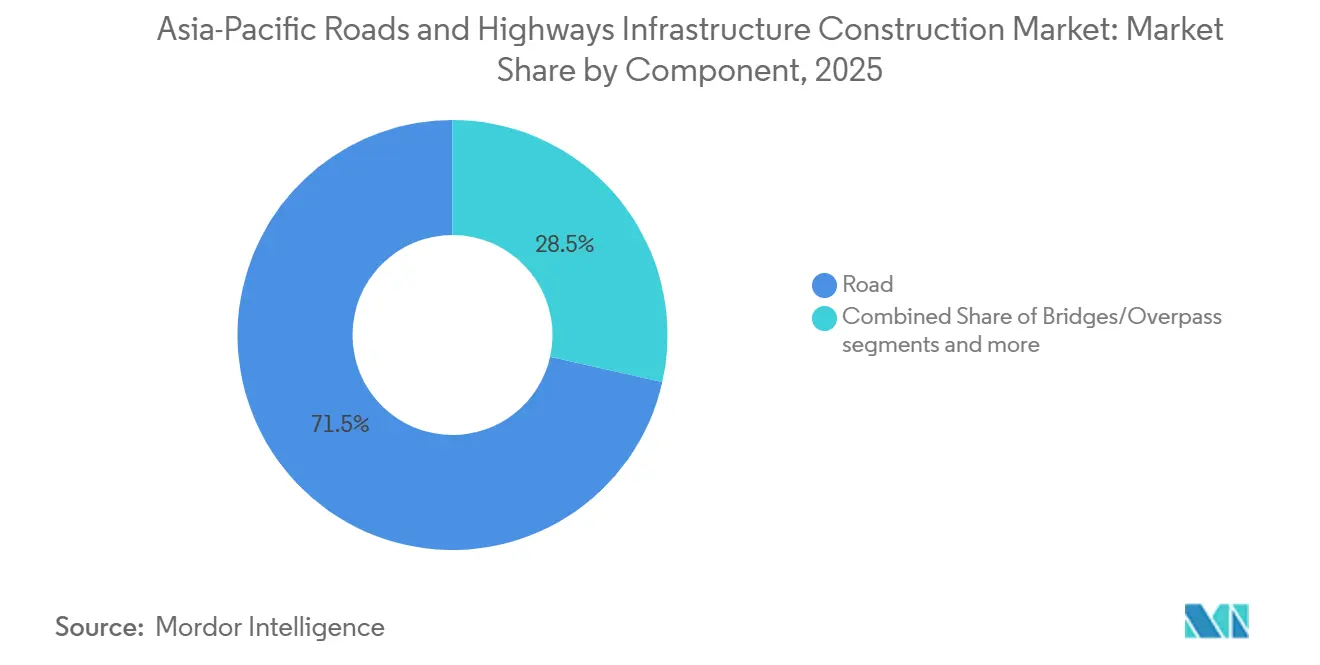
Road Networks Command Market as Bridges/Overpass Build MomentumRoad works held a 71.50% share of the Asia-Pacific roads and highways infrastructure construction market in 2025, keeping this segment clearly ahead of bridges, tunnels, and other asset classes. The lead position reflects the region’s long-running need for earthworks, pavement construction, drainage, and related civil work across major highway and feeder road systems. China remained central to that pattern, with its highway mileage exceeding 5.5 million km in 2025 and still leaving room for more secondary and rural feeder road construction in western and central provinces. The largest share, therefore, stayed with standard road building because network coverage needs still outweigh the value of more specialized structures in most national programs.
Bridges/overpasses are set to grow at a 7.80% CAGR through 2031, making them the fastest-growing component group. This rise comes from a mix of new corridor bridges in Southeast Asia and large renewal programs in Japan, South Korea, and Australia. Japan’s Ministry of Land, Infrastructure, Transport and Tourism operates a statutory inspection cycle for more than 730,000 road bridges, and 70% of them are on municipal roads where deterioration risk is most acute. Japan’s expressway operators also allocated 70% of a USD 27 billion budget for highway structure renewal to bridge rehabilitation, with bridge deck replacement alone accounting for 60% of total spending. That shift shows that the Asia-Pacific roads and highways infrastructure construction market is moving toward more engineering-intensive work, even as road building still accounts for the largest share of value.



By Construction Type:
New Projects Dominate as Renovation AcceleratesNew construction accounted for 78.60% of the Asia-Pacific roads and highways infrastructure construction market in 2025, which reflects the region’s continued focus on greenfield corridors and controlled-access expressways. India’s Bharatmala Pariyojana Phase 1 continues to support this flow through economic corridors, ring roads, and port connectivity projects delivered across build-operate-transfer, hybrid annuity, and engineering-procurement-construction models. Vietnam also crossed 3,800 km of built expressways during the 2021-2025 period, exceeding the 3,000 km national target and demonstrating that the government maintained momentum in new corridor development. These programs retained the largest share of new infrastructure assets because many parts of the Asia-Pacific still need first-round network expansion before they fully shift to mature renewal cycles.
Renovation is forecast to grow at a 7.20% CAGR through 2031, faster than the pace of new construction. That increase follows the aging profile of roads and related assets built during earlier infrastructure booms in Japan, Australia, and South Korea. It also reflects a practical choice in Southeast Asia, where widening and upgrading existing routes can sometimes meet freight and logistics needs more quickly than securing new alignments. This split between current value and future growth is important because it favors contractors that can manage resurfacing, widening, bridge replacement, and structural repair alongside traditional greenfield work. For the Asia-Pacific roads and highways infrastructure construction market, the balance is no longer only about adding kilometers, but also about extending the useful life of assets already in service.
By Investment Source:
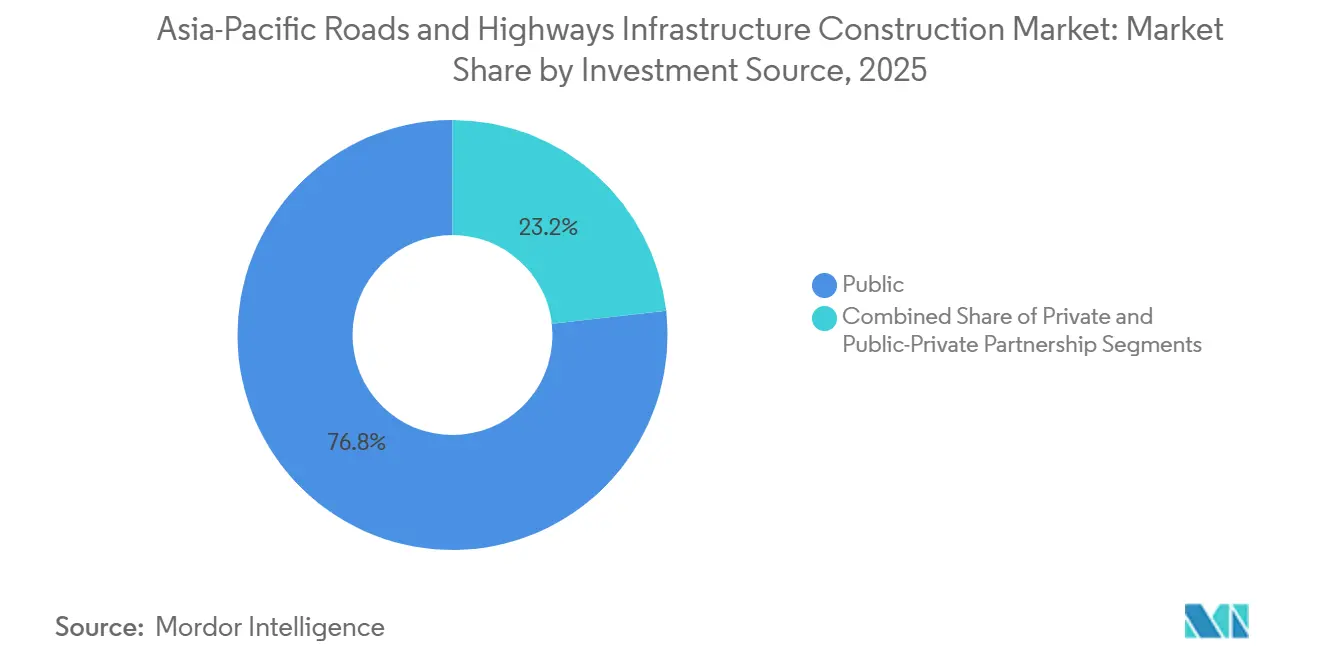
Public Funds Lead, but Public-Private Partnership Reshapes FinancingPublic investment accounted for 76.80% of the Asia-Pacific roads and highways infrastructure construction market in 2025, confirming that sovereign and state-directed capital still funds most of the region’s road pipeline. That pattern is especially visible in China, where the National Development and Reform Commission committed USD 112 billion in 2026 to 1,417 projects under the Two Priorities program. Public dominance also remains strong in India and Australia, where central and federal programs continue to shape the largest road spending decisions. Trunk highways, national corridors, and strategic logistics links often require longer payback periods, making them less attractive for purely private investors without additional public support or structured financing mechanisms.
Public-private partnership financing is projected to grow at 8.30% CAGR through 2031, making it the fastest-growing funding source in the Asia-Pacific roads and highways infrastructure construction market. India identified a 13,400 km pipeline worth USD 98.3 billion to be tendered under public-private partnership formats over the next 3 years, with build-own-transfer taking priority in fiscal 2026-27. Vietnam also moved ahead with a USD 1.4 billion expansion of the Ho Chi Minh City-Trung Luong-My Thuan Expressway, financed through private capital and supported by a USD 1.07 billion syndicated loan led by Vietcombank. This financing shift matters because it broadens project capacity without asking governments to carry the full cost of each new corridor. It also rewards contractors and investors who can structure bankable concessions rather than execute engineering work.
By Type:
National Networks Anchor Bulk of Market ActivityNational road projects accounted for 61.20% of the Asia-Pacific roads and highways infrastructure construction market in 2025, maintaining a strong lead over state and local projects. The largest funding blocks still sit with central highway agencies because they control access-controlled corridors, national freight routes, and cross-state links. India’s National Highways Authority spent USD 29.0 billion in fiscal 2025-26, underscoring the continued concentration of national spending within a limited set of agencies and programs. China’s national expressway pipeline also continues under central policy direction, with landmark bridges and tunnels identified as priority projects in the current planning cycle. The result is a market where the largest contract packages still come from national agencies rather than from smaller sub-national authorities.
State-level roads are forecast to grow at a 7.10% CAGR through 2031, making them the fastest-growing segment. This acceleration reflects stronger activity in India’s state public works pipelines, Indonesia’s provincial toll roads, and Vietnam’s provincial expressway programs under public-private partnership structures. Local roads remain less valuable, but they still support rural connectivity and last-mile access across major countries in the region. That means growth is spreading beyond flagship national routes and into a wider pool of secondary and connector assets. In the Asia-Pacific roads and highways infrastructure construction market, this creates a split in which global engineering firms pursue very large national contracts. At the same time, regional specialists remain active in state and local delivery.
Geography Analysis
China Roads and Highways Infrastructure Construction Market
China held a 46.80% share of the Asia-Pacific roads and highways infrastructure construction market in 2025, making it the largest country market in the region by a wide margin. China reported fixed-asset investment in transportation at USD 550.5 billion in 2025. In the first quarter of 2026, it completed another USD 48.1 billion in major transportation project investments across 1,845 highway and waterway projects valued at USD 14 million or more each. The country remains the largest part of the regional pipeline because its central planning system can still direct very large sums toward transport infrastructure. At the same time, the work mix is changing from broad greenfield expansion in coastal areas toward mountain corridors, bridge renewal, and tunnel-heavy routes in western provinces.
India and Japan Roads and Highways Infrastructure Construction Market
India is forecast to grow at an 8.50% CAGR through 2031, making it the fastest-growing country segment in the region. The Ministry of Road Transport and Highways budget reached USD 34.8 billion in fiscal 2026-27, up 8% year over year, and access-controlled highways remain a stated priority. India also constructed 5,313 km of national highways in fiscal 2025-26, exceeding the target by 15% and demonstrating that execution is keeping pace with policy intent. Japan presents a different profile, because its new-build activity is limited while renewal demand is great and persistent. Japan’s highway structure renewal program also earmarked USD 27 billion for bridge deck replacement and tunnel rehabilitation, which keeps the country important for specialist contractors even without a broad greenfield cycle.
Australia and Broader APAC Roads and Highways Infrastructure Construction Market
Australia remains a mature but active part of the Asia-Pacific roads and highways infrastructure construction market, supported by a 10-year federal pipeline above USD 75.6 billion and a fiscal 2025-26 road investment component of USD 5.5 billion. Infrastructure Australia’s 2026 Budget Statement also pointed to Bruce Highway upgrades and Hume Highway freight improvements as near-term priorities backed by federal funding. The rest of Asia-Pacific is gaining weight through public-private partnership expansion, with Vietnam pursuing USD 15.8 billion in expressway capacity upgrades and the Philippines carrying a broad project pipeline through its public-private partnership framework. This means regional growth is no longer concentrated only in the largest economies, even though China and India still define the overall direction of demand.
Competitive Landscape
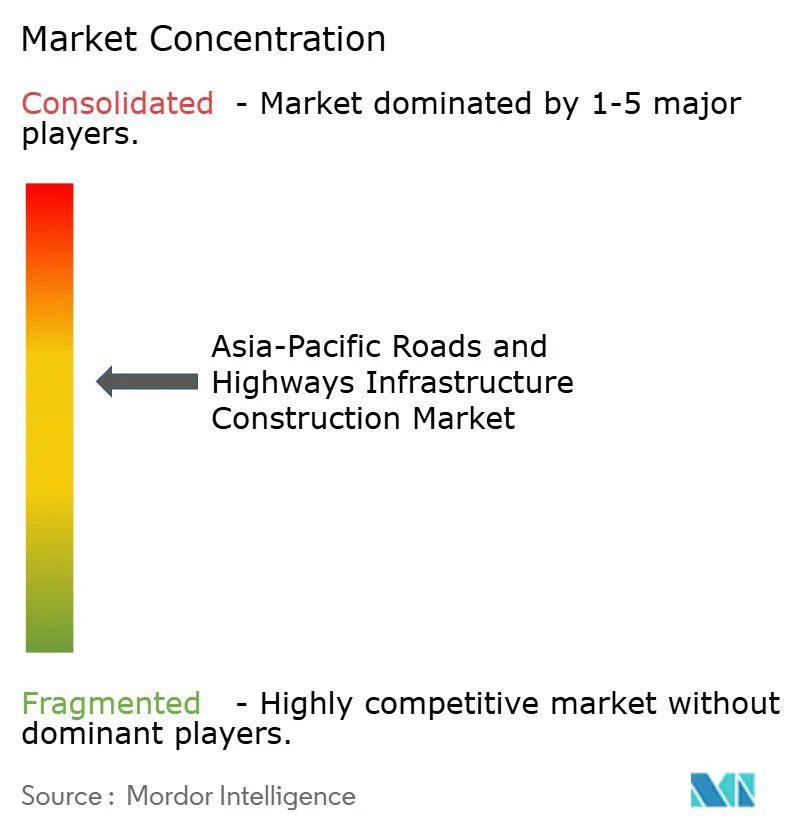
The Asia-Pacific roads and highways infrastructure construction market is moderately consolidated, with a group of large contractors holding strong positions across major infrastructure programs. At the same time, regional and local players continue to compete in domestic project segments. China Communications Construction Company Limited and China Railway Construction Corporation Limited maintain leading positions through extensive project portfolios, engineering capabilities, access to financing, and participation in large-scale domestic and Belt and Road Initiative-linked projects. Japanese contractors such as Obayashi, Kajima, Shimizu, and Taisei remain well-positioned in Japan’s infrastructure renewal market, supported by technical expertise and long-standing relationships with public authorities. Indian and Southeast Asian contractors also maintain competitive positions through local execution capabilities and participation in government-led road development programs, including hybrid annuity, engineering, procurement, and construction (EPC), and state-level contracts.
Competitive strategies among leading contractors are increasingly focused on geographic expansion, technical specialization, and higher-value infrastructure opportunities. Gamuda Berhad reported an order book of USD 10 billion in its second-quarter fiscal 2026 investor briefing, with Australia accounting for 36% and Malaysia for 39%, reflecting its expansion into complex regional infrastructure markets. Hyundai Engineering and Construction entered the Japanese licensing market in July 2026 through Hyundai E&C Japan in Tokyo, targeting technology-intensive infrastructure opportunities. Samsung C&T Engineering and Construction also signed a memorandum of understanding with Infroneer Holdings in July 2026 to collaborate on global infrastructure development, public-private partnership concessions, and co-investment projects. These developments indicate that leading contractors are strengthening their positions through international diversification, financing capabilities, and specialized delivery expertise rather than competing solely on project volume.
Technology adoption is further reinforcing the position of established contractors in the Asia-Pacific roads and highways infrastructure construction market. The use of integrated Building Information Modeling and digital terrain modeling on a Sumatran expressway project demonstrated the ability of advanced digital tools to reduce construction timelines by 120 days and improve productivity by 15%. As governments increasingly prioritize schedule certainty, asset lifecycle management, and construction efficiency, contractors with digital capabilities, engineering depth, and integrated delivery models are gaining competitive advantages. While smaller contractors continue to participate in localized road projects, the market increasingly favors companies that can combine scale, technical expertise, financing strength, and digital execution capabilities.
Asia-Pacific Roads and Highways Infrastructure Construction Industry Leaders
China Communications Construction Company Limited
China Railway Group Limited
China State Construction Engineering Corporation Limited
Larsen & Toubro Limited
Hyundai Engineering & Construction Co., Ltd.
- *Disclaimer: Major Players sorted in no particular order
Asia-Pacific Roads and Highways Infrastructure Construction Market Companies Covered in this Report
- China Communications Construction Company Limited
- China Railway Group Limited
- China State Construction Engineering Corporation Limited
- Larsen & Toubro Limited
- Hyundai Engineering & Construction Co., Ltd.
- Gamuda Berhad
- HOCHTIEF AG
- VINCI Construction
- China Railway Construction Corporation Limited
- Penta-Ocean Construction Co., Ltd.
- Obayashi Corporation
- Kajima Corporation
- Shimizu Corporation
- Taisei Corporation
- Maeda Corporation
- Sinohydro Corporation Limited
- Tata Projects Limited
- PT Wijaya Karya (Persero) Tbk
- PT PP (Persero) Tbk
- HEB Construction

Recent Industry Developments in Asia-Pacific Roads and Highways Infrastructure Construction Market
- July 2026: China's National Development and Reform Commission (NDRC) finalized the 2026 list of key national construction projects, committing CNY 800 billion (USD 112 billion) under the "Two Priorities" program to support 1,417 major projects, including transport infrastructure along the Yangtze River corridor, the New International Land-Sea Trade Corridor in western China, and major water conservancy and urban pipeline network projects.
- July 2026: India's Cabinet Committee on Economic Affairs (CCEA) approved the construction of the Ganga Corridor (46 km elevated road) and the Varuna Corridor (43 km) in Varanasi, at a combined cost of INR 25,446 crore (USD 3.0 billion). Designed to operate at 80-100 kmph, with a target travel time reduction from 60 minutes to 20 minutes, both projects will decongest National Highway-19 (NH-19) and reduce freight transit costs in one of India's most congested urban corridors.
- July 2026: Vietcombank arranged a syndicated loan of VND 27.1 trillion (USD 1.07 billion) from 6 banks to finance the expansion of the Ho Chi Minh City (HCMC)-Trung Luong-My Thuan Expressway (96 km) under a Public-Private Partnership (PPP)/Build-Operate-Transfer (BOT) model. The deal is the largest syndicated credit package for a BOT transport project in Vietnam's history. Construction commenced in December 2025, and the project is expected to reach operational status in 2028.
- June 2026: A consortium led by Phuong Thanh Transport Construction and Investment Joint Stock Company broke ground on the Hanoi-Thai Nguyen-Cho Moi Expressway (CT.07 Expressway), a VND 21 trillion (USD 825 million) project fully funded by private capital under the public-private partnership model. The expressway is expected to enter partial operation in 2028, marking one of Vietnam's first large-scale expressways financed without state budget capital.


Asia-Pacific Roads and Highways Infrastructure Construction Market Report Scope
The Asia-Pacific Roads and Highways Infrastructure Construction Market Report is Segmented by Component (Road, Bridges/Overpass, Tunnels, and Others), Construction Type (New Construction and Renovation), Investment Source (Public, Private, and Public-Private Partnership), Type (National, State, and Local), and Geography (China, Japan, India, Australia, and More). The Market Forecasts are Provided in Terms of Value (USD).
| Road |
| Bridges/Overpass |
| Tunnels |
| Others |
| New Construction |
| Renovation |
| Public |
| Private |
| Public-Private Partnership |
| National |
| State |
| Local |
| China |
| Japan |
| India |
| Australia |
| Rest of Asia-Pacific |
| By Component | Road |
| Bridges/Overpass | |
| Tunnels | |
| Others | |
| By Construction Type | New Construction |
| Renovation | |
| By Investment Source | Public |
| Private | |
| Public-Private Partnership | |
| By Type | National |
| State | |
| Local | |
| By Country | China |
| Japan | |
| India | |
| Australia | |
| Rest of Asia-Pacific |


Key Questions Answered in the Report
What is the 2031 value outlook for roads and highways infrastructure construction in the Asia-Pacific?
The Asia-Pacific roads and highways infrastructure construction market is forecast to reach USD 1.37 trillion by 2031, rising from USD 0.98 trillion in 2026 at a 6.93% CAGR.
Which country leads road and highway construction activity in the Asia-Pacific?
China led with 46.80% of regional value in 2025, supported by very large transport fixed asset investment and centrally directed project pipelines.
Which country is growing fastest in the region through 2031?
India is projected to grow at 8.50% CAGR through 2031, supported by larger ministry budgets, execution gains, and a strong national highway pipeline.
Which segment holds the largest share by component?
Road works held the largest component share at 71.50% in 2025 because many countries still need broad network expansion and feeder connectivity.
What funding model is expanding fastest in Asia-Pacific highway projects?
Public private partnership financing is growing fastest at 8.30% CAGR through 2031, as governments try to stretch budgets and bring in private capital for large corridors.
What are the main risks affecting project delivery across the region?
The main risks are right of way delays, approval bottlenecks, and input cost volatility, all of which can slow execution and affect contractor margins.
Page last updated on:





