
Market Overview
| Study Period | 2021 - 2031 |
|---|---|
| Forecast Data Period | 2026 - 2031 |
| Base Year Market Size (2025) | USD 32.78 Billion |
| Market Size (2026) | USD 33.88 Billion |
| Market Size (2031) | USD 41.48 Billion |
| Growth Rate (2026 - 2031) | 4.13 % |
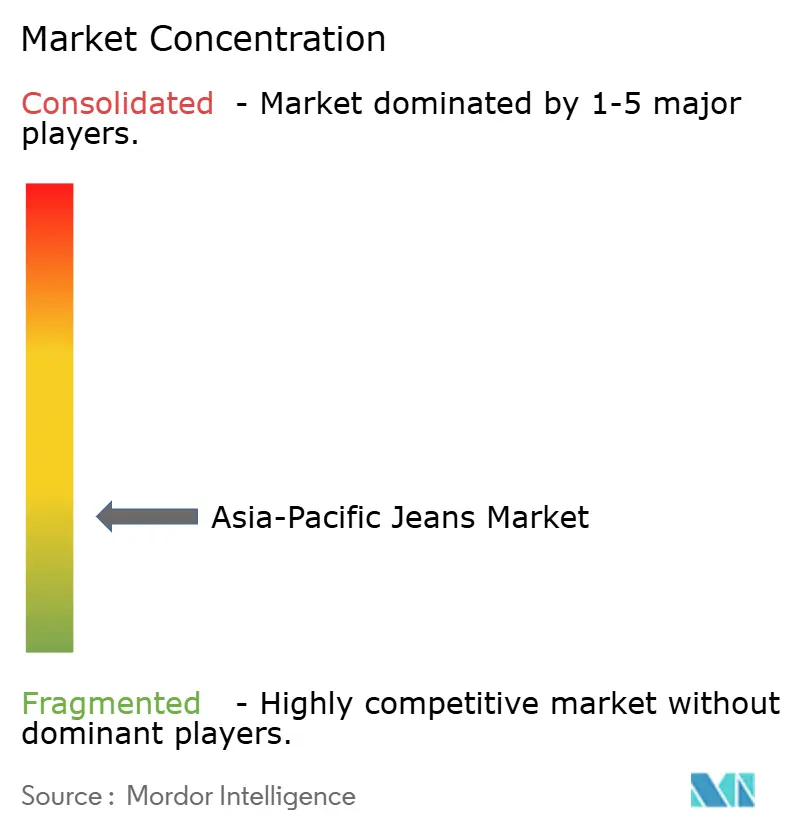
| Market Concentration | Low |
Major Players *Disclaimer: Major Players sorted in no particular order Image © Mordor Intelligence. Reuse requires attribution under CC BY 4.0. | |
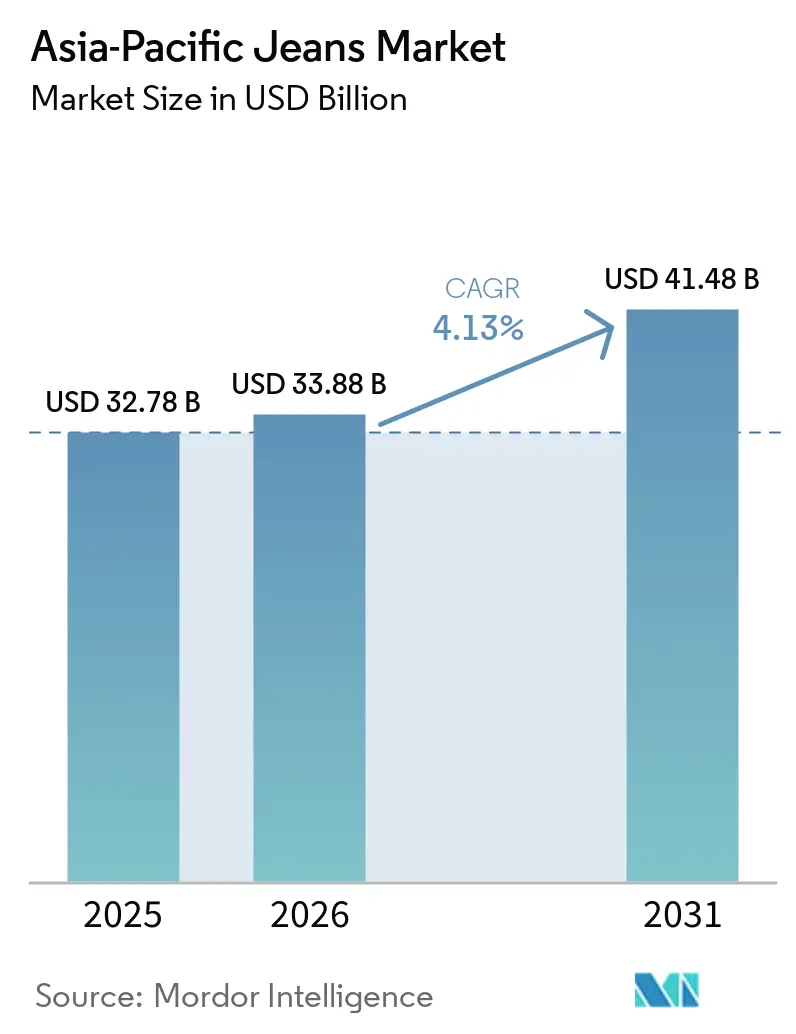
Asia-Pacific Jeans Market Analysis by Mordor Intelligence
The Asia-Pacific jeans market size was valued at USD 32.78 billion in 2025 and is forecast to reach USD 33.88 billion by 2026 and USD 41.48 billion by 2031, growing at a CAGR of 4.13% during the forecast period. The Asia-Pacific jeans market brings together mature retail economies such as Japan, South Korea, and Australia with faster-developing demand in India and Southeast Asia. Premium positioning is more established in the mature markets, while India and Southeast Asia continue to add first-time branded buyers. Retail conditions remain fragmented across the region, and consumer expectations differ widely across its national markets. Brands need separate approaches for urban aspirational shoppers and price-sensitive mass consumers. Premium direct-to-consumer formats and localized product ranges are becoming more important as the Asia-Pacific jeans market develops.
Key Report Takeaways
- By Type/Fit, Regular Fit held 24.37% revenue share in 2025, while Slim Fit recorded the highest projected CAGR at 4.75% through 2031.
- By End User, Men held 46.71% of the Asia-Pacific jeans market share in 2025, while Women's jeans recorded the highest projected CAGR at 5.11% through 2031.
- By Category, Mass held 65.17% revenue share in 2025, while Premium recorded the highest projected CAGR at 5.62% through 2031.
- By Distribution Channel, Specialist Stores held a 31.26% revenue share in 2025, while Online Retail Stores recorded the highest projected CAGR at 6.37% through 2031.
- By Geography, China held a 37.18% revenue share in 2025, while India recorded the highest projected CAGR at 6.28% through 2031.
Note: Market size and forecast figures in this report are generated using Mordor Intelligence’s proprietary estimation framework, updated with the latest available data and insights as of January 2026.
Market Trends and Insights
Drivers Impact Analysis of Asia-Pacific Jeans Market*
| Drivers | (~) % Impact on CAGR Forecast | Geographic Relevance | Impact Timeline |
|---|---|---|---|
| Rising Demand for Casual and Athleisure-Style Denim | +0.9% | APAC-wide, concentrated in India, South Korea, Thailand | Medium term (2-4 years) |
| Social Media and Influencer-Driven Fashion Trends | +0.8% | Southeast Asia, India, South Korea, Japan | Short term (≤ 2 years) |
| Stretch and Comfort-Fit Fabric Innovations | +0.7% | Japan, China, South Korea; spill-over to Southeast Asia | Medium term (2-4 years) |
| Growing Preference for Premium and Designer Jeans | +0.6% | China tier-1 cities, Japan, South Korea, urban India | Long term (≥ 4 years) |
| Expanding Private-Label and Direct-to-Consumer Brand Offerings | +0.6% | China, India, Australia, South Korea | Medium term (2-4 years) |
| Increasing Adoption of Sustainable, Eco-Friendly Denim | +0.5% | Japan, Australia, South Korea; early gains in India | Long term (≥ 4 years) |
| Source: Mordor Intelligence | |||
Rising Demand for Casual and Athleisure-Style Denim
Workplace casualization is moving jeans beyond occasional social use and into regular wardrobes across the Asia-Pacific jeans market. The shift is distinct from the substitution pattern often seen in Western markets, where athleisure can displace denim. In India, casualwear represented 31% of apparel consumption in 2025, and the domestic apparel sector is expected to increase from USD 95.7 billion in 2025 to USD 146.3 billion by 2029 at a 9% CAGR, according to the Clothing Manufacturers Association of India [1]. Men’s casualwear has a strong role in first-time branded purchases in Tier-2 and Tier-3 cities. Athleisure labels entering denim have reinforced consumer expectations for garments that combine comfort, stretch, and style. Denim producers that meet these expectations can address everyday demand rather than only occasion-based purchases.
Stretch and Comfort-Fit Fabric Innovations
Fabric technology has moved from a point of differentiation to a basic product requirement in the Asia-Pacific jeans market. Kaihara Corporation and NAGASE Group commercialized EnzyBlue, a recycled indigo dye created from discarded denim fibers, for a limited-edition EDWIN model in 2025. The development combines material circularity with product performance in a single denim offering. Lenzing AG, Kaihara Denim, and Asahi Kasei also introduced the SAISEI Collection, a stretch denim range using ROICA EF yarn and pre-consumer recycled content. ROICA EF yarn has 30% lower carbon dioxide emissions than conventional yarn, according to the companies. Slim Fit benefits from these advances because its fit and performance requirements align with high-tensile stretch fabrics.
Growing Preference for Premium and Designer Jeans
The premium category is forecast to grow at a 5.62% CAGR from 2026 to 2031, reflecting stronger demand from aspirational consumers. Japan serves as Levi Strauss & Co.’s Asia North Star for premium repositioning. Levi Strauss & Co. has shifted Japan from a largely wholesale business toward an operating model that is approximately 75% direct-to-consumer. The company stated that Japan revenue had increased nearly 50% since 2019. Stores in Nagoya, Shinjuku, and Harajuku rank among the company’s highest-volume locations globally. This direct-to-consumer approach is also being applied in India, South Korea, and Singapore, where experience-led stores perform differently from conventional wholesale channels.
Increasing Adoption of Sustainable, Eco-Friendly Denim
Sustainable denim is becoming more relevant to mainstream demand in the Asia-Pacific jeans market, particularly when environmental certification also signals quality. Crystal International’s Crystal Denim division introduced the CirClimate collection in June 2025 using 100% cellulosic fibers, including Eastman Naia Acetate Renew and TENCEL. The collection included compostable packaging and used a circular Design to Disappear concept for premium buyers in Japan, South Korea, and Australia. A 2025 cradle-to-grave lifecycle assessment found that eco-friendly denim manufacturing can reduce climate impact by up to 30% and water use by 64% compared with conventional processes [2]. Recover’s Vietnam facility supplies recycled cotton fiber used by Dawn Denim in Spring/Summer 2026 collections, with the collection reporting up to 99.9% lower water use. This supports Vietnam’s role as a regional circular-denim supply-chain location.
Restraints Impact Analysis of Asia-Pacific Jeans Market*
| Restraints | (~) % Impact on CAGR Forecast | Geographic Relevance | Impact Timeline |
|---|---|---|---|
| Intense Competition from Joggers and Leggings | -1.2% | APAC-wide, most acute in Southeast Asia and India | Short term (≤ 2 years) |
| Rapidly Changing Fashion Cycles Causing Inventory Risk | -0.9% | China, South Korea; spill-over to fast-fashion hubs | Medium term (2-4 years) |
| Fluctuating Cotton and Raw Material Prices | -0.7% | Global; APAC manufacturing nations most exposed | Medium term (2-4 years) |
| Strict Environmental Regulations on Dye Effluents | -0.5% | China (MEE protocols), India, Bangladesh | Long term (≥ 4 years) |
| Source: Mordor Intelligence | |||
Intense Competition from Joggers and Leggings
Competition from athleisure is uneven across the Asia-Pacific jeans market. The strongest displacement is in the sub-USD 30 price tier and among women aged 18-34 in South Korea, Thailand, and Singapore. These consumers often view athleisure as a credible lifestyle choice, and performance fabrics have reduced the practical gap between athleisure and denim. The impact has been strongest in mass-tier basics rather than in premium or mid-premium denim. Brands that invest in fit technology and fabric performance therefore have some protection from direct substitution. Younger consumers who adopt joggers and leggings as default casual clothing may have a lower affinity for jeans as they enter their peak spending years.
Fluctuating Cotton and Raw Material Prices
Cotton price volatility creates the greatest pressure on mass-tier producers in the Asia-Pacific jeans market. The mass category accounted for 65.17% of value in 2025, leaving a large share of the sector exposed to thin margins. Mass-tier brands have limited capacity to pass higher input costs to consumers without encouraging substitution toward synthetic alternatives. These brands also face rising costs as denim production changes across regional manufacturing locations. Companies without backward integration into fabric sourcing have fewer ways to manage the impact of raw-material changes. The pressure is greater when private-label rivals compete in the same value-oriented customer base.
*Our forecasts treat driver/restraint impacts as directional, not additive. The impact forecasts reflect baseline growth, mix effects, and variable interactions.
Asia-Pacific Jeans Market Segment Analysis
By Type/Fit:
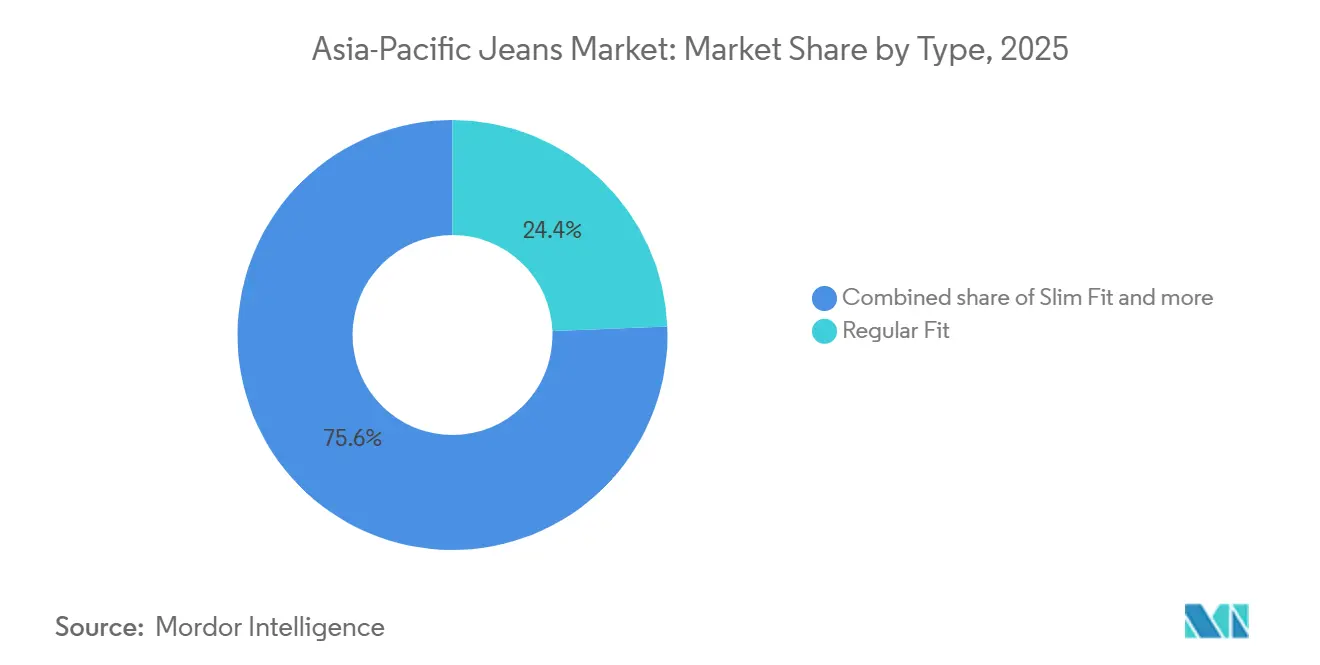
Regular Fit Anchors Volume as Slim Silhouettes Drive GrowthSlim fit is the fastest-growing Type/Fit segment, with the Asia-Pacific jeans market size for Slim fit projected to grow at a 4.75% CAGR from 2026 to 2031. Demand is supported by fashion preferences, casual workplace clothing, and functional fabric development in South Korea, Japan, and urban India. Fast Retailing’s UNIQLO supports volume growth through Slim-Straight and Skinny styles, using its Kaihara Denim partnership to provide fabric precision at mass-market price points. The segment relies on stretch materials that can maintain shape, movement, and comfort.
Regular fit held 24.37% of regional value in 2025. It remains established among middle-income consumers in China, Indonesia, and India because workwear-adjacent styling and accessible pricing make it a common first branded-jeans purchase. Stretch-cotton blends and selvedge finishes broaden its appeal in premium sub-tiers without moving too far from the needs of mass buyers. Regular fit continues to provide a stable volume base while narrower silhouettes gain momentum.

By End User:
Men Anchor Volume but Women's and Children's Segments Define Growth MomentumWomen’s jeans are projected to grow at a 5.11% CAGR from 2026 to 2031. Rising female labor force participation in India, Vietnam, and Indonesia, together with wider use of jeans as primary wardrobe apparel, supports this demand. Pepe Jeans India stated that womenswear represented 30% of its India revenue, compared with 65% in Europe, showing room for brands with women’s product capabilities. This growth reflects changes in work and lifestyle rather than a short fashion cycle.
Men accounted for 46.71% of market value in 2025, making the segment the largest end user group. Longer style cycles and standardized fit requirements support inventory planning, larger-scale production, and premium lifestyle positioning. Children’s jeans are also receiving more attention, and Levi’s Kids entered India through Apparel Group in 2025 to address a premium children’s category that international brands had historically served less extensively. The larger end user base gives brands a clear volume foundation, while women’s and children’s lines widen the opportunity set.
By Category:
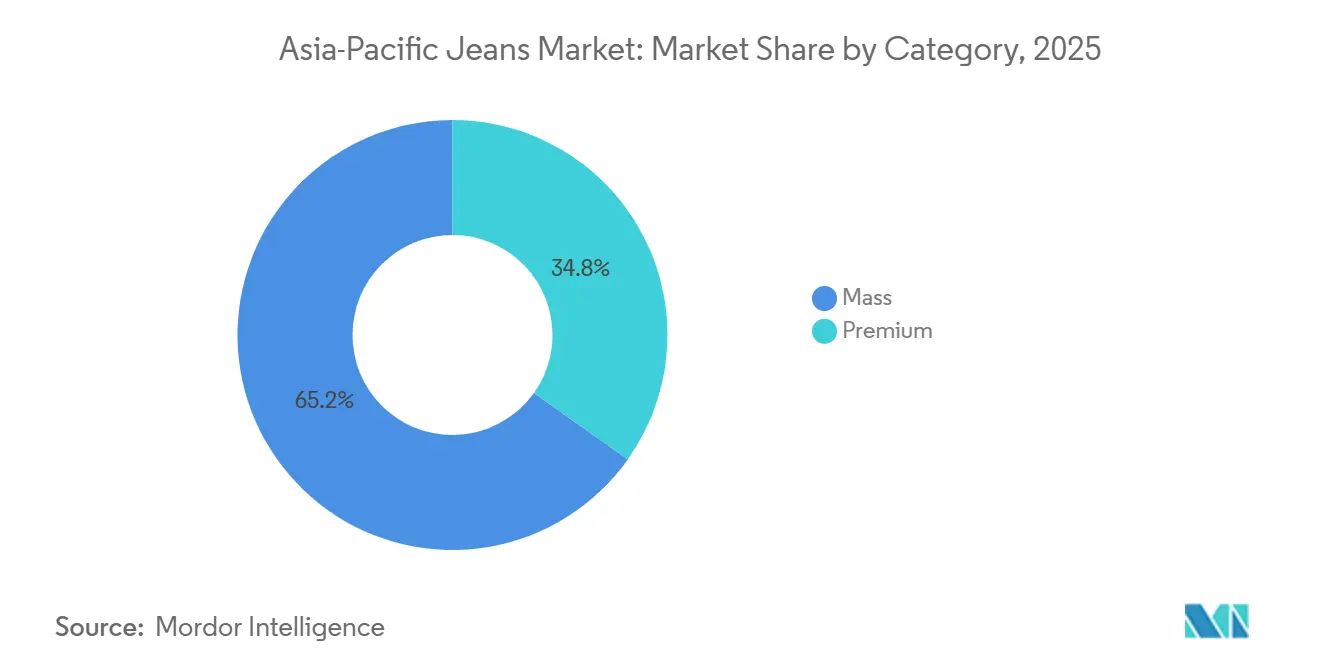
Mass Dominates Revenue as Premium Rewrites Margin EconomicsThe premium category has the highest category-level CAGR at 5.62% from 2026 to 2031. Its growth is tied to changing consumer expectations, and international labels see South and Southeast Asia as underpenetrated for premium denim. Premium direct-to-consumer stores provide product education, fit guidance, and a stronger brand experience. India, South Korea, and Singapore are receiving greater attention from premium brands in the Asia-Pacific jeans industry.
The mass category held 65.17% of regional value in 2025, supported by a broad middle-income consumer base and established Indian manufacturing clusters. The Ahmedabad, Bangalore, and Tirupur corridor produces 1.5-2 billion meters of denim fabric each year. Domestic private-label competition, higher input costs, and changing expectations in Tier-1 cities create pressure on the category. Product innovation must keep pace with consumers who expect comfort, better fit, and stronger value.
By Distribution Channel:
Specialist Stores Lead as Online Retail Reshapes the Channel StackOnline retail stores are forecast to grow at a 6.37% CAGR from 2026 to 2031, the highest rate among distribution channels. Mobile-first purchasing, algorithmic discovery, and platform ecosystems allow brands to reach Tier-2 and Tier-3 cities without physical retail infrastructure. Fast Retailing reported that e-commerce represented approximately 15% of UNIQLO sales in Japan and approximately 20% in Greater China and South Korea. The online share is expected to increase as logistics capacity and digital consumer engagement improve.
Specialist stores accounted for 31.26% of distribution value in 2025. Their position remains important because shoppers can assess fit, feel, and styling before purchasing, which can affect both conversion and returns. Curated store environments also help brands communicate their positioning in Japan, South Korea, and Australia. Specialist Stores retain a leading role even as online retail expands.
Geography Analysis
China Jeans Market
China held 37.18% of regional value in 2025, supported by its manufacturing base and advanced digital retail environment. Its consumer conditions are divided between premium direct-to-consumer demand and pressure in mid-tier wholesale channels. Greater China revenue declined 4% year over year to JPY 650.2 billion in fiscal year 2025, and Fast Retailing is moving its Mainland China operations to independent-store management. PVH Corp. reported Asia-Pacific revenue of USD 686.9 million in the first half of fiscal year 2025, compared with USD 742.3 million in the previous-year period, while China’s tighter dye and wastewater standards add to compliance needs for denim finishing. PVH CORP. These conditions make channel choice and supply-chain compliance important for brands operating in China.
India Jeans Market
India is the fastest-growing geography, with the Asia-Pacific jeans market size for India projected to increase at a 6.28% CAGR from 2026 to 2031. Branded-jeans adoption remains at an earlier stage than in China, with first-time buyers entering through mass-market and mid-premium channels. India’s apparel sector increased from USD 49.3 billion in 2020 to USD 95.7 billion in 2025, while rural consumers accounted for 58% of consumption, according to the Clothing Manufacturers Association of India. Levi Strauss & Co. reported double-digit direct-to-consumer growth in India in the third quarter of fiscal year 2025. Its entry into children’s denim indicates that international labels are also addressing segments historically left mainly to local suppliers.
APAC Jeans Market
Japan and South Korea remain reference markets for premium denim through selvedge craftsmanship, product quality, and rapid trend adoption. Indonesia and Vietnam are more volume-oriented and focused on mass-category demand, while Singapore and Thailand show stronger demand for premium and sustainable denim. Australia and New Zealand remain relevant for premium positioning. Other Asia-Pacific markets benefit from e-commerce access where physical retail infrastructure is less developed.
Competitive Landscape
The Asia-Pacific jeans market has a low concentration, as no individual international brand holds significant regional volume. National conditions vary from Japan’s selvedge-focused brand loyalty to Indonesia’s value-led mass demand, making regional strategies difficult to standardize. Levi Strauss & Co., PVH Corp.’s Calvin Klein, and Inditex’s Zara participate in premium and upper-mass categories, while Fast Retailing’s UNIQLO operates at the quality-mass intersection through its Kaihara fabric partnership. Levi Strauss & Co. reported that direct-to-consumer sales represented 46% of company revenue globally in the third quarter of fiscal year 2025. This channel shift is relevant for mid-tier brands evaluating their sales models.
Levi Strauss & Co. reported Asia net revenue of USD 277.7 million in the third quarter of fiscal year 2025, increasing 12% on both a reported and organic basis, while its Asia direct-to-consumer revenue increased 14% organically. Fast Retailing responded to weaker Greater China performance by moving to independent-store management in Mainland China. PVH Corp. identified China’s wholesale channel as the principal driver of the decline in its Asia-Pacific revenue in the first half of fiscal year 2025. These moves show why premium direct-to-consumer formats can perform differently from wholesale-dependent models. A single operating model is unlikely to serve all national markets equally well.
Opportunities remain in women’s premium-casual jeans in Southeast Asia, children’s branded denim across South and Southeast Asia, and certified sustainable denim in Japan, South Korea, and Australia. Domestic private-label labels in China use Tmall and Douyin to acquire consumers directly, while platform-native direct-to-consumer labels in India are expanding without traditional retail networks. China’s textile-quality standards and environmental compliance rules can increase denim-finishing costs in coastal manufacturing locations. These requirements favor brands with compliant, diversified supply chains.
Asia-Pacific Jeans Industry Leaders
-
Diesel S.p.A.
-
Gap Inc.
-
Levi Strauss & Co.
-
PVH Corp.
-
American Eagle Outfitters, Inc.
- *Disclaimer: Major Players sorted in no particular order
Asia-Pacific Jeans Market Companies Covered in this Report
- Levi Strauss & Co.
- Kontoor Brands, Inc.
- PVH Corp.
- Gap, Inc.
- H & M Hennes & Mauritz AB
- Industria de Diseño Textil, S.A. (Inditex)
- Diesel S.p.A.
- American Eagle Outfitters, Inc.
- Fast Retailing Co., Ltd.
- G-Star RAW
- AG Adriano Goldschmied
- Mavi Giyim Sanayi ve Ticaret A.Ş.
- Nudie Jeans Co.
- Fashion Box S.p.A.
- Guess?, Inc.
- True Religion Apparel, Inc.
- Big John Co., Ltd.
- Pepe Jeans Group, S.L.
- Western Glove Works
- Centric Brands LLC
Recent Industry Developments in Asia-Pacific Jeans Market
- December 2025: Levi's Kids launched in India through Apparel Group, entering the premium children's denim segment for the first time with planned national rollout across e-commerce marketplaces and standalone physical stores.
- October 2025: NAGASE Group commercialized "EnzyBlue," a recycled indigo dye made from discarded denim fibers, in collaboration with Kaihara Corporation. The product was adopted in a limited-edition EDWIN denim model, marking a commercial breakthrough for closed-loop material innovation in Japanese denim.
- June 2025: Crystal International's Crystal Denim division launched the CirClimate sustainable denim collection using 100% cellulosic fibers with compostable packaging, targeting premium buyers in Japan, South Korea, and Australia under a circular "Design to Disappear" concept.
Asia-Pacific Jeans Market Report Scope
Jeans are Trousers or Pants that Are Made From Denim or Dungaree Cloth. The Asia-Pacific Jeans Market is Segmented by Type/Fit (Regular Fit, Slim Fit, Skinny Fit, Bootcut, Flared, and Other Type/Fit), End User (Men, Women, and Children), by Category (Mass and Premium), by Distribution Channel (Supermarkets/Hypermarkets, Specialist Stores, Online Retail Stores, and Other Distribution Channels), and by Geography (China, Japan, India, Thailand, Singapore, Indonesia, South Korea, Australia, New Zealand, and Rest of Asia-Pacific). The Market Forecasts are Provided in Terms of Value (USD).
Segmentation Overview
By Type/Fit
| Regular Fit |
| Slim Fit |
| Skinny Fit |
| Bootcut |
| Flared |
| Other Type/Fit |
By End User
| Men |
| Women |
| Children |
By Category
| Mass |
| Premium |
By Distribution Channel
| Supermarkets/Hypermarkets |
| Specialist Stores |
| Online Retail Stores |
| Other Distribution Channels |
By Geography
| China |
| Japan |
| India |
| Thailand |
| Singapore |
| Indonesia |
| South Korea |
| Australia |
| New Zealand |
| Rest of Asia-Pacific |
| By Type/Fit | Regular Fit |
| Slim Fit | |
| Skinny Fit | |
| Bootcut | |
| Flared | |
| Other Type/Fit | |
| By End User | Men |
| Women | |
| Children | |
| By Category | Mass |
| Premium | |
| By Distribution Channel | Supermarkets/Hypermarkets |
| Specialist Stores | |
| Online Retail Stores | |
| Other Distribution Channels | |
| By Geography | China |
| Japan | |
| India | |
| Thailand | |
| Singapore | |
| Indonesia | |
| South Korea | |
| Australia | |
| New Zealand | |
| Rest of Asia-Pacific |
Key Questions Answered in the Report
What is the projected value of the Asia-Pacific jeans market by 2031?
The Asia-Pacific jeans market is forecast to reach USD 41.48 billion by 2031, growing at a 4.13% CAGR from its USD 32.78 billion value in 2025.
Which Asia-Pacific country is expected to grow fastest for jeans?
India is the fastest-growing geography, with a projected CAGR of 6.28% from 2026 to 2031.
Which jeans fit has the largest regional share?
Regular Fit held the largest Type/Fit share at 24.37% in 2025, while Slim Fit is forecast to grow at 4.75% CAGR.
Which sales channel is expanding fastest for jeans in Asia-Pacific?
Online Retail Stores are expected to grow at 6.37% CAGR through 2031.