
Market Overview
| Study Period | 2020 - 2031 |
|---|---|
| Forecast Data Period | 2026 - 2031 |
| Base Year Market Size (2025) | USD 15.99 Billion |
| Market Size (2026) | USD 17.79 Billion |
| Market Size (2031) | USD 30.56 Billion |
| Growth Rate (2026 - 2031) | 11.23 % |
| Market Concentration | Medium |
Major Players *Disclaimer: Major Players sorted in no particular order Image © Mordor Intelligence. Reuse requires attribution under CC BY 4.0. | |
Asia-Pacific Induction Motor Market Analysis by Mordor Intelligence
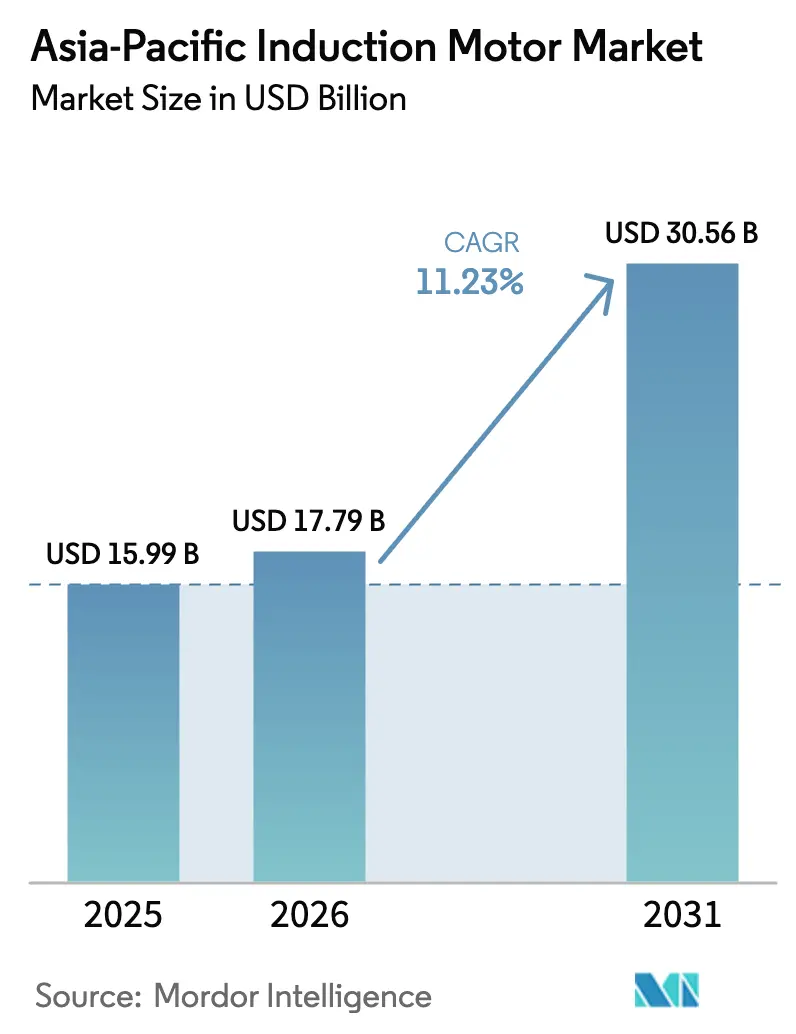
The Asia Pacific induction motor market size was valued at USD 15.99 billion in 2025 and estimated to grow from USD 17.79 billion in 2026 to reach USD 30.56 billion by 2031, at a CAGR of 11.23% during the forecast period (2026-2031). This robust outlook reflects a decisive shift toward energy-efficient electrification, accelerated spending on automation, and supportive policy frameworks that incentivize premium-class motors. Manufacturers are transitioning from reactive component replacement to proactive system-wide optimization, seeking operational savings and sustainability gains in tandem. Heightened electricity prices, intensified grid decarbonization targets, and expanding data-center footprints collectively reinforce demand for high-efficiency motors across industrial, commercial, and residential applications. Competitive dynamics are moving beyond hardware attributes to integrated motor-drive packages with embedded intelligence, creating fresh opportunities for suppliers that combine mechanical, electronic, and software capabilities.
Key Report Takeaways
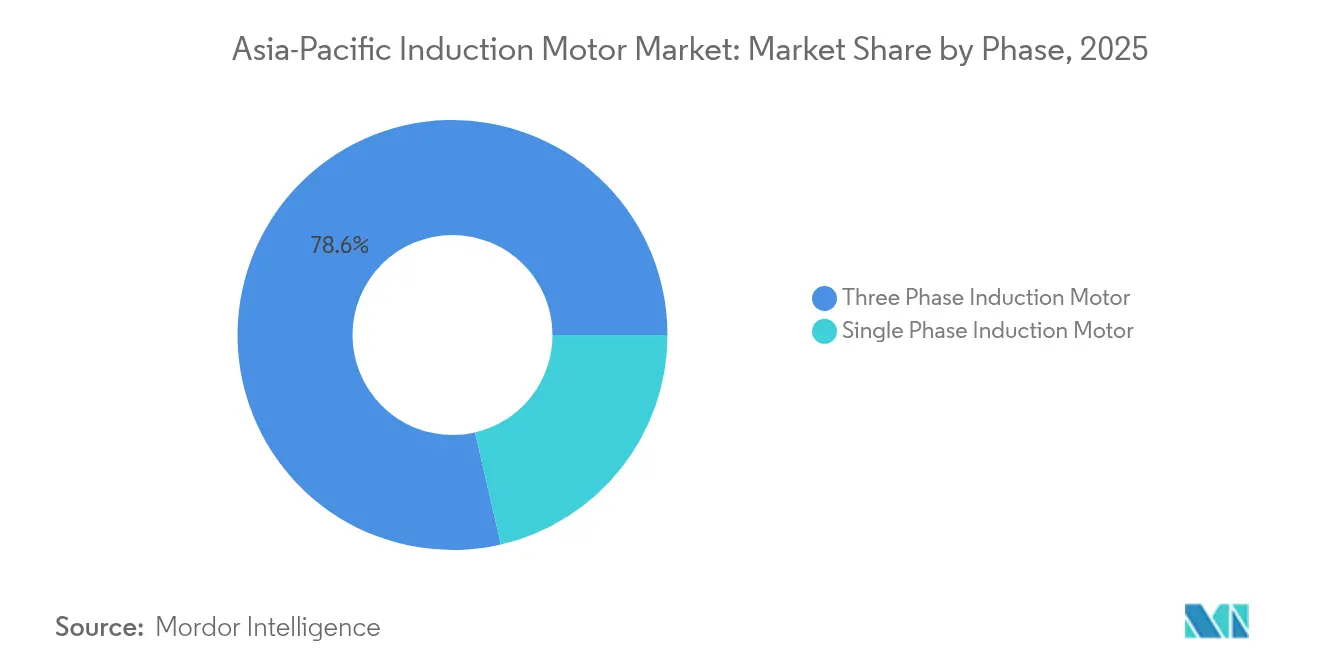
- By Phase, three-phase induction motors led with a 78.62% share of the Asia Pacific induction motor market in 2025, while single-phase variants are forecast to post a 12.93% CAGR through 2031.
- By Power Rating, the 0.5 kW – 7.5 kW power band accounted for 33.25% of the Asia Pacific induction motor market size in 2025; sub-0.5 kW ratings are expected to expand at a 11.52% CAGR to 2031.
- By Efficiency Class, IE2 motors held a 44.68% share of the Asia Pacific induction motor market size in 2025, whereas IE4 units are expected to advance at a 11.73% CAGR through 2031.
- By End-User Industry, power generation captured a 21.54% revenue share in 2025; HVAC applications are growing at the fastest rate, with a 11.31% CAGR until 2031.
- By Country, China dominated with a 37.02% share in 2025, but India is the fastest-growing geography, with an 11.47% CAGR through 2031.
Note: Market size and forecast figures in this report are generated using Mordor Intelligence’s proprietary estimation framework, updated with the latest available data and insights as of 2026.
Market Trends and Insights
Drivers Impact Analysis of Asia-Pacific Induction Motor Market*
| Driver | (~) % Impact on CAGR Forecast | Geographic Relevance | Impact Timeline |
|---|---|---|---|
| Increasing Need for Higher Energy Efficiency | +2.1% | China, Japan, Australia | Medium term (2-4 years) |
| Rising Demand for Power Savings in Residential and Industrial Sectors | +1.8% | Core Asia-Pacific, Southeast Asia | Short term (≤ 2 years) |
| Government Energy-Efficiency Mandates Across Asia Pacific | +1.5% | China, India, Japan, South Korea, Australia | Long term (≥ 4 years) |
| Accelerating Industrial Automation Investments | +2.3% | China, Japan, South Korea, Southeast Asia | Medium term (2-4 years) |
| Rapid Growth in Data Center Construction Across Southeast Asia | +1.2% | Singapore, Malaysia, Thailand, Indonesia, Vietnam | Short term (≤ 2 years) |
| Plug-and-Play IE4 Motor Retrofits in Brownfield Facilities | +0.9% | Japan, Australia, mature Chinese zones | Medium term (2-4 years) |
| Source: Mordor Intelligence | |||
Increasing Need for Higher Energy Efficiency
Utility demand-response programs, carbon pricing mechanisms, and corporate net-zero pledges elevate energy efficiency to the top of procurement criteria across the Asia Pacific induction motor market. Motor-driven systems consume nearly 45% of the world's power, making efficiency gains pivotal for grid stability and reducing emissions. Advances such as amorphous-metal cores and optimized magnetic circuits push efficiencies beyond IE4 levels. Hitachi’s radial-gap prototype achieves 95% efficiency at 20,000 rpm, while occupying one-fifth the volume of conventional motors.[1]Hitachi Ltd., “Radial-Gap Amorphous-Metal Motor Development,” Hitachi, hitachi.com Coupled with variable-frequency drives and smart control algorithms, these innovations yield rapid paybacks in energy-intensive sectors including mining, petrochemicals, and data processing. The convergence of economic and environmental incentives secures steady demand for premium-class motors over the medium term.
Government Energy-Efficiency Mandates Across the Asia Pacific
Regulatory standards are pivotal in steering the Asia Pacific induction motor market toward higher efficiency classes. China enforces IE3 as the minimum standard for most industrial applications, Japan’s Top Runner program continually raises benchmarks, and Australia mandates specific efficiency thresholds for motors exceeding 0.73 kW.[2]Ministry of Economy Trade and Industry, “Top Runner Program,” METI, meti.go.jp These policies trigger compliance-driven replacement cycles, compelling OEMs to integrate IE3 and IE4 motors into equipment destined for regulated markets. Harmonization discussions within ASEAN are pointing to the broader adoption of similar rules, which is expected to amplify demand for premium motors across Southeast Asia. Manufacturers that align product lines early capture share and reduce retrofit complexity for end users facing binding deadlines.
Accelerating Industrial Automation Investments
Asia hosts 70% of the global annual robot installations, led by China, which installed 276,288 units in 2023.[3]International Federation of Robotics, “Robot Density Nearly Doubled Globally,” IFR, ifr.org Automation elevates requirements for precision torque, rapid acceleration, and predictive diagnostics, attributes often lacking in legacy induction motors. Suppliers respond with sensor-rich designs and edge analytics that feed plantwide maintenance platforms, reducing unplanned downtime. Integrated servo packages and electronically commutated alternatives vie for a share, yet induction motors retain their appeal where ruggedness, cost, or high-temperature tolerance dominate the selection criteria. As factories digitalize, demand skews toward premium three-phase units paired with advanced drives, reinforcing CAGR momentum through 2030.
Rapid Growth in Data Center Construction Across Southeast Asia
Live data center supply in the region is forecasted to grow from 11.1 GW in 2023 to 26.7 GW by 2028. Cooling and power-back-up systems in hyperscale facilities deploy thousands of motors, making energy efficiency critical to achieving favorable power-usage-effectiveness scores. Operators increasingly specify IE4 or IE5 motors for chilled-water pumps, cooling-tower fans, and air-handling units, shifting bulk orders toward high-efficiency suppliers. Tropical climates magnify cooling loads, so motor upgrades deliver outsized operating-cost savings, reinforcing a secular demand driver for the Asia Pacific induction motor market.
Restraints Impact Analysis of Asia-Pacific Induction Motor Market*
| Restraint | (~) % Impact on CAGR Forecast | Geographic Relevance | Impact Timeline |
|---|---|---|---|
| Availability of Permanent-Magnet Synchronous Motor Alternatives | -1.4% | China, Japan, South Korea, parts of Southeast Asia | Medium term (2-4 years) |
| High Initial Cost of Premium-Efficiency (IE4) Induction Motors | -0.8% | Price-sensitive Southeast Asian and Indian markets | Short term (≤ 2 years) |
| Grid Instability in Emerging Economies Limiting Large-Motor Deployment | -0.6% | Indonesia, Philippines, Vietnam, rural India | Long term (≥ 4 years) |
| Inverter-Driven Harmonics Causing Early Motor Failures | -0.4% | High VFD-adoption industrial zones | Medium term (2-4 years) |
| Source: Mordor Intelligence | |||
Availability of Permanent-Magnet Synchronous Motor Alternatives
Permanent-magnet synchronous motors (PMSMs) boast higher power density and superior part-load efficiency, thereby eroding the induction motor's share in precision-speed applications. Chinese automaker GAC’s 98.5% efficient e-drive demonstrates PMSM performance advantages and cost convergence as rare-earth prices stabilize. In robotics and servo duties, PMSMs offer microsecond response times, along with smaller footprints, tilting buyer preference away from induction technology. Induction suppliers counter with hybrid designs and control-software enhancements, yet the competitive threat persists, particularly in premium power segments.
High Initial Cost of Premium-Efficiency (IE4) Induction Motors
IE4 motors carry a 20-30% price premium relative to IE2 units, challenging payback thresholds for small and medium-sized enterprises in Southeast Asia and India. Energy savings on sub-0.5 kW units are modest in absolute terms, extending breakeven periods beyond three years for many buyers. Budget limitations delay replacement cycles, allowing standard-efficiency motors to linger despite regulatory pressure. Financing schemes, utility rebates, and bundled service contracts partially offset sticker shock; however, the upfront cost remains a headwind for wholesale adoption of the highest efficiency tiers.
*Our forecasts treat driver/restraint impacts as directional, not additive. The impact forecasts reflect baseline growth, mix effects, and variable interactions.
Asia-Pacific Induction Motor Market Segment Analysis
By Phase:
Three-Phase Dominance Amid Single-Phase AccelerationThree-phase motors secured a 78.62% market share in the Asia Pacific induction motor market in 2025, underscoring their centrality to industrial operations that value balanced power delivery and robust torque. The Asia Pacific induction motor market size for three-phase units is expected to expand steadily as automation intensifies in manufacturing hubs. Single-phase motors, which hold the remaining 21.38%, are rapidly scaling across distributed manufacturing and residential automation, benefiting from their straightforward installation and compatibility with standard utility feeds.
Industrial robotics, precision machining, and conveyor systems continue to anchor three-phase demand, particularly in China, Japan, and South Korea. Conversely, the growth of small workshops, residential HVAC, and edge-computing installations in Southeast Asia propels single-phase uptake at a double-digit CAGR. Suppliers tailor marketing strategies by phase, promoting durability and control sophistication for three-phase buyers while emphasizing price and plug-and-play convenience for single-phase prospects.



By Power Rating:
Mid-Range Concentration With Edge-Computing GrowthThe 0.5 kW – 7.5 kW bracket commanded 33.25% of the Asia Pacific induction motor market size in 2025, reflecting its deployment across auxiliary pumps, compressors, and general-purpose machinery. Sub-0.5 kW units, though smaller in value, are projected to register an 11.52% CAGR as compact IoT devices and miniaturized HVAC systems proliferate.
High-power segments above 75 kW cater to large-scale mining, petrochemical, and power generation duties, yet modest capacity additions and a preference for efficiency upgrades over new builds cap their growth pace. In parallel, advances in magnetic materials and cooling techniques elevate power density, enabling lower-rating motors to perform tasks once reserved for larger frames. This evolution reinforces the twin-track growth narrative of the Asia Pacific induction motor market.
By Efficiency Class:
IE2 Leadership Challenged by IE4 InnovationIE2 units retained a 44.68% share of the Asia Pacific induction motor market size in 2025, buoyed by their cost-effectiveness and broad regulatory acceptance. However, IE4 motors are forecast to outpace all other classes at an 11.73% CAGR, catalyzed by utility incentives and stringent sustainability targets.
IE3 serves as the compliance minimum in many jurisdictions, securing steady demand where payback analysis discounts IE4 premiums. IE1 motors continue to decline as phase-out schedules tighten. OEMs like Grundfos have standardized IE4 motors in their pump lines, accelerating diffusion into downstream equipment markets. The efficiency class mix illustrates the gradual, policy-led migration toward super-premium designs across the Asia Pacific induction motor market.

By End-User Industry:
Power Generation Leads Amid HVAC SurgePower generation applications accounted for a 21.54% revenue share in 2025, leveraging high-duty motors for boiler feed, cooling, and emissions control. HVAC represents the fastest-growing end-use, advancing at 11.31% CAGR as data centers multiply and climate-control retrofits sweep Southeast Asia.
Chemical and petrochemical complexes maintain a stable demand for specialized motors resistant to corrosive environments, while metal and mining operations in Australia and Indonesia require rugged, high-horsepower units. Food and beverage processing, as well as water-treatment projects, broaden the addressable base, requiring hygienic and explosion-proof variants. These patterns underscore the Asia Pacific induction motor market’s expansion from heavy industry into service-oriented and infrastructure sectors.
Geography Analysis
China Induction Motor Market
China retained its leadership position with a 37.02% share of the Asia Pacific induction motor market in 2025, leveraging scale economies and local production depth. Government mandates and automation upgrades sustain demand for IE3 and IE4 motors, while export-oriented manufacturers sharpen price competition. WEG’s USD 62 million expansion in Chongqing highlights the company's continued confidence in the country’s long-term prospects.
APAC and Oceania Induction Motor Market
India is the fastest-growing territory, poised for an 11.47% CAGR through 2031, as “Make in India” initiatives, renewable energy rollouts, and smart city programs stimulate motor uptake across manufacturing and infrastructure. Local producers capitalize on cost-competitive fabrication and rising technical competencies, yet premium segments still attract imports from global brands. Japan and South Korea emphasize precision and efficiency, driving the adoption of advanced motor control in robotics and semiconductor fabrication. Southeast Asian nations-including Malaysia, Vietnam, and Thailand-benefit from the relocation of manufacturing and the burgeoning construction of data centers, which is escalating demand for high-efficiency HVAC motors. Australia and New Zealand focus on mining, agriculture, and renewable energy projects, which require durable motors suitable for harsh environments. Hyundai’s USD 479 million EV investment in Malaysia exemplifies the region’s growing appeal for motor-intensive production.
Regulatory Landscape
Energy-efficiency regulation continues to shape motor specifications across Asia-Pacific as authorities align Minimum Energy Performance Standards (MEPS) to IEC IE classes. China implemented GB 30254-2024 for high-voltage three-phase cage induction motors in April 2026, replacing the 2013 version and tightening the compliance bar for large industrial installations.
In Australia, the Energy and Climate Change Ministerial Council (ECMC) approved recommendations in May 2026 to update MEPS for three-phase cage induction motors, including expanding coverage down to smaller motors (0.12 kW) and lifting required efficiency levels (IE2 for small motors and IE3 for medium and large). India is also progressing its MEPS pathway, with the Bureau of Energy Efficiency (BEE) engaging stakeholders in May 2026 on shifting three-phase induction motor requirements from IE2 to IE3, reinforcing regional momentum toward premium-efficiency procurement and verification readiness (testing, labeling, and certification workflows).
Value Chain Analysis
The value chain covers upstream electrical steel, copper/aluminum conductors, die-cast rotors, insulation systems, bearings, housings, and power-electronics components (drives, sensors, connectivity), which increasingly determine inverter-duty performance. Motor OEMs and regional assemblers convert these inputs into standard and application-specific motors, then route products through direct industrial sales, distributors, and OEM channels (pumps, compressors, HVAC equipment, machine tools), while aftersales services (spares, rewinds, condition monitoring, and retrofit engineering) capture lifecycle value.
Downstream, system integrators and automation OEMs are raising demand for motor-drive packages, digital diagnostics, and verified efficiency documentation, shifting influence toward suppliers with application engineering and local service coverage. Capability investment in precision machining and automated assembly links directly to qualification outcomes, and in April 2026 TMT Automation Ltd. showcased high-precision CNC and automated loading/unloading at its Taichung facility to deepen partnerships with Japanese customers, indicating how manufacturing transparency and process capability help suppliers win higher-value industrial programs where reliability and repeatable quality matter alongside nameplate efficiency.
Competitive Landscape
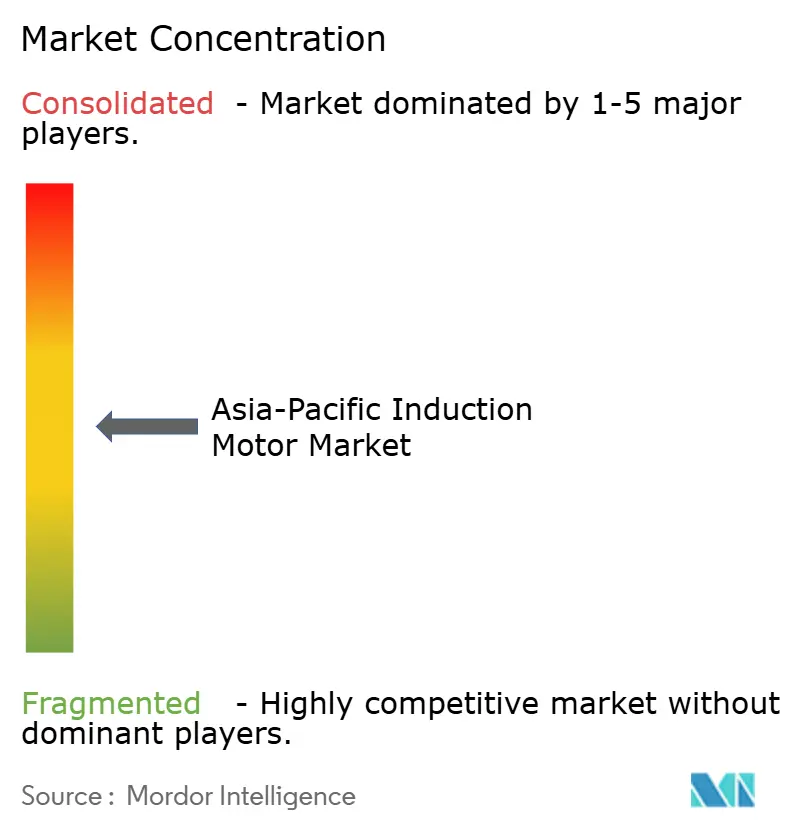
The Asia Pacific induction motor market exhibits moderate fragmentation, with the top five suppliers accounting for roughly 45% of the combined share. Meanwhile, numerous regional specialists and emerging Chinese entrants compete vigorously on cost and customization. ABB, Siemens, and Nidec lead premium-efficiency and large-horsepower niches, leveraging extensive R&D, global service networks, and proprietary drive technologies.
Regional manufacturers such as TECO, Kirloskar Electric, and CG Power focus on mid-range ratings, supplying local OEMs with cost-optimized solutions and agile lead times. Chinese newcomers employ vertical integration strategies and scale advantages to penetrate commodity segments across ASEAN and South Asia. Software-centric competitors introduce cloud-enabled condition monitoring and predictive analytics, blurring the distinction between hardware and digital services.
Strategic moves illustrate shifting battlegrounds. ABB and SKF Indonesia have forged a framework agreement that merges motor technology with bearing analytics to reduce downtime in energy-intensive plants. TECO partnered with Danfoss Taiwan to offer integrated motor-drive packages targeting 15-40% energy savings in mining operations. Such collaborations underscore a trend toward holistic value propositions that bundle motors, drives, sensors, and lifecycle services.
Asia-Pacific Induction Motor Industry Leaders
ABB Ltd.
Siemens AG
Nidec Corporation
Toshiba Mitsubishi-Electric Industrial Systems Corporation (TMEIC)
WEG S.A.
- *Disclaimer: Major Players sorted in no particular order
Asia-Pacific Induction Motor Market Companies Covered in this Report
- ABB Ltd.
- Siemens AG
- Nidec Corporation
- Toshiba Mitsubishi-Electric Industrial Systems Corporation (TMEIC)
- WEG S.A.
- Regal Rexnord Corporation
- Fuji Electric Co., Ltd.
- Kirloskar Electric Company Limited
- SEALOCEAN Motor Co., Ltd.
- TECO Electric and Machinery Co., Ltd.
- Hyundai Electric and Energy Systems Co., Ltd.
- CG Power and Industrial Solutions Limited
- Brook Crompton Asia Pacific Pte. Ltd.
- Leroy-Somer (Nidec Leroy-Somer Holding)
- Toshiba Corporation
- Mitsubishi Electric Corporation
- Schneider Electric SE
- Lafert Group S.p.A.
- Bharat Bijlee Limited
- Marathon Electric India Pvt. Ltd.

Market Opportunities and Future Outlook
Localization and dual-sourcing across Asia-Pacific are creating whitespace for suppliers that can qualify motors and components across multiple manufacturing bases while maintaining consistent efficiency and inverter-duty performance. A concrete signal is Changzhou Baojie Motors (CBM) opening an AC induction motor production facility in Thailand (Pinthong Industrial Park) in March 2026 to support alternate production for U.S.-bound programs, reflecting buyer demand for supply-chain flexibility, lead-time resilience, and trade-risk mitigation.
Premium-efficiency upgrades and motor-drive integration are also expanding the addressable solution scope beyond standalone motors. ABB’s announced USD 75 million investment program in India for 2026 includes induction motor manufacturing expansion in Vadodara and additional capacity for low-voltage drives and specialized motors in Peenya, aligning with demand for VFD-compatible motors used in automation, process industries, and energy-efficiency retrofits. With tighter MEPS trajectories in major markets (China, Australia, and India), these moves support opportunities in compliant IE3/IE4 portfolios, inverter-duty designs that address harmonics and insulation stress, and packaged offerings that combine motors, drives, and monitoring to shorten commissioning timelines and enable measurable energy savings.
Recent Industry Developments in Asia-Pacific Induction Motor Market
- June 2026: Siemens completed the sale of its Low Voltage Motors and Geared Motors businesses to Innomotics India Pvt. Ltd. for INR 2,200 crore. The transaction reshapes channel relationships and product stewardship for installed bases across India, while concentrating development and service execution under a motor-focused specialist.
- July 2025: Nidec inaugurated the Nidec Qingdao Industrial Park in Jiaozhou, China, a 108,000 square meter manufacturing site with capacity to produce 18 million motors annually. The added scale strengthens regional supply capability for high-volume motor demand and supports shorter lead times for OEM and industrial customers.
- May 2024: Nidec signed a memorandum of understanding with Taiwan’s Metal Industries Research & Development Centre (MIRDC) to collaborate on high-efficiency motor system products. The collaboration reinforces the shift toward system-level efficiency engineering (motor plus controls and application tuning) needed to meet tightening IE-class requirements and enterprise energy-reduction targets.


Asia-Pacific Induction Motor Market Report Scope and Research Methodology
Market Definition and Coverage
This market covers the value of induction motors sold and used across Asia-Pacific. It is counted as factory-built motor units supplied to industrial, commercial, and infrastructure applications where induction drive technology is specified.
Scope exclusions: We exclude after-sales labor services, standalone motor repair activities, and non-induction motor technologies (such as synchronous motors) when they are not sold as induction motor products.
Segments Covered in This Report
- By Phase
- Single Phase Induction Motor
- Three Phase Induction Motor
- By Power Rating
- Below 0.5 kW
- 0.5 kW – 7.5 kW
- 7.5 kW – 37 kW
- 37 kW – 75 kW
- Above 75 kW
- By Efficiency Class
- IE1 Standard Efficiency
- IE2 High Efficiency
- IE3 Premium Efficiency
- IE4 Super Premium Efficiency
- By End-User Industry
- Oil and Gas
- Chemical and Petrochemical
- Power Generation
- Water and Wastewater
- Metal and Mining
- Food and Beverage
- Discrete Manufacturing
- Heating, Ventilation and Air-Conditioning (HVAC)
- Other End-User Industries
- By Country
- China
- India
- Japan
- South Korea
- Australia and New Zealand
- Rest of Asia Pacific
Data Sources, Market Sizing, and Validation
Desk Research
Desk work started with building a clean picture of addressable motor demand across the region and mapping where purchases show up in public data. We used public sources such as International Energy Agency efficiency and electricity-use publications, UN Comtrade trade statistics for motor-related HS codes, World Bank and IMF macro series, and national statistics and energy agencies across major APAC economies for industrial output and infrastructure signals.
To make the model usable year to year, we also reviewed company annual reports, investor presentations, and press releases to understand product mix, capacity additions, and pricing direction. These were then cross-checked against reputable press and association updates. Where needed, we used paid subscriptions for company financials and intelligence, news and financials tracking, patent databases, and shipment-level import and export data to sanity-check volumes and timing. The sources listed here are illustrative, and other public and paid references were also used to collect, validate, and clarify inputs.
Primary Interviews and Surveys
Primary conversations were used to confirm demand drivers that do not show up clearly in public datasets, including procurement cycles, specification shifts, and how efficiency standards influence replacement demand. We spoke with motor makers, distributors, OEM buyers, and large end users across key APAC markets so assumptions on volumes, average selling prices, and mix by application could be pressure-tested before finalizing totals.
Distribution of primary research fieldwork respondents
| Company type | Respondent position |
|---|---|
| Top tier: 28% | CXOs: 16% |
| Mid tier: 54% | Functional/Unit leaders: 38% |
| Smaller Players: 18% | Managers: 46% |
Market-Sizing & Forecasting
Our sizing logic starts with a top-down build where industrial activity and investment signals are translated into motor demand pools, then split into new-build and replacement needs. In practice, production and trade data are used to reconstruct how many induction motors are being supplied into APAC. This supply view is then aligned to end-use signals such as manufacturing output, construction and infrastructure spend, and utility and water project activity.
Those totals are corroborated with selective bottom-up checks, mainly by rolling up sampled supplier revenues, channel checks on price bands, and an ASP x volume approach for common motor ratings when interview feedback was consistent. A few inputs mattered most in this market, including industrial production indices, motor-related import and export movements, energy-efficiency policy adoption (and enforcement timing), pricing shifts in copper and electrical steel, and the mix shift toward variable frequency drive-ready motors used in pumps, fans, compressors, and conveyors. Where direct volume build was thin for smaller countries, we filled gaps using proxy indicators like electricity consumption growth and manufacturing value-added, and then scaled results using the closest comparable markets.
For forecasting, scenario analysis was used so growth could be tied to observable drivers, including capex cycles, infrastructure awards, and replacement waves triggered by efficiency upgrades. The final forecast path was adjusted only after it matched expert expectations on lead times, procurement behavior, and realistic price progression in local currency before being converted to USD.
Data Validation & Update Cycle
We validate outputs by checking whether implied motor spending stays consistent with independent signals such as industrial electricity use, factory output trends, and trade flow direction, and then re-checking any sharp year-to-year movements. If a country result shows an unusual jump, the drivers are reviewed again, assumptions are revisited, and respondents are re-contacted when the variance cannot be explained by a clear policy, capex, or pricing event.
Before sign-off, the model goes through a multi-step internal review so calculations, unit handling, and currency timing remain consistent across countries. The report is refreshed annually, and interim updates are made when major events happen, such as policy changes tied to efficiency classes or meaningful shifts in commodity-driven motor pricing. Right before delivery, we do a last pass to ensure the latest public indicators and any new expert feedback are reflected.
Mordor Intelligence's Asia Pacific Induction Motor Market Size Versus Other Published Estimates
Published market numbers for APAC induction motors can vary, even when they appear to cover the same region. The spread usually comes from what is counted as an induction motor sale, how replacement demand is treated, and whether values are built from local currency pricing or from a single USD assumption.
The table shows a meaningful gap around the 2025 starting value, and in the Mordor Intelligence model the market is counted as induction motor product revenue in Asia-Pacific without adding adjacent AC motor categories or service-heavy repair revenues that can inflate totals. Differences can also come from how price progression is handled, since some estimates apply one regional ASP trend while others adjust by country mix and commodity-linked inputs. Timing of refresh matters when industrial capex turns quickly.
Benchmark comparison
| Source | Market Size | Gaps in Research Methodology |
|---|---|---|
| Mordor Intelligence | USD 15.99 B (2025) | |
| Regional Consultancy A | USD 18.40 B (2026) | Uses a later start year and appears to blend broader motor classes and higher price assumptions, which can lift the value when efficiency-driven replacement is treated as accelerated across all countries. |
| Industry Briefing B | USD 9.00 B (2024) | Likely reflects a narrower demand lens tied mainly to industrial automation use cases, with limited country coverage and conservative conversion to USD that can understate value in high-growth APAC markets. |
Looking across the three figures, most of the difference is explained by scope boundaries, year selection, and how ASPs and currency are carried through the model. By keeping inputs tied to observable supply and demand signals and then validating them with targeted bottom-up checks, the final number stays traceable to clear steps that can be repeated when new data arrives.


Key Questions Answered in the Report
How large is the Asia Pacific induction motor market in 2026?
The market is valued at USD 17.79 billion in 2026 and is forecast to reach USD 30.56 billion by 2031.
Which segment holds the highest share by phase?
Three-phase motors lead, accounting for 78.62% of market revenue in 2025.
Which efficiency class is growing fastest?
IE4 super-premium efficiency motors are advancing at an 11.73% CAGR through 2031.
Why is India the fastest-growing country for induction motors?
Manufacturing expansion, infrastructure projects, and supportive government programs are driving an 11.47% CAGR through 2031.
What factor most restrains premium motor adoption?
The 20-30% price premium of IE4 motors over IE2 alternatives lengthens payback periods for cost-sensitive buyers.
Which industries are boosting HVAC motor demand in Southeast Asia?
Rapid data-center construction and climate-control retrofits are propelling HVAC applications at an 11.31% CAGR through 2031.
Page last updated on:


 Your data is secure and never sold or shared.


