
Market Overview
| Study Period | 2020 - 2031 |
|---|---|
| Forecast Data Period | 2026 - 2031 |
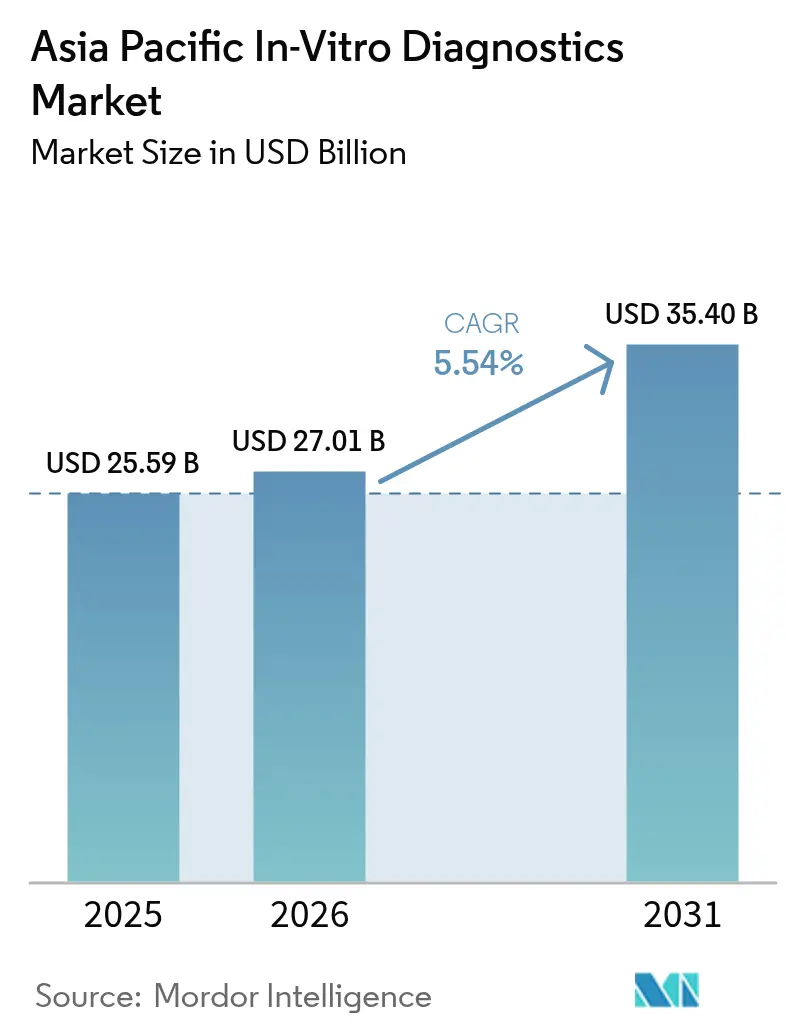
| Base Year Market Size (2025) | USD 25.59 Billion |
| Market Size (2026) | USD 27.01 Billion |
| Market Size (2031) | USD 35.4 Billion |
| Growth Rate (2026 - 2031) | 5.54 % |
| Market Concentration | Medium |
Major Players *Disclaimer: Major Players sorted in no particular order Image © Mordor Intelligence. Reuse requires attribution under CC BY 4.0. | |
Asia Pacific In-Vitro Diagnostics Market Analysis by Mordor Intelligence
Asia-Pacific in-vitro diagnostics market size in 2026 is estimated at USD 27.01 billion, growing from 2025 value of USD 25.59 billion with 2031 projections showing USD 35.4 billion, growing at 5.54% CAGR over 2026-2031. Robust healthcare spending, wider diagnostic reach, and a mounting chronic-disease burden underpin this steady trajectory. Rising government screening mandates, ageing populations, and industry-friendly localization incentives are opening profitable niches, while precision-medicine technologies—especially molecular assays—are changing competitive rules. Multinational and regional manufacturers are accelerating factory builds and digital upgrades to secure regulatory clearance faster, capture growth in Tier-2/3 cities, and serve the increasing preference for self-testing. Competitive intensity remains moderate, yet price pressure and quality concerns around ultra-low-cost reagents continue to shape procurement choices.
Key Report Takeaways
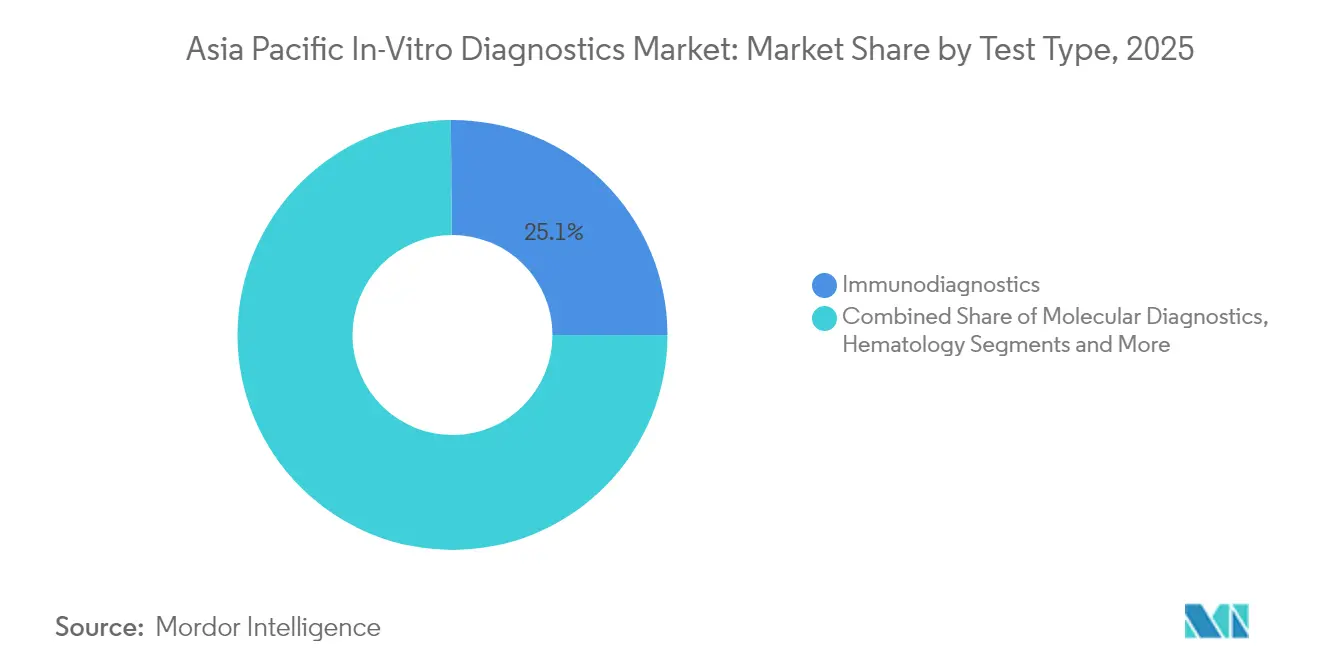
- By test type, immunodiagnostics led with 25.12% of Asia-Pacific in-vitro diagnostics market share in 2025; molecular diagnostics is projected to post the fastest 9.71% CAGR through 2031.
- By product, reagents and kits captured 59.65% of the Asia-Pacific in-vitro diagnostics market size in 2025, while software and services are advancing at an 11.07% CAGR between 2026 and 2031.
- By usability, reusable devices held 69.92% revenue share in 2025; disposable devices are forecast to expand at a 9.84% CAGR by 2031.
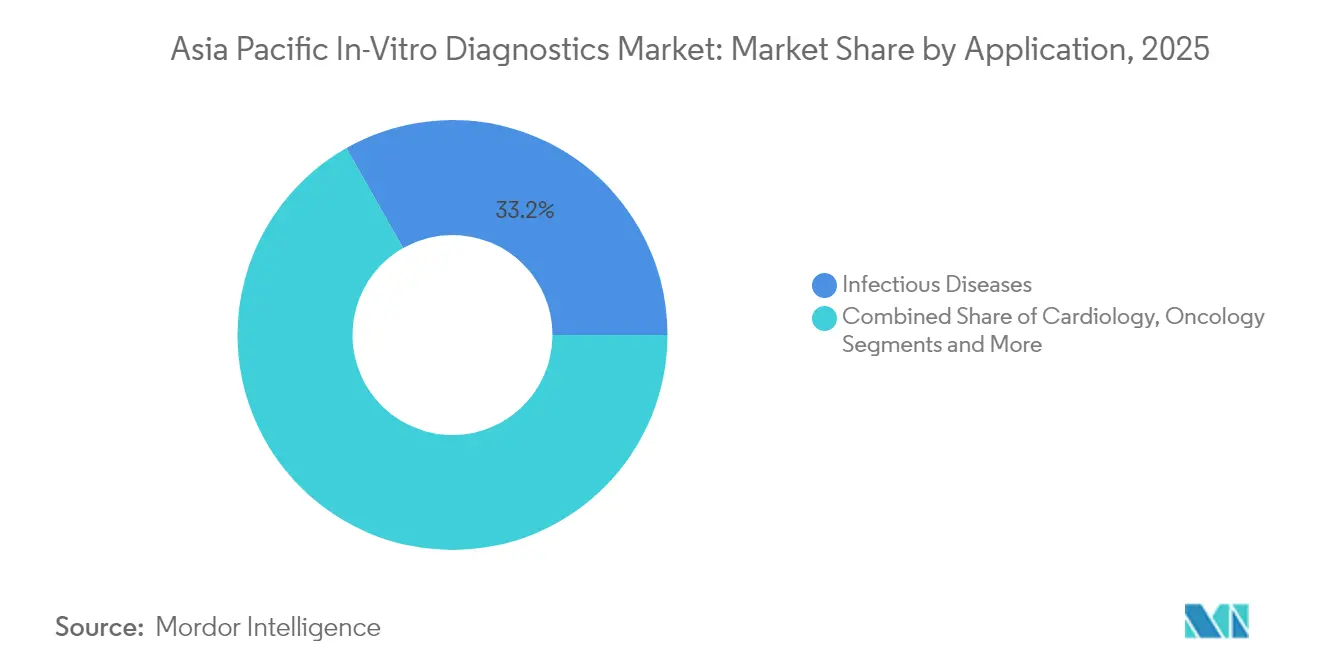
- By application, infectious-disease testing accounted for a 33.22% share of the Asia-Pacific in-vitro diagnostics market size in 2025, whereas oncology is growing at an 10.98% CAGR through 2031.
- By end user, diagnostic laboratories commanded 54.67% share in 2025 and home-care self-testing is expected to deliver a 12.06% CAGR over 2026-2031.
- By country, China dominated with 45.05% of regional revenue in 2025; India is on track for the strongest 11.68% CAGR to 2031.
Note: Market size and forecast figures in this report are generated using Mordor Intelligence’s proprietary estimation framework, updated with the latest available data and insights as of 2026.
Market Trends and Insights
Drivers Impact Analysis of Asia Pacific In-Vitro Diagnostics Market*
| Driver | (~) % Impact on CAGR Forecast | Geographic Relevance | Impact Timeline |
|---|---|---|---|
| Demographic ageing | +1.5% | Japan, China, South Korea, Southeast Asia | Long term (≥ 4 years) |
| Government cancer & infectious-disease screening | +1.2% | China, India, Australia, Thailand | Medium term (2-4 years) |
| Automated lab hubs in Tier-2/3 cities | +0.9% | India, China, Indonesia | Medium term (2-4 years) |
| Localization incentives for IVD manufacturing | +0.7% | India, China, Vietnam | Short term (≤ 2 years) |
| Rising diabetes & metabolic-syndrome burden | +0.5% | China, India | Long term (≥ 4 years) |
| Source: Mordor Intelligence | |||
Demographic ageing escalating demand for high-value diagnostics
Japan’s 65+ cohort reached 29.1% in 2024 and China’s elderly population is expanding 3.2% yearly, translating into higher volumes for oncology and cardiovascular assays. Health ministries are backing proactive detection to trim downstream treatment spending, with every USD 1 spent on early testing saving USD 3.4 in future care. Biomarkers such as pTau181 are entering routine workflows following the 2025 launch of Roche’s Elecsys pTau181 assay. Specialized geriatric diagnostics—Alzheimer’s, frailty panels, and cardio-renal markers—are beginning to form micro-segments that command premium pricing.
Government-mandated cancer & infectious-disease screening programs
China’s Healthy China 2030 initiative directed USD 8.7 billion to cancer-screening infrastructure in 2024, while India lifted diagnostic allocations by 43% for 2024-2025. Standardized nationwide protocols favor automated, high-throughput platforms and incentivize firms aligned with priority diseases. bioMérieux now channels 75% of its global R&D budget to antimicrobial-resistance assays to meet these public-health agendas[1]bioMérieux, “Universal Registration Document 2024,” biomerieux.com. Economic planners link screening coverage to labor-productivity gains, further embedding diagnostics in macro-development strategy.
Expansion of automated laboratory hubs into Tier-2/3 cities improving test accessibility
More than 450 automated labs opened across India’s smaller cities in 2024, slashing result turn-around by 62% and trimming per-test operating cost by 28%. China’s rural-health program ties subsidies to hub-and-spoke laboratory networks. These facilities centralize high-complexity testing, permit night-shift processing, and integrate cloud-based reporting dashboards for remote clinicians. Suppliers able to configure scalable, modular systems that fit mid-volume settings are winning sizeable framework bids.
Localization incentives drawing IVD manufacturing CAPEX
India’s Production Linked Incentive scheme earmarked USD 400 million for medical devices, triggering 17 IVD-plant announcements in 2024. Local manufacturing entitles suppliers to tender preferences and condenses import-license timelines. Sysmex began reagent and instrument production at its first India plant in April 2025 to reinforce hematology leadership. Comparable benefits exist in Vietnam’s high-tech parks, where land-use holidays and R&D tax credits attract mid-tier manufacturers.
Restraints Impact Analysis of Asia Pacific In-Vitro Diagnostics Market*
| Restraint | (~) % Impact on CAGR Forecast | Geographic Relevance | Impact Timeline |
|---|---|---|---|
| Lengthy multi-agency regulatory approvals | −0.8% | Japan, China, South Korea | Medium term (2-4 years) |
| Skills shortage in molecular & bio-informatics | −0.6% | India, Indonesia, Vietnam, Philippines | Short term (≤ 2 years) |
| Quality variability of ultra-low-cost reagents | −0.4% | India, China, Thailand | Short term (≤ 2 years) |
| Source: Mordor Intelligence | |||
Lengthy multi-agency regulatory approvals delaying product launches
Average clearance spans 18-24 months in Japan and 14-20 months in China, against 9-12 months for Western dossiers. Compliance outlays run 37% higher regionally, pushing smaller innovators to partner or concede share to multinationals that can field dedicated regulatory teams[2]Asia Pacific Medical Technology Association, “Regulatory Landscape of LDT in APAC,” apacmed.org. ASEAN’s harmonization roadmap shows progress, yet uneven national transposition slows benefits. Rapid-cycle technologies risk obsolescence before approval, compelling firms to sequence launches or adopt modular filings that can accommodate iterative upgrades.
Skills shortage in molecular and bio-informatics outside metropolitan laboratories
Regional labs lack roughly 45,000 qualified molecular technologists, constraining adoption of high-complexity assays. Talent premiums inflate wage bills 15-25%, nudging labs toward automation and AI-supported interpretation. Remote e-learning modules and cloud-based annotation services offer interim relief, while universities expand genomics curriculums. Roche’s cobas platforms illustrate simplified workflows that lower staffing thresholds and speed onboarding.
*Our forecasts treat driver/restraint impacts as directional, not additive. The impact forecasts reflect baseline growth, mix effects, and variable interactions.
Asia Pacific In-Vitro Diagnostics Market Segment Analysis
By Test Type:
Molecular Diagnostics Redefining Clinical PracticeImmunodiagnostics held 25.12% Asia-Pacific in-vitro diagnostics market share in 2025, reflecting entrenched use across infection control and chronic-disease monitoring. Molecular diagnostics is forecast for a 9.71% CAGR, dwarfing the broader 5.54% trend, and its Asia-Pacific in-vitro diagnostics market size contribution will climb steadily through 2031. Investment funnels into precision oncology and real-time pathogen surveillance, with PCR remaining the workhorse while next-generation sequencing moves downstream.
Point-of-care molecular platforms now deliver results in under an hour, vital for sepsis and respiratory triage. AI-augmented algorithms raise diagnostic accuracy by 28% when paired with molecular outputs. The COVID-19 infrastructure boom left a durable installed base, lowering entry barriers for broader assays. Suppliers that integrate multiplex capability, sample-to-answer simplicity, and cloud analytics are best placed to win micro-lab and emergency-department budgets.



By Product:
Software Integration Driving Value CreationReagents and kits provided 59.65% of revenue in 2025 thanks to repeat-purchase economics inherent in testing workflows. Instruments remain critical, yet software and services will compound at 11.07% annually and account for a rising slice of Asia-Pacific in-vitro diagnostics market size. Laboratories demand cloud laboratory-information systems, middleware analytics, and AI-driven decision support to convert raw data into actionable care insights.
Roche’s 2025 cobas roadmap embeds machine-learning modules that flag utilization gaps and recommend test panels, helping facilities balance cost and clinical yield. Subscription models tied to uptime guarantees and continuous algorithm upgrades broaden recurring revenue streams. Interoperability with electronic medical records and payer portals has become a key tender criterion, advantaging vendors that champion open-API strategies.
By Usability:
Disposable Devices Expanding Access PointsReusable analyzers dominated with 69.92% share in 2025, but disposable devices will outrun aggregate growth at a 9.84% CAGR. Microfluidic cartridges now host multiplex molecular and immunoassay chemistries, bringing lab-grade accuracy to physician offices, retail clinics, and homes. Reduced maintenance, no calibration flows, and biosafety convenience underpin clinical uptake.
Infectious-disease screening benefits strongly; single-use molecular panels for influenza and RSV entered mainstream pediatric practice after pandemic-era evaluation. BioMérieux’s 2024 acquisition of SpinChip provides edge-printed microfluidic disposables capable of running enzyme assays in <15 minutes. Sustainable materials and smart-chip recycling solutions are emerging to counter environmental cost criticisms.
By Application:
Oncology Driving Precision Medicine AdoptionInfectious-disease testing held 33.22% of 2025 revenue, yet oncology diagnostics will post an 10.98% CAGR to 2031, almost double the Asia-Pacific in-vitro diagnostics market growth pace. Liquid biopsy advances allow early relapse detection and therapy monitoring without invasive tissue sampling. Comprehensive genomic panels and companion diagnostics underpin personalized treatment, with breast, lung, and colorectal cancers the early beneficiaries.
AI-assisted pattern recognition across imaging and molecular datasets yields 31% higher early-stage discovery rates. Payers gradually reimburse high-value genomics after cost-effectiveness evidence accumulates. Vendors offering end-to-end oncology solutions—from screening through minimal residual disease monitoring—will consolidate loyalty among leading cancer centers.
By End User:
Self-Testing Revolution Transforming Care ModelsDiagnostic laboratories processed 54.67% of volumes in 2025, leveraging bulk purchasing and sophisticated robotics. Home-care and self-testing, however, will accelerate at 12.06% CAGR, unlocking new Asia-Pacific in-vitro diagnostics market potential. Smartphone-linked lateral-flow cassettes and Bluetooth glucose readers demonstrate how consumer electronics ecosystems absorb health functions.
The FDA’s 2025 Home as a Health Care Hub guidance catalyzes device designs prioritizing intuitive app interfaces and remote physician oversight. Roche’s Accu-Chek SmartGuide pairs continuous glucose reading with AI-generated coaching, highlighting how hardware, software, and behavioral nudges interlock. National insurers explore reimbursements for validated self-tests that lower emergency visits and enable population-level surveillance.
Geography Analysis
China In-Vitro Diagnostics Market
China captured 45.05% of the Asia-Pacific in-vitro diagnostics market in 2025, anchored by vast population, hospital digitization, and strategic policy such as tender bundling for high-throughput systems. Despite near-term price caps that squeezed margins for multinationals, ongoing NMPA reforms promise streamlined pathways for localized production and innovative assays. Rural diagnostics networks supported by 5G cloud links extend testing far beyond megacities.
APAC In-Vitro Diagnostics Market
India is the growth pacesetter at a 11.68% CAGR. Government PLI incentives, rising insurance coverage, and public-private lab chains fuel double-digit revenue expansion. Immunology demand is set to double from INR 160 billion to INR 320 billion within the decade, signaling lucrative viral-hepatitis and auto-immune test segments. Urban dominance persists, but hub-and-spoke rollouts plus mobile vans gradually shrink rural diagnostic gaps. Japan and South Korea remain high-value markets thanks to affluent ageing demographics, automated mega-labs, and a culture of preventive screening. Australia’s strong evidence-based procurement sustains premium pricing for precision assays, while Indonesia, Thailand, and Vietnam climb from low bases with infrastructure upgrades and donor-backed disease programs. Hong Kong’s InnoLife Healthtech Hub positions the city as an R&D and finance gateway for regional genomics start-ups.
Regulatory Landscape
Asia-Pacific IVD access continues to be shaped by risk-based authorization models and country-by-country evidence requirements, with approval timelines remaining a key constraint (commonly 18-24 months in Japan and 14-20 months in China as reflected in the report context). Australia keeps a structured pathway through the Therapeutic Goods Administration (TGA), where IVDs must meet safety, quality, and performance requirements for inclusion in the Australian Register of Therapeutic Goods (ARTG), and the depth of assessment varies by risk classification and the strength of conformity assessment evidence. India operates a risk-based framework under the Medical Device Rules, alongside efforts to strengthen regulatory capacity and clarify requirements across IVD classes.
At the regional level, regulatory convergence work is becoming more visible through reliance and harmonization initiatives. APACMed tracks formal regulatory reliance pathways across multiple APAC economies (including Australia, India, Singapore, Malaysia, Thailand, Vietnam, and the Philippines), supporting abridged routes that can leverage prior approvals and overseas clinical evidence where accepted. Industry and academic-led platforms such as Duke-NUS Centre of Regulatory Excellence programs (including CREATING initiative work) also help keep regulator-manufacturer dialogue active on faster, more consistent market access, including Laboratory Developed Tests (LDT) governance where fragmentation complicates multi-country launch planning.
Competitive Landscape
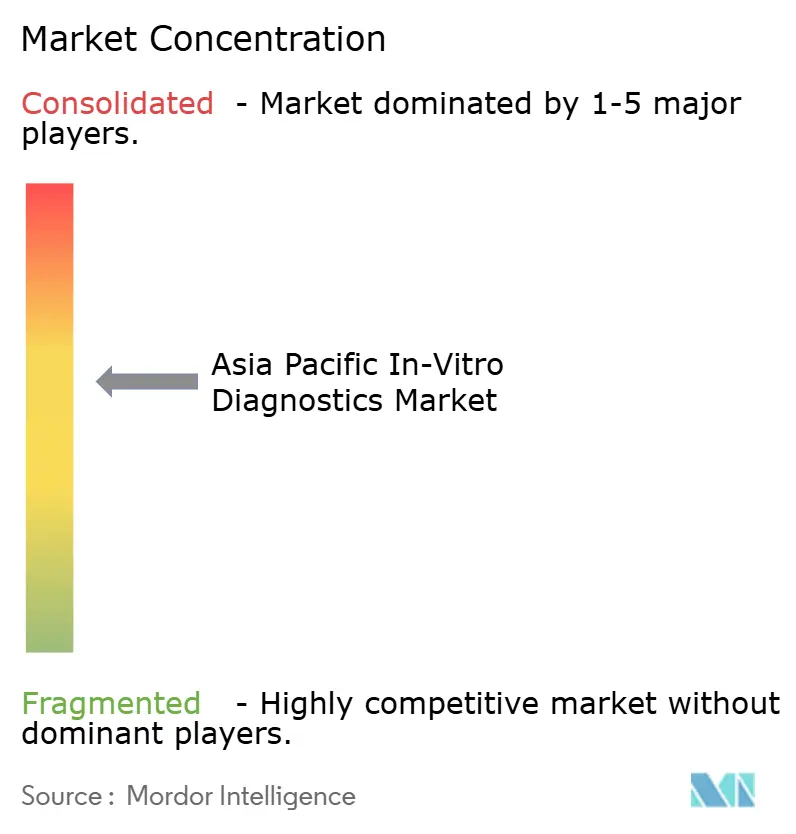
Roughly 200 manufacturers vie for a share; the top 10 control a significant share, indicating moderate concentration. Abbott, Roche, and Siemens Healthineers leverage wide portfolios and service networks to lock multi-year reagent contracts. Mindray and Seegene exploit cost agility and local insight to penetrate mid-tier hospitals. Localization of manufacturing—e.g., Sysmex’s 2025 India plant—reduces tariffs and wins public tenders stipulating domestic value addition.
Molecular and point-of-care segments see brisk product launches and smaller players introducing niche platforms, spurring faster turnover of technology cycles. Integration of software analytics into instruments adds new barriers to entry; vendors capable of combining assay chemistry with AI dashboards achieve sticky customer relationships. Partnerships between diagnostics firms and tele-health platforms signal future ecosystem plays where test results trigger automated care pathways.
Regulatory navigation remains a differentiator. Advantaged firms pre-engage with agencies, leverage real-world evidence for conditional filings, and adopt modular submissions to shorten time-to-market. Pricing reform pressures compel innovation in value-based contracting, bundling reagents, service, and data analytics for outcome-linked payments, particularly in oncology and diabetes management.
Asia Pacific In-Vitro Diagnostics Industry Leaders
Siemens Healthineers AG
bioMérieux SA
Thermo Fisher Scientific
F Hoffmann-La Roche Ltd
Abbott Laboratories
- *Disclaimer: Major Players sorted in no particular order
Asia Pacific In-Vitro Diagnostics Market Companies Covered in this Report
- Abbott Laboratories
- Roche
- Danaher
- Siemens Healthineers
- Thermo Fisher Scientific
- bioMérieux
- Sysmex
- QIAGEN
- Beckton Dickinson
- Bio-Rad Laboratories
- Arkray
- Tosoh
- QuidelOrtho
- Agilent Technologies
- Mindray
- Seegene
- DiaSorin S.p.A. (Luminex)
- Genrui Biotech Inc.
- Werfen Life Diagnostic
- Fujirebio Holdings Inc.
- Meril Life Science
Read Analysis of Asia Pacific In-Vitro Diagnostics Companies

Market Opportunities and Future Outlook
Two near-term whitespace areas are widening around (1) software-enabled workflow integration for laboratories and (2) population-scale genomics and proteomics programs that lift demand for standardized sample handling, biobanking, and high-throughput testing. Thermo Fisher Scientific’s December 2025 expansion of bioprocessing design centers in Hyderabad (India), Incheon (South Korea), and Singapore points to continued capital deployment into Asia-based capability hubs that support local assay development, validation, and scale-up. In 2026, Thermo Fisher also announced collaboration with Singapore’s PRECISE-SG100K to advance population-scale proteomics and biobanking, reinforcing pull for tools, services, and companion workflows that connect sample logistics to downstream molecular readouts.
A second opportunity set sits at the intersection of regulatory modernization and public-health resilience. Companies that build dossiers and quality systems for multi-market submissions can use reliance pathways and structured authorization routes (for example, TGA ARTG inclusion processes in Australia) to limit rework across countries. APACMed has prioritized diagnostics capacity building aligned with World Health Assembly Resolution 76.5, and has promoted more consistent value-assessment approaches for diagnostics, which creates room for evidence packages that link test performance to pathway outcomes, not only unit price. Within this operating environment, regional manufacturing and localization incentives already visible in the report context (including India’s medical-device PLI scheme) pair with these policy pushes to support differentiated strategies in Tier-2/3 access expansion, self-testing ecosystems, and higher-complexity molecular menus, where training and digital decision support can be bundled into procurement.
Recent Industry Developments in Asia Pacific In-Vitro Diagnostics Market
- May 2026: Roche Diagnostics and AstraZeneca signed a three-year memorandum of understanding to accelerate adoption of AI-powered digital and computational pathology across nine Asia-Pacific markets. The collaboration focuses on advanced pathology use cases in breast and lung cancer, reinforcing a shift toward software-linked diagnostics and more standardized workflows across multi-country provider networks.
- November 2025: Siemens Healthineers outlined plans to launch 30 new assays for the Atellica Solution and Atellica CI analyzers during 2026, spanning areas such as brain health, liver disease, cardiometabolic conditions, infectious disease, cancer, and reproductive health. A broader on-system assay menu supports account retention in high-throughput labs and strengthens the reagent pull-through model that underpins recurring IVD revenues.
- April 2024: APACMed continued to advance regional workstreams on IVD policy and regulatory affairs, including tools that track regulatory reliance pathways across multiple Asia-Pacific economies. These efforts support more predictable multi-country launch sequencing for manufacturers and can reduce duplicative evidence generation when national authorities recognize formal reliance mechanisms.


Asia Pacific In-Vitro Diagnostics Market Report Scope and Research Methodology
Market Definition and Coverage
This market covers the total value of in vitro diagnostic (IVD) testing used to screen, detect, and monitor diseases in Asia Pacific, counted through sales of IVD products and related services used in labs and near-patient settings.
Scope exclusions: It excludes imaging diagnostics, research-only reagents not used for clinical testing, and purely therapeutic devices.
Segments Covered in This Report
- By Test Type
- Clinical Chemistry
- Molecular Diagnostics
- Immunodiagnostics
- Hematology
- Coagulation
- Microbiology
- Urinalysis
- By Product
- Instruments
- Reagents & Kits
- Software & Services
- By Usability
- Disposable IVD Devices
- Reusable IVD Devices
- By Application
- Infectious Diseases
- Diabetes
- Oncology
- Cardiology
- Autoimmune Diseases
- Nephrology
- Respiratory Diseases
- Other Applications
- By End User
- Diagnostic Laboratories
- Hospitals & Clinics
- Academic & Research Institutes
- Home Care & Self-testing
- By Country
- China
- Japan
- India
- Australia
- South Korea
- Rest of Asia-Pacific
Data Sources, Market Sizing, and Validation
Desk Research
Desk work starts by building a fact base on testing demand and supply, before any model is finalized. We use public health and health-system signals that explain why test volumes move, such as surveillance updates, screening guidelines, and lab capacity additions.
Typical sources reviewed include government health ministries and statistical offices across Asia Pacific, World Health Organization updates, World Bank health indicators, and peer-reviewed clinical journals on test utilization and sensitivity trends. We also use customs or trade statistics when available, because they can show where IVD instruments and key reagents are tracked by country.
Company annual reports, investor presentations, and trusted press coverage help us interpret pricing direction and product mix shifts, for example reagents versus instruments, and the practical rollout timing by country. Where needed, we use paid subscription sources for company financial details and a patent database to cross-check product pipelines and the likely revenue exposure by segment. Sources above are illustrative only, and other public and licensed references are used for data collection, validation, and clarification.
Primary Interviews and Surveys
Primary inputs are gathered through expert interviews and structured surveys with laboratory directors, hospital procurement teams, distributors, and IVD product specialists across key Asia Pacific countries. These discussions test assumptions on test volumes, replacement cycles for analyzers, reagent consumption patterns, and the pace of adoption for areas such as molecular diagnostics. Findings are then used to refine the model outputs for each country, including how fast instruments convert into recurring reagent usage.
Distribution of primary research fieldwork respondents
| Company type | Respondent position |
|---|---|
| Top tier: 31% | CXOs: 14% |
| Mid tier: 51% | Functional/Unit leaders: 27% |
| Smaller Players: 18% | Managers: 59% |
Market-Sizing & Forecasting
Sizing starts with a top-down build where healthcare testing demand is reconstructed country by country using indicators that connect directly to IVD use, and then rolled up to an Asia Pacific total. Inputs typically include infectious disease testing intensity, chronic disease screening coverage (such as diabetes monitoring needs), the installed base and replacement cycle for core lab analyzers, reagent-to-instrument revenue mix, and country-level pricing and reimbursement pressure that shifts average selling prices.
Once the total is formed, we corroborate it with selective bottom-up checks, such as sampled supplier revenue splits by geography, distributor feedback on instrument placements, and volume-times-price calculations for high-usage test areas. Where disclosures are incomplete, gaps are handled using peer benchmarks and country mix logic, which are revisited during interviews.
For forecasting, scenario analysis is used so the trajectory reflects realistic ranges in public screening programs, hospital and lab spending, and adoption speed for newer test technologies. The final path is selected after experts confirm that assumptions fit procurement cycles and lab throughput constraints across the region.
Data Validation & Update Cycle
Outputs are validated through multiple checks so the numbers stay consistent with real-world signals. We compare modeled totals against independent indicators such as reported diagnostic activity trends, import patterns for instruments, and stated expansion plans for lab networks, then investigate and correct unusual jumps when they conflict with other evidence.
Before sign-off, the model goes through step-by-step analyst review, with re-contacts triggered when a country assumption or pricing trend looks inconsistent with interview feedback. Reports are refreshed annually, and interim updates are made when material events occur, including major guideline changes or sharp currency and input-cost swings. Right before delivery, a final review pass is completed so clients receive the latest updated view for the Asia Pacific market.
Mordor Intelligence's Vitro Diagnostics Asia Pacific Market Size Compared Against Other Published Estimates
Published market sizes for Asia Pacific IVD can look far apart because the scope is not always aligned and the same year is not always used. Differences usually come from what gets counted as IVD value, how instruments versus reagents are treated, and how quickly pricing and mix are refreshed.
In practice, the biggest gaps show up when some estimates lean on older base years, assume a faster or slower shift toward molecular diagnostics, or include adjacent categories like research-use-only supplies and broader laboratory services without a clean cut. Currency conversion timing and whether country-level validation is done with local buyers also changes the total, especially when demand is concentrated in a few large markets.
Benchmark comparison
| Source | Market Size | Gaps in Research Methodology |
|---|---|---|
| Mordor Intelligence | USD 25.59 B (2025) | |
| Trade Journal A | USD 16.22 B (2023) | Uses an earlier base year and tends to emphasize current demand signals, which can understate later-period reagent growth and the post-2023 recovery in testing volumes in some countries. |
| Industry Bulletin B | USD 34.20 B (2025) | Appears to apply broader inclusions and higher assumed pricing levels across the region, and it provides limited transparency on how instruments, reagents, and software or services are separated. |
The spread mainly comes down to year selection and what is treated as in-scope IVD revenue, plus how pricing and country mix are updated. By keeping the count tied to clinical IVD products and related software or services, and by stress-testing country-level assumptions with channel and lab feedback, the estimate stays traceable to repeatable steps, which is the approach applied by Mordor Intelligence.


Key Questions Answered in the Report
How large is the Asia-Pacific in-vitro diagnostics market in 2026?
The market is valued at USD 27.01 billion in 2026 and is forecast to reach USD 35.4 billion by 2031.
Which test type is expanding the fastest across Asia-Pacific?
Molecular diagnostics is growing at a 9.71% CAGR due to wider precision-oncology and infectious-disease use cases.
Why is India considered the most dynamic market within Asia-Pacific?
India's 11.68% CAGR stems from large infrastructure investments, supportive manufacturing incentives, and rising disease awareness.
How are regulations affecting product launch timelines?
Multi-agency approvals in Japan and China extend launch timelines to 14-24 months, increasing compliance costs and favoring firms with dedicated regulatory teams.
Which companies recently expanded manufacturing in the region?
Sysmex opened a new Indian plant in April 2025, and Roche gained approvals for its SBX sequencing system in Japan and Australia in February 2025.
Page last updated on:


 Your data is secure and never sold or shared.


