
Asia-Pacific Data Center Real Estate Market Size and Share
Market Overview
| Study Period | 2020 - 2031 |
|---|---|
| Forecast Data Period | 2026 - 2031 |
| Base Year Market Size (2025) | USD 20.63 Billion |
| Market Size (2026) | USD 23.27 Billion |
| Market Size (2031) | USD 43.57 Billion |
| Growth Rate (2026 - 2031) | 13.36 % |
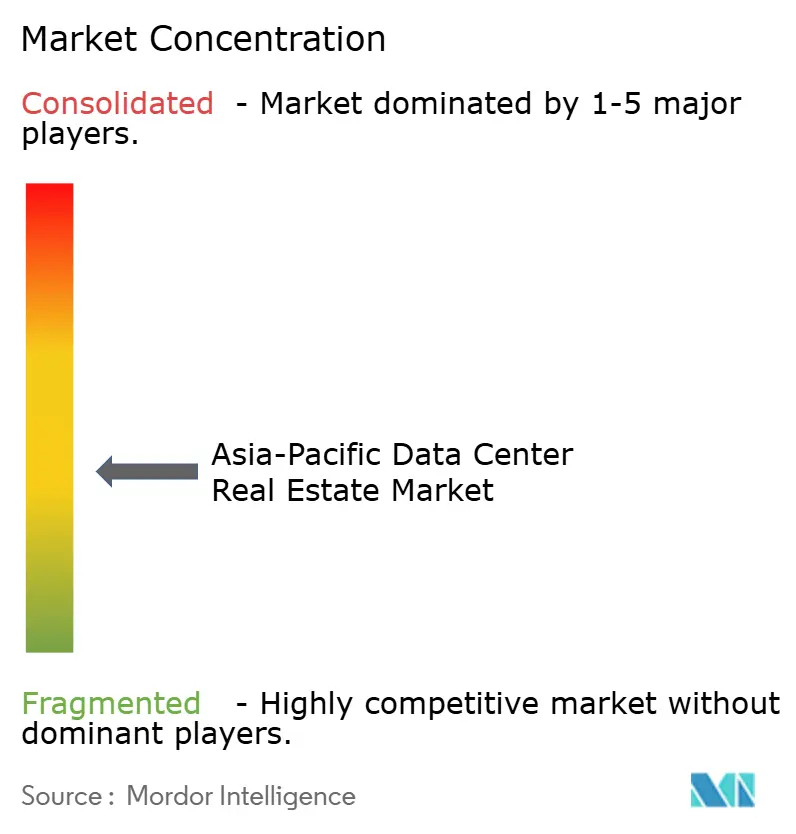
| Market Concentration | Medium |
Major Players *Disclaimer: Major Players sorted in no particular order Image © Mordor Intelligence. Reuse requires attribution under CC BY 4.0. | |
Asia-Pacific Data Center Real Estate Market Analysis by Mordor Intelligence
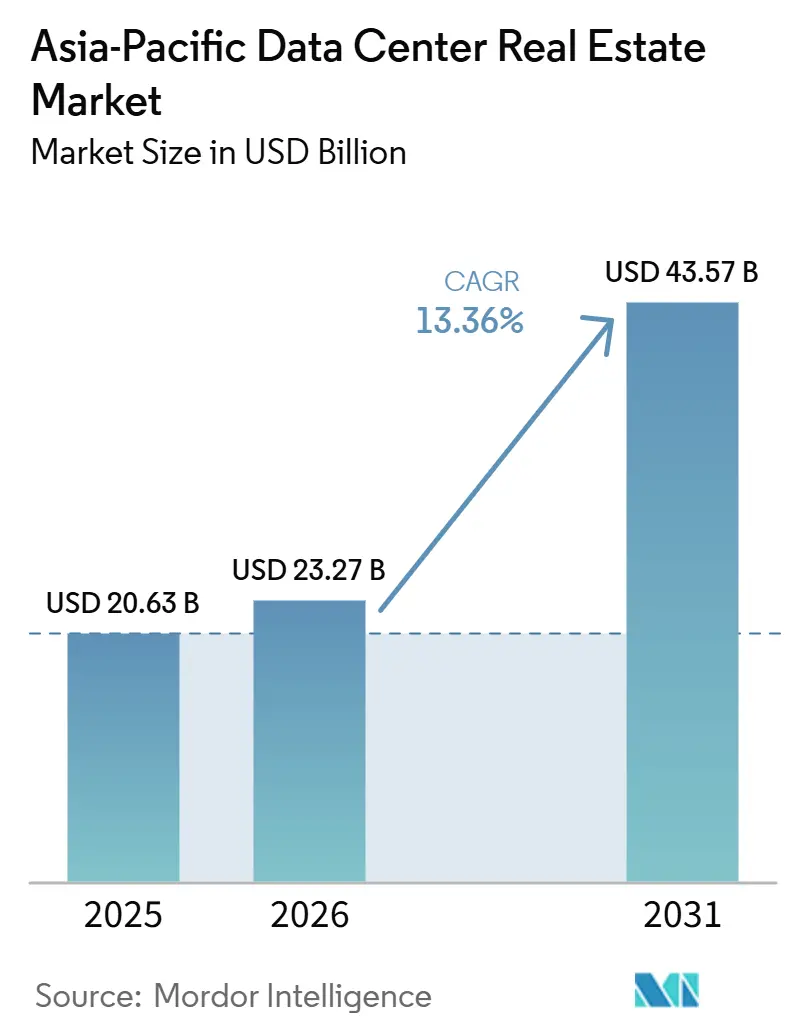
The Asia-Pacific Data Center Real Estate Market size is expected to increase from USD 20.63 billion in 2025 to USD 23.27 billion in 2026 and reach USD 43.57 billion by 2031, growing at a CAGR of 13.36% over 2026-2031.
AI-led infrastructure demand is changing the tenant base in the Asia-Pacific data center real estate market, with GPU-heavy users and single-tenant AI buyers locking in capacity before projects are completed. Institutional capital is moving deeper into the asset class, supporting a broad development cycle across core and emerging hubs in the Asia-Pacific data center real estate market. Data sovereignty rules in markets such as Indonesia, Vietnam, the Philippines, and Malaysia are also making in-country hosting a compliance requirement rather than a simple commercial choice, which is giving leased colocation a firmer demand base. At the same time, long grid connection timelines, power-ready land shortages, and higher construction costs are filtering growth toward operators that can secure utilities, labor, and renewable energy earlier than peers. That mix is shifting competition in the Asia-Pacific data center real estate market away from basic capacity expansion and toward AI-ready design, renewable procurement, and multi-country execution.
Key Report Takeaways
- By property type, colocation facilities held 45.80% of the Asia-Pacific data center real estate market share in 2025, while edge data center properties are projected to grow at 16.10% CAGR through 2031.
- By ownership, leased properties accounted for 76.90% of the Asia-Pacific data center real estate market size in 2025, and the same segment is also forecast to expand at 13.90% CAGR through 2031.
- By enterprise size, large enterprises commanded 68.30% share in 2025, while small and medium enterprises recorded the highest projected CAGR at 14.80% through 2031.
- By end-user, information technology and telecom accounted for 46.20% share in 2025, while healthcare is advancing at 15.10% CAGR through 2031.
- By geography, China accounted for 41.80% of the Asia-Pacific data center real estate market in 2025, while India is the fastest-growing country segment, with a 17.20% CAGR through 2031.
Note: Market size and forecast figures in this report are generated using Mordor Intelligence’s proprietary estimation framework, updated with the latest available data and insights as of January 2026.
Market Trends and Insights
Drivers Impact Analysis of Asia-Pacific Data Center Real Estate Market*
| Drivers | (~) % Impact on CAGR Forecast | Geographic Relevance | Impact Timeline |
|---|---|---|---|
| AI Workloads Accelerate High-Density Demand | +3.50% | Global Asia-Pacific, concentrated in China, Japan, India, Australia | Short term (≤ 2 years) |
| Hyperscaler Pre-Leasing Supports New Capacity | +2.80% | China, India, Malaysia, Australia | Short term (≤ 2 years) |
| Data Sovereignty Policies Increase In-Country Hosting | +2.20% | Vietnam, Indonesia, India, Philippines, Malaysia | Medium term (2-4 years) |
| Liquid Cooling Adoption Enables Next-Generation Facilities | +1.80% | China, Japan, Singapore, expanding to India and Southeast Asia | Medium term (2-4 years) |
| Secondary Asia-Pacific Markets Attract Investment | +1.50% | India, Malaysia, Thailand, Indonesia, Vietnam | Medium term (2-4 years) |
| Renewable Procurement Supports Sustainable Development | +0.90% | Malaysia, Japan, Australia, Singapore | Long term (≥ 4 years) |
| Source: Mordor Intelligence | |||
AI Workloads Accelerate High-Density Data Center Demand
Single-tenant Artificial Intelligence (AI) customers are changing demand patterns in the Asia-Pacific data center real estate market by reserving capacity before construction begins and requesting bespoke, high-density designs. That behavior is compressing deal cycles and reducing the amount of speculative space that reaches smaller tenants in core hubs[1]Goldman Sachs, “The Outlook for Data Centers in Asia,” Goldman Sachs Insights, goldmansachs.com . Rack density expectations are also moving sharply upward, with many AI-oriented deployments now designed well above legacy enterprise standards, reshaping power, cooling, and structural requirements across the Asia-Pacific data center real estate market. The regional data center development pipeline reached 19.4GW in 2025, including 3.7GW under construction and 15.7GW in planning, underscoring how quickly supply is being repositioned to meet AI demand. Malaysia and India accounted for 58% of new IT load added across Asia-Pacific in 2025, which shows that the AI build cycle is already broadening beyond the region’s most mature locations.
Hyperscaler Pre-Leasing Supports New Capacity Expansion
Hyperscaler pre-leasing acts as a market-clearing mechanism in the Asia-Pacific data center real estate market, as capacity is often committed years before delivery. That lowers speculative development risk for owners, but it also leaves less available inventory for smaller cloud and enterprise users. Amazon Data Services signed a 17-year lease for 4 acres in Mumbai’s Powai district in July 2026, which shows how long-dated commitments are now being used to secure scarce future supply in major Indian hubs. AirTrunk said its JHB1 and JHB2 campuses in Johor Bahru were almost 100% contracted before it announced USD 3 billion for JHB3 and JHB4 in April 2026. This sequence confirms that the Asia-Pacific data center real estate market remains demand-led in its major hubs, with pre-leasing driving new supply forward rather than developers building ahead of visible demand.
Data Sovereignty Policies Increase In-Country Hosting Demand
Data sovereignty regulations across Asia-Pacific are expanding the addressable base for in-country hosting because several workloads can no longer be served from offshore infrastructure. Indonesia’s Personal Data Protection Law became operational in October 2024, and the framework increased the need for domestic hosting in public-sector and regulated environments. Vietnam’s Decree 147/2024/ND-CP and the Philippines’ 2025 sovereignty framework are moving in the same direction, indicating that operators in the Asia-Pacific data center real estate market are seeing demand driven by compliance rather than convenience. These rules are encouraging sovereign cloud structures that require dedicated in-country infrastructure, often with local telecom or state-linked partners. That makes leased colocation more durable in the Asia-Pacific data center real estate market, as the underlying demand is tied to legal, risk-control, and continuity requirements rather than solely to enterprise cloud adoption cycles.
Liquid Cooling Adoption Enables Next-Generation Data Center Facilities
Liquid cooling is moving from pilot status to a core design requirement for facilities that want to serve dense AI workloads in the Asia-Pacific data center real estate market. The technology is becoming more important because standard air-cooled buildings are harder to adapt to the rack densities that large AI tenants now request. KDDI said its Osaka AI data center cut server-cooling energy use by 94% and lowered PUE to 1.05 after deploying liquid cooling, giving operators in the Asia-Pacific data center real estate market a clear performance benchmark. Equinix also launched HK6 in Hong Kong in June 2026, featuring direct-to-chip liquid cooling, demonstrating that major colocation providers are standardizing high-density AI capabilities in new regional assets. The result is a two-tier asset pool in the Asia-Pacific data center real estate market, where AI-ready stock can command stronger lease terms. At the same time, older air-cooled buildings face a higher retrofit burden.
Restraints Impact Analysis of Asia-Pacific Data Center Real Estate Market*
| Restraints | (~) % Impact on CAGR Forecast | Geographic Relevance | Impact Timeline |
|---|---|---|---|
| Grid Interconnection Delays Slow Development | -2.1% | Southeast Asia, especially Malaysia, Indonesia, Vietnam, Philippines, Australia | Short term (≤ 2 years) |
| Power-Ready Land Shortages Limit Core Hub Expansion | -1.8% | Singapore, Hong Kong, Tokyo, Sydney | Short term (≤ 2 years) |
| Construction Cost Inflation and Labor Shortages Pressure Economics | -1.4% | Japan, Singapore, Philippines, Thailand | Medium term (2-4 years) |
| AI-Ready Retrofit Complexity Raises Upgrade Costs | -1.2% | Japan, South Korea, Australia, mature Asia-Pacific hubs | Medium term (2-4 years) |
| Source: Mordor Intelligence | |||
Grid Interconnection Delays Slow Data Center Development
Grid interconnection timelines are becoming the most serious near-term constraint on growth in the Asia-Pacific data center real estate market, as they often extend beyond the development timelines for new facilities. The gap is clear in Southeast Asia, where data center construction can be completed in 1 to 3 years, but utility connection timelines can take more than 5 years. In Johor, up to 30% of new data center applications were rejected in 2024 due to grid delivery not being ready, indicating that the problem is not only about generation capacity. 90% of Asia-Pacific operators cited grid connection delays as their top growth constraint, and 70% also flagged transmission limits, confirming that access and throughput are under pressure. This is pushing operators in the Asia-Pacific data center real estate market toward locations where substations, transmission buildouts, and utility approvals can be secured earlier in the project cycle.
Power-Ready Land Shortages Limit Core Hub Expansion
Power-ready land is becoming a key constraint in the Asia-Pacific data center real estate market because sites must include grid access, utility approvals, and expansion potential, not just physical land. This pressure is strongest in core hubs such as Singapore, Hong Kong, Tokyo, and Sydney, where demand remains high, but the number of viable large-scale sites is limited. Operators are therefore treating secured power as a competitive asset, which is why Digital Edge emphasized a fully powered parcel and a 90 MVA power agreement when it announced its SEL5 project in South Korea in 2026. AirTrunk’s decision to add JHB3 and JHB4 beside its almost fully contracted Johor Bahru campuses also shows that developers prefer locations where land and utility readiness can scale together. This is pushing some investment away from the most established hubs and toward nearby or secondary markets that can offer faster land assembly and power access. The result is that demand in core cities stays strong, but new supply enters more slowly because site readiness has become as important as tenant demand.
*Our forecasts treat driver/restraint impacts as directional, not additive. The impact forecasts reflect baseline growth, mix effects, and variable interactions.
Asia-Pacific Data Center Real Estate Market Segment Analysis
By Property Type:
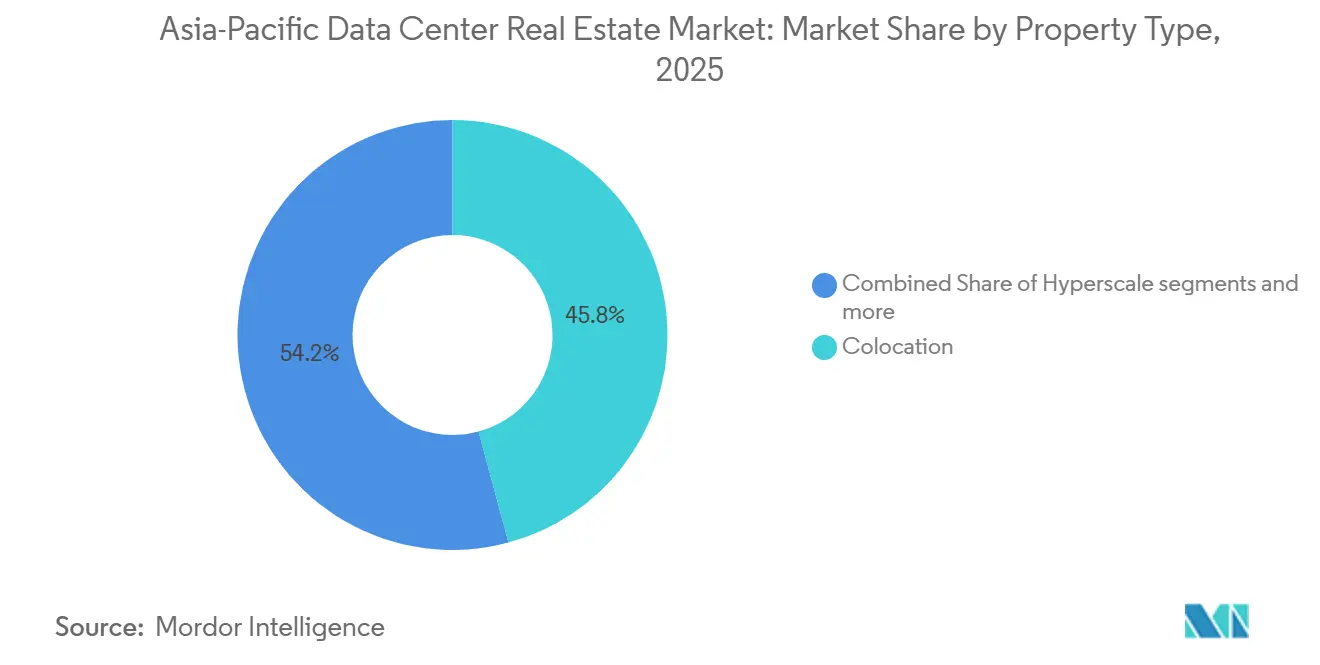
Colocation Anchors the Market as Edge Data Center Properties Pull Demand to the PeripheryColocation facilities held 45.80% of the Asia-Pacific data center real estate market share in 2025, maintaining their leading position among property types. Their lead reflects hyperscalers' and enterprise tenants' preference for managed capacity that avoids the capital burden of owning land and buildings outright. In the Asia-Pacific data center real estate market, this preference is reinforced by pre-leasing behavior, as major tenants often secure colocation space 12 to 18 months before delivery. The result is a structure where most net new supply in top-tier cities is absorbed quickly, often before broader enterprise tenants can enter the pipeline. Hyperscale properties remain the second-largest type and are attracting the largest single-project commitments as AI campuses grow, densify, and become more specialized.
AirTrunk’s expansion in Johor Bahru shows the scale of that hyperscale buildout, with JHB3 and JHB4 adding more than 2GW of combined IT load beside campuses that were already almost fully contracted[2]AirTrunk, “AirTrunk Doubles Down in Malaysia with Two New Hyperscale Campuses in Johor Bahru,” AirTrunk, airtrunk.com. Modular properties are gaining traction in India’s manufacturing corridors and in Southeast Asian industrial zones because prefabricated designs can shorten deployment windows to 12 to 18 months. The others category, which includes wholesale, retail, and enterprise-owned stock, is under more pressure because many older facilities were not designed for AI-grade power density. Edge data center properties are the fastest-growing type, with a 16.10% CAGR through 2031, driven by 5G buildouts, real-time AI inference, and smart-city use cases that require lower latency than centralized hubs can provide. That leaves the Asia-Pacific data center real estate market with a clear split: colocation remains the base of current demand, while edge capacity shapes the next wave of distributed growth.


By Ownership:
Leased Properties Sustain a Structural AdvantageLeased properties dominated ownership structures with 76.90% share of the Asia-Pacific data center real estate market size in 2025, and they also lead growth at 13.90% CAGR through 2031. That dual lead shows that leased models are not only well established but are also expanding their role in the Asia-Pacific data center real estate market. Hyperscalers are shifting toward third-party leased structures because they prefer to keep more balance-sheet capital available for servers, networking, and software rather than tying it up in real estate. The model is even more attractive in countries where land ownership or operating rules make direct control by foreign operators more difficult. Those constraints make leasehold and managed structures a practical route for international expansion across several Asia-Pacific markets.
Institutional finance is also supporting this ownership pattern, as more capital vehicles are now willing to treat stabilized data center assets as mainstream infrastructure. Japan’s regulatory adjustment in 2025, which recognized data center equipment as real estate eligible for J-REIT acquisition, strengthened the financing case for leased development. NTT DATA’s plan to inject assets into its Singapore-listed REIT points in the same direction, with operators using asset recycling to fund additional supply in the Asia-Pacific data center real estate market. Owner-occupied assets still serve domestic hyperscalers and large enterprises in markets such as China, Japan, and Australia, especially where scale justifies direct control. Even so, the wider capital base, regulatory fit, and balance-sheet logic keep leased properties in a stronger long-term position in the Asia-Pacific data center real estate market.
By Enterprise Size:
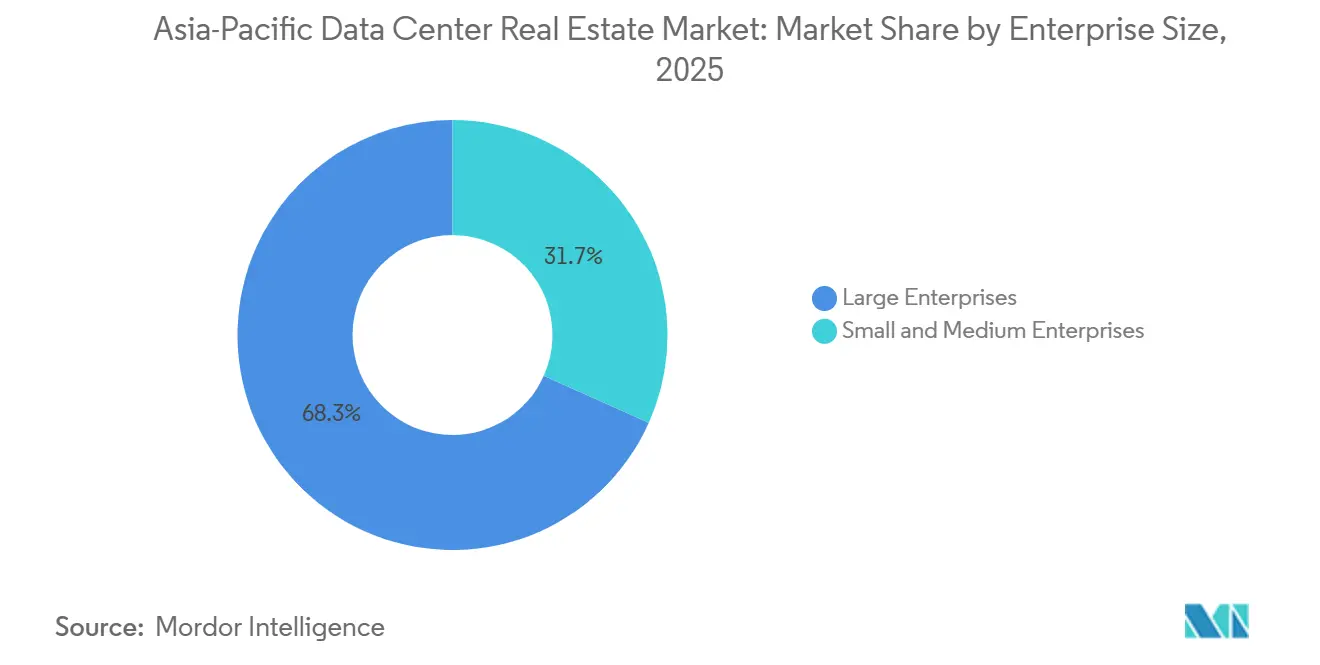
Large Enterprises Underwrite Growth, Small and Medium Enterprises (SMEs) Accelerate Demand BreadthLarge enterprises held 68.30% of the Asia-Pacific data center real estate market share by enterprise size in 2025, making them the primary revenue base for operators. Global technology firms, financial institutions, and government-linked organizations dominate this tier because they can sign 10 to 15-year leases and commit to significant volumes early. In the Asia-Pacific data center real estate market, that kind of tenancy supports underwriting capital-intensive AI-ready developments with stronger revenue visibility. The profile of large tenants is also changing because single-tenant AI customers now behave more like build-to-suit occupiers than standard colocation buyers. Their focus on bespoke cooling, power density, and security is raising the bar for design and delivery across the region.
Healthcare and banking, financial services, and insurance users in the large-enterprise tier are also increasing demand for dedicated private cloud environments in colocation facilities, which tend to support premium lease structures. NTT DATA’s REIT plan shows that institutional capital is treating large-enterprise-anchored assets as a reliable way to recycle funds into newer AI infrastructure. SMEs are the fastest-growing customer group, with a 14.80% CAGR through 2031, as more companies move from on-premises server rooms to managed colocation. Much of this demand comes through retail colocation, sub-rack deployments, and managed support services in tier 2 and secondary urban locations. That means the Asia-Pacific data center real estate market is broadening beyond hyperscaler-led campuses, with SME demand supporting smaller, more distributed facilities that would not be justified by cloud buyers alone.

By End-Users:
IT Leadership Entrenched, Healthcare Leads the Next Demand CycleInformation technology and telecom accounted for 46.20% of the Asia-Pacific data center real estate market in 2025, keeping this group firmly in the lead among end users. Global cloud providers, content delivery networks, and telecom operators drive that result by absorbing a large share of both hyperscale and colocation capacity. In the Asia-Pacific data center real estate market, the same group often shapes both supply and demand, as some hyperscalers are major developers and the largest occupiers. Banking, financial services, and insurance remain the second-largest end-user base because data residency, redundancy, and continuity rules make certified colocation and resilient infrastructure essential. Government and public-sector demand is also rising as national AI programs, digital identity projects, and sovereign cloud initiatives increase the need for in-country hosting across India, Singapore, and Malaysia.
Healthcare is the fastest-growing end-user category, with a 15.10% CAGR through 2031, supported by EHR digitization, AI-led diagnostics, and telehealth rollouts across Southeast Asia. Health digitization programs in Vietnam, Cambodia, and India are expanding the need for secure compute and storage environments that conventional hospital IT teams cannot easily provide at scale. Broader adoption of robotics, predictive analytics, digital twins, and AI decision support, all of which require resilient, low-latency infrastructure. Healthcare localization rules in several Asia-Pacific markets are pushing more of this demand into private cloud environments housed inside certified colocation facilities. That is giving the Asia-Pacific data center real estate market a new anchor tenant class in tier 2 cities, where healthcare systems can support fresh development beyond the usual cloud and telecom corridors.
Geography Analysis
China Data Center Real Estate Market
China held 41.80% of the Asia-Pacific data center real estate market share in 2025, making it the largest national market by a wide margin. State-backed hyperscale programs, domestic large language model companies, and the East Data, West Computing initiative are concentrating investment in power-rich inland clusters with access to renewable generation. Chindata’s plan to invest USD 3.3 billion in a 1.2GW cluster in Ningxia shows how green power access and state policy are aligning in western development zones.
India and Australia Data Center Real Estate Market
India is the fastest-growing geography in the Asia-Pacific data center real estate market, with a 17.20% CAGR through 2031, and the scale of current commitments shows why. AirTrunk committed USD 30 billion to build 5 GW of capacity in India through 2030, making it the largest single-country commitment by any data center operator globally. AdaniConneX also announced a 1GW AI-ready platform in Visakhapatnam in April 2026, backed by USD 10 billion from the Adani Group and linked to the company’s wider 5GW target. Mumbai’s live data center capacity rose 42% to 768MW in 2025, which reflects strong absorption from Amazon, Google, and CapitaLand-backed pipelines. Australia is also strengthening its role in premium AI infrastructure, with CDC Data Centres securing a 555MW hyperscaler contract that underlines the country’s standing as a credible large-scale delivery location.
ASEAN Data Center Real Estate Market
The rest of Asia-Pacific, including Malaysia, Singapore, Indonesia, Vietnam, and Thailand, is benefiting from a geographic rebalancing as power and land shortages redirect capital from established hubs to newer locations. Johor Bahru posted 53% year-on-year growth in live capacity in 2025, which made it one of the fastest-growing markets in the region. DayOne’s 1.5GW renewable supply deal with TNB in Malaysia showed that large green power arrangements are becoming part of the location strategy for the Asia-Pacific data center real estate market. Singapore still anchors enterprise and financial services demand in Southeast Asia because of regulatory stability, submarine cable connectivity, and IMDA’s managed release of new capacity, which continue to make it a strategic regional hub.
Competitive Landscape
The Asia-Pacific data center real estate market exhibits moderate concentration at the platform level, while remaining fragmented at the asset level, with no single operator controlling more than 15% of regional investment value. AirTrunk, Equinix, and NTT DATA are among the most geographically diversified platforms, with portfolios spanning multiple Asia-Pacific countries through combinations of owned campuses, long-leasehold sites, and managed assets. Competition is driven by operators differentiating themselves through AI-ready infrastructure, renewable energy procurement, and capital-recycling strategies that support continuous expansion. Equinix's 15-year virtual power purchase agreement with ENEOS Renewable Energy for 121 MW in Japan demonstrates how renewable energy sourcing strengthens both operational resilience and sustainability commitments[3]Equinix, “Equinix Reinforces Responsible Operations in Japan with Landmark 15-Year PPA with ENEOS Renewable Energy,” Equinix Newsroom, newsroom.equinix.com. Similarly, AirTrunk's Johor Bahru expansion combines nearly fully pre-contracted capacity with a multi-campus growth strategy focused on hyperscale demand and power availability.
Competitive intensity is also increasing as emerging regional platforms expand their presence across high-growth markets. Princeton Digital Group secured USD 2.5 billion in combined equity and debt financing in 2025, including USD 1.3 billion from Stonepeak, and subsequently acquired land for a 240 MW campus in Jakarta in July 2026. India's CtrlS is advancing a 600 MW campus in Hyderabad, while Vantage Data Centers raised USD 1.6 billion from GIC and ADIA in September 2025 to support regional expansion. Keppel's entry into South Korea in June 2026 further demonstrates that both global infrastructure investors and regional specialists continue to compete for hyperscale demand. As a result, opportunities remain distributed across rapidly expanding markets such as South Korea and Indonesia, where demand continues to outpace supply.
Technology capability is becoming an increasingly important differentiator in lease decisions across the Asia-Pacific data center real estate market. Enterprise and hyperscale customers are placing greater emphasis on direct-to-chip liquid cooling, intelligent power management, renewable energy integration, and support for high-density AI workloads, creating competitive challenges for older facilities requiring extensive retrofits. Operators with advanced cooling technologies, strong sustainability credentials, and multi-country development pipelines are better positioned to secure large-scale deployments. However, regional developers with strong local execution capabilities and strategic market presence continue to compete effectively, supporting the market's moderately concentrated competitive structure rather than allowing dominance by a small number of operators.
Asia-Pacific Data Center Real Estate Industry Leaders
AirTrunk
Equinix, Inc.
Digital Realty Trust, Inc.
NTT DATA Group Corporation
NEXTDC Limited
- *Disclaimer: Major Players sorted in no particular order
Asia-Pacific Data Center Real Estate Market Companies Covered in this Report
- AirTrunk
- Equinix, Inc.
- Digital Realty Trust, Inc.
- NTT DATA Group Corporation
- NEXTDC Limited
- ST Telemedia Global Data Centres
- Princeton Digital Group
- GDS Holdings Limited
- Chindata Group Holdings Limited
- BDx Data Centers
- AdaniConneX
- CtrlS Datacenters Limited
- Nxtra by Airtel
- Sify Technologies Limited
- Vantage Data Centers
- Colt Data Centre Services
- Telehouse
- Keppel Data Centres
- Digital Edge
- Empyrion Digital

Recent Industry Developments in Asia-Pacific Data Center Real Estate Market
- June 2026: Digital Edge secured a fully powered parcel in Ansan, South Korea, supported by a 90 MVA power agreement, to develop SEL5, a 60MW hyperscale AI-ready data center, extending its South Korea network to five locations across Seoul, Incheon, Ansan, and Busan.
- June 2026: Equinix launched HK6 in Hong Kong, an AI-ready data center with 1,000 cabinets in its first phase, direct-to-chip liquid cooling, and an initial investment of USD 124 million. The facility is designed to scale to 3,550 cabinets and provides direct connectivity to the Hong Kong-Shenzhen Innovation and Technology Park.
- June 2026: AirTrunk committed USD 30 billion to develop 5GW of data center capacity in India through 2030, entering the country through its acquisition of Lumina CloudInfra and securing a letter of intent for a 3GW campus in Maharashtra.
- May 2026: NEXTDC officially launched KL1 Kuala Lumpur, its first international data center, offering 65MW of IT capacity designed to Tier IV standards and targeting Uptime Institute Tier IV certification, making it the first such facility in Peninsular Malaysia.


Asia-Pacific Data Center Real Estate Market Report Scope
The Asia-Pacific Data Center Real Estate Market Report is Segmented by Property Type (Colocation, Hyperscale, and More), Ownership (Leased and Owner Occupied), Enterprise Size (Large Enterprises, and Small and Medium Enterprises), End-Users (Information Technology and Telecom, and More), and Geography (China, Japan, India, Australia, Rest of Asia-Pacific). The Market Forecasts are Provided in Terms of Value (USD).
| Colocation |
| Hyperscale |
| Edge Data Center Properties |
| Modular Data Center Properties |
| Others (Wholesale, Retail and Enterprise) |
| Leased |
| Owner Occupied |
| Large Enterprises |
| Small and Medium Enterprises |
| Information Technology and Telecom |
| Banking, Financial Services, and Insurance |
| Government and Public Sector |
| Healthcare |
| Other End Users |
| China |
| Japan |
| India |
| Australia |
| Rest of Asia-Pacific |
| By Property Type | Colocation |
| Hyperscale | |
| Edge Data Center Properties | |
| Modular Data Center Properties | |
| Others (Wholesale, Retail and Enterprise) | |
| By Ownership | Leased |
| Owner Occupied | |
| By Enterprise Size | Large Enterprises |
| Small and Medium Enterprises | |
| By End-Users | Information Technology and Telecom |
| Banking, Financial Services, and Insurance | |
| Government and Public Sector | |
| Healthcare | |
| Other End Users | |
| By Country | China |
| Japan | |
| India | |
| Australia | |
| Rest of Asia-Pacific |


Key Questions Answered in the Report
What is driving growth in Asia-Pacific data center real estate through 2031?
AI-led infrastructure demand is the main growth driver, supported by data sovereignty rules, hyperscaler pre-leasing, and the need for high-density, AI-ready facilities. The market is projected to rise from USD 23.27 billion in 2026 to USD 43.57 billion by 2031 at 13.36% CAGR.
Which property type leads regional demand today?
Colocation led with 45.80% share in 2025 because hyperscalers and enterprises prefer managed capacity that reduces upfront capital commitments while preserving flexibility.
Which part of the region is expanding the fastest?
India is the fastest-growing country segment at 17.20% CAGR through 2031, supported by large commitments from operators such as AirTrunk and AdaniConneX.
Why are leased assets so dominant in this sector?
Leased properties held 76.90% share in 2025 and are also the fastest-growing ownership model because they fit hyperscaler capital allocation preferences and several Asia-Pacific regulatory structures.
Which end-user group is creating the next wave of demand?
Healthcare is the fastest-growing end-user at 15.10% CAGR through 2031, driven by EHR digitization, telehealth expansion, and rising use of AI in diagnostics and hospital operations.
Page last updated on:





