
Market Overview
| Study Period | 2021 - 2031 |
|---|---|
| Forecast Data Period | 2026 - 2031 |
| Base Year Market Size (2025) | USD 28.55 Billion |
| Market Size (2026) | USD 30.61 Billion |
| Market Size (2031) | USD 40.62 Billion |
| Growth Rate (2026 - 2031) | 7.25 % |
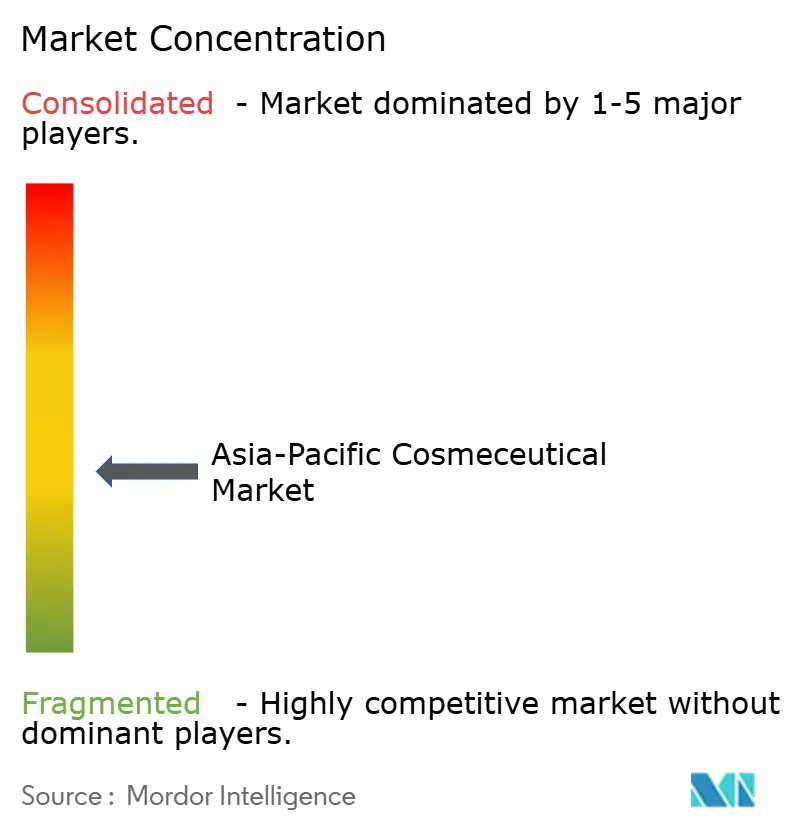
| Market Concentration | Medium |
Major Players
*Disclaimer: Major Players sorted in no particular order Image © Mordor Intelligence. Reuse requires attribution under CC BY 4.0. |
|
Asia-Pacific Cosmeceutical Market Analysis by Mordor Intelligence
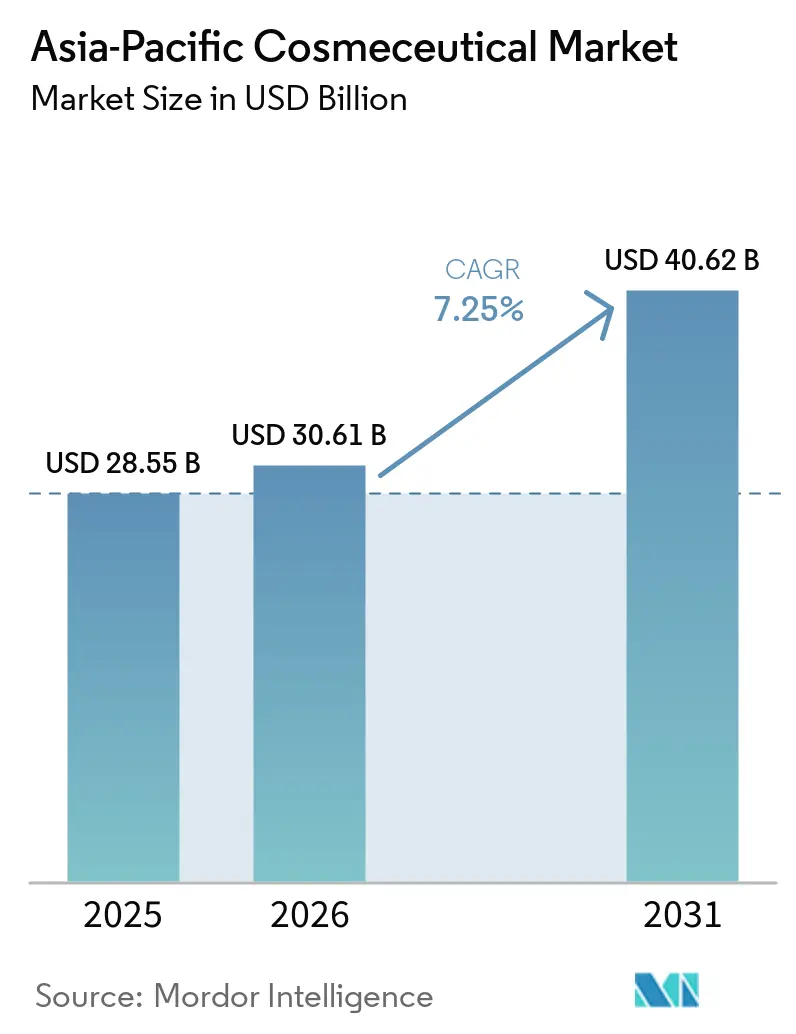
The Asia-Pacific cosmeceuticals market reached USD 28.55 billion in 2025 and is anticipated to reach USD 30.61 billion in 2026, with the market forecast to grow to USD 40.62 billion by 2031 at a CAGR of 7.25%. The market is driven by a broader shift from conventional beauty products toward functional, efficacy-oriented formulations that combine cosmetic benefits with targeted skin and hair health outcomes. Key growth factors include increasing consumer awareness of active ingredients, growing emphasis on preventive skincare, demand for clinically supported formulations, and the adoption of advanced formulation technologies. The expanding availability of specialized products addressing specific concerns is also encouraging consumers to move from basic personal-care routines toward more targeted, treatment-oriented regimens.
Key Report Takeaways
- By product type, skincare held 59.45% of the Asia-Pacific cosmeceuticals market share in 2025, while lip care is forecast to expand at a 7.95% CAGR through 2031.
- By category, conventional products accounted for 72.12 of the Asia-Pacific cosmeceuticals market share in 2025, while natural and organic products are forecast to grow at an 8.73% CAGR through 2031.
- By end user, female consumers represented 71.54% of spending in 2025, while the male segment is forecast to record an 8.59% CAGR through 2031.
- By distribution channel, beauty and health stores held 46.72% share in 2025, while online retail stores are forecast to grow at a 9.14% CAGR through 2031.
- By geography, China held 34.23% share in 2025, while South Korea is forecast to grow at an 8.81% CAGR through 2031.
Note: Market size and forecast figures in this report are generated using Mordor Intelligence’s proprietary estimation framework, updated with the latest available data and insights as of January 2026.
Asia-Pacific Cosmeceutical Market Trends and Insights
Drivers Impact Analysis*
| Driver | (~) % Impact on CAGR Forecast | Geographic Relevance | Impact Timeline |
|---|---|---|---|
| Growing consumer demand for clinically proven anti-aging actives | +2.0% | Japan, China, South Korea | Long term (≥ 4 years) |
| Increasing adoption of active skincare ingredients | +1.5% | Asia-Pacific-wide | Medium term (2–4 years) |
| Growing influence of dermatologists and professional skincare recommendations | +1.2% | China, India, Japan core | Medium term (2–4 years) |
| Influence of K-beauty and J-beauty skincare innovation | +1.1% | Asia-Pacific, India,core | Long term (≥ 4 years) |
| Expansion of multifunctional cosmeceutical products | +0.9% | Urban Asia-Pacific, South-Asian Countries | Short term (≤ 2 years) |
| Rising demand for science-backed and clinically positioned formulations | +0.8% | China, South Korea, Australia | Medium term (2–4 years) |
| Source: Mordor Intelligence | |||
Growing consumer demand for clinically proven anti-aging actives
Growing consumer demand for clinically proven anti-aging actives is supporting the Asia-Pacific cosmeceutical market. Consumers increasingly seek targeted formulations that address visible signs of aging, including wrinkles, pigmentation, loss of firmness, and uneven skin tone. The shift toward evidence-based skincare is driving greater adoption of formulations containing clinically studied active ingredients, while increasing interest in preventive skincare is prompting consumers to incorporate anti-aging products into their regular routines. For instance, according to China's National Bureau of Statistics, people aged 65 years and above accounted for 15.9% of China's population in 2025, highlighting the growing older consumer base and the relevance of products designed to address age-related skin concerns[1]Source: National Bureau of Statistics of China, "Age distribution in China", stats.gov.cn.
Increasing adoption of active skincare ingredients
The increasing adoption of active skincare ingredients is driving the Asia-Pacific cosmeceuticals market, as consumers prioritize formulations that deliver targeted, functional, and evidence-based skincare benefits. The growing use of bioactive ingredients in everyday products allows formulations to address specific concerns such as visible aging, dryness, loss of firmness, uneven skin tone, and skin-barrier health. Advances in ingredient processing are further improving the functionality of these formulations. This trend is also encouraging the development of products that combine multiple active benefits within daily-use formats, broadening the role of cosmeceuticals in regular skincare routines. For instance, in March 2025, Shiseido launched the new Ultimune Power Infusing Serum, incorporating its patented Power Fermented Camellia+ technology based on fermented camellia seed extract, reflecting the increasing use of bioactive and fermentation-derived ingredients to deliver targeted skincare benefits and strengthen product efficacy.
Growing influence of dermatologists and professional skincare recommendations
The growing influence of dermatologists and professional skincare recommendations is supporting market growth, as consumers increasingly seek expert-backed guidance when selecting products for specific skin and scalp concerns. Dermatologist involvement strengthens consumer confidence in product safety, formulation efficacy, and ingredient suitability. Professional recommendations are also encouraging the adoption of specialized products beyond basic skincare routines. This influence is further supporting the development of clinically positioned formulations that combine targeted active ingredients with solutions for specific concerns, reinforcing the credibility of cosmeceutical products. For instance, in February 2026, CeraVe launched its first haircare range in Australia, developed with dermatologists and focused on scalp health, including its Hydrating Anti-Dandruff Shampoo and Conditioner, which are designed to eliminate up to 100% of visible flakes while leaving hair 12 times more hydrated.
Influence of K-beauty and J-beauty skincare innovation
The influence of K-beauty and J-beauty skincare innovation is driving the Asia-Pacific cosmeceuticals market, as consumers increasingly seek functional and efficacy-oriented skincare products inspired by Korean and Japanese beauty routines. The focus on specialized formulations, distinctive product formats, and ingredient-driven skincare is encouraging consumers to explore advanced products beyond conventional beauty routines, supporting broader adoption of cosmeceuticals. For instance, according to South Korea's Ministry of Culture, Sports and Tourism, 57.1% of consumers who had experience with Korean cultural content in 2024 expressed willingness to purchase Korean beauty products and services, highlighting growing consumer interest in K-beauty and its potential to influence skincare purchasing preferences.
Restraints Impact Analysis*
| Restraint | (~) % Impact on CAGR Forecast | Geographic Relevance | Impact Timeline |
|---|---|---|---|
| Stringent regulatory requirements for cosmeceutical claims | -1.0% | China, Japan, South-Asian Countries | Long term (≥ 4 years) |
| Counterfeit and unauthorized cosmeceutical products | -0.8% | China, India, South-Asian Countries | Medium term (2–4 years) |
| Short product life cycles and rapidly changing skincare trends | -0.6% | South Korea, China | Short term (≤ 2 years) |
| High cost and complexity of clinical testing | -0.5% | India, South-Asian Countries, Australia | Long term (≥ 4 years) |
| Source: Mordor Intelligence | |||
Stringent regulatory requirements for cosmeceutical claims
Stringent regulatory requirements for cosmeceutical claims are restraining the Asia-Pacific cosmeceuticals market, as manufacturers must substantiate product safety, ingredient suitability, and efficacy claims to comply with applicable cosmetic regulations. Regulatory scrutiny of claims related to anti-aging, skin repair, whitening, and other functional benefits requires additional testing, technical documentation, and scientific evidence before products can be marketed. Differences in ingredient restrictions, claim definitions, notification or registration procedures, and labeling requirements across regulatory frameworks further increase compliance complexity for companies seeking to commercialize products across multiple markets. These requirements can extend product development and market-entry timelines, increase regulatory costs, and limit the use of efficacy-oriented claims, creating barriers to the introduction and expansion of cosmeceutical products.
Counterfeit and unauthorized cosmeceutical products
Counterfeit and unauthorized cosmeceutical products are restraining the Asia-Pacific cosmeceuticals market by undermining consumer confidence in product authenticity, safety, and efficacy. Products distributed outside authorized channels may expose consumers to formulations with unverified ingredients, inadequate quality controls, improper storage conditions, or misleading claims. This raises concerns about adverse skin reactions and reduces trust in the broader category. Counterfeit products also weaken the credibility of legitimate brands by creating inconsistent consumer experiences and making it harder to distinguish genuine products from unauthorized alternatives. The growing use of online marketplaces and cross-border digital commerce further expands the channels through which unauthorized products reach consumers, increasing monitoring and enforcement challenges for manufacturers and regulators.
*Our forecasts treat driver/restraint impacts as directional, not additive. The impact forecasts reflect baseline growth, mix effects, and variable interactions.
Segment Analysis
By Product Type: Skincare Anchors Volume, Lip Care Redefines the Category
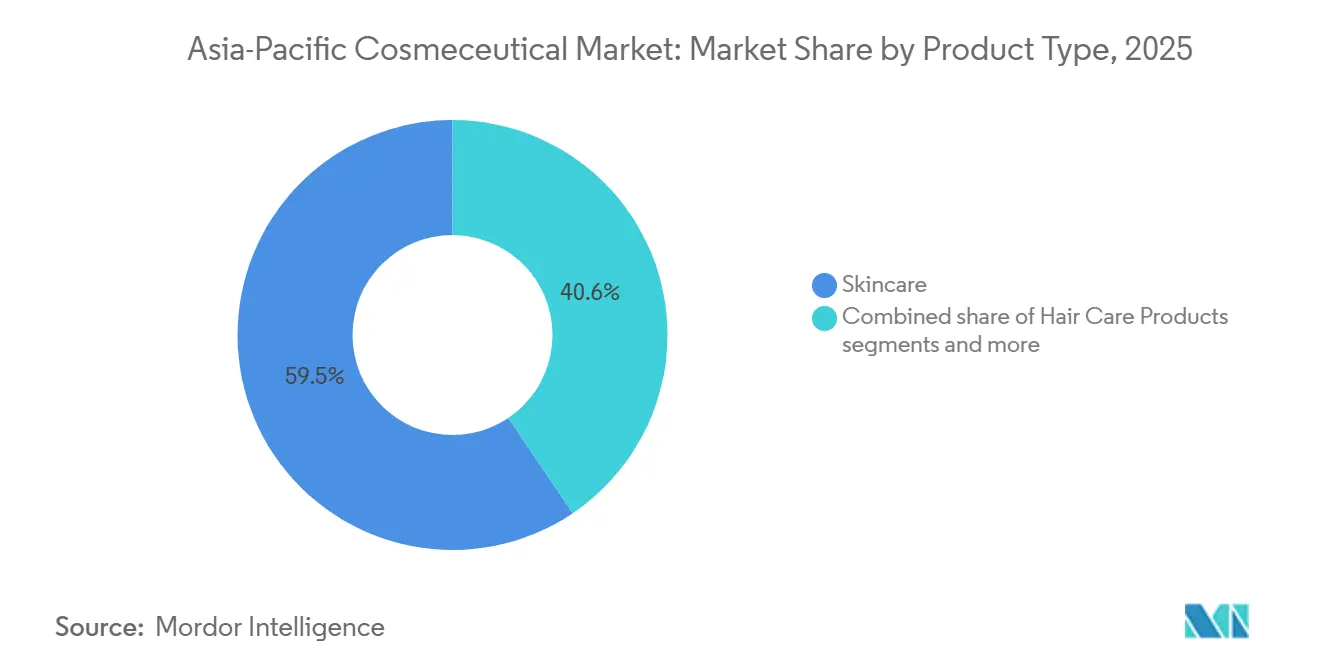
Skincare products held a 59.45% share of the Asia-Pacific cosmeceuticals market in 2025, driven by growing consumer focus on targeted skin health and demand for formulations that address visible concerns such as wrinkles, pigmentation, acne, uneven skin tone, dryness, and sensitivity. The segment is gaining traction through the use of clinically studied active ingredients that deliver specific functional benefits, reinforcing consumer preference for efficacy-oriented skincare over conventional cosmetic formulations. Continuous innovation in serums, creams, moisturizers, masks, and other specialized formats is expanding product choices, while growing emphasis on preventive skincare is encouraging consumers to incorporate functional products into regular routines.
Lip care products are the fastest-growing product-type segment, at a CAGR of 7.95% (2026–2031). This growth is driven by increasing consumer focus on lip hydration, softness, and appearance, along with rising demand for products that combine cosmetic appeal with functional benefits such as nourishment, moisture retention, and protection from dryness. The segment is also benefiting from differentiated formulations and variants that cater to evolving consumer preferences for targeted lip care. For instance, in January 2025, Lotus Herbals launched a premium lip balm range in three variants such as Peptide, Cafe Mocha, and Sugar Delight, reflecting the broader trend of ingredient-focused formulations that expand consumer choice and support increased adoption of lip care products.



By Category: Conventional Holds Scale, Natural/Organic Rewrites Margin Dynamics
Conventional cosmeceutical products held a 72.12% share of the market in 2025, supported by established consumer acceptance, broad availability, and an extensive product range across routine skincare and personal care needs. Their dominance is further reinforced by familiarity with conventional formulations and the continued integration of functional ingredients that deliver targeted benefits while maintaining established product textures, formats, and usage patterns. Consistent formulation development and the use of proven active ingredients are enabling conventional cosmeceuticals to address evolving consumer expectations for efficacy, convenience, and specialized skin benefits, sustaining their strong market position.
The natural/organic category is the fastest-growing segment, at a CAGR of 8.73% from 2026 to 2031, driven by growing consumer preference for plant-based, naturally derived, and minimally processed ingredients perceived as gentler and more compatible with regular skincare routines. The category is further supported by increasing attention to ingredient transparency, clean-label formulations, and the avoidance of certain synthetic ingredients, prompting brands to develop products that combine natural actives with functional skincare benefits. Growing innovation in botanical extracts, plant-derived oils, essential nutrients, and naturally sourced bioactive ingredients is expanding the range of natural and organic cosmeceutical formulations, strengthening consumer acceptance and accelerating category growth.
By End User: Female-Led Market, Male Segment in Structural Formation Phase
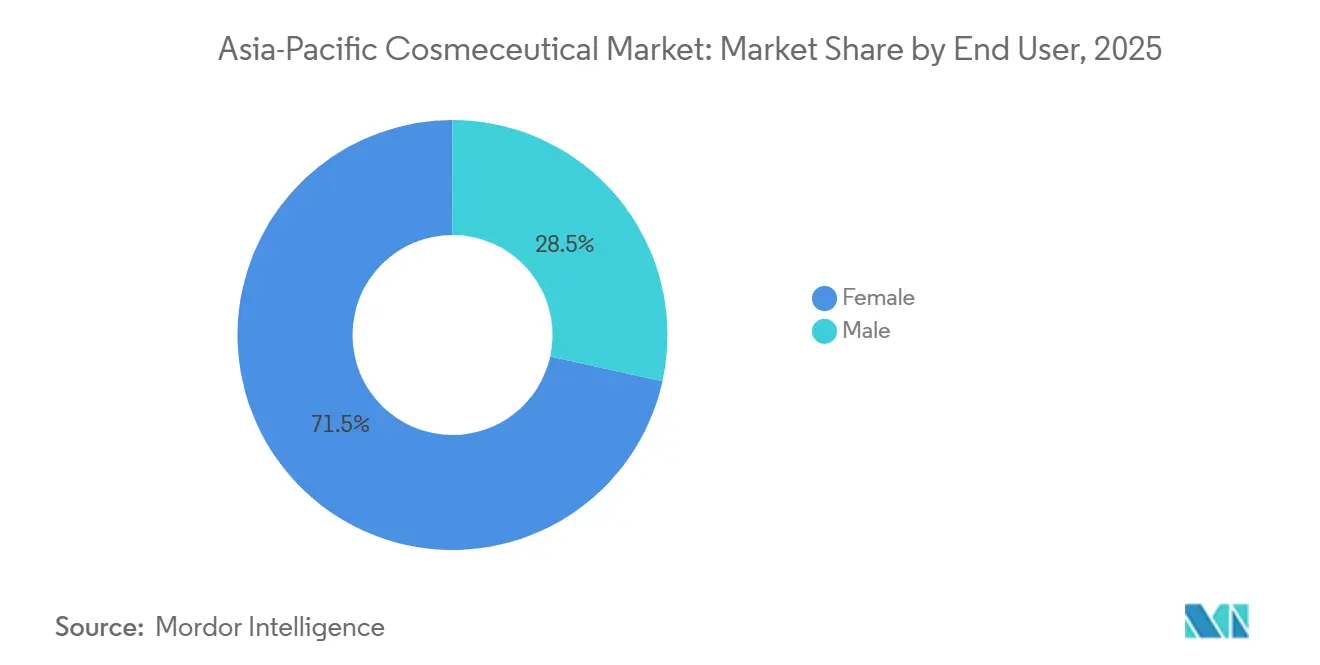
Female consumers accounted for 71.54% of Asia-Pacific cosmeceuticals spending in 2025, driven by strong demand for specialized skincare solutions addressing concerns such as skin brightening, hydration, anti-aging, pigmentation, and overall skin appearance. The segment is further supported by the widespread adoption of multi-step skincare routines, which encourage the use of multiple targeted products and increase the frequency and breadth of cosmeceutical consumption. For instance, according to Japan's Ministry of Internal Affairs and Communications, the employment rate for women in Japan reached 55.1% in 2025, up from approximately 54.2% in 2024, reflecting greater participation of women in the workforce and supporting demand for convenient, targeted, and routine-oriented personal-care products[2]Source: Ministry of Internal Affairs and Communications, "Employment rate of women in Japan", soumu.go.jp.
The male end-user segment is the fastest-growing at a CAGR of 8.59% (2026–2031), driven by increasing skincare awareness, greater acceptance of dedicated male grooming routines, and rising demand for targeted solutions addressing concerns such as acne, oiliness, aging, uneven skin tone, and irritation. The segment is also benefiting from the expansion of simplified and multifunctional formulations that combine multiple skincare benefits within convenient routines, making cosmeceutical products more accessible to male consumers. Growing emphasis on personal appearance and skin health is encouraging men to move beyond basic grooming toward regular use of specialized skincare products, supporting sustained segment growth.
By Distribution Channel: Specialist Retail as the Trust Gateway, Online as the Volume Engine
Beauty and health stores held a 46.72% share in 2025, supported by their ability to provide consumers with physical access to cosmeceutical products and facilitate informed purchase decisions through product demonstrations, staff guidance, and personalized recommendations. The opportunity to examine product textures, packaging, and formulations before purchase strengthens consumer confidence. Professional consultation and ingredient-focused guidance are particularly relevant for specialized products where consumers seek reassurance regarding product suitability and expected benefits. The channel also enables brands to establish credibility through premium merchandising, in-store education, and personalized skincare consultations, reinforcing its role in cosmeceutical purchasing.
Online retail stores represent the fastest-growing distribution channel at a 9.14% CAGR (2026–2031), driven by the expanding availability of specialized products, greater purchasing convenience, and easier access to detailed information on ingredients, formulations, product benefits, and consumer reviews. Online platforms allow consumers to compare multiple products based on formulation characteristics and targeted benefits without being restricted by physical store assortments. The integration of educational beauty content, personalized product recommendations, customer ratings, promotional bundles, and convenient replenishment options is further encouraging product discovery and repeat purchases, supporting the rapid expansion of online distribution for cosmeceuticals.
Geography Analysis
China accounted for a 34.23% share of the Asia-Pacific cosmeceuticals market in 2025, supported by its well-established skincare culture, strong consumer awareness of specialized beauty formulations, and broad demand for products addressing targeted skin concerns. The market is further supported by the wide availability of functional skincare formats and continued formulation innovation. Growing attention to active ingredients, product efficacy, and preventive skin health is encouraging consumers to incorporate cosmeceutical products more consistently into their skincare routines.
South Korea is the fastest-growing market, at an 8.81% CAGR (2026–2031), supported by its highly developed beauty ecosystem, continuous formulation innovation, strong emphasis on functional skincare, and rapid adoption of emerging beauty trends. The country's export strength reinforces the scale and international reach of its beauty industry, supporting ongoing product development and category visibility. For instance, according to the Observatory of Economic Complexity (OEC), South Korea exported USD 9.47 billion of beauty products in 2025, highlighting the country's substantial position in international beauty-product trade and its role in driving innovation within the broader cosmeceutical market[3]Source: Observatory of Economic Complexity (OEC), "Beauty Products in South Korea", oec.world .
India, Indonesia, Thailand, Singapore, and the broader Rest of Asia-Pacific represent the market's structural growth frontier, driven by increasing awareness of functional skincare, greater exposure to ingredient-led beauty trends, expanding e-commerce accessibility, and the growing integration of specialized skincare into daily routines. Rising digital engagement is enabling consumers to access product education, ingredient information, reviews, and a wider range of specialized formulations, while the expansion of online and organized retail is improving product availability. Together, these factors are broadening the consumer base for cosmeceuticals and creating additional opportunities for category penetration across emerging regional markets.
Competitive Landscape
The Asia-Pacific cosmeceuticals market has a moderately fragmented competitive landscape, with global beauty and dermatology-focused companies competing alongside regional and specialist players. Key companies include Shiseido Company, Limited, Kao Corporation, L'Oréal S.A., Unilever PLC, and Galderma Group AG. Competition is increasingly centered on dermatologist-backed credibility, clinically supported formulations, active-ingredient innovation, and personalized skincare. Established players leverage research capabilities and professional positioning to differentiate their offerings. Industry analyses identify a broad mix of multinational, regional, and specialist participants, indicating that competition is not concentrated among a small number of companies.
Competitive opportunities are emerging around male-focused cosmeceuticals and halal-certified formulations. Changing grooming routines and demand for specialized, inclusive product propositions are creating opportunities for differentiated product development. Male-oriented offerings can address increasingly specific skincare needs through simplified and multifunctional routines, while halal-certified formulations can strengthen product accessibility among consumers seeking products aligned with specific ingredient and manufacturing requirements. Competition is also expanding beyond formulation toward digital engagement, personalization, and ingredient transparency, creating additional avenues for differentiation.
Artificial intelligence (AI) is enabling personalized skincare recommendations, allowing companies to connect skin assessment with tailored product selection and routine guidance. For instance, Galderma's Cetaphil offers the MySkin AI Skin Analysis Tool, which analyzes a user's skin through a selfie and provides a personalized skin analysis report and skincare routine recommendations. This illustrates how digital technologies are being integrated into cosmeceutical consumer engagement, shifting product discovery from generic recommendations toward more individualized skincare guidance.
Asia-Pacific Cosmeceutical Industry Leaders
-
Shiseido Company, Limited
-
Kao Corporation
-
L'Oréal S.A.
-
Unilever PLC
-
Galderma Group AG
- *Disclaimer: Major Players sorted in no particular order

Recent Industry Developments
- July 2026: Kao Corporation launched Curel Moist Barrier Oil Serum, a product designed for dry, sensitive skin prone to recurring flakiness, roughness, tightness, and irritation in extremely dry environments, such as those caused by winter air, air conditioning, and heating.
- June 2026: Gravity, a KAIST technology-based haircare brand, has launched a functional anti-hair loss shampoo using polydeoxyribonucleotide (PDRN). The company aims to target the premium haircare market by leveraging its self-produced raw materials and proprietary technology.
- March 2026: Ego Pharmaceuticals has relaunched Elucent, its Melbourne-based skincare brand formulated for women, with two product ranges backed by scientific formulations. The two ranges, 'Age Defying' and 'Bright + Balanced', are designed to address common skincare concerns.


Asia-Pacific Cosmeceutical Market Report Scope
Cosmeceuticals are cosmetic products with bioactive ingredients purported to have medical benefits. The Asia-Pacific cosmeceuticals market is segmented by product type, category, end-user, distribution channel, and geography. Based on product type, the market is segmented into skin care products, hair care products, lip care products, and eye care products. The skin care products segment is further categorized into facial cleanser, moisturizer and creams, sun protection, toners, and other skin care product types, while hair care products are further categorized into shampoos and conditioners, hair colourants and dyes, and other hair-care products. Based on category, the market is segmented into conventional and natural/organic. Based on end-user, the market is segmented into male and female. Based on distribution channel, the market is segmented into supermarkets and hypermarkets, beauty and health stores, online retail stores, and other distribution channels. Based on geography, the market is segmented into China, India, Japan, Australia, Indonesia, South Korea, Thailand, Singapore, and Rest of Asia-Pacific. For each segment, the market sizing and forecast have been done based on the value (in USD million).
By Product Type
| Skin Care Products | Facial Cleanser |
| Moisturizer and Creams | |
| Sun Protection | |
| Toners | |
| Other Skin Care Product Types | |
| Hair Care Products | Shampoos and Conditioners |
| Hair Colourants and Dyes | |
| Other Hair-care Products | |
| Lip Care Products | |
| Eye Care Products |
By Category
| Conventional |
| Natural/Organic |
By End-User
| Male |
| Female |
By Distribution Channel
| Supermarkets and Hypermarkets |
| Beauty and Health Stores |
| Online Retail Stores |
| Other Distribution Channels |
By Geography
| China |
| India |
| Japan |
| Australia |
| Indonesia |
| South Korea |
| Thailand |
| Singapore |
| Rest of Asia-Pacific |
| By Product Type | Skin Care Products | Facial Cleanser |
| Moisturizer and Creams | ||
| Sun Protection | ||
| Toners | ||
| Other Skin Care Product Types | ||
| Hair Care Products | Shampoos and Conditioners | |
| Hair Colourants and Dyes | ||
| Other Hair-care Products | ||
| Lip Care Products | ||
| Eye Care Products | ||
| By Category | Conventional | |
| Natural/Organic | ||
| By End-User | Male | |
| Female | ||
| By Distribution Channel | Supermarkets and Hypermarkets | |
| Beauty and Health Stores | ||
| Online Retail Stores | ||
| Other Distribution Channels | ||
| By Geography | China | |
| India | ||
| Japan | ||
| Australia | ||
| Indonesia | ||
| South Korea | ||
| Thailand | ||
| Singapore | ||
| Rest of Asia-Pacific | ||


Key Questions Answered in the Report
What is the projected value of the Asia-Pacific cosmeceuticals market by 2031?
The Asia-Pacific cosmeceuticals market is projected to reach USD 40.62 billion by 2031, growing at a 7.25% CAGR from 2026.
Which product type leads cosmeceutical demand in Asia-Pacific?
Skincare leads the region, with a 59.45% share in 2025.
Which category is growing fastest in Asia-Pacific cosmeceuticals?
Natural and organic products are forecast to grow at an 8.73% CAGR through 2031.
Which country holds the largest regional position?
China held 34.23% of regional demand in 2025.
Page last updated on:


 Your data is secure and never sold or shared.


