
Asia-Pacific 5G Infrastructure Market Size and Share
Market Overview
| Study Period | 2020 - 2031 |
|---|---|
| Forecast Data Period | 2026 - 2031 |
| Base Year Market Size (2025) | USD 32.95 Billion |
| Market Size (2026) | USD 34.67 Billion |
| Market Size (2031) | USD 56.32 Billion |
| Growth Rate (2026 - 2031) | 10.19 % |
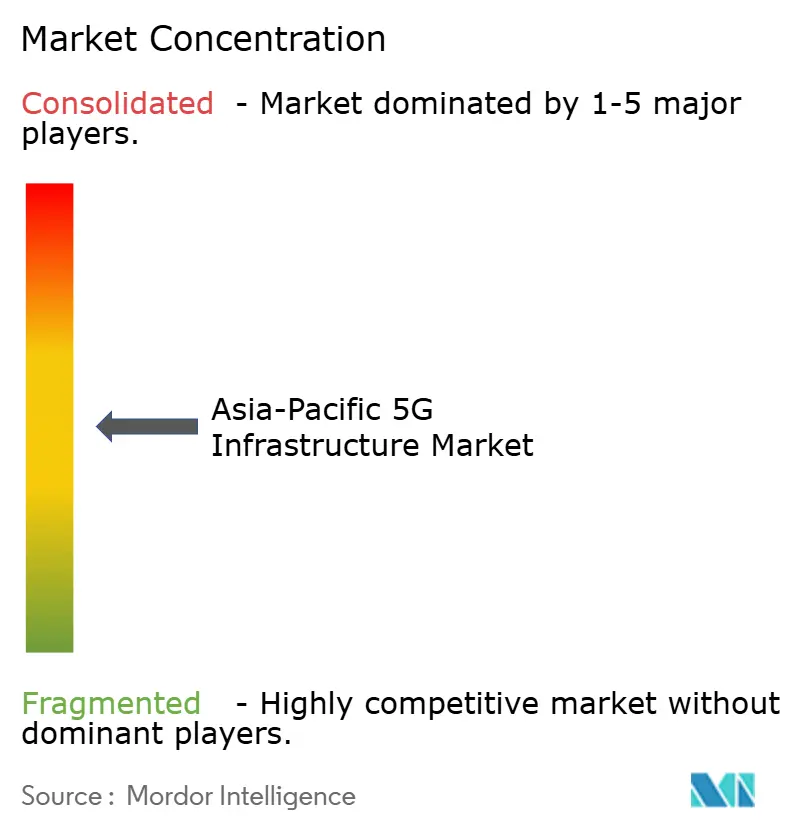
| Market Concentration | Medium |
Major Players *Disclaimer: Major Players sorted in no particular order Image © Mordor Intelligence. Reuse requires attribution under CC BY 4.0. | |
Asia-Pacific 5G Infrastructure Market Analysis by Mordor Intelligence
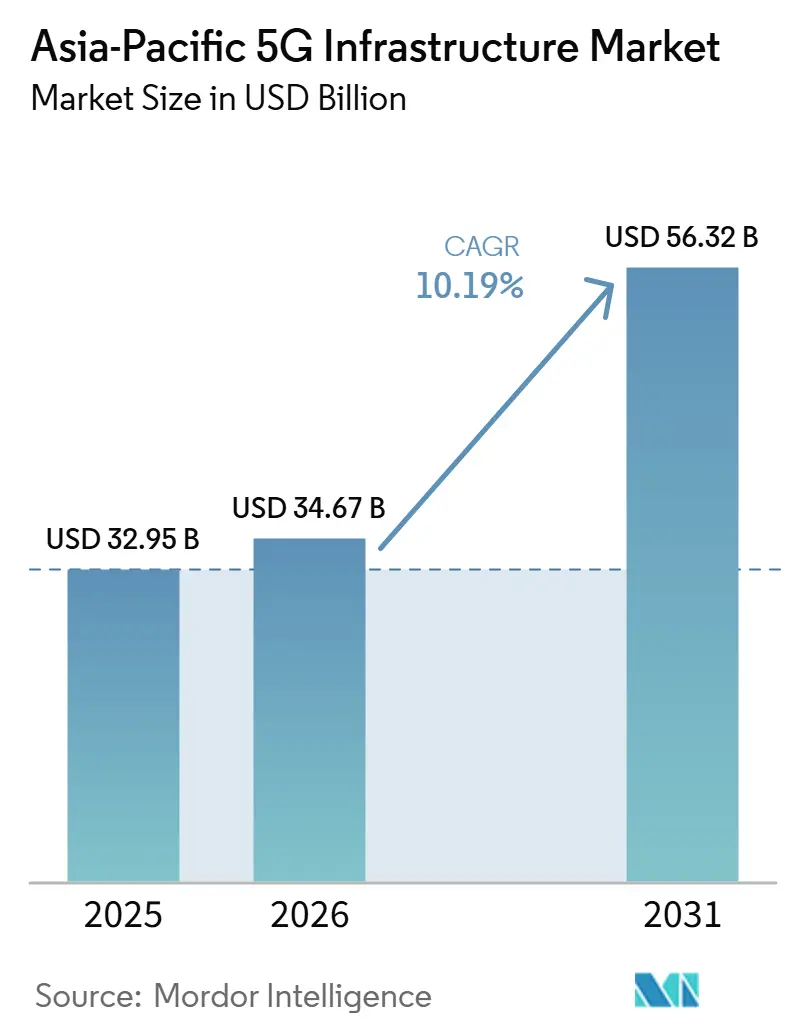
The Asia-Pacific 5G Infrastructure Market size is projected to expand from USD 32.95 billion in 2025 and USD 34.67 billion in 2026 to USD 56.32 billion by 2031, registering a CAGR of 10.19% from 2026 to 2031. Government spectrum programs, the transition from 4G to standalone 5G, and enterprise demand for reliable connectivity are driving investment across the region. China’s large installed network has created a deployment model that other regional markets can study, while also underscoring the need for denser radio networks and stronger backhaul capacity. Operators are shifting their focus toward services that can support industrial users, private networks, edge computing, and differentiated service levels. Vendors are responding through cloud-native core platforms, Open RAN systems, and AI-enabled radio management. Capital requirements, uneven access to mid-band spectrum, and integration work across multiple vendors could slow deployments in some countries.
Key Report Takeaways
- By communication infrastructure, 5G radio access network (RAN) held 60.96% of revenue share in the Asia-Pacific 5G infrastructure market in 2025, while the core network (cloud-native 5G core) is projected to expand at a 14.80% CAGR through 2031.
- By spectrum band, mid-band (1-6 GHz) held 69.21% of revenue share in the Asia-Pacific 5G infrastructure market in 2025, while high-band/mmWave (above 24 GHz) is projected to expand at a 17.22% CAGR through 2031.
- By network architecture, non-standalone held 66.30% of revenue share in the Asia-Pacific 5G infrastructure market in 2025, while standalone is projected to expand at a 15.55% CAGR through 2031.
- By core network technology, network function virtualization held 35.12% of revenue share in the Asia-Pacific 5G infrastructure market in 2025, while network slicing is projected to expand at a 17.48% CAGR through 2031.
- By end-user vertical, consumer electronics held 42.00% of revenue share in the Asia-Pacific 5G infrastructure market in 2025, while industrial manufacturing is projected to expand at a 16.50% CAGR through 2031.
- By country, China held 51.20% of revenue share in the Asia-Pacific 5G infrastructure market in 2025, while India is projected to expand at a 17.20% CAGR through 2031.
Note: Market size and forecast figures in this report are generated using Mordor Intelligence’s proprietary estimation framework, updated with the latest available data and insights as of January 2026.
Asia-Pacific 5G Infrastructure Market Trends and Insights
Drivers Impact Analysis*
| Driver | (~) % Impact on CAGR Forecast | Geographic Relevance | Impact Timeline |
|---|---|---|---|
| Rising 5G Traffic Density and Low-Latency Demand | +2.8% | Asia-Pacific, concentrated in China, Japan, and South Korea | Short term (≤ 2 years) |
| Government-Led Spectrum Allocation and Rollout Programs | +2.5% | India, Vietnam, Indonesia, and Australia, with early gains in metropolitan service areas | Short term (≤ 2 years) |
| Expansion of Private 5G for Industrial Automation | +1.7% | China, Japan, South Korea, and Indonesia, with spillover to Vietnam and India manufacturing corridors | Medium term (2-4 years) |
| Accelerating Open RAN and Cloud-Native Network Adoption | +1.4% | Japan, India, Indonesia, Vietnam, and Malaysia | Medium term (2-4 years) |
| Cross-Border Semiconductor Supply Chain Diversification in Asia-Pacific | +0.8% | China, India, Taiwan, and South Korea, with spillover to Malaysia and Vietnam fabrication ecosystems | Long term (≥ 4 years) |
| Edge-Driven Monetization for Ports, Mining, and Logistics Nodes | +0.6% | Asia-Pacific port and logistics hubs, including Singapore, Busan, Shanghai, and Mumbai | Medium term (2-4 years) |
| Source: Mordor Intelligence | |||
Rising 5G Traffic Density and Low-Latency Demand
China had more than 1.204 billion 5G subscriptions and 2.888 billion mobile IoT terminal connections by the end of 2025. This scale requires operators to add capacity while also upgrading their standalone core networks. China’s 5G-Advanced service covered 330 cities in March 2026, supported by active antenna systems that can manage beamforming at scale. The parallel buildout of dense radio sites and standalone architecture shortens the path to low-latency services, but it also increases early capital requirements for vendors and site specialists. Smart factories using 5G and industrial internet programs recorded 20.5% gains in product quality and 24.7% gains in production capacity. These operating results support wider demand for capacity and latency-sensitive industrial connectivity in the Asia-Pacific 5G infrastructure market.
Government-Led Spectrum Allocation and Rollout Programs
India’s Telecom Regulatory Authority released auction recommendations in February 2026 for 11,789.15MHz across 9 frequency bands. The proposal carried a reserve value of INR 2.10 lakh crore (USD 23.1 billion).[1]Telecom Regulatory Authority of India, “Recommendations on the Auction of Radio Frequency Spectrum in the Frequency Bands Identified for International Mobile Telecommunications,” Telecom Regulatory Authority of India, trai.gov.in It also linked a 10% reduction in the reserve price to new base stations in coverage gaps, directing operator spending toward underserved areas. Vietnam paired spectrum discounts with equipment-cost support for operators that build 20,000 5G base stations, using policy to encourage infrastructure investment. South Korea required standalone upgrades by 2026 and used lower LTE reallocation fees to support operators that meet indoor coverage goals. Government measures now extend beyond spectrum allocation and shape the pace, location, and architecture of network investment across the Asia-Pacific 5G infrastructure market.
Expansion of Private 5G for Industrial Automation
ZTE Corporation and Telkomsel deployed a UE-transparent Hybrid Private Network at an automotive facility in Karawang, Indonesia, in November 2025.[2]ZTE Corporation, “ZTE Collaborates with Telkomsel to Build a UE-Transparent Hybrid Private Network,” ZTE OpenLab, zte.com.cn The design provided industrial-grade 5G without hardware changes to existing factory devices. This approach can reduce compatibility costs that have limited private 5G adoption in ASEAN factories. China had more than 25,000 5G and industrial internet projects and 1,260 specialized 5G factories active in the first quarter of 2026. The reported 18.4% reduction in operating costs and 24.7% increase in production capacity at benchmark facilities give manufacturers practical evidence for private-network investment. Industrial automation, therefore, gives the Asia-Pacific 5G infrastructure market a demand base that public consumer coverage alone cannot provide.
Accelerating Open RAN and Cloud-Native Network Adoption
NTT DOCOMO and NEC launched Japan’s first commercial 5G Core on Amazon Web Services on February 26, 2026.[3]NTT DOCOMO, “DOCOMO and NEC Launch Japan’s First Commercial 5G Core on AWS, Built with World’s First AI-Automated Network Construction Technology,” NTT DOCOMO, docomo.ne.jp The companies stated that AI automation reduced deployment time by 80%, enabling cloud-native core infrastructure to move from trials into carrier operations. Rakuten Symphony received a Japanese Ministry of Economy, Trade and Industry grant of up to JPY 8 billion (USD 50.2 million) in April 2026 for Open RAN and RAN Intelligent Controller deployments in 7 countries.[4]Rakuten Symphony, “Rakuten Symphony Selected for METI Grant to Accelerate Open RAN and RIC Deployment in the Global South,” Rakuten Symphony, rakuten.com The program combines deployment activity with interoperability testing and helps diversify radio supply chains. Nokia’s cloud-native IMS and subscriber data management functions also went live on Rakuten Mobile’s network in March 2026. These production systems indicate that the Asia-Pacific 5G infrastructure market is moving toward multi-vendor core and radio environments.
Restraints Impact Analysis*
| Restraint | (~) % Impact on CAGR Forecast | Geographic Relevance | Impact Timeline |
|---|---|---|---|
| High Densification and Fiber Backhaul CAPEX | -2.1% | Asia-Pacific, most acute in India, Indonesia, and Australia’s remote areas | Short term (≤ 2 years) |
| Spectrum Cost Pressure and Uneven Mid-Band Availability | -1.6% | Indonesia, Thailand, and the Philippines, with spillover to South Asia | Medium term (2-4 years) |
| Multi-Vendor Interoperability and Integration Complexity | -1.1% | Japan, India, and ASEAN Open RAN deployments, with wider relevance in 5G-Advanced markets | Medium term (2-4 years) |
| Power Availability and Site Acquisition Constraints in Dense Urban Markets | -0.8% | Dense urban markets, including India’s tier-1 cities, Jakarta, and Metro Manila | Short term (≤ 2 years) |
| Source: Mordor Intelligence | |||
High Densification and Fiber Backhaul CAPEX
Dense small-cell networks require fiber links to each site, especially where operators use mmWave spectrum or add capacity layers. China’s optical fiber network reached 74.99 million km by the end of 2025, providing a strong foundation for its large 5G rollout. Many Southeast Asian and South Asian markets have less last-mile fiber, which makes densification more expensive and slower to deliver. The wider region faced a USD 200 billion infrastructure investment shortfall through the end of the decade, including gaps in backhaul financing. Operators without strong fiber networks must choose between expensive wireless backhaul and delayed capacity expansion. Site acquisition, power access, and landlord negotiations can add 18-24 months to small-cell rollouts in markets such as India and Indonesia.
Spectrum Cost Pressure and Uneven Mid-Band Availability
Mid-band spectrum from 1-6GHz supports most 5G deployments in the region, with 3.5GHz operating as the main workhorse band. Indonesia’s planned 3.5GHz award remained delayed until 2027 in March 2025, limiting the country’s access to new mid-band capacity. High reserve prices can redirect operator capital from network construction toward auction payments. India’s 2026 recommendations proposed reductions of 7-37% across relevant bands, showing how price reforms can change the investment balance. The effect is particularly significant for new entrants and second-network operators that must compete with providers holding earlier spectrum awards. Uneven band availability may therefore result in varying coverage quality and rollout schedules across the Asia-Pacific 5G infrastructure market.
*Our forecasts treat driver/restraint impacts as directional, not additive. The impact forecasts reflect baseline growth, mix effects, and variable interactions.
Segment Analysis
By Communication Infrastructure: RAN Investment Anchors the Deployment Cycle
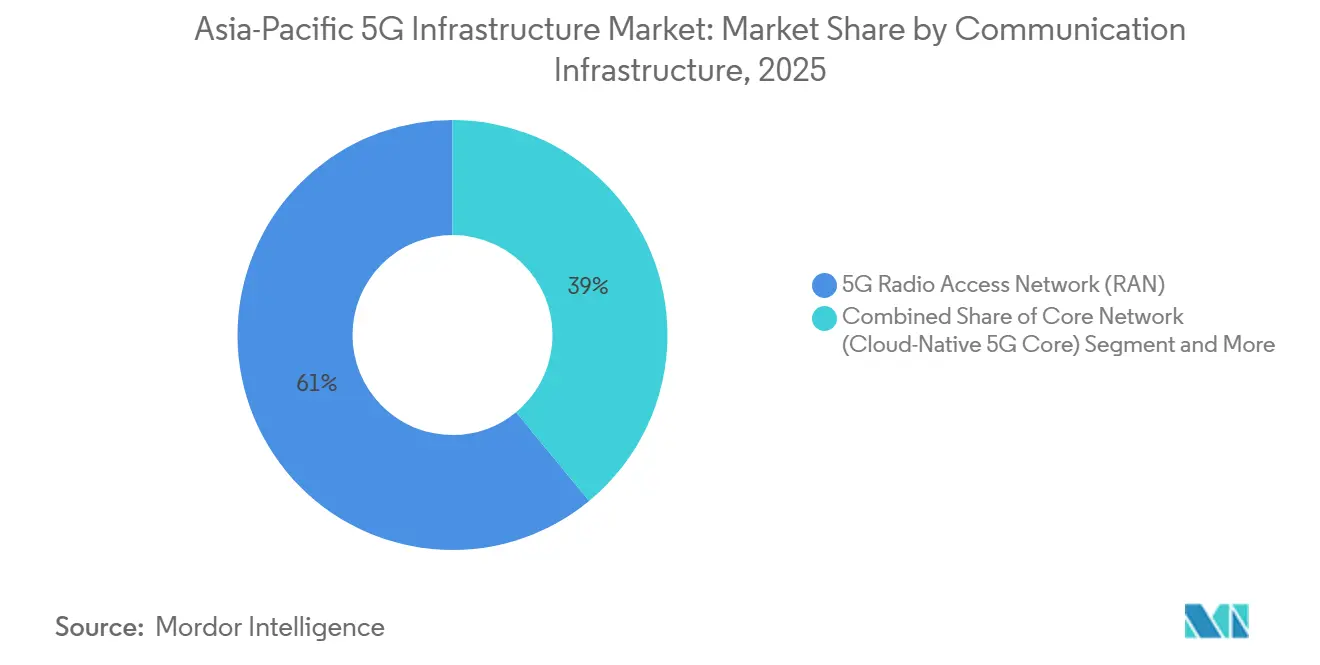
5G Radio Access Network held 60.96% of the Asia-Pacific 5G infrastructure market share within communication infrastructure in 2025. RAN remains the main destination for capital spending as operators densify base stations across China, India, Japan, and Southeast Asia. China Tower deployed more than 900,000 base stations per year by mid-2026 and had helped build more than 5.6 million sites in total. This operating scale shows why radio equipment, antennas, and site infrastructure continue to account for a large part of spending. Transport/xHaul is the second-largest sub-segment because every new macro site and small cell requires fronthaul, midhaul, or backhaul links.
Core Network is projected to expand at a 14.80% CAGR through 2031, making it the fastest-growing sub-segment of communication infrastructure. The Asia-Pacific 5G infrastructure market size for cloud-native core systems is supported by the shift away from legacy packet gateways. NTT DOCOMO’s commercial cloud-native core reduced power consumption by 70%, according to the company, offering an operating-cost benchmark for other operators. Nokia and Tune Talk completed an ASEAN cloud-native core deployment in January 2026, extending this architecture to a developing operator market. Cloud-native core platforms can help operators scale capacity, automate network functions, and support enterprise services. Open Telecom Ecosystem practices and 3GPP Release 17 and Release 18 requirements are also affecting vendor selection for these deployments.



By Spectrum Band: Mid-Band Dominance Faces Targeted mmWave Demand
Mid-band spectrum held 69.21% share of the spectrum band segment in 2025. It remains the primary coverage and capacity layer for macro 5G networks because regional regulators have broadly adopted plans for the 3.5 GHz band. The band offers a practical balance between propagation range and network capacity. Low-band spectrum below 1 GHz supports rural coverage and indoor service in countries with extensive underserved areas. India and Australia give policy priority to the 600 MHz and 700 MHz bands because those frequencies can extend coverage beyond major cities.
High-band/mmWave is projected to expand at a 17.22% CAGR through 2031. Japan’s operators have commercial 28GHz deployments, while South Korea has enterprise licensing for 28GHz use. India also included 26GHz in its forthcoming spectrum auction framework. The Asia-Pacific 5G infrastructure market is likely to use mmWave first in factories, stadiums, transit facilities, and similar concentrated locations rather than broad consumer coverage. Samsung’s live trial with KDDI showed a 52% increase in throughput on the 3.7GHz band using its AI-powered RAN Speed Optimizer. Equipment costs can improve as Japan and South Korea build more operational experience, which could support use in other regional markets after 2027.
By Network Architecture: NSA Remains Large As SA Adoption Accelerates
Non-Standalone architecture held 66.30% of the network architecture segment in 2025. NSA uses a 4G LTE anchor with a 5G New Radio overlay, which allowed many operators to introduce 5G on their existing core networks. This approach offered better consumer download speeds at a lower incremental cost. Its installed base remains important across much of the region. Operators continue to rely on NSA, where the business case for a dedicated 5G core is not yet established.
Standalone architecture is projected to expand at a 15.55% CAGR through 2031. The need for network slicing, low-latency services, and enterprise-focused revenue models is driving the Asia-Pacific 5G infrastructure market for SA deployments. South Korea required operators to upgrade to 5G SA by 2026 and used LTE reallocation fee incentives linked to indoor base-station goals. KT launched South Korea’s first 5G SA service for iPhone users in March 2026, while SK Telecom targeted a commercial SA launch in the fourth quarter of 2026. SA migration aligns products with 3GPP Release 16 and later standards, reducing the integration risk that previously slowed dedicated 5G core adoption.
By Core Network Technology: NFV Retains Scale While Network Slicing Builds Demand
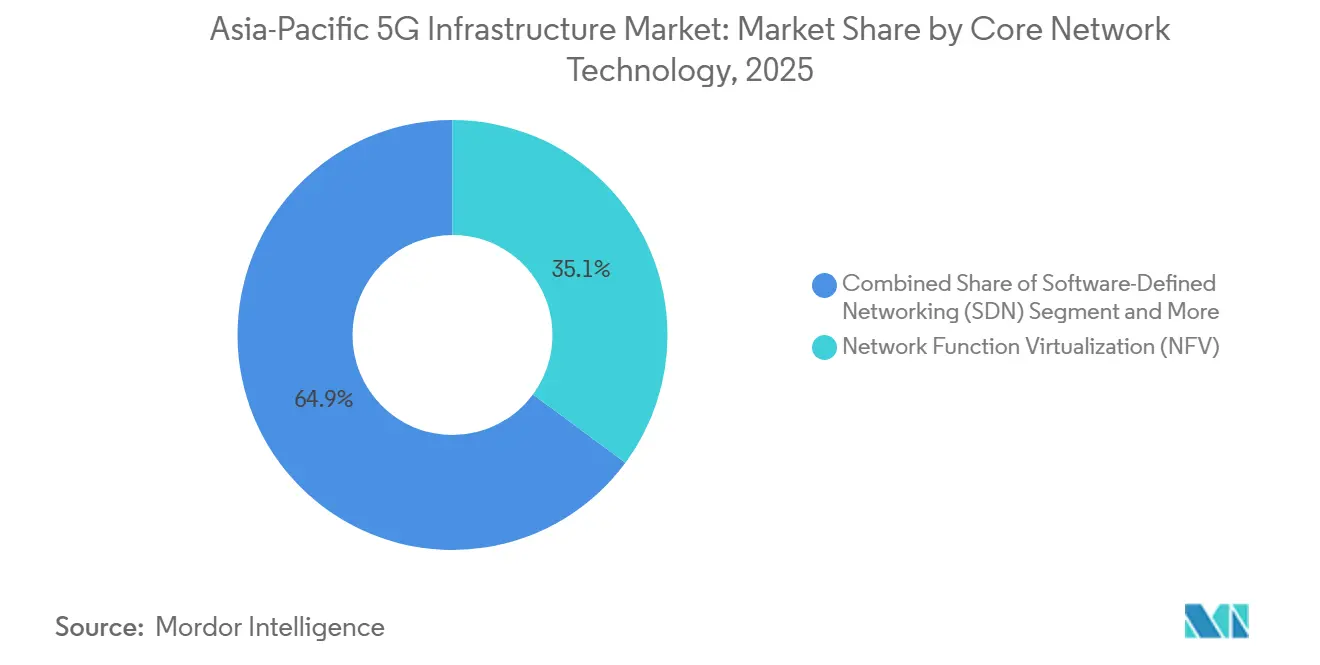
Network Function Virtualization held 35.12% share of the core network technology segment in 2025. It represents the installed base created when operators moved functions from dedicated hardware to virtualized systems. Software-Defined Networking supports traffic control across these systems. Multi-Access Edge Computing provides local processing capacity for workloads that need faster response times. Ports, logistics facilities, and manufacturing sites are among the settings where edge computing can support private 5G services.
Network slicing is projected to expand at a 17.48% CAGR through 2031. The Asia-Pacific 5G infrastructure market share for network slicing reflects a shift from standard data plans to service tiers tailored to specific use cases. Asia-Pacific accounted for 36% of commercial network slicing offerings worldwide in November 2025. Jio Platforms launched 10 active nationwide 5G slices in August 2025 for IoT, gaming, fixed wireless access, and mission-critical communications. Bharti Airtel launched commercial 5G network slicing in India in 2026, using Ericsson technology and Nokia’s 5G Core capabilities, enabling operators to offer service characteristics that conventional consumer connectivity cannot provide.
By End-User Vertical: Consumer Electronics Leads While Manufacturing Expands
Consumer electronics accounted for 42.00% of the end-user vertical segment in 2025. Smartphone adoption across China, South Korea, Japan, India, and Southeast Asia continues to drive demand for broad macro-layer coverage. This demand supports investment in the radio networks that later serve enterprise use cases. Automotive and mobility, healthcare and life sciences, energy and utilities, public safety and defense, and smart cities require more specialized connectivity. Their needs include stronger device density, low latency, service separation, and predictable performance.
Industrial manufacturing is projected to expand at a 16.50% CAGR through 2031. The Telkomsel-Pegatron Smart Manufacturing Lighthouse in Batam achieved latency below 10ms and planned to increase the number of connected devices from 600 to more than 1,200. Nokia and Indosat agreed in June 2026 to a nationwide AI-RAN rollout in Indonesia, supported by NVIDIA’s USD 1 billion investment in Nokia. These projects show that industrial users are seeking automated operations, local computing, and secure connections between machines and control systems from the Asia-Pacific 5G infrastructure market. The IEC 62443 standard is also becoming more relevant as private 5G operators establish cybersecurity practices for operational technology networks.
Geography Analysis
China held 51.20% of the Asia-Pacific 5G infrastructure market share in 2025. The country had 4.958 million active 5G base stations in March 2026, equal to 34.4 sites per 10,000 people. 5G coverage had reached all towns and more than 95% of administrative villages. Co-build and co-share programs involving China Mobile, China Unicom, and China Telecom supported this broad deployment. China projected a 5G contribution of CNY 5.6 trillion (USD 767 billion) to national economic output and planned to deploy 500,000 additional 5G-Advanced base stations and 1 million high-speed optical ports under its 15th Five-Year Plan.
India is projected to expand at a 17.20% CAGR through 2031, the fastest rate among the national markets cited. More than 518,000 5G base transceiver stations had been installed by 2025, supporting around 380 million wireless data subscribers on 5G services. The proposed reduction in auction reserve prices and incentives for coverage-deficient areas supports the growth of the Asia-Pacific 5G infrastructure market in India. India’s National Frequency Allocation Plan 2025 identified approximately 700 MHz in the 6 GHz band for future 5G, 5G-Advanced, and 6G use.
Japan and South Korea form the region’s technology leadership corridor for standalone networks and early AI-RAN work. South Korea’s government-required SA upgrades, KT’s March 2026 iPhone service, and SK Telecom’s planned fourth-quarter 2026 launch support a near-term architecture shift. Japan’s NTT DOCOMO, SoftBank, KDDI, and Rakuten Mobile operate commercial or near-commercial SA networks, while Ericsson and SoftBank signed a multiyear framework in March 2026 to modernize SoftBank’s core toward standalone operation. Australia also has a programmable 5G-Advanced initiative with Ericsson and Telstra that includes Open RAN-ready radio hardware and AI-based automation. Southeast Asia and Taiwan offer varied entry points, including Vietnam’s spectrum measures, Indonesia’s private 5G manufacturing projects, and Taiwan’s AI-native network work.
Competitive Landscape
The Asia-Pacific 5G infrastructure market has moderate consolidation in radio access networks, while software and core layers have more vendors. Huawei Technologies, Ericsson, Nokia, ZTE, and Samsung are established suppliers across the regional RAN market. Chinese vendors have large installed bases in China, Southeast Asia, and selected South Asian markets. Ericsson and Nokia have strong positions in Japan, South Korea, Australia, and India, as well as in higher-value Southeast Asian contracts. U Mobile selected Huawei and ZTE for Malaysia’s second 5G network in 2025, showing how supplier choices are changing vendor positions in ASEAN.
Nokia expanded cloud-native IMS into live production at Rakuten Mobile in March 2026. The company also pursued AI-RAN activities with operators in Indonesia and Taiwan in 2026, placing greater emphasis on software functions and network management rather than on radio hardware alone. Mavenir, Rakuten Symphony, and Airspan Networks are moving Open RAN deployments from trials toward production contracts. Mavenir’s cloud-native packet core went live at Rakuten Mobile in April 2026 and supported the country’s nationwide emergency roaming service.
Rakuten Symphony’s government-supported Open RAN program across 7 countries has positioned the company as a reference supplier for network diversification initiatives. Samsung’s AI-RAN works with KDDI and KT, also showing how radio performance is becoming a competitive factor. Qualcomm chipsets and Intel processors provide important silicon for Open RAN systems, while China’s 42% share of global 5G standard-essential patent declarations supports domestic vendors in licensing discussions. The Asia-Pacific 5G infrastructure market will continue to balance established vendor scale with growing demand for interoperable and software-based network systems.
Asia-Pacific 5G Infrastructure Industry Leaders
Huawei Technologies Co., Ltd.
Telefonaktiebolaget LM Ericsson
Nokia Corporation
ZTE Corporation
Samsung Electronics Co., Ltd.
- *Disclaimer: Major Players sorted in no particular order

Recent Industry Developments
- April 2026: Rakuten Symphony was selected for a METI grant of up to JPY 8 billion (USD 50.2 million) to lead Open RAN and RIC deployments across 7 countries: Indonesia, Vietnam, Malaysia, India, Kuwait, Bolivia, and Paraguay, running from May 2026 through March 2029, with 100 virtualized base stations per country.
- April 2026: Mavenir’s cloud-native Converged Packet Core went live on Rakuten Mobile’s nationwide network on Rakuten Cloud Platform in Japan, enabling the country’s new nationwide emergency roaming service “JAPAN Roaming,” the first deployment of cloud-native packet core in a national emergency roaming capacity in Asia-Pacific.
- March 2026: NTT DOCOMO and NEC launched Japan’s first commercial 5G Core on AWS on February 26, 2026, using agentic AI to automate 5G Core design and construction, reducing deployment time by 80% and power consumption by 70% compared to conventional on-premises infrastructure, the first deployment of this class in Asia-Pacific.


Asia-Pacific 5G Infrastructure Market Report Scope
The Asia-Pacific 5G infrastructure market generates revenue from 5G equipment, software licenses and subscriptions, integration, deployment, modernization, managed services, maintenance, and support for mobile operators and enterprises in manufacturing, automotive, healthcare, energy, smart cities, public safety, and consumer applications.
The Asia-Pacific 5G infrastructure market report is segmented by communication infrastructure (5G radio access network (RAN), transport/xHaul (front-haul, mid-haul, back-haul), and core network (cloud-native 5G core)), spectrum band (low-band (less than 1 GHz), mid-band (1-6 GHz), and high-band / mmWave (above 24 GHz)), network architecture (non-standalone (NSA), and standalone (SA)), core network technology (software-defined networking (SDN), network function virtualization (NFV), multi-access edge computing (MEC), and network slicing), end-user vertical (consumer electronics, automotive and mobility, industrial manufacturing, healthcare and life sciences, energy and utilities, public safety and defense, smart cities and infrastructure, and other end-user verticals (retail, media, agriculture)), and country (China, Japan, South Korea, India, Australia, and Rest of Asia-Pacific). The market forecasts are provided in terms of value (USD).
| 5G Radio Access Network (RAN) |
| Transport/xHaul (Front-Haul, Mid-Haul, Back-Haul) |
| Core Network (Cloud-Native 5G Core) |
| Low-Band (Less Than 1 GHz) |
| Mid-Band (1-6 GHz) |
| High-Band / mmWave (Above 24 GHz) |
| Non-Standalone (NSA) |
| Standalone (SA) |
| Software-Defined Networking (SDN) |
| Network Function Virtualization (NFV) |
| Multi-Access Edge Computing (MEC) |
| Network Slicing |
| Consumer Electronics |
| Automotive and Mobility |
| Industrial Manufacturing |
| Healthcare and Life Sciences |
| Energy and Utilities |
| Public Safety and Defense |
| Smart Cities and Infrastructure |
| Other End-User Verticals (Retail, Media, Agriculture) |
| China |
| Japan |
| South Korea |
| India |
| Australia |
| Rest of Asia-Pacific |
| By Communication Infrastructure | 5G Radio Access Network (RAN) |
| Transport/xHaul (Front-Haul, Mid-Haul, Back-Haul) | |
| Core Network (Cloud-Native 5G Core) | |
| By Spectrum Band | Low-Band (Less Than 1 GHz) |
| Mid-Band (1-6 GHz) | |
| High-Band / mmWave (Above 24 GHz) | |
| By Network Architecture | Non-Standalone (NSA) |
| Standalone (SA) | |
| By Core Network Technology | Software-Defined Networking (SDN) |
| Network Function Virtualization (NFV) | |
| Multi-Access Edge Computing (MEC) | |
| Network Slicing | |
| By End-User Vertical | Consumer Electronics |
| Automotive and Mobility | |
| Industrial Manufacturing | |
| Healthcare and Life Sciences | |
| Energy and Utilities | |
| Public Safety and Defense | |
| Smart Cities and Infrastructure | |
| Other End-User Verticals (Retail, Media, Agriculture) | |
| By Country | China |
| Japan | |
| South Korea | |
| India | |
| Australia | |
| Rest of Asia-Pacific |


Key Questions Answered in the Report
What is the Asia-Pacific 5G infrastructure market size?
The Asia-Pacific 5G infrastructure market was USD 34.67 billion in 2026 and is forecast to reach USD 56.32 billion by 2031, at a 10.19% CAGR.
Which communication infrastructure category led regional spending?
5G Radio Access Network led the communication infrastructure segment with a 60.96% share in 2025.
What spectrum range is most important for 5G deployment in Asia-Pacific?
Mid-band spectrum led with a 69.21% share in 2025 because it balances coverage and capacity for macro networks.
Why are standalone 5G networks gaining attention?
SA networks support network slicing, low-latency services, and enterprise applications, and they are projected to grow at a 15.55% CAGR through 2031.
Which end-user area is expected to grow fastest?
Industrial manufacturing is projected to grow at a 16.50% CAGR through 2031 as factories use private 5G for automation and connected operations.
Which country is expected to expand fastest through 2031?
India is projected to grow at a 17.20% CAGR, supported by spectrum reforms and continuing network investment.
Page last updated on:





