
India Professional Online Courses Market Size and Share
Market Overview
| Study Period | 2022 - 2031 |
|---|---|
| Forecast Data Period | 2026 - 2031 |
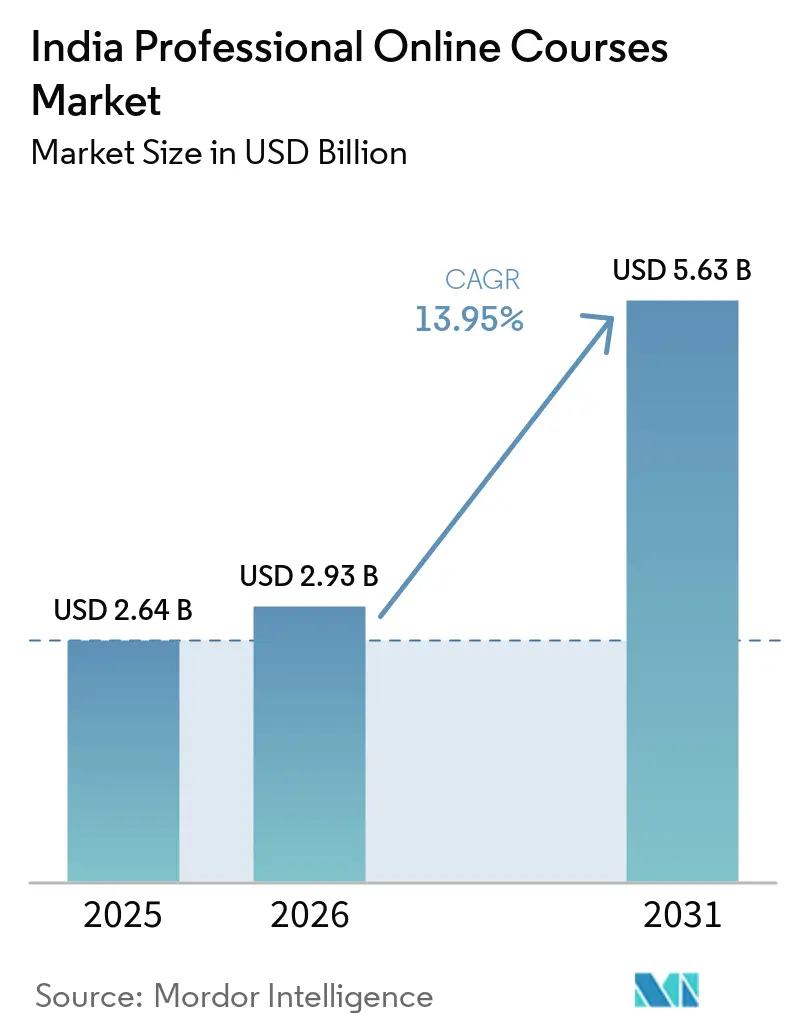
| Base Year Market Size (2025) | USD 2.64 Billion |
| Market Size (2026) | USD 2.93 Billion |
| Market Size (2031) | USD 5.63 Billion |
| Growth Rate (2026 - 2031) | 13.95 % |
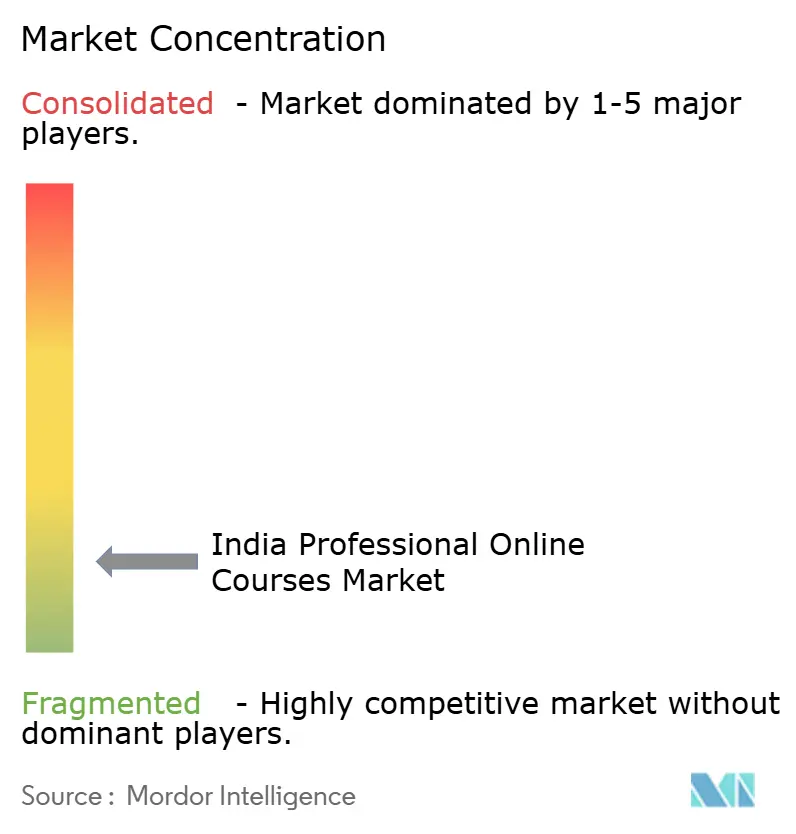
| Market Concentration | Low |
Major Players *Disclaimer: Major Players sorted in no particular order Image © Mordor Intelligence. Reuse requires attribution under CC BY 4.0. | |
India Professional Online Courses Market Analysis by Mordor Intelligence
The India Professional Online Courses Market size was valued at USD 2.64 billion in 2025 and is estimated to grow from USD 2.93 billion in 2026 to reach USD 5.63 billion by 2031, at a CAGR of 13.95% during the forecast period (2026-2031).
India's shift from traditional, institution-led skill-building to modular credentials that employers can directly associate with specific roles and tasks is driving market growth. With mobile data prices at a mere INR 13.98 (approximately USD 0.16) per GB, urban and peri-urban professionals now have broader access to paid digital learning, a realm they previously found challenging to enter through campus-based executive education. The supply side has also seen a formalization: the number of higher education institutions authorized to offer online programs surged from 58 in 2021-2022 to 113 in 2023-2024. Concurrently, the count of approved online programs jumped from 345 to 756. The Indian professional online courses market is witnessing robust demand from working professionals, a surge in technology and data credentials, and a predominantly self-funded B2C learning ecosystem. By 2025, Individual Learners are projected to account for 64.83% of enterprise-type revenue, with Technology and Data Courses accounting for 28.72% of demand. Despite a modest formal workforce training rate of 4.1% in 2024, initiatives like the government-backed IndiaAI Mission, boasting a budget of INR 10,371.92 crore (USD 1.25 billion), and the increasing enterprise reliance on quarterly skill-gap assessments underscore a growing appetite. This creates a consistent demand for platforms that seamlessly link learning outcomes with hiring prospects and offer verified credentials.[1]
Key Report Takeaways
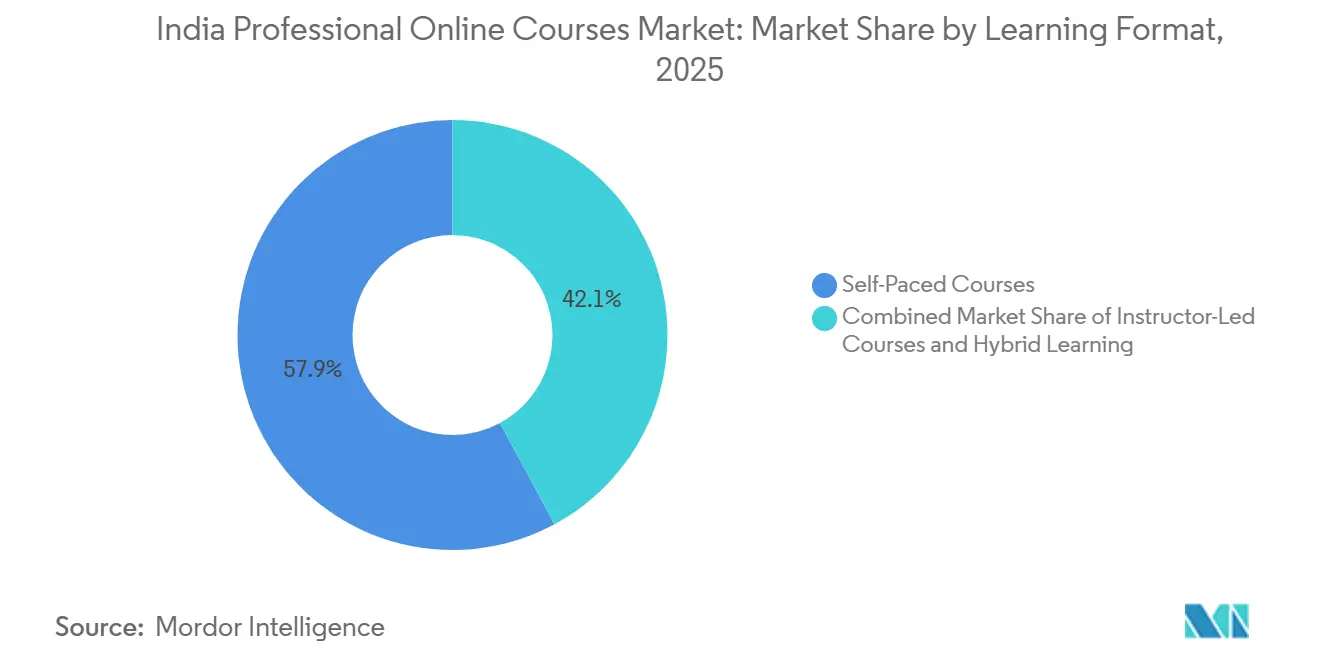
- By learning format, Self-Paced Courses led with 57.86% share in 2025, while Hybrid Learning Programs are forecast to expand at a 15.67% CAGR through 2031.
- By course type, Technology and Data Courses accounted for 28.72% of the India professional online courses market size in 2025 and are projected to advance at a 15.91% CAGR through 2031.
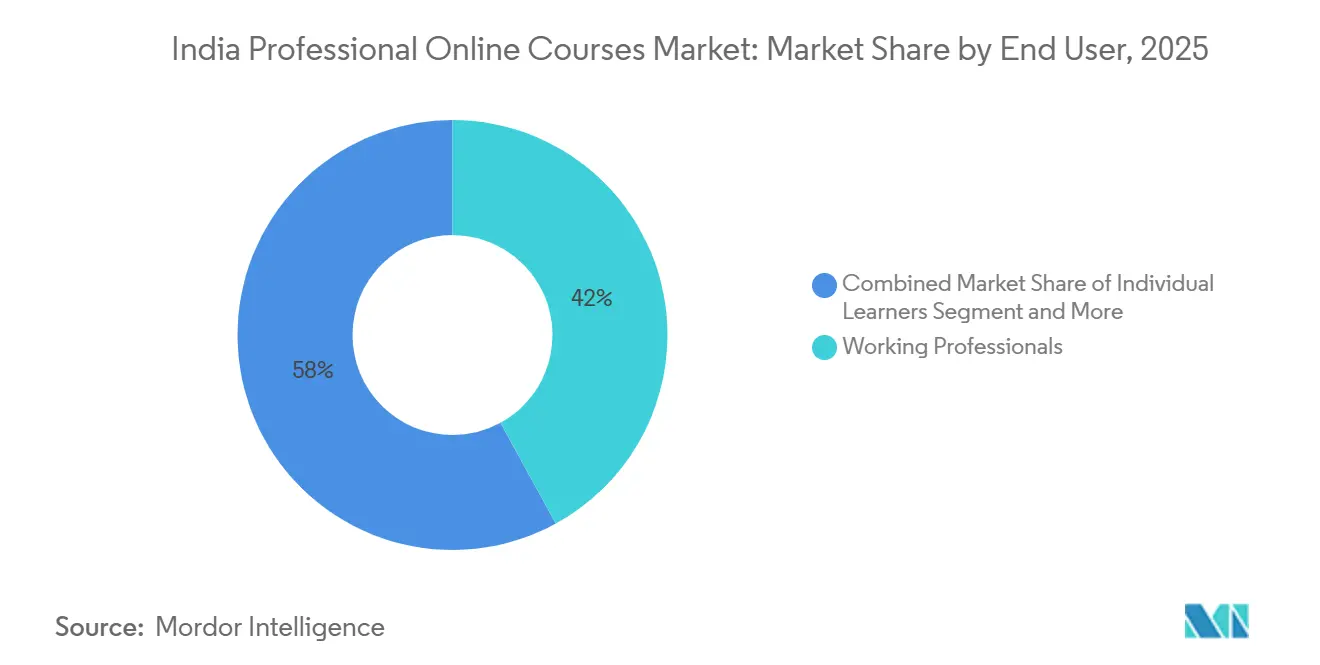
- By end user, Working Professionals held 42.02% share in 2025, while Students and Fresh Graduates recorded the highest projected CAGR at 15.34% through 2031.
- By enterprise type, Individual Learners held 64.83% of the India professional online courses market share in 2025, while Small and Medium Enterprises are expected to grow at a 14.97% CAGR to 2031.
- By geography, South India held 31.57% of the India professional online courses market size in 2025, while West India is projected to record the fastest CAGR at 14.84% through 2031.
Note: Market size and forecast figures in this report are generated using Mordor Intelligence’s proprietary estimation framework, updated with the latest available data and insights as of January 2026.
India Professional Online Courses Market Trends and Insights
Drivers Impact Analysis*
| Drivers | (~) % Impact on CAGR Forecast | Geographic Relevance | Impact Timeline |
|---|---|---|---|
| Rising demand for career-aligned upskilling and reskilling | +4.5% | National, with highest intensity in South India and North India | Medium term (2-4 years) |
| Expanding adoption of cohort-based and mentor-led learning formats | +1.8% | National, with early concentration in metro learner markets | Short term (≤ 2 years) |
| Corporate learning budgets shifting toward role-based digital training | +2.5% | National, concentrated in IT and ITeS, BFSI, and manufacturing hubs | Medium term (2-4 years) |
| Government and skilling ecosystem support for employability-linked learning | +1.5% | National, with priority deployment in Tier 2 and Tier 3 cities and non-metro districts | Long term (≥ 4 years) |
| AI-enabled personalization improving learner completion and outcomes | +2.0% | National, with stronger effect in mobile-first non-metro learners | Medium term (2-4 years) |
| Growth of niche job-ready credentials in high-demand technical domains | +1.2% | South and West India tech corridors, with rising demand in GCC hubs | Short term (≤ 2 years) |
| Source: Mordor Intelligence | |||
Rising Demand for Career-Aligned Upskilling and Reskilling
The India professional online courses market is benefiting from a labor environment in which AI-related disruption and export-led growth in higher-skilled services are occurring simultaneously. SWAYAM had crossed 4 crore cumulative enrollments by early 2024, indicating the depth of interest in digital learning, even before paid professional programs captured the higher-value part of the demand. The paid end of the market is gaining strength as employer-recognized credentials draw learners away from open-access formats and toward verified outcomes. On Coursera, enrollments in GenAI courses by Indian learners are rapidly growing, as the platform reported in early 2024 that a learner in India enrolls in a GenAI course once every 3 minutes, indicating demand was still accelerating rather than flattening. Enrollment mix also points to breadth in demand, with management programs drawing 45% of online learners with 3 to 10 years of experience and technology programs pulling strong participation from IT and ITeS professionals at 35% and BFSI professionals at 20%, which supports platforms that can serve multiple career tracks with employer-linked credentials.[2]
Expanding Adoption of Cohort-Based and Mentor-Led Learning Formats
The India professional online courses market is seeing stronger adoption of cohort-based formats because completion, accountability, and placement outcomes matter more when learners are paying for career advancement. IIT Madras’s BS in Data Sciences program exceeded 9,000 annual intakes for 4 straight years. It had produced 177 graduates, over 2,500 placements, and 850 admissions to Ivy League or equivalent global institutions, demonstrating that structured blended delivery can generate strong, measurable outcomes without full-time campus attendance. The IIM Nagpur and TimesPro PG Certificate Program in AI and GenAI for Managers also showed how institutional brands are extending their reach through edtech partners while maintaining employer trust. These programs command prices that are 3 to 5 times higher than comparable self-paced content because live sessions, mentor check-ins, and peer work reduce the risk of learner disengagement. UpGrad’s 1.6 lakh sign-ups for cohort-based short-format bootcamps and certifications in FY25 also showed that many learners start with flexible content and then move toward more structured formats as the career value of the decision becomes clearer.
Corporate Learning Budgets Shifting Toward Role-Based Digital Training
The India professional online courses market is benefiting from a clear shift in enterprise learning spend toward role-specific technical capability building rather than broad awareness-based training. In FY25, 58.5% of Indian organizations increased their L&D budgets, and AI and generative AI training saw the sharpest rise in demand, with IT and ITeS leading adoption at 48%, followed by manufacturing and supply chain at 14% and BFSI at 10%. Demand is also moving up the organization chart, as mid-level employee training rose from 15% of enterprise L&D programs in FY24 to 35% in FY25, while senior-level training demand more than doubled year on year. This shift supports vendors that can serve entire job families with mapped learning paths instead of offering only isolated modules. NIIT Learning Systems, with 110 global enterprise clients and revenue visibility of USD 459 million as of May 2026, shows how large buyers are moving toward managed training service contracts that offer stronger continuity than catalog subscriptions.
Government and Skilling Ecosystem Support for Employability-Linked Learning
Government support is reinforcing the India professional online courses market by widening access, formalizing the digital learning supply, and expanding employability-linked skill development across more parts of the country. The IndiaAI Mission, backed by INR 10,371.92 crore (USD 1.25 billion), is creating institutional demand for AI-focused credentials that traditional universities and legacy certification bodies cannot deliver at the pace enterprises now require. The number of higher education institutions approved to offer online programs reached 113 universities in the 2025 academic year. While approved programs rose to 756, this points to stronger supply-side legitimacy for formal online learning pathways. PMKVY 4.0 had trained 27.08 lakh candidates across 38 sectors by December 2025, which shows that employability-linked skilling is being pushed at scale through the broader national skilling system. As these programs expand into Tier 2 and Tier 3 locations, private platforms with recognized certificates and mobile-first delivery are likely to capture the premium layer of demand that sits above publicly funded foundational skilling.
Restraints Impact Analysis*
| Restraints | (~) % Impact on CAGR Forecast | Geographic Relevance | Impact Timeline |
|---|---|---|---|
| Price sensitivity among learners versus perceived credential value | -1.8% | National, with stronger impact in non-metro and Tier 2 and Tier 3 segments | Medium term (2-4 years) |
| High dropout rates in self-paced online learning programs | -1.5% | National, with stronger impact in lower-income and non-metro segments | Short term (≤ 2 years) |
| Fragmented course quality and inconsistent employer recognition | -1.2% | National, with disproportionate effect on SME and early-career B2C segments | Long term (≥ 4 years) |
| Limited broadband quality and device access in lower-income segments | -0.8% | East India, Central India, and Tier 3 plus non-metro locations | Long term (≥ 4 years) |
| Source: Mordor Intelligence | |||
Price Sensitivity Among Learners Versus Perceived Credential Value
Price remains a restraint in the India professional online courses market, as learners can choose between free content and premium, branded programs that may cost more than INR 3 lakh. That wide gap creates a willingness-to-pay problem for mid-tier providers that lack the brand strength of top institutions or the scale of large platforms. Employer confidence is a key conversion factor, and 68% of Indian HR managers viewed Tier 1 higher education institution-backed online degrees as equivalent to campus degrees. At the same time, standalone platform certificates faced more skepticism. This is why installment plans, tuition-refund structures, and placement-linked promises are becoming important tools in premium program sales. Providers that cannot underwrite learner outcomes or add institutional trust are more exposed to free alternatives and to lower conversion in price-sensitive markets.
High Dropout Rates in Self-Paced Online Learning Programs
High dropout rates remain a major barrier to the India professional online courses market, as self-paced learning still dominates volume but not completion quality. Faculty at IIM Bangalore noted that global MOOC completion rates are often only 3% to 5%, and the same pattern limits the commercial value of purely asynchronous delivery when learners need credible outcomes. The contrast with paid professional certifications, where completion rates can range from 40% to 60%, shows why structured accountability has become an important product differentiator. Non-completion weakens learner satisfaction, reduces referrals, and can increase refund pressure, which raises acquisition costs for platforms that depend on scale marketing. This is pushing the market toward mentor-led and hybrid products, where completion economics are stronger, and employers place greater value on the certificate.
*Our forecasts treat driver/restraint impacts as directional, not additive. The impact forecasts reflect baseline growth, mix effects, and variable interactions.
Segment Analysis
By Learning Format: Completion Economics Reshaping Format Preference
Self-Paced Courses held 57.86% of the India professional online courses market in 2025, reflecting the appeal of flexibility for working adults managing jobs, commute time, and family commitments. That volume lead does not remove the completion problem, because free self-paced MOOCs often see only 3% to 5% completion while paid professional certifications reach 40% to 60%. Many learners still begin with self-paced modules because the entry cost is lower and the learning schedule is easier to control. Instructor-Led Online Courses sit in the middle of the format mix, offering online convenience while adding live expert access and real-time feedback that enterprise buyers value. This makes instructor-led delivery useful for organizations that want visible skill transfer and stronger proof of participation than a fully self-managed course can offer.
Hybrid Learning Programs are forecast to grow at a 15.67% CAGR through 2031, making them the fastest-rising format in the India professional online courses market. Hybrid growth is driven by programs that combine online delivery with campus immersion, peer interaction, and mentor support, thereby reducing learner drift and improving the perceived value of the certificate. IIM Ahmedabad’s Blended Post Graduate Program in Management showed how high-trust institutions can monetize brand strength without requiring full-time residency. That model is likely to influence more executive and technical offerings. Platforms that built their base on self-paced content are now adding hybrid routes to retain learners who want deeper credentials and clearer job outcomes after completing entry-level programs. The format shift is important because it increases revenue per learner relationship and gives providers a stronger defense against low-priced competition for commodity content.

By Course Type: Technology and Data Credentials Anchor Market Growth
Technology and Data Courses held 28.72% of the India professional online courses market in 2025 and are forecast to expand at a 15.91% CAGR through 2031, keeping them at the center of category growth. This leadership reflects the spread of AI adoption, the hiring needs of software-led employers, and the premium placed on cloud, data science, cybersecurity, and AI engineering skills. The Indian professional online courses industry is particularly exposed to this category because enterprise skills spending is increasingly aligned with technical roles that require rapid updates and verifiable competencies. MeitY’s digital skilling priorities and UGC’s quality framework both support a more formal pipeline for recognized technical credentials. That policy and employer mix is one reason technology and data courses have moved from optional upskilling to a baseline requirement for a growing share of India’s white-collar workforce.
Business and Management Courses remain a major category because they serve professionals with 3 to 10 years of experience who are seeking promotion, a role change, or stronger managerial credentials. The Indian professional online courses industry also has strong demand for Finance and Accounting Courses as GCCs and multinational captive units expand India-based teams that need IFRS, FP&A, and risk analytics capabilities. Design and Creative, Language and Communication, and Marketing and Sales courses serve smaller but durable niches, especially in client-facing export services and digital commerce roles. Test Preparation and Certification Courses, including PMP, Six Sigma, and cloud vendor credentials, tend to produce high ticket values because they are directly linked to hiring screens and employer reimbursement. The course mix, therefore, spans both broad career progression and narrow job-readiness needs, but the strongest revenue momentum remains concentrated in technology-led credentials with clear hiring relevance.
By End User: Early-Career Entry Accelerates Alongside the Professional Core
Working Professionals remained the largest end-user group, with a 42.02% share in 2025, reflecting the long-standing role of online certificates and bootcamps in mid-career advancement. This group has supported much of the revenue base through EMI-funded program purchases, particularly in technology, management, and executive upskilling categories. Demand among working professionals has widened from junior staff to more senior roles, as enterprise training for mid-level employees rose from 15% in FY24 to 35% in FY25, and senior-level demand more than doubled. That means platforms must now serve different learning depths, from foundational refreshers to leadership-facing AI programs. The revenue center remains mature, but the needs inside it are becoming more diverse and more outcome-driven,
Students and Fresh Graduates are projected to grow at a 15.34% CAGR through 2031, making them the fastest-rising end-user segment in the India professional online courses market. Their rise signals that professional credential building is moving earlier in the career cycle, as general degrees alone no longer provide enough signaling in skill-intensive hiring markets. Individual Learners, as a broader demand category, still underscores the self-funded nature of the market, while enterprises generate higher revenue per account through subscriptions, curriculum bundles, and managed services. UpGrad’s acquisition of Internshala in February 2026, which added 34 to 35 million registered users and 450,000 employer connections, showed how platforms are linking learning, internships, and employment more closely for this younger user base. As that linkage deepens, a larger share of demand is likely to move from fee-only learning toward pricing structures tied more directly to outcomes and placement support.
By Enterprise Type: B2C Scale Masks the SME Growth Opportunity
Individual Learners held 64.83% of the Indian professional online courses market share in the enterprise segment in 2025, indicating that the category still depends heavily on self-funded consumption. The Indian professional online courses industry grew on the back of urban, English-proficient professionals who were willing to pay for branded credentials through EMI structures and flexible course formats. Large enterprises remain important because they purchase at higher contract values and increasingly prefer managed learning partnerships over ad hoc course buying. NIIT Learning Systems illustrated this pattern with 110 enterprise clients and net revenue retention above 100% as of December 2025, indicating recurring wallet share from established accounts. Enterprise revenue is therefore more concentrated in fewer but larger relationships, while B2C remains broader but more price-sensitive.
Small and Medium Enterprises are forecast to grow at a 14.97% CAGR through 2031, making them the fastest-growing buyer group under the enterprise type. This part of the Indian professional online courses industry has been underserved because many platforms have built their sales, billing, and support models around either direct consumer or large enterprise accounts. Winning SME budgets requires LMS integration, curriculum mapping, compliance reporting, and bulk commercial terms that consumer-first platforms are still building out. India’s more than 1,700 Global Capability Centers also sit between classic SME and large-enterprise definitions because they can have large learning demand but uneven internal L&D maturity. That creates meaningful white space for platforms to package enterprise-grade delivery without the complexity or pricing of a large managed services contract.
Geography Analysis
which made it the largest regional contributor. Karnataka, Tamil Nadu, Telangana, and Kerala offer dense IT and ITeS employment, high literacy, and strong digital adoption, which reduces friction to career-linked online learning adoption. Karnataka accounted for 14% of India’s GenAI course enrollments on Coursera in 2025, while Tamil Nadu contributed 11%, reflecting the region’s strong technology workforce. State-level efforts such as Tamil Nadu’s Naan Mudhalvan platform and Telangana’s T-Hub ecosystem also widen the addressable learner base beyond employees already inside large corporate systems. ICRIER’s classification of Karnataka, Tamil Nadu, Kerala, and Telangana as Advanced Digitalisers supports the view that South India will remain the first testing ground for premium cohorts, hybrid formats, and regional-language professional learning models.
West India is projected to expand at a 14.84% CAGR through 2031, making it the fastest-growing geography in the India professional online courses market. Maharashtra alone accounted for 20% of India’s GenAI enrollments on Coursera in 2025, and its learners represented 9.17% of national online learner volumes, which confirms strong demand depth in the state. Mumbai and Pune support demand from the BFSI and IT services sectors, while Ahmedabad is gaining relevance as a GCC and startup destination, drawing more Gujarat learners into paid professional education. Higher per-capita income in the Maharashtra and Gujarat belt reduces pricing resistance and supports stronger uptake of premium cohort and hybrid formats than the national average. The region also benefits from manufacturing-heavy states, where automation is changing job roles and increasing demand for role-specific digital certifications in sectors such as automotive, pharmaceuticals, and chemicals.
North India held a strong position in 2025, with Delhi-NCR ranking among upGrad’s top 5 enrollment markets due to its concentration of corporate headquarters, government institutions, and demand for management education. East and Central India remain smaller in terms of current revenue. Still, the demand base is deeper than formal market capture suggests, as more than 40% of Internshala’s 34-35 million users come from Tier 2 and Tier 3 markets. Rural fixed or Wi-Fi penetration was only 9.1% in 2025, and East and Central India posted weaker digital economy scores, which still limit conversion into paid, high-engagement programs. Central India’s classification as an Aspirational Digitaliser indicates a lower base, but its direction remains positive as adoption spreads. As mobile quality improves and regional-language offerings expand, these under-penetrated regions are likely to account for a larger share of new learner additions in the later years of the forecast period.[3]
Competitive Landscape
The India professional online courses market remains fragmented, with no single platform controlling the category across formats, course types, and end-user groups. The largest structural event was the completion of the Coursera and Udemy combination in May 2026, which created an entity with 290 million learners, 18,000 enterprise customers, more than 95,000 instructors, and pro forma annual revenue above USD 1.5 billion. That transaction reset global benchmarks for content scale, enterprise distribution, and the economics of AI-enabled personalization. Domestic players are responding through consolidation, with upGrad acquiring Internshala in February 2026 and also pursuing a merger with Unacademy to build a broader career-lifecycle platform. NIIT Learning Systems has taken a different route by acquiring SweetRush and deepening its positioning as an AI-enabled enterprise learning partner rather than competing in price-sensitive consumer categories.
Simplilearn is strengthening its position through institutional and technology partnerships that carry high employer credibility in technical domains. Its Applied Agentic AI program with Microsoft and its Professional Certificate Program in Agentic AI and Multi-Agent AI Systems with IIT Patna show a clear attempt to lead at the frontier of AI training before the category becomes crowded. Technology is also becoming a direct competitive tool, with SimpliMentor GPT and AI-driven candidate matching inside upGrad’s Internshala integration pointing to a stronger emphasis on outcome engineering rather than on content volume alone. This matters in India because learners and employers still give greater value to credentials that come with institutional backing, clear role alignment, or visible job-market linkage. The next competitive layer is likely to be built around who can connect learning, assessment, mentorship, and hiring signals most efficiently at scale.
Domestic platforms such as upGrad, Great Learning, Simplilearn, Intellipaat, and other specialist providers still compete actively because the market is segmented by audience, format, price point, and credential strategy rather than by one uniform purchase logic. Platforms that can add job matching, internships, enterprise deployment, or co-branded certification are better placed to defend pricing against free content and low-cost aggregators. The white space remains meaningful in Indian-language professional learning, because less than 1% of current professional course revenue comes from learners using Indian languages other than English, even though informal online learning in Hindi is expanding faster. The India professional online courses market, therefore, rewards scale. However, it still does not behave like a winner-take-all category because trust, course depth, employer linkage, and delivery model differ sharply across user groups. Competitive intensity is rising, but concentration remains low because no participant yet holds a dominant share, covers the full category, and enjoys unchallenged employer trust across the full market.
India Professional Online Courses Industry Leaders
-
Coursera, Inc.
-
upGrad Education Private Limited
-
Great Learning
-
Simplilearn Solutions Private Limited
-
Udemy, Inc.
- *Disclaimer: Major Players sorted in no particular order
Recent Industry Developments
- June 2026: Simplilearn, in partnership with Vishlesan I-Hub Foundation at IIT Patna, launched a Professional Certificate Program in Agentic AI and Multi-Agent AI Systems, delivered as a 10-week live virtual program targeting technology and product professionals.
- May 2026: Coursera completed its combination with Udemy, creating a combined entity with 290 million learners, 18,000 enterprise customers, and pro forma annual revenue exceeding USD 1.5 billion.
- May 2026: Simplilearn launched The Simplilearn Leadership Council, an invite-only network of the top 1% of global industry and academic experts, to co-design AI-first professional learning programs.
- December 2025: Coursera announced its plan to combine with Udemy to build a broader global skills platform focused on AI-era workforce training.
India Professional Online Courses Market Report Scope
| Self-Paced Courses |
| Instructor-Led Online Courses |
| Hybrid Learning Programs |
| Technology and Data Courses |
| Business and Management Courses |
| Finance and Accounting Courses |
| Marketing and Sales Courses |
| Design and Creative Courses |
| Language and Communication Courses |
| Test Preparation and Certification Courses |
| Individual Learners |
| Working Professionals |
| Students and Fresh Graduates |
| Enterprises |
| Individual Learners (B2C) |
| Small & Medium Enterprises (SMEs) |
| Large Enterprises |
| North India |
| South India |
| West India |
| East India |
| Central India |
| By Learning Format | Self-Paced Courses |
| Instructor-Led Online Courses | |
| Hybrid Learning Programs | |
| By Course Type | Technology and Data Courses |
| Business and Management Courses | |
| Finance and Accounting Courses | |
| Marketing and Sales Courses | |
| Design and Creative Courses | |
| Language and Communication Courses | |
| Test Preparation and Certification Courses | |
| By End User | Individual Learners |
| Working Professionals | |
| Students and Fresh Graduates | |
| Enterprises | |
| By Enterprise Type | Individual Learners (B2C) |
| Small & Medium Enterprises (SMEs) | |
| Large Enterprises | |
| By Geography | North India |
| South India | |
| West India | |
| East India | |
| Central India |
Key Questions Answered in the Report
What is the size of the India professional online courses market in 2025 and 2031?
The India professional online courses market was valued at USD 2.64 billion in 2025 and is projected to reach USD 5.63 billion by 2031, growing at a 13.95% CAGR over 2026 to 2031.
Which course category is leading growth in India?
Technology and Data Courses led with 28.72% share in 2025 and are expected to grow at a 15.91% CAGR through 2031, supported by AI, cloud, and data skill demand.
Why are hybrid and cohort-based programs gaining traction?
Hybrid Learning Programs are projected to grow at a 15.67% CAGR because they improve completion, accountability, and perceived credential value compared with purely self-paced formats.
Which learner group drives the most revenue today?
Working Professionals held 42.02% of demand in 2025, showing that mid-career upskilling remains the main revenue base for providers.
Which region is the largest and which is growing the fastest?
South India was the largest region with 31.57% share in 2025, while West India is expected to grow the fastest at a 14.84% CAGR through 2031.
What is the biggest challenge for providers in India?
Price sensitivity and weak completion in self-paced formats remain major issues, especially when learners compare paid programs with free content and question credential value.