
Aromatic Solvents Market Size and Share
Market Overview
| Study Period | 2021 - 2031 |
|---|---|
| Market Size (2026) | USD 7.15 Billion |
| Market Size (2031) | USD 9.02 Billion |
| Growth Rate (2026 - 2031) | 4.75 % |
| Fastest Growing Market | Asia-Pacific |
| Largest Market | Asia-Pacific |
| Market Concentration | Medium |
Major Players *Disclaimer: Major Players sorted in no particular order Image © Mordor Intelligence. Reuse requires attribution under CC BY 4.0. | |
Aromatic Solvents Market Analysis by Mordor Intelligence
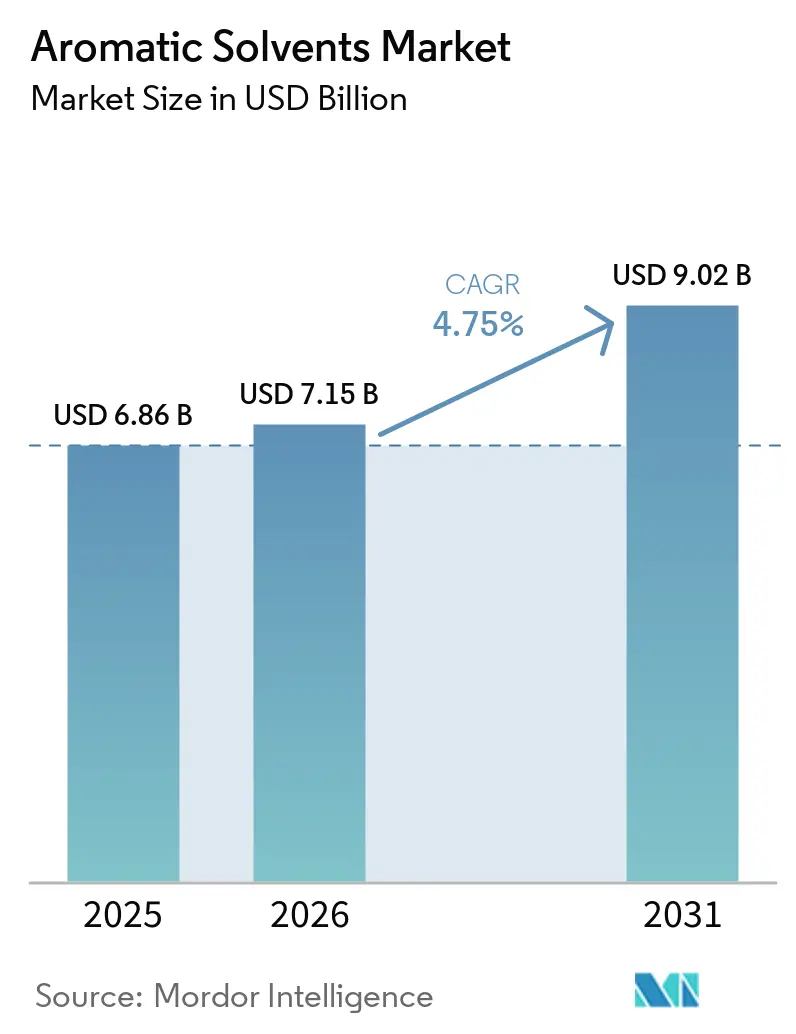
The aromatic solvents market size was valued at USD 6.86 billion in 2025 and is estimated to grow from USD 7.15 billion in 2026 to reach USD 9.02 billion by 2031, at a CAGR of 4.75% during the forecast period (2026-2031). The aromatic solvents market is supported by industrial coatings, high-performance adhesives, printing inks, cleaning, and chemical manufacturing. Toluene, xylene, and ethylbenzene remain central materials due to their strong solvency, controlled evaporation, and resin compatibility. These properties are important when manufacturers need stable application behavior across varying temperatures, substrates, production conditions, film thickness, drying times, and resin systems. Solvent-borne formulations remain relevant where waterborne or bio-based systems do not meet the required operating performance. Qualified industrial formulations require time and investment to change, which limits rapid substitution in applications with defined performance requirements. Regulatory action is encouraging reformulation, particularly in decorative coatings, while performance-led applications remain largely unaffected. Integrated producers manage feedstock and solvent margins across the value chain. New capacity in Asia-Pacific is expanding regional supply, while solvent recovery at major customer sites is moderating virgin material demand in selected applications. Demand conditions are shaped by technical requirements, regulatory obligations, feedstock economics, supplier purchasing decisions, regional supply conditions, application qualification cycles, and the capacity decisions of integrated producers in key regional markets.
Key Report Takeaways
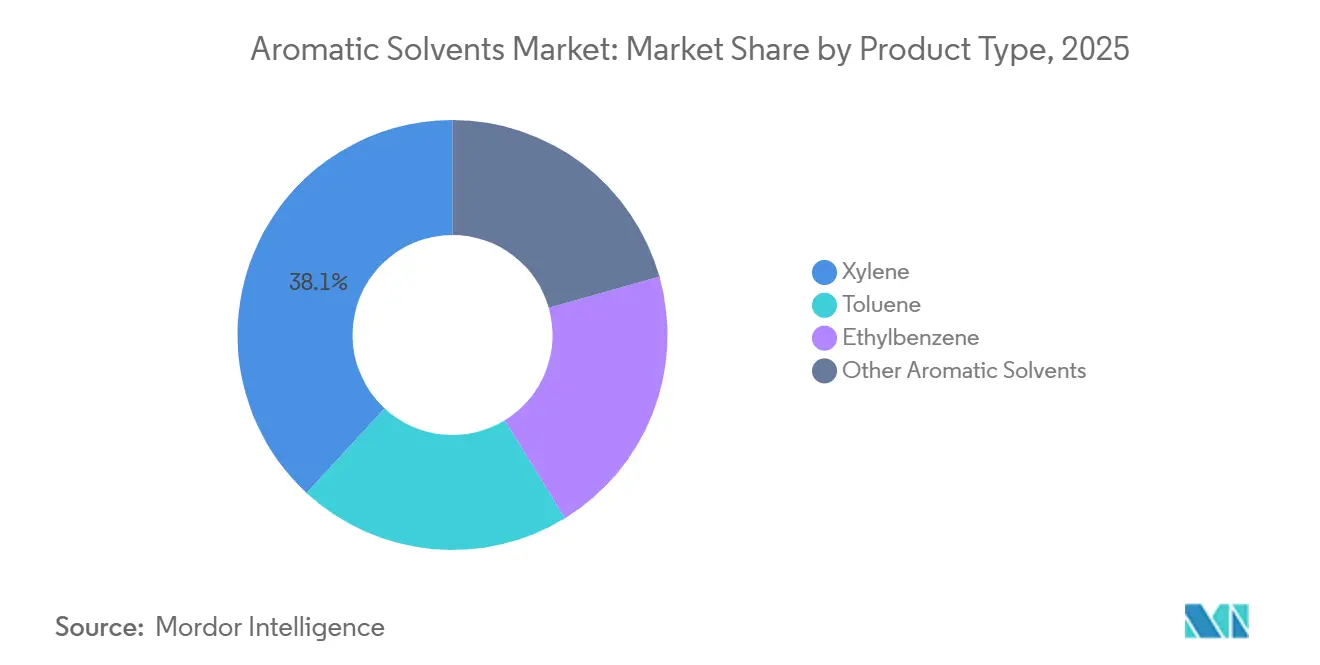
- By product type, xylene held a 38.13% share in 2025 and is forecast to grow at a 5.13% CAGR through 2031.
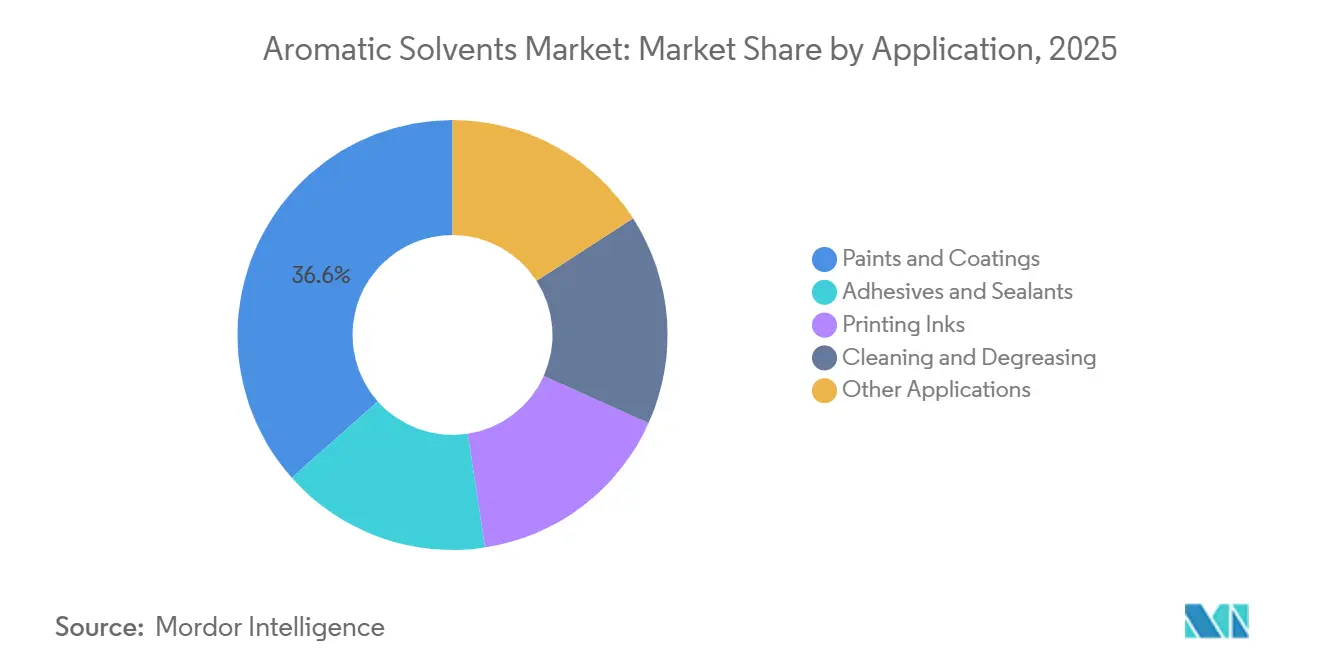
- By application, paints and coatings accounted for a 36.56% share in 2025, while adhesives and sealants are forecast to grow at a CAGR of 5.45% through 2031.
- By geography, Asia-Pacific accounted for 41.32% of the market in 2025 and is forecast to grow at a CAGR of 5.67% through 2031.
Note: Market size and forecast figures in this report are generated using Mordor Intelligence’s proprietary estimation framework, updated with the latest available data and insights as of January 2026.
Global Aromatic Solvents Market Trends and Insights
Drivers Impact Analysis*
| Drivers | (~) % Impact on CAGR Forecast | Geographic Relevance | Impact Timeline |
|---|---|---|---|
| Rising Demand for Paints and Coatings | +1.8% | Global, with a concentration in Asia-Pacific and North America | Long term (≥ 4 years) |
| Expanding Automotive and Transportation Production | +1.0% | Asia-Pacific core, including China, India, and South Korea, with spillover to the Middle East and Africa | Medium term (2-4 years) |
| Growth in Industrial Cleaning, Adhesives, and Printing Inks | +0.8% | Global, with early gains in ASEAN manufacturing corridors | Medium term (2-4 years) |
| Expansion of Petrochemical and Chemical-Intermediate Manufacturing in Asia-Pacific | +1.1% | Asia-Pacific core, with secondary effects on North American and European trade flows | Long term (≥ 4 years) |
| Solvent Recovery and Closed-Loop Reclamation Adoption | +0.2% | North America and Europe, with early adoption in China's Original Equipment Manufacturer (OEM) paint shops | Short term (≤ 2 years) |
| Source: Mordor Intelligence | |||
Rising Demand for Paints and Coatings
Paints and coatings remain the largest consumption channel for the aromatic solvents market. Solvent-borne alkyd, epoxy, polyurethane, and acrylic systems are used in industrial maintenance, marine, and automotive refinish applications. Mixed xylene and toluene support controlled evaporation and resin compatibility across varied application conditions. Waterborne systems have replaced some decorative paint applications, but they do not meet all technical requirements in industrial coatings. Regulatory pressure has separated lower-performance architectural applications from performance-driven industrial uses. A 2026 study found that UK decorative paints had shifted away from alkane solvents toward alcohols, ketones, esters, and siloxanes following the EU Paints Directive.
This shift in decorative coatings does not eliminate the need for aromatic solvents in all coating formulations. Industrial users often need to requalify coatings before replacing a solvent system, a process that can delay changes in protective, marine, and automotive refinish applications. The aromatic solvents market, therefore, retains demand where performance, process control, and substrate compatibility are closely linked. High-purity grades hold a stronger position where users face strict technical specifications. This distinction helps explain why reformulation is more advanced in decorative coatings than in many industrial systems.
Expanding Automotive and Transportation Production
Automotive production supports the aromatic solvents market through coatings, adhesives, rubber processing, and cleaning operations. Vehicle assembly requires materials that meet defined application and curing conditions. Electric vehicle assembly also uses structural adhesives in multi-material vehicle designs, and these adhesives require solvent carriers to control viscosity and open time during application. Structural bonding, therefore, creates an additional demand route for aromatic solvents in vehicle manufacturing, relevant across China, India, South Korea, and other regional production centers.
Transportation manufacturing does not affect all uses of aromatic solvents equally. Coatings remain important for protection, repair, and finishing, while adhesives support joining and assembly. The aromatic solvents market benefits when these uses occur within large manufacturing supply chains. India's policy support for automotive components strengthens the conditions for domestic manufacturing activity. China's large vehicle output also makes its supply chain an important destination for coating and bonding materials. Demand is linked to industrial activity rather than passenger vehicle sales alone.
Growth in Industrial Cleaning, Adhesives and Sealants, and Printing Inks
Industrial cleaning, adhesives and sealants, and printing inks provide the aromatic solvents market with a diverse range of demand drivers. Aromatic solvents effectively dissolve synthetic resins, polymers, and ink components. Gravure and flexographic inks use solvent carriers in flexible packaging applications, and demand for flexible packaging is supported by the continued need for consumer and e-commerce distribution formats. Solvent-based contact adhesives remain important in footwear, furniture, and industrial bonding across Southeast Asia. These end uses reduce dependence on a single consumption channel.
Electronics manufacturing in Vietnam, Malaysia, and the Philippines supports selective demand for precision solvent cleaning. Mixed xylene grades are used in applications such as photoresist stripping and circuit board preparation, which require attention to contamination control and material compatibility. The movement of some electronics production into Southeast Asia broadens the regional demand base for the aromatic solvents market. Printing inks provide a stable outlet for fast evaporation on high-speed presses, while adhesives add demand from packaging, consumer goods, and industrial assembly.
Expansion of Petrochemical and Chemical-Intermediate Manufacturing in Asia-Pacific
Asia-Pacific petrochemical investment affects the aromatic solvents market on both the supply and demand sides. Production of purified terephthalic acid, styrene, and polyurethane precursors increases captive use of aromatic feedstocks. China, India, and South Korea remain important locations for this downstream activity. Larger integrated sites can use aromatic streams internally or supply merchant grades to nearby customers, supporting availability while also increasing regional competition. This structure also strengthens the link between solvent pricing and broader benzene, toluene, and xylene (BTX) value chain economics. Steam crackers that use ethane rather than naphtha produce lower BTX co-product output, which can tighten merchant aromatic availability in some locations. Refinery-integrated production expansions in Asia can therefore influence price differences between integrated sites and merchant markets.
Sinopec began work in 2025 to expand the Tahe refining and chemical project in Xinjiang. The project includes an 800,000 metric tons-per-year aromatics complex and is scheduled for completion by 2029. The upgrade also includes a 1.5 million metric tons per year continuous catalytic reforming unit, raising crude processing capacity to 8.5 million metric tons per year. BASF stated that the site includes 18 plants and 32 production lines. These projects add scale to regional chemical production and can intensify competition for merchant solvent sales. India remains an important destination for new domestic aromatic production as producers seek to reduce their dependence on imports. Mangalore Refinery and Petrochemicals Limited (MRPL) began shipping toluene from its aromatic complex in January 2025, a move the company described as a step toward reducing its dependence[1]The Hindu, “MRPL Flags Off First Parcel Truck of Toluene,” The Hindu, thehindu.com..
Restraints Impact Analysis*
| Restraints | (~) % Impact on CAGR Forecast | Geographic Relevance | Impact Timeline |
|---|---|---|---|
| Volatile Feedstock and Crude-Oil-Linked Pricing | -0.3% | Global, with acute sensitivity in import-dependent regions of South and Southeast Asia and Europe | Short term (≤ 2 years) |
| VOC, Worker-Exposure, and Hazardous-Material Restrictions | -0.5% | North America and Europe, with growing regulatory influence in ASEAN and China | Long term (≥ 4 years) |
| Formulation Qualification Costs for Low-Aromatic Substitution | -0.2% | Global, concentrated among mid-sized coatings and adhesives formulators | Medium term (2-4 years) |
| Source: Mordor Intelligence | |||
Volatile Feedstock and Crude-Oil-Linked Pricing
Aromatic solvents are closely tied to naphtha economics and crude oil price movements. Changes in crude prices can pass through the supply chain rapidly. During price increases, producers face higher input costs, while customers may delay purchases as they assess future price direction. This can pressure demand and margins simultaneously. The effect is particularly difficult for distributors without feedstock hedging or integrated production. Companies that can balance margins across Benzene, Toluene, and Xylene (BTX) and derivative operations are better positioned in the aromatic solvents market. Buyers may also adjust order timing to manage working capital and avoid purchasing during sudden price movements. This behavior can make short-term demand appear weaker even when underlying consumption has not changed. Feedstock exposure remains an important consideration in supplier selection, inventory planning, and contract discussions across the solvent value chain.
Integrated refiners can manage some cost pressure within broader refinery and chemical operations. Pure distributors have less ability to offset rapid movements in spot prices. Import-dependent regions face added exposure when freight and feedstock costs rise together. China's refinery-to-chemicals investments can increase local availability, but new capacity can also create temporary oversupply in individual grades, influencing regional merchant pricing. Price volatility remains a planning challenge for formulators, distributors, and buyers of solvent-intensive materials.
Volatile Organic Compound (VOC), Worker-Exposure, and Hazardous-Material Restrictions
Volatile Organic Compound (VOC) rules, occupational exposure requirements, and hazardous material classifications create a complex compliance environment for solvent users. The burden is often greater for mid-sized formulators that sell into multiple jurisdictions. The U.S. Environmental Protection Agency amended national VOC emission standards for aerosol coatings in January 2025. The final rule added 17 compounds and revised reactivity factors, product categories, testing, reporting, and related requirements. Manufacturers were required to comply by July 17, 2025, although revised limits and factors could be adopted from the rule's effective date[2]U.S. Environmental Protection Agency, “National Volatile Organic Compound Emission Standards for Aerosol Coatings, Final Rule,” Federal Register, govinfo.gov.. These changes increase the importance of formulation reviews and documented compliance.
European decorative paint reformulation illustrates how regulation can alter solvent choices over time. A 2026 UK study reported a significant decline in paint VOC mass emissions following implementation of the EU Paints Directive. It also found that 2024 paint formulations contained virtually no alkane content, instead using alcohols, ketones, esters, and siloxanes. The aromatic solvents market remains exposed where regulations apply to consumer-facing formulations. Industrial uses may shift more slowly, as product approval and performance requirements are more demanding. Compliance requirements can add cost and extend decision cycles for all solvent users.
*Our forecasts treat driver/restraint impacts as directional, not additive. The impact forecasts reflect baseline growth, mix effects, and variable interactions.
Segment Analysis
By Product Type: Xylene’s Dual-Market Position Drives Category Leadership
Xylene held 38.13% of the aromatic solvents market share in 2025, and the aromatic solvents market size for xylene is forecast to grow at a CAGR of 5.13% through 2031. Xylene serves as a functional solvent in industrial coatings and adhesives, and also connects to para-xylene, purified terephthalic acid, and polyester value chains. This dual role gives integrated producers flexibility when allocating material between solvent and derivative uses. The relationship between merchant and captive demand can influence availability and pricing. Xylene's growth reflects demand from both downstream chemical production and solvent-consuming applications.
Toluene is the second-largest product type and is used in paints, adhesives, and printing inks. It can also serve as a transalkylation feedstock to produce additional xylene, linking its demand cycle closely to xylene and broader benzene, toluene, and xylene (BTX) economics. Ethylbenzene is mainly produced within styrene-integrated complexes, which limits its position as a merchant solvent. Its specialized uses include laboratory, pharmaceutical, and electronics cleaning applications. Other aromatic materials, including trimethylbenzene fractions and C9-C10 aromatic naphthas, are used in high-solids industrial coatings, where lower volatility can support higher solids content.
Sinopec's new-generation integrated aromatics technology received official appraisal in April 2026. The technology includes a para-xylene adsorbent and an ethylbenzene-to-xylene isomerization catalyst at an 890,000 metric tons per year aromatics unit. The China Petroleum and Chemical Industry Federation recognized the technology, and 25 national invention patents were granted. The development reflects continued focus on separation efficiency and yield optimization. Large integrated sites can use such improvements to strengthen their operating economics, while smaller producers may find it harder to match these gains without similar technical capabilities.



By Application: Adhesives and Sealants Challenge Coatings’ Structural Dominance
Paints and coatings accounted for 36.56% of the aromatic solvents market share in 2025, while adhesives and sealants are projected to record a CAGR of 5.45% through 2031. Industrial maintenance, protective, marine, and automotive refinish work support the demand for coatings. Structural bonding in electric vehicles and flexible packaging supports adhesive demand. These applications have different exposure to volatile organic compound (VOC) regulations and different product approval cycles, giving the aromatic solvents market several routes for demand growth.
Adhesive formulations in automotive and footwear applications across Asia are less directly affected by architectural coating regulations, supporting continued use in applications where bonding performance is central. Printing inks offer another stable outlet, particularly in gravure systems that require fast evaporation on high-speed web presses. Cleaning and degreasing are growing selectively in electronics manufacturing locations in Vietnam, Malaysia, and the Philippines, where high-purity mixed xylene and toluene grades are used for contamination control. Pharmaceutical synthesis, rubber processing, and agrochemical production are smaller applications in which stringent purity requirements can support higher-value sales.
The application mix reduces reliance on construction-led coating cycles alone. Automotive, packaging, electronics, and industrial manufacturing each create separate demand conditions. Waterborne alternatives are more established in some decorative paint uses but are less readily substituted in performance-led coating, adhesive, or printing applications. Buyers assess solvent choice against processing needs, material compatibility, and compliance requirements, keeping application-specific technical requirements central to the aromatic solvents market.
Geography Analysis
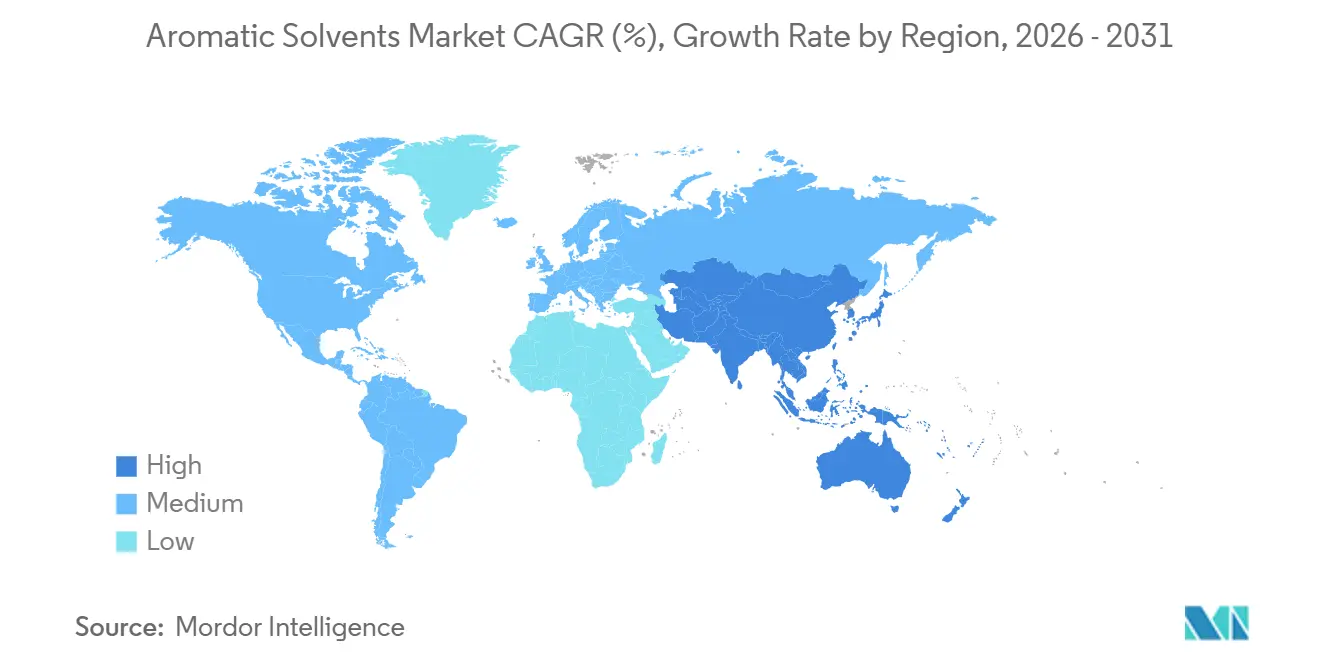
Asia-Pacific held a 41.32% share in 2025 and is forecast to grow at a CAGR of 5.67% through 2031. China, India, South Korea, and ASEAN form the main regional growth base. Demand is supported by investment in construction, infrastructure, manufacturing, and petrochemicals. China has concentrated petrochemical and end-use capacity in the Yangtze River Delta, the Pearl River Delta, and the Beijing-Tianjin-Hebei corridor. These clusters link solvent supply with coating, packaging, automotive, and chemical manufacturing. New integrated capacity can increase both regional availability and competition. This geographic concentration also supports local supplier networks, downstream purchasing relationships, and specialized distribution infrastructure.
India remains important as domestic aromatic production expands alongside strong manufacturing demand. Indian Oil Corporation Limited's Panipat Refinery P-25 project was reported to be approaching final commissioning by the end of 2026. Adani Petrochemicals' Valor Petrochemicals project is targeting completion of Phase I in 2026. MRPL's 2025 toluene shipment also marked a domestic step toward lower import dependence. South Korea supplies regional electronics and automotive coating manufacturers with high-purity xylene. Together, these developments keep Asia-Pacific central to the aromatic solvents market.
North America is mature in output but remains important for automotive refinish, industrial maintenance, construction, packaging adhesives, and merchant solvent supply. Reduced Benzene, Toluene, and Xylene (BTX) co-product output from ethane-fed steam crackers can affect the availability of certain aromatic streams, making refinery-integrated supply more important for customers seeking consistent grades. Europe has lower use of decorative paint solvents following long-running Volatile Organic Compounds (VOC) reformulation efforts. Research documented in 2026 in the UK showed that newer decorative paint formulations replaced alkane solvents with alcohols, ketones, esters, and siloxanes. European demand remains more stable in industrial uses that require defined process performance and product reliability. South America is supported mainly by demand from the Brazilian automotive and packaging industries. The Middle East and Africa region is seeing emerging demand growth through chemical diversification and automotive manufacturing.

Competitive Landscape
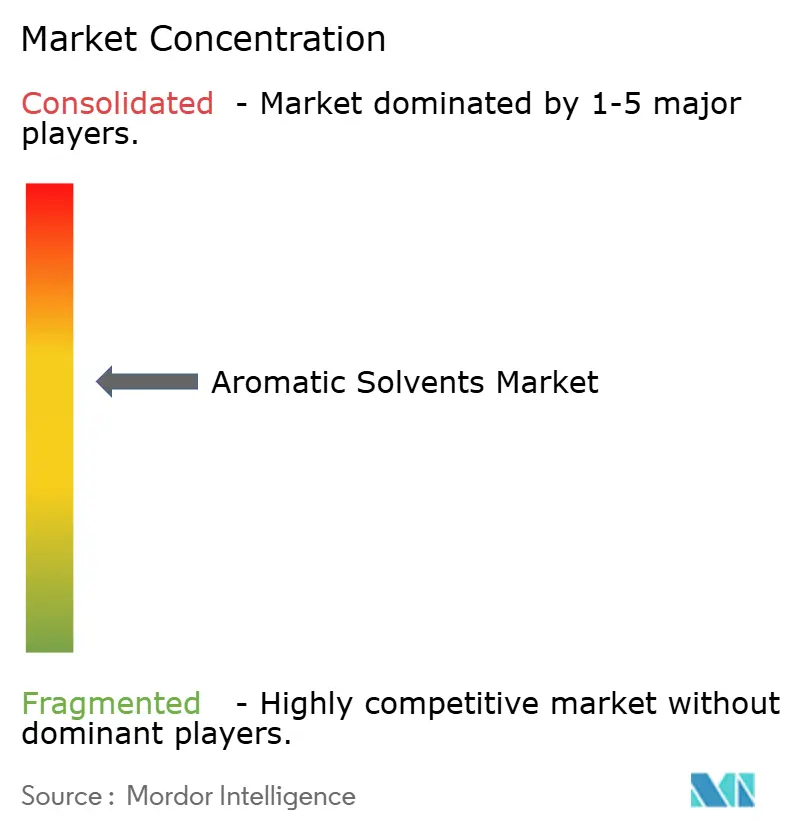
The aromatic solvents market is moderately consolidated. Integrated petroleum and chemical producers have advantages in access to feedstocks, extraction, processing, and the internal use of aromatic streams. These companies can shift material between derivatives and merchant solvent grades as relative margins change. Smaller regional suppliers and distributors compete through availability, logistics, customer service, and grade customization. Their role is important where customers require reliable local deliveries or closely specified materials. This structure makes feedstock integration important for profitability and supply resilience, while also creating opportunities for specialized suppliers to provide high-purity, application-specific grades. The market does not follow a single uniform competitive model across all regions. Competitive positions vary with local feedstock availability, end-use manufacturing density, technical specifications, and customer purchasing patterns.
BASF inaugurated its Zhanjiang Verbund site in March 2026. The site uses 100% renewable electricity, and BASF states that its integrated design, process innovations, and use of renewable energy can reduce carbon dioxide emissions by up to 50% compared with a conventional petrochemical site. Its steam cracker was designed to process feedstocks including naphtha and butane. Sinopec is also advancing aromatics production through the Tahe upgrade, which includes an 800,000 metric ton/year aromatics complex. These developments reflect the strategic importance of integrated production scale, efficiency, and feedstock flexibility. They can raise the cost threshold for companies competing primarily in commodity grades. Large projects can also affect regional merchant availability as new supply enters service. Specialty grades remain a practical route for suppliers that cannot match large integrated sites in scale. Their competitive position depends on quality consistency, technical support, and dependable supply.
Circularity is another area of competitive activity in the aromatic solvents market. PPG and SAIC General Motors' 2025 program uses recovered cleaning solvents in a closed-loop process. The initiative enables the reuse of up to 80% by weight of collected waste solvents and recycles more than 430 tons annually. The process uses distillation and purification to recover components for use in coatings, as raw materials, or as reclaimed solvents. Suppliers that support recovery, purification, collection, and specification control can strengthen customer relationships in major original equipment manufacturer (OEM) accounts. These capabilities matter where manufacturers seek to reduce hazardous waste and reliance on conventional disposal methods. High-purity electronics-cleaning xylene, pharmaceutical-grade toluene, and C9 aromatic naphtha for high-solids coatings remain differentiated opportunities. These positions are based on product quality, application knowledge, and dependable supply rather than scale alone. The ability to meet documented quality requirements can be as important as quantity in these specialized applications.
Aromatic Solvents Industry Leaders
BASF
China Petroleum & Chemical Corporation
Exxon Mobil Corporation
Reliance Industries Limited
Shell plc
- *Disclaimer: Major Players sorted in no particular order

Recent Industry Developments
- August 2026: ExxonMobil is one of four final non-binding bidders for Shell's US chemical assets portfolio, valued at up to USD 8 billion according to the Financial Times, spanning facilities in Texas, Louisiana, and Pennsylvania. If completed, the acquisition would mark the largest consolidation of aromatic solvent production capacity in North America in decades, with significant implications for merchant market supply concentration and the pricing dynamics of Gulf Coast-sourced toluene and xylene.
- September 2025: Sinopec began construction on the upgrade of its Tahe refining and petrochemical complex in Xinjiang. The project targets crude processing capacity expansion to 8.5 million metric tons/year, along with the addition of an 800,000 metric tons/year aromatics complex and a 1.5 million metric tons/year continuous catalytic reforming unit. Once operational, the expanded complex is expected to increase aromatics output and strengthen Sinopec's position in the domestic petrochemical supply chain. The project is scheduled for completion by 2029.


Global Aromatic Solvents Market Report Scope
Aromatic solvents are petroleum-derived liquids containing a ring-shaped carbon structure (benzene ring) that provides strong dissolving capabilities for industrial applications. These solvents are widely used across industries such as paints and coatings, adhesives, rubber, and chemical manufacturing, where effective dissolution of resins, oils, and other compounds is required.
The aromatic solvents market is segmented by product type, application, and geography. By product type, the market is segmented into toluene, xylene, ethylbenzene, and other aromatic solvents. By application, the market is segmented into paints and coatings, adhesives and sealants, printing inks, cleaning and degreasing, and other applications. The report also covers market size and forecasts for the aromatic solvents across 15 countries in major regions. The market sizes and forecasts are provided in terms of value (USD).
| Toluene |
| Xylene |
| Ethylbenzene |
| Other Aromatic Solvents |
| Paints and Coatings |
| Adhesives and Sealants |
| Printing Inks |
| Cleaning and Degreasing |
| Other Applications |
| Asia-Pacific | China |
| India | |
| Japan | |
| South Korea | |
| ASEAN Countries | |
| Rest of Asia-Pacific | |
| North America | United States |
| Canada | |
| Mexico | |
| Europe | Germany |
| United Kingdom | |
| France | |
| Italy | |
| NORDIC Countries | |
| Rest of Europe | |
| South America | Brazil |
| Argentina | |
| Rest of South America | |
| Middle East and Africa | Saudi Arabia |
| South Africa | |
| Rest of Middle East and Africa |
| By Product Type | Toluene | |
| Xylene | ||
| Ethylbenzene | ||
| Other Aromatic Solvents | ||
| By Application | Paints and Coatings | |
| Adhesives and Sealants | ||
| Printing Inks | ||
| Cleaning and Degreasing | ||
| Other Applications | ||
| By Geography | Asia-Pacific | China |
| India | ||
| Japan | ||
| South Korea | ||
| ASEAN Countries | ||
| Rest of Asia-Pacific | ||
| North America | United States | |
| Canada | ||
| Mexico | ||
| Europe | Germany | |
| United Kingdom | ||
| France | ||
| Italy | ||
| NORDIC Countries | ||
| Rest of Europe | ||
| South America | Brazil | |
| Argentina | ||
| Rest of South America | ||
| Middle East and Africa | Saudi Arabia | |
| South Africa | ||
| Rest of Middle East and Africa | ||


Key Questions Answered in the Report
What is current market size of Aromatic Solvents Market?
The aromatic solvents market size was valued at USD 6.86 billion in 2025 and is estimated to grow from USD 7.15 billion in 2026 to reach USD 9.02 billion by 2031, at a CAGR of 4.75% during the forecast period (2026-2031).
Which application is growing fastest for aromatic solvents?
Adhesives and sealants are projected to grow at a CAGR of 5.45% through 2031, supported by applications in vehicle bonding and flexible packaging.
Why do aromatic solvents remain important in coatings?
They provide solvency, evaporation control, and resin compatibility in performance-led applications where waterborne alternatives do not meet every requirement.
Which region has the strongest growth outlook?
Asia-Pacific held a 41.32% share in 2025 and is forecast to grow at a CAGR of 5.67% through 2031.
Page last updated on:





