
Agricultural Parametric Insurance Market Size and Share
Market Overview
| Study Period | 2020 - 2031 |
|---|---|
| Market Size (2026) | USD 10.5 Billion |
| Market Size (2031) | USD 14.20 Billion |
| Growth Rate (2026 - 2031) | 6.30 % |
| Fastest Growing Market | Middle East and Africa |
| Largest Market | North America |
| Market Concentration | Low |
Major Players *Disclaimer: Major Players sorted in no particular order Image © Mordor Intelligence. Reuse requires attribution under CC BY 4.0. | |
Agricultural Parametric Insurance Market Analysis by Mordor Intelligence
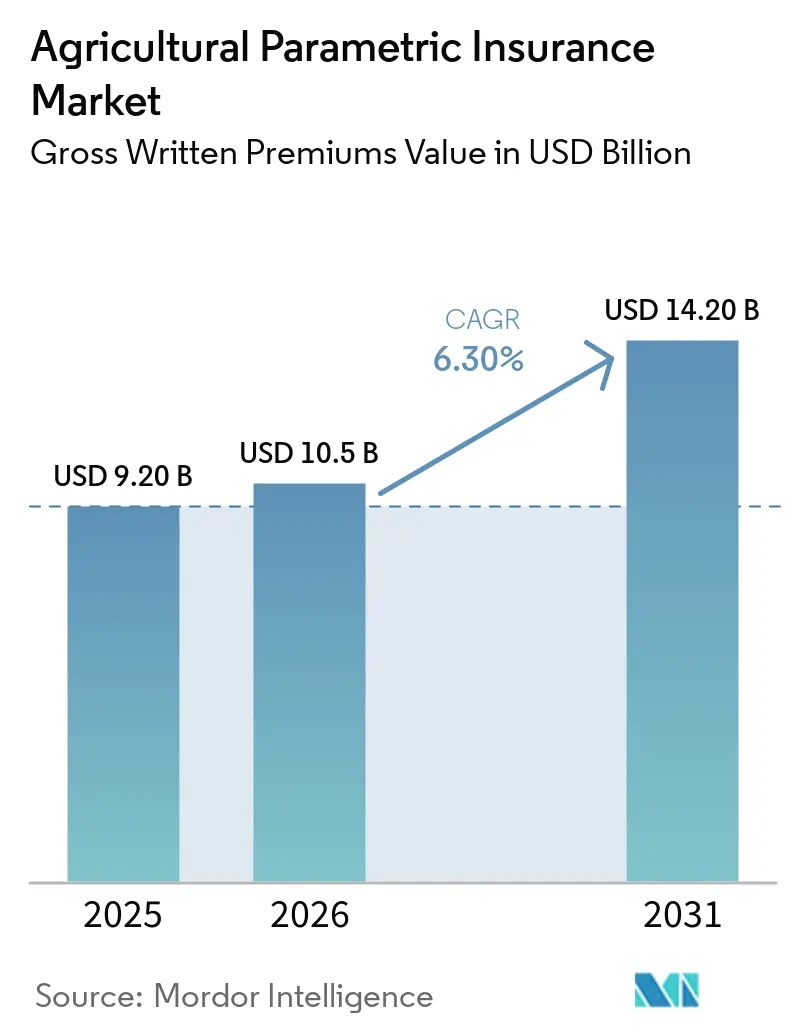
The agricultural parametric insurance market size was valued at USD 9.2 billion in 2025 and estimated to grow from USD 10.5 billion in 2026 to reach USD 14.2 billion by 2031, at a CAGR of 6.3% during the forecast period (2026-2031). Repeated droughts, floods, and other weather events are increasing the need for coverage that can respond without field-level loss assessment. Governments are using predefined triggers to replace uncertain disaster spending with planned risk-transfer costs. Satellite and remote-sensing data are making index development more practical across a wider range of farming areas. The agricultural parametric insurance market is also benefiting from distribution through finance, input, and equipment relationships, especially where agent networks are limited. Product providers are competing through trigger quality, underwriting capacity, and access to public programs or established agricultural distribution networks.
Key Report Takeaways
- By product type, meteorological index insurance captured 36.1% of the agricultural parametric insurance market share in 2025, while earth-observation index insurance is projected to grow at a 13.2% CAGR through 2031.
- By agricultural segment, cereals and grains captured 38.7% of the agricultural parametric insurance market share in 2025, while livestock is projected to grow at a 12.5% CAGR through 2031.
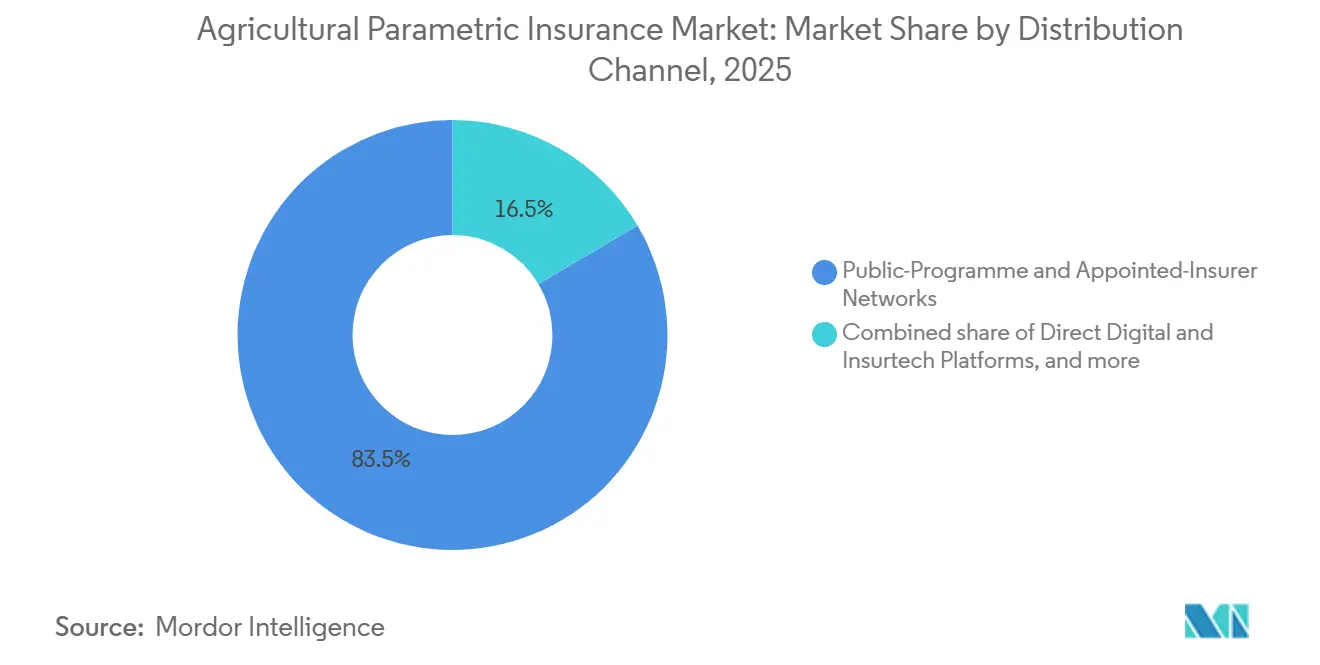
- By distribution channel, public-programme and appointed-insurer networks captured 83.5% of the agricultural parametric insurance market share in 2025, while direct digital and insurtech platforms are projected to grow at an 18.7% CAGR through 2031.
- By policyholder, commercial farms and estates captured 46.7% of the agricultural parametric insurance market share in 2025, while agribusinesses, processors, and offtakers are projected to grow at a 14.1% CAGR through 2031.
- By geography, North America captured 47.2% of the agricultural parametric insurance market share in 2025, while the Middle East and Africa region is projected to grow at an 11.6% CAGR through 2031.
Note: Market size and forecast figures in this report are generated using Mordor Intelligence’s proprietary estimation framework, updated with the latest available data and insights as of January 2026.
Global Agricultural Parametric Insurance Market Trends and Insights
Drivers Impact Analysis*
| Driver | (~) % Impact on CAGR Forecast | Geographic Relevance | Impact Timeline |
|---|---|---|---|
| Rising Extreme Weather Events | +1.5% | Global | Short term (≤ 2 years) |
| Government Subsidies and Public-Private Programs | +1.2% | North America, South America, South Asia, the Middle East, and Africa | Medium term (2-4 years) |
| Automated Post-Disaster Payouts | +0.8% | Global, with early gains in Sub-Saharan Africa and South Asia | Short term (≤ 2 years) |
| Satellite, Weather, and Remote-Sensing Data | +1.0% | Global, with strong adoption in Africa, South Asia, and Southeast Asia | Medium term (2-4 years) |
| Embedded Insurance Through Agricultural Finance | +0.7% | South America, Sub-Saharan Africa, Southeast Asia | Medium term (2-4 years) |
| Smallholder Demand for Parametric Protection | +0.6% | Sub-Saharan Africa, South Asia, Southeast Asia | Long term (≥ 4 years) |
| Source: Mordor Intelligence | |||
Rising Climate Volatility Forces a Structural Rethink of Agricultural Risk Transfer
Climate-linked disruptions are becoming a recurring operating issue for farms and agricultural lenders. Swiss Re reported in 2025 that traditional agricultural insurance was growing at 5% annually, while parametric products were growing at 15% to 20%. This difference reflects the value of a model that can respond when shocks recur before earlier indemnity claims are resolved. Swiss Re also reported that 600 million smallholder farmers produce 1/3 of the global food supply, largely on rain-fed land with limited financial reserves[1]https://www.swissre.com/reinsurance/property-and-casualty/agriculture-risks/agricultural-insurance-parametric-products.html. Repeated moderate droughts can weaken farm finances over several seasons, even when a single event is not catastrophic. The agricultural parametric insurance market gives governments and insurers a way to set transparent triggers and provide faster liquidity after qualifying events. Its wider use depends on making these terms understandable to participating farmers.
Government Subsidies and Public-Private Programs Fund Coverage Scale Markets Cannot Achieve Alone
Government participation remains central where agricultural parametric coverage has progressed beyond pilot programs. India’s Union Budget 2026-27 allocated INR 12,200 crore (USD 1.46 billion) to the Pradhan Mantri Fasal Bima Yojana[2]https://www.pib.gov.in/PressNoteDetails.aspx?ModuleId=3&NoteId=159760&id=159760®=48&lang=2. The program had insured more than 92.46 crore farmer applications since 2016 and paid claims exceeding INR 2.06 lakh crore (USD 24.65 billion) by 2026. Kharif 2026 enrollment reached 241.38 lakh farmers and 278.12 lakh hectares by late August, while the Weather-Based Crop Insurance Scheme covered another 25.95 lakh applications for fruit, vegetable, and plantation crops. Colombia contracted 5 parametric agricultural policies in August 2026 for 14,402 smallholder farmers, providing up to USD 20.14 million against drought and excess rainfall. Detailed public frameworks can set standards for trigger design, data use, and delivery that private providers need to meet before accessing program volume. These frameworks can determine how quickly the agricultural parametric insurance market moves from pilot coverage to wider implementation.
Satellite and Remote-Sensing Data Lower Index Cost While Improving Trigger Precision
Earth-observation data are changing how insurers construct and update agricultural indices. A 2025 review of 89 index-insurance studies across 34 countries found that land-surface satellites appeared in 91% of studies that used satellite data. The review found that the Normalized Difference Vegetation Index appeared in 30 of 49 satellite-imagery studies, or 61.2% of those studies[3]https://nhess.copernicus.org/articles/25/913/2025/. Africa used satellite data in 85.2% of its 27 studies, reflecting gaps in weather-station coverage. The European Space Agency found that Sentinel-1 radar and Sentinel-2 optical imagery can support field-scale crop-damage probability maps, including during cloud cover. These data sources support lower-cost index calibration and allow programs to refine triggers as longer historical series become available. This is broadening the range of locations where the agricultural parametric insurance market can be supported by more granular observations.
Embedded Insurance Channels Unlock Distribution Scale in Underserved Markets
Embedding cover in credit, input supply, and equipment financing can reach farmers without relying on large agent networks. In February 2026, CNH Capital, Shepherd Compello, BNP Paribas Leasing Solutions, and Swiss Re launched a weather service within agricultural equipment-financing agreements in Europe. The service initially launched in Spain and uses satellite monitoring to identify qualifying rainfall or drought conditions. Zambia’s Farmer Input Support Programme required index insurance for beneficiaries and reached 1.02 million farmers in 2023-24[4]https://irff.undp.org/blog/zambias-digital-approach-crop-index-insurance-and-mobile-payouts. After the drought, the program paid ZMW 800 million (USD 42.4 million) to 500,000 affected farmers through mobile-money integration. The agricultural parametric insurance market can therefore support both farm liquidity and more stable procurement for processors that depend on smallholder supply. These established transactions can lower the cost of reaching participants in the agricultural parametric insurance market.
Restraints Impact Analysis*
| Restraint | (~) % Impact on CAGR Forecast | Geographic Relevance | Impact Timeline |
|---|---|---|---|
| Basis Risk Between Index Triggers and Farm Losses | -0.8% | Global | Short term (≤ 2 years) |
| Limited Farmer Awareness and Trust | -0.5% | Sub-Saharan Africa, South Asia, Southeast Asia | Medium term (2-4 years) |
| Insufficient Historical Weather and Yield Data | -0.4% | Sub-Saharan Africa, South Asia | Long term (≥ 4 years) |
| Premium Affordability Constraints | -0.6% | Sub-Saharan Africa, South Asia, South America | Medium term (2-4 years) |
| Source: Mordor Intelligence | |||
Basis Risk Remains the Principal Barrier to Voluntary Renewal and Commercial Scaling
Basis risk occurs when a farm experiences a loss, but the agreed index does not trigger a payment. This mismatch can determine whether a farmer renews coverage after a difficult season. A 2026 study in The Geneva Papers on Risk and Insurance found that basis risk follows spatial patterns linked to the distance between exposure and weather stations and the size of the hazard footprint. The finding places importance on portfolio design and local data coverage, rather than pricing alone. Multi-index approaches combining vegetation signals and rainfall anomalies are being examined to improve how products reflect farm conditions. The agricultural parametric insurance market will continue to depend on transparent trigger communication and regular index refinement to sustain voluntary renewal. Managing this issue remains essential to confidence in the agricultural parametric insurance market.
Low Farmer Awareness and Distrust of Automated Payouts Suppress Enrollment Even Where Products Exist
Farmer awareness and confidence in automated payout processes remain limited in many emerging markets. A survey of 384 smallholder farmers in Zambia’s Copperbelt and Central Provinces found that awareness rose from 38% in 2020-21 to 69% in 2024-25. The same survey found that enrollment reached 44% among aware farmers, while 58.4% identified premium cost as the main barrier and 47.2% cited distrust of payout processes. A loss without a payout can reduce confidence across local farming networks, particularly where the reason for an index result is unclear. Programs also need to reflect women farmers’ decision schedules and seasonal liquidity constraints, which can affect willingness to enroll. Clear local communication and affordable premium structures remain necessary for broader adoption.
*Our forecasts treat driver/restraint impacts as directional, not additive. The impact forecasts reflect baseline growth, mix effects, and variable interactions.
Segment Analysis
By Product Type: Meteorological Coverage Leads While Earth-Observation Products Grow Fastest
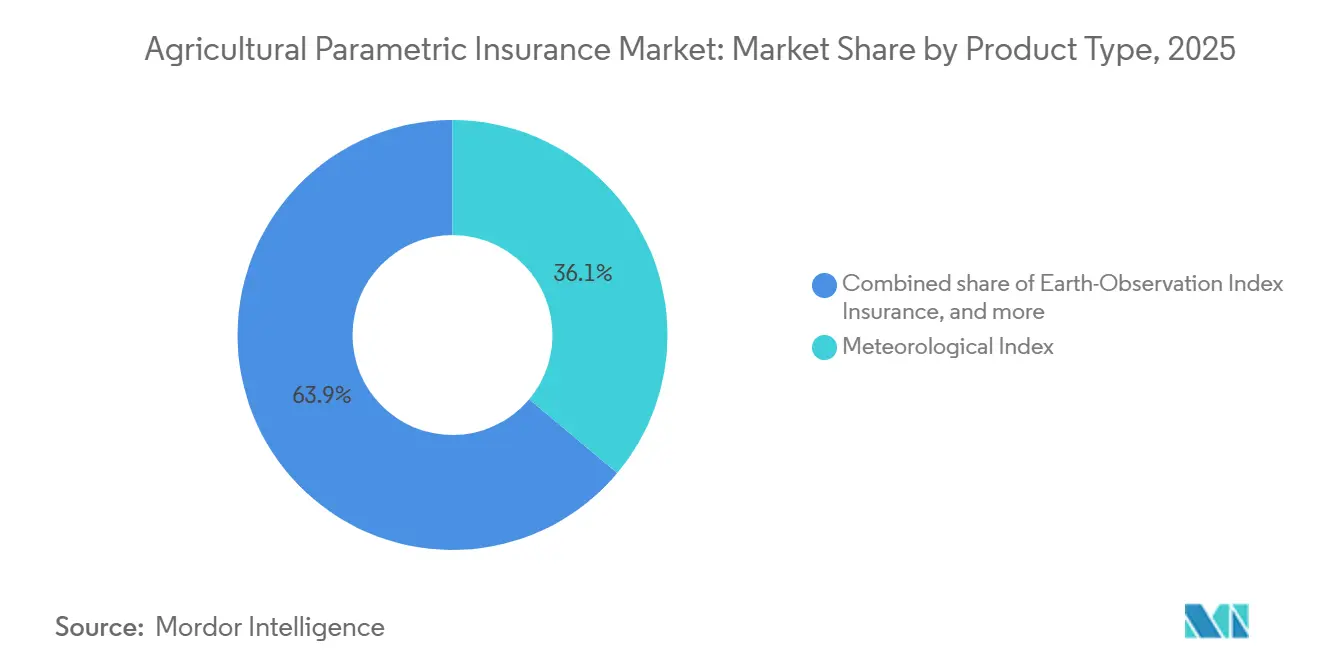
Meteorological index insurance held 36.1% of the agricultural parametric insurance market size in 2025, making it the largest product category. It uses rainfall totals, temperature anomalies, or standardized drought indices measured through weather-station networks. Its established role reflects long use in government-mandated programs across North America, Europe, and South Asia. These programs have developed operating processes around weather observations and predefined payout terms. Meteorological products remain practical where weather-station data are reliable, and program rules are well established. They remain an established reference point for product development in the agricultural parametric insurance market.
Earth-observation index insurance is forecast to expand at a 13.2% CAGR between 2026 and 2031. It draws on vegetation indices, soil moisture readings, and crop-condition signals from Sentinel and MODIS platforms. A 2025 review found that pasture-production indices achieved correlations of 43.8% to 62% with ground forage yields and up to 90% with yield losses in dry years. The European Space Agency also demonstrated field-scale damage mapping through combined Sentinel-1 and Sentinel-2 imagery. Area-yield, area-revenue, income, and biological outcome products remain relevant where aggregate production, price exposure, or biological measures better reflect the covered risk.


By Agricultural Segment: Cereals Lead Premiums While Livestock Expands Coverage
Cereals and grains captured 38.7% of agricultural segment premiums in 2025. This position reflects the historical depth of actuarial data for staple crops and the policy priority assigned to food-security programs. A 2025 review found that cereals represented 63 of 97 crop-study observations, or 64.9%. The studies were concentrated in China, India, the United States, and Kenya. Oilseeds, pulses, fiber crops, sugar, and industrial crops hold secondary positions in multi-crop programs.
Livestock is forecast to grow at a 12.5% CAGR from 2026 to 2031. Index-Based Livestock Insurance uses satellite-monitored vegetation conditions to estimate forage availability across a district or county. When the index falls below a specified drought threshold, enrolled pastoralists receive payments without individual herd assessment. Research on Ethiopia’s livestock insurance schemes documented the role of these products in managing climate risks in arid and semi-arid areas. Horticulture and perennial crops remain underinsured because their multiyear production cycles can weaken single-season weather relationships. Aquaculture is an emerging area for temperature-index and rainfall-runoff products in Southeast Asian shrimp and fish-pond production.
By Distribution Channel: Public Programs Lead While Digital Platforms Scale
Public-programme and appointed-insurer networks captured 83.5% of the distribution share in 2025. Government participation, premium-subsidy routing, and regulatory approvals channel a significant share of volume through designated carriers. India’s PMFBY and Weather-Based Crop Insurance Scheme use insurer panels selected through state-level tenders. Similar public arrangements organize agricultural coverage in Kenya and other large agricultural markets. This structure supports broad access but can limit open distribution outside approved networks.
Direct digital and insurtech platforms are expected to grow at an 18.7% CAGR through 2031. Expanding smartphone and mobile-money use allows providers to reach rural areas where agent networks are costly to maintain. Digital channels can also shorten application, underwriting, and payout processes. Banks, microfinance institutions, and agricultural finance providers can bundle coverage into loan origination and protect credit portfolios against regional weather losses. Cooperatives can combine farmer demand into policy groups large enough to support viable pricing. Equipment, input, and value-chain partners are using embedded arrangements to connect coverage with established agricultural transactions. These approaches are widening routes to customers in the agricultural parametric insurance market.
By Policyholder: Commercial Farms Lead While Agribusiness Demand Increases
Commercial farms and estates captured 46.7% of policyholder premiums in 2025. Larger operators can generally support standalone policy underwriting and engage with index-design requirements. Their access to agronomist advice, formal banking relationships, and export contracts can also support adoption. These farms use parametric cover alongside other tools, including futures hedges and forward contracts. Their participation provides a current premium base for the agricultural parametric insurance market. It also gives insurers experience with larger, more documented exposures.
Agribusinesses, processors, and offtakers are forecast to grow at a 14.1% CAGR between 2026 and 2031. These buyers are using policies tied to supply-region weather indicators to manage procurement shortfalls and spot-market replacement costs. Coverage can support processors when rainfall or temperature conditions disrupt supplies from contracted farming areas. Smallholder farmers and herders remain the largest potential policyholder group but account for a smaller share of current premiums. Financial institutions are also using parametric policies as portfolio-level protection against drought or flood-related loan-default clusters. Governments and public entities serve as policyholders in sovereign pools while also supporting product design and premium funding. This range of policyholders expands the commercial base of the agricultural parametric insurance market.
Geography Analysis
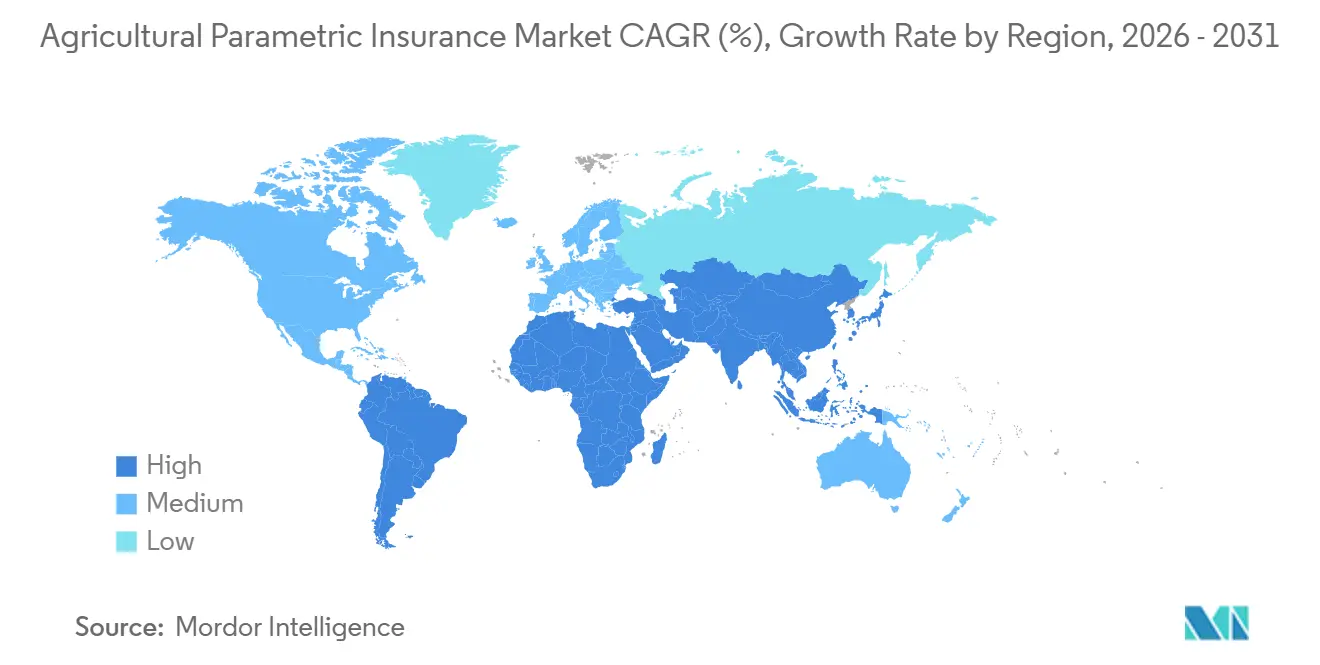
North America captured 47.2% of agricultural parametric insurance premiums in 2025. The region benefits from the United States Federal Crop Insurance Program and its premium-subsidy structure, administered by the United States Department of Agriculture Risk Management Agency. The 2025 One Big Beautiful Bill Act expanded support for beginning farmers and changed area-based coverage plans, including the Supplemental Coverage Option. The Crop and Livestock Income Protection program became effective for the 2026 crop year in 13 states. Canada and Mexico have smaller parametric-adjacent programs that are responding to climate exposure in prairie wheat and maize-growing areas.
South America is seeing public-policy activity around agricultural risk protection, while Colombia added departmental-level parametric coverage in 2026. Colombia’s 5 policies covered 14,402 smallholder farmers across Sucre, Córdoba, Cundinamarca, Meta, and Chocó. The policies provide up to USD 20.14 million against drought and excess rainfall through a satellite-derived Water Balance Index. Europe is expanding the embedded-finance approach through the 2026 CNH Capital, BNP Paribas Leasing Solutions, Shepherd Compello, and Swiss Re service. In the Asia-Pacific region, India’s 2026 Kharif enrollment and increased use of remote-sensing yield estimation reinforce the role of national programs. Indonesia, Australia, and Japan span pilot and commercial approaches for rice, maize, horticulture, and extreme-weather coverage.
The Middle East and Africa agricultural parametric insurance market size is projected to grow at an 11.6% CAGR from 2026 to 2031, the fastest regional pace. A large share of small-scale farmers in Sub-Saharan Africa remains without formal coverage, creating a sizable protection gap. The African Risk Capacity is expanding national risk-pool infrastructure and has set an objective to protect 700 million people across Africa by 2034. The European Investment Bank announced in 2026 a grant of up to EUR 4 million (USD 4.7 million) to the World Food Programme for Ethiopian parametric microinsurance. The program is expected to cover 210,000 smallholder farmers and establish a Premium Guarantee Fund. These programs are extending coverage from smallholder agriculture toward sovereign and infrastructure-related climate risks.

Competitive Landscape
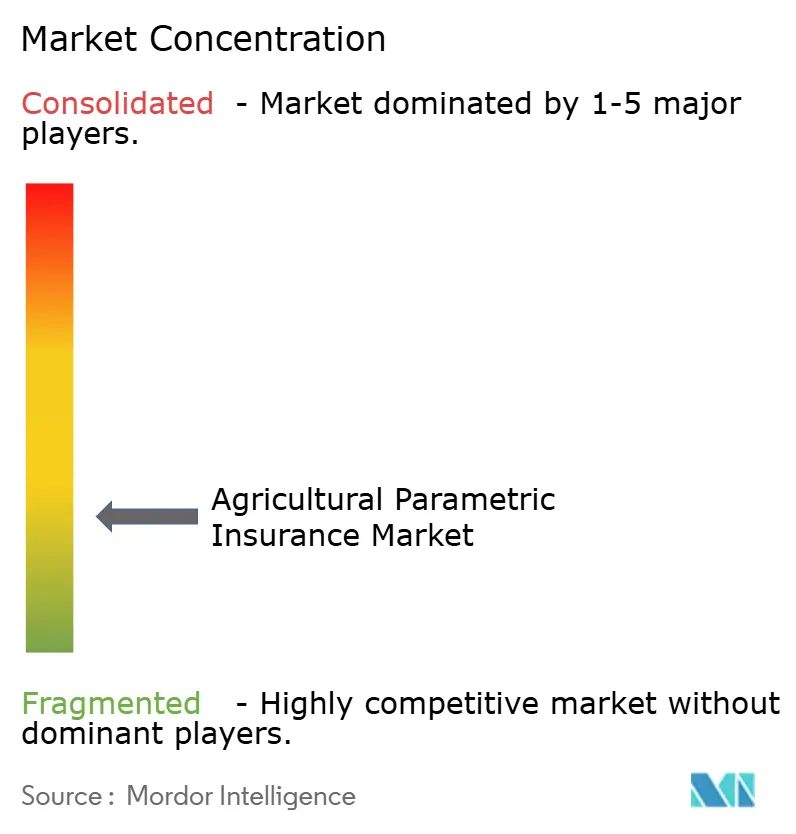
The agricultural parametric insurance market is fragmented, with competition spread across global reinsurers, specialist parametric platforms, regional insurers, and development-focused providers. Major players such as Swiss Re, Munich Re, AXA XL, Hannover Re, SCOR SE, and Allianz provide reinsurance and capacity, while specialists including Descartes Underwriting, Arbol, CelsiusPro, and IBISA Network compete through index design, data analytics, and distribution partnerships. Regional providers such as ACRE Africa, Pula Advisors, Global Parametrics, and African Risk Capacity further contribute to market fragmentation through localized smallholder and sovereign programs. Competition varies by crop, livestock, aquaculture, geography, and regulatory environment, creating opportunities for specialized entrants with strong local partnerships and tailored risk solutions.
Data capabilities are becoming increasingly important for managing general agents and insurtech providers. Arbol partnered with Pollen Systems and Omniris in February 2026 to combine parametric underwriting, field-level agricultural intelligence, and geographic information system data. This type of arrangement seeks to improve the speed and transparency of risk assessment and claims resolution. African specialists often compete through public-sector relationships, regulatory approvals, and farmer distribution reach. Satellite data can be accessed more widely over time, making local operating capability important for durable differentiation. Insurers also need trusted explanations of triggers and payments to support renewal in smallholder settings.
The 2026 CNH Capital, BNP Paribas Leasing Solutions, Shepherd Compello, and Swiss Re launch provides a clear example of a commercial embedded-finance strategy. The service links qualifying weather conditions to one monthly equipment-finance installment in Spain and wider European markets. Colombia’s 2026 program shows how reinsurers, insurers, public agencies, and international risk-financing partners can co-design coverage for smallholders. India’s PMFBY and Weather Based Crop Insurance Scheme show the continued importance of designated insurer networks in public agricultural programs. Strategic partnerships that connect underwriting capacity, data, and established farmer channels are likely to remain central to competitive positioning. Such partnerships are shaping access and delivery across the agricultural parametric insurance market.
Agricultural Parametric Insurance Industry Leaders
Swiss Re
Munich Reinsurance Company
AXA XL
Hannover Rück SE
Sompo International
- *Disclaimer: Major Players sorted in no particular order

Recent Industry Developments
- August 2026: Colombia’s government contracted 5 parametric agricultural insurance policies covering 14,402 smallholder farmers across Sucre, Córdoba, Cundinamarca, Meta, and Chocó, providing up to USD 20.14 million in protection against drought and excess rainfall using a satellite-derived Water Balance Index. The product was co-designed by Colombia’s Ministry of Agriculture with a consortium comprising Swiss Re, Munich Re, AXA Climate, Guy Carpenter, Raincoat, and La Previsora, with premiums co-financed by the Government of Colombia and the InsuResilience Solutions Fund. This was the first deployment of departmental-government parametric agricultural insurance in the country and is intended as a template for national replication.
- August 2026: The European Investment Bank, through EIB Global, announced a grant of up to EUR 4 million (USD 4.7 million) to the United Nations World Food Programme to develop and pilot parametric microinsurance for an estimated 210,000 smallholder farmers in Ethiopia. The program includes a Premium Guarantee Fund and capacity building for rural financial institutions under RUFIP III. It is the European Investment Bank’s first climate-risk insurance project.
- August 2026: India’s PMFBY enrolled 241.38 lakh farmers and 278.12 lakh hectares in Kharif 2026 by late August. The Union Budget 2026-27 allocated INR 12,200 crore (USD 1.46 billion) to the program. The complementary Weather Based Crop Insurance Scheme covered 25.95 lakh farmer applications for fruit, vegetable, and plantation crops in Kharif 2026.
- February 2026: CNH Capital, BNP Paribas Leasing Solutions, Shepherd Compello, and Swiss Re launched a parametric weather service embedded in agricultural equipment-financing agreements across Europe. The service is triggered when satellite monitoring identifies qualifying extreme rainfall or drought conditions. It launched first in Spain, with wider European availability planned through 2026. Payouts equal one monthly equipment-finance installment and support farmers when qualifying weather conditions prevent machinery use.


Global Agricultural Parametric Insurance Market Report Scope
| Meteorological Index Insurance |
| Earth-Observation Index Insurance |
| Area-Yield Index Insurance |
| Area-Revenue and Income Index Insurance |
| Biological Outcome Index Insurance |
| Cereals and Grains |
| Oilseeds, pulses and Fiber Crops |
| Sugar and Other Industrial Crops |
| Horticulture |
| Pasture, Rangeland and Forage |
| Livestock |
| Aquaculture |
| Public-Programme and Appointed-Insurer Networks |
| Banks, MFIs and Agricultural Finance Institutions |
| Brokers, Agents and Managing General Agents |
| Cooperatives, Farmer Organizations and Contract-Farming Aggregators |
| Agri-input, Equipment and Value-Chain Embedded Partners |
| Direct Digital and Insurtech Platforms |
| Smallholder Farmers and Herders |
| Commercial Farms and Estates |
| Agribusinesses, Processors and Offtakers |
| Financial Institutions |
| Governments and Public-Sector Entities |
| North America | United States |
| Canada | |
| Mexico | |
| South America | Brazil |
| Argentina | |
| Rest of South America | |
| Europe | United Kingdom |
| Germany | |
| France | |
| Italy | |
| Spain | |
| Rest of Europe | |
| Asia-Pacific | China |
| Japan | |
| India | |
| South Korea | |
| Australia | |
| Indonesia | |
| Thailand | |
| Malaysia | |
| Singapore | |
| Vietnam | |
| Rest of Asia-Pacific | |
| Middle East and Africa | Saudi Arabia |
| United Arab Emirates | |
| Turkey | |
| South Africa | |
| Egypt | |
| Rest of Middle East and Africa |
| By Product Type | Meteorological Index Insurance | |
| Earth-Observation Index Insurance | ||
| Area-Yield Index Insurance | ||
| Area-Revenue and Income Index Insurance | ||
| Biological Outcome Index Insurance | ||
| By Agricultural Segment | Cereals and Grains | |
| Oilseeds, pulses and Fiber Crops | ||
| Sugar and Other Industrial Crops | ||
| Horticulture | ||
| Pasture, Rangeland and Forage | ||
| Livestock | ||
| Aquaculture | ||
| By Distribution Channel | Public-Programme and Appointed-Insurer Networks | |
| Banks, MFIs and Agricultural Finance Institutions | ||
| Brokers, Agents and Managing General Agents | ||
| Cooperatives, Farmer Organizations and Contract-Farming Aggregators | ||
| Agri-input, Equipment and Value-Chain Embedded Partners | ||
| Direct Digital and Insurtech Platforms | ||
| By Policyholder | Smallholder Farmers and Herders | |
| Commercial Farms and Estates | ||
| Agribusinesses, Processors and Offtakers | ||
| Financial Institutions | ||
| Governments and Public-Sector Entities | ||
| By Geography | North America | United States |
| Canada | ||
| Mexico | ||
| South America | Brazil | |
| Argentina | ||
| Rest of South America | ||
| Europe | United Kingdom | |
| Germany | ||
| France | ||
| Italy | ||
| Spain | ||
| Rest of Europe | ||
| Asia-Pacific | China | |
| Japan | ||
| India | ||
| South Korea | ||
| Australia | ||
| Indonesia | ||
| Thailand | ||
| Malaysia | ||
| Singapore | ||
| Vietnam | ||
| Rest of Asia-Pacific | ||
| Middle East and Africa | Saudi Arabia | |
| United Arab Emirates | ||
| Turkey | ||
| South Africa | ||
| Egypt | ||
| Rest of Middle East and Africa | ||


Key Questions Answered in the Report
What is agricultural parametric insurance?
It uses predefined weather, vegetation, or other measurable triggers to make a payment without field-by-field loss assessment.
How large is the agricultural parametric insurance market?
It is estimated at USD 10.5 billion in 2026 and is forecast to reach USD 14.2 billion by 2031 at a 6.3% CAGR.
Which product type leads agricultural parametric coverage?
Meteorological Index Insurance led with 36.1% share in 2025, while Earth-Observation Index Insurance has the highest product CAGR at 13.2%.
Why are satellite data important for agricultural insurance?
Satellite data can support vegetation, moisture, and crop-condition indices, particularly where weather-station coverage is limited.
Which region is growing fastest for agricultural parametric insurance?
The Middle East and Africa region is forecast to grow at 11.6% CAGR from 2026 to 2031.
What limits wider adoption of parametric cover?
Basis risk, limited awareness, distrust of automated payouts, limited historical data, and premium affordability can constrain enrollment.
Page last updated on:


 Your data is secure and never sold or shared.


