
Qatar Aquaculture Market Analysis by Mordor Intelligence
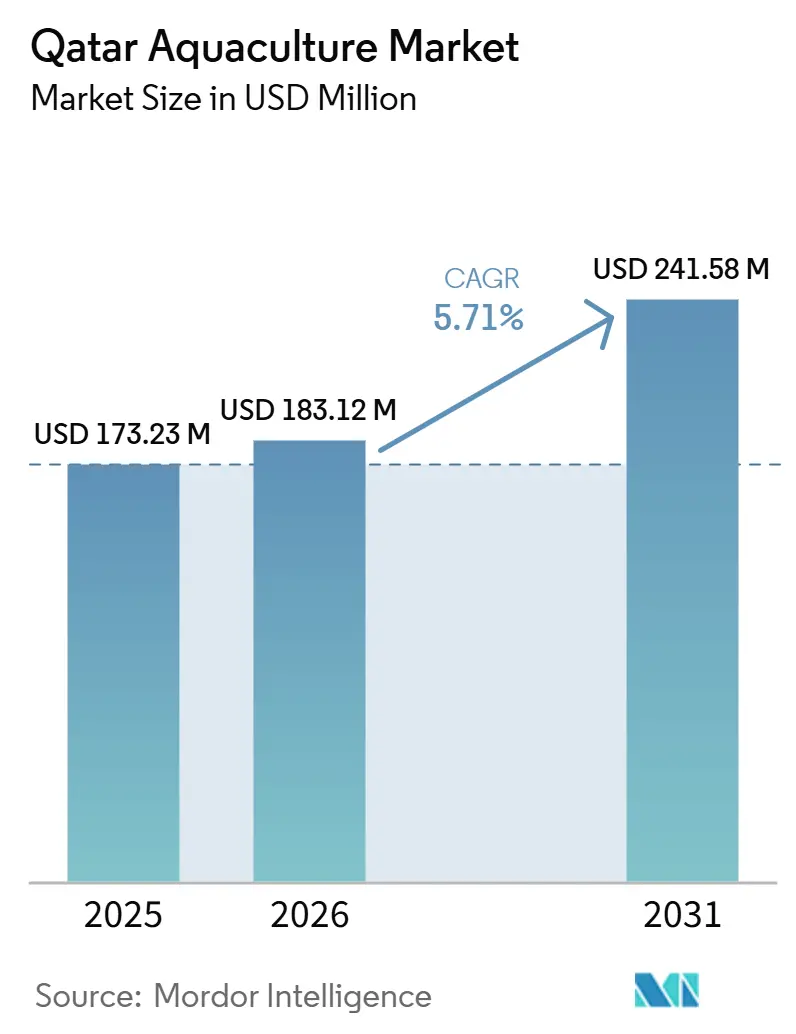
The Qatar aquaculture market size in 2026 is estimated at USD 183.12 million, growing from 2025 value of USD 173.23 million with 2031 projections showing USD 241.58 million, growing at 5.71% CAGR over 2026-2031. Year-round recirculating aquaculture systems (RAS) integrated with district cooling loops are lowering energy costs, while government incentives under the Aquaculture Strategy 2030 de-risk capital investment and accelerate technology transfer. Feed localization pilots utilizing microalgae and insect protein aim to reduce reliance on imported pellets, which account for up to 55% of farm operating expenses. A widening consumption gap, premium demand from Doha’s hospitality corridor, and post-blockade import substitution mandates collectively anchor medium-term volume growth. Meanwhile, carbon-credit revenue streams tied to low-impact offshore cages attract ESG-minded capital looking for blue-carbon assets.
Key Report Takeaways
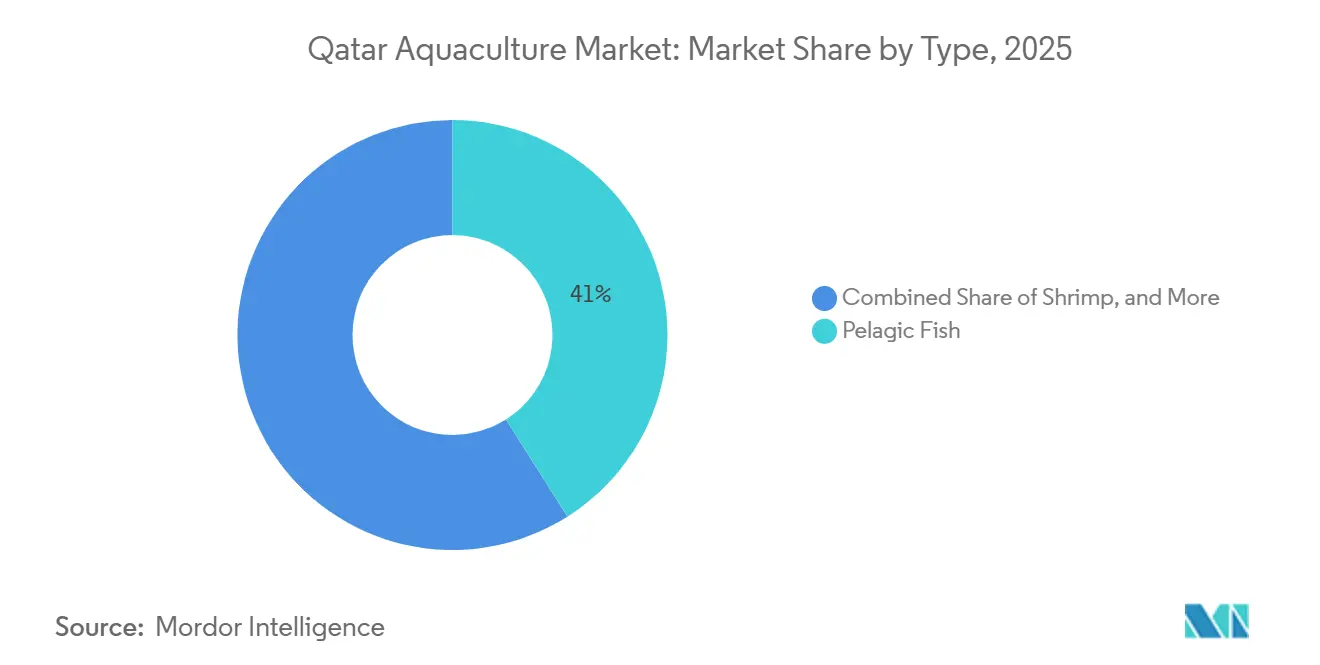
- By type, pelagic fish led with a 41.02% share of the Qatar aquaculture market size in 2025, and shrimp is forecast to advance at a 9.24% CAGR through 2031.
Note: Market size and forecast figures in this report are generated using Mordor Intelligence’s proprietary estimation framework, updated with the latest available data and insights as of 2026.
Qatar Aquaculture Market Trends and Insights
Drivers Impact Analysis*
| Driver | (~) % Impact on CAGR Forecast | Geographic Relevance | Impact Timeline |
|---|---|---|---|
| Growing seafood-consumption gap | +1.2% | National, Doha metro and hospitality zones | Medium term (2-4 years) |
| Government Aquaculture Strategy 2030 funding | +1.5% | National, priority RAS pilot zones | Long term (≥ 4 years) |
| Import-substitution push post-2017 blockade | +0.9% | National, strategic food-security mandate | Short term (≤ 2 years) |
| RAS pilot farms integrated with district-cooling plants | +0.8% | Doha and Al Khor industrial zones | Medium term (2-4 years) |
| Demand from hospitality mega-projects | +0.7% | Doha, West Bay, Lusail City, and Pearl Qatar | Short term (≤ 2 years) |
| Carbon-credit monetization for low-impact offshore cages | +0.4% | Coastal zones with blue-carbon ecosystems | Long term (≥ 4 years) |
| Source: Mordor Intelligence | |||
Growing Seafood-Consumption Gap
Per-capita seafood intake reached 24.5 kg in 2024, while domestic farms supplied less than 5% of the volume, leaving Qatar dependent on imports that exceeded 95% of consumption. Population growth, at 2.1%, and sustained expatriate inflows add 1,200–1,500 metric tons of incremental demand each year, thereby tightening supply–demand balances in retail and hotel channels. Local producers able to harvest and deliver within 24 hours realize price premiums of 15–25% over frozen imports, motivating new entrants to fast-track hatchery capacity. Global aquaculture output surpassed that of capture fisheries in 2022; however, the wider Middle East accounted for less than 2% of that total, highlighting regional underinvestment [1]. Operators are piloting on-farm microalgae and black soldier fly meal to trim pellet imports and stabilize feed costs.
Government Aquaculture Strategy 2030 Funding
The Ministry of Municipality and Environment ring-fences capital grants and subsidized utilities for RAS, hatcheries, and offshore cage pilots, enabling ventures that once faced prohibitive upfront costs. Qatar Development Bank offers long-term loans, and the Free Zones Authority guarantees land along industrial corridors, reducing the total project capital expenditure by up to 30%. Priority species include Hamour, seabass, shrimp, and tilapia, each supported by mandatory technology-transfer clauses embedded in joint-venture contracts with foreign vendors. Policymakers benchmark Saudi Arabia’s 80,000 metric tons NEOM target when calibrating local capacity incentives. University consortia pilot closed-loop water-reuse and pathogen surveillance, compressing the learning curve for private farms.
Import-Substitution Push Post-2017 Blockade
The air and land blockade forced a rapid pivot toward local food production. Subsequent procurement rules favor domestically raised seafood in government and hotel tenders, ensuring offtake for new farms. Subsidy reforms adopted after Qatar ratified the WTO Agreement on Fisheries Subsidies in 2024 further encourage sustainable aquaculture over potentially over-fished wild catch. High-value species such as lobster and live Hamour, which suffer quality loss over long shipping lanes, anchor local premium niches priced at USD 35–60 per kg in Doha markets.
RAS Pilot Farms Integrated with District-Cooling Plants
RAS modules co-located with district cooling infrastructure maintain water temperatures of 22–28 °C year-round, resulting in a 30–40% reduction in electricity demand compared to standalone chillers. Projects in Doha and Lusail leverage existing chilled-water loops, turning waste heat into stable aquatic microclimates for salmon, seabass, and shrimp. A Finnforel–ADQ feasibility study in Abu Dhabi validates the viability of cold-water salmon RAS in desert climates and provides a technical blueprint for Qatari operators[2]. Modular systems from regional vendors, such as Saqua, shorten lead times and reduce foreign-exchange exposure compared to European imports.
Restraints Impact Analysis*
| Restraint | (~) % Impact on CAGR Forecast | Geographic Relevance | Impact Timeline |
|---|---|---|---|
| Limited suitable coastline and harsh summer | -0.6% | National, shallow coastal zones | Short term (≤ 2 years) |
| Scarcity of certified hatchery brood-stock | -0.5% | National, all finfish | Medium term (2-4 years) |
| High salinity spikes causing bio-filter collapse | -0.4% | Coastal RAS facilities | Short term (≤ 2 years) |
| Dependence on imported specialized feeds | -0.3% | National | Long term (≥ 4 years) |
| Source: Mordor Intelligence | |||
Limited Suitable Coastline and Harsh Summer
Only one-fifth of Qatar’s 563-km shoreline offers depths of 15–40 m with adequate currents for modern cage arrays, a scarcity compounded by shipping lanes and oil infrastructure. Sea-surface temperatures reach 34–36 °C in July and August, necessitating seasonal fallowing or the use of costly water-cooling rigs. Labor regulations that curtail midday outdoor work add operational complexity, while insurance carriers demand higher premiums for stocks exposed to heat stress risk.
Scarcity of Certified Hatchery Brood-Stock
The Ras Matbakh Aquatic Research Centre produces 1 million Hamour fingerlings annually, but a 10,000 metric tons target requires a fifteen-fold increase in output, compelling farms to import juveniles at USD 0.50–2.00 apiece. Novo Holdings’ genetics acquisition centralizes brood-stock supply in salmonids, sidelining tropical species crucial for Gulf diversification. Without regional broodstock hubs, operators cannot advance selective breeding that boosts feed conversion and disease resistance.
*Our forecasts treat driver/restraint impacts as directional, not additive. The impact forecasts reflect baseline growth, mix effects, and variable interactions.
Segment Analysis
By Type: Pelagic Fish Retain Volume Leadership While Growth Moderates
Pelagic fish accounted for 41.02% of the Qatar aquaculture market share in 2025, driven by demand for sardine, mackerel, tuna, and barracuda in local grills and high-turnover buffet lines. The segment reflects capacity additions limited by the domestication challenges of migratory tuna and the thermal sensitivity of mackerel. The Qatar aquaculture market size for Pelagic Fish is forecast to grow between 2026 and 2031, sustained by hotels paying premiums for daily-harvested bonito fillets. Acoustic feeding sensors and AI-driven biomass monitors, sourced from InnovaSea Systems, have reduced feed waste by 8-12%, bringing pellets closer to a 1.4 feed-conversion ratio and improving lifecycle economics. Still, offshore cage rollouts must negotiate narrow windows between sandstorms, shipping lanes, and summer heat peaks that curtail diving operations.
Shrimp’s 9.24% CAGR positions it as the highest-momentum segment of the Qatar aquaculture market through 2031. The Qatar aquaculture market size for Shrimp is forecast to grow over the outlook period. Strategic proximity to the UAE gives Qatari producers logistical advantages. Bio-secured indoor tanks prevent White Spot Syndrome outbreaks that have plagued open-pond operations in South Asia, underpinning the premium hotels' willingness to pay for assured supply continuity. A second development phase, planned by Aqua Development, targets a 3,000 metric ton capacity, which is projeted to increase the segment's market share in Qatar's aquaculture market by 2031.

Geography Analysis
Doha and its contiguous Lusail-West Bay corridor accounted for over 60% of Qatar's aquaculture market size in 2025, driven by tourist arrivals that reached 4 million the previous year and a dense landscape of luxury hotels. Demand concentration supports just-in-time logistics, allowing farms to deliver live products to kitchens within two hours, thereby minimizing post-harvest losses. The corridor’s compound annual growth outstrips the national average, driven by 20 new hotel openings slated by 2027.
Northern municipalities such as Al Khor contribute 17.72% of national consumption. Al Khor’s industrial zone hosts district cooling loops that feed RAS clusters, which together represent 35% of the installed tank volume. Proximity to spare land parcels and seawater intakes fosters further expansion, but trucking distances to Doha’s main wholesale market lengthen cold-chain transit. Planned highway upgrades under Qatar National Vision 2030 will trim transit time by 15 minutes, mitigating the constraint.
The sparsely populated south, including Mesaieed, consumes less than 10% of volume yet hosts Qatar Energy infrastructure that limits offshore cage siting due to maritime exclusion zones. Nonetheless, its deepwater berths facilitate the delivery of heavy-lift prefabricated cage rings. Long-term plans call for a 5,000 metric ton offshore cluster integrated with seaweed strips, aiming to generate blue carbon credits to offset industrial emissions.
Competitive Landscape
The Qatar aquaculture market is moderately concentrated, with the top domestic producers, while international technology licensors anchor the remaining capacity through build-operate-transfer contracts. Qatar National Fish Farming Company leveraged early RAS adoption to lock in multi-year hotel supply deals, whereas Al-Qataria for Production of Fish focuses on pelagic cage systems. Foreign vendors, such as AquaMaof, AKVA Group, and InnovaSea Systems, embed performance guarantees in their turnkey packages, transferring operational risk back to the equipment suppliers [3].
Feed imports from Skretting, BioMar, and Aller Aqua leave farms susceptible to fluctuations in commodity prices. Consequently, a consortium is exploring the development of a 60,000 metric tons regional feed mill that would blend local soy by-products with microalgae oil to reduce freight costs. The consolidation of genetics following Novo Holdings’ purchase of Benchmark’s unit signals a deeper financialization of brood-stock supply chains, a trend that could elevate entry barriers for smaller hatcheries.
Strategic moves in 2025 include the Qatar National Fish Farming Company trialing AI-enabled camera systems that auto-calibrate pellet dispensers, achieving a 9% feed-savings benchmark in a six-month validation. Al-Qataria commissioned a hybrid solar-diesel microgrid at its coastal RAS hub, cutting grid draws by 40%. ADQ’s double-track agreements with Finnforel and Aqua Development pre-position the Emirate to scale salmon and shrimp if pilot economics verify at production scale.
Recent Industry Developments
- February 2025: Aqua Bridge Group, a United Arab Emirates-based investor that acquired Greek aquaculture company Avramar, unveiled plans for a 27,000 metric tons Intensive Aquaculture Farm and Aquatic Research Center in Unnao, Uttar Pradesh, India, demonstrating regional investor activity in South Asian aquaculture expansion and indicating growing international capital flows into aquaculture projects in the Gulf region's investor base.
- December 2024: ADQ partnered with South Korean aquaculture technology start-up Aqua Development to pilot shrimp farming in a 0.5-hectare land-based experimental site within Khalifa Economic Zones, Abu Dhabi, testing patented biological systems to simulate natural shrimp environments under United Arab Emirates climatic conditions and aiming for higher-efficiency, lower-cost, sustainable shrimp production.
- November 2024: ADQ and Finnforel signed a feasibility agreement to develop a state-of-the-art fish farming facility in Khalifa Economic Zones, Abu Dhabi, assessing the potential for advanced aquaculture production capacity in the United Arab Emirates economic zone and signaling Gulf region investment interest in aquaculture infrastructure and supply-chain development.
Qatar Aquaculture Market Report Scope
Aquaculture is the production of aquatic organisms under controlled conditions throughout part or all of their lifecycle. Qatar's aquaculture industry has been expanding over the past few years. The Qatar Aquaculture Market is segmented by Type (Pelagic Fish [Sardine, Mackerel, Tuna, and Barracuda], Demersal Fish [Grouper, Trevally, Emperor, and Pomfret], Freshwater Fish, Scallop, Shrimp, Lobsters, Caviar and Other Types). The report offers market sizes and forecasts in volume (metric tons) and value (USD) for all the above segments.
By Type (Production Analysis (Volume), Consumption Analysis (Volume and Value), Import Analysis (Volume and Value), Export Analysis (Volume and Value), and Price Trend Analysis)
| Pelagic Fish | Sardines |
| Mackerel | |
| Tuna | |
| Barracuda | |
| Demersal Fish | Grouper |
| Trevally | |
| Emperor | |
| Pomfret | |
| Freshwater Fish | |
| Scallop | |
| Shrimp | |
| Lobster | |
| Caviar | |
| Other Types |
| By Type (Production Analysis (Volume), Consumption Analysis (Volume and Value), Import Analysis (Volume and Value), Export Analysis (Volume and Value), and Price Trend Analysis) | Pelagic Fish | Sardines |
| Mackerel | ||
| Tuna | ||
| Barracuda | ||
| Demersal Fish | Grouper | |
| Trevally | ||
| Emperor | ||
| Pomfret | ||
| Freshwater Fish | ||
| Scallop | ||
| Shrimp | ||
| Lobster | ||
| Caviar | ||
| Other Types | ||
Key Questions Answered in the Report
How big is the Qatar Aquaculture Market?
The Qatar Aquaculture Market size is expected to reach USD 183.12 million in 2026 and grow at a CAGR of 5.71% to reach USD 241.58 million by 2031.
What is the current Qatar Aquaculture Market size?
In 2026, the Qatar Aquaculture Market size is expected to reach USD 183.12 million.
What years does this Qatar Aquaculture Market cover, and what was the market size in 2025?
In 2025, the Qatar Aquaculture Market size was estimated at USD 183.12 million. The report covers the Qatar Aquaculture Market historical market size for years: 2019, 2020, 2021, 2022, 2023 and 2024. The report also forecasts the Qatar Aquaculture Market size for years: 2026, 2027, 2028, 2029, 2030 and 2031.