
Application Security Remediation Platform Market Size and Share
Market Overview
| Study Period | 2020 - 2031 |
|---|---|
| Market Size (2026) | USD 1.11 Billion |
| Market Size (2031) | USD 3.23 Billion |
| Growth Rate (2026 - 2031) | 23.87 % |
| Fastest Growing Market | Asia-Pacific |
| Largest Market | North America |
| Market Concentration | Low |
Major Players *Disclaimer: Major Players sorted in no particular order Image © Mordor Intelligence. Reuse requires attribution under CC BY 4.0. | |
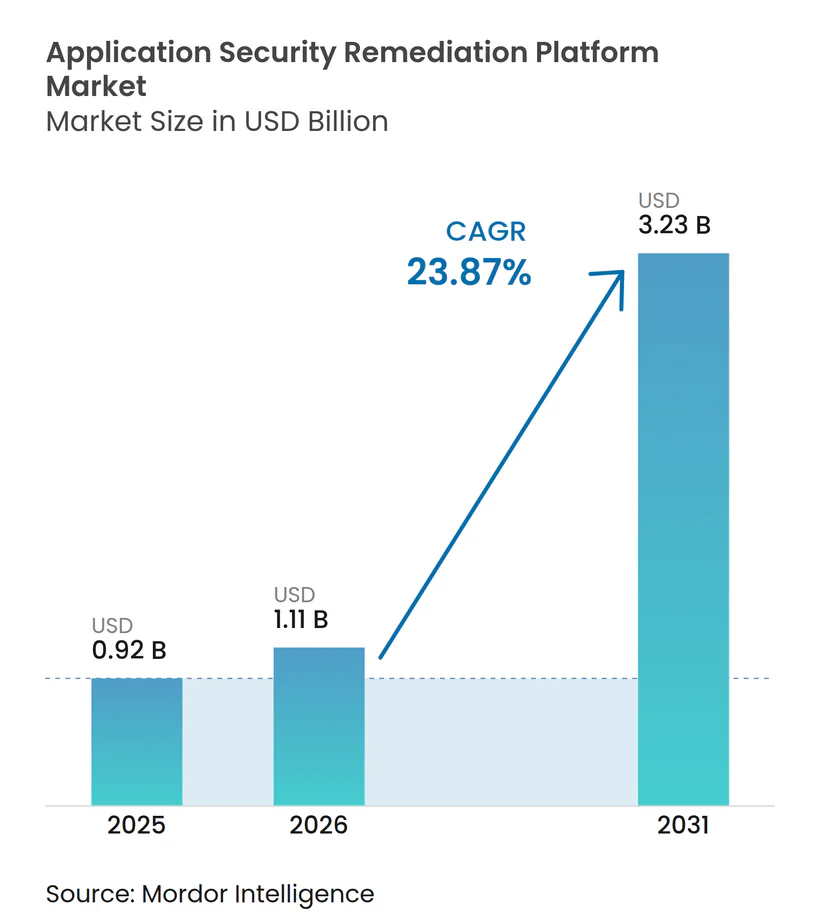
Application Security Remediation Platform Market Analysis by Mordor Intelligence
The Application security remediation platform market size is expected to grow from USD 0.92 billion in 2025 to USD 1.11 billion in 2026, and is forecast to reach USD 3.23 billion by 2031, at a 23.87% CAGR over 2026-2031. The Application security remediation platform market is expanding as remediation becomes a continuous activity in software development rather than a task completed after a scan. AI-assisted coding has increased delivery speed and the number of vulnerabilities entering production code, placing pressure on manual triage and repair processes. Buyers are looking for platforms that integrate intake, risk review, fix delivery, and closure checks into a single workflow. Compliance requirements are also increasing the demand for documented, time-stamped evidence that vulnerabilities were addressed. The Application security remediation platform market offers opportunities for vendors that can integrate with existing developer tools, reduce integration effort, and support complex enterprise environments.
Key Report Takeaways
- By component, software platforms held 67.33% of the Application security remediation platform market share in 2025, while services are projected to expand at a 26.55% CAGR through 2031.
- By remediation capability, vulnerability triage and prioritization accounted for 48.12% of the Application security remediation platform market revenue in 2025, while automated code fix generation is projected to grow at a 25.33% CAGR through 2031.
- By deployment mode, cloud-based deployment held 61.89% of the Application security remediation platform market revenue in 2025, while hybrid deployment is projected to expand at a 25.98% CAGR through 2031.
- By organization size, large enterprises accounted for 68.05% of the Application security remediation platform market revenue in 2025, while SMEs are projected to expand at a 26.24% CAGR through 2031.
- By industry vertical, BFSI held 22.41% of the Application security remediation platform market revenue in 2025, while healthcare and life sciences are projected to grow at a 24.91% CAGR through 2031.
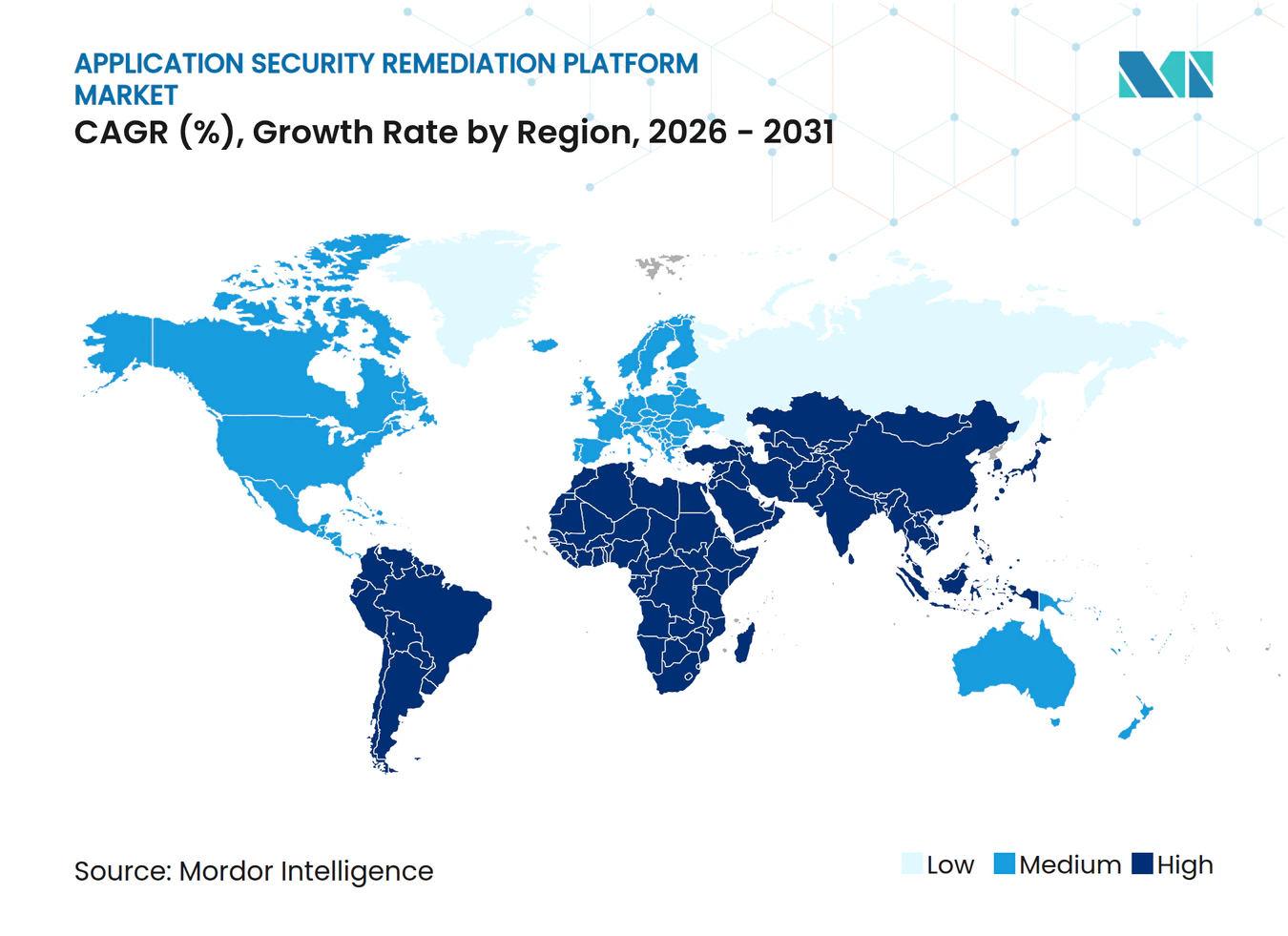
- By geography, North America held 35.16% of global revenue in 2025, while Asia-Pacific is projected to expand at a 25.60% CAGR through 2031.
Note: Market size and forecast figures in this report are generated using Mordor Intelligence’s proprietary estimation framework, updated with the latest available data and insights as of January 2026.
Market Trends and Insights
Drivers Impact Analysis of Application Security Remediation Platform Market*
| Driver | (~) % Impact on CAGR Forecast | Geographic Relevance | Impact Timeline |
|---|---|---|---|
| AI-Assisted Code Generation Increasing Remediation Workloads | +5.5% | Global, concentrated in North America, Western Europe, and Asia-Pacific technology hubs, including India and South Korea | Short term (≤ 2 years) |
| Expansion of DevSecOps and Shift-Left Security Programs | +5.0% | North America and the European Union, with spillover to Asia-Pacific and the Middle East and Africa | Medium term (2-4 years) |
| Increasing Regulatory Pressure for Documented Vulnerability Remediation | +4.2% | European Union and North America, with spillover to India and Australia | Medium term (2-4 years) |
| Growth of Software Supply Chain Vulnerabilities | +3.5% | Global | Short term (≤ 2 years) |
| Security Engineering Talent Constraints | +1.8% | North America and Europe, with emerging relevance in Asia-Pacific | Medium term (2-4 years) |
| Exploitability-Based Prioritization Reducing Alert Fatigue | +1.2% | North America and Europe, with growing adoption in Asia-Pacific | Short term (≤ 2 years) |
| Source: Mordor Intelligence | |||
AI-Assisted Code Generation Increasing Remediation Workloads
Veracode reported that AI-generated code passed security checks at a 55% rate when models received no explicit security guidance, leaving a substantial volume of known vulnerabilities for developers to address.[1] The Application security remediation platform market is responding to this backlog because manual teams cannot review and repair every issue at the pace of AI-supported development. Common weaknesses can appear in string handling, authorization checks, and credential management, which makes consistent remediation processes more important. Many of these weakness types align with established CWE categories, allowing platforms to apply targeted rules when proposing a repair. Developers still need controls that place the proposed repair in the right code context and support review before release. This relationship between code generation and remediation keeps demand tied to the security practices used in agentic development workflows.
Expansion of DevSecOps and Shift-Left Security Programs
The Application security remediation platform market benefits as organizations move beyond finding issues earlier in development and focus on fixing them throughout the lifecycle. Datadog stated that DevSecOps programs need contextual intelligence to prioritize meaningful risks and reduce the silos between security and engineering teams. This need places greater value on tools that can route an issue to the responsible developer and connect remediation work to the existing build process. Platforms that operate via IDE extensions, pull request comments, and CI gates can reduce the disruption security tasks create for developers. Strong scanning coverage alone does not resolve the workflow gap between discovering a vulnerability and confirming it has been fixed. The Application security remediation platform market, therefore, favors providers that combine security context with a practical developer experience, provide a clear ownership path for each finding, and make remediation progress visible to both security leaders and engineering managers. This operating model can prevent unresolved issues from moving between teams without a decision and help development groups understand which security tasks must be completed before a release can proceed.
Increasing Regulatory Pressure for Documented Vulnerability Remediation
The EU Cyber Resilience Act introduced reporting obligations that take effect on September 11, 2026, and require manufacturers of digital products to report actively exploited vulnerabilities to ENISA and national CSIRTs within 24 hours. The Application security remediation platform market gains relevance when organizations must create reliable records for vulnerability closure rather than retain informal evidence across separate systems. DORA has been enforceable since January 17, 2025, while PCI DSS 4.0.1 became mandatory on March 31, 2025, increasing attention to continuous validation and tracked remediation cycles in regulated environments. These obligations make time-stamped remediation evidence a practical operating requirement for financial entities and digital product manufacturers. Platforms that generate compliance-ready evidence as part of their normal workflow can reduce secondary documentation work. Regulatory demands also extend procurement interest beyond security teams to risk, audit, and compliance functions.
Growth of Software Supply Chain Vulnerabilities
Software supply chain risk is widening the scope of issues that remediation teams must identify, prioritize, and resolve. The Cyber Resilience Act requires machine-readable component inventories in technical documentation, which limits the usefulness of static inventories that are not connected to current exposure information. A transitive dependency can sit several layers below an application and still require an exposure assessment, a repair path, and recorded closure. The Application security remediation platform market is driven by the need for dependency tracking, reachability analysis, and fix orchestration within a connected workflow. Platforms that link component inventories to live exploitability information can help teams determine which alerts require immediate action. The same capabilities can help organizations meet reporting deadlines that cannot be managed through periodic manual review.
Restraints Impact Analysis of Application Security Remediation Platform Market*
| Restraint | (~) % Impact on CAGR Forecast | Geographic Relevance | Impact Timeline |
|---|---|---|---|
| Integration Complexity Across Fragmented Development Toolchains | -2.8% | Global, most acute for large enterprises with heterogeneous SDLC stacks in North America and Europe | Medium term (2-4 years) |
| Developer Resistance to Automated Code Changes | -2.0% | North America and Europe, with emerging relevance in Asia-Pacific | Long term (≥ 4 years) |
| Limited Ground Truth for Exploitability and Fix Validation | -1.5% | Global | Long term (≥ 4 years) |
| Runtime and Legacy Application Remediation Constraints | -1.0% | Europe and Asia-Pacific, where banking and manufacturing technology stacks include substantial legacy systems | Long term (≥ 4 years) |
| Source: Mordor Intelligence | |||
Integration Complexity Across Fragmented Development Toolchains
Enterprise development environments can include source control, CI/CD orchestration, container registries, SAST engines, SCA scanners, DAST platforms, and ticketing systems. The lack of common data structures means that a remediation platform may need many two-way integrations before it can cover the full workflow. This work can extend implementation periods because organizations need to connect active scanners and route work to the correct development teams. The Application security remediation platform market faces a particular adoption barrier among mid-market buyers, whose tools may be less standardized and whose security budgets are more constrained. Pre-built connectors and API-first designs can reduce implementation effort, but they do not remove the challenge for every environment. Integration complexity remains a central concern for multi-vendor enterprises that need a clear path to value after deployment.
Developer Resistance to Automated Code Changes
Developers may hesitate to accept machine-generated patches without review, especially when a production-critical system could be affected by an incorrect change. Pixee found that 49.6% of application security job postings required senior-level experience or above, while 1.9% were open to entry-level candidates, reflecting the expertise organizations seek in this field. The concern is strongest in business-critical monolithic codebases, where a correct-looking patch may still alter application behavior. Vendors are responding with features such as call-path traces, CVE references, and before-and-after code comparisons within the developer environment. These details help developers understand why a change is proposed and decide whether it is safe to accept. The Application security remediation platform market will depend on vendors' progress in improving confidence in automated fixes and validation.
*Our forecasts treat driver/restraint impacts as directional, not additive. The impact forecasts reflect baseline growth, mix effects, and variable interactions.
Application Security Remediation Platform Market Segment Analysis
By Component:
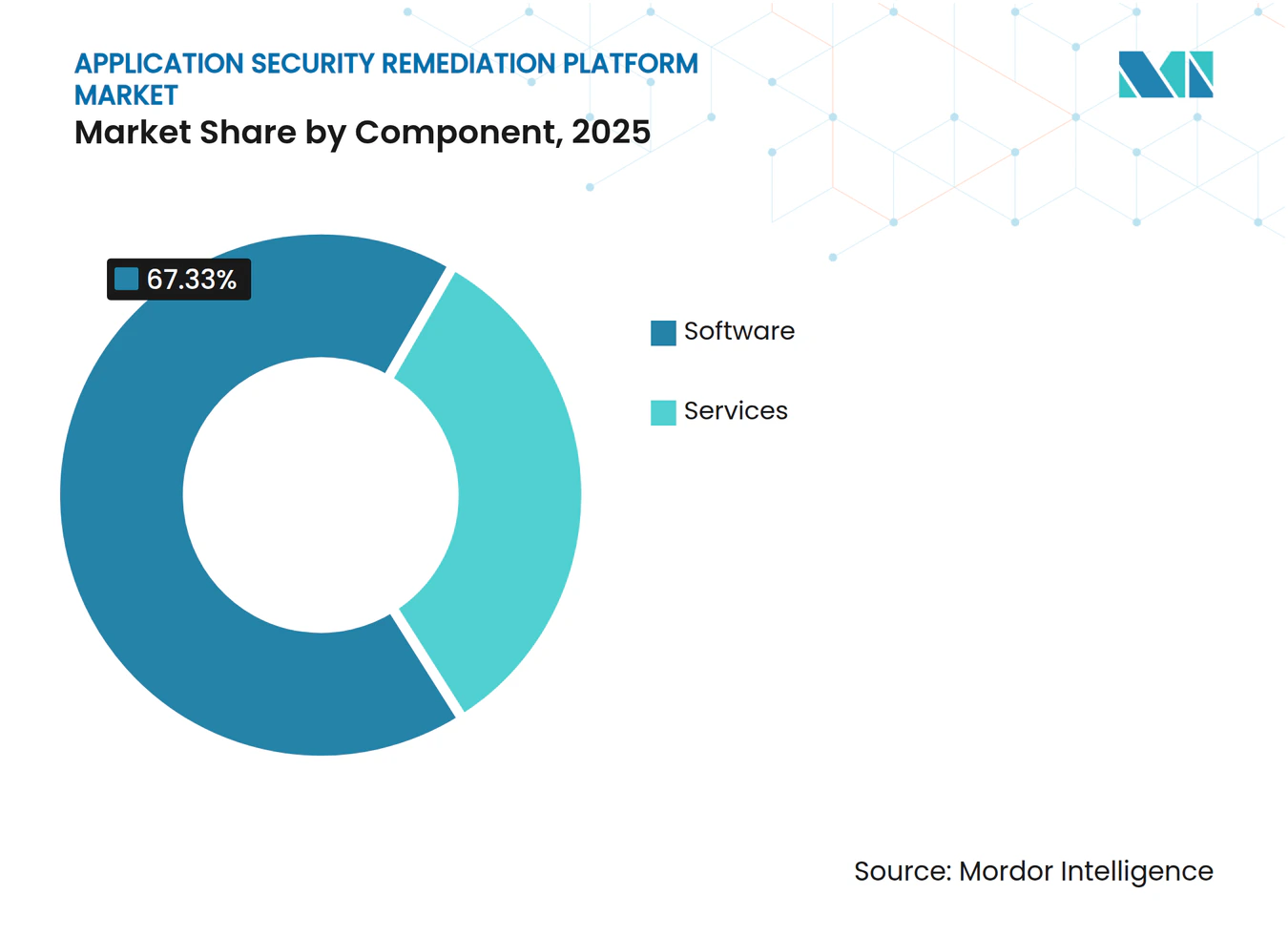
Software Platforms Set the Remediation Architecture StandardSoftware platforms held 67.33% of component revenue in 2025, giving them the leading position in the Application security remediation platform market because enterprises preferred a single environment that could connect finding intake, risk deduplication, fix delivery, closure verification, and reporting rather than requiring security and engineering teams to manage separate handoffs among point solutions. The platform approach reduces repetitive coordination work and can absorb tasks that previously consumed security engineering hours, especially when AI-assisted prioritization, automated fix generation, and application context graphing are used to manage growing volumes of code and vulnerability findings. Its role is also broadening from a development security tool to a governance layer, as compliance rules increasingly require organizations to create auditable records documenting how a finding was reviewed, assigned, repaired, and confirmed closed. This capability matters when a buyer needs operational workflows and compliance evidence from the same system, because relying on secondary documentation processes can slow remediation and produce inconsistent records. Software platforms, therefore, remain central to enterprise architecture decisions, although their value depends on the quality of integrations, workflow design, and developer acceptance of the remediation work they generate.
Services are projected to grow at a 26.55% CAGR through 2031, the fastest rate within the component split, because many buyers still need external help to configure integrations, establish remediation processes, and manage security work that their internal teams cannot cover. The segment reflects a persistent shortage of experienced security engineers, making managed remediation services relevant when an organization needs a provider to operate triage and remediation workflows on its behalf. Mid-market enterprises can use these services to access application security support without building a full in-house team, while large organizations can use them during complex platform rollouts or to supplement staff across their application portfolios. Service providers can also help align the platform with existing source control, scanning, CI/CD, and ticketing systems, which is often necessary before remediation tasks reach the correct developer teams. The Application security remediation platform industry consequently combines a software-led model with specialist service capacity, allowing the component mix to address both automation needs and the practical staffing constraints that affect implementation.


By Remediation Capability:
Triage Leads as Automated Fix Generation AcceleratesVulnerability triage and prioritization captured 48.12% of remediation capability revenue in 2025 because organizations operating high-volume scanning programs need reliable context to distinguish issues that pose real exposure from alerts that do not require immediate developer attention. Safeguard stated that reachability analysis can classify 80% to 90% of findings in a typical dependency tree as unreachable, which illustrates why filtering and prioritizing the right work can be more important than simply accelerating every possible fix.[2] Good triage helps security teams direct limited developer time toward actionable vulnerabilities, reduce alert fatigue, and establish a defensible remediation sequence across applications, dependencies, and production environments. It also supports the later stages of the workflow because orchestration, repair, validation, and closure records have less value when they are applied to issues without confirmed relevance. The Application security remediation platform market, therefore, continues to rely on triage as its largest capability, while buyers look for platforms that combine severity with reachability, application context, and exploitability information.
Automated code fix generation is projected to expand at a 25.33% CAGR through 2031 as generative AI models improve their ability to produce syntactically correct patch suggestions that fit the specific code context developers are reviewing. Remediation workflow orchestration, dependency upgrade and patch automation, runtime mitigation and virtual patching, and verification and closure management complete the repair cycle by coordinating ownership, delivering changes, assessing outcomes, and recording evidence after a vulnerability has been addressed. Large enterprises increasingly need these connected capabilities as they move beyond identifying and ranking issues to executing remediation across extensive portfolios without relying on manual coordination in every case. The competitive emphasis is moving toward fix quality, developer acceptance rates, and the depth of governance reporting, while triage functions become a more established foundation across competing platforms. This progression favors providers that can take a prioritized finding through a clear, reviewable path to a verified outcome, rather than leaving the buyer to combine separate tools for each stage of the remediation process. The Application security remediation platform market also rewards platforms that preserve the rationale for prioritization and the results of validation, since those records allow technical teams to explain remediation decisions later without reconstructing activity across multiple systems.
By Deployment Mode:
Cloud Alignment With CI/CD Sustains LeadershipCloud-based deployment accounted for 61.89% of revenue in 2025, reflecting its fit with containerized and CI/CD-driven development environments, where security tools must work continuously with code repositories, build systems, cloud infrastructure, and distributed scanning sources. Cloud-hosted platforms can ingest and correlate findings as they are produced, thereby limiting the synchronization delays associated with periodic data pulls from on-premises systems and providing teams with a current view of remediation activity. This operating model is valuable where vulnerability reporting obligations have short response periods, because teams need timely context on the affected application, the responsible owner, the available fix, and the status of closure verification. Cloud delivery can also support collaboration among distributed development and security teams by placing the workflow within the systems used to build and release applications. The Application security remediation platform market remains favorable to cloud-based offerings because they align with the operating patterns of many modern software organizations, although they must still meet customer requirements for data handling and integration.
Hybrid deployment is projected to grow at a 25.98% CAGR through 2031 because many enterprises need a design in which pre-production scanning and triage operate in the cloud, while fix orchestration and closure verification remain within private network boundaries. This arrangement can support data residency, intellectual property protection, and regulatory controls without requiring the organization to lose access to cloud-connected development workflows. On-premises deployment remains relevant for air-gapped government systems, critical infrastructure environments, and geographies where source code cannot move through external cloud infrastructure. Hybrid platforms are most useful when they can route findings and remediation tasks between cloud and private components without forcing the buyer to maintain dual toolchains or duplicate operational processes. The segment’s growth shows that deployment flexibility is essential for large enterprise procurement, particularly when the organization has varied application types, security controls, and legal requirements across its operations.
By Organization Size:
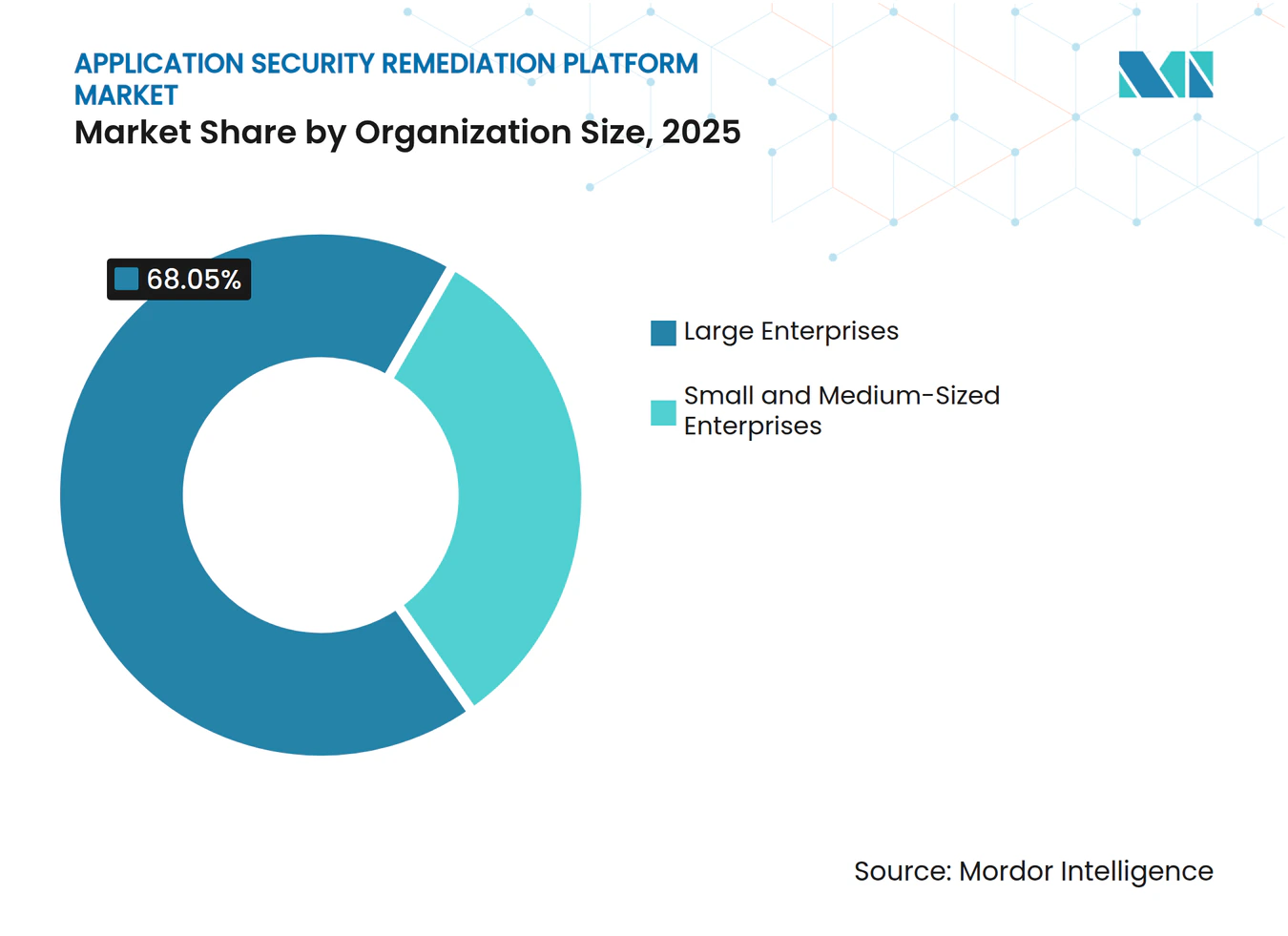
Enterprises Anchor Spend as SMEs Increase AdoptionLarge enterprises accounted for 68.05% of organization-size revenue in 2025, reflecting their large application portfolios, higher finding volumes, dedicated application security teams, and compliance obligations that can justify investment in complex remediation platforms. These buyers can configure and operate the technology at scale, and regulated sectors often require a more formal approach to vulnerability closure than smaller organizations do. Commercial patterns also show Global 2000 customers moving from separate product licenses to unified platform agreements that cover vulnerability management, ASPM, and software supply chain security in a single contract. This broader purchasing model can increase the scope of platform use and connect remediation activity across more applications, teams, and security functions. The Application security remediation platform market has a stable enterprise base because these organizations have both the need and the resources to manage an end-to-end remediation program, even where integration work remains substantial.
SMEs are projected to grow at a 26.24% CAGR through 2031 because consumption-based and developer-seat pricing can lower the minimum purchase size and managed services can provide application security program support without a full-time internal team. ISC2 found that 95% of cybersecurity practitioners reported at least 1 critical skills need in 2025, while 28% identified application security as a need, a constraint that can affect smaller organizations more strongly because they have fewer specialists. Easier integration, guided workflows, and external operating support can help SMEs use remediation platforms without carrying the same configuration burden as a large enterprise. Vendors that reduce deployment complexity can make structured remediation more accessible to organizations with limited security budgets and development resources. The Application security remediation platform industry can drive adoption across this segment as pricing, service delivery, and product integration better match the operating conditions of smaller buyers.

By Industry Vertical:
BFSI Anchors Demand as Healthcare Gains PriorityBFSI accounted for 22.41% of industry-vertical revenue in 2025, making it the largest vertical in the Application security remediation platform market, as it operates many regulated and customer-facing applications and must demonstrate traceable vulnerability closure to auditors and supervisors. The sector treats remediation as a compliance and operational responsibility rather than only an IT task, which raises the value of platforms that preserve clear evidence from initial discovery through final verification. Demand also extends across the fintech supply chain because software providers serving financial institutions can face comparable expectations regarding secure development practices and documented remediation processes. This expands the addressable customer base beyond banks, insurers, and financial services organizations to include their technology suppliers and supporting application providers. BFSI remains the leading vertical because the density of sensitive digital applications and the strength of its compliance demands make structured remediation an ongoing requirement.
Healthcare and life sciences are projected to grow at a 24.91% CAGR through 2031 as patient-facing portals and third-party APIs create application-layer exposure that endpoint-focused controls may not fully address. PwC reported that cybersecurity is among the leading investment priorities for healthcare payers, providers, pharmaceutical companies, and life sciences organizations, underscoring the need for continued attention to application security remediation as digital services become more central. IT and telecommunications, government and public administration, retail and e-commerce, industrial manufacturing, energy and utilities, and transportation and logistics also make meaningful contributions to demand across the vertical mix. Oil and gas, education and research institutions, and media and entertainment are early-stage adoption groups that can increase adoption as application-layer threat targeting broadens and platform pricing becomes more accessible. Healthcare and life sciences stand out because growing digital exposure and cybersecurity investment priorities are converging, strengthening demand for more systematic remediation processes.
Geography Analysis
The Americas Application Security Remediation Platform Market
North America accounted for 35.16% of global revenue in 2025 and remained the largest regional segment in the Application security remediation platform market, supported by the United States’ concentration of enterprise software vendors, financial institutions, and defense contractors subject to secure development and SBOM-related requirements. Large enterprises in the region increasingly use multi-domain platform agreements instead of separate point-tool contracts, a buying pattern that can increase deal size and deepen the relationship between vendors and their customers. The United States continues to broaden compliance obligations for government suppliers and downstream technology chains, thereby supporting demand for tools that provide evidence of remediation activity. Canada and Mexico contribute through regulated financial and energy applications, although their adoption rates trail those of the United States.[3] South America, led by Brazil and Argentina, is still at an earlier stage, with financial services and government as the main demand anchors and adoption linked to national cybersecurity rules and digital infrastructure maturity.
EMEA Application Security Remediation Platform Market
Europe is the second-largest geographic segment, with Germany, the United Kingdom, and France as primary demand centers because NIS2, DORA, and the Cyber Resilience Act require documented remediation programs across critical infrastructure, financial services, and digital product manufacturing. DORA has been enforceable since January 2025 and requires financial entities to maintain ICT risk controls and auditable records of vulnerability closures, creating a direct need for platforms with evidence-generation capabilities. BENELUX countries are early users of DORA compliance tooling because they host financial infrastructure and EU institutions, while Germany’s SBOM technical requirements are encouraging adoption among industrial manufacturers and critical infrastructure operators. The United Kingdom continues to advance its Cyber Security and Resilience Bill and maintains comparable capability needs despite operating outside EU jurisdiction. The Middle East and Africa remain emerging areas where government and financial services investment follows national Vision programs and digital economy initiatives, creating an initial base for application security investment.
APAC Application Security Remediation Platform Market
Asia-Pacific is projected to grow at a 25.60% CAGR through 2031, the fastest regional rate in the Application security remediation platform market, as rising software assurance requirements across diverse regulatory environments accompany the region's digital economy growth. India’s July 2026 cybersecurity framework directions require commercial banks to maintain documented vulnerability assessment and remediation programs with specified timelines, while South Korea, Japan, and Australia are building software supply chain assurance into critical infrastructure policy. China’s domestic cloud expansion and enforcement of its Cybersecurity Law and Data Security Law also support investment in locally compliant application security platforms. These conditions create a compliance-led procurement cycle that resembles the European pattern, although providers must address local policy, integration, and deployment requirements across the region. The Application security remediation platform market can benefit when providers translate these requirements into workflows that span diverse development environments, because regional buyers still need a practical way to assign, resolve, and document security work.
Competitive Landscape
Market Concentration
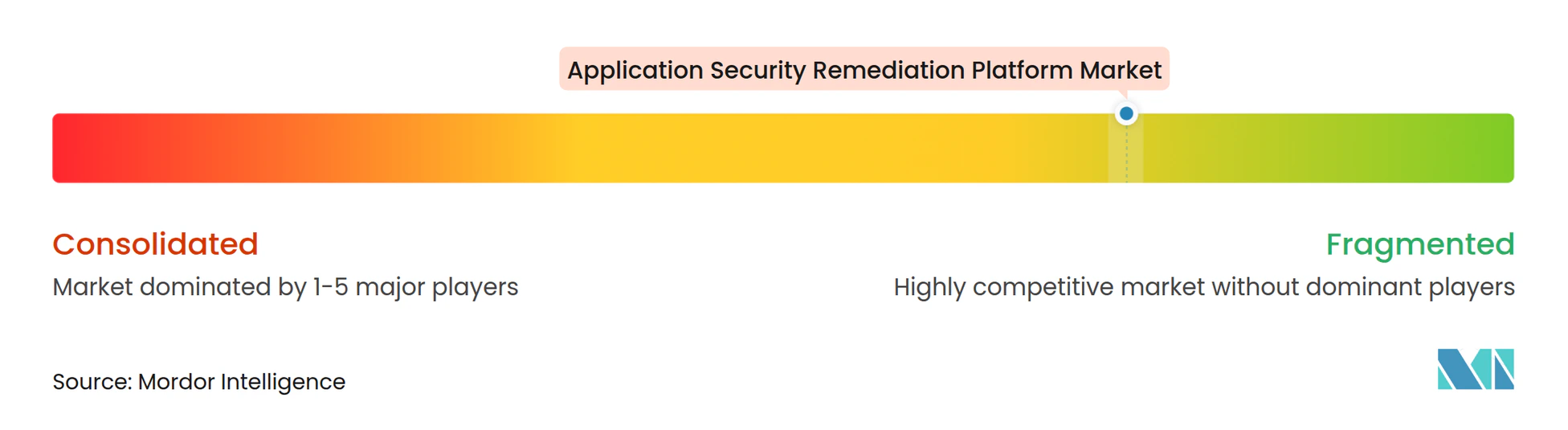
The Application security remediation platform market is fragmented, with more than 30 vendors competing across discovery, triage, fix automation, and closure management, and with both narrow point-solution providers and broad platform vendors addressing overlapping parts of the remediation lifecycle. ArmorCode, Brinqa, Nucleus Security, Seemplicity Technologies, and Vulcan Cyber compete as ASPM-focused providers, while Checkmarx, Snyk, and Veracode are extending their application security testing platforms into remediation orchestration, fix automation, and closure management. A central strategy is platform extension, as vendors want to bring adjacent functions into a connected workflow and prevent integration complexity from prompting customers to switch. Runtime remediation and legacy application environments remain areas where automated fixes lack sufficient context for no-touch patching, creating opportunities for vendors with runtime instrumentation and application context-graphing capabilities. The field, therefore, combines specialized offerings with platforms that seek to manage a larger share of the security and developer workflow.
Checkmarx launched Fusion in July 2026, combining its SAST engines with Anthropic models within the Checkmarx One platform.[4] Snyk made Evo Continuous Offensive Security generally available in August 2026, adding autonomous pentesting and agent red teaming as continuous validation functions. OX Security launched its AI-Native Application Protection Platform in July 2026 to govern the agentic development lifecycle from prompt to runtime. These actions show that competitors are adding validation, governance, and AI-supported functions around core remediation work, while keeping those functions within their wider product environments. The Application security remediation platform market is becoming more competitive as providers seek to address the full developer security process without requiring buyers to add more disconnected tools.
Emerging providers are building autonomous security agents that can triage, fix, and verify vulnerabilities within automated workflows, but they still need to show that developers can understand and accept the recommended repairs. Reachability analysis, AI-based fix-confidence scoring, and software dependency graphing address buyer concerns about prioritization, safe automation, and complex dependencies. Developer experience, fix acceptance rates, and the quality of audit evidence are becoming selection factors as scanning breadth becomes less distinct across vendors. Providers must support compliance teams that need reliable closure records while delivering changes that developers can review safely in their existing workflow, and buyers assess whether a platform can operate across existing scanners and repositories without creating new work queues, because automation loses value if security teams must manually reconcile information before work can begin in the Application security remediation platform market.
Application Security Remediation Platform Industry Leaders
-
ArmorCode, Inc.
-
Apiiro Ltd.
-
Checkmarx Ltd.
-
Cycode Ltd.
-
Veracode, Inc.
- *Disclaimer: Major Players sorted in no particular order
Application Security Remediation Platform Market Companies Covered in this Report
- ArmorCode, Inc.
- Apiiro Ltd.
- AppSOC, Inc.
- Backslash Security Ltd.
- Brinqa, Inc.
- Checkmarx Ltd.
- Cycode Ltd.
- Endor Labs, Inc.
- HCLSoftware
- HackerOne, Inc.
- Invicti Security Corporation
- Kondukto, Inc.
- Legit Security Ltd.
- Mend.io, Inc.
- NopSec, Inc.
- Nucleus Security, Inc.
- OpenText Corporation
- OX Security Ltd.
- Pixee, Inc.
- PlexTrac, Inc.
- Qwiet AI, Inc.
- Seemplicity Technologies Ltd.
- Security Compass Technologies Inc.
- Snyk Limited
- SOOS, Inc.
- StackHawk, Inc.
- Veracode, Inc.
- Vicarius, Inc.
- Vulcan Cyber Ltd.
- WhiteHat Security, Inc.
- ZeroNorth A/S
Recent Industry Developments in Application Security Remediation Platform Market
- August 2026: Snyk released Evo Continuous Offensive Security to general availability, introducing AI-powered autonomous pentesting and agent red teaming that continuously attack applications as code changes and return validated, proof-of-exploit evidence, addressing the 350-day testing gap left by traditional annual manual pentests costing USD 20,000 to USD 100,000. This launch significantly extended Snyk's platform beyond scanning to include adversarial validation, targeting enterprise buyers seeking unified remediation and exploit-verification workflows.
- July 2026: OX Security launched its AI-Native Application Protection Platform, establishing itself as the first vendor to govern the full agentic development lifecycle from prompt to runtime in a single platform backed by USD 94 million in total funding, including a USD 60 million Series B led by DTCP. The concurrent announcement of an OX Security-Tenable integration enabled cloud-to-code risk correlation with remediation lineage tracking, directly addressing fragmented visibility across cloud and application environments.
- July 2026: Checkmarx announced Checkmarx Fusion in early access, a hybrid scanning approach that combines its application security engines with Anthropic models, running entirely within the customer's cloud environment via Amazon Bedrock, achieving an F1 score of 0.741 across all languages and codebases, including AI-generated code. The product positioned Checkmarx to address the 49% share of production code reported as AI-generated in its own 2026 Future of Application Security report.
- July 2026: Checkmarx unveiled self-healing application security through its Assist Agent Family, introducing autonomous agents that detect, fix, and verify vulnerabilities as developers code within the Checkmarx One platform, addressing the real-time gap in fix generation created by AI-accelerated code volumes.
Global Application Security Remediation Platform Market Report Scope
The Application Security Remediation Platform Market comprises software solutions, platforms, and associated services designed to prioritize, orchestrate, automate, track, verify, and manage the remediation of security vulnerabilities across software applications, development environments, and production systems. These platforms help organizations reduce security risk by enabling faster identification, prioritization, correction, validation, and closure of application security issues throughout the software development lifecycle. The market includes technologies that aggregate findings from security testing tools, vulnerability scanners, code repositories, software composition analysis platforms, runtime environments, and developer workflows to streamline remediation processes. Application security remediation platforms support vulnerability prioritization, remediation workflow management, automated code-fix generation, dependency and patch automation, runtime mitigation, virtual patching, remediation verification, and closure management.
The Application Security Remediation Platform Market Report is Segmented by Component (Software and Services), Remediation Capability (Vulnerability Triage and Prioritization, Remediation Workflow Orchestration, Automated Code Fix Generation, Dependency Upgrade and Patch Automation, Runtime Mitigation and Virtual Patching, and Remediation Verification and Closure Management), Deployment Mode (Cloud-Based, On-Premises, and Hybrid), Organization Size (Large Enterprises, and Small and Medium-Sized Enterprises), Industry Vertical (Government and Public Administration, Industrial Manufacturing, Retail and E-Commerce, Transportation and Logistics, Energy and Utilities, Oil and Gas, IT and Telecommunication, Media and Entertainment, Education and Research Institutions, Healthcare and Life Sciences, Banking, Financial Services, and Insurance [BFSI], and Other Industry Verticals), and Geography (North America, South America, Europe, Asia-Pacific, and Middle East and Africa). The Market Forecasts are Provided in Terms of Value (USD).
Segmentation Overview
| Software |
| Services |
| Vulnerability Triage and Prioritization |
| Remediation Workflow Orchestration |
| Automated Code Fix Generation |
| Dependency Upgrade and Patch Automation |
| Runtime Mitigation and Virtual Patching |
| Remediation Verification and Closure Management |
| Cloud-Based |
| On-Premises |
| Hybrid |
| Large Enterprises |
| Small and Medium-Sized Enterprises |
| Government and Public Administration |
| Industrial Manufacturing |
| Retail and E-Commerce |
| Transportation and Logistics |
| Energy and Utilities |
| Oil and Gas |
| IT and Telecommunication |
| Media and Entertainment |
| Education and Research Institutions |
| Healthcare and Life Sciences |
| Banking, Financial Services, and Insurance (BFSI) |
| Other Industry Verticals |
| North America | United States | |
| Canada | ||
| Mexico | ||
| South America | Brazil | |
| Argentina | ||
| Rest of South America | ||
| Europe | Germany | |
| United Kingdom | ||
| France | ||
| Italy | ||
| BENELUX | ||
| Rest of Europe | ||
| Asia-Pacific | China | |
| Japan | ||
| India | ||
| South Korea | ||
| Australia | ||
| Rest of Asia-Pacific | ||
| Middle East and Africa | Middle East | United Arab Emirates |
| Saudi Arabia | ||
| Rest of Middle East | ||
| Africa | South Africa | |
| Nigeria | ||
| Egypt | ||
| Rest of Africa | ||
| By Component | Software | ||
| Services | |||
| By Remediation Capability | Vulnerability Triage and Prioritization | ||
| Remediation Workflow Orchestration | |||
| Automated Code Fix Generation | |||
| Dependency Upgrade and Patch Automation | |||
| Runtime Mitigation and Virtual Patching | |||
| Remediation Verification and Closure Management | |||
| By Deployment Mode | Cloud-Based | ||
| On-Premises | |||
| Hybrid | |||
| By Organization Size | Large Enterprises | ||
| Small and Medium-Sized Enterprises | |||
| By Industry Vertical | Government and Public Administration | ||
| Industrial Manufacturing | |||
| Retail and E-Commerce | |||
| Transportation and Logistics | |||
| Energy and Utilities | |||
| Oil and Gas | |||
| IT and Telecommunication | |||
| Media and Entertainment | |||
| Education and Research Institutions | |||
| Healthcare and Life Sciences | |||
| Banking, Financial Services, and Insurance (BFSI) | |||
| Other Industry Verticals | |||
| By Geography | North America | United States | |
| Canada | |||
| Mexico | |||
| South America | Brazil | ||
| Argentina | |||
| Rest of South America | |||
| Europe | Germany | ||
| United Kingdom | |||
| France | |||
| Italy | |||
| BENELUX | |||
| Rest of Europe | |||
| Asia-Pacific | China | ||
| Japan | |||
| India | |||
| South Korea | |||
| Australia | |||
| Rest of Asia-Pacific | |||
| Middle East and Africa | Middle East | United Arab Emirates | |
| Saudi Arabia | |||
| Rest of Middle East | |||
| Africa | South Africa | ||
| Nigeria | |||
| Egypt | |||
| Rest of Africa | |||
Key Questions Answered in the Report
What is the application security remediation platform market size?
The application security remediation platform market was USD 1.11 billion in 2026 and is forecast to reach USD 3.23 billion by 2031, at a 23.87% CAGR.
Why are enterprises adopting application security remediation platforms?
Organizations use these platforms to prioritize findings, deliver fixes within development workflows, and produce documented evidence that vulnerabilities were closed.
Which component holds the largest share of application security remediation platforms?
Software platforms held 67.33% of component revenue in 2025 because enterprises favor unified workflows for intake, prioritization, repair, and closure verification.
Which deployment model leads application security remediation?
Cloud-based deployment led with 61.89% of revenue in 2025 because it fits CI/CD workflows and supports continuous correlation of findings.
Which end-user sector has the largest current demand?
BFSI held 22.41% of industry-vertical revenue in 2025 because regulated financial applications require traceable remediation records.
Which region is expected to grow fastest through 2031?
Asia-Pacific is projected to grow at a 25.60% CAGR through 2031, supported by digital economy expansion and software assurance requirements.