
API Abuse Detection Market Size and Share
Market Overview
| Study Period | 2020 - 2031 |
|---|---|
| Market Size (2026) | USD 1.41 Billion |
| Market Size (2031) | USD 3.84 Billion |
| Growth Rate (2026 - 2031) | 22.24 % |
| Fastest Growing Market | Asia-Pacific |
| Largest Market | North America |
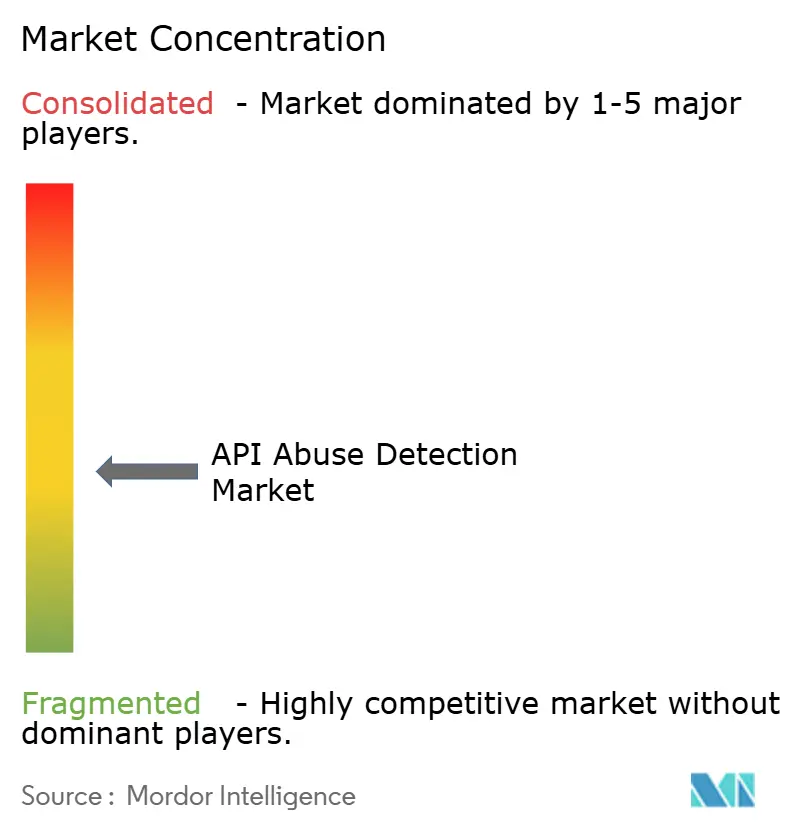
| Market Concentration | Medium |
Major Players *Disclaimer: Major Players sorted in no particular order Image © Mordor Intelligence. Reuse requires attribution under CC BY 4.0. | |
API Abuse Detection Market Analysis by Mordor Intelligence
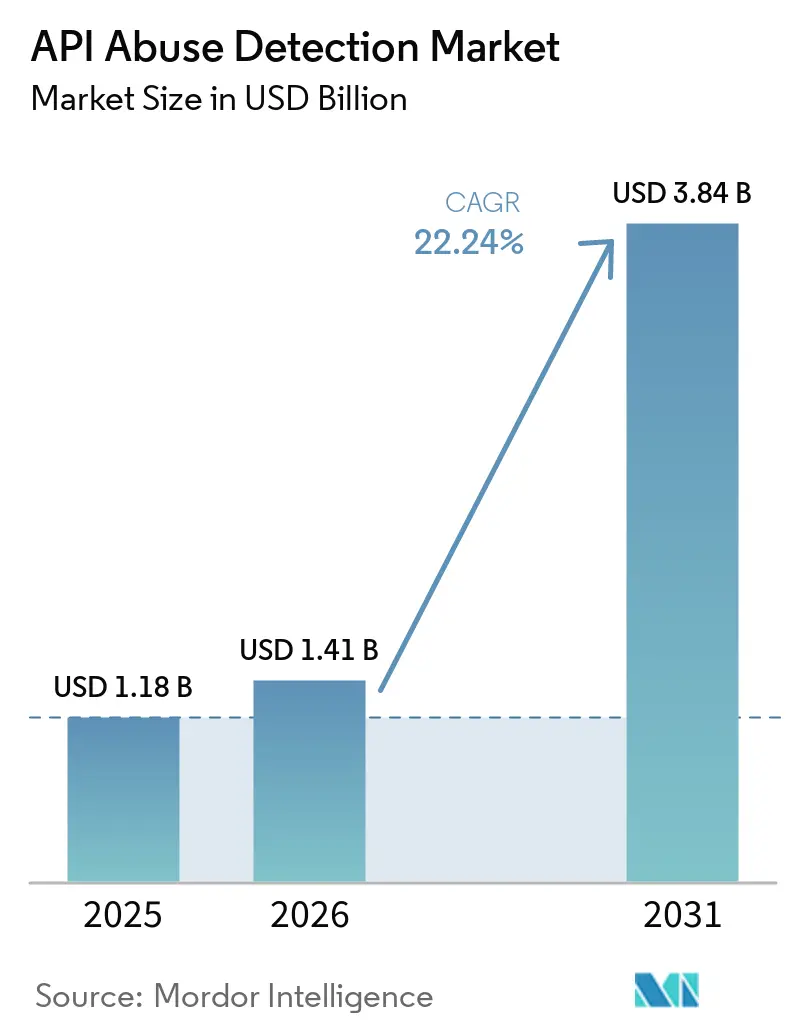
The API Abuse Detection Market size is expected to grow from USD 1.18 billion in 2025 to USD 1.41 billion in 2026, and is forecast to reach USD 3.84 billion by 2031, at a 22.24% CAGR over 2026-2031. API attacks had already increased beyond the capacity of many legacy defenses by 2025. Organizations are moving from perimeter controls toward runtime behavioral detection as API exposure spans REST, GraphQL, gRPC, and AI agent interfaces. Authenticated activity and compromised sessions are raising the value of entity profiling, behavioral analytics, and anomaly correlation. The API abuse detection market also benefits from rising digital transaction volumes, regulatory oversight, and cloud-native application architectures. Platform vendors are responding through acquisitions, developer integrations, and broader AI security capabilities.
Key Report Takeaways
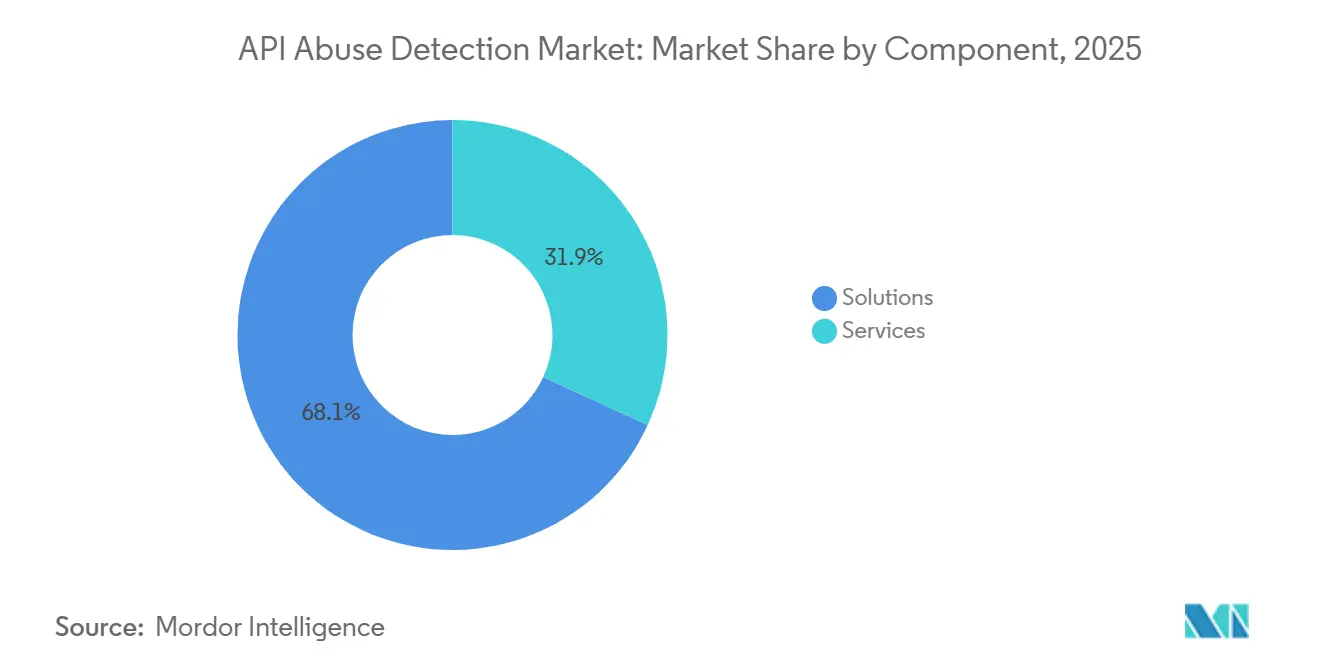
- By component, solutions accounted for 68.12% of the API abuse detection market revenue in 2025, while services are projected to expand at a 25.03% CAGR through 2031.
- By deployment, cloud held 61.33% of the API abuse detection market revenue share in 2025, while hybrid deployment is projected to expand at a 24.40% CAGR through 2031.
- By organization size, large enterprises held 67.08% of the API abuse detection market revenue share in 2025, while SMEs are projected to expand at a 24.71% CAGR through 2031.
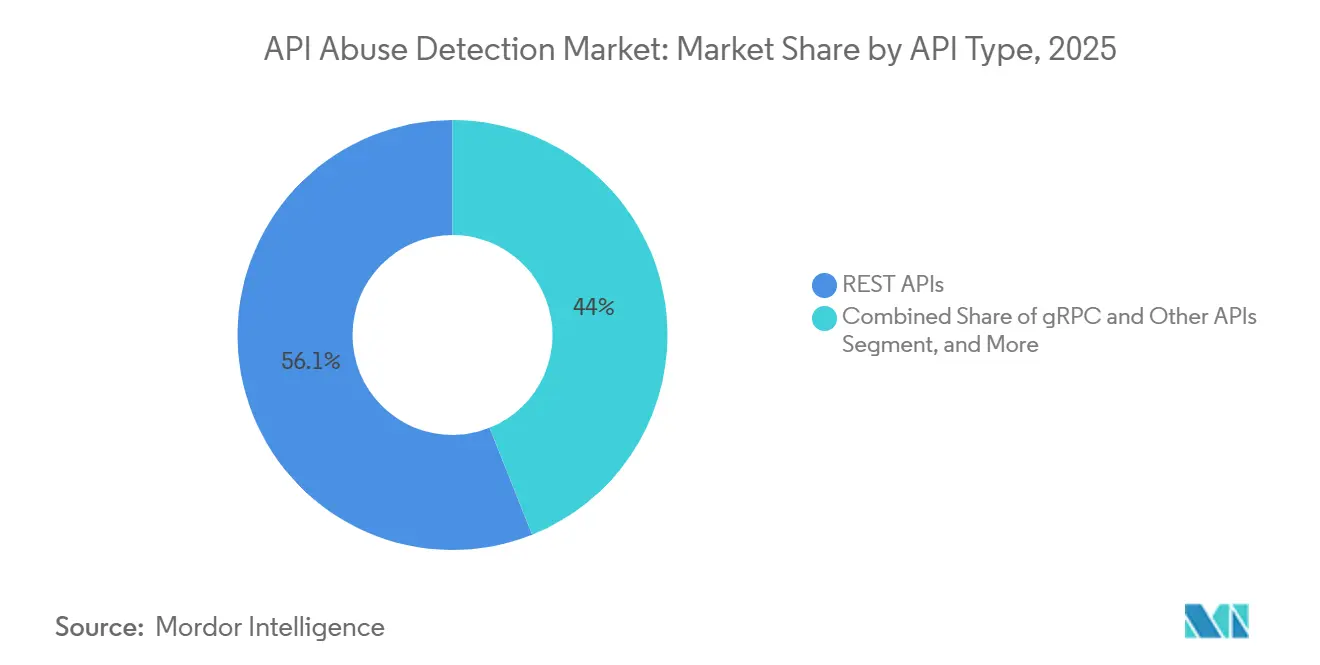
- By API type, REST APIs accounted for 56.05% of API abuse detection market revenue in 2025, while gRPC and other APIs are projected to expand at a 24.02% CAGR through 2031.
- By industry vertical, BFSI held 25.11% of the API abuse detection market revenue share in 2025, while healthcare and life sciences are projected to expand at a 23.16% CAGR through 2031.
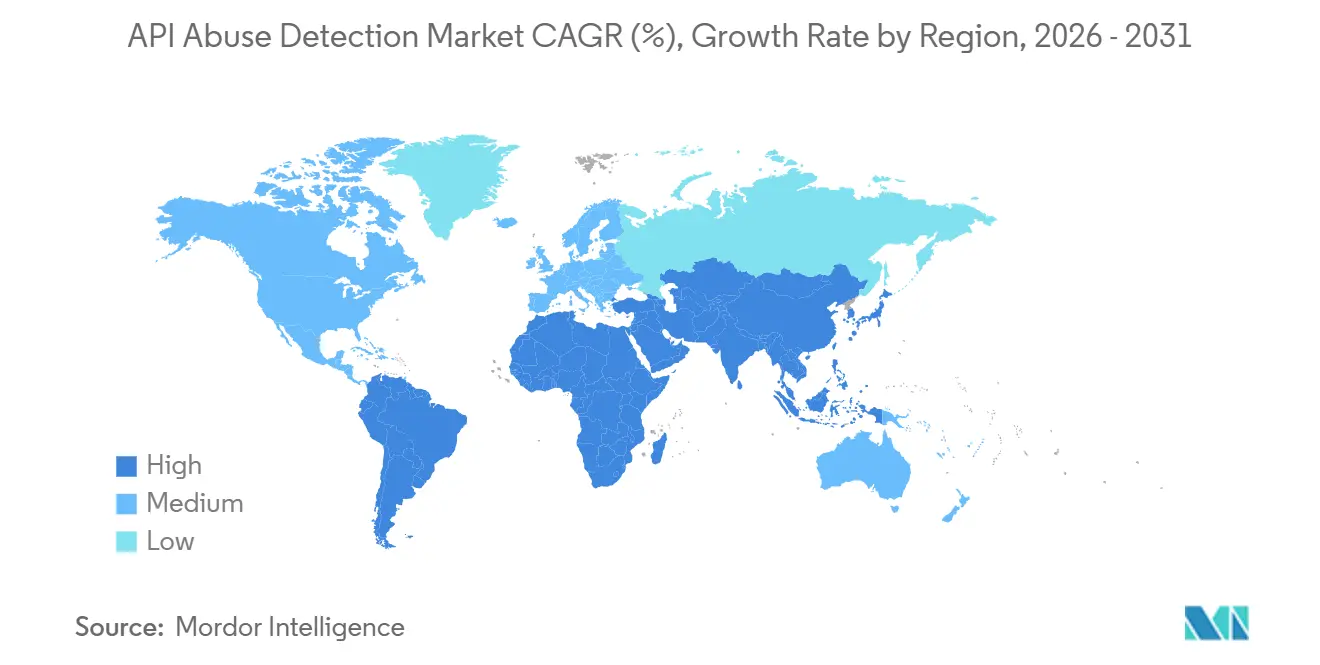
- By geography, North America held 36.19% of the API abuse detection market revenue share in 2025, while Asia-Pacific is projected to expand at a 23.60% CAGR through 2031.
Note: Market size and forecast figures in this report are generated using Mordor Intelligence’s proprietary estimation framework, updated with the latest available data and insights as of January 2026.
Global API Abuse Detection Market Trends and Insights
Drivers Impact Analysis*
| Driver | (~) % Impact on CAGR Forecast | Geographic Relevance | Impact Timeline |
|---|---|---|---|
| Expansion of API-Enabled Digital Transactions | +5.0% | Global | Short term (≤ 2 years) |
| Rising Credential Stuffing and Account-Takeover Automation | +4.2% | Global, concentrated in North America and Europe | Short term (≤ 2 years) |
| Regulatory Pressure for API Inventory and Resilience | +3.8% | North America and EU, with spillover to Asia-Pacific | Medium term (2-4 years) |
| Growth of Cloud-Native and Microservices Architectures | +3.2% | Global, Asia-Pacific fastest-growing | Medium term (2-4 years) |
| AI-Assisted Reconnaissance and Business-Logic Probing | +2.8% | Global | Short term (≤ 2 years) |
| API Abuse Detection Embedded in Fraud and Bot-Management Programs | +2.1% | North America, EU, and Asia-Pacific core | Medium term (2-4 years) |
| Source: Mordor Intelligence | |||
Expansion of API-Enabled Digital Transactions
Organizations now use partner APIs and developer marketplaces to generate direct revenue. An API abuse event can therefore interrupt revenue and breach partner service commitments. Salt Security reported that, in 2026, 66% of organizations had increased their API count by more than 50% over the previous 12 months.[1]Salt Security, “Salt Security Research: As AI Agents Outpace Security, Most Organizations Face an Unsecured API Surge,” Salt Security, salt.security. Security teams must instrument a growing API estate while product teams release new services. This makes revenue assurance and service-level agreements relevant to procurement in the API abuse detection market. Financial services, logistics, and media organizations face this exposure, with API monetization already part of their operating models.
Rising Credential Stuffing and Account-Takeover Automation
Credential stuffing no longer depends only on predictable IP rotation or call-volume patterns. A 2025 open-banking study found that stronger rate limits and anomaly detection reduced operational tail losses by 20-30% against baseline cases. PCI DSS 4.0.1 became mandatory on March 31, 2025, requiring internet-facing payment systems to address automated credential attacks. Passwordless and token-based authentication increase the need to assess complete API sessions rather than only login endpoints. Behavioral profiling helps distinguish compromised activity from approved use with valid credentials. This requirement narrows the practical gap between traditional web application firewalls and dedicated API abuse detection platforms.
Regulatory Pressure for API Inventory and Resilience
DORA took effect on January 17, 2025, requiring EU financial entities to maintain operational resilience across information and communication technology services. BaFin began accepting DORA incident notifications and third-party service registers on that date. PCI DSS 4.0.1 also requires logging, monitoring, access controls, and session management for payment environments. These requirements favor platforms that can provide audit trails without large capital infrastructure commitments. Germany's NIS2 implementation entered into force in December 2025 and widened resilience obligations to more entities. The compliance workload supports continued demand for the API abuse detection market among regulated buyers.
Growth of Cloud-Native and Microservices Architectures
Service meshes move security attention from an external gateway to internal service-to-service traffic. Encrypted east-west traffic can carry gRPC or event-bus API calls that edge tools cannot inspect without terminating TLS. The API abuse detection market, therefore, needs controls that operate more closely with sidecar proxies and service-mesh policies. Cloud-native deployments also create APIs faster than older security tools can inventory and cover. Hybrid deployment gives organizations options for latency, data residency, and sovereignty requirements. This architecture pattern creates demand for coverage that follows API traffic across private and public environments.
Restraints Impact Analysis*
| Restraint | (~) % Impact on CAGR Forecast | Geographic Relevance | Impact Timeline |
|---|---|---|---|
| Fragmented API Ownership and Incomplete Asset Inventory | -1.8% | Global | Long term (≥ 4 years) |
| False Positives in Legitimate High-Volume Automation | -1.2% | Global, acute in North America and Asia-Pacific core | Medium term (2-4 years) |
| Encrypted East-West Traffic and Observability Gaps | -0.9% | Global, acute in cloud-dense markets | Long term (≥ 4 years) |
| Integration and Skills Burden Across DevSecOps Toolchains | -0.7% | Global, acute in developing markets | Long term (≥ 4 years) |
| Source: Mordor Intelligence | |||
Fragmented API Ownership and Incomplete Asset Inventory
Asset visibility remains a basic limitation for API abuse detection. In the second half of 2025, 19% of security teams were very confident in the accuracy of their API inventory, while 25% were not very or not at all confident. Ownership is often divided among product engineering, platform, data, and partner integration teams. A complete register may not have a single accountable owner. Discovery is consequently becoming part of platform sales and can increase deal complexity. Akamai introduced Security Posture Center capabilities with code-to-runtime mapping to connect observed APIs with source repositories and recent committers. The API abuse detection market must address this discovery gap before runtime controls can cover all exposed interfaces.
False Positives in Legitimate High-Volume Automation
Legitimate RPA workflows, AI agent pipelines, batch jobs, and partner bots can resemble malicious behavior. Kong's 2025 survey found that more than half of organizations had experienced an API security incident during the prior year. The same survey found that 40% of respondents were unsure their security investment was sufficient for emerging risks. AI-generated API clients with legitimate credentials can lack a behavioral history for evaluation. Financial trading, logistics aggregation, and media monetization have little tolerance for incorrect blocking. Providers need contextual models that assess longitudinal session behavior rather than relying solely on volume thresholds and IP reputation.
*Our forecasts treat driver/restraint impacts as directional, not additive. The impact forecasts reflect baseline growth, mix effects, and variable interactions.
Segment Analysis
By Component: Solutions Lead, Services Accelerate DevSecOps Integration
Solutions accounted for 68.12% of the API abuse detection market share in 2025. Enterprise buyers seek platforms with SIEM and SOAR connectors, behavioral baselining, policy enforcement, and centralized inventory management, functions that are difficult to reproduce through a services contract alone. The solutions category includes runtime protection, posture management, discovery, and business-logic anomaly detection, enabling buyers to cover the API attack surface through one procurement process. Cequence Security stated that its platform protects more than 10 billion daily API interactions. That operating scale shows why large customers prioritize reliable processing and low performance impact.
Services are projected to expand at a 25.03% CAGR through 2031. Managed security service models allow organizations to outsource monitoring to specialized security operations teams while professional services support DevSecOps integration and policy design. This approach is relevant to mid-sized businesses without a dedicated API security team, and 42Crunch surpassed 2 million tool downloads in November 2025 and expanded access through the Microsoft Security Store. Its freemium model shows how developer tools and advisory services can drive broader platform adoption. The API abuse detection industry uses these channels to help customers operationalize software after purchase.


By Deployment: Hybrid Model Gains Ground in Multi-Cloud Environments
Cloud deployment accounted for 61.33% of the API abuse detection market in 2025. Cloud platforms can scale with API traffic and connect with cloud identity services, while hybrid deployment is projected to grow at a 24.40% CAGR through 2031. It reflects the need to cover private data centers, public clouds, and colocation facilities, and to enable organizations to inspect internal service-mesh traffic on-premises while routing public APIs through cloud-delivered controls. This split can meet data residency, latency, and sovereignty needs. It also avoids treating one hosting model as sufficient for every workload.
On-premises deployment remains relevant where data rules prevent API traffic from entering an external inspection service. Defense contractors, central bank infrastructure, and critical infrastructure operators are key examples, and F5 launched the API Security Local Edition in 2026 for environments that require API visibility without external cloud connectivity. The release shows that on-premises and hybrid models remain durable for regulated enterprises, while some organizations are moving from fully local tools to hybrid architectures. That transition can broaden coverage for providers rather than simply replace an existing revenue source. The API abuse detection market is adapting to these mixed infrastructure choices.
By Organization Size: Enterprise Scale Dominates, SME Adoption Rates Climb
Large enterprises held 67.08% of revenue in 2025. Their API estates can include thousands of internal, partner, and public endpoints, and they also manage regulated data flows and established security operations. These conditions require platforms that can process millions of daily API calls without throughput degradation, while PCI DSS 4.0.1 and DORA further prioritize API controls in regulated sectors. Large deployments, therefore, continue to support the established base of the API abuse detection market.
SMEs are projected to grow at a 24.71% CAGR through 2031. API-first software models expose smaller firms to the risk of abuse from the early stages of operation. Cloud-delivered managed detection reduces the need for capital infrastructure, and payment and healthcare rules can apply regardless of company size. Developer-tier and freemium products also lower initial adoption barriers, and 42Crunch expanded its freemium offering for developers using VS Code, JetBrains, and Eclipse in 2025. This creates a path from individual developer use to wider organizational procurement.
By API Type: REST Holds Majority Share, gRPC Drives Microservices Frontier
REST APIs held 56.05% of the API type segmentation in 2025. Their broad client compatibility, HTTP caching, and OpenAPI tooling support use in public and partner programs, while the OWASP API Security Top 10 also provides a familiar basis for evaluating REST security controls. REST remains the default architecture for many externally exposed services, and this installed base supports consistent demand for monitoring and protection. The API abuse detection market must still identify business-logic abuse that goes beyond conventional request inspection.
gRPC and other APIs are projected to grow at a 24.02% CAGR through 2031. Binary Protocol Buffer serialization and encrypted service-mesh traffic create different visibility requirements. Reflection endpoints can reveal method names and service structures when production configurations do not disable them, while Wallarm reported a 9.8% quarter-over-quarter rise in API-related CVEs in the second quarter of 2025. GraphQL also carries introspection and deeply nested query risks, while SOAP retains a declining but material role in legacy enterprise and government connections. These protocol differences require coverage that can recognize varied request models and traffic behavior.

By Industry Vertical: BFSI Dominates, Healthcare Accelerates on Regulatory Momentum
BFSI held 25.11% revenue share in 2025. Open banking APIs, payment volume, and account takeover risk create a direct need for controls, while the sector also faces threats of transaction manipulation and data access. PCI DSS 4.0.1 and DORA place auditable requirements on many financial organizations operating in North America and Europe. These requirements support security spending even when discretionary budgets are constrained, and the API abuse detection market serves this vertical with behavioral controls for high-value transactions.
Healthcare and life sciences are projected to grow at a 23.16% CAGR through 2031. FHIR interoperability requires providers to expose patient data through standardized interfaces while maintaining HIPAA-aligned safeguards. In 2025, Amazon Web Services demonstrated that foundation models can classify data sensitivity and prepare compliance reports for FHIR APIs.[2]Amazon Web Services, “Build Intelligent Security for Healthcare APIs with Amazon Bedrock,” AWS Machine Learning Blog, aws.amazon.com. IT and telecommunications, retail and e-commerce, government, and transportation have distinct exposure patterns: telecom operators manage network APIs, retailers face checkout and scalping abuse, and governments protect citizen service data. Manufacturing, energy, oil and gas, media, education, and research institutions expand the user base as digitalization connects IT and operational technology systems, adding distinct API attack surfaces to the API abuse detection industry.
Geography Analysis
North America held 36.19% of the API abuse detection market share in 2025. The region combines digital commerce infrastructure, regulated financial institutions, and mature enterprise security procurement, while U.S. consumer-facing platforms also face enforcement pressure around automated credential attacks and privacy. Canada's position follows banking modernization and alignment with U.S. enterprise procurement cycles, and South America remains an emerging area for adoption. Brazil's Open Finance framework has supported interoperability in open banking and drawn additional attention to fintech API protection.
Europe has a distinct demand profile because regulatory obligations are central to procurement, and BaFin began processing DORA notifications and third-party ICT registers on January 17, 2025. BAFIN.DE Germany's NIS2 legislation entered into force in December 2025 and widened resilience obligations, while the United Kingdom, France, and BENELUX benefit from financial services concentration and established DevSecOps adoption. EU open banking frameworks also sustain security demand in BFSI, providing a stable base for the API abuse detection market through the forecast period.
Asia-Pacific is projected to expand at a 23.60% CAGR through 2031. Akamai found that, in 2025, 85% of surveyed organizations in China, India, Japan, and Australia had experienced an API security incident in the prior 12 months. The same study reported an average estimated incident cost above USD 580,000 per event.[3]Akamai Technologies, “New Akamai Study Reveals API Security Incidents Cost APAC Enterprises Over USD 580,000 on Average in the Past Year,” Akamai Newsroom, akamai.com. IIJ launched its Raptor Behavioral Detection Solution for Japanese securities trading systems in June 2025. The Middle East and Africa are earlier-stage regions, with the UAE and Saudi Arabia supported by digital infrastructure programs. Mobile payment APIs in South Africa, Nigeria, and Egypt are an initial source of demand for detection tools.

Competitive Landscape
The API abuse detection market is moderately fragmented. CDN and network security vendors compete with API-native specialists and newer AI-first providers, while Akamai acquired Noname Security for USD 450 million in June 2024. The transaction combined API discovery and posture management with Akamai's CDN, web application firewall, and edge infrastructure, and the acquisition showed that large providers may buy specialized capabilities rather than build them internally. F5 expanded its AI security platform in 2026 following its acquisition of SurePath AI.[4]F5, “F5 Launches AI Security Platform to Put Security Leaders in Control of Enterprise AI Risk,” F5 Investor Relations, investors.f5.com. It added network-based AI discovery, intent classification, and shadow AI detection to its application delivery and security platform.
Competitive strategies center on agentic AI protection, developer toolchains, and unified abuse prevention. Salt Security announced a solution for API actions performed by AI agents across MCP and A2A protocols in September 2025, while Cequence introduced Agent Personas in April 2026 for infrastructure-level privilege scoping of autonomous AI agents. 42Crunch and Akto focus on design-stage security controls in developer workflows, while Arkose Labs expanded its platform with Arkose Edge and Arkose Scraping Protection in April 2025. Its USD 1 million warranty program links product performance with a financial commitment, while MCP and A2A security are early areas of competition in the API abuse detection market.
Vendors are also pursuing compliance-driven SME demand through cloud-based managed services. OWASP API Security Top 10 conformance and alignment with the NIST Cybersecurity Framework are common qualification criteria. 42Crunch co-authored CIS companion guides covering AI agents, large language models, and MCP environments. Participation in standards can help suppliers establish credibility where buyer requirements are still developing.
API Abuse Detection Industry Leaders
Akamai Technologies, Inc.
F5, Inc.
Traceable, Inc.
Wiz, Inc.
Zscaler, Inc.
- *Disclaimer: Major Players sorted in no particular order

Recent Industry Developments
- August 2026: Cequence Security launched Agentic Zero Trust capabilities for its AI Gateway, adding AI Discovery, API Registry, LLM Registry, and Skill Registry alongside upgraded Agent Personas. These capabilities allow business users to deploy governed AI agents bound to defined models, tools, and data access rights, with enforcement automatically governed by policy, eliminating the need for technical configuration and directly addressing the governance gap in enterprise agentic AI programs.
- July 2026: F5 expanded its AI-powered web application and API protection solutions and launched the F5 AI Security Platform with the acquisition of SurePath AI. The integration introduces network-based AI discovery, intent classification, and shadow AI detection into F5's Application Delivery and Security Platform, creating a unified lifecycle from AI workload discovery through runtime API protection.
- June 2026: Zscaler expanded Project AI-Guardian by adding technology alliance partners, including AWS, Google Cloud, OpenAI, Databricks, CoreWeave, and Equinix, to the initiative, broadening the Zero Trust Exchange ecosystem for enterprise AI security governance. The expansion is designed to provide end-to-end API security enforcement and visibility across AI-driven enterprise workloads at scale.
- May 2026: 42Crunch announced an integration with Claude Code, enabling automated API security testing and remediation within AI-driven development workflows. The integration is designed to eliminate the trade-off between AI-accelerated development speed and API security validation, allowing enterprises to scale autonomous software development without relaxing API governance standards.


Global API Abuse Detection Market Report Scope
The API Abuse Detection Market comprises software solutions, platforms, and associated services designed to identify, analyze, prevent, and respond to malicious, anomalous, unauthorized, or abusive activities targeting application programming interfaces (APIs). These solutions continuously monitor API traffic, user behavior, access patterns, transactions, and API interactions to detect threats such as credential abuse, account takeover, business logic abuse, automated attacks, bot activity, API fraud, data exfiltration, denial-of-service attempts, and unauthorized access. The market includes technologies that leverage behavioral analytics, machine learning, anomaly detection, threat intelligence, API traffic inspection, risk-based analysis, and runtime security monitoring to identify suspicious API activities and protect API-driven applications and digital services. API abuse detection solutions help organizations strengthen API security posture, improve threat visibility, reduce attack risk, protect sensitive data, ensure compliance, and safeguard business-critical API ecosystems.
The API Abuse Detection Market Report is Segmented by Component (Solutions and Services), Deployment (Cloud, On-Premises, and Hybrid), Organization Size (Large Enterprises, and Small and Medium-Sized Enterprises), API Type (REST APIs, GraphQL APIs, SOAP APIs, and gRPC and Other APIs), Industry Vertical (Government and Public Administration, Industrial Manufacturing, Retail and E-Commerce, Transportation and Logistics, Energy and Utilities, Oil and Gas, IT and Telecommunication, Media and Entertainment, Education and Research Institutions, Healthcare and Life Sciences, Banking, Financial Services, and Insurance [BFSI], and Other Industry Verticals), and Geography (North America, South America, Europe, Asia-Pacific, and Middle East and Africa). The Market Forecasts are Provided in Terms of Value (USD).
| Solutions |
| Services |
| Cloud |
| On-Premises |
| Hybrid |
| Large Enterprises |
| Small and Medium-Sized Enterprises |
| REST APIs |
| GraphQL APIs |
| SOAP APIs |
| gRPC and Other APIs |
| Government and Public Administration |
| Industrial Manufacturing |
| Retail and E-Commerce |
| Transportation and Logistics |
| Energy and Utilities |
| Oil and Gas |
| IT and Telecommunication |
| Media and Entertainment |
| Education and Research Institutions |
| Healthcare and Life Sciences |
| Banking, Financial Services, and Insurance (BFSI) |
| Other Industry Verticals |
| North America | United States | |
| Canada | ||
| Mexico | ||
| South America | Brazil | |
| Argentina | ||
| Rest of South America | ||
| Europe | Germany | |
| United Kingdom | ||
| France | ||
| Italy | ||
| BENELUX | ||
| Rest of Europe | ||
| Asia-Pacific | China | |
| Japan | ||
| India | ||
| South Korea | ||
| Australia | ||
| Rest of Asia-Pacific | ||
| Middle East and Africa | Middle East | United Arab Emirates |
| Saudi Arabia | ||
| Rest of Middle East | ||
| Africa | South Africa | |
| Nigeria | ||
| Egypt | ||
| Rest of Africa | ||
| By Component | Solutions | ||
| Services | |||
| By Deployment | Cloud | ||
| On-Premises | |||
| Hybrid | |||
| By Organization Size | Large Enterprises | ||
| Small and Medium-Sized Enterprises | |||
| By API Type | REST APIs | ||
| GraphQL APIs | |||
| SOAP APIs | |||
| gRPC and Other APIs | |||
| By Industry Vertical | Government and Public Administration | ||
| Industrial Manufacturing | |||
| Retail and E-Commerce | |||
| Transportation and Logistics | |||
| Energy and Utilities | |||
| Oil and Gas | |||
| IT and Telecommunication | |||
| Media and Entertainment | |||
| Education and Research Institutions | |||
| Healthcare and Life Sciences | |||
| Banking, Financial Services, and Insurance (BFSI) | |||
| Other Industry Verticals | |||
| By Geography | North America | United States | |
| Canada | |||
| Mexico | |||
| South America | Brazil | ||
| Argentina | |||
| Rest of South America | |||
| Europe | Germany | ||
| United Kingdom | |||
| France | |||
| Italy | |||
| BENELUX | |||
| Rest of Europe | |||
| Asia-Pacific | China | ||
| Japan | |||
| India | |||
| South Korea | |||
| Australia | |||
| Rest of Asia-Pacific | |||
| Middle East and Africa | Middle East | United Arab Emirates | |
| Saudi Arabia | |||
| Rest of Middle East | |||
| Africa | South Africa | ||
| Nigeria | |||
| Egypt | |||
| Rest of Africa | |||


Key Questions Answered in the Report
What is the API abuse detection market size?
The API abuse detection market size is USD 1.41 billion in 2026 and is forecast to reach USD 3.84 billion by 2031, at a 22.24% CAGR. The forecast reflects continued demand for behavioral detection as organizations protect a broader range of API interfaces. Buyers are also consolidating discovery, monitoring, and response requirements into broader security programs, particularly where APIs carry sensitive information or support direct digital transactions.
What is driving adoption of API abuse detection platforms?
Higher API volumes, credential attacks, digital transactions, cloud-native architectures, and compliance requirements are driving adoption. In the API abuse detection market, these conditions increase the need for runtime visibility, behavioral profiling, and policy enforcement across both public and internal interfaces. The requirements are becoming more relevant as automated tools and AI agents access services with credentials that may appear valid at the start of a session. This makes session context, user behavior, and API inventory accuracy practical requirements for effective control decisions.
Which component leads spending on API abuse detection?
Solutions led with 68.12% revenue share in 2025 because enterprises need integrated detection, discovery, and policy enforcement functions. The API abuse detection market rewards suppliers that connect these capabilities with existing SIEM and SOAR systems and centralized inventory tools.
Which deployment model is growing fastest?
Hybrid deployment is projected to grow at a 24.40% CAGR through 2031 as organizations protect traffic across private and public environments. This deployment option gives API abuse detection market buyers more flexibility where latency, sovereignty, or data residency rules affect inspection choices.
Which end-user vertical has the largest share?
BFSI held 25.11% revenue share in 2025, supported by open banking exposure, payment activity, and compliance needs. The API abuse detection market supports this vertical with controls designed to identify account takeover, transaction manipulation, and inappropriate data access.
Which region is expected to grow fastest?
Asia-Pacific is projected to grow at a 23.60% CAGR through 2031, supported by expanding fintech activity and API security incidents. API abuse detection market demand is also supported by government digital infrastructure programs and a growing focus on API governance in financial services.
Page last updated on:


 Your data is secure and never sold or shared.


